Thanks to Fusion Investment Fund support in 2013 (sabbatical to myself that set things in motion) and 2014/2015 (SMN&CCCP for Ross Hill, Vijay Reddy and myself), we have managed to establish a well running training and research platform in Sumatra, Indonesia. The first students to benefit were MRes students Rosanna Consiglio and Helen Slater. They have written (more or less actively) about their experiences in their online blogs: Rosanna: http://indonesiasikundur.blogspot.co.uk/ and Helen: http://pisforprimate.blogspot.com/. Rosanna’s August post sums up the incredible experience she’s had during 8 months in Indonesia.
Ross and I also had a very productive time during our much shorter 2-week training and networking visit at the start of the fieldwork in January 2015 and we cannot wait to go back again in January 2016 thanks to a new FIF SMN grant to expand the network and training platform to include exciting new research and training opportunities in ecotourism and conservation of the critically endangered Sumatran elephant in a wider region throughout the iconic Leuser Ecosystem.
During our visit we started up a now well-established research and training programme on Landscape Ecology and Primatology, we call it LEAP. 
LEAP brings together a team of landscape ecologists, primatologists, biogeographers, and specialists in remote sensing, carbon stock assessment and forest inventory, led by myself and Ross Hill. Thanks to FIF funding and the impetus created by our visit to Indonesia we have presented several staff-student posters and papers at international conferences about LEAP research and had team meetings with other UK collaborators in Liverpool. We have now submitted several funding applications, of which our successful Marie S Curie Intra-European fellowship application is most notable because we will have a postdoc starting in October to analyse the data that our MRes students are returning with.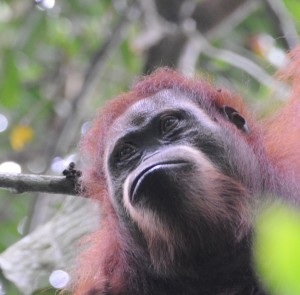
The aim of LEAP research is to develop methods for rapid assessment of forest structure and relate this to carbon stocks stored in tree biomass and habitat quality for keystone species. This research programme fits perfectly into the concept of FUSION as it includes a range of opportunities for students to get a global experience whilst contributing to world-leading new research with national and international scientists on applied conservation issues that are globally important. The programme is inter-disciplinary within life and environmental sciences but also includes colleagues from tourism Vijay Reddy and Susanna Curtin, to develop eco-tourism opportunities in the region and we welcome further collaborations.
Our personal visit to Indonesia has been instrumental in making Bournemouth University visible to the local stakeholders from the charity programme Sumatran Orangutan Conservation Programme (SOCP), the university of North Sumatra (USU), forestry and wildlife departments, and the people at the Sikundur field site. 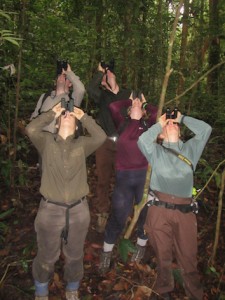 We could show the important skills we bring to this collaboration and are now well embedded into various research opportunities. We are the main primate community researchers at this field site (although Prof Wich from Liverpool John Moores and the SOCP remain the prime orang-utan researchers) and can truly call it a Bournemouth University field site.
The success of this developing international multi-disciplinary network has resulted in an opportunity to expand the focus to the critically endangered Sumatran elephant (Elephas maximus sumatranus). For that project we have been applying for several external funds with a Marie S Curie application for a postdoc fellowship due in on the 10th of September 2015 with a new collaborator, Dr Gaius Wilson from India.
We have been tweeting about the research, as have our students (e.g. #sikundur), and recently, a BU funded UG Research Assistant, Matthew Hammond, from the media school started up our new website. We plan to launch it fully at the start of this academic year. He also created the new logo you can see above give the research programme and learning platform a recognisable logo and to advertise all the exciting things that are happening at BU.
So what’s next for LEAP? The elephant conservation programme – work in progress.
Starting in September/ October: a PhD studentship, Kelly van Leeuwen, to study Ugandan savannah chimpanzees and their landscapes as part of the Institute for Landscape Studies and Human Evolution (ISLHE); a PhD studentship, Chris Marsh, to study the primate community of Sikundur; an MRes student, Emma Hankinson, to study the primates at Sikundur; Marie S Curie funded postdoc fellow, Cici Alexander, studying methods to assess carbon and analyse remote sensing data at Sikundur based on photographic data from drone-mounted cameras; and of course the launch of our website and various grant applications and conference submissions.
Please do not hesitate to contact me or Ross if you are keen to become involved in LEAP.




![InnovateUK_LogoA_Interim_RGBx320govuk[1]](http://blogs.bournemouth.ac.uk/research/files/2014/12/InnovateUK_LogoA_Interim_RGBx320govuk11.jpg)












 International Open Access Week: open access and the REF
 Food Price Research Shortlisted for Civil Service Prize
 3C Event: Research Culture, Community & Connections – Wednesday 11 November 3-4pm
 ECR Opportunities: New Development Programme, Researcher Grants & Upcoming Events
 Horizon Europe Cluster 3 (Civil Security for Society) 2026 Calls Now Open
 MSCA Doctoral Networks 2026 Call Information Webinar
 ESRC Festival of Social Science 2026: Application Deadline Extended to Thursday 25 June 2026
 Reminder: Register for the ESRC Festival of Social Science 2026 Information Session
 ECR Funding Open Call: Research Culture & Community Grant – Apply now
 ERC Advanced Grant 2025 Webinar
 Update on UKRO services
 European research project exploring use of ‘virtual twins’ to better manage metabolic associated fatty liver disease