Are you a member of the University Association for Contemporary European Studies? Successful applicants for Small Event Grants will receive up to £1,000 of funding for one-off events, typically conferences or workshops. Closing date Friday 18th September 2015. Proposals are welcome on any aspect of contemporary European Studies, particularly interdisciplinary proposals which encourage the participation…
/ Full archive
Digital Project Grants – Awards up to £40,000
Digital Project Grants – Awards up to £40,000
The Paul Mellon Centre for Studies in British Art invites applications for its digital project grants. These provide institutions and individuals help to support a curator or research scholar undertaking a digital research project which will lead to a digital or online project. Closing date 30th September 2015. Projects may include: online exhibition or curation…
ERC Starting Grants – Information and Proposal Writing Event LSE, London, 8 September, 13:30 – 16:30
In its capacity as UK National Contact Point for the European Research Council, the UK Research Office (UKRO), in partnership with the hosting institution, is holding an event at London School of Economics and Political Science for researchers who are interested in applying for the 2016 ERC Starting Grants call. Details and registration are here.
Each session will provide participants with a detailed practical overview of the ERC Starting Grants scheme. Participants should gain a deeper understanding of the proposal format and the key issues they are required to address in planning, writing and costing a proposal as well as tips for preparing for interview. There will also be ample opportunity to ask questions. Attendance will be free of charge, thanks to the support from the organisations hosting the events.
Funding Opportunities
Engineering and Physical Sciences Research Council, GB
Silicon Photonics for Future Systems programme innovation fund
The EPSRC‐funded Programme Grant “Silicon Photonics for Future Systems (SPFS)” includes an innovation fund to enable the inclusion of additional partners to bring additional value to the programme.
Initial engagement will be via short research projects that support the aims of the programme. Therefore, proposals from UK‐based academic researchers are invited for projects valued up to £100k to support the research areas of the Programme Grant.
Closing Date: 26 August 2015 at 5pm
Engineering and Physical Sciences Research Council, GB and other funders
Synthetic biology applications for protective materials
The EPSRC Engineering theme, in partnership with Dstl and the BBSRC, are inviting proposals that explore research in the area of Synthetic Biology applications for Protective Materials. Funds of up to £2.5 million are available. We expect to support between four and five research projects, up to three years in duration, subject to the quality of the proposals received. Under this partnership, funding is available to support cutting-edge, novel academic research on new applications for Synthetic Biology with regard to protective materials. Proposals will be assessed through external peer review followed by a panel meeting.
Applicants must complete the Intent to Submit survey on this page by 28 August 2015; applicants who do not do this will be ineligible for the call.
The closing time and date for full proposals is 16:00 on 01 October 2015.
By submitting a full application to this call you give Dstl, EPSRC and BBSRC the right to show it to other Government departments in confidence.
Engineering and Physical Sciences Research Council, GB and other funders
High Value Manufacturing Catapult fellowships
High Value Manufacturing Catapult fellowships aim to strengthen relations between academics and manufacturers, and accelerate the transition of research from the laboratory to industry.
Funded by EPSRC and coordinated by the University of Sheffield AMRC, the fellowship programme aims to increase academic involvement in the High Value Manufacturing Catapult. Academic fellows will carry out research at one or more of the seven centres that form the HVM Catapult, a national network backed by Innovate UK.
The fellowships will enable academic staff to spend six-month research visits, spread over one to four years, in one or more of the HVM Catapult centres. The projects must be aligned to work previously funded by EPSRC.
EPSRC and Innovate UK are now inviting proposals for the third round of fellowships. For more information and to apply, please visit the High Value Manufacturing Catapult fellowships website, or email: catapultfellowships@sheffield.ac.uk
Closing Date: 28th August 2015
Arts and Humanities Research Council, GB and other funders
Cultural heritage and rapid urbanisation in India
The Arts and Humanities Research Council (AHRC) and Indian Council for Historical Research (ICHR) are pleased to announce a joint call for Research Networking projects addressing the theme of ‘Cultural Heritage and Rapid Urbanisation in India’. Funding of between £30,000-£45,000 per project for UK applicants is available on a full economic cost (fEC) basis with AHRC meeting 80% of the fEC. Matched resources are available from ICHR for Indian applicants. Awards should have a duration of up to 6 months and will be expected to start between 1st December 2015 and 1st February 2016. It is expected that 4-5 awards will be made under this call.
Awards will be funded through the Newton Fund – a 5 year programme that aims to strengthen research and innovation partnerships between the UK and emerging knowledge economies.
Closing Date: 22 September 2015 at 4pm
Innovate UK, GB and other funders
Connected and autonomous vehicles
The Department for Business, Innovation and Skills (BIS) is to invest up to £20 million* in collaborative R&D projects and feasibility studies (delivered by Innovate UK on behalf of BIS) to stimulate developments in autonomous vehicles and connected transport systems.
Building on the government’s ‘Introducing driverless cars to UK roads’ collaborative research initiative, this competition aims to encourage development of connected and autonomous vehicles, focusing on three themes – connectivity, autonomy and customer interaction – along with catalysing new business models. Proposals must be led by a business and be collaborative. We are primarily seeking to fund collaborative research and development (industrial research). Small business partners could receive up to 70% of their eligible project costs, medium-sized businesses 60% and large businesses 50%.
We welcome consortia led by any sized company and particularly encourage proposals from medium-sized companies. Research organisations may participate as collaborators in a consortium but business partners must incur at least 70% of the total eligible project costs. We expect collaborative R&D projects to range in size from total costs of £1 million to £5 million. We encourage overseas-based partners to participate in consortia by conducting their R&D in the UK. Up to £2.5 million of the total funding will be available for smaller-scale feasibility studies. These are open to companies working alone or collaboratively. Small businesses could receive up to 70% of their eligible project costs, medium-sized businesses 60% and large businesses 50%. We expect feasibility studies to range in size from £50,000 to £250,000.
The deadline for applications is at noon on 30 September 2015.
There will be a briefing in London for potential applicants on 4 August 2015.
Leverhulme Trust, GB
Research fellowships
Offering up to £50,000 over three to twenty-four months for experienced researchers to conduct a programme of research in any discipline. Research Fellowships are open to experienced researchers, particularly those who are or have been prevented by routine duties from completing a programme of original research. Awards are not limited to those holding appointments in higher education.
The maximum value of a Fellowship is £50,000. The awards provide research expenses over and above normal living costs and/or provide a contribution towards reasonable replacement costs or loss of earnings. Please ensure that applications do not include any ineligible costs.
Fellowships are tenable for between 3 and 24 months, and the current round of awards must commence between 1 June 2016 and 1 May 2017.
Closing Date: 12 November 2015
Leverhulme Trust, GB
International academic fellowships
Enabling established researchers based at a UK higher education institution to spend a period of time in overseas research centres, to develop new knowledge, skills and ideas. Up to £40,000 is available for a period of three to twelve months.
International Academic Fellowships provide established researchers with a concentrated period based in one or more research centres outside the UK. The intention of the scheme is to provide opportunities to develop new knowledge, skills and ideas, and may for example be used for the following:
- observing and learning ground-breaking techniques or practices
- developing new lines of research through overseas collaboration
- making “discipline-hopping excursions” into new areas of research
- developing innovations in teaching
- exchanging ideas
If you wish to dedicate a period abroad entirely to a research project you should apply to the Trust’s Research Fellowships scheme.
The maximum value of a Fellowship is £40,000. Eligible costs include: reasonable replacement cover whilst the Fellow is overseas; travel to and within the overseas country or countries; a maintenance grant to meet the increased expense of living overseas; and essential research costs.
Please ensure that applications do not include any ineligible costs.
Fellowships are tenable for between 3 and 12 months, and the current round of awards must commence between 1 June 2016 and 1 May 2017.
Closing Date: 12th of November 2015.
Medical Research Council, GB and other funders
Methodology for eliciting expert opinion
MRC and NIHR invite applications (through the Methodology Research Programme) to conduct research into methodology for expert opinion elicitation. A vignette (PDF, 206KB)commissioned by the Methodology Advisory Group provides more background information. Applications are particularly sought on the following:
- A short project to compare the available expert elicitation protocols and software and to identify strengths and weaknesses with the aim of identification of the most important aspects of “good” expert elicitation. This could lead into a longer-term project to propose and validate an optimally efficient protocol and software.
- Investigation of whether the mode of expert opinion elicitation affects results. It would be valuable to validate individual elicitation methods/protocols, and to conduct head to head comparisons of different elicitation methods/protocols. Are different/more reliable answers achieved with an elaborate, structured method versus a streamlined one? E.g. comparison of face-to-face vs online methods.
- Methodology to identify and understand the range of opinions that are being obtained from an elicitation exercise, particularly where they may be conflicting.
- Methods for synthesis of elicited expert opinion with other strands of evidence, to inform e.g. HTA or diagnostic decision making.
Applications for projects are invited through the normal MRC funding grant schemes (research grant, new investigator research grant etc.) and will be considered at the regular Methodology Research Programme Panel meetings, to this competition’s usual deadlines. These will be in competition with other applications received, but the Panel will be mindful of the strategic importance of this area.
Closing date: 19 Nov 15
Leverhulme Trust, GB
Emeritus fellowships
Providing research expenses of up to £22,000 over up to two years to enable senior researchers who have retired from an academic post to complete a research project and prepare the results for publication. The 2016 round opens on 1 September 2015. The maximum value of a Fellowship is £22,000.
- Travel and subsistence costs for periods away from home
- The employment of a research, clerical or secretarial assistant to support (rather than conduct) the work of the applicant
- Photocopies
- Photographic expenses
- Office or laboratory consumables.
There is no provision for a personal maintenance allowance or remuneration for the applicant under this scheme. Please ensure that applications do not include any ineligible costs.
Closing Date: 4th February 2016
HEFCE Open Access Policy – Adjustments and Qualifications
 On Friday (24 July 2015), HEFCE announced a number of adjustments and qualifications to its policy for open access (OA) in the next REF following consultation with HEIs. The key adjustment is that:
- From 1st April 2016, authors will have until 3 months after publication to deposit outputs in our Institutional Repository (BURO) via BRIAN. This is a temporary measure for the first year of the policy, to allow time to transition to a new way of working.
- From 1st April 2017, the transition period will end, and in order to comply with the Open Access policy, authors will be expected to deposit outputs in (BURO) via BRIAN within 3 months of acceptance.
In light of these adjustments, it is recommended that authors still deposit outputs as soon as possible after acceptance to ensure continued compliance with all OA policies.
The circular and updated policy are available through the links below, if you have any queries or require further information on Open Access at BU including the Open Access Publication Fund, please contact Peng Peng Hatch at pphatch@bournemouth.ac.uk.
View this circular letter on the HEFCE website at: http://www.hefce.ac.uk/pubs/year/2015/CL,202015/
View the full updated HEFCE policy at: http://www.hefce.ac.uk/pubs/Year/2014/201407/
Euraxess – July highlights
The Euraxess July newsletter is promoting the following opportunities that are relevant to Bournemouth University:
Brazilian State Funding Agencies, articulated by its National Council (CONFAP), have launched a call for proposals offering support to researchers based in UK Universities and Research Institutions to spend from two weeks to four years working in research in Brazil, in collaboration with local colleagues.
The call offers support for researchers in the UK through:
a) Fellowships
b) Research Mobility Grants
c) Young Investigator Grants comprising a scholarship plus a research funding grant.
These Newton Fund activities offer an opportunity for UK researchers to develop the strengths and capabilities of their research groups through training, collaboration and reciprocal visits with a partner in some of the best research groups in the Brazil.
The second round of applications is now open and will close on 23 October 2015.
Do you have links with an Early Stage Researcher based in ASEAN, Brazil, China, India, Japan or North America? Then direct them to this scheme. First prize is a free trip to Europe, a one-day science communication workshop and a meeting with European Commission representatives in Brussels, Belgium, and a meeting at a European research institution of their choice! Closing dates are in September but applicants will need to check the information for their region.
Environmental sustainability in Europe and India
TECO “Technological Eco-Innovations for the Quality Control of Polluted Waters and Soils” is a new project funded by the European Union and coordinated by the Italian National Research Council (CNR) with the partnership of the National Environmental Engineering Research Institute (NEERI – India).
The goal of TECO is to improve and promote collaborations between Europe and India in the field of environmental sustainability.
Grants are provided for the mobility of European researchers, engineers and experts to spend up to three months in Indian research institutes or private companies to open new professional collaborations and to develop innovative ideas in the field of new technologies applied to the decontamination of waters and soils.
The deadline is 15 September 2015. The mobility program will start from January 2016.
Newton Funding Opportunities (see also previous blog post)
There are currently 24 opportunities listed as open for applications by the Newton fund.
Locations include: Egypt, India,Indonesia,Kazakhstan,Mexico,Philippines,South Africa,Vietnam, Brazil, Turkey and Chile. A wide range of disciplines is also represented, from Agriculture to Rapid Urbanisation.
British Academy Newton Advanced Fellowships (see also previous blog post)
Newton Advanced Fellowships provide early to mid-career international researchers with an opportunity to develop their research strengths and capabilities, and those of their group or network, through training, collaboration and visits with a partner in the UK.
Sign up to receive your own copy of the Euraxess Newsletter so that you are the first to know about international opportunities.
Introducing Katie Breadmore: Event Organiser in the Knowledge Exchange and Impact Team
 Hi! My name is Katie Breadmore and I am currently working towards my degree in Events and Leisure Marketing. The third year of my course involves a yearlong work placement (until the end of July, 2016) in which I am working for the Knowledge Exchange and Impact team in the Research and Knowledge Exchange Office as an event organiser. My role involves the planning and co-coordinating of BU’s annual Festival of Learning as well as supporting a variety of other public engagement events over the course of the year. I am excited to see the events that I will be planning come to light and am ready for the challenge!
Women Innovators – EU Prize
Are you or do you know a Woman Innovator?
 With the EU Prize for Women Innovators, the European Commission wants to give public recognition to outstanding women entrepreneurs who brought their innovative ideas to the market. The aim is to inspire other women to follow in their footsteps.
After two successful editions in 2011 and 2014, the European Commission has launched the third edition of the prize.
Three prizes will be awarded in Spring 2016:
- 1st prize: €100 000
- 2nd prize: €50 000
- 3rd prize: €30 000
Contestants will be able to submit their entries until 20 October 2015 (12:00 – Brussels time).
An independent panel of judges from business and academia will select the three winners who will be announced in 2016.
Who can participate in the contest?
The contest is open to all women who have founded or co-founded their company and who have at some point of their careers benefitted from the EU’s research framework programmes, the EURATOM Framework Programme, the Competitiveness and Innovation framework programme (CIP) or actions relating to research and innovation under the European Structural and Investment Funds (known as the Structural Funds prior to 2014).
The contestant must reside in an EU Member State or a country associated to Horizon 2020, the EU’s research and innovation programme.
The company must have been registered before 1 January 2013 and have had an annual turnover of at least EUR 100 000 in 2013 or 2014.
Apply via the website
EU Horizon 2020 Funding – Societal Challenges
 The following calls are being promoted on the Participant Portal:
Digital Security : Cybersecurity, Privacy and Trust : closing 27/8/15
Disaster-resilience: Safeguarding and Securing Society, including adapting to climate change: closing 27/8/15
Border Security and External Security: closing 27/8/15
Fight against Crime and Terrorism: closing 27/8/15
FCH2 JU Call for proposals 2015 (Fuel Cells and Hydrogen 2 Joint Undertaking): closing 27/8/15
Bio Based Industries: closing 15/9/15
H2020-JTI-IMI2-2015-05-Two Stage (Innovative Medicines Initiative 2 (IMI2) Joint Undertaking): closing 13/10/15 (stage 1) and 15/3/16 (stage 2)
Green Vehicles: closing 15/10/15
Mobility for Growth (transport): closing 15/10/15
European Capital of Innovation Prize (plus dedicated website): closing 18/11/15
Horizon 2020 Dedicated SME Instrument Phase 1 and 2, 2014-2015 with specific themes (Company to apply): next closing dates – 17/9/15 and 25/11/15
Horizon Prize – Food Scanner: due to open in September 2015 with a closing date of 9/3/16
Horizon Prize – Better use of Antibiotics: closing 17/8/16
All closing dates are 17:00 (Brussels time)
If you are applying to any of these calls, be that as Lead or in collaboration with another organisation, please contact Paul Lynch or Emily Cieciura (Research Facilitators – EU and International) or contact your Faculty Funding Development Officer.
Horizon 2020 Information Day: 21 September 2015
SOCIETAL CHALLENGE: Climate – INFO DAY
The European Commission is organising an Information Day on 21 September in Brussels to present the 2016 work programme of Horizon 2020’s Societal Challenge “Climate Action, Environment, Resource Efficiency and Raw Materials”.
The Information Day will focus on the upcoming calls for proposals under Horizon 2020’s Societal Challenge “Climate Action, Environment, Resource Efficiency and Raw Materials” and related call topics in the “Blue Growth – Demonstrating an Ocean of Opportunities”, “Industry 2020 in the Circular Economy” and “Smart and Sustainable Cities” focus areas.
Representatives of the research community, SME associations, businesses, industry and European institutions are invited to join the event on Monday, 21 September 2015 in the Albert Borschette Conference Centre, rue Froissart 36, 1040 Brussels. We expect more than 500 participants.
Events are added regularly to the Horizon 2020 pages.
If you attend an external funder event of this type, please remember to let your RKEO Facilitator or Officer know. It may be that we can help share information that you obtain with others at BU with similar interests or alert you to others who might be potential partners.
COST Scheme Anonymity Requirements
For those who attended the recent COST Workshop and others considering applying to this networking scheme. Some useful advice on the sometimes tricky matter of anonymising your application has been issued by the COST Secretariat and is available here.
Impact case studies: what are they and why are they important?
Impact is fast becoming a new buzzword in higher education as demonstrating impact becomes more and more of priority in the context of the Research Excellence Framework (REF) and requirements of funders. Precisely because of its associations with REF and funding bids, the term ‘impact’ can be off-putting, but really it means no more than showing how research is making a difference – something that many researchers do instinctively but perhaps wouldn’t think to classify as ‘impact’.
HEFCE defined impact as “an effect on, change or benefit to the economy, society, culture, public policy or services, health, the environment or quality of life, beyond academia.” Impact then, can be seen as the effect and research the catalyst for change. HEFCE have identified four particularly outstanding impact case studies from the last REF, which they believe represent all the different ways that research can make a difference. These are:
- Advances in gamma-ray detection and imaging: University of Southampton
- Collaborative Strategic partnership with BorgWarner: University of Huddersfield
- Bringing recognition and improved welfare service provision to young adult carers: University of Nottingham
- ‘Cold War Modern’: the international impact of modern design on public understanding and curatorial practice: Royal College of Art
Under the 2014 REF, impact counted as 20% of a unit’s overall quality score and there have been suggestions that in the next REF it may count for even more. Panels took into account the research’s ‘reach’ and ‘significance’ and gave a rating of between 4* and unclassified for each profile. Last year’s results showed that 97% of BU’s research is having an outstanding, very considerable or considerable impact on society – a fantastic achievement. You can read examples of our REF case studies here.
As well as being an opportunity to show how our research is making a difference, impact case studies can influence the make-up of our overall REF submission profile. For example, if two impact case studies were submitted to a unit each would count for 10% of the profile’s overall score – a significant part of each submission. The number of case studies submitted also determined the number of staff that can be returned within each unit of assessment. Up to 14.99 (FTE) staff required 2 impact case studies, with each additional case study allowing the inclusion of another 9.99 (FTE) staff. The contribution of each case study author to the overall unit result was therefore very significant. Their contribution went beyond that of REF, as the materials gathered have also been used to highlight BU’s research excellence as part of a University Alliance project as well as being used to persuade future students to study at BU.
Although it seems only a short period of time since the last REF results were published, preparations for the next REF – thought to be in 2020 – are already underway. The submission date is likely to be late 2019, which means that researchers who are currently working to connect their research results with people or organisations that could benefit from their knowledge are excellent candidates for future impact case studies. While research impact needs to take place within the specific REF timeframe, the underpinning research could be recent or date back several years, with impact building on years of previous work.
To find out more about research impact and the support on offer from BU, please contact the Knowledge Exchange and Impact Team in the Research Knowledge and Exchange Office.
To find out more about the impact element of the REF, you can read analysis reports of REF 2014 from King’s College London and RAND Europe.
Call for Papers: Media Representations of ‘Antisocial Personality Disorder’, 16th September.
Call for papers:
Media Representations of ‘Antisocial Personality Disorder’
Wednesday, 16th September 2015
Bournemouth University
ESRC Seminar Series: Cross Disciplinary Perspectives on ‘antisocial personality disorder
This day-event is being organised as part of the ESRC sponsored seminar series ‘Cross Disciplinary Perspectives on antisocial personality disorder’ (aspd-incontext.org) and is being run in association with the Faculty of Media and Communication at Bournemouth University and the ‘Media and the Inner World’ research network.
We are using ‘Antisocial personality disorder’ as a shorthand for a range of labels used to describe individuals who seem to act in very antisocial ways but who otherwise appear to have a clear understanding of the world. A central thesis of this series is that the kinds of difficulties that are likely to involve the use of labels like ASPD need to be understood within broader historical, cultural and socio-political contexts than many psychological and psychiatric constructs allow.
This event is designed to explore the ways in which the meanings of ASPD have been shaped by the representations of ‘antisocial’ or ‘deviant’ identities in wider culture – in art, literature, film, television and news media. One can find such representations in classic literary depictions of antiheroes like Heathcliff in Emily Brontë’s Wuthering Heights or Camus’s L’etranger. Lionel Shriver’s 2003 novel and later film adaptation, We Need to Talk about Kevin provides a more contemporary example of a portrayal of an antisocial individual that provoked discussion about the gendered dynamics of the family and maternal ambivalence. Cinematic representations of psychological disturbance can be found in the ‘outsider’ despair and destructiveness of Travis Bickle in Taxi Driver (Scorsese, 1976), or in representations of jealous women in films such as Fatal Attraction (Lyne, 1987) or Gone Girl (Fincher, 2014). On TV, the proliferation of forensic detective dramas such as CSI (CBS, 2000) or legal dramas such as Silk (BBC1, 2001), often trouble the boundaries of ASPD and its meanings as a psychological condition.In news media, representations of mental health are also widespread in efforts to understand the subcultural shaping of individuals such as Dylann Roof, Timothy McVeigh, Mohammad Sidique Khan and others committing acts of ‘terror’.
Whilst such images contribute to the cultural shaping of ASPD, they in turn can have influence on legal and psychiatric debates about the nature of dangerous individuals. As the role of Taxi Driver in the trial of John Hinckley (who attempted to assassinate Ronald Reagan) illustrated, the interaction of media, psychiatry and law can be very direct and can have powerful implications. It is important therefore to explore the ways in which images of ASPD in popular culture also influence the fields of forensic psychotherapy, psychiatry and the law.
We are therefore inviting submissions from people who have an interest in media representations of ‘antisocial personality disorder’ and their significance to psychiatry and socio-legal contexts.
As this is sponsored by the ESRC we be able to pay modest travel and accommodation costs for speakers.
If you are interested in contributing, please send a 300 word abstract to:
· Dr David W Jones, Reader in Psychosocial Studies, University of East London (d.jones@uel.ac.uk)
Closing Date: 7th August (we will let people know soon after)
The organisers
· Dr David W Jones, Reader in Psychosocial Studies, University of East London (d.jones@uel.ac.uk)
· Dr Chris Scanlon, Group Analyst and Principal Lecturer in Psychosocial Studies, University of East London. (c.scanlon@uel.ac.uk)
· Professor David Gadd (University of Manchester)
· Candida Yates, Professor of Culture and Communication, Faculty of Media and Communication, Bournemouth University (cyates@bournemouth.ac.uk).
New BU Research Methods paper
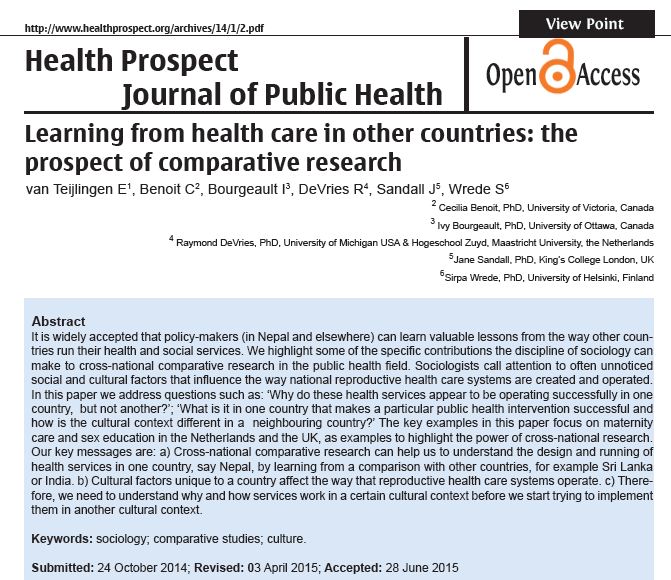
Yesterday the journal Health Prospect published another of our research methods papers. This latest paper on cross-national comparative research has been written by five sociologists from Northern Europe and North America: Ray De Vries (University of Michigan USA & Hogeschool Zuyd, Maastricht University, the Netherlands), Cecilia Benoit (University of Victoria, Canada), Jane Sandall (King’s College London), Ivy Bourgeault (University of Ottawa, Canada), Sirpa Wrede (University of Helsinki, Finland) and Edwin van Teijlingen (Bournemouth University). We have been working together on cross-cultural and cross-national issues in maternity care and midwifery since the mid-1990s. Our collaborative research led to the edited volume Birth by Design: Pregnancy, Midwifery Care and Midwifery in North America and Europe (Routledge, 2001). The book was short-listed for the British Sociological Association’s (BSA) Medical Sociology Book Prize in 2004.
The paper in Health Prospect is the latest in a series of papers addressing issues around the method of doing cross-national research. We highlight some of the specific contributions the discipline of sociology can make to cross-national comparative research in the public health field. Sociologists call attention to often unnoticed social and cultural factors that influence the way national reproductive health care systems are created and operated. The paper is published in an Open Access journal so it is easily and freely available to anybody across the globe.
Prof. Edwin van Teijlingen
CMMPH
- van Teijlingen, E., Benoit, C., Bourgeault, I., DeVries, R., Sandall, J., Wrede, S. (2015) Learning from health care in other countries: the prospect of comparative research, Health Prospect 14(1): 8-12. info/index.php/HPROSPECT/article/view/13036/10525
Marie Sklodowska-Curie Project – ENEFOR
We would like to welcome you to our Marie Sklodowska – Curie project “ENEFOR”. We proudly present you our website (http://enefor.eu) and we look forward for a live discussion on the project’s output!
This project is funded by the European Union’s Horizon 2020 research and innovation programme under the Marie Sklodowska-Curie grant agreement (No 658494). The project started on April 2015 and it will be completed on April 2017.
This exciting and innovative project aims to develop new econometric model frameworks to forecast oil price and oil price volatility, which will be successful in enhancing internal consistency, forecasting accuracy and easiness to communicate extracting added-value (in terms of predictability) information from the ultra high sampling frequency. In addition, this project aims to use the forecasted oil price volatility to predict the economic policy uncertainty in Europe, given that oil price shocks exert significant impact on the effectiveness of economic policy.
Policy Update
Monday
NUS
The National Union of Students will support a major demonstration against austerity and for free education, in a reversal of a decision which was taken over just a month ago. NUS backs national fees demonstration and censures president (THE).
Tuesday
Student Debt
In a new report, The Institute for Fiscal Studies says the loss of maintenance grants which was announced by the chancellor of the Exchequer in this month’s Budget, will see the poorest 40 per cent of students in England leave university with debts of up to £53,000, rather than up to £40,500. You can view the report here.
Extremism
An article in the Guardian Higher Education Network discusses the new responsibilities that universities will face regarding stopping events happening that could potentially draw people into terrorism. The article suggests that the vague guidelines will perpetuate stereotypes and limit debate. The article also mentions that placing such a heavy responsibility on lecturers will subvert the pedagogic relationship between lecturers and students in the university setting. How do you spot a student extremist in a university? (Guardian Higher Education Network).
EU Membership
Universities need more positive and persuasive arguments for EU membership, according to Nick Hillman, Director of the Higher Education Policy Institute. He has argued that universities should focus on benefits of international collaboration and the importance of big research projects. The pro-EU case must be about more than just funding (Research Fortnight).
Wednesday
Consultation- Alternative Providers
The outcome of the ‘Alternative Providers of Higher Education: Improving Quality and Value for Money’ consultation led by BIS has been published. Some key outcomes reveal that the government will require all alternative providers to provide KIS data from 2016/17 as well as requiring students at alternative providers on courses eligible for student support to have their English language skills assessed at minimum international level B2 on starting the course. You can view the consultation outcome here.
Thursday
HEFCE
The inability of universities to demonstrate the effectiveness of initiatives aimed at improving participation, retention and student success is “increasingly untenable” as the teaching excellence framework approaches according to HEFCE. Hefce to ask for data on outcomes of access and attainment schemes (THE).
REF
The Institute of Economic Affairs, has published a report calling for the abolition of the Research Excellence Framework, used by the funding councils to allocate an annual £1.6 billion of quality-related research funding to UK universities. The authors argue that the REF “uses significant resources and distorts resource allocation within the higher education sector away from teaching and knowledge dissemination”. News blog: right-wing thinktank close to Sajid Javid calls for scrapping of REF (THE).
Friday
Graduate Employment
Female graduates are more likely to find jobs after they leave university than their male peers, but those men who do find work enjoy higher starting salaries, the latest statistics on graduate employment show. Female graduates find more jobs, while men win higher pay (The Guardian).
Open Days – European Week of the Regions and Cities
The European Commission and the European Committee of the Regions are hosting the 13th edition of OPEN DAYS which will take place on 12-15 October in Brussels. The OPEN DAYS - European Week of Regions and Cities is an annual four-day event during which cities and regions showcase their capacity to create growth and jobs, implement European Union cohesion policy, and prove the importance of the local and regional level for good European governance. The event is free and online registrations is required here REGISTRATION.
The full programme is here PROGRAMME and includes sessions on job creation, ICT solutions, SMEs, entrepreneurship, low-carbon transport and many other policy matters. The sessions are aimed at EU, national, regional and local policy/decision makers; authorities managing and evaluating cohesion policy programmes and projects; other stakeholders: private companies, financial institutions, European and national associations and academics, students and researchers. Should be a good opportunity for networking and getting an EU perspective on interesting regional, national and international topics.
Understanding Open Access workshop

Following the Finch Report, the Open Access movement has gained significant momentum in the UK. Most major funders now have open access policies and mandates. HEFCE’s post-REF2014 policy states – ‘To be eligible for submission in the post-REF2014, journal articles and conference proceedings (with ISSN) accepted for publication after 1 April 2016 must be made open access.
RKEO currently provides a series of Open Access and BRIAN development workshop to help academics understand Open Access and what needs to be done to comply. In this ‘Understanding Open Access’ workshop, you will:
– Gain a background and understanding of Open Access
– Understand what it means for Bournemouth University
– Know how to comply with the Open Access Policies (via BRIAN)
The next workshop will take place on 4th August, from 10am to 11am, at EB202, Lansdowne.
To book a place, please send an email to Organisational Development.
For queries about the workshop, please direct them to Pengpeng Hatch at RKEO.
BU staff can login below:
Other services







Recent posts
BU research Funding opportunities EU
 Three CMWH presentations at Berlin conference
 New interdisciplinary paper on Nepal
- New BU Social Work paper published this week
- NEW BOOK Just Published: Rather and Buhalis, 2026, Metaverse Marketing: Challenges, Opportunities, and Fundamental Mechanisms
 National Postdoc Appreciation Week 2026: The Changing Landscape of Postdoc Careers
 NIHR Insight South West Central Conference 2026 at Bournemouth University
 Horizon Europe Cluster 3 (Civil Security for Society) 2026 Calls Now Open
 MSCA Doctoral Networks 2026 Call Information Webinar
 ESRC Festival of Social Science 2026: Application Deadline Extended to Thursday 25 June 2026
- Apply now to take part in the 2026 ESRC Festival of Social Science
 Reminder: Register for the ESRC Festival of Social Science 2026 Information Session
 ECR Funding Open Call: Research Culture & Community Grant – Apply now
- MSCA Postdoctoral Fellowships 2025 Call
 ERC Advanced Grant 2025 Webinar
- European Migration Research and Impact – Invitation to a Roundtable Discussion
- MSCA Postdoctoral Fellowships 2025
 Update on UKRO services
 European research project exploring use of ‘virtual twins’ to better manage metabolic associated fatty liver disease
 Research Information Network
- Physical Sciences Case studies: information use and discovery
- Information handling in collaborative research: an exploration of five case studies
- Information literacy monitoring and evaluation
- Data centres: their use, value and impact
- Heading for the open road: costs and benefits of transitions in scholarly communications