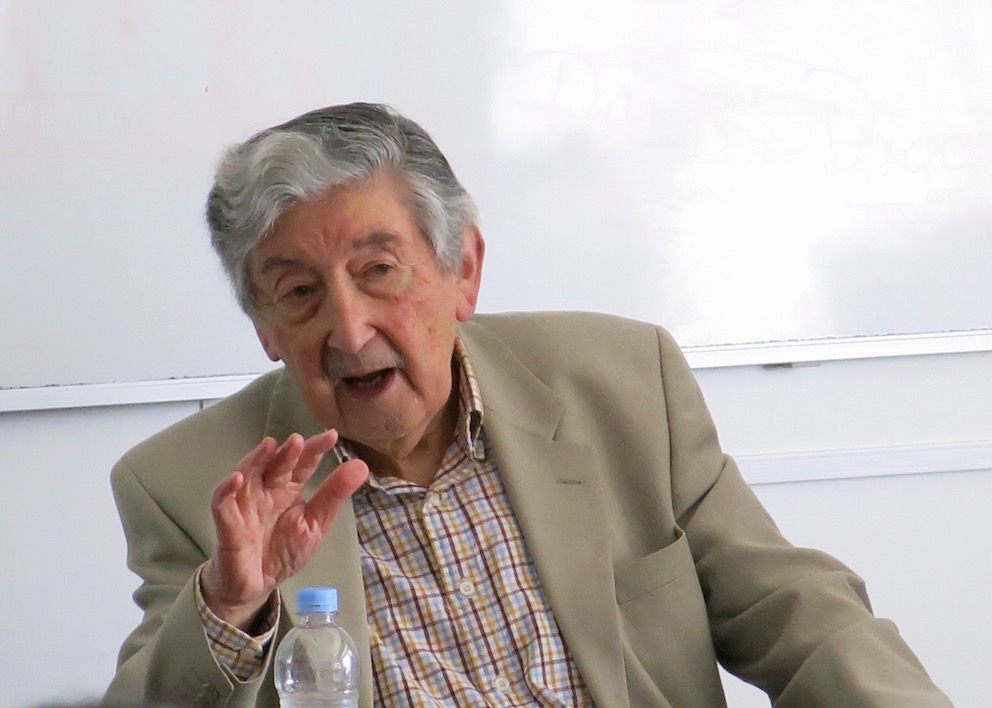
Professor Otto Hutter
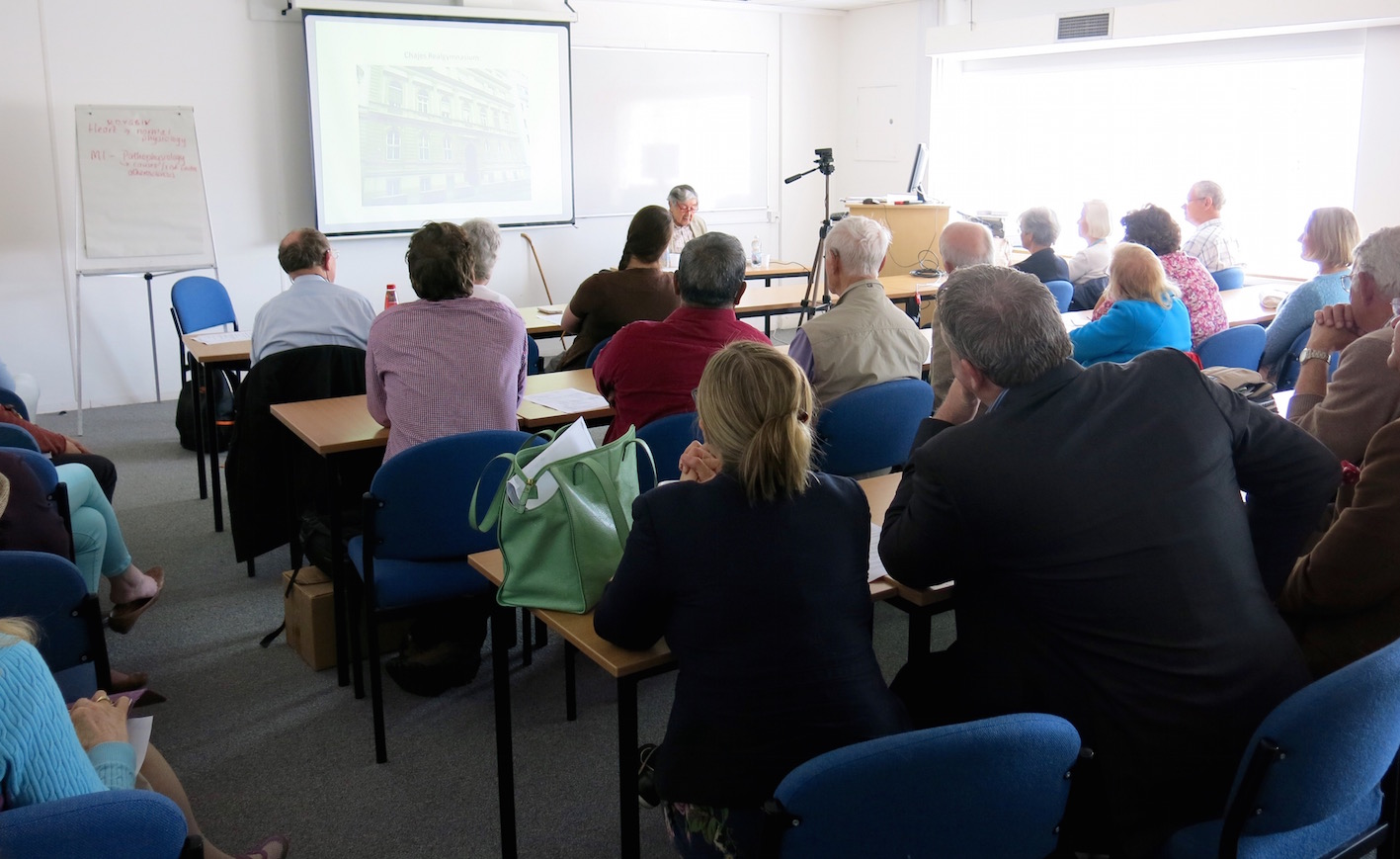
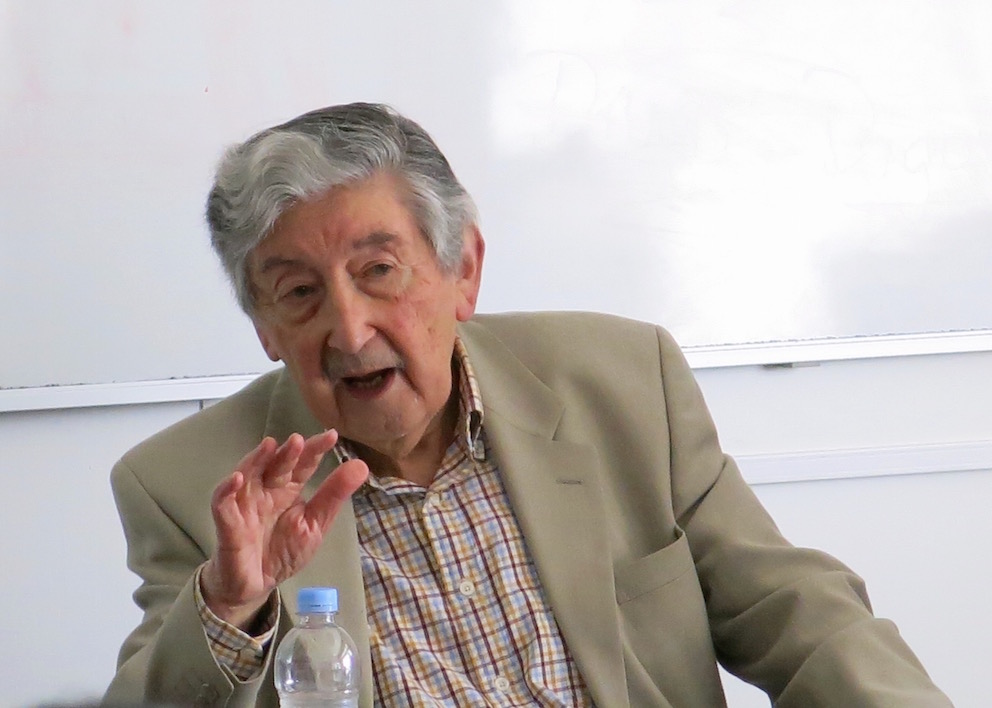
As part of our on-going successful research seminar series at the Faculty of Heath & Social Sciences’ Centre for Social Work, Sociology & Social Policy, on the 27th May we were very privileged to be able to invite back Professor Otto Hutter, former Regius Professor of Physiology at the University of Glasgow (1971 to 1990). This was a hugely successful public engagement event that attracted an audience of 52 people, drawn in part via the Dorset Race Equality Council, the Bournemouth Council of Christians and Jews and composed of a large number of the general public, our Visiting Fellow, the Rector of St Peter’s Church, Revd Dr Ian Terry, BU students and staff from the Midwifery, Social Work and Sociology teams and the Public Engagement team.
Educated in Vienna and England, Professor Hutter graduated with a BSc and PhD from University College, London and worked in the Department of Physiology there focusing on neuromuscular and synaptic transmissions and cardiac and skeletal muscle. He was a member of the staff of the National Institute for Medical Research from 1961 and joined the University of Glasgow ten years later, eventually becoming an Honorary Senior Research Fellow in the School of Life Sciences at the University.
His childhood experiences, however, are even more astonishing. Back in 1938 with the black clouds of war looming over Europe, Stanley Baldwin, the former Prime Minister, made an impassioned appeal on radio for public aid on the 8th Dec 1938, in the wake of the infamous Kristallnacht pogrom that had just taken place a month earlier in Germany. Over £522,000 – a huge sum then – was raised in answer to the call from the concerned, ecumenical British public. This provided the impetus for the famous Kindertransport Movement that sought to rescue as many endangered Jewish children as possible from Nazi oppression.
Otto, as a 14-year-old boy, was one of the first children to reach sanctuary in Britain on the Kindertransport. He was eventually taken under the wing of his British sponsors and soon after excelled at the public school, Bishop’s Stortford College, as public schools also rose to the challenge of taking in refugee children on a scholarship basis. From there, he continued his rise to eminence.
However, since retirement to Bournemouth, Professor Hutter has been a tireless member of the local community, giving and attending talks at Holocaust Commemoration events. About 18 months ago Professor Hutter was kind enough to give a talk to our BU sociology students. It was so very good, so deeply moving – as many students told us later – that we wanted him to repeat it. However, Professor Hutter told us that he does not like repeating the same talk and so this time the seminar focused on the individual research he has painstakingly undertaken to uncover the stories of the 40 Viennese school mates from the academically elite Chajes Gymnasium in Vienna that he left behind upon his escape to Britain.
A quite incredible piece of social history was revealed emerging from the darkest period of modern European history; and yet among the tragic examples there were many more where the classmates had survived through combinations of ingenuity, luck, sheer perseverance and opportunism – not forgetting the key element for many tales of survival: the diligence and self-effacing devotion of the parents of these gifted children.
More of these youngsters than might reasonably be supposed went to on survive and prosper across the globe as far afield as Latin America, North America, the UK and, in particular, Israel. A high proportion went on to become academics, like Professor Hutter himself, along with others who became successful professionals and entrepreneurs. Jewish refugees, including some classmates, who escaped to Ecuador, were apparently later celebrated by the Ecuadorian Government as having brought vital technical innovation and European know-how to greatly benefit this formerly undeveloped, agrarian society.
Professor Hutter had the audience delighted by the account of an incredible escape of a particularly irresistibly charming classmate, who having escaped to Vichy France, had been rounded up for deportation and was rescued on the eve of his journey to death by the plucky daughter of a high powered Vichy politician.
However, equally those who did not survive need to be commemorated as the unforgotten victims of the Holocaust. We heard of one young girl who died of typhoid fever, having nursed fellow sufferers among the refugee ship to Cuba, where very sadly she succumbed to the disease upon docking at Havana. Professor Hutter told us about other classmates who had escaped to Belgium but were then captured and sent first to Theresienstadt concentration camp and then to their deaths in Auschwitz. One of the most moving accounts was that of young man and his sister who were killed in 1945, having managed to survive in hiding in Vienna for so long. The brother was captured in a bunker with nine other Jews as the SS were fleeing from the city ahead of the Allies, but still determined to kill as many of the dispersed Jewish community as could be found. Each captured individual was taken out one-by-one where those inside could hear the rattle and blast of the machine-guns and hand-grenades used for execution. Prof Hutter’s former classmate was the first to die.
The highly picaresque and deeply poignant were all covered in this splendid piece of research, which completely engaged the audience. However, these are also lessons from history that hold powerful resonance for today’s political arena, where European governments seem to gravitate towards entrenched right-wing positions, as can be seen by the election results in both the UK and Israel.
Each survivor from the Viennese Gymnasium enriched the countries immeasurably with their intelligence and their talent. These immigrants had no choice but to try to make a new life for themselves in their adopted countries and did so with extraordinary energy, zeal and optimism. This is the real story of why immigration remains the life-blood of progressive nations – and yet is so little heard of these fundamentally positive aspects in today’s ignorant and short-sighted political rhetoric that panders to xenophobia and isolationism. Today UK governments might well have been tempted not allow individuals like Otto Hutter into this country in the first place or equally tempted to deport them back again to their countries of origins. It makes one pause for a long moment to truly take in the full consequences of such disastrous and bigoted attitudes and associated actions.
Sara Ashencaen Crabtree and Jonathan Parker
 Research Professional are visiting BU on the morning of 23rd June to demonstrate their ‘Funding Insight’ module. Their description of Funding Insight is that it ‘helps you avoid spending too much time on funding applications that fail. It reveals the hidden structures in the research funding landscape, giving you deeper insight and helping you make better applications’.










 Three CMWH presentations at Berlin conference
 New interdisciplinary paper on Nepal
 National Postdoc Appreciation Week 2026: The Changing Landscape of Postdoc Careers
 NIHR Insight South West Central Conference 2026 at Bournemouth University
 Horizon Europe Cluster 3 (Civil Security for Society) 2026 Calls Now Open
 MSCA Doctoral Networks 2026 Call Information Webinar
 ESRC Festival of Social Science 2026: Application Deadline Extended to Thursday 25 June 2026
 Reminder: Register for the ESRC Festival of Social Science 2026 Information Session
 ECR Funding Open Call: Research Culture & Community Grant – Apply now
 ERC Advanced Grant 2025 Webinar
 Update on UKRO services
 European research project exploring use of ‘virtual twins’ to better manage metabolic associated fatty liver disease