An orchestra for people with dementia and their families faciliated by players from the Bournemouth Symphony Orchestra (BSO) and BU Music students has been funded following a successful application from Ian Jones, Ian Davis and I to the FIF CCCP strand. The kick off meeting with the musicians, students and the BUDI team was held on the 5 March and we are currently in the process of recruiting people with dementia, and their carers if they wish, to participate in a 10 week programme that will start in April and culminate with a performace at the Winton Life Centre on 14 June as part of the BU Festival of Learning. This is the first project that we are aware of where a symphony orchestra works with people with dementia giving them the opportunity to relearn instruments, learn instruments for the first time while combining this with the choir approach of many initiatives in the UK and worldwide which acknowledge the power of music for the well-being of those with dementia. The team working on this project are very excited about the possibilities this project offers, not just as an example of public and community engagement, and a fused approach to working between students, researchers and professional musicans that engages with those living in our community, but because it ensures that we address one of the fundamental myths that often surround dementia of decline in abilities, when in fact people with dementia can learn new things!
Category / Public engagement
FUSION within Sustainable Design Research Centre (SDRC) – Faculty of Science & Technology
“At the heart of the BU2018 strategy is the powerful fusion of research, education and professional practice, creating a unique academic experience where the sum is greater than the component parts”.
SDRC has been actively engaged with the BU Fusion initiative through various methods i.e. Fusion fund, Festival of Learning, Fusion conferences, international collaborations, chairing international conferences, keynote & invited guest speaking, journal reviews & editorship, funding councils review panels, visiting professors from international HE, engaging with regional industry & community stakeholders and research informed education.
Some examples of research informed education & linkages between the two academic activities are provided briefly.
Design Engineering Level – C
Unit: Design Methods & Projects (40 credit)
Dr Zulfiqar Khan is leading this significant unit within the Design & Engineering framework in the Faculty of Science & Technology. This unit has four projects. Final project (project 4, 50% of the course work) is linked to The Tank Museum. An educational trip to the museum is part of the course work, an additional visit (complimentary free entry for the day), which involves access/study to/in archives and study of engineering systems & components within design & engineering context. This project is linked to the PhD research projects with the Tank Museum [Zulfiqar Khan lead] and current collaborative research project with the Defence Science & Technology Laboratory (DSTL) Ministry of Defence [Zulfiqar Khan lead]. Topics in these projects are related to the Sustainable Design Research Centre areas of Corrosion, Contact Mechanics and Tribology.
Design Engineering Level – H
Unit: Advanced Technology & innovation (40 credit)
Dr Zulfiqar Khan is leading this core unit within the Design & Engineering framework in the Faculty of Science & Technology. The students submit a research paper (50% of the coursework) in the second semester. Students have the opportunity to get involved with the existing PhD programmes within SDRC [mainly led by Zulfiqar Khan] or engage in new mini research projects. Students are involved with the Sustainable Design Research Centre research themes in Renewable Technology, Corrosion, Tribology & Sustainable Design. Students published 2 x journal and 1 x Conference papers in AY 2012-13. Students have published 1 x journal paper this year. 2 x journal & 1 x conference papers are submitted in AY 2013-14 and are currently under review.
Design Engineering Level – I & H
Unit: Design Projects (40 credit) and Final Design Projects (60 credit)
Zulfiqar is QS for level I and supervised the following level H projects. Students in both levels were involved in the Sustainable Design Research Centre Renewable Technology theme in collaboration with community led Poole Tidal Energy Partnership [ZK one of the founding directors] projects in Tidal Energy. Final year projects in Tidal Turbine and Heat Pump were showcased in the BU Festival of Design & innovation (FoDI) 2011-2012. Level I students were set projects to design non-rotating tidal turbines and students presented their work to the community stakeholders in renewable technology.
Product Design Level – H
Unit: Design Projects 3 (60 Credits)
A retro-fitted horizontal axis wind turbine (HAWT) was designed & a functional prototype was developed by a final year student [ZK supervised]. Student participated and presented his work in the BU Renewable Technology Public Engagement (Question Time) Event as part of the BU Festival of Learning 2013 organised by SDRC [ZK and Mark Hadfield].
MEng Level – I
Unit: Thermo-fluids & Heat Transfer (20 credit)
Zulfiqar Khan contributed to the development of this unit and has been leading as unit leader. Two research projects in Solar-thermal technologies (thermal conductivity and thermal expansion) are fully funded by Energy Company [ZK lead] within Sustainable Design Research Centre. This research is supported by off campus experimental and simulation labs at the industrial unit [ZK lead]. A lab has been developed at BU to fully link the newly developed unit through its fundamentals to the current researches in thermo-fluids, heat transfer (thermal conductivity, thermal convection) and fluids (Bernoulli’s, Frictional flow, Fluid properties) linking research in Solar-Thermal technologies. MEng level I students have been performing experiments in fluid properties and heat transfer which are directly linked with the researches within SDRC.
Students’ lead published papers
- Nugent, M., Khan, Z. (2014). The effects of corrosion rate and manufacturing in the prevention of stress corrosion cracking on structural members of steel bridges. The Journal of Corrosion Science and Engineering JCSE, 17(16). Retrieved from http://www.jcse.org/
- Wilton-Smith, K., Khan, Z., Saeed, A., & Hadfield, M. (2013). Accelerated Corrosion tests of Waste-gated Turbocharger’s Adjustable and Fixed End Links. In 11th International Conference on Surface Effects and Contact Mechanics. Siena, Italy: Wessex Institute of Technology, UK. Retrieved from http://www.wessex.ac.uk/13-conferences/contact-and-surface-2013.html
- Dobson, P., & Khan, Z. (2013). Design considerations for carbon steel pipes materials’ selection applied in fossil powered plants subjected to wet-steam flow accelerated- corrosion review paper. Journal of Corrosion Science and Engineering, 16, 1-13. Retrieved from http://www.scopus.com/source/sourceInfo.url?sourceId=12326&origin=recordpage
- Denham, L., & Khan, Z. (2013). The prevention of corrosion and corrosion
stress cracking on structural members of
fixed deep sea oil rigs. The Journal of Corrosion Science and Engineering, 16, 1-13. Retrieved from http://www.jcse.org/
If you have interests in BU Fusion, Research informed education and or SDRC research activities and would like further information then please contact
Dr Zulfiqar Khan (Associate Professor)
Director SDRC
An EU Masters in Dementia
Positive
about Dementia is an EU multi-lateral project to develop an inter-disciplinary Masters programme to educate and develop an effective and informed dementia workforce. It was launched in September 2013 and is funded by the EU Lifelong Learning programme. The Positive about Dementia Masters programme will take a positive and appreciative view of the life experience of people living with dementia. The curriculum will contain modules that will explore dementia awareness, evidence-based practice,and research to inform how we can support the wellbeing of people with dementia through educating dementia professionals. The BU team (involving colleagues from SciTech, the Business School, HSC and BUDI) hosted the kick off meeting back in December and following our next team meeting in Dublin in February we are moving full steam ahead with partners in all countries currently conducting consultations with a range of local stakeholders including service commissioners and providers as well as people with dementia and their carers about their views on what the curriculum should cover. A website has been created which will document our development activities over the next 2 and 1/2 years www.posadem.eu. In due course we will be looking for students to pilot the modules we create. If you have a view about what the curriculum should look like or if you know someone who may be interested in being one of our pilot group students do get in touch.
School of Tourism Researcher Presents Keynote on CSR at ‘8th Health and Wellbeing at Work Conference’
School of Tourism researcher Dr Tim Breitbarth (Sport Academic Group) delivered a keynote presentation at the 8th Health and Wellbeing At Work conference in Birmingham at the beginning of March. Health and Wellbeing At Work is the UK government’s programme for improving the health and wellbeing of working age people.
Now in its 8th successful year, the two-day conference held at the NEC featured – for the first time – a track fully dedicated to Corporate Social Responsibility (CSR). Tim has published widely on CSR in international business and sport. The thousands of national and international participants could pick and mix from 20 tracks and visit the large exhibition.
Following Tim’s presentation on ‘Making the business case for CSR’, other well-known presenters and practitioners like Professor David Crowther (De Montfort University), Mark Baird (Head of Industry Affairs & Alcohol Policy, Diageo), Nicky Day (Director of Corporate Partnerships, WWF) and Karen McArthur (Global Head of Corporate Responsibility, Thomson Reuters) informed and inspired the audience.
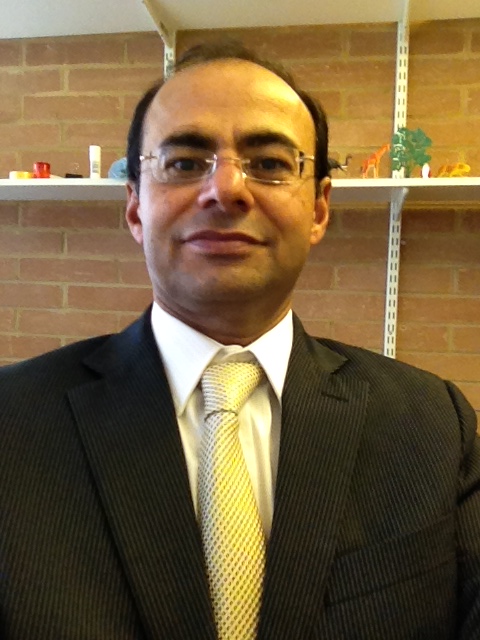
Invited by Sterling Events, Tim also co-chaired the track together with Yogesh Chauhan (Director Corporate Sustainability, Tata Consultancy Services; Business In The Community Board Trustee Director).
Fusion funding supports Brussels trip to find out what EU does for you
As a result of a successful Fusion fund bid, 34 students drawn from across Bournemouth University’s Media and Business Schools will go on a five-day fact finding trip to Brussels between 17th-21st March. The trip is part of a project around engaging the public in the 2014 European Parliamentary Elections. The students, who will be accompanied by Dr. David McQueen and Dr. Dan Jackson (Media School), will be gathering data and producing a range of media reports (interviews, features, blogs, photographs, profiles and backgrounders) which will feed into Media School coverage of EU election night on 22nd May. The itinerary includes a meeting with MEPs Ashley Fox and Julie Girling organised by Douglas Tham (Politics Society President and Politics and Media second-year student), tours of the Council of the EU, the Parlamentarium, the European Commission and the Palais de Justice.
The Fusion project links to the research theme Communities, Cultures and Conflicts. In particular, it links into work within the Media School on governance and exploring ways of deepening democracy through developments in political communication and in the production and consumption of news. Research outputs will include qualitative data on young people’s attitudes to the EU elections in Britain, but also in other EU nations. Students will be reflecting on opportunities and barriers to engaging young people in EU political affairs and considering the particular challenges media professionals face in covering the election against a backdrop of political disengagement, the rise of UKIP and increasing euro-scepticism. As a recent Eurobarometer survey (2012) demonstrated only 27% of Britons were very or fairly attached to the EU, last by a significant margin out of all member states. The survey also revealed Britons to be amongst the most uninformed citizens of all member states about EU matters, thus raising democratic concerns about the public’s potential for manipulation, and the democratic legitimacy of elected representatives with turnout at the last EU Parliamentary Elections in the UK at just 34.7%.
This multidisciplinary project will embrace staff-student co-creation to produce research and media outputs that will inform and engage students and the local public in the 2014 EU Parliamentary Elections. Alongside the many benefits for participating BU students and staff, the project will strengthen links between Bournemouth University and local and regional political parties, media organisations, as well as EU political and educational institutions in Brussels and beyond.
The students who will attend represent programmes across the Media School including Politics and Media, TV Production, Journalism, Radio Production, Animation, Post Production Editing the Business School’s Law degree,
More details on the Brussels trip and the election night coverage will follow in future posts.
David McQueen
(Programme Leader: BA Politics and Media)


Sharing ideas
Is it possible for BU to help shape a social movement for positive change? I have been lucky enough to attend various external events recently that have been pretty inspiring from the point of view of hearing from colleagues working in different countries and different sectors in the UK about new, novel, creative, innovative (select the word you prefer!) approaches to understanding dementia, conducting dementia research and generally creating what I would call a ‘social movement’ to improve and enhance the lives of all those affected by dementia. I shared some of these with staff on the BU induction session this week and got a pretty good response from new colleagues working across BU schools and services so thought I would take the opportunity to share some of the ideas that hearing about work elsewhere have got me thinking about in terms of what we might be able to do locally as part of the work that BUDI is doing on behalf of the University, but also that aligns to current government priorities about creating dementia friendly communities.
The first idea that excites me is the idea of intergenerational schools that has been pioneered in Cleveland by a truly inspirational colleague, Professor Peter Whitehouse who is a neurologist by trade, but a social innovator at heart. Take a look at the innovative approach they have used to improve education standards for kids but also providing community engagement opportunities for those living with dementia http://www.tisonline.org/. What I love about his work is that when I first met him over 15 years ago it seemed to me that he was very much talking about medical aspects of Alzheimer’s Disease (which I tend to be critical about) and so I was intrigued when he then wrote a book challenging medical conceptualisations about dementia back in 2008, http://www.themythofalzheimers.com/a really good read for anyone interested in constructions of knowledge – and over the years he has been involved in so many cutting edge scientific studies but he has also been applying more ‘social’ knowledge to his community to help improve the day to day lives of those with dementia. So a scientist who is applying practical lessons to the real world. Could we create an intergenerational school here in Dorset? or could we apply aspects of this idea and create for example an intergenerational garden where people with dementia work with kids, families, to create an inner city space where people share life skills and work in community with one another? Thanks to Ian Jones and his community partnership work which is such an asset to what we can do research wise at BU, we are going to test out the idea of having school children work with people with dementia learning to play with technology such as the wii, xbox, ipad, Nintendo DS. So we are going to do a little bit of intergenerational work locally that also feeds into the wider UK work to try and create a generation of dementia savyy youngsters who will understand dementia, be open to talking about it, know the risk factors and generally help to reduce the stigma surrounding dementia in our society. Angela Rippon, who is an Alzheimer Society ambassador gave a fantastic talk about the Alzheimer Society schools project at the Dementia Leadership Challenge project washup workshop we hosted in Bournemouth at the and of February; and I have been following this up and it is disappointing that there appear to be no projects happening in Bournemouth. What could we do with local schools to help raise awareness and contribute to the long term challenge of erradicating the stigma that surrounds dementia? See this link for some really creative projects that are happening across the UK http://alzheimers.org.uk/schools. Back in December ULT agreed to a proposal developed by a group of BU colleagues for BU to work towards being a dementia friendly university. What might this mean beyond raising awareness of dementia amongst our student and staff body, addressing HR policies and creating a dementia friendly environment that makes it easier for all staff, students and visitors to find their way around campus? Could we create opportunities for people with dementia to help students with their projects, for example to create technologies that genuinely address from the outset the needs and wishes of members of our community who become socially disabled by their dementia? Could we encourage students to create a media campaign that challenges negative images of dementia and raises awareness of dementia at the same time? I like the idea of a bus poster campaign that has been used successfully elsewhere to raise awareness of mental health issues, but there are likely many other creative approaches!
Can we build on the positive reputation I believe that BU has of being an applied University, and by this I mean one that equips its students to apply knowledge to their future working lives, a University that addresses societal issues by getting dementia embedded into more of our activities? I appreciate that there are many societal issues, different health conditions that may also be worthy of this kind of approach, so really I am talking about an example of how we can contribute to the notion of a ‘social movement’ generally to help improve society. Dementia offers an opportunity to test out social innovation and given 1 in 3 of us will develop dementia and a further 1 in 3 will know someone with dementia (friend, family, neighbour) more than 2/3 of us are going to directly experience dementia as our population continues to age. If you have creative ideas about how we might achieve a ‘social movement’ type approach do feel free to pop into PG63 or the first floor of the EBC and have a chat with me or the rest of the BUDI team.
Engage 2014 Competition
Are you involved in public engagement with research? Have you been involved in a great project that you want to share? Why not enter the Engage 2014 Competition.
See more information here: http://www.publicengagement.ac.uk/competition
Do you want a Knowledge Transfer Partnership?
Then come to our proposal writing workshop!
On Tuesday 18th March 2014, Neil Grice, our local TSB KTP Advisor, will be leading a workshop here at BU. This workshop aims to help you write a KTP proposal that will more closely meet the requirements of the Technology Stategy Board and related funders, including major UK Research Councils. Remember that KTPs are a great way of demonstrating research impact.
To attend this worskhop, with strictly limited places, please email me – ecieciura@bournemouth.ac.uk by noon on Friday 14th March. The event will take place from 11:30 – 13:00 in Studland House (S217)
In the meantime, if you would like to know more about the KTP scheme, go to the TSB’s dedicated website. Here you will find lots of resources for academics, companies and graduates. Specifically for academics, is the TSB’s Innovation through Collaboration brochure – KTP_Acad_Bro_Press_DEC_13.
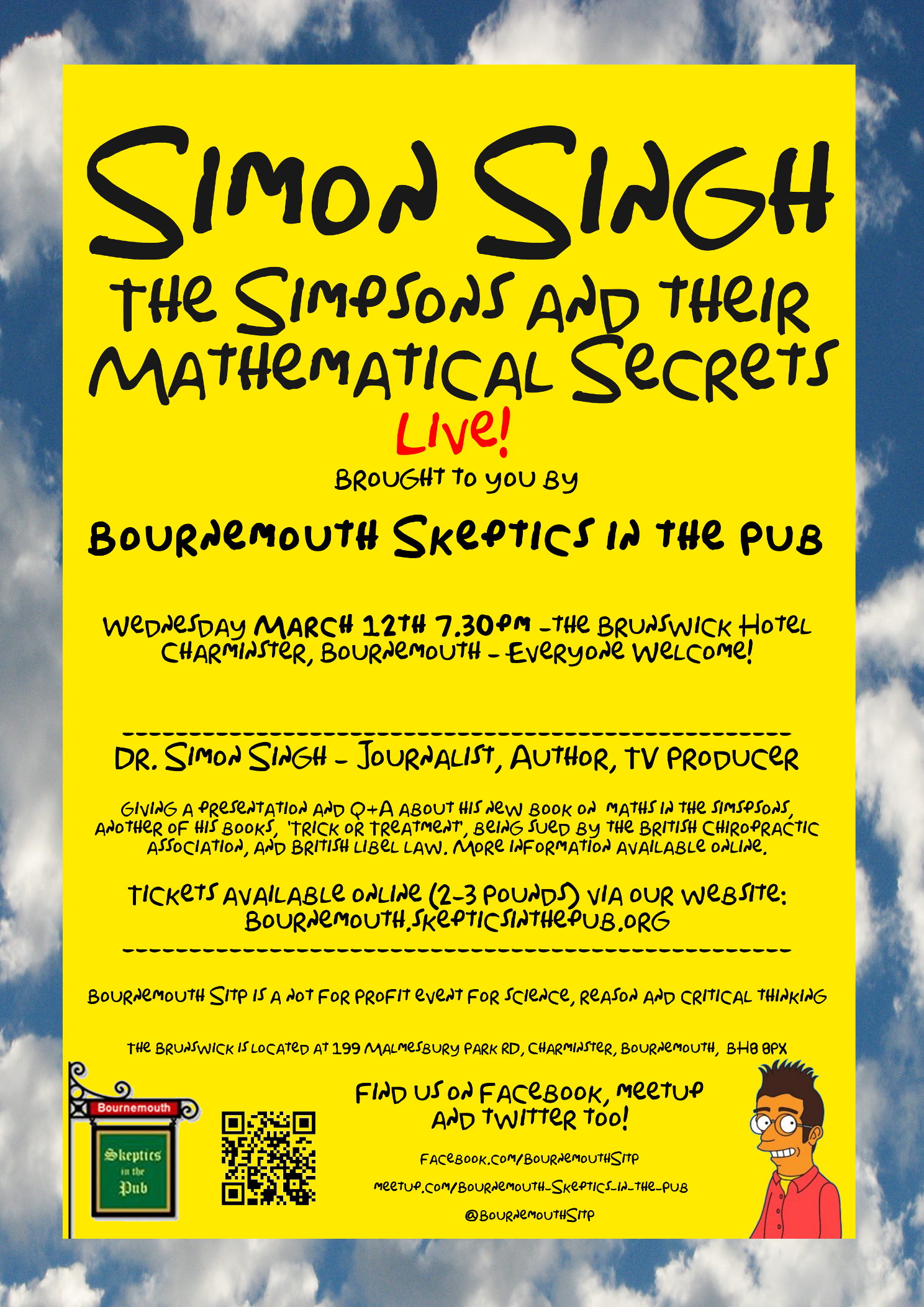
Simon Singh – The Simpsons and their mathematical secrets! Wednesday 12th March…
Bournemouth Skeptics in the Pub will be welcoming Dr Simon Singh (Journalist, Author & TV producer) to the stage to give his talk on ‘The Simpsons and their mathematical secrets’. The event will take place at The Brunswick Hotel in Charminster on Wednesday 12th March at 7.30pm. Everyone is welcome to attend this event, and you are able to buy tuickets online (£2-3) via their website.
The Simpsons and Their Mathematical Secrets
Simon Singh author of Fermat’s Last Theorem and Big Bang, talks about his latest book, which explores mathematical themes hidden in The Simpsons. Everyone knows that The Simpsons is the most successful show in television history, but very few people realise that its team of mathematically gifted writers have used the show to explore everything from calculus to geometry, from pi to game theory, and from infinitesimals to infinity. Singh will also discuss how writers of Futurama have similarly made it their missions to smuggle deep mathematical ideas into the series.
Simon will also discuss the libel action brought against him by the British Chiropractic Association and the subsequent reform to English libel law. Chiropractors very welcome.
Find out more about what Bournemouth Skeptics in the Pub is here.
Carnival FestIM: Developing Staff -Student research collaborations at the School of Tourism
The Festival Impact Monitor (FestIM) is a Fusion supported project that is intended to develop the following:
1) An approach to evaluating the impact of events using data from social media.
2) Reusable Learning Objects that can guide future researchers seeking to apply social media data.
3) Individuals with experience in conducting research with social media data
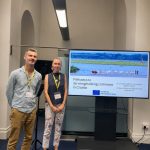
Overall, the project intends to develop approaches to evaluating festivals using online narratives of event stakeholders. FestIM can deliver significant benefits for funders of events and event organizers as understanding the characteristics of online audiences can help them create new types of sponsorship products to fund event activity . Further, it enables the evaluation of social impacts, an area that is difficult to assess using conventional qualitative and quantitative approaches. Finally, for events located over a large geographical area, the costs of evaluation can be prohibitive. FestIM can provide a cost effective alternative to traditional evaluation approaches. To achieve the second and third objectives, the FestIM project is working with a group of Level H dissertation students. At this stage in their research, these students have completed their literature review and secondary data analysis of online engagement at festivals. FestIM provided the opportunity for these students to deliver their research at the International Festival & Events Association of Europe conference in Nice, France to an audience of academics and industry professionals. The team is shown below along with Dr Phil Long, Associate Dean and IFEA Member and Dr Debbie Sadd and Dr Nigel L. Williams of the FestIM project.
The students listed below presented their research to festival organisers from across Europe and the USA and by all accounts delivered a fantastic performance:
Sarah Ardin: community conversations which examines the impact of small rural and urban festivals using social media.
Emma Craig: evaluating the impact of Notting Hill Carnival using social media.
Ryan Kulikowski: the use of Social media as an engagement tool by Festival support organizations
Courtney Lee: the core FestIM process itself and its application to the Love Luton Festival
Doreen Mbagwu: the engagement of the Nigerian and Ghanaian community with Notting Hill Carnival
Rogan Sage: Glastonbury as a platform for engagement with social issues
Jasmine Waddell: post purchase evaluation of Festivals using Glastonbury as a case study.
Above: Courtney, Rogan and Ryan presenting at the main conference.
In addition to presenting their academic research, the students had the opportunity to get an exclusive look behind the scenes of the Nice Carnival which was celebrating its 130th birthday. They participated in workshops with the leading carnival historian Annie Sidro and met the Deputy Mayor of Nice. They then attended the major events of the weekend including a Battle of the Flowers, Main carnival procession and Rock and Roll 10 mile road race. It wasn’t all work as the students were able to take a quick hop down the coast to see Monte Carlo and Monaco. The students will continue to develop their research and will present their completed dissertation findings in our workshop in July at the School of Tourism.
Family Rituals Research Update: The Impact of Work Travel on Home Life
Family Rituals 2.0 is a multidisciplinary project funded by the Engineering and Physical Sciences Research Council and seeks to understand how work-related travel affects participation in family and home life. It is particularly interested in how ‘mobile workers’ keep in touch with family while work takes them apart, and the role technologies play in sustaining such communications.
The research team at Bournemouth (Prof Adele Ladkin, Dr Marina Marouda) has successfully completed the first stage of this research that involved talking to a range of employers to obtain organisational views on mobility and work-life balance. Our organisations came from diverse sectors, including tourism and hospitality, transport, logistics/haulage, media and NGOs.
For the second stage of the study we are looking to acquire the views of people who travel for work. For these purposes, we are conducting interviews with mobile workers to learn about their experiences of working away and how they use communication technologies to keep in contact with family during periods of absence.
Interested to take part?
We are seeking to interview people in all types of jobs that involve travel, whatever their occupation – from engineers to lorry drivers, aircrew to corporate CEO’s. We offer research participants up to £50 in Love2Shop vouchers as a thank you for their time and help.
For more information please visit our website http://familyrituals2-0.org.uk/
If you wish to take part please contact Dr Marina Marouda at mmarouda@bournemouth.ac.uk
Abseil and New Cancer Research – Dr Simon Thompson
Dr Simon Thompson, Associate Professor of Clinical Psychology and Neuropsychology, and Professor Siamak Noroozi, Chair of Advanced Technology, both of the Faculty of Science & Technology, have been awarded the BU Fully Funded PhD Studentship to improve the design and fitting procedure of prosthetic eyes in children with retinoblastoma. It will involve an exploration of skill-based and technology-based procedures to achieve psychological and technological recommendations for the National Health Service.
Retinoblastoma is a disease close to home. My daughter was diagnosed at only 9 months old which resulted in losing one of her eyes to cancer. Thankfully, nearly 2 years on, she is cancer-free and developing healthily like any other child and thanks to the care of the Royal London Hospital/St Bartholomew’s Hospital.
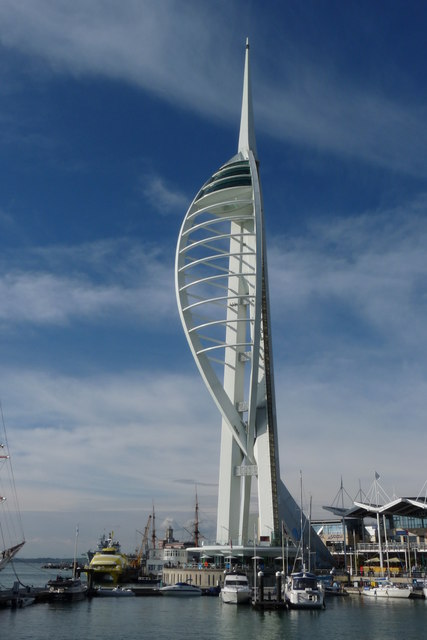
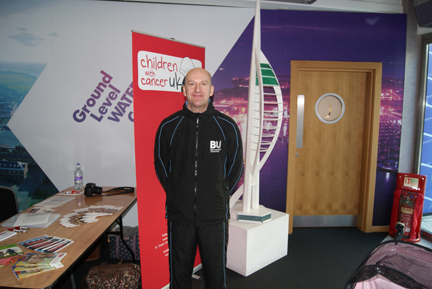
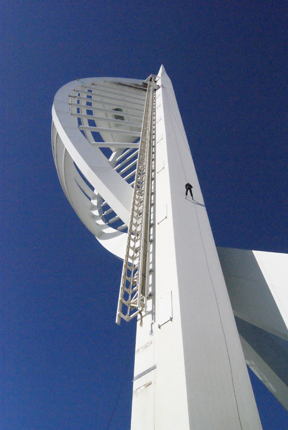
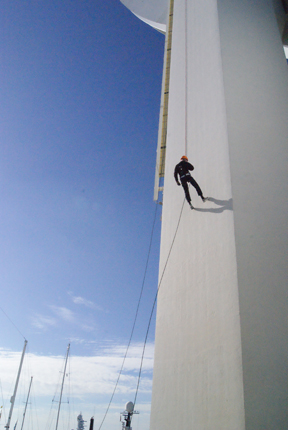
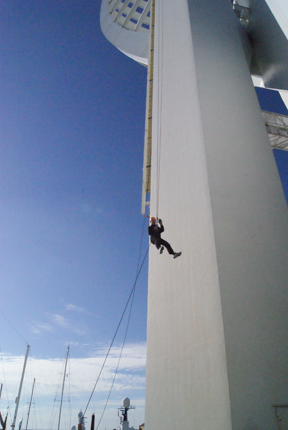
Like a number of parents who have faced adversity through their children, it has changed my perspective on life considerably. When presented with a new and different type of challenge last week, I could not resist. On 1st March, I was invited to raise money for Children with Cancer, by abseiling the Spinnaker Tower in Gunwharf Quays, Portsmouth. This was a rather daunting challenge as I had never climbed or abseiled before and was not particularly keen on heights.
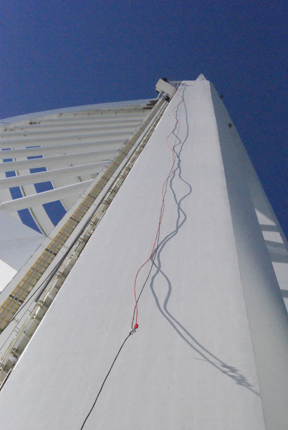
Soaring 170 metres above Portsmouth Harbour and the Solent, the Spinnaker Tower is taller than the London Eye, Blackpool Tower and Big Ben and has already established itself as a national icon.
The moment I took my second hand off the railings of the safety deck, I felt the immensity of the height and the distance below me. I thought if my daughter can get through cancer, then I can get through this. Luckily, it was a brilliant day and the ropes proved helpful. Looking up at the Tower the next day, I could not quite believe what I had achieved.
The research we are conducting is crucial to those affected by retinoblastoma. Prosthetics are fitted to the range of age groups and also for reasons other than cancers, including facial injuries and maxillofacial diseases. Therefore, it is important to produce guidelines on good fitting and manufacture for the benefit of patients. Recruitment to the project begins in April this year.
Anyone wishing to sponsor the abseil event is invited to send their payments, payable to Children with Cancer, to Dr Thompson or directly to the Charity.
http://www.childrenwithcancer.org.uk/Appeal/donate
BU to stage ‘National Hack the Government 2014’
Do you want to take part? The constructive hack day is taking place across the weekend of March 8th & 9th at Kimmeridge House on our Talbot Campus, at the invitation of the BU Cyber Security Unit.
Anyone wishing to participate needs to sign up via this link: http://rewiredstate.org/hacks/nhtg14#signup (it looks like a very involved sign up form, but only the * need completing).
This is the first time the event has been run outside of London and Bournemouth is one of only four other centres across the whole of the UK, so this really is a great opportunity right on our doorstep.
The event’s intention is to use open data to address civic issues and Bournemouth Borough Council are being very supportive in sourcing as much relevant data as they can. More information can be found here.
The Centre for Intellectual Property Policy and Management (CIPPM) launches copyrightuser.org
On Friday 14 February 2014, the Centre for Intellectual Property Policy and Management (CIPPM) launched the Copyrightuser.org
Copyrightuser.org is an independent online resource aimed at making UK copyright law accessible to creators and members of the public.
The project was funded by BU’s Fusion Investment Fund (FIF) in 2012 and was developed in collaboration with CIPPM and the Centre for Excellence in Media Practice (CEMP)
The online resource is applicable to anyone who uses copyright – whether it be in education, music, film, gaming, artistic work etc.
The objective of the portal is to inform creators on how to protect their work; how to license and exploit it; and how to legally re-use the works of others.
As such, it is a useful tool for creators and also for the general public in understanding the issues surrounding copyright law.
The 1-minute video on the landing page of copyrightuser.org further demonstrates what this online resource is about.
Following on from the success of the research carried out as a result of the support received from the
FIF, the CIPPM-led team went on to secure RCUK funding provided by CREATe, University of Glasgow in August 2013 to extend the scope of the project.
The work on Phase II of copyrightuser.org is now underway.
The copyrightuser.org team consists of:
- Dr. Dinusha Mendis (Principal Investigator & Co-Director CIPPM)
- Mr. Bartolomeo Meletti (Lead Multimedia Producer and CIPPM Research Assistant)
- Ms. Hayleigh Bosher (PhD Candidate (Copyright) and CIPPM Research Assistant)
- Professor Martin Kretschmer (Principal Investigator & Director CREATe, University of Glasgow)
- Dr. Kris Erickson (Co-Investigator, CREATe, University of Glasgow).
The team is further assisted by an Editorial Board consisting of Professor Maurizio Borghi (Director, CIPPM); Professor Ruth Towse (Co-Director, CIPPM); and Professor Ronan Deazley (Professor of Copyright Law, University of Glasgow).
We invite you to visit copyrightuser.org and welcome your feedback.
Exploring digital archives with pupils from St Katharine’s School, Southbourne.
Last week I spent time at St Katharine’s School, Southbourne helping Year 5 pupils learn about digital archives. The school is involved in the ‘Be the best you can be’ programme which focuses on helping young people discover their unique potential. The programme was launched at the school last autumn with a visit from the Olympic athlete Mark Richardson who spent time with each class talking about what it takes to compete for your country.
- .

- Pupils searching the digital archives
The sessions I led were part of a week long programme of activities and learning opportunities for pupils. Other sessions were led by a graphic designer, a chef and a BBC News journalist. The sessions were not just about learning a new skill but also a chance for pupils to find out more about the skills and expertise needed if you aspired to work in that particular role. I was asked lots of questions about what a researcher does in a university and were else researchers might work. I was also asked why I wanted to be a researcher and what it was like to work in a university. The pupils had never seen a thesis before and asked me why I had done a PhD, why I was interest in that topic and what it was like to work on the same thing for a long time – it was just like being back in my viva!
Digital archives were used in my PhD and I really enjoyed sharing with the pupils some of the knowledge and skills I developed during my research. The first part of the session looked at what archives are and what they could tell us about past events or people. I picked digital archives that could be related back to current topics that Year 5 are thinking about and discussing in class. The second half was a hands-on session for the pupils to explore for themselves a number of digital archives that might help them with current and future project work. It was great to work with the pupils and really interesting to see what captured their imagination and there were some surprises!
The teaching staff also found the sessions very interesting. Through the sessions they discovered some new learning resources which they are going to build into their future teaching. I really enjoyed taking my university skills and experience out into the local community and sharing them with the pupils and staff from St Katharine’s School.
Workshop on Business and Human Rights – Networks of Transnational Governance at Hebrew University
Dr. Guy Harpaz, Prof. Sascha-Dominik Bachmann, and Pini Miretski are organizing an exciting international workshop on Business and Human Rights – Networks of Transnational Governance that will be held on February 19-20, 2014, at the Hebrew University of Jerusalem, Israel.
The workshop aims to bring together scholars and practitioners, in order to examine the various interfaces among networks of transnational regulation designed to regulate the respect of businesses for human rights. We shall seek to understand the interfaces and linkages between the various regulative initiatives in this developing field. In the workshop we will question whether emerging networks are replacing the roles previously taken by the state, whether the privatization of regulation is supplied by transnational networks and orchestrated by states, or whether an evolution of polycentric governance is complementing an entrapped international legal order.
http://mishpatim.mscc.huji.ac.il/upload/CFP.for.BHR.Workshop.pdf and http://lcbackerblog.blogspot.co.uk/2014/01/call-for-papers-workshop-on-business.html
How people value the New Forest – can you contribute?
Arjan Gosal in the Faculty of Science and Technology is conducting research into spatial mapping of ecosystem services. As part of his doctoral studies he has developed an online survey that is open to all stakeholders in the New Forest National Park and surrounding areas. This includes local residents, tourists, farmers, land owners, nature conservation organisations, local government, game managers and many others.

This research aims to gather valued opinions of the community who live, work or use the New Forest National Park. The survey data will be used to determine the services and habitats most important to stakeholder groups. This information will be incorporated with the online mapping exercise data into geographic models to show ecosystem service values within the New Forest National Park.
Survey participants are entitled to enter into a free prize draw to win one of two £20 Amazon.co.uk vouchers. The survey takes approximately 15-20 minutes to complete.
If you would like to contribute to this important study please complete the short survey online at: www.newforestsurvey.co.uk
For further information or for any questions please contact Arjan Gosal (info@newforestsurvey.co.uk).
Screenings of RUFUS STONE continue to grow
T
he research-based short film, RUFUS STONE, continues to gain traction and make an impact. RUFUS STONE was the key output of a three-year Research Councils UK funded New Dynamics of Ageing Project at Bournemouth University. Since it’s gala premier in 2012, the film has been screened widely for academics, NGO workers, healthcare providers and community audiences of all ages and backgrounds.
RUFUS STONE is a film about love, sexual awakening and treachery, set in the bucolic countryside of south west England, and viewed through the lens of growing older. It is based on knowledge gathered as part of the research project “Gay and Pleasant Land? – a study about positioning, ageing and gay life in rural South West England and Wales.”
More information about the research project and the film
Watch the Trailer for the film
UPCOMING SCREENINGS:
13 March: University of Alberta the Arts-based Research Studio and Joe Norris present a screening of RUFUS STONE followed by a Q & A with Project lead, Author and Executive Producer, Kip Jones via Skype. 12 noon to 2 p.m. Canadian time.
22 March: Keele University’s “Dynamic Qualitative Research” two-day conference will show the film. Mid-day. Kip will be present to take questions and comments.
24 April: RUFUS STONE will be featured as a Special Event in the Frontiers Stream at the British Sociological Association’s Annual Conference at Leeds University. A lunchtime screening, Kip will take questions following the screening. 12:30-13:30
Roger Stevens Lecture Theatre 20.
ALSO: Working out details to screen RUFUS STONE at University of Melbourne’s “Artistry, performance and scholarly inquiry” Conference in July. Stay tuned!


Three NIHR Internships awarded at BU
Research highlighted at the UN in New York
Poverty in the UK: book launch today at BU
BU contributions to successful Global Health conference
New paramedic science paper by BU’s Dr. Ursula Rolfe
Horizon Europe Cluster 3 (Civil Security for Society) 2026 Calls Now Open

MSCA Doctoral Networks 2026 Call Information Webinar

ESRC Festival of Social Science 2026: Application Deadline Extended to Thursday 25 June 2026

Reminder: Register for the ESRC Festival of Social Science 2026 Information Session

ECR Funding Open Call: Research Culture & Community Grant – Apply now

ERC Advanced Grant 2025 Webinar
Update on UKRO services
European research project exploring use of ‘virtual twins’ to better manage metabolic associated fatty liver disease