You don’t have to spend Writing Week working on grant applications. You may already have a dataset and now you finally have some time to do something with it. But where to start? It’s often a good idea to go back to your original research questions/aims/objectives. As we said yesterday, a well thought out research question can help shape your analysis strategy.
Hopefully you will have a record of which variables you were measuring and how data were coded. Were any calculations performed using the raw data to create new variables? How were these done? This is all part of good data management. To find out more visit the information pages created by the Library and Learning Support Team.
Once you are reacquainted with your data, it’s often a good idea (in the case of quantitative data) to start plotting graphs to find out more. Always keep in mind the original aims of the study, it’s easy to wander down a path of distraction. If you are feeling confused by all of this or, have got yourself lost down a data track, the BUCRU team are at hand to help.
Peter Thomas is available on Tuesday and Wednesday while Sharon Docherty is available Tuesday, Wednesday and Thursday this week. Why not drop us an email or pop by to see us in R505?
Category / writing
Making the Most of Writing Week Part 5: Designing your study
So you have formed a strong team, chosen a funder and involved some service users to help develop a research idea with impact. What’s next?
Step 5 is designing your study. The heart of a good piece of research is a strong research question with clear aims and achievable objectives. Sounds easy, right? This is often one of the most difficult aspects of any research project. If you then add having to align your ideas with the priorities of your chosen funder, this task becomes a bit more difficult. However, it is worth the effort. Spending time putting together well constructed research questions will make designing the rest of the study much easier and will even help you formulate your data analysis strategy.
If all of this sounds a bit daunting, never fear because BUCRU are at hand to help. Did you know that some of the members of BUCRU form the Bournemouth branch of NIHR Research Design Service (RDS)? The RDS is here to advise and provide practical support for anyone developing a research grant application to a national, peer reviewed funding competition in the fields of applied health or social care. You can find the Bournemouth team in Royal London House.
If you need help with the design of your study (particularly if it is quantitative) Peter Thomas is available on Tuesday and Wednesday while Sharon Docherty is available Tuesday, Wednesday and Thursday this week. Why not drop us an email or pop by to see us in R505?
New paper Dr. Pramod Regmi
 Dr. Pramod Regmi in FHSS published his latest paper today in the South East Asia Journal of Public Health. The paper ‘Priority public health interventions and research agendas in post-earthquake Nepal’ is co-authored with researchers based in New Zealand, Nepal and the UK [1]. The authors reminds the readers that natural disasters cause huge damage to infrastructure, economies as well as population health. Nepal’s 2015 earthquake has multiple effects on population health and health services delivery. Many public health facilities, mostly health posts or sub-healthposts, were damaged or completely destroyed. Priority health services such as immunisation and antenatal care were also seriously affected.
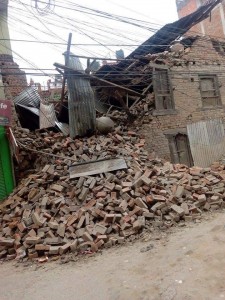 The earthquake has prompted the need for a disaster-related population-health-research agenda as well as renewed disaster strategy in post-earthquake Nepal. Meanwhile, it also unveiled the gap in knowledge and practice regarding earthquake resilience in Nepal. The paper arues that there is an opportunity for school-based and community-based interventions in both disaster preparedness and resilience. Nepal can build on experiences from other countries as well as from its own. We have discussed possible impacts of the Nepal earthquake on population health and health system infrastructures. We have also suggested possible public health interventions bestowing active awareness among the population and a research agenda in this regard. We strongly urge for the translation of the National Health Policy (2014) into action, as it prioritizes the need of an earthquake resistant infrastructure as well as the implementation of a disaster response plan.
Reference:
Regmi, PR, Aryal, N., Pant, PR, van Teijlingen, E., Simkhada, P., Devkota, B. (2015) Priority public health interventions and research agendas in post-earthquake Nepal South East Asia Journal of Public Health 5(2): 7-12 (http://www.banglajol.info/index.php/SEAJPH/article/view/28307/18835 )
Making the Most of Writing Week Part 4: Research grant applications – not THAT PPI
With the start of FHSS writing week, we are continuing our series of blogs providing you with some (hopefully) useful advice on how to make the best of this dedicated time. Remember, there are members of the BUCRU team available during this week to help you (i.e. anyone interested in health research) along the way.
Once you have decided on a funder, an important (but sometimes overlooked) aspect of working up a grant application is the planning and documenting of the involvement of service users/patients/relevant groups or organisations (Public Patient Involvement or PPI) ie the people most likely to have a vested interest in the research you are intending to do. Indeed, many major national funders, including the NIHR, require detailed evidence of how service users have been involved. But do you know who to approach? When? How? What can service users be involved with? What can they add? Sometimes it’s relatively straightforward to identify appropriate individuals and organisations. Other occasions can call for more creativity. Hot tip: everything takes longer to arrange than you might think. Allow a minimum of 6 weeks to plan, consult service users and feedback from the PPI consultation to your colleagues.
If you’d like some advice about planning PPI and conducting service user consultations for a project Helen Allen (helena@bournemouth.ac.uk) will be pleased to advise you. Helen is available on Tuesday 26th.
Midwifery-led antenatal care models
BU academics in CMMPH (Centre for Midwifery, Maternal & Perinal Health) have been working with colleagues across the UK in the so-called McTempo Collaboration on mapping the key characteristics of midwifery-led antenatal care models. This week BMC Pregnancy & Childbirth published our paper that brings this evidence together [1]. The lead author of the paper, Dr. Andrew Symon, is based at the University of Dundee his co-authors are based at the University of Stirling, UCLAN, Queen’s University, Belfast, NHS Education for Scotland and Bournemouth University. The McTempo (Models of Care: The Effects on Maternal and Perinatal Outcomes) collaboration is a multi-disciplinary and multi-institutional research grouping established to explore and evaluate differentcare models used in maternity care.
 Our specific aim in this paper was to map the characteristics of antenatal care models tested in Randomised Controlled Trials (RCTs) to a new evidence-based framework for quality maternal and newborn care (QMNC) [2]. This offers the opportunity to identify systematically the characteristics of care delivery that may be generalizable across contexts, thereby enhancing implementation. The paper concludes: “The QMNC framework facilitates assessment of the characteristics of antenatal care models. It is vital tounderstand all the characteristics of multi-faceted interventions such as care models; not only what is done but why itis done, by whom, and how this differed from the standard care package. By applying the QMNC framework we have established a foundation for future reports of intervention studies so that the characteristics of individual models can be evaluated, and the impact of any differences appraised.”
The paper has been published in an Open Access journal and is, therefore, easily available across the globe.
References:
- Symon, A., Pringle, J., Cheyne, H., Downe, S., Hundley, V., Lee, E., Lynn, F., McFadden, A., McNeill, J., Renfrew, M., Ross-Davie, M., van Teijlingen, E., Whitford, H, Alderdice, F. (2016) Midwifery-led antenatal care models: Mapping a systematic review to an evidence-based quality framework to identify key components and characteristics of care BMC Pregnancy & Childbirth 16: 168 http://www.biomedcentral.com/1471-2393/16/168
- Renfrew MJ, McFadden A, Bastos MH, Campbell J, Channon AA, Cheung NF, Audebert Delage Silva DR, Downe S, Kennedy HP, Malata A, et al. (2014) Midwifery and quality care: findings from a new evidence-informed framework for maternal and newborn care. The Lancet, 384(9948): 1129-1145.
CEMP report for LSE Media Policy blog on Global Media Literacy Alliance
Following the recent Unesco global media and information literacy alliance event in Latvia and looking ahead to CEMP’s Media Education Summit in Rome, Julian McDougall reports here for the LSE Media Policy project on MIL developments and issues for the European research community in the context of Brexit.
Making the Most of Writing Week Part 3: Research grant applications – choosing a funder
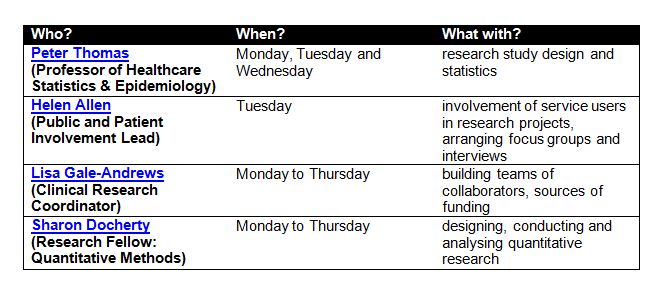
Since next week (25-29 July) is Writing Week in the Faculty of Health and Social Sciences (but anyone interested in health research can come and see us), we’ll be giving you some tips on ways to make the most of the dedicated writing time as well as letting you know which members of the BU Clinical Research Unit team can help you and when they are available (see table below).
In yesterday’s post we covered how we can help you build a research team. Step 3 focuses on choosing a suitable funder for your research project. You may be an established researcher with several grants already under your belt and a fair idea about the funders that are appropriate for your area of research. Whatever stage you’re at it’s important to target the right funder. Ensure your research idea fits with the funder’s strategic aims and priorities. Do they fund solely quantitative research, or do they prefer a mixed-methods approach? Do they have open investigator-led calls or commissioned calls only? Although it’s not all about the money, ensure the funder has a sufficient funding limit for your project – an under-costed project will be obvious to a funder and is unlikely to be successful.
If you’re not sure where to start Lisa Gale-Andrews (lgaleandrews@bournemouth.ac.uk) can help identify suitable health research funders for your project. She will be available all day Monday-Thursday during Writing Week if you’d like to pop in (R506).
There’s more to come on grant applications over the next few days including research design, and the importance of patient and public involvement (PPI).
Making the Most of Writing Week Part 2: Research grant applications – building a team
Next week (25-29 July) is Writing Week in the Faculty of Health and Social Sciences. A whole week dedicated to freeing up some time for academic writing. So, how can you make the most of this opportunity? Over the next few days, we’ll give you some tips on ways to spend your Writing Week as well as letting you know which members of the BU Clinical Research Unit (BUCRU) team can help you and when they are available.
Writing Week is not just about writing papers – it also provides an opportunity to finally start thinking about that piece of research you’ve been dying to do. In BUCRU we have a wealth of expertise to support health research, and several members of our team are also members of the NIHR Research Design Service (more to come on that in a later blog). The next few posts cover our speciality subject – research grant applications.
Step 2 is thinking about your research team. You might have a great idea for a research project, but do you have the right people to ensure a strong, supportive team who can deliver the research? Depending on your research question, you might need a multi/interdisciplinary team of academics from different disciplines, clinicians, nurses, Allied Health Professionals etc. You may have a good network around you already, but what do you do if you don’t? Lisa Gale-Andrews is Clinical Research Co-ordinator in BUCRU, and can help facilitate research collaborations particularly with clinicians in the local health service and with academics across Faculties. Please contact Lisa (lgaleandrews@bournemouth.ac.uk) if you’re looking for contacts and for support in building your research team. She will be available all day Mon-Thurs during Writing Week if you’d like to pop in (R506).
There’s more to come on grant applications over the next few days including choosing a funder, research design, and the importance of patient and public involvement (PPI).
Making the Most of Writing Week Part 1: Be Prepared!
Next week (25-29 July) is Writing Week in the Faculty of Health and Social Sciences. A whole week dedicated to freeing up some time for academic writing. So, how can you make the most of this opportunity? Over the next few days, we’ll give you some tips on ways to spend your Writing Week.
Step 1 is to set a goal for the week… but make it realistic. Unless you are one of the lucky people who find it easy to write, you won’t be able to produce a whole grant proposal/manuscript in that time but you can make a start. Go through that list of jobs you’ve been putting off until you “have more time” and decide how you will spend your week.
Don’t forget the BU Clinical Research Unit team are here to help not only HSS researchers but anyone involved in health research. Below is a list of who is available and how each of us can help.
FoL debate highlighted on USA website
 Last week’s Festival of Learning debate on the motion: “Advising pregnant women to avoid drinking alcohol during pregnancy is symptom of the Nanny State and another step towards the medicalisation of childbirth” has just been hightlighted in the USA. Our work featured on Jeffery Nicholas’ thoughts on social reality, a site established by Prof. Jeff Nicholas (click here!). Prof. Nicholas is a philospher based at Providence College with an interest in midwifery in society.
Faculty of Health & Social Sciences’ Liz Norton and Edwin van Teijlingen affiliated with the Centre for Midwifery, Maternal & Perinatal Health (CMMPH) argued in favour of the motion. Donna Wixted, Joint Bournemouth University (BU)-Portsmouth Hospitals NHS Trust, doctoral student and Greta Westwood of Portsmouth Hospitals NHS Trust & the University of Southampton argued strongly against the motion. The exciting debate was chaired by Prof. Vanora Hundley from the Faculty of Health & Social Sciences.
New CMMPH paper by PhD student Sheetal Sharma
 Today saw the publication in BMC Pregnancy & Childbirth of the paper ‘Dirty and 40 days in the wilderness: Eliciting childbirth and postnatal cultural practices and beliefs in Nepal’ with as lead author FHSS PhD student Sheetal Sharma [1]. This paper argues that pregnancy and childbirth are very much socio-cultural events that carry varying meanings across different societies and cultures. These are often translated into social expectations of what a particular society expects women to do (or not to do) during pregnancy, birth and/or the postnatal period. The study explored beliefs around childbirth in Nepal, a low-income country with a largely Hindu population. The paper then sets these findings in the context of the wider global literature around issues such as periods where women are viewed as polluted (or dirty even) after childbirth.
Sheetal is doing ve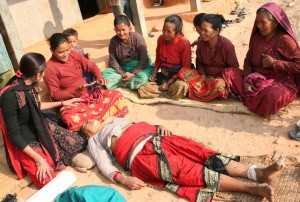 ry well with her PhD publications as a few weeks ago her major quantitative findings paper was published in PLOS One [2]. Both papers are published in Open Access journals and therefore easily available to researchers, health promotors, health care providers and health policy-makers in low-income countries. Sheetal evaluated a research project funded by the London-based charity Green Tara Trust. Her PhD is supervised by Dr. Catherine Angell, Prof. Vanora Hundley and Prof. Edwin van Teijlingen all nbased in CMMPH with external supervision from BU Visiting Faculty Prof. Padam Simkhada (liverpool John Moores University).
References:
- Sharma, S., van Teijlingen, E., Hundley, V., Angell, C., Simkhada, P. (2016) Dirty and 40 days in the wilderness: Eliciting childbirth and postnatal cultural practices and beliefs in Nepal BMC Pregnancy & Childbirth 16: 147 https://bmcpregnancychildbirth.biomedcentral.com/articles/10.1186/s12884-016-0938-4
- Sharma, S., van Teijlingen, E., Belizán, J.M., Hundley, V., Simkhada, P., Sicuri, E. (2016) Measuring What Works: An impact evaluation of women’s groups on maternal health uptake in rural Nepal, PLOS One 11(5): e0155144 http://journals.plos.org/plosone/article?id=10.1371%2Fjournal.pone.0155144
New paper FHSS Dr. Sarah Collard
 Congratulations to Dr. Sarah Collard on her latest paper ‘The psychosocial impact of exercising with epilepsy: A narrative analysis’ in Epilepsy & Behavior. The paper offers valuable insight into the psychosocial benefits of and barriers to exercising with epilepsy and draw attention to the individual differences in how a person with epilepsy copes with uncontrolled seizures and their impact on his/her exercise routine. This knowledge can lead to future research in exploring how a person with epilepsy can overcome these barriers to exercise and encourage more people with epilepsy to enjoy the benefits of exercise.
Congratulations!
Prof. Edwin van Teijlingen
CMMPH
Why editorials?
 BU academics are editors on a wide range of scientific journals. As editors we often write editorials for academic journals which have a number of specific functions. It is a key means of communication between the editor(s) and the journal’s readership. It is also vehicle to highlight topical academic and political issues related to the journal and the discipline(s) it represents.
Earlier this week the latest issue of the Journal of Asian Midwives came out with an editorial which is an illustration of the first point giving information to the readers [1]. The topics addressed in this editorial included the announcement that this new journal was now indexed in the CINAHL Database, a recent major international conference in the field and a call for the forthcoming 2017 ICM (Internation Confederation of Midwives) tri-annual conference. Today saw the publication of an editorial on the Zika virus and its potential impact in Nepal in the journal Medical Science [2]. This guest editorial co-written by BU’s Visiting Faculties Dr. Brijesh Sathian and Prof. Padam Simkhada with Prof. Edwin van Teijlingen (Centre for Midwifery, Maternal & Perinatal Health) calls for action in Nepal. A country where malaria is endemic. The Zika virus uses mosquitoes like the ones spreading Dengue fever and malaria. Zika is a virus we do not wish to see spreading in countries where malaria is already rife. The editorial warns that precautionary measures are needed to prevent a Zika outbreak as the spread of the virus to the country seems inevitable, the only uncertainty is when it will be arriving.
Both journals are Open Access which means these editorials can be read by anybody with internet access free of charge.
References:
- Jan, R., van Teijlingen, E. (2016) Editorial JAM June 2016, Journal of Asian Midwives 3(1):1. http://ecommons.aku.edu/jam/vol3/iss1/1/
- van Teijlingen, E., Sathian, B., & Simkhada, P. (2016). Zika & Nepal: a far greater risk for its population than to individuals. Medical Science 4(2): 312-313. http://www.pubmedhouse.com/journals/ms/articles/1064/PMHID1064.pdf
New paper on Birthing Centres in Nepal
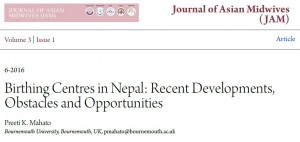 Congratulations to Preeti Mahato in the Centre for Midwifery, Maternal & Perinatal Health (CMMPH) on the publication of a paper based on her Ph.D. research. Her paper ‘Birthing centres in Nepal: Recent developments, obstacles and opportunities’ can be found in the June 2016 edition of the Journal of Asian Midwives (JAM) [1]. All articles in JAM are Open Access to ensure midwives and researchers in the poorest parts of Asia can freely access the scientific articles in the journal.
This literature review was appraised the relevant literature on birthing centres in Nepal, South Asia, and other similar settings. Preeti and her co-authors concluded that birthing centres in Nepal have the potential to improve both (a) the institutional delivery rate; and (b) the proportion of births that benefit from the presence of a skilled birth attendant (SBA). However, accessibility, socio-demographic characteristics, and cultural factors act as barriers to pregnant women attending birthing centres and hospital facilities.
Preeti’s Ph.D. is supervised by Dr. Catherine Angell and Prof. Edwin van Teijlingen in CMMPH and Prof. Padam Simkhada at Liverpool John Moores University. Padam is also Visiting Faculty at the Faculty of Health & Social Sciences (FHSS).
Reference:
- Mahato, P., van Teijlingen, E., Simkhada, P., Angell, C. (2016) Birthing centres in Nepal: Recent developments, obstacles and opportunities, Journal of Asian Midwives 3(1): 17-30.
Best paper award!
 Best Paper for 2015 Award in the international journal Heart. A paper published by Bournemouth University PhD student, Edward Carlton, and his supervisors, Prof. Ahmed Khattab (FHSS) and Prof. Kim Greaves from the University of the Sunshine Coast in Australia in collaboration with world-renowned hospitals: John Radcliffe Hospital in Oxford; Royal Brisbane & Women’s Hospital in Australia; and Christchurch Hospital in New Zealand has been announced as the Winner of the “Heart Best Paper 2015 Award” [1]. This award is in recognition of the high quality and clinical impact of the paper. The winner for this award were chosen by the Editorial Team from the top 10 papers in each of the following three categories: downloads, citations and Altmetrics Score.
Dr. Edward Carlton has just finished his PhD at BU and he is now working as an Emergency Medicine Consultant in Bristol.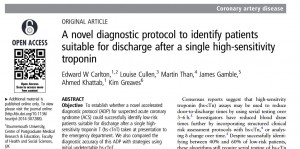
Congratulations!
Prof. Edwin van Teijlingen
CMMPH
Reference:
Carlton EW, Cullen L, Than M, Gamble J, Khattab A, Greaves K. A novel diagnostic protocol to identify patients suitable for discharge after a single high-sensitivity troponin. Heart. 2015 Jul;101(13):1041-6. doi: 10.1136/heartjnl-2014-307288. Epub 2015 Feb 17.
New publication Carol Bond & Osman Ahmed
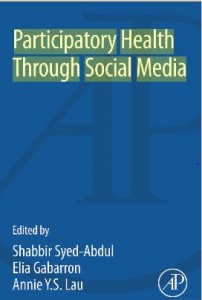 The week saw the publication of a new book by Elsevier (June 9th) Health Through Social Media which contains a chapter by FHSS staff Drs Carol Bond and Osman Ahmed called ‘Patient Empowerment Through Social Media’. Carol and Osman have a wide-ranging experience in researching and publishing about e-health, m-health and social media. They co-authored this topical chapter with a colleague in Australia.
Congratulations!
Prof. Edwin van Teijlingen
CMMPH
BU-Nepal link highlighted
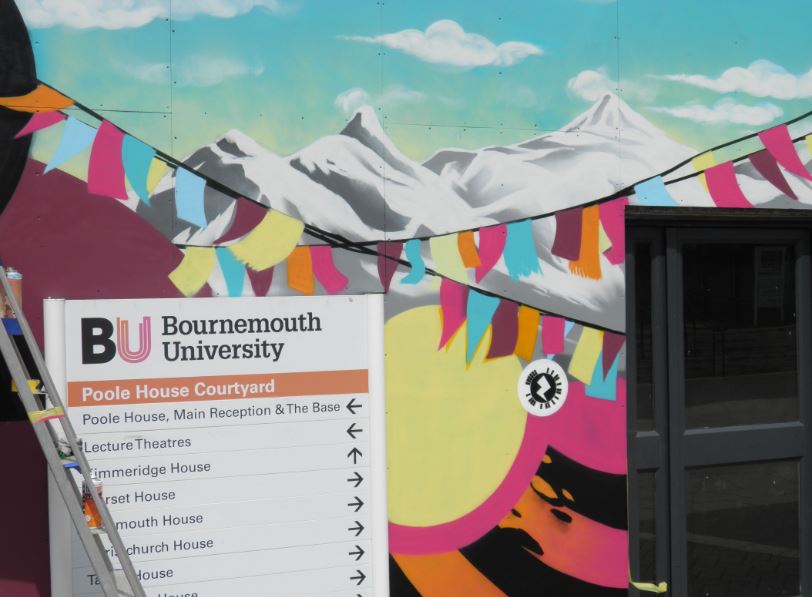 This week BU’s work in Nepal was highlighted in several ways. Most publicly on the wonderful new mural at Talbot Campus. Secondly, BU currently displays some of the entries of images to the past two years of its research photo competition. The photos show the creativity of BU’s academics and students as well as the fascinating range of research taking place at the university. One of these pictures was taken by FHSS Visiting Faculty Dr. Bibha Simkhada during fieldwork in Dhading, Nepal. The selected photos are on display in the Atrium Art Gallery until the 13th of June.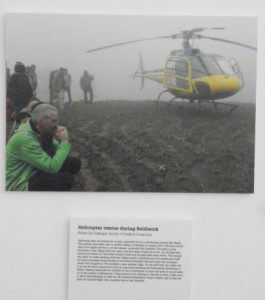
Last, but not least, another FHSS Visiting Faculty, Poole Hospital NHS Foundation Trust midwife Jillian Ireland published a blog on her involvement in the THET-funded project in Nepal. She reflects on her time as UK volunteer in Nepal. Jilly wrote: ” Three volunteers Andrea Lawrie, David Havelock and I are keen to share what we experienced in a paper sometime soon and today I will condense some of my own reflections. I wrote ‘letters’ (via email) to my Head of Midwifery, Sandra Chitty and to Senior Lecturer in Midwifery at Bournemouth University Dr. Jen Leamon while I was away, using different styles of expression to ‘get at’ my reflections from more than one angle. It helped me to separate out elements of the whole experience.”
Prof. Edwin van Teijlingen
CMMPH
New paper BU PhD student Sheetal Sharma
 Congratulations to FHSS PhD student Sheetal Sharma on her latest paper [1]. The paper ‘Measuring What Works: An impact evaluation of women’s groups on maternal health uptake in rural Nepal’ appeared this week in the journal PLOS One. Sheetal’s innovative mixed-methods approach was applied to a long-running maternity intervention in rural Nepal. The paper concludes that community-based health promotion in Sheetal’s study had a greater affect on the uptake of antenatal care and less so on delivery care. Other factors not easily resolved through health promotion interventions may influence these outcomes, such as costs or geographical constraints. The evaluation has implications for policy and practice in public health, especially maternal health promotion.
Reference:
- Sharma, S., van Teijlingen, E., Belizán, J.M., Hundley, V., Simkhada, P., Sicuri, E. (2016) Measuring What Works: An impact evaluation of women’s groups on maternal health uptake in rural Nepal, PLOS One 11(5): e0155144 http://journals.plos.org/plosone/article?id=10.1371%2Fjournal.pone.0155144
BU staff can login below:
Other services







Recent posts
BU research Funding opportunities EU
 SONAMONI contributions to Safety Conference 2026 in South Africa
- REF adds ‘midwifery’ to Unit of Assessment 3 name
 Three CMWH presentations at Berlin conference
 New interdisciplinary paper on Nepal
- New BU Social Work paper published this week
- NEW BOOK Just Published: Rather and Buhalis, 2026, Metaverse Marketing: Challenges, Opportunities, and Fundamental Mechanisms
 Horizon Europe Cluster 3 (Civil Security for Society) 2026 Calls Now Open
 MSCA Doctoral Networks 2026 Call Information Webinar
 ESRC Festival of Social Science 2026: Application Deadline Extended to Thursday 25 June 2026
- Apply now to take part in the 2026 ESRC Festival of Social Science
 Reminder: Register for the ESRC Festival of Social Science 2026 Information Session
 ECR Funding Open Call: Research Culture & Community Grant – Apply now
- MSCA Postdoctoral Fellowships 2025 Call
 ERC Advanced Grant 2025 Webinar
- European Migration Research and Impact – Invitation to a Roundtable Discussion
- MSCA Postdoctoral Fellowships 2025
 Update on UKRO services
 European research project exploring use of ‘virtual twins’ to better manage metabolic associated fatty liver disease
 Research Information Network
- Physical Sciences Case studies: information use and discovery
- Information handling in collaborative research: an exploration of five case studies
- Information literacy monitoring and evaluation
- Data centres: their use, value and impact
- Heading for the open road: costs and benefits of transitions in scholarly communications