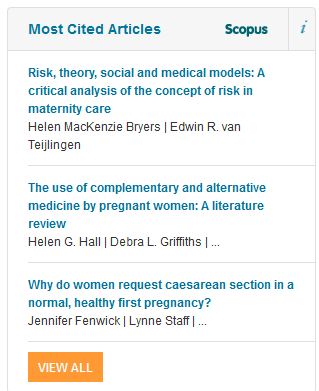
 The scientific paper ‘Risk, Theory, Social & Medical Models: a critical analysis of the concept of risk in maternity care’ written by Dr. Helen MacKenzie Bryers (NHS Highland) and BU Professor of Reproductive Health Research is now listed on the website of the international journal Midwifery as its top most cited paper since 2010 (1). Midwifery, published by Elsevier, is one of the leading global journals in the field of midwifery and maternity care.
The paper provides a critical analysis of the risk concept, its development in modern society in general and UK maternity services in particular. Through the associated theory, the authors explore the origins of the current preoccupation with risk. Using Pickstone’s historical phases of modern health care, the paper explores the way maternity services changed from a social to a medical model over the twentieth century and suggests that the risk agenda was part of this process.
‘Risk, Theory, Social & Medical Models’ has been cited 40 times in SCOPUS, measured today Jan. 25th 2015. In Google Scholar the citation rate is even higher and stands at 69.
Prof. Edwin van Teijlingen
Centre for Midwifery, Maternal and Perinatal Health
Faculty of Health & Social Sciences
Reference
- MacKenzie Bryers, H., van Teijlingen, E. (2010) Risk, Theory, Social & Medical Models: a critical analysis of the concept of risk in maternity care, Midwifery 26(5): 488-496.



















 3C Online Social: Thursday 26 March 1–2pm – Research Culture, Community & Can you Guess Who?
 Four BU students at national midwifery conference
 INRC book roundtable/presentation by Drs Jonathan Cole and Catherine Talbot, Wednesday 22/04/2026, 13:00h, P426
 BU M.Res. student’s evidence to UK Parliamentary Women & Equalities Committee
 ECR Funding Open Call: Research Culture & Community Grant – Apply now
 ECR Funding Open Call: Research Culture & Community Grant – Application Deadline Friday 12 December
 MSCA Postdoctoral Fellowships 2025 Call
 ERC Advanced Grant 2025 Webinar
 Update on UKRO services
 European research project exploring use of ‘virtual twins’ to better manage metabolic associated fatty liver disease