The emergence of Hybrid Threats and Hybrid War as new security challenges of the 21st Century – from its early examples in Israels war against Hezbollah in 2006 to Russia’s War in Eastern Ukraine. Dr. Sascha Dov Bachmann, Associate Professor in Law, Co-Director of BU’s Conflict, Rule of Law and Society( https://research.bournemouth.ac.uk/centre/conflict-rule-of-law-and-society/) presented at the 24th Annual SLS-BIICL Conference on Theory and International Law at the British Institute of International and Comparative Law in London. He argues that Hybrid War is more than Compound Warfare by utilising new technologies of cyber and Hybrid Threats. His work on teh subject was recently published as HYBRID WARS: THE 21st-CENTURY’S NEW THREATS TO GLOBAL PEACE AND SECURITY in the South African Journal of Military Studies, http://scientiamilitaria.journals.ac.za/pub/article/view/1110/1107.
Tagged / collaborative research
Latest Major Funding Opportunities
The following funding opportunities have been announced. Please follow the links for more information:
Biotechnology and Biological Sciences Research Council, GB
The Biotechnology and Biological Sciences Research Council, together with the Medical Research Council, the Engineering and Physical Sciences Research Council and the Economic and Social Research Council, invites outline proposals for its Diet and Health Research Industry Club. Funding enables UK universities and institutes to carry out research that will enhance understanding and facilitate the development of products with health and nutrition benefits, and help address diet-related health issues in the longer term. Research proposals must address at least one of the challenges: Understanding the relationship between food processing and nutrition; designing foods to maintain and improve health; understanding food choice and eating behaviour to improve health through diet. Maximum award: Not specified. Closing date: 4pm, 01/07/15 for outline proposals. Full proposals are by invitation.
Economic and Social Research Council, GB
The Economic and Social Research Council, the Medical Research Council, the Arts and Humanities Research Council, the National Council of State Funding Agencies (CONFAP) and the Conselho Nacional de Desenvolvimento Científico e Tecnológico (CNPq) invite applications for their Healthy Urban Living call and the Social Science of the Food-Water-Energy Nexus, under the Newton Fund. For the Healthy Urban Living stream, all proposals must address the theme of health inequalities and justice and one or more of the following areas: urban design, planning housing and infrastructure; communities, culture and heritage; leadership, governance and institutions. The total fund from the Research Councils is £2.5m, with matched equivalent for Brazilian partners. For the Social Science of the Food-Water-Energy Nexus stream, proposals should clearly identify one or more of these themes as the focus of the research project and demonstrate how it will be applied to the development of the Social Science of the Food-Water-Energy Nexus: Measuring, modelling and understanding the Nexus; innovation for sustainable transformations; the political economy and governance of the Nexus; human welfare, development and the Nexus. The total fund from the Research Councils is £1.25m, with matched equivalent for Brazilian partners. Maximum award: Not specified. Closing date: 4pm, 02/07/15.
Engineering and Physical Sciences Research Council, GB
The Engineering and Physical Sciences Research Council and Innovate UK invite expressions of interest to attend their state of the art in simulation and design workshop. This aims to identify the state of the art in fundamental simulation and modelling techniques that can help improve the design process within engineering design, and to enable users to progress in their use of these tools and determine key areas of need not currently being addressed by research programmes. The workshop will be held on 16 July 2015. The workshop will focus on the areas of optimisation, multiphysics, materials modelling and multiscale, with challenges identified in the sectors of automotive, aerospace, energy, built environment, healthcare technologies, electronics, and the process industries of chemicals and food.Awards cover reasonable travel and subsistence costs, including accommodation, refreshments and meal costs. Maximum award: Not specified. Closing date: 4pm, 10/06/15.
Innovate UK, GB
Innovate UK, Biotechnology and Biological Sciences Research Council and the Engineering and Physical Sciences Research Council invite expressions of interest for the fourth round of their Early-stage Translation studies, under the Industrial Biotechnology Catalyst. This supports research and development for the processing and production of materials, chemicals and bioenergy through the sustainable exploitation of biological resources, including tissues, enzymes, and genes from organisms that include algae, marine life, fungi, microorganisms and plants, and accelerate commercialisation. Projects must be pre-competitive and academic-led. Funding is only available to academics in line with the standard BBSRC and EPSRC eligibility rules. Total project costs should be between £2m and £5m and projects should last between three and five years. Maximum award: £5m. Closing date: 12pm, 05/08/15 for expressions of interest.
Medical Research Council, GB
The Medical Research Council, together with the Economic and Social Research Council, the Brazilian Council of State Funding Agencies and the Brazilian National Council for Scientific and Technological Development, invite proposals for the UK-Brazil Neglected Infectious Diseases Partnership. The initiative will provide funding for collaborative research projects, focussed on neglected infectious diseases in Brazil. Proposals may focus on Dengue Fever and other vector-borne diseases, Leishmaniasis, Chagas Disease, Leprosy, Schistosomiasis, Omtestinal Helminth Infectious, Rotaviruses and emerging viruses. Projects should last between two and three years. Maximum award: Not specified. Closing date: 01/06/15.
Natural Environment Research Council, GB
The Natural Environment Research Council invites applications for its Industrial CASE Studentships. This scheme promotes collaboration between the research community and the end users of research. Applicants must demonstrate excellent science research along with the potential for societal or economic impact through strong collaboration with the non-academic partners and the provision of high quality training in research skills. The CASE partner must be an end user organisation that can use the outputs of research in developing business, technology, regulation, policy or social and environmental enterprise, within the public, private or third sector. The CASE partner must have a base in the UK. Maximum award: Not specified. Closing date: 4pm, 08/07/15.
Please note that some funding bodies specify a time for submission as well as a date. Please confirm this with your RKEO Funding Development Officer
You can set up your own personalised alerts on Research Professional. If you need help setting these up, just ask your School’s/Faculty’s Funding Development Officer in RKEO or view the recent blog post here.
If thinking of applying, why not add notification of your interest on Research Professional’s record of the bid so that BU colleagues can see your intention to bid and contact you to collaborate.
Datalabs 3: Digital Storytelling with Data
Digital transformations in communications have led to the increasing popularity of data visualisations and the use of maps and other multimedia interactives for representing complex data. Often, these visual data stories can better communicate the significance of research findings to policy-makers and the public. Beyond engendering greater comprehension, this turn to the visual can also tap into our emotions and cultural values.
Next week the Fusion CCCP funded Datalabs project brings you Datalabs 3: Digital Storytelling with Data. Bringing together academic colleagues, learning support and IT staff, UG and PG students, as well as external stakeholders and community participants, the Datalabs project is co-creating digital skills and data literacy through hands-on workshops. Our first two events have been oversubscribed, so please register early to secure your participation!
Datalabs 3 hosts two events.
Thursday
14 May 2015 register here
MASTERCLASS: Turning Numbers into Narratives: An introduction to digital storytelling with data
Time: 11:00-14:00 (Please note there will be lunch served at 12:30)
Location: KG01, Kimmeridge House, Talbot Campus
In this Masterclass, we will introduce the audience to the emerging interdisciplinary field of data storytelling research. Drawing on a range of contemporary examples, we will present a variety of techniques and technologies for creating data stories.
Friday 15 May 2015 register here
WORKSHOP: Digital Storytelling with Data
Time: 10:00-16:00 (Please note there will be lunch served at 12:30)
Location: W403, Weymouth House, Talbot Campus
In this hands-on workshop we will engage with data visualisation tools, gaining insight into the process that data storytellers use to get information online and out into the public. We will take participants from spreadsheet to headline, looking at how narrative practices shape the ways we design visualisations to tell stories with data. We will also reflect on the ethical questions that come with turning numbers in narratives.
The social sciences at BU
In response to an open email invitation, a group of social scientists from across BU met on Tuesday 17 March to discuss prospects for inter-Faculty collaboration. As in previous meetings between FMC and HSS colleagues, it was apparent that there were opportunities for more collaborative work than currently exists, and that there is considerable enthusiasm for developing links. A growing presence of the social sciences in BU, and of BU in the social sciences, was felt to be essential to BU’s development as a university with a rich intellectual community. If you haven’t received the report from this meeting by email, and would like to do so, please email Prof. Barry Richards (brichards@bmth.ac.uk)
Piirus – creating relationships is critical
Following on from the recent post on Pirrus, please read on to find out more…
According to a recent survey of the Association of Research Managers and Administrators’ members, over 3 out of 5 ARMA members find creating multi-disciplinary relationships challenging.
The survey found that a large majority of members (80%) thought that creating relationships between different disciplines was critical to their role but 71% found it challenging to achieve.
Other key findings from the survey:
• 87% thought identifying research trends was important to their role – but over half found it challenging in practice
• 76% found creating relationships between researchers in different geographies challenging
• 66% thought creating relationships with researchers in specific institutions was important to their role
Piirus, a free service for the global research community – allows researchers from institutions around the world, and across disciplines, to connect and collaborate more easily.
However, despite the benefits of academic social networks like Piirus, the survey found that only one third of those surveyed were members of academic networking sites. Furthermore, over 75% of members who did use academic networking sites, do not utilise them to identify and create connections for their researchers.
Commenting on the findings, Fiona Colligan, Head of Piirus said: ‘We see Piirus as not only as a much needed offering from the sector to help connect researchers to opportunities but also as a solution to the challenges raised by ARMA members in their role supporting researchers. We are delighted to offer Piirus to this important professional community and look forward to working with ARMA members to learn how we can grow this service in our joint pursuit in supporting research excellence’
To join, go to the Piirus site. It is free!
Representations of PR – online resource
Representation of professions and employment takes many forms and is often shaped by books and visual and aural media.
In the public relations field, characters such as Edina in Absolutely Fabulous and the foul-mouthed spin doctor Malcolm Tucker in The Thick of It are well known, as are terms like “PR success” and “PR disaster”, even though the events may have little to do with public relations practices or activities.
Apart from one US researcher, Professor Joe Saltzman of the University of Southern California, there has been little investigation of representations of public relations in books and entertainment media.
Working with colleagues in Australia, Sweden and the US, Professor Tom Watson of the Faculty of Media & Communication developed the PRDepiction blog: https://prdepiction.wordpress.com/ in 2012.
“We wanted to create a resource that would offer a catalogue of books, films, TV and radio, as well as articles, and encourage interdisciplinary research,” said Professor Watson.
As the blog has a relatively simple structure, additions and amendments can be made quickly. It has just been overhauled with a new look and revisions and more entries.
“PRDepiction has grown over the years and become more international. The latest additions include TV series in Australia and the UK, and a three-book series on a fashion PR guru from Australia,” said Professor Watson.
Additions can be sent to PR Depiction as blog Comments or to twatson@bournemouth.ac.uk. The blog also has a Twitter address, @PRDepiction.

PRDepiction's Twitter logo
We regret to inform you ….
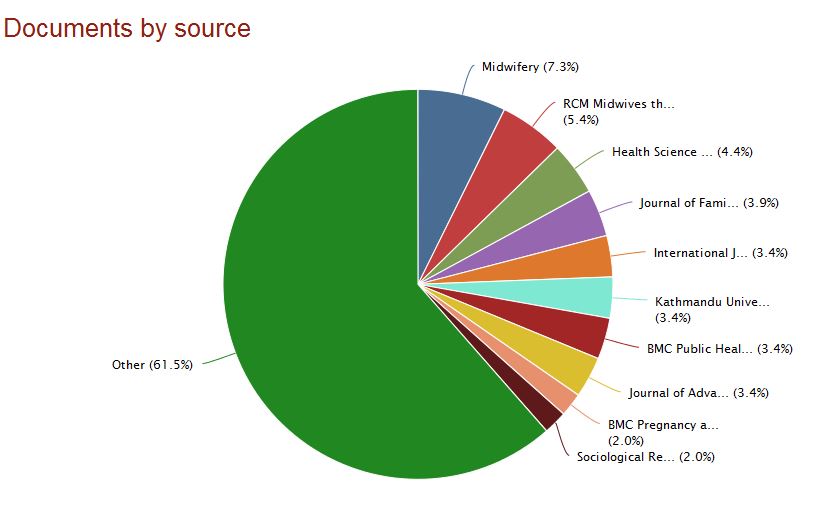 It is always disappointing for an academic author to receive a rejection letter. Today I received yet another one from Midwifery (published by Elsevier). Sometimes I think academic publishing in good journal is not getting any easier over time. Neither does the experience of having over two hundred peer-reviewed academic papers make a rejection easier to deal with. This was my third paper in a row that got rejected by Midwifery. All three papers were rejected on resubmission, so a lot of extra work had gone into these papers after the initial peer review and the editor’s feedback. These three papers where led by three different postgraduate students (Sharma, Baral & Burton) as first authors, and in each case co-authored by myself and different BU academics and/or from other universities.
Midwifery is the journal in which I have published more papers than any other journal (see top blue piece of pie in ‘Documents by source’) as reported on SCOPUS today (26 April 2015). Moreover, I am co-author of one of the top five most downloaded papers in Midwifery for 2014 (see recent BU Research Blog), and this paper is also the most cited Midwifery paper since 2010! Still I manage to have three papers rejected in a row.
What is does show to me is that the journal’s peer review system is robust (i.e. blind and impartial) because I am also a member of Midwifery’s editorial committee. I think it is back to the drawing board and discuss with each set of authors what the next step should be for our papers. To be fair we had a paper published already this year in Midwifery, namely: Grylka-Baeschlin, S., van Teijlingen, E.R., Stoll, K., Gross, M.M. (2015) Translation and validation of the German version of the Mother-Generated Index and its application during the postnatal period. Midwifery 31(1): 47–53.
As an editorial board we try continuously to maintain a high quality of papers to be published in our journal, and we would like to encourage potential authors to keep submitting their papers to Midwifery.
Prof. Edwin van Teijlingen
CMMPH
Major earthquake in Nepal: Help needed
Yesterday’s earthquake, with a magnitude of 7.9 on the Richter Scale, killed thousands of people. It is now 9 AM on Sunday morning and just had a report from friends in Nepal about a major after shock whilst the number of reported deaths is increasing by the hour. The number of causalities in rural areas will only become known over the next few weeks, because of the remoteness of some of the affected areas and the damage to infrastructure (roads, power cables, telephone, and internet links). We know from previous disasters in low-income countries like Nepal that help will be slower to reach rural areas.
The Government of Nepal has asked for international aid and the first aid arrived yesterday from neighbouring India. Yesterday the United States has made one million US$ available for the most immediate aid according to USAID, whilst the Belgian government activated its so-called B-Fast team (Belgian First Aid & Support Team). Like many countries, the UK has offered support. These big relief efforts are vital, especially for the immediate support in finding people under the rubble, and bringing in clean water, blankets, food, medicine and other supplies.
Only last month we published an editorial arguing that Nepal needs a greater focus on health protection to tackle emerging public health ha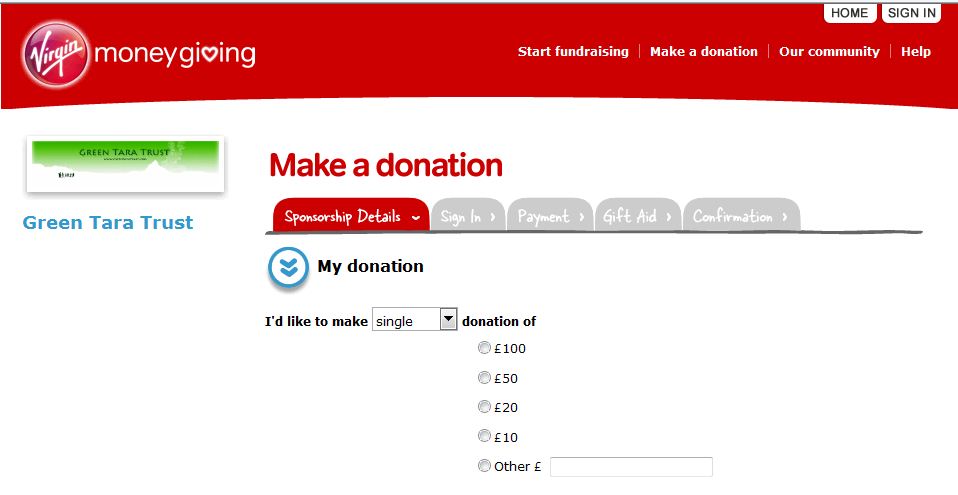 zards.1 In this editorial we observed that “whilst Nepal has made some head way in disaster planning, much of this seems to be focused mainly around earthquake disaster planning only.” The coming weeks and months we teach us to what extent this earthquake disaster management has been effective.
Researchers at BU have been working in Nepal for over ten years and in that period, have come to know many people and made lots of friends. We are worried about those we know personally, friends across Nepal, especially in our field sites, former and current Green Tara Nepal staff, the shop keepers next door to the Green Tara office, former and current students, and so on. Like so many people our first reaction was that we need to do something, starting with collecting money for the people of Nepal. We have decided that unlike a general appeal for help, like many friends of Nepal will set up over the next few days across the globe, we would stick to what we are good at: (a) improving maternity care in rural Nepal; and (b) stimulating health promotion. The former because women will continue to become pregnant and babies will continue to be born, the latter because the risk is that any disaster relief will focus on the here and now. Moreover, we want our disaster relief to be based on the same principles as outlined in Table 1 as the rest of our work.2
Table 1: Underlying philosophy of the Green Tara programme
The desired intervention or programme needs to be:
|
Donations can be made to Green Tara Trust (London) through the official donation web page:
This money will be used to implement sustainable low-cost, health intervention projects, working in close collaboration with local communities. There need to be projects on the ground now which are focusing immediately on the long-term preventative approach.
Please give generously!
Karunamati (Green Tara Trust, UK)
Padma Dharini (Green Tara Trust, UK)
Padam Simkhada (Liverpool John Moores University & Green Tara Nepal)
Edwin van Teijlingen (Bournemouth University, UK)
References:
- Simkhada, P., Lee, A., van Teijlingen, E., Karki, P., Neupane C.H. (2015) Need and importance of health protection training in Nepal, Nepal Journal of Epidemiology (editorial) 5(1): 441-443.
- van Teijlingen, E., Simkhada, P., Stephen, J., Simkhada, B., Woodes Rogers, S., Sharma, S. (2012) Making the best use of all resources: developing a health promotion intervention in rural Nepal. Health Renaissance 10(3): 229-235.
Piirus – Connecting researchers Crossing boundaries
If you are wanting to build up your research network, then Piirus may be just what you need.
You will not only be able to link with other academics but also receive email updates or Twitter feeds from Pirrus. In addition, if you sign up now, Piirus will also send you a copy of their case study on co-authoring.
The following information is from the Piirus website. There is also a short video about this service.
What is Piirus?
Piirus helps you to connect with other researchers – it’s as simple as that.
If you want to make contacts, or find a collaborator, within your field or from a different discipline, then Piirus is a quick and easy tool to help you get in touch.
How does it work?
Sign up and create a short profile with your collaboration interests, research areas and methodologies. You can also add links to external sites where other users can find out more about you, such as your LinkedIn, your blog or your Academia.edu entry.
As soon as you have a profile, Piirus will suggest researchers with whom you may be interested in collaborating, based on the information in your profile. You can also search for users with particular interests, expertise or techniques.
What can Piirus do for me?
It can help you to:
- make contacts for your research and your career, both within your institution and beyond
- find expertise on a specific topic or technique
- make interdisciplinary connections to refresh your work and widen funding opportunities
- improve the visibility of your research outside your institution
Who can sign up to Piirus?
Piirus is open to any researchers from academic institutions and research centres. This includes doctoral researchers, early career researchers and research active staff.
You’ll need to sign up using your academic email address.
How is Piirus different from sites like LinkedIn and Academia.edu?
Piirus is a quick and easy tool to help you make contacts and find collaborators. We keep it simple by focusing on connecting researchers. On Piirus you make yourself known for what you are wanting to research or collaborate on RIGHT NOW, and it’s simple to link out to all the other websites that you are currently on, such as your departmental profile or portfolio, blog, LinkedIn or Academia.edu profiles. There is less effort to create and maintain a Piirus profile because you don’t have to enter all the information your other profiles contain separately onto your Piirus profile.
About Piirus
Piirus started life in 2011 as Research Match, a service designed for researchers within the University of Warwick to find their research match. Users found the site so useful that we decided to expand it, so that more people could enjoy this tool.
Piirus is managed by the University of Warwick.
Our values
- Ethical – developed and funded by the sector for the sector. Any surplus is invested back into Piirus to help fund and accelerate global research.
- Impartial – Piirus grew out of the Library at University of Warwick so it is no surprise that it naturally crosses boundaries of discipline and field.
- Integrity – a global network dedicated only to researchers so they can make meaningful connections.
- Clarity – we build profiles and connections based on researchers’ current activities and not on historic data based on publications.
- Genuine – real connections with real researchers. We never create fake profiles or analytics.
- Value – we are not about vanity metrics – only the quality of interaction for our research community.
BNAC conference reported in Nepal

Last week FHSS PhD student Ms. Preeti Mahato and I attended the 13th Annual Conference of BNAC (Britian-Nepal Academic Council) in London. The conference venue was held at SOAS in central London. In total 28 papers on nine wid e-ranging themes concerning Nepal and its global connections were presented and debated by a large number of participants ranging from post-graduate students to established professors and researchers from the UK, Nepal and some other EU countries. The conference was reported upon in Nepal on an online news website called eKantipur.
Prof. Edwin van Teijlingen
CMMPH
Social Science Baha lecture series Nepal
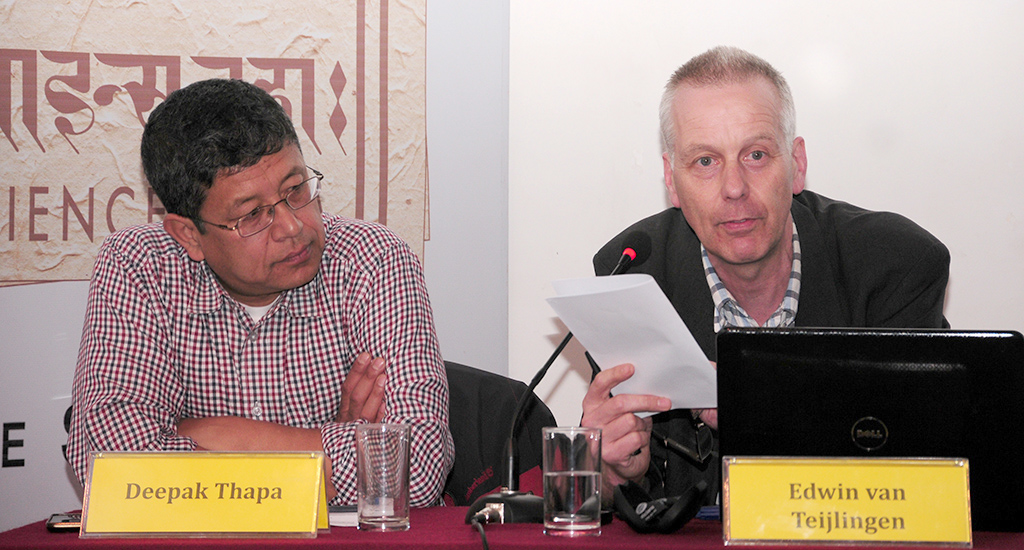 Earlier this week Prof. Edwin van Teijlingen presented at Social Science Baha on the topic of research capacity building in Nepal. Together with many colleagues in Nepal and the UK Edwin has been working on a DFID and British Council funded project under the title PARI (which stands for ‘Partnership on improving Access to Research Literature for Higher Education Institutions in Nepal’). The invited presentation has been recorded by Social Science Baha and is now available online here.
The slides used on Monday are available too.
Presentation April 2015 Soc Sci Baha
Prof. Edwin van Teijlingen
CMMPH
Invited talk Easter Monday
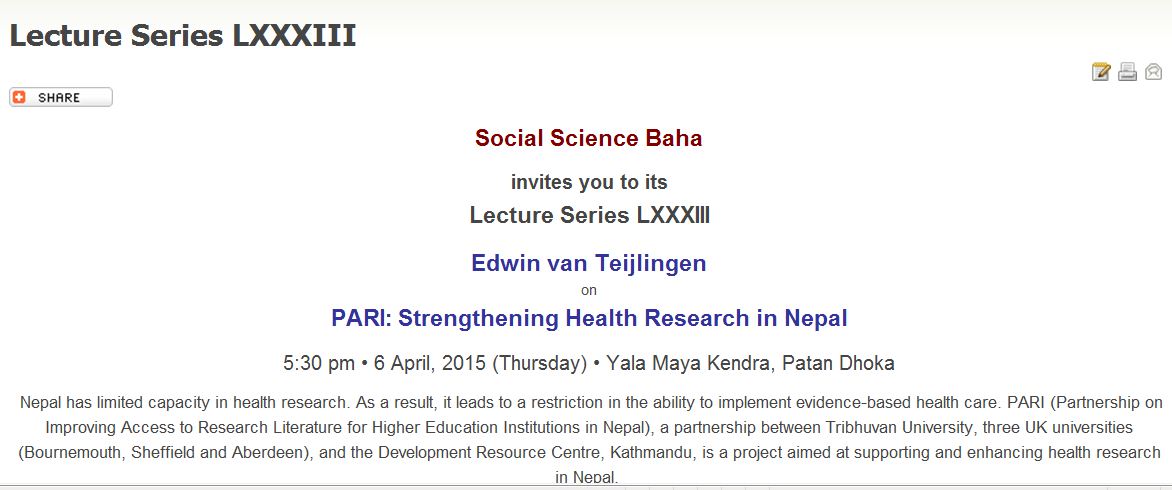 On 6th April, Easter Monday, professor Edwin van Teijlingen will present the process and selected findings of research capacity building work conducted in Nepal. The invited lecture at Social Science Baha in Kathmandu was originally planned for early January, but unfortunately had to be cancelled at the last moment due to a national strike in Nepal.
PARI (Partnership on improving Access to Research Literature for Higher Education Institutions in Nepal) refers to a project to support and enhance health research in Nepal; a partnership between Tribhuvan University, three UK universities (including Bournemouth University), and the Development Resource Centre (Nepal). The British Council and DFID (UK) funded PARI to help build research capacity over a three-year period.
Nepal has limited capacity in health research, which restricts ability to implement evidence-based health care. PARI aimed to move university lecturers away from textbook teaching and make them more critical of the academic literature available on the Internet.
PARI workshops delivered to Nepal universities introduce the foundations of evidence-based practice and outline key electronic databases of health care and health service literature available to Nepalese academics. These workshops were informed by: (1) a curriculum review of all health-related courses at the major universities in Nepal; and (2) a needs assessment with lecturers, librarians and students of the major universities.
Key message included that We need to move away from textbook teaching in health care and teach health-care discipline students how to find the most appropriate evidence-based treatment for each patient.

The PARI team:
Ram Sharan Pathak,Tribhuvan University,Nepal
Padam Simkhada, Liverpool John Moores University, UK.
Bhimsen Devkota, Development ResourceCentre,Nepal
Edwin van Teijlingen,Bournemouth University,UK
Julie Bruce,University of Warwick, UK
Pramod Regmi, Development Resource Centre, Nepal
Amudha Poobalan, University of Aberdeen, UK
Trilochan Pokharel, Nepal Administrative Staff College, Kathmandu Nepal
The work has resulted in two academic publications:
- Simkhada, P., van Teijlingen, E., Devkota, B., Pathak, R.S., Sathian, B. (2014) Accessing research literature: A mixed-method study of academics in Higher Education Institutions in Nepal, Nepal Journal of Epidemiology 4(4): 405-14. http://www.nepjol.info/index.php/NJE/article/view/11375
- Simkhada, P., van Teijlingen, E., Pokharel, T., Devkota, B., Pathak, R.S. (2013) Research Methods Coverage in Medical & Health Science Curricula in Nepal, Nepal Journal Epidemiology 3(3): 253-258. www.nepjol.info/index.php/NJE/article/view/9185
New paper on obesity research
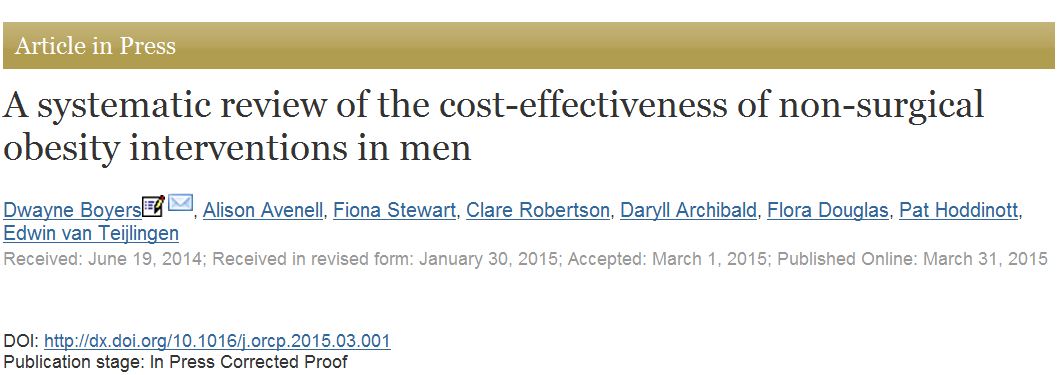 Colleagues associated with the Health Economics Research Unit (HERU), Health Services Research Unit (HSRU) and the Rowett Institute of Nutrition and Health (all based at the University of Aberdeen), the Nursing, Midwifery & Allied Health Professional Research Unit (University of Stirling), the Scottish Collaboration for Public Health Research & Policy (SCPHRP) based at the University of Edinburgh and the Centre for Midwifery, Maternal and Perinatal Health (CMMPH) at Bournemouth University published their latest paper on obesity research. The paper ‘A systematic review of the cost-effectiveness of non-surgical obesity interventions in men’ is published in the journal: Obesity Research & Clinical Practice. This systematic review summarises the literature reporting the cost-effectiveness of non-surgical weight-management interventions for men. Studies were quality assessed against a checklist for appraising decision modelling studies. This research is part of the larger ROMEO study.
Prof. Edwin van Teijlingen
Faculty of Health & Social Sciences
Reference:
Boyers, D., Avenell, A., Stewart, F., Robertson, C., Archibald, D., Douglas, F., Hoddinott, P., van Teijlingen, E., A systematic review of the cost-effectiveness of non-surgical obesity interventions in men, Obesity Research & Clinical Practice (online first)
Policy brief on Obesity
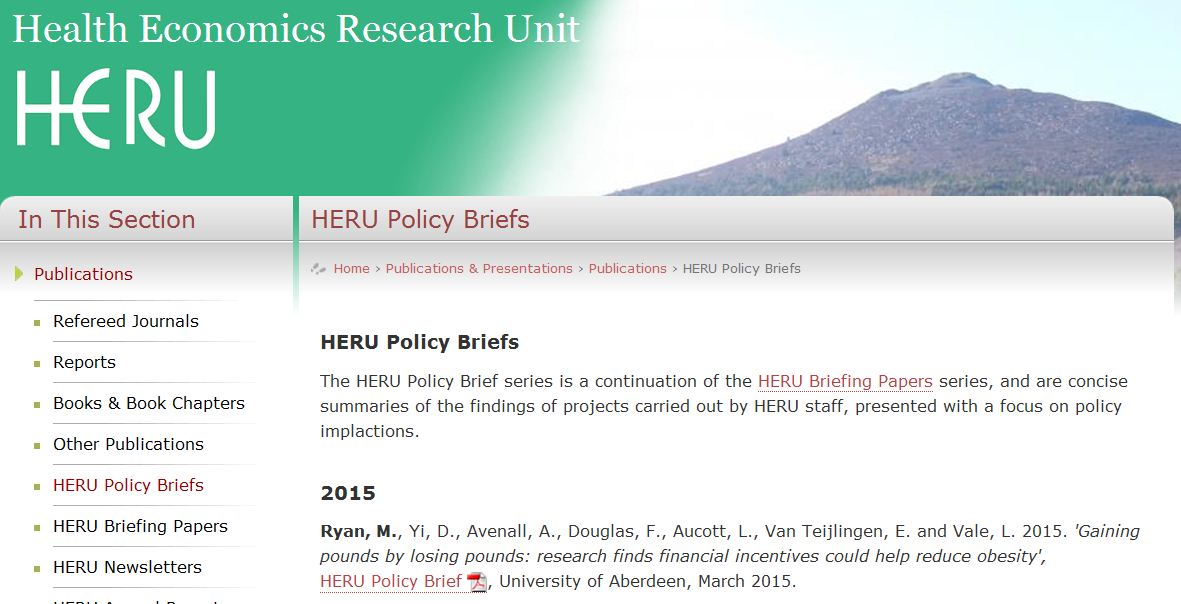 Today my colleagues at the University of Aberdeen’s Health Economics Research Unit (HERU) published their latest HERU Policy Brief on ‘Gaining pounds by losing pounds: research finds financial incentives could help reduce obesity’. The policy brief is now available on line. These policy briefs are concise summaries of the findings of research projects, presented with a focus on policy implications. Linking research findings to possible policy improvements increase the chance that our research has an impact on the wider society. Furthermore, that our research has an impact in REF terms.
This latest policy brie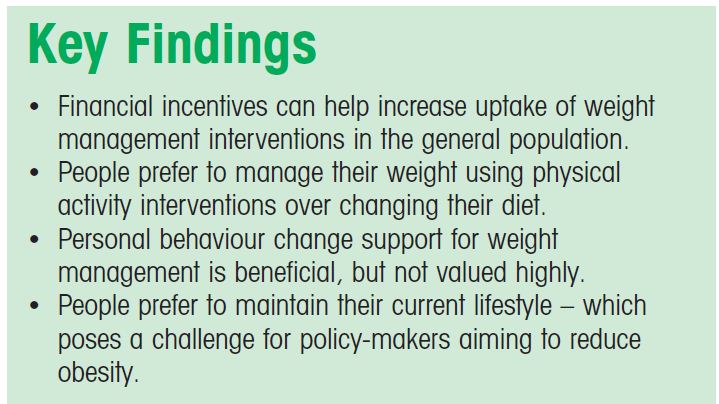 f ‘Gaining pounds by losing pounds: research finds financial incentives could help reduce obesity’ is part of a larger project called PROGRESS (Prevent Obesity GRowing Economic Synthesis Study), funded by the National Preventative Research Initiative (NPRI) and the Universities of Aberdeen and Melbourne. The project started when I was still at the University of Aberdeen, before I came down to Bournemouth more than five years ago now. Our research highlights that despite evidence that dietary interventions are the most effective way to lose weight, respondents preferred lifestyle interventions involving physical activity. Also that behaviour-change support improves effectiveness of interventions, but its value to participants was limited. A general preference to maintain current lifestyles, together with the sensitivity of take-up to financial costs, suggests financial incentives could be used to help maximise up-take of healthy lifestyle interventions. Finally, men required more compensation to take up healthier lifestyles.
Full details on methods and results are available in the health economics paper due to be published later this year, currently ‘published ahead of print’ (Ryan et al. 2014).
Prof. Edwin van Teijlingen
Faculty of Health & Social Sciences
Reference:
Ryan, M., Yi, D., Avenell, A., Douglas, F., Aucott, L., van Teijlingen, E. & Vale, L. (2014) Gaining pounds by losing pounds: preferences for lifestyle interventions to reduce obesity, Health Economics, Policy & Law, [Epub ahead of print] doi: 10.1017/s1744133114000413.
MIDWIFERY: Top five most down-loaded articles for 2014
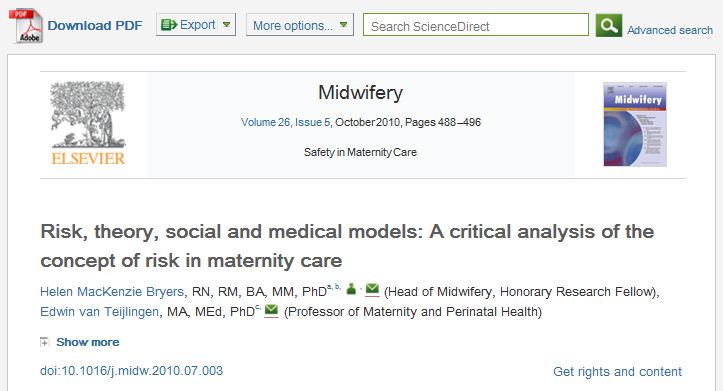 Today academic publisher Elsevier sent round an email with the top five most downloaded articles from the international journal Midwifery.
We were pleased to see that the fifth paper on that list is a BU paper jointly written with Dr. Helen Bryers, Consultant Midwife in Scotland.

Prof. Edwin van Teijlingen
CMMPH
Student-midwife-run postnatal clinic: FUSION example
FHSS staff and students published their latest article ‘Would a student midwife run postnatal clinic make a valuable addition to midwifery education in the UK? — A systematic review’ now out on line in Nurse Education Today 35 : 480-486. The paper is written by Wendy Marsh, Dana M. Colbourne, Susan Way & Vanora Hundley.
We are pleased to inform you that the final version of your article with full bibliographic details is now available online. The publishers are providing the following personal article link, which will provide free access to this article, and is valid for 50 days, until April 17, 2015: http://authors.elsevier.com/a/1QcG5xHa50bEa
Prof. Edwin van Teijlingen
CMMPH
GeoNet climate change event and next seminars
GeoNet, the fusion-funded interdisciplinary seminar project, held our first lunchtime session ‘A conversation about climate change’ recently. We were really pleased to see the Coyne so packed out (come early next time to be sure of getting a cookie!) with a wide range of students, PGRs and staff from across the university. Short talks to introduce the panel members (covering both the impacts of climate change and how these are communicated) were followed by a very interesting discussion. We considered how terms are often used out of context or incorrectly (for example the ‘Anthropocene’ in the geological sense of the word would be classified after the fact). It was also interesting for me personally to discover why there is often false balance in the media when climate change is discussed – the reporters have to use a political template (because climate change is a politicised subject) and this template calls for equal representation of the views of all sides. Of course this results in a poor representation of the state of scientific knowledge.
We also discussed the right of non-scientists to enter the debate – this is based on a democratic right to have an opinion but not necessarily on knowledge. The cult of celebrity was an interesting topic, not something that I expected to be discussing in the context of climate change, but perhaps we need more celebrities to support David Attenborough in representing environmental change. Leading on from this, we discussed whether scientists should have more media coverage. Whilst this might seem an obvious way of increasing public knowledge, it could backfire because scientists have a general lack of media training, lack of experience in delivering ‘soundbites’ and have to acknowledge uncertainty, which can negatively affect the public perception of them as experts. We decided that social media might be the answer, as it is not bound by the politicised template and can provide a platform for scientists to talk about their findings, as well as allowing discussions to enable understanding of what uncertainty actually means.
Our next two events are The Hero’s Journey of Alfred Russel Wallace in Southeast Asia from 18.00-19.30 on the 10th March in Barnes Lecture Theatre and Low carbon cities: why and how from 12.00-13.00 on the 17th March in TAG02. Tea, coffee and cookies will be provided at both and active participation is encouraged!
Booking is necessary for the 10th March via http://www.eventbrite.co.uk/e/the-heros-journey-of-alfred-russel-wallace-in-southeast-asia-tickets-13409922439 (free to BU staff and students)
Latest Funding Opportunities
 Arts & Humanities Research Council
Connected Communities Festival 2015. The Connected Communities Festival in 2015 will provide an opportunity to explore creative ways to widen and deepen community engagement with the exciting and innovative research being undertaken by the Connected Communities Programme. There will be £5000 available for participants. Closing Date 11/3/15 at 16:00
British Academy
Newton Advanced Fellowships. Newton Advanced Fellowships provide early to mid-career international researchers who already have a track record with an opportunity to develop their research strengths and capabilities, and those of their group or network, through training, collaboration and visits with a partner in the UK. Each award provides up to £37,000 per year for applicants from Brazil, Mexico, South Africa and Turkey. Closing Date: 18/3/15
Newton Mobility Grants. These grants provide support for international researchers based in a country covered by the Newton Fund to establish and develop collaboration with UK researchers around a specific jointly defined research project. Grants are offered up to a maximum of £10,000 for a period of one year. Closing Date: 18/3/15
British Council
Researcher Links workshop in London on health & development. We have grants for early career researchers to attend a workshop in Mexico entitled ‘Towards comprehensive evaluation for health and development: promoting the integration of evaluation methods.’ The grants will cover all travel, accommodation and meals. Costs for the visa will be covered; however participants will be responsible for making all the necessary arrangements. Closing Date: 20/2/15
Economic and Social Research Council
Big Data for Resilience: realising the benefits for developing countries – Scoping exercise call. This call aims to explore the potential of big data to support disaster and climate resilience in developing countries. We expect applications covering a wide range of issues – from risk reduction, hazard prediction, prevention and preparedness, to response, recovery and reconstruction. Applications can be made for up to £2,500 for case studies, reviews, policy analyses or small prototype projects under £10,000. Projects must be completed within two months of the start of the grant. Closing Date: 2/3/15 at 16:00
Research Grants open call. Awards ranging from £200,000 to £2 million can be made to eligible institutions to enable individuals or research teams who have have an excellent idea for a research project. There is considerable flexibility when it comes to subject area, too. As long as you always make sure that your suggested topic falls within ESRC’s remit, you are free to concentrate on any research area. Closing Date: Open
Understanding, countering and mitigating security threats Research and Evidence Hub. The aim of the Hub is to maximise the impact of existing research in order to inform approaches to countering contemporary security threats to individuals, communities, and institutions. Up to £1.8 million per annum, for up to a three year period will be available. Closing Date: 24/3/15 at 16:00
ESRC and Satellite Applications Catapult Knowledge Exchange Fellowships. ESRC will jointly support up to four Knowledge Exchange Fellows to provide a bridge between excellent UK social and economic research and the leading edge satellite applications capability in the UK and inform the funding partners’ understanding of some of the opportunities for the development, uptake and application of social sciences. Closing Date: 2/3/15 at 16:00
Engineering and Physical Sciences Research Council
3DP-RDM Feasibility Studies – Call for Proposals. The objective of “Defining the research agenda for 3D printing-enabled re-distributed manufacturing” (3DP-RDM) is to convene a multi-disciplinary research and multi-industry user network which will fund fund 4-6 feasibility studies across the two years of the network. Budgets for feasibility studies should be £35k-65k. Closing Date: 2/3/15
Autonomous Manufacturing. The aim of the call is to support research that addresses the research challenges that underpin autonomous manufacturing. There are funds totalling £10M for this call to support multidisciplinary research programmes of up to five years. Closing Date: 16/4/15
Platform Grants. Platform Grant funding provides a baseline of flexible support (a platform) that can be used for the retention of key staff, feasibility studies, longer-term research and International Networking for periods of up to five years. Closing Date: 27/3/15
Innovate UK
Innovation Vouchers – Round 11. Up to £5k funding for for start-up, micro, small and medium-sized enterprises to work with an external expert to gain the knowledge to innovate and grow from experts such as universities and further education colleges. Closing Date: 22/4/15
Leverhulme Trust
Major Research Fellowships in the Humanities and Social Sciences. These awards enable well-established and distinguished researchers in the humanities and social sciences to devote themselves to a single research project of outstanding originality and significance, capable of completion within two or three years. Candidates should state explicitly what the proposed outcomes of the award will be. The Fellowships fund the salary costs (normally starting at the most junior point of the lecturer scale at the institution concerned) of an individual to undertake the normal duties of the applicant for the duration of the Fellowship. Closing Date: 7/5/15
Medical Research Council
New Investigator Research Grant (NIRG). This fund provides support for clinical and non-clinical researchers while they are establishing themselves as independent principal investigators. NIRGs provide funding for three or more years. MRC will only pay up to 64% of the actual new investigator’s salary . Closing Date: 3/6/15
Partner Grant- Neurosciences & Mental Health Board. Partnership Grants provide core funds for one to five years to support partnerships between diverse groupings of researchers to work collaboratively. Closing Date: 3/6/15
Programme Grant- Neurosciences & Mental Health Board. Programme grants provide larger, longer term (five years) and renewable programme funding. They aim to help the medical science community to ‘think bigger’. Closing Date: 3/6/15
Tackling AMR Theme 1: Understanding resistant bacteria. This call will focus on research related to human or animal bacterial pathogens. Up to £250k (80% fec) will be made available over 12-24 months. Closing Date: 17/3/15
Research Grant-Neurosciences & Mental Health Board. A research grant can be awarded for any period of up to five years, but those of two years or less are for proof of principle or pilot work only. research grants are suitable for focused research projects that may be short- or long-term in nature The budget for research grant awards will not typically exceed £1 million. Closing Date: 3/6/15
Natural Environment Research Council
Highlight Topics February 2015. NERC has allocated £12m to this call and a maximum of £3m (cost to NERC) is available per highlight topic. Notification of intent to submit a proposal must be received at least one month before the closing date. Notification Date: 9/3/15 Closing Date: 9/4/15
The Royal Society
The SABMiller Royal Society Exchange Programme. The programme will focus on supporting collaborative research projects between researchers in the UK and researchers in sub-Saharan Africa. The award will cover travel and subsistence up to £5,000 per year for training purposes and funds up to £2,000 per year for research costs over three years. Closing Date: 30/4/15
Wolfson Research Merit Award. The scheme provides universities with additional support to enable them to recruit or retain respected scientists of outstanding achievement and potential to the UK. There will be up to 5 years’ funding of a salary enhancement, usually in the range of £10,000 to £30,000 per annum. Closing Date: 12/3/15
Wellcome Trust
Arts Awards. Arts Awards support the creation of new artistic work that critically engages artists and audiences with biomedical science. There are two strands to the funding, Small Arts Awards (small- to medium-sized projects – up to and including £40 000) and Large Arts Awards (£40,000-£150,000). Closing Date: 1/5/15
BU staff can login below:
Other services







Recent posts
BU research Funding opportunities EU
- NEW BOOK Just Published: Rather and Buhalis, 2026, Metaverse Marketing: Challenges, Opportunities, and Fundamental Mechanisms
 National Postdoc Appreciation Week 2026: The Changing Landscape of Postdoc Careers
 NIHR Insight South West Central Conference 2026 at Bournemouth University
 BU PhD student presented at World Safety Conference in South Africa
 National Research Supervision Recognition: Apply Now & Join the Supporting Workshop on 16 September
- NEW AI PAPER JUST PUBLISHED Artificial Intelligence and Human Resources Recruitment for Tourism and Hospitality
 Horizon Europe Cluster 3 (Civil Security for Society) 2026 Calls Now Open
 MSCA Doctoral Networks 2026 Call Information Webinar
 ESRC Festival of Social Science 2026: Application Deadline Extended to Thursday 25 June 2026
- Apply now to take part in the 2026 ESRC Festival of Social Science
 Reminder: Register for the ESRC Festival of Social Science 2026 Information Session
 ECR Funding Open Call: Research Culture & Community Grant – Apply now
- MSCA Postdoctoral Fellowships 2025 Call
 ERC Advanced Grant 2025 Webinar
- European Migration Research and Impact – Invitation to a Roundtable Discussion
- MSCA Postdoctoral Fellowships 2025
 Update on UKRO services
 European research project exploring use of ‘virtual twins’ to better manage metabolic associated fatty liver disease
 Research Information Network
- Physical Sciences Case studies: information use and discovery
- Information handling in collaborative research: an exploration of five case studies
- Information literacy monitoring and evaluation
- Data centres: their use, value and impact
- Heading for the open road: costs and benefits of transitions in scholarly communications