Yesterday the international journal Health Policy & Planning published our latest article with the title ‘Understanding the formulation of non-communicable disease policies in Nepal: A qualitative study‘ [1]. The paper is part of the PhD work (at the University of Hudderfield) by the first author, Dr. Anju Vaidya, who is originally from Nepal. Anju’s thesis was supervised by Prof. Padam Simkhada (University of Chester), Prof. Andre Lee (The University of Sheffield) and by Bournemouth University’s Prof. Edwin van Teijlingen.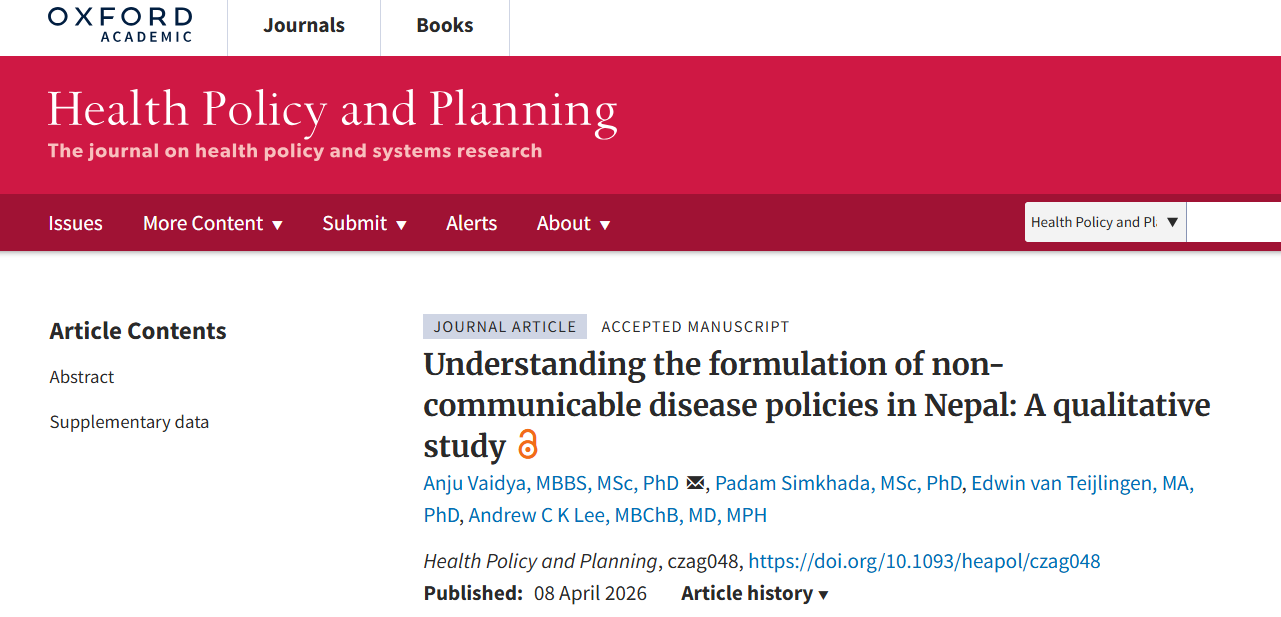
The paper recognises that there is limited evidence about the process through which health policies were formulated in Nepal. This study used Kingdon’s multiple streams framework to explore how NCDs (non-communicable diseases) were recognised and prioritised, how policy alternatives were decided, how policy windows were opened, and which contextual factors influenced the policy formulation process. Anju’s PhD included a qualitative study to gain a comprehensive understanding of the formulation of major NCD-related policies in Nepal. Semi-structured interviews were conducted with 12 key stakeholders, and policy documents were analysed using framework analysis.
The NCDs were gradually prioritised through the convergence of global and local evidence, sustained advocacy, and international commitments. Policymakers encountered several challenges, such as competing health priorities, the chronic nature of NCDs, donor preferences for communicable diseases, financial constraints, and multisectoral complexities of NCDs. The Package of Essential Non-communicable diseases (PEN) interventions were adopted as a policy alternative, informed by global evidence, World Health Organization (WHO) recommendations, and lessons from other countries. While coordinated efforts by stakeholders brought the problem, policy and politics streams together, the role of policy entrepreneurs was found to be less relevant in Nepal’s context.
Health Policy & Planning is an Open Access journal, hence the paper is available worldwide to anybody with internet access.
Prof. Edwin van Teijlingen
Centre for Midwifery & Women’s Health
References:
- Vaidya, A., Simkhada, P., van Teijlingen, E., Lee, A.C.K. (2026) Understanding the formulation of non-communicable disease policies in Nepal: A qualitative study, Health Policy and Planning, [online first] czag048, https://doi.org/10.1093/heapol/czag048









 National Postdoc Appreciation Week 2026: The Changing Landscape of Postdoc Careers
 NIHR Insight South West Central Conference 2026 at Bournemouth University
 BU PhD student presented at World Safety Conference in South Africa
 National Research Supervision Recognition: Apply Now & Join the Supporting Workshop on 16 September
 Horizon Europe Cluster 3 (Civil Security for Society) 2026 Calls Now Open
 MSCA Doctoral Networks 2026 Call Information Webinar
 ESRC Festival of Social Science 2026: Application Deadline Extended to Thursday 25 June 2026
 Reminder: Register for the ESRC Festival of Social Science 2026 Information Session
 ECR Funding Open Call: Research Culture & Community Grant – Apply now
 ERC Advanced Grant 2025 Webinar
 Update on UKRO services
 European research project exploring use of ‘virtual twins’ to better manage metabolic associated fatty liver disease