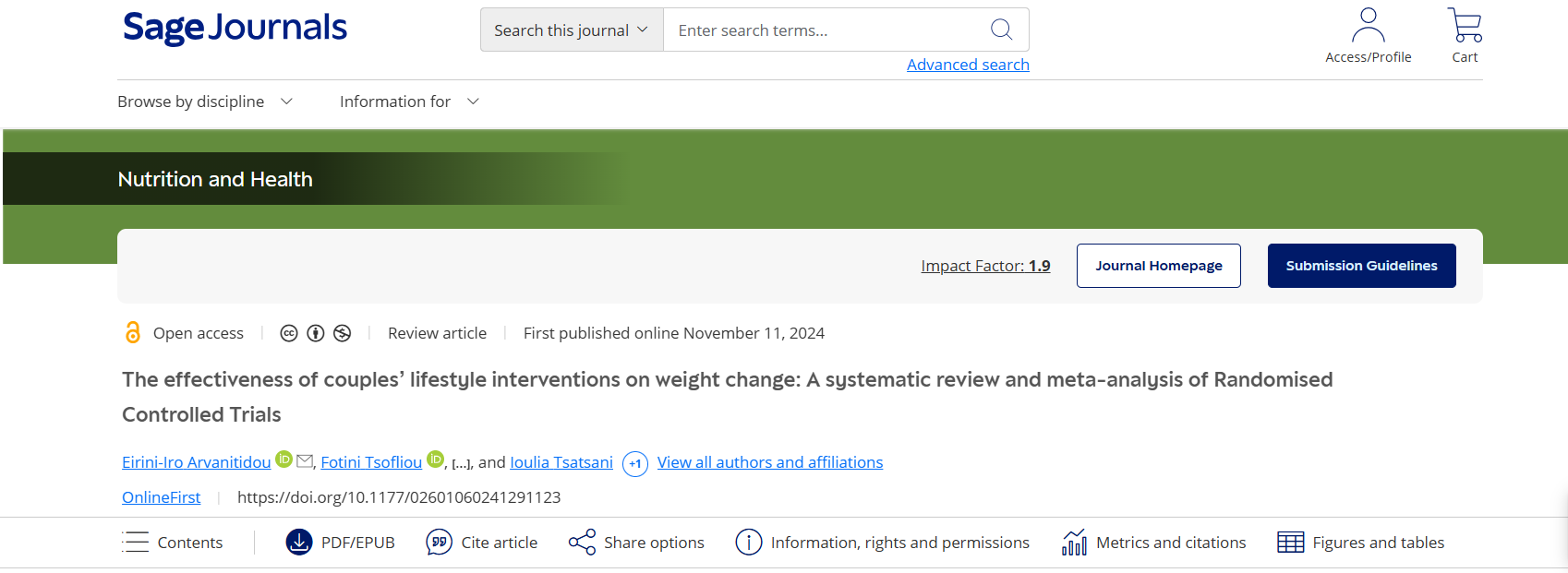
 Congratulations to Faculty of Health & Social Sciences (FHSS) PhD student colleagues Dr. The effectiveness of couples’ lifestyle interventions on weight change: A systematic review and meta-analysis of Randomised Controlled Trials‘.
Iro is a PhD student and this systematic review and meta-analysis is the first to investigate the effectiveness of lifestyle interventions targeting couples on weight loss, compared to interventions focused on individuals or standard care. The findings suggest that interventions aimed at couples lead to greater weight loss, though the results should be interpreted with caution due to the wide heterogeneity among the studies. The authors conclude that further research is needed with evidence-based study designs, targeting younger participants, and incorporating intervention of longer duration, and longer follow-up periods.
- Arvanitidou, E. I., Tsofliou, F., Wood, J., & Tsatsani, I. (2024). The effectiveness of couples’ lifestyle interventions on weight change: A systematic review and meta-analysis of Randomised Controlled Trials. Nutrition and health, 2601060241291123. Advance online publication. https://doi.org/10.1177/02601060241291123







 Verbal autopsy paper published two days ago
 ESRC Studentships for 2027 Entry: Opportunity Now Open
 SONAMONI contributions to Safety Conference 2026 in South Africa
 Three CMWH presentations at Berlin conference
 Horizon Europe Cluster 3 (Civil Security for Society) 2026 Calls Now Open
 MSCA Doctoral Networks 2026 Call Information Webinar
 ESRC Festival of Social Science 2026: Application Deadline Extended to Thursday 25 June 2026
 Reminder: Register for the ESRC Festival of Social Science 2026 Information Session
 ECR Funding Open Call: Research Culture & Community Grant – Apply now
 ERC Advanced Grant 2025 Webinar
 Update on UKRO services
 European research project exploring use of ‘virtual twins’ to better manage metabolic associated fatty liver disease