The 13th Annual Postgraduate Research Conference, hosted by the Doctoral College.
Joseph McMullen (PhD, FMC) with this poster entitled: Particulate matter: Regulating an invisible killer.
Click the poster below to enlarge.
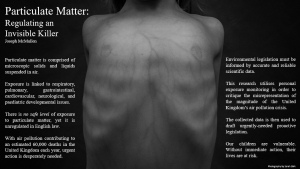
Research indicates that exposure to atmospheric pollutants diminishes immune responses and increases viral penetration and replication. Specifically, particulate matter – microscopic solids and liquids suspended in air – represents an unseen and unregulated threat to global human life and welfare. There is no evidence of a safe level of exposure, and particulate matter is linked to respiratory, pulmonary, gastrointestinal, cardiovascular, neurological, and paediatric developmental issues. In spite of this, domestic ambient particulate concentrations are unregulated. This work utilises particulate sampling in order to suggest the creation of a proactive regulatory framework informed by science and integrating post-hoc monitoring. Punitive action is suggested for non-compliance with the proposed legal obligations in addition to punitive measures beyond financial penalties.
You can view the full poster exhibition and pre-recorded presentations on the conference webpage.
If this research has inspired you and you’d like to explore applying for a research degree please visit the postgraduate research web pages or contact the Doctoral College dedicated admissions team.







 SONAMONI contributions to Safety Conference 2026 in South Africa
 Three CMWH presentations at Berlin conference
 New interdisciplinary paper on Nepal
 Horizon Europe Cluster 3 (Civil Security for Society) 2026 Calls Now Open
 MSCA Doctoral Networks 2026 Call Information Webinar
 ESRC Festival of Social Science 2026: Application Deadline Extended to Thursday 25 June 2026
 Reminder: Register for the ESRC Festival of Social Science 2026 Information Session
 ECR Funding Open Call: Research Culture & Community Grant – Apply now
 ERC Advanced Grant 2025 Webinar
 Update on UKRO services
 European research project exploring use of ‘virtual twins’ to better manage metabolic associated fatty liver disease