I was delighted to be awarded a FIF Staff Networking and Mobility grant to develop international links with staff and students in Canada, Australia and Malta in the three areas of e-learning, employability and Cyberpsychology. During the visits I will set-up cross-University online discussions, for students to discuss how psychology theory and methods can be used to understand online behaviour. This will not only develop students’ global awareness and key technological skills, but the activity will also generate research data to inform cross-cultural understanding of online phenomena. Also during the visits, I’m looking forward to learning more about the work of Australian academics into the concept of ‘Psychological literacy’ to bring this into my own employability teaching. Finally, I have been invited to disseminate my own work on psychology teaching and learning through guest talks and staff workshops at each University and I will also be coordinating a Symposium during the International Conference on Teaching of Psychology in Vancouver. A longer term aim is to develop links with these universities to explore psychology student placements. This is going to be a busy 6 months;-)
Category / Awarded & submitted bids
Fusion Investment Fund – Decreasing spatial disorientation: towards dementia-friendly environments
Dr Jan Wiener (DEC) and myself are delighted to have been awarded Fusion funding to develop a student driven research programme to investigate navigation and orientation skills in people with dementia.
Spatial disorientation is among the earliest indicators of dementia, an increasingly common condition in our ageing society that currently costs the UK £23 billion annually. We aim to develop an inter-disciplinary eye-tracking research programme to investigate factors that affect spatial disorientation in people with dementia. Data gathered will be used to formulate design principles for dementia-friendly care homes, potentially reducing care costs, and leading to new knowledge with significance and reach.
To record gaze when solving wayfinding tasks, we will combine eye-tracking, head tracking and virtual reality (VR) technology. Participants will stand or sit in front of an array of large monitors arranged in a semi-circle that subtends their entire horizontal visual field and affords natural viewing behaviour. In order to create this unique and technically advanced research environment, students from DEC, HSC and the Media School will collaborate as researchers, increasing their skills through immersive experience on a well-designed, cutting-edge research programme.
This will give ambitious students with different backgrounds a unique opportunity to work co-operatively as part of a high-level, well-resourced multi-disciplinary team. We will share the knowledge we gain on improving dementia care home design with the academic community, practitioners, service providers, and the general public. These links will in turn enable us to form strategic local and national partnerships to ensure that the knowledge gained has an impact on professional practice.
Dr Mariela Gaete Reyes (HSC/BUDI) & Dr Jan Wiener (DEC)
BFX

In November 2012 the VFX Hub – a HEIF funded initiative from BU and AUB, launched BFX, a 5-day festival of Animation and Visual Effects that will be held annually in Bournemouth.
One of the highlights of BFX will be a competition which aims to discover the best new talent in Visual Effects and will run from July to mid August 2013, with the winners being announced during the festival in September. Competitors will be expected to form teams of 4-6 members and will have to submit a written creative and technical treatment that explains in detail how they intend to produce an animated or VFX sequence in answer one of five specific briefs. Following the recent award of Fusion Funding the VFX Hub team will be presenting BFX to an international audience at FMX in Stuttgart during April, as well as pitching the competition to Animation and VFX students at several other UK Universities in the coming weeks – with the aim of attracting teams from at least 8 other institutions. The teams will live on campus at BU free-of-charge for the duration of the competition and each member will receive a £70 per week stipend towards their cost of living expenses. The work produced by the teams will mentored throughout the 6-weeks by professionals from Soho VFX companies Framestore, Double Negative, Cinesite, MPC and The Mill.
The rest of the festival itinerary will be updated on the website as events, venues and personalities are confirmed; it will include master classes, workshops, screenings, an exhibition and advice on careers and education.
Euro PR history network backed by Fusion
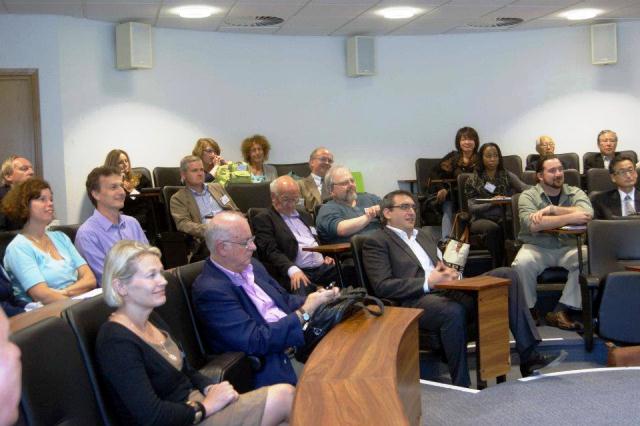
IHPRC at EBC - Scene for first EPRHN meeting
A proposal to develop an innovative Europe-wide network of researchers in the history of public relations field has been supported by the Fusion Investment Fund (FIF).
The European Public Relations History Network (EPRHN) was formed in mid-2012 by Prof Tom Watson and backed by EUPRERA (European Public Relations Education & Research Association) as a priority project for the next three years. It was set up to identify archives and resources, undertake collaborative research, and prepare bids to European research bodies and PR industry organisations.
The field of public relations history has been developed at BU over the past four years, mainly through the establishment of the International History of Public Relations Conference (IHPRC).
Prof Watson said: “there has been increasing interest in the conference and PR historical research in Europe over the past 3-4 years but it has largely focused on national histories, personalities or phenomena. Collaborative research, across national boundaries, has yet to emerge. There is little shared knowledge of archival resources, where they exist or can be created.”
So far, 35 academics and practitioners from 12 countries have shown their interest in EPRHN. Its first publication, a catalogue of archives and resources in seven countries has just been published. A EPRHN planning meeting will be held at BU after IHPRC in June.
Within The Media School, the network will also help develop European aspects of the Centre for Media History (CMH). CMH is already developing relationships with universities in Sweden and northern Germany. CMH and EPRHN will, it is hoped, foster the recruitment of PGR students interested in media and communication historical research.
The Fusion funding will allow EPRHN to hold a planning event at BU after IHPRC in late June and for Prof Watson and Dr Tasos Theofilou, who is working with him on both PR history projects, to attend EUPRERA’s annual conference in Barcelona in October. At EUPRERA, they will hold the network’s first formal meeting and workshop. [Photos by Minna-Liisa Nurmilaasko, PROCOM Finland].
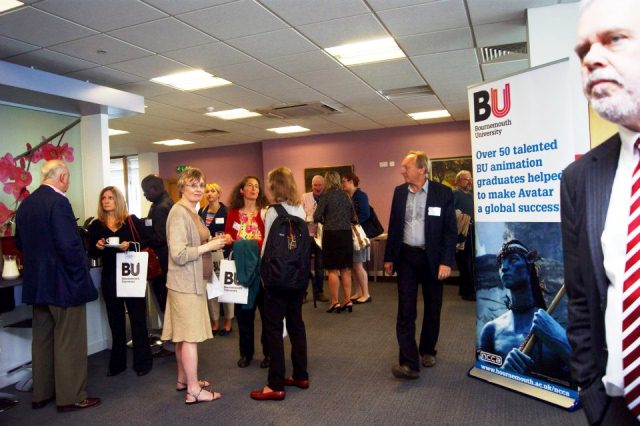
IHPRC 2012
Working with the United Nations World Tourism Organisation (UNWTO) Themis Foundation in Andorra. School of Tourism’s Adele Ladkin on her FIF Staff Mobility Funding
In September of last year, Professor Adele Ladkin received funding from the FIF staff mobility strand to undertake two visits to the UNWTO.Themis Foundation Headquarters in Andorra. 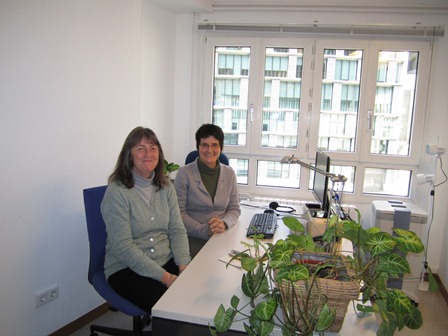
As part of its Capacity Building Programme, UNWTO.Themis provides educational courses for tourism industry experts. Due to the demand for different topics, subject experts from the tourism industry and public sector are recruited as facilitators to deliver the courses.
Adele has just returned from her first visit to Andorra where she and Ms Sònia Figueras, the UNWTO.Capacity Programme manager at the UNWTO.Themis Foundation have been writing a teaching guide, and developing an intensive training course for the facilitators.
As a provider of educational courses, the World Tourism Organization (UNWTO) is committed to sharing best practice in tourism teaching and learning. The purpose of the course is to assist and train  facilitators to provide UNWTO Themis courses. Along with practical guidance, the course aims to ensure that facilitators understand and articulate the philosophy and strategic issues of the UNWTO, UNWTO.Themis and their programmes.
The visit provided an excellent opportunity for knowledge exchange, with Adele gaining an insight into the latest educational activities being undertaken by UNWTO.Themis, and for her to share her expertise in developing tourism educational materials. As Adele states: “This has been a very intensive visit with us working collectively on the educational materials. It also gave me the opportunity to discuss the potential for further research collaboration, which is great news for the School of Tourism and BU.” Adele will return to Andorra for the second visit later in the year.
Women in academia and FIF SMN Funding
There are currently 18, 465 professors across British Academia; only 3,790 (20.5%) are female. The number of female professors has increased by 1.5% since 2010[i]. At this rate of increase (0.75% per year) it will take 119 years for women to achieve equal numbers in the professoriate (and that is assuming the total number of professors stays the same!). At the same time the ratio of women to men is roughly equal at undergraduate level. At Phd the number of women starts to decline, through to postdoctoral, to lecture, to SL to professor. We might imagine this as an inverted pyramid.
With these concerns in mind, I have recently been asked to edit a symposium in the journal European Political Science (which I will now co-edit with Stephen Bates [University of Birmingham]) about the status of women in political science. While there are clearly issues which impact upon women’s careers across the academy (and I have written about this elsewhere), the aim of our symposium is to map the way in which women are positioned in my own discipline, political science, across Europe. Space and resources have meant that we are beginning with a ‘snapshot’ with contributions from Finland, Germany, Spain and the UK and authors will be asked to map the ‘state of play’ in political science in their own country. From here the intention is to then move to a discussion about what possibilities and opportunities lie ahead for women. While the symposium is about political science, there are clearly wider themes applicable beyond our discipline; about women in academia more generally their opportunities for entrance, engagement and progression.
The FIF SMN networking grant gives me the opportunity to attend the European Consortium for Political Research (ECPR) Gender and Politics Conference in Barcelona. Here I am hoping to meet with the ECPR Gender and Politics Group steering committee and discuss the ways in which European Political Science currently seeks to tackle this issue. We are also hoping to apply for funding for a full scale data collection project, looking at best practice elsewhere and developing tools and recommendations to support and promote women within the profession.
[i] 2012 data from Higher Education Statistics Agency; 2010 data from the Equality Challenge Unit
Fusion Investment Funding – An educational game for nursing student engagement in caring for people with dementia
Dr Christos Gatzidis (DEC) and myself, along with BUDI colleagues Michele Board and Patricia McParland are delighted to have been awarded funding to develop an educational game for nursing students. Thanks to the funding we will be able to recruit a Research Assistant who will develop technical aspects of an interactive 3D virtual game which will respond to a European Union Directive for including dementia education in pre-registration nursing programmes.
Colleagues from HSC and BUDI will help in the preparation of detailed information to be incorporated in the game. Its veracity (and user-friendliness) will be assessed by people who have dementia and those who care for them. We will be presenting our developed game to a number of audiences, both in person and in print, once the project has reached completion in 2014 and will be offering updates along the way.
Rick Fisher, HSC
Buzz around Rufus Stone continues to create academic, cinematic and community impact
“Anyone of any age and background can sit and watch this film, understand it, learn from it and emotionally connect to it”.— Dr Patricia Leavy in The Qualitative Report
The short film, Rufus Stone, (Kip Jones, Author and Executive Producer), seems to move from strength to strength. The movie was based on research as part of Research Councils UK funded research at Bournemouth University and a project of the national New Dynamics of Ageing programme.
 Harry Kershaw, Martha Myers-Lowe &Tom Kane
Rufus Stone was screened as part of an ESRC Festival of Social Science event at BU in November for representatives of health and social care organisations. Participants went away from the day of activities with new knowledge about growing older as gay or lesbian in rural settings. Attendees each received a set of Method Deck cards produced by the research team to encourage their own groups in discussion and activities around these issues.
A Masterclass is in the planning stages for late April where representatives from both statutory and voluntary groups can come to Bournemouth for two days, learn about our research, view the film and take part in exercises drawn from the Method Deck. They then will be equipped to return to their groups with training in organising their own meaningful exercises around interfacing with older gay and lesbian citizens in their organisations. By partaking in the two days of activities, participants will receive copies of the Method Deck and the film. Stay tuned for details.
Freshers on HSC’s “Exploring Evidence to Guide Practice’ unit as well as Social Work students have had recent screenings as part of their learning experiences. There will be future opportunities for BU students to take advantage of this ‘home grown’ successful learning resource.
The film was screened in January at Birkbeck/University of London’s very modern Gordon Square cinema in Bloomsbury for their Doing Critical Social Research seminar series. A lively discussion followed with what seemed a very appreciative audience.
Cambridge University welcomes Rufus to the Cambridge Arts Picturehouse cinema on the 22nd of February at 4 p.m. as part of their Arts and Science Researcher Forum. A Q&A with Jones and Rufus Stone’s director, Josh Appignanesi, will follow the screening, BU’s Trevor Hearing will moderate.
There will be a screening of Rufus Stone in March at Talbot campus hosted by BU Media School’s Narrative Group. Following the film, Jones will discuss the use of narrative research, biography and autobiography in creating the film’s story and script. Great chance to catch the film if you haven’t seen it already. 18 March, Kimmeridge (KG03) at 1 p.m.
Community screenings at local cinemas in Poole and Wareham are set for the BU Festival of Learning on June 5th at the Lighthouse and June 12th at the Rex. Both start at 1 p.m. with refreshments and conversation to follow. We are particularly hoping to draw crowds of a range of ages and backgrounds from local communities.
 William Gaunt, Lin Blakley & Niall Buggy
For information, registration and/or ticket details for all future screenings, check the sidebar on Rufus Stone the movie BU microsite.
Buzz around the film has also hit the net. The Sociological Imagination features the trailer for the film on its pages and discusses ‘Turning Research into Film’. The Qualitative Report frequently features updates about Rufus Stone in its Weekly Report and recently ran a review of the film by author and educator, Patricia Leavy.
London School of Economics and Political Science (LSE) “Impact of Social Science” web pages recently interviewed Kip Jones about Rufus Stone. Topics covered include: “How did Rufus Stone come about?” “What is the relationship between the research and the film?” and “What advice to you have for social scientists interested in using tools from the arts?” 5 Minutes with Kip Jones: “we engage in the creative process and open new doors for communication”.
As well as winning two awards at the prestigious Rhode Island International Film Festival last summer, the film has also recently featured in the Torin (Italy) Film Festival and the UK Jewish Film Festival in London.
An academic article by HSC’s Kip Jones, Lee-Ann Fenge, Rosie Read and Marilyn Cash goes live in Forum: Qualitative Social Research, an on-line journal, shortly. The paper outlines the research behind the film, then presents in-depth life stories of four of the research participants.
Jones has also recently published , “Connecting Research with Communities through Performative Social Science”, which makes a case for the potential of arts-based social science to reach audiences and engage communities.
FIF – The Poole & Purbeck Portal
The Poole and Purbeck Portal is a new inter-school collaboration between the School of Applied Sciences, the Media School and the National Centre for Computer Animation – made possible by the Fusion Investment Fund.
The Portal will be launching in February, creating a shop window to showcase excellence in research from both our Academics, and our Students – further cementing BU’s leadership in the region. The Portal will engage the key stakeholders in the area; and work with the local community to provide the answers to the big questions relating to the regions rich natural environment, heritage and future.
Through the engagement of key stakeholders, new partnerships will emerge – students will benefit from work placements, research projects, and potentially graduate employment. The university will benefit from these new collaborations by, for example, increased consultancy projects.
The Portal itself was constructed within the ethos of the Fusion Fund – 2nd year media students were recruited to design and build the website, Red Balloon & the VFX Hub were commissioned to create a film-integrated animation promotional video, opening up cross collaborative streams across the University.
Fusion Investment Funding – Devils and Dolls Reseach Project
Jim Pope and myself are extremely pleased to have gained Fusion Funding for our ‘Devils and Dolls’ research project. This project will investigate children’s responses to Roald Dahl’s (anti)heroines, looking at Matilda and The Magic Finger.
We have arranged to visit four local primary schools to conduct workshops with their current Year 6 students. Our methodology will employ a qualitative approach through a range of activities to be conducted in-class with groups of Year Six children. These hour-long sessions will revolve around discussing key scenes from the book and film and asking the children to give written and verbal opinions on whether these characters are heroic; how they are similar to/different from other heroes, and so forth. We currently estimate we will be running the session with around 100-200 children during the spring term.
We will be presenting our research as a conference paper (full abstract below) at the ‘Devils and Dolls’ conference (Bristol University, 27 March 2013) and intend to write our findings up into a full article over the summer. We’re very excited about this project which we think is an excellent opportunity to engage in primary research into a severely under-represented area: the responses of child readers to children’s fiction and its uses in education. We’re also especially delighted to have received this funding as it will enable us to make new networking contacts with local schools that will benefit BU in future research in this area. The study will directly inform our future teaching on Children’s Literature unit (BA English Level I) and we hope the proposed outputs will also promote the research and media teaching being done here at BU at both a national and international level.
Lost little girls (with scary powers): how do children respond to Roald Dahl’s heroines?
Jim Pope and Julia Round
Bournemouth University
Depictions of the child in literature for children are often stereotyped and dichotomous: for every Dennis the Menace there is a Peter Perfect, and it often seems there is little in between the two poles. But the depiction of the individual child can contain a similar tension within itself and some child characters (Matilda, The Magic Finger) are shown to have the capability for innocence and destruction in equal measure. These children are neither saintly nor monstrous, and thus they don’t easily fit the stereotypes of children’s literature. How do children interpret and respond to these characters?
This paper considers examples of the ‘little girl’ who, despite innocent appearance, can wreak great destruction. It begins by summarising critical opinion on the subject and the narrative stances of Dahl (whose morals and messages are generally very clear and didactic). Extracts, clips and theory are used to demonstrate that such characters cannot be clearly defined as a ‘devil’ or a ‘doll’ and that in fact there is a great deal of tension within each character. These dichotomies are explored and reflected upon using relevant extracts and clips.
However, ‘lit crit’ like this all too often begins and ends with a point of view or an argument to be built. When critics talk authoritatively about the tones, styles, messages and impacts of children’s lit, they are writing from the perspective of an adult with things to say. The response of adult critics is itself in a multiply dichotomous position – the adult commenting on the child’s interpretation of the child character created by an adult. How far do we wish to go with such conflicted criticism? Should we not instead consider how modern child readers understand these modern heroines – are they pleased to see characters like these behaving badly (sometimes) yet still winning?
The paper concludes with presentation of findings from a small reader-response study, in which we discussed extracts and clips from the books with groups of child readers. Their responses and reactions to these characters are used to reflect upon the critics’ conclusions and the texts themselves.
Fusion supports new PR research collaboration in Asia
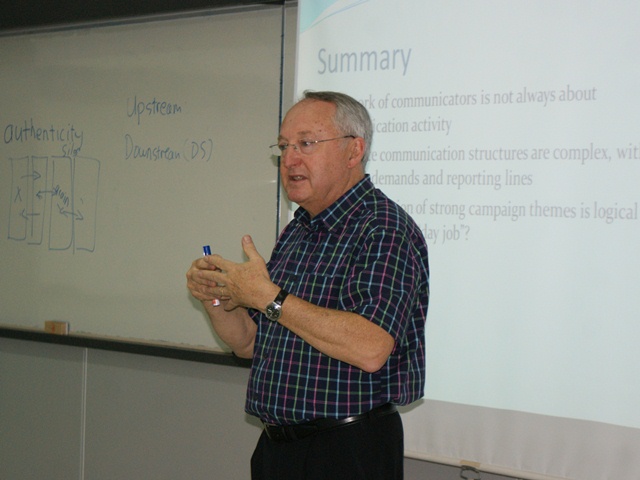
Prof Tom Watson teaching at Chulalongkorn University
For several years, the Media School (TMS) has been developing a relationship with Chulalongkorn University in Bangkok, Thailand. Chula, as it is known, is rated as the No.1 university in the kingdom.
The SMN award allows the development of a collaborative project between TMS and the Faculty of Communication Arts at Chula to organise an academic conference on public relations in Asia in Bangkok on November 18-19.
The conference will provide a platform for academic research on public relations history, current theory and practice, and future trends. In particular, it will investigate Asian (i.e. non Anglo-American) perspectives of public relations and will be the first dedicated conference to do so.
Prof Tom Watson, who is a co-chair of the conference, says the SMN funding “will lead to the development of a sustainable academic and research partnership between the two universities. It will enable BU staff participation in cross-cultural research with Thai colleagues. The conference will also place BU in a leadership role on research into cross-cultural communications and international public relations.”
Dr Ana Adi is working with Prof Watson on the project. She taught at Chula in mid-2012 on a staff exchange. She and at least one other TMS academic will be attending the conference and presenting papers.
The conference collaboration started with attendance by Chula’s Dr Napawan Tantivejakul at the International History of Public Relations Conference 2011 at BU, which began a dialogue about a joint conference with an Asian focus. This was cemented when Prof Watson visited Chula in November last year as a visiting professor and negotiated the arrangements. It is hoped that there will be 16 speakers, plus two keynotes, and 50 delegates at the November event.

Good luck & Congratulations!

I would like to offer congratulations to Julie Robson and Chris Chapleo (Business School) for being awarded funding from the TSB Classic KTP, Stephanie Farmer (Media School) for securing a contract with XPRIZE, Jonathan Monteith (ApSci) for his successful application to Anesco.
Congratulations are also due to Karina Gerdau-Radonic (ApSci), Adrian Newton (ApSci), Roger Herbert (ApSci) and Paola Palma (ApSci) for arranging their various short courses.
 I would like to wish good luck to Andrew Ford (ApSci) for his application for a NERC Grant, Samuel Nyman (DEC) for his application to EPSRC – EOI, Jonathan Parker and Sara Crabtree for their application for funding from ESRC, Kris Erickson (Media School) for his application to ESRC, Chris Chapleo and Tim Ford, Ke Rong and Donald Nordberg (Business School) for their applications for funding to BA/Leverhulme, Sarah Williams (DEC) for her application for funding to the Bupa Foundation, Stephanie Farmer (Media School) for her application to Pumpseal UK, Lihua You (Media School) for his application to Royal Academy of Engineering, Ana Adi (Media School) for her application to KidZone Direct, Max Lowestein (Business School) for his application to SLSA, Lindsay Watson (Media School) for her application for funding from Skillset, Adrian Newton (ApSci) for his application to EC FP7 Collaborative Stage 1 (of 2), Jon Williams and Lu Esteves (ApSci) for their application to EC FP7 Collaborative Stage 1 (of 2), David Parham (ApSci) for his application to English Heritage.
Best wishes
Matthew
The Haunter
Joe Flintham (Media School) and Andy Pulman (Health and Social Care) recently received funding of £2000 from the Research Development Fund to help push forward with a project called ‘The Haunter’. This collaborative work with Tim Wright (digital writer and Visiting Fellow in the Media School) is an experimental narrative piece which brings together site-specific stories, walks in landscapes and homebrew electronics, in order to explore Thomas Hardy’s poetry.

The Haunter is a live event in which participants are tasked with carrying a haunted box around a prescribed route in the environs of Dorchester. At key points, the box, rumoured to be the same one which contained Thomas Hardy’s heart before it was interred at the graveyard at Stinsford, recites poetry written by Hardy following the death of his first wife Emma. The walkers’ journey through poetry and landscape leads them to encounter feelings of grief and absence, to unveil abandoned dreams and stories ended, and perhaps to reflect on lost or neglected love in their own lives.
In the immediate experience, the walk explores themes of bereavement and regret, and the interplay of places and memories, but it is also an experiment in new hybrid forms of narrative: the experience created by ‘The Haunter’ draws on new opportunities offered by site-specific media and the role that place and environment can play in the telling of a story; social and participatory dramatic experiences in which audiences play an embodied role in the enactment of a story; and the affective possibilities opened up by the interaction with physical objects.
In order to make these narrative explorations possible, a further hidden layer of experimentation is necessary: to build hybrid objects which are at once familiar and humane (such as hand-crafted wooden boxes) and at the same time, smart and technologically equipped (context-aware and digital-media capable). In order to deliver the experience of The Haunter, it has been necessary to develop custom electronic devices crossed with antique knick-knacks. This harnesses the smarts available in the newest mobile phones, but wraps their powers into a century-old world of caskets and poems, sea-side courtship memories and tracks through Hardy’s Wessex.
The result is a participatory narrative whose writing, delivery and design is built with the necessary openness to collaboration and experimentation: the walkers encounter not only the box and its poetry, but also landscape, weather, and each other; the writers of the story must interweave the given words of the poems and the medium-specific affordances of phsyical devices with the vagaries of walker behaviour; and the makers must match the predetermined world of system code and electronic hardware capacities with the richly unpredictable world of human behaviour and narrative imagination.

The RDF funding has facilitated the development of a prototype and specifications for a device that can be used to deliver site-specific media experiences that are applicable in a variety of settings such as heritage projects, health-walking and locative story-telling. The funding has also made it possible to allow students to learn the kinds of disciplines involved – physical computing, GPS systems and electronics, etc. Finally, we are currently exploring opportunities with potential partners who can support us developing the project further.
More information:
Tim Wright – Location-based Storytelling
Andy Pulman – Health Walking
Joe Flintham – Hauntology
Hear about Julia Round’s experience of the ‘Comic Arts Conference’ made possible by a £1200 award from the Fusion Investment Fund
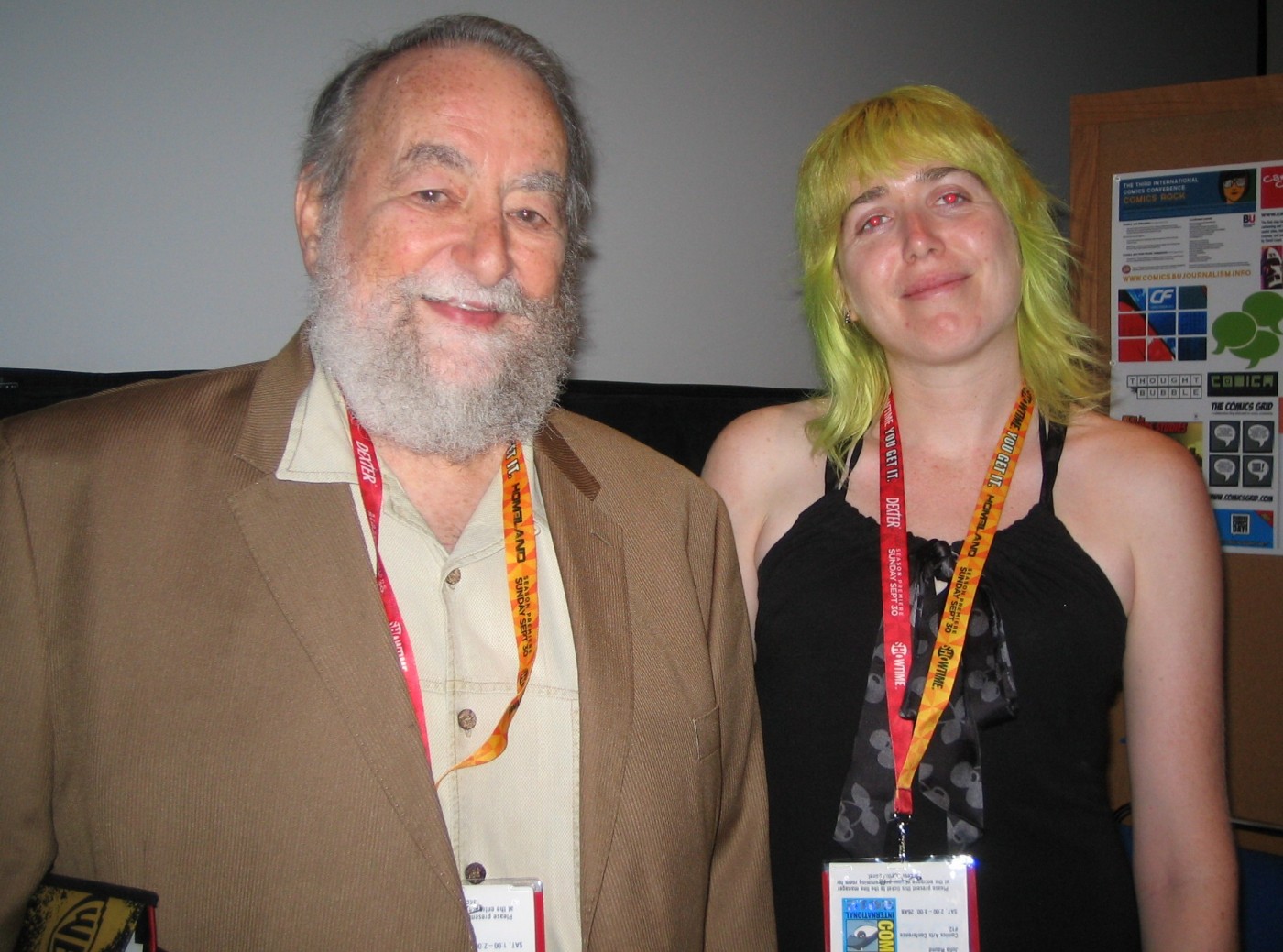 I applied to the BU Fusion Fund under the Networking and Staff Mobility strand for travel funding to attend the Comic Arts Conference, held annually in San Diego, CA. This year marked the 20th anniversary of this extremely important academic conference, which is organised by the Institute for Comics Studies (http://www.instituteforcomicsstudies.org/) as part of Comic-Con International. Like the Comic-Con itself, theCAC has grown in size and stature since its beginnings, and now invites presentations from academics, teachers, professionals, critics and fans and throughout the Comic-Con weekend it attracts a wide audience.
This year the interdisciplinary programming included presentations from political, transmedial, educational, historical, cultural and ethnographic perspectives, as well as many more. These included panels such as ‘Subaltern Counterculture and the Strengths of the Underdog’ and ‘Teaching with Comics’ as well as crowd-pleasing subjects like the continuation of the ‘Whedonverse’ (discussing the comics of Buffy and Willow, amongst others) and ‘The Dark Knight Rises: Is Batman Broken?’ in which academics Travis Langley and Robin Rosenberg expanded on their recently published monographs. Friday’s sessions included ‘Images of Nation’, ‘Revolution and Reaction’ (featuring comix creator and historian Trina Roberts who talked about her new comic Lily Renee: Escape Artist) and two afternoon sessions in which scholars such as Arlen Schumer, Mark Evanier, Charles Hatfield and Andrei Molotiu discussed the work of comics legend Jack Kirby from a variety of perspectives.
My aims for attending the conference were to promote the comics scholarship taking place in the UKand (of course!) the research and teaching being done here at BU. My presentation (‘Comics Scholarship in the UK’) discussed my experiences of launching and editing Studies in Comics journal, of joint conference organisation and collaborative activities between various UK comics scholarship initiatives, and reflected on the future possibilities for comics scholarship in the UK and the role of BU and Studies in Comics in enhancing these.
I was also able to arrange an interview with key transmedia scholar Henry Jenkins and conduct an interview with comics creator Charlie Adlard (artist on The Walking Dead), both of which will soon see publication. Henry Jenkins’ theories of transmediality form a key part of teaching on BACOM and BAENG units such as Adaptation, Alternate Worlds and Narrative Structures, and so current BU students will benefit directly from this opportunity. Research presented by other conference delegates will also inform future teaching on these courses.
Attending the CACwas obviously a fantastic networking opportunity and I was honoured to meet pioneers of comics scholarship such as David Kunzle, John Lent, Vicki Green and Joseph ‘Rusty’ Witek. These scholars spoke about their forays into comics research back when the field was unrecognised and the term ‘graphic novel’ was yet to hit the public consciousness. They also offered suggestions for the future of comics scholarship, suggesting that the field should keep its sense of humour and identity and ‘write to express not impress’ (John Lent). It was particularly gratifying to see these trailblazers receive a standing ovation for all their work towards the creation and development of comics studies as a field in its own right and to meet them in person. There was also an extra round of applause for John Lent (pictured below), whose International Journal of Comic Art continually seeks to expand the scope of comics studies and has paved the way for the acceptance of journals such the one I edit (Studies in Comics) by academic presses.
At the other end of the scale, I also met participants in The Power of Comics’ Field Study programme (an initiative whereby undergraduate and postgraduate students earn college credit for conducting research while attending the convention: http://www.powerofcomics.com/fieldstudy), who presented their findings from the past few days. Their projects included a study of dealer versus consumer attitudes; ‘cross-play’ experiences; aggression in geek culture; the volunteer experience and a comparative study with sporting events, amongst others. I hope that making contact with future scholars such as these will benefit BU in the future.
The core benefits I got out of attending theCACwere gaining primary research material through interviewing both a leading international scholar and a leading comics creator; the opportunity to meet both new and established scholars working in my discipline; disseminating my own research and promoting the reputation of BU; and (in due course) the publication of two interviews and a review of the conference in a peer-reviewed academic journal. I am also in touch with a number of new contacts and we are discussing future research collaborations. As an international visitor to theCAC, I was struck by how far so many of the attendees had travelled (from all overAmerica, as well as the rest of the world) and feel very lucky to have had the opportunity to attend such a global gathering.
Good luck & Congratulations!
Congratulations to Roger Herbert (ApSci) for his matched funding from Natural England, Zhidong Xiao (Media School) for securing funding from Wuhan Vocational College of Software and Engineering to run Wuhan Teachers Training Programme in Computer Animation, Anthea Innes and Clive Andrewes (HSC) for their funding from TSB, Kip Jones (HSC) for securing funding from ESRC, Caroline Ellis-Hill (HSC) for running the Masterclass: Systematic Reviews and Jonathan Monteith (ApSci) for his funding received from Blandford Forum Town Council.
Good luck to Raian Ali (DEC) for his application to Marie Curie, to both Zulfiqar Khan (DEC) and Venky Dubey for their applications to EPSRC/DST, Hongchuan YU (Media School) for his application to AHRC, Heather Savigny (Media School) for her application to the British Academy, Rosie Read (bid led by Bradford University) for her ESRC dementia initiative, Mary-Ann Robertson and Clive Andrewes for their application to the Royal Bournemouth and Christchurch Hospital, Chris Shiel (ApSci) for her EC – FP7 Collaborative Stage 1 (of 2) application, Anita Diaz (ApSci) for her application to the Higher Education Authority, Richard Stillman (ApSci) for his applications to the Marine Management Organisation – RPS and HR Wallingford, Peter Comninos (Media School) for his EC FP7 Collaborative Stage 1 (of 2) application and Anthea Innes and Samuel Nyman (HSC) for their EC FP7 – Health – collaborative project Stage 1 (of 2) application.
Best wishes
Matthew
Good luck & Congratulations!
It’s been a great fortnight for the School of Applied Sciences! Congratulations to Richard Stillman (ApSci) for his matched funding from Natural England and his funding from The British Association for Shooting and Conservation, Paul Cheetham (ApSci) for his funding from Inforce, Adrian Newton (ApSci) for his funding from Forestry Commission, Bronwen Russell and Jonathan Monteith (ApSci) for their funding from Dorset County Council and CgMs Consulting and Genoveva Esteban (ApSci) for her funding from SembCorp.
Good luck to Anthea Innes, Patricia McParland, Samuel Nyman and Stephen Page (BUDI, HSC) for their application to ESRC – Dementia Initiative, David Secchi and Fabian Homberg (BS) for their application for a Leverhulme Research Grant, Vanora Hundley (HSC), Edwin Van Teijlingen (HSC) and Ann Luce (Media School) for their cross-School application for a Leverhulme Research Grant, Sarah Hean and Will Haydock (HSC) with their application to Offender Health South West, Anthea Innes (HSC) for her application to NHS Bournemouth and Poole, Lesley Milne, Vanora Hundley and Edwin Van Teijlingen (HSC) for their application to the Wellbeing of Women – Midwives International Fellowship Award, Anthea Innes, Patricia McParland and Clare Cutler for their applications to South West Dementia Partnership – Dementia Challenge Fund, Amanda Korstjens (ApSci) for their application to Primate Conservation Incorporated and to Dave Parham (ApSci) for his applications to English Heritage,
Best wishes
Matthew
Good Luck and Congratulations!
Congratulations to Venky Dubey (DEC) for securing funding from the National Institute of Academic Anaesthesia (NIAA)/Obstetric Anaesthetists Association (OAA), Christos Gatzidis (DEC) for securing funding from the European Commision – Leonardo programmes, Crispin Farbrother (School of Tourism) for the implementation of the Hospitality Services – WSET Short course series
Good luck to Venky Dubey and Alexander Pasko (DEC) for their application for funding from the Wellcome Trust and Julie Robson and Chris Chapleo (Business School) for their application to the Technology Strategy Board
Good Luck and Congratulations!
Congratulations to Dean Wright (Media School) for securing funding from both Air-site Ltd and Dorling Kindersley Ltd and Kathy Hodder (ApSci) for securing funding from Fieldwork Ecological Services Ltd.
Good luck to Jaqui Hewitt-Taylor (HSC) for her Nuffield Foundation Outline application, Heather Hartwell (School of Tourism), Barry Richards (Media School), Darren Lilleker (Media School), Anita Diaz (ApSci), Rob Britton (ApSci) and Elena Cantarello (ApSci) for their applications to EC – Marie Curie – IEF and Jian Chang (Media School) for his application to EC – Marie Curie – IIF.
BU staff can login below:
Other services







Recent posts
BU research Funding opportunities EU
 ECR Opportunities: New Development Programme, Research Grants & Upcoming Events
 Help us capture BU’s knowledge exchange activity HE-BCI survey 2025–26
 Verbal autopsy paper published two days ago
 ESRC Studentships for 2027 Entry: Opportunity Now Open
- Personal Reflection on Sharing Research Through Art: Collaborating to Understand Ageing in a Digital World
 SONAMONI contributions to Safety Conference 2026 in South Africa
 Horizon Europe Cluster 3 (Civil Security for Society) 2026 Calls Now Open
 MSCA Doctoral Networks 2026 Call Information Webinar
 ESRC Festival of Social Science 2026: Application Deadline Extended to Thursday 25 June 2026
- Apply now to take part in the 2026 ESRC Festival of Social Science
 Reminder: Register for the ESRC Festival of Social Science 2026 Information Session
 ECR Funding Open Call: Research Culture & Community Grant – Apply now
- MSCA Postdoctoral Fellowships 2025 Call
 ERC Advanced Grant 2025 Webinar
- European Migration Research and Impact – Invitation to a Roundtable Discussion
- MSCA Postdoctoral Fellowships 2025
 Update on UKRO services
 European research project exploring use of ‘virtual twins’ to better manage metabolic associated fatty liver disease
 Research Information Network
- Physical Sciences Case studies: information use and discovery
- Information handling in collaborative research: an exploration of five case studies
- Information literacy monitoring and evaluation
- Data centres: their use, value and impact
- Heading for the open road: costs and benefits of transitions in scholarly communications