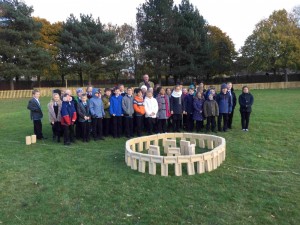
Current Archaeology, the UK’s best-selling archaeological magazine, features news of BU’s discovery of a previously unrecorded Neolithic long barrow in the Cotswolds in its December issue that goes on sale today. The excavations, directed by Professor Tim Darvill and Dr Martin Smith from the Department of Archaeology, Anthropology and Forensic Science, revealed a large stone-built mound dating to around 3800 BC. Such mounds served as territorial markers as well as burial places for communities living in the area. The work forms part of a larger study looking at the history and development of the Cotswold landscape since prehistoric times and includes collaboration with staff from the German Archaeological Institute in Berlin.
Category / REF Subjects
Royal Academy of Engineering – SME Leaders Programme
Are you working with engineering companies that would be interested in this funding opportunity?
Why not send them this information in order that they can consider making an application ?
The Royal Academy of Engineering, sponsored through the Enterprise Hub, invites applications for its small- and medium-sized enterprises leaders programme. This supports promising leaders of high growth engineering SMEs. Recipients receive a grant of between £10,000 to £15,000 towards the cost of training courses and executive education for themselves.
This scheme is open for applications by SMEs until 4pm on 24 November 2016. For further details on the scheme click on this link.
Helping Nepal to establish its midwifery profession
The international journal Sexual & Reproductive Healthcare (Elsevier publication) published the online first version of our latest maternity-care research paper on Nepal [1]. This paper is part of the successfully completed PhD research project of Malin Bogren (first author). The paper uses a qualitative approach based on the framework of Complex Adaptive Systems. Malin conducted semi-structured interviews with 17 key people representing eight different organisations (actors) promoting the development of the midwifery profession in Nepal. The move of midwifery from an occupation to a profession in Nepal is a challenging process. The study indicates the importance of understanding the motivations of, and barriers perceived by, actors that can promote or obstruct the establishment of the midwifery profession. It also points to the importance of informing the wider public about the role and responsibility of an autonomous midwifery profession.
The paper adds to our previous work around midwifery in Nepal [2-3].
Prof. Edwin van Teijlingen
CMMPH
References:
- Bogren, M.U., Berg, M., Edgren, L., van Teijlingen, E., Wigert, H. (forthcoming) Shaping the midwifery profession in Nepal – Uncovering actors’ connections using a Complex Adaptive Systems framework. published online: October 4, 2016
- Bogren M, van Teijlingen E., Berg M. (2013) Where midwives are not yet recognized: A feasibility study of professional midwives in Nepal, Midwifery 29(10): 1103-1109.
- Bogren, M.U., Bajracharya, K., Berg, M., Erlandsson, K., Ireland, J., Simkhada, P., van Teijlingen, E. (2013) Nepal needs midwifery, Journal of Manmohan Memorial Institute of Health Sciences (JMMIHS) 1(2): 41-44.
Stern review of the REF – what next?
The Stern review of the REF was published in July 2016. The government have accepted the main recommendations, and we are expecting in November a HEFCE technical consultation on implementation – to affect the next REF exercise (probably in 2021). It is expected that the new arrangements will be settled by the summer of 2017.
So what did Stern recommend – and what is likely to be in the consultation?
- The main thing that Stern might have done, but did not do – following widespread concern in the sector – was move to a metrics-based approach for the REF. Peer review and case studies will remain and there will be an opportunity to celebrate success wherever it is found in the REF – not a metrics based ranking. There may be new metrics, and a new Forum for Responsible Research Metrics has been launched, but the key is that these metrics should be used responsibly and carefully.
- All research active staff should be returned in the REF (and allocated to a unit of assessment).
- Outputs should be submitted at Unit of Assessment level with a set average number per FTE, but with flexibility for some faculty members to submit more and others less than the average. A total cap should be set based upon two outputs on average per FTE with an individual cap (e.g. six) and a minimum per FTE (potentially 0).
There has been some concern expressed about these changes – Maddalaine Ansell (University Alliance) via Wonkhe and James Wilsdon in The Guardian, 29th July 2016. At BU, our strategy is that all academic staff should be active in research as part of Fusion, so we will not be moving towards teaching only contracts. We hope the sector will not do so either – we will consider pressing for all staff to be included and remove any risks around the definition of “research active” to avoid this
- The total number of outputs per UoA should be adjusted so that it does not significantly exceed the 190,000 reviewed in REF2014. This may require the average number of outputs submitted per faculty member to be below two.
- Outputs should not be portable. The review proposes that outputs should be submitted by the HEI where the output was demonstrably generated and that work should be allocated to the HEI where they were based when work accepted for publication. There may be some flexibility around maximum numbers when staff have moved- e.g. maximum three outputs from those who have left.
Concern has been expressed that this will restrict employment options for early career researchers, e.g. Paul Kirby. James Wilsdon again “the broader move to reduce output numbers and decouple them from individuals should reduce pressure on those at the start of their career, or who take time out of research because of childcare, illness or caring responsibilities” Other views: – it might be fairer to early career researchers who will be recruited on potential not previous publications
- Institutions should be given more flexibility to showcase their interdisciplinary and collaborative impacts by submitting institutional level impact case studies
- Impact should be based on research of demonstrable quality. However, case studies could be linked to a research activity and a body of work as well as to a broad range of research outputs
- Guidance on the REF should make it clear that impact case studies should not be narrowly interpreted, need not solely focus on socioeconomic impacts but should also include impact on government policy, public engagement and understanding, cultural life, academic impacts outside the field and impacts on teaching – the report recommends that research leading to impact on curricula and/ or pedagogy should be included. BU welcomes these changes and we look forward to seeing more details of these plans.
So watch this space – once the consultation is launched the Research and Knowledge Exchange team will be working with the policy team to prepare a BU response. You can read more about BU’s policy and public affairs work on our intranet pages.
InsideBU – Out Now
The latest issue of InsideBU, the magazine for BU staff and students, is out now.
This issue brings the concept of Fusion to life through a range of features and articles including:
- Celebrating undergraduate research through hosting the prestigious British Conference of Undergraduate Research (BCUR) next year
- National research into the scale and impact of financial scamming in the UK, headed by BU’s National Centre for Post-Qualifying Social Work and Professional Practice
- The research stories behind the Fusion mural on Talbot Campus.
Hard copies are available across both campuses and you can also read it online – simply click the arrows on the bottom right of the screen to expand it to a full page size.
If you use a screen-reader, Word and PDF versions are also available. The current issue – and all back issues – can also now be found on the Staff Intranet, under ‘Find’ on the bottom right of the homepage.
Please email insidebu@bournemouth.ac.uk if you would like hard copies sent directly to you.
We appreciate all feedback and suggestions for future issues. If you have a story for the next issue of InsideBU, email insidebu@bournemouth.ac.uk.
BU’s Dr.Sascha Dov Bachmann to speak at conference convened by the South African National Defence Force (SANDF)
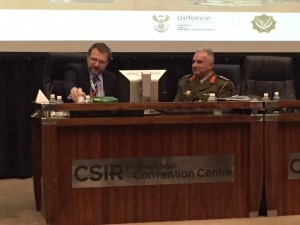
Dr Sascha Dov Bachmann, Associate Professor in International Law and Extraordinary Associate Professor in War Studies (Swedish Defence University) will present his work on Hybrid War and law fare in the 21st Century at SANDF’s First International Conference on Military Law, in Pretoria from 1 to 3 November.
The objective of the conference is to expose and bring awareness to the South African public in general and academia in particular on the importance of Military Law within a country’s legal system.
South Africa is among the leading countries in contributing military personnel and major equipment for peace missions in pursuance of its policy to promote peace and stability in the continent. The country’s important role in mediation to end conflicts, has earned it a good standing, reputation and respect among the community of nations.
As an active participant in international structures, South Africa raises the interests of the African continent and other developing countries. Since it plays a meaningful role for the success of the region and the continent, it is incumbent that it stays afloat in every spectrum possible including the development and application of Military Law.
Furthermore here at home, the community at large; to some extent the Military community; academia and jurors alike seem not to be aware of the relevance, extent and application of Military Law.
The Conference will be opened by the Minister of Defence and Military Veterans the Honourable Minister N.N. Mapisa-Nqakula. The Key Note Speaker will be our former Chief Justice, Justice Sandile Ngcobo.
Dr Sascha Dov Bachmann will present the findings on an ongoing project on Hybrid War and lawfare and how it impacts on AU states and their operational capacities and abilities.
Are you Slacktivist? – read story of student-academic co-creation journey
For me last academic year (2015-16) was amazing in terms of fantastic things I have been working on with UG and PG students. One of these projects was study on Slacktivists’ behaviour – study initiated and conducted by brilliant BA (Hons) Business Studies with Marketing student (about to graduate), Freya Samuelson-Cramp.
Results of Freya’s study have been extensively shared with external audiences, i.e. at ‘Parallel worlds: real life vs digital personalities‘ BU Festival of Learning event organised in partnership with Barclays Digital Eagle Labs and at ‘Digital Planet and its People’ BU Global Festival of Learning in Sias Internationa, China. ‘Slacktivism’ is a term that combines the words “slacker” and “activism“, it is most commonly associated with actions like signing online petitions, copying social network statuses or changing a profile photo in aid of a cause. Freya’s study, under my supervision, haa examined how slacktivists are behaving when it comes to charity-related content and what personality traits as well influencing factors drive slacktivist behaviour.
This topic in actual fact deserves recognition in other contexts of studies as slacktivism is a norm behaviour in online, social media, context and is exercised in relation to any type of social media content.
However, the reason for this post was primarily to communicate latest recognition and progress events that both Freya and I were part of.

Firstly, Freya’s final year research project was shorlisted for the ‘Best Bachelor’ thesis category at the Digital Communications Awards (DCA) 2016. The DCAs exclusively honour achievements in the field of digital communication throughout Europe and welcomes practitioners from various industries! It is prestigious event judged and attended by world-known pioneers in the field of digital communications. Freya has defended her work and was praised for rigorous methodological approach as well as topic that has interest and relevance to all businesses involved in use of social media channels.
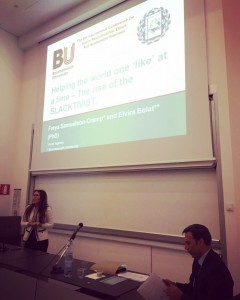
Secondly, on 6-7 October 2016 I have presented joint conference paper titled ‘Helping the world one ‘like’ at a time – The rise of the Slacktivist‘ at the 5th International CSR Conference which took place in Bocconi University, Milan – fantastic conference, organised and chaired by BU academic Dr Georgiana Grigore. Once again, the paper has received enormous interest with follow-up controversial discussions around the notion of slacktivism and we are now working on submission of full paper as the book chapter.
Freya now works as account executive at Good Agency and about to graduate with First-class honours degree. In contradiction to all stories of UG student-academic collaborations, which end at the graduation point, I and Freya are planning to continue working together on understanding further what constitutes stacktivism behaviour. Apart from that we invite to Digital Me photo gallery event, part of the ESRC Festival of Social Science, which takes place on 5th November at the Sovereign Shopping Center.
Finally, hope this positive story can inspire you to co-create with students. We also would love to thank CEL for funding the project through Co-creation fund, GlobalBU team, Department of Marketing (Faculty of Management) and Department of Leadership, Strategy and Organisational Behaviour (Faculty of Management) for ongoing support in conducting research and disseminating results of our study.
Any questions about our story, mentioned conference paper or Digital Me event, email at ebolat@bournemouth.ac.uk
ESRC’s Festival of Social Science- What is the Internet Hiding from you?
Date: Tuesday 8 November 2016
Time: 2:30pm-5pm
Location: Executive Business Centre (EBC), Bournemouth University, 89 Holdenhurst Road, Bournemouth, BH8 8EB
As part of the ESRC Festival of Social Science, BU’s Dr Nava Tintarev and Dr Paolo Palmieri will host an information session and focus group to talk about their research into digital privacy and discuss people’s opinions on the use of their personal data
As many of us may be aware our personal data is used to filter our Facebook timeline and that Amazon personalises our suggestions. With an exponential growth of information, many online systems filter and adapt what information we are exposed to. However as users, we have not always agreed to this personalisation and we’re often left unaware whether our personal data is being used to benefit us. There is also a risk that if personalisation gets ‘too good’; this can narrow down our exposure to new things. We’re left to wonder how our personal information is being used.
Imagine a tourist visiting a city and looking for new places to explore. A recommender system would suggest several places to visit and a certain sequence to visit them in. To give good recommendations, the system needs to consider the relationship between suggested items. For example, the tourist may not want to visit more than two museums in a day, and they would not want to go from one museum straight to another one, so there should be something else to visit in-between.
Working together with adults of different backgrounds and degrees of technological experience Dr Nava Tintarev hopes to understand what factors influence a good explanation for these sequences, through the focus group and better understand how people feel about this personalisation.
One scenario is when there is no best option and the sequences have taken into account trade-offs. For example, someone travelling in a group may not see their top preference within the sequence, because the system took into account the preference of others in the group.
The second scenario in which explanations can really help is when the recommendations contain unexpected, but risky items. Often recommender systems suggest safe items, for example suggesting the latest Star Wars movie to a Star Wars fan, or inferring from a user’s consumption habits that they are similar to users that like the newly released Jurassic World movie. The problem is that even though these systems suggest novel items, these recommendations are predictable. They miss out on what potentially could be the greatest strength of recommender systems: helping users discover new items and new interests they didn’t realise they had.
It is vital to understand people’s concerns. Dr Nava Tintarev’s research looks specifically at the use of explanations to help users make good decisions about recommendations of sequences of items. It is important that they are confident that they can trust these systems. Through her research, she hopes to help users gain a better sense of how their personal data is being used. This event will help you gather a better understanding of how big data companies use personal data and the challenges they face.
The 14th annual Festival of Social Science takes place from 5-12 November 2016 with more than 250 free events nationwide. Run by the Economic and Social Research Council, the Festival provides an opportunity for anyone to meet with some of the country’s leading social scientists and discover, discuss and debate the role that research plays in everyday life. With a whole range of creative and engaging events there’s something for everyone including businesses, charities, schools and government agencies. A full programme is available at www.esrc.ac.uk/festival You can also join the discussion on Twitter using #esrcfestival.
This event is running twice on Tuesday 8 November to allow as many people as possible to attend. I if you would like to attend the 14:30-17:00 session please book your free place here. If you would prefer to attend in the evening there is a session running 18:00-20:30 for which you can book your free place here.
To find out more about the ESRC Festival of Social Science and all the events taking place please visit www.bournemouth.ac.uk/esrc-fss you can also email Joanna Pawlik or Naomi Kay to find out more.
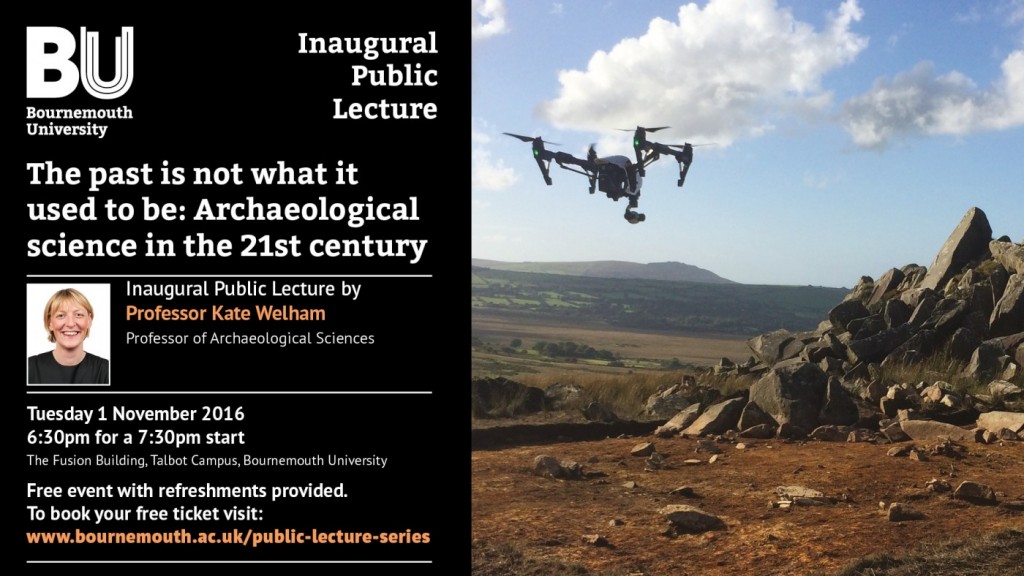
The past is not what it used to be: archaeological science in the 21st century
BU’s inaugural lecture series returns this autumn, with a taste of the past. Advances in technology are making a difference to all areas of our lives – even to how we understand our history. The use of technology in archaeology has been revolutionary, not just in the kinds of equipment that can be used, but also that so much can now be used in the field, giving almost instant analysis.
Bournemouth University’s Professor Kate Welham is an expert in archaeological sciences, with a particular focus on remote sensing techniques. Her work has taken her to sites all over the world – from Tanzania and Spain to Easter Island and closer to home – Glastonbury Abbey. Over the course of her career, she has seen the field of archaeology change and grow immeasurably.
Kate’s lecture will share stories of her fieldwork experiences across the world, the way technology has revolutionised the way archaeologists work and how she has involved BU students in her research. There will also be an opportunity before and after the lecture to meet some of BU’s current archaeology students and see some of the equipment used by BU’s archaeologists out in the field.
Bournemouth University’s Inaugural Lecture Series aims to celebrate new professorial appointments and the depth and breadth of research produced by the university. For further information on the Inaugural Lecture Series please visit www.bournemouth.ac.uk/public-lecture-series
About the event
To book your free ticket, click here.
Venue: The Fusion Building on Talbot Campus.
Date: Tuesday 1 November.
Time: 6:30pm for a 7:30pm lecture start.
Please do arrive early as there will be an opportunity to see and handle some of the equipment used by the Department of Archaeology, Anthropology & Forensic Science.
Refreshments will be provided at the event.
Parking is available for free on campus.
For more information about the event, please contact Rachel Bowen at rbowen@bournemouth.ac.uk.
Visitors from Nepal at FHSS
As part of FHSS’s sustained research in Nepal Dr. Sujan Marahatta and Mr. Jiwan Sharma from Manmohan Memorial Institute of Health Sciences (MMIHS) came to the UK to discuss further future collaborations. The Nepali visitors met with our Dean Prof. Steve Tee and Dr. Malcolm McIver FHSS’s Associate Dean for Global Engagement as well with Postdoctoral Fellow Dr Pramod Regmi and BU PhD student Mr. Jib Acharya.
BU academics have been collaborating with MMIHS for over seven years. Currently, we have three projects in Nepal with MMIHS: one funded by the Centre for Excellence in Learning on introducing CPD (Continuous Professional Development) in nursing in Nepal and coordinated by Dr. Catherine Angell; and project designed by Dr. Regmi on transgender issues in Nepal which is funded by FHSS monies, and study on returned trafficked women in Nepal which has received a small small amount of money from both FHSS and Liverpool John Moores University. Prof. Edwin van Teijlingen, in the Centre for Midwifery, Maternal & Perinatal Health (CMMPH), has been a Visiting Professor at Manmohan Memorial Institute of Health Sciences for nine years so it is a long-standing working relationship.
MMIHS publishes its own journal the Journal of Manmohan Memorial Institute of Health Sciences which is part of Nepal Journals Online (NepJOL) and Open Access. Apart from Prof. van Teijlingen, CMMPH Prof. Hundley, Dr. Regmi, or our BU media colleague Dr. Luce (Faculty of Media & Communication) and various members of FHSS’s Visiting Faculty have published in this journal.
FHSS and MMIHS are now working towards a more formal academic relationship.
ESRC’s Festival of Social Science- Innovations in Hospitality and Travel
Date: Thursday 10 November 2016
Time: 10am-1pm
Location: Bournemouth University, Talbot Campus, Fern Barrow, Poole, BH12 5BB
The International Centre of Tourism and Hospitality Research will be running an event as part of the ESRC Festival of Social Science. Tourism plays a major part in Bournemouth’s economy, attracting millions of visitors to the seaside town every year. In 2011 alone, the town saw 5.6 million visitors, who spent £460 million between them. BU’s Dr Giampaolo Viglia will be presenting to the audience the innovations that have been introduced to the travel and hospitality industry, via cutting edge social science research.
The workshops aim to provide some evidence on the actual behaviour of operators in the hotel and aviation industry and to ask: How much do they use dynamic pricing strategies? When is the best time to book? How should they react to the seller’s pricing strategies? What are the main drivers behind the price trend structure? What additional profit can the revenue management techniques in the hospitality industry offer? Is delegating the price decision to the consumers in restaurants appropriate?
BU’s Dr Giampaolo Viglia will be joined by Professor Claudio Piga, from Keele University and the staff from HOTS Business game to discuss dynamic pricing, the best time to book and new pricing mechanisms. This will be followed by a tea/coffee break, to recharge your batteries. We will then hear from BU researchers Dr Viachaslau Filimonau, Professor Adele Ladkin, Professor Heather Hartwell and Dr Sean Beer who will discuss innovations in food, technology and menu labeling. The event has been designed to engage professionals and consumers in discussion and to showcase the growing research agenda on the impact of innovation on the travel and hospitality industry.
Innovations are influencing the travel and hospitality industries offering more flexibility on the supply side and driving informed decisions on the consumer side. The rapid growth of online bookings has had a massive impact on the industry. The internet encourages greater price scrutiny since the relevant information is both easier to obtain and transparent, given that any party can compare the prices of several alternatives with very little effort. This is bound to have an impact on how operators set prices since they too can easily obtain this information and rapidly respond accordingly. There will also be an opportunity for debate between professionals and consumers.
The 14th annual Festival of Social Science takes place from 5-12 November 2016 with more than 250 free events nationwide. Run by the Economic and Social Research Council, the Festival provides an opportunity for anyone to meet with some of the country’s leading social scientist and discover, discuss and debate the role that research plays in everyday life. With a whole range of creative and engaging events there’s something for everyone including businesses, charities, schools and government agencies. A full programme is available at www.esrc.ac.uk/festival. You can also join the discussion on Twitter using #esrcfestival.
To find out more about the ESRC Festival of Social Science and all the events taking place please visit www.bournemouth.ac.uk/esrc-fss you can also email Joanna Pawlik or Naomi Kay to find out more.
BU Sociology graduate invited speaker at the World Youth Buddhist Symposium
Alexandra Jarrett is a former BU student who is graduating this year from the BA (Hons) Sociology & Anthropology programme in HSS. Prior to taking up her MA studies at the highly prestigious School of Oriental and African Studies (SOAS), Alex was invited to the beautiful northern Thai city of Chiang Mai to present aspects of her final-year dissertation on Buddhist death rituals and beliefs.
Alex’s contribution was very warmly welcomed beyond our hopes and expectations. As her supervisor I was delighted to hear her accounts of how this experience deepened her understanding of her chosen area of interest: the anthropology of relgioun and spiritual belief systems, which she started exploring moredeeply in the Soc+ unit ‘Seekers, Believers & Iconoclasts: Sociology of Thought’. Participation in the Symposium also elevated Alex’s awareness of how much bright, energetic and keen UK students have to offer on the world stage at a dismal time when Britain seems to be wilfully stepping away from the limelight and heading out of the backdoor. Enough of the doleful thoughts – over now to Alex:
‘This summer, I was delighted to be asked to deliver a guest speech at the World Youth Buddhist Symposium in Thailand. The theme of the symposium was “The way of Peace” and I delivered a talk entitled “consumerism and the false self”. When I arrived at the university in Chiang Mai, I was overwhelmed by the setting of the symposium. The ceiling was lit up by giant lanterns and the front of the stage full of flowers. I was very impressed with the organisation of and the pride that was taken in holding this symposium.
The first day of the symposium was magnificent – the opening show began with traditional Thai dances and a flag ceremony (where I was chosen to represent Britain). Each day of the symposium began with the introduction of the honourable guests, which included Khenpo Sydogye (a famous Tibetan teacher). Over the course of four days, I learnt about different religious perspectives towards peace and how this should be achieved worldwide. As well as this, I took part in meditation and a life release ceremony involving releasing fish into the lake whilst singing and chanting mantras.
My speech was ten minutes long and discussed the influence of consumerism, social media and technology on achieving peace. I discussed the idea of how wealth can often contribute towards selfishness and how technology creates an idea of a false self where consumers become obsessed with projecting a certain image of themselves online. As well as delivering this speech, I was asked to perform a song on the final day of the symposium during the closing ceremony.
My experience at this symposium was amazing and I learnt a lot about Buddhism and different religious perspectives towards peace. The symposium was predominantly run by the Chinese so I also learnt a lot about the Chinese culture and their pride in running an organised, impressive conference.’
The entire Soc+ team is very proud of Alex and her achievements, which were featured in the BU news. We hope she will stay in touch and return to BU one day to address junior Sociology+ students as one of our most excellent and inspiring alumnae. Well done Alex!
Alexandra Jarrett and Sara Ashencaen Crabtree
BU THET Nepal project presented at RCM conference
Our THET (Tropical Health & Education Trust) funded project which trains community health worker such as Auxiliary Nurse Midwives (ANMs) on mental health issues related to pregnancy was presented at the Royal College of Midwives (RCM) conference today by FHSS Visiting Faculty Jillian Ireland (photo). Jillian is also a community midwife at Poole Hospital NHS Foundation Trust.
Mental health is poorly covered in the training of health care providers in Nepal. This all the more worrying as it is also culturally a difficult sensitive topic to discuss. This makes it difficult for front-line health workers, especially generalists or non-mental health specialists, to start a discussion about mental health issues with pregnant women, new mothers and their wider families.
Our THET partnership includes the Department of Health, Physical & Population Education at Nepal’s oldest and largest university Tribhuvan University’s (TU), Bournemouth University and Liverpool John Moores University (LJMU). This project is funded under the Health Partnership Scheme (HPS). HPS funds to carry out training and capacity-building projects in low-income countries, such as Nepal. HPS itself is funded by the UK Department for International Development (DfID) and managed by THET (Tropical Health and Education Trust).
The partnership working has resulted in several publications on mental health and maternity care in Nepal. [1-3]
References:
- Simkhada, B., Sharma, G., Pradhan, S., van Teijlingen, E., Ireland, J., Simkhada, P., Devkota, B. & the THET team. (2016) Needs assessment of mental health training for Auxiliary Nurse Midwives: a cross-sectional survey, Journal of Manmohan Memorial Institute of Health Sciences 2(1): 20-26. http://www.nepjol.info/index.php/JMMIHS/article/view/15793/12738
- van Teijlingen, E., Simkhada, P., Devkota, B., Fanning, P., Ireland, J., Simkhada, B., Sherchan, L., Silwal, R.C., Pradhan, S., Maharjan, S.K., Maharjan, R.K. (2015) Mental health issues in pregnant women in Nepal. Nepal Journal of Epidemiology 5(3): 499-501. http://www.nepjol.info/index.php/NJE/article/view/13607/11007
- Simkhada, P., van Teijlingen E., Winter, R.C., Fanning, C., Dhungel, A., Marahatta S.B. (2015) Why are so many Nepali women killing themselves? A review of key issues Journal of Manmohan Memorial Institute of Health Sciences 1(4): 43-49. http://www.nepjol.info/index.php/JMMIHS/article/view/12001
A Cloud Based Intelligent Safety Transport Framework for Schools
We would like to invite you to the latest research seminar of the Creative Technology Research Centre.
Speaker: Manoharan Ramachandran (PhD student within the Creative Technology Department).
Title: A Cloud Based Intelligent Safety Transport Framework for Schools
Time: 2:00PM-3:00PM
Date: Wednesday 26th October 2016
Room: PG11, Poole House, Talbot Campus
Abstract: Safety in school transportation systems is a critical issue which involves children who are the most vulnerable users of them. Statistics show that in Great Britain (GB) alone 1191 children were injured in 371 coach crashes between 2005 and 2015. Though coach journeys are considered as the safest mode of transport for children, the coach accidents are the one which resulted in a high number of fatalities per accident. England has more than 25000 schools and each school at least make 2 trips per year which is equivalent to 50000+ trips made every year. Schools rely on coach operators to provide vehicles for school trips and home to school services. In the last eight months alone (Jan – Sept 2016), 102 coach operators’ licenses have been revoked without public inquiry in England due to operator’s non compliance. Around 8.3 million pupils are enrolled in England schools. There are no specific safety models available to ensure the safety of children who travelling through coaches. Parents have to spend a considerable amount of time on the streets and making phone calls seeking information about the coach whilst waiting for it, due to the unpredictable nature of the traffic, particularly during the winter months. Proper selection of coach operator, vehicle and real time vehicle tracking & monitoring can considerably mitigate safety risks and the problems of school transport. Most of the existing literature so far has focused on the economy and the shortest routes to transport children, but they do not consider the safety aspects of the coach operator, vehicle and the driver. In this research, two case studies have been conducted in four sectors of stakeholders to identify their problems and needs in school transportation. The outcome will be discussed at this seminar.
We hope to see you there.
BU Researcher Dr Firend Al Rasch has released a book: Asian Case Studies- Lessons from Malaysian Industries
BU’s Dr Firend Al Rasch has recently published a book around his research into Asian industry and their significance to the world of trade and commerce. The book ‘Lessons from Malaysian Industries’ is one of a series of Asian case studies and explains how these industries can stay relevant among other key players in the Asian market.
This section of the series explores Malaysia which is relatively small in comparison to its other Asian-Pacific neighbours, such as India and China. In 2010, the country set a target to become a high-income nation by 2020. Dr Rasch analysed a number of Malaysian companies from a number of industries, including palm oil, electrical, electronics, business services, oil and gas etc. He discusses how Malaysia is at a disadvantage as it’s unable to compete with its larger neighbours, nor is it able to grow to the high-end market value of Singapore.
In the wake of the Transatlantic Trade and Investment Partnership (TTIP) the economic landscape is becoming ever more competitive and has the potential to force many businesses to become non-existent. The study recognises how Malaysia needs to identify its strongest market niche and use this to maximise its income in order to remain relevant in the global market.
The book has used research methods that enable the reader to understand the reasoning of how Malaysian companies build their company structure and how they discuss moving forward. For example, Dr Rasch, has examined case studies such as VADS Berhad, a fully integrated Connectivity/ICT/BPO Solutions Provider which represents the issues a typical Malaysian company faces.
As well as this, the book has analysed financial data, to present the importance of financial structure. He has also looked at a breakdown of the company’s marketing strategies, to understand how they sell themselves. The methods of data collection of real companies, give the reader real-life perspective of how companies run and how the industry can survive in such a diverse and important trade region.
To get yourself a copy of the book head over to Amazon
If you’d like to ask Dr Rasch anything, then get in touch.
EU award for PhD student Preeti Mahato
FHSS PhD student Preeti Mahato in the Centre for Midwifery, Maternal & Perinatal Health (CMMPH) has been awarded a funded place on the COST Action Training School BEYOND BIRTH COHORTS: from study design to data management. This training school will run from 23-15 November in Spain.
COST (European Cooperation in Science and Technology) is a unique platform where European researchers can jointly develop their ideas and initiatives across all scientific disciplines through trans-European networking of nationally funded research. Preeti pal has been awarded the sum of 500 euro to cover the cost of attending the Training School and travel and accommodation costs. Preeti’s PhD project is on maternity care provision in Nepal. Preeti’s research focuses on the quality and equity of service available at birthing centres. In Nepal, birthing centres act as first contact point for the women seeking maternity services especially the basic obstetric care. She is supervised by Dr. Catherine Angell, Prof. Edwin van Teijlingen and BU Visiting Faculty Prof. Padam Simkhada (based at Liverpool John Moores University).
Preeti has already published the first PhD paper ‘Birthing centres in Nepal: Recent developments, obstacles and opportunities’ in the Journal of Asian Midwives (JAM) [1], whilst another was published in the Nepal Journal of Epidemiology [2]. Furthermore, a more general health and development paper was published this year in Health Prospect [3].
Congratulations!
Prof. Edwin van Teijlingen
CMMPH
References:
- Mahato, P., van Teijlingen, E., Simkhada, P., Angell, C. (2016) Birthing centres in Nepal: Recent developments, obstacles and opportunities, Journal of Asian Midwives 3(1): 17-30.
- Mahato, P.K., Regmi, P.R., van Teijlingen, E., Simkhada, P., Angell, C., Sathian, B. (2015) Birthing centre infrastructure in Nepal post 2015 earthquake. Nepal Journal of Epidemiology 5(4): 518-519. http://www.nepjol.info/index.php/NJE/article/view/14260/1157
- Regmi, P., van Teijlingen, E., Hundley, V., Simkhada, P., Sharma, S., Mahato, P. (2016) Sustainable Development Goals: relevance to maternal & child health in Nepal. Health Prospect 15(1):9-10. healthprospect.org/archives/15/1/3.pdf
The social sciences at BU
Earlier this year a Fusion-funded series of public events at BU was organised by Professors Ann Brooks (FHSS), Candida Yates (FMC) and Barry Richards (FMC). For these ‘Dialogues in the Social Sciences’, leading social scientists were invited to speak at BU, along with other figures from outside and inside academia, on topics of current concern. The aim was to offer to BU students and staff, and to members of the local public, opportunities to hear and take part in authoritative and informed discussion of social and political issues.
The first was entitled ‘Increasing inequality? Widening opportunity? Debating higher education reform’ Two leading educationists from the University of London Institute of Education discussed the Higher Education Green Paper. Professor Sir Peter Scott (former editor of THE, and former V-C of Kingston University) and Professor Ann Phoenix, eminent psychosocial researcher, outlined their analysis of the prospects for the sector. BU’s Dr. Mastoureh Fathi (FHSS) and Ellie Mayo-Ward (SUBU V-P) were respondents. Chaired by Professor Iain MacRury of FMC, this event explored some of the risks to the sector in the current proposals.
In the second event (‘Our scandalised society’), criminologist Professor Chris Greer (City University) and Lord Blair (Sir Ian Blair, former Commissioner of the Met) discussed key issues regarding how the British state is responding to scandal proliferation, the implications of scandal for crime control and institutional regulation in the digital age, and the risk of scapegoating as a substitute for understanding and solving, particularly in a 24/7 news environment. Professor Ann Brooks was in the chair for an intriguing examination of the roles of both media and police in this complex intersection of social changes.
Professor Matthew Feldman of Teesside University is an expert on the Far Right; he was joined for the third and final event by Emman el-Badawy of the University of Exeter and the Centre on Religion and Geopolitics, and Dr Usama Hasan of the counter-radicalisation organisation the Quilliam Foundation, both experts on violent jihadism. Under the title of ‘Radicalisation: what is it and what threat does it pose?’, Professor Barry Richards chaired a wide-ranging discussion which both put the current threat of Islamist terror in broader historical contexts and looked closely at some of the debates around the Prevent counter-terrorism programme.
Each one of these events demonstrated that with excellent speakers and a thoughtful audience, a good discussion is guaranteed. All of them involved both students and members of the public, though the challenge of drawing in large numbers for early evening extra-curricular events was also in evidence. As well as their value to participants, these events flagged up internally and externally that BU has a growing base of social-scientific expertise, networked with internationally leading experts and pursuing a clear public engagement mission.
Green Bubbles Open workshop: innovation in recreational SCUBA diving
Green Bubbles is a EU-funded project dedicated to sustainable recreational SCUBA diving. Recreational SCUBA diving has become a mass leisure activity engaging millions of divers worldwide. The diving industry generates large direct and indirect revenues for coastal communities and Marine Protected Areas (MPAs). Other benefits linked to diving include the promotion of ocean stewardship, contribution to scientific research, fostering social inclusion and personal development. Yet, diving has also negative impacts, due to damage or disturbance of habitats and organisms, and to conflicts with local communities for the access to/use of the same resources, equity issues, or cultural clashes. The central objective of Green Bubbles is to maximise the benefits associated with diving while minimising its negative impacts, thus achieving the environmental, economic and social sustainability of the system.

Poster of speakers for Green Bubbles Open Workshop
On 26-27 September, Green Bubbles had its first open workshop, in Santa Margherita Ligure, in Italy. Dr Lenia Marques, from the Department of Events and Leisure, was one
of the keynote speakers, bringing leisure and tourism integrated approaches into the discussion.
The workshop brought together many local and international stakeholders and it was a moment not only of discussion of different perspectives, but also of synergy creation.
It was a successful workshop and we look forward to seeing the developments of the rest of the project as
well as the future projects which started to emerge from this meeting.
Please check out the links and follow the project on social media:

www.greenbubbles.eu
Official website: www.greenbubbles.eu
E-mail: join@greenbubbles.eu
Social media hashtags: #GreenBubblesRISE #GreenBubblesproject #sustainable #diving
For more information at BU, please contact Dr Lenia Marques, lmarques@bournemouth.ac.uk.


NIHR Insight South West Central Conference 2026 at Bournemouth University
BU PhD student presented at World Safety Conference in South Africa
National Research Supervision Recognition: Apply Now & Join the Supporting Workshop on 16 September
3C Event: ECR Network Café – Wednesday 16 September 2-3pm
BU geography student’s undergraduate dissertation published in international journal
Horizon Europe Cluster 3 (Civil Security for Society) 2026 Calls Now Open

MSCA Doctoral Networks 2026 Call Information Webinar

ESRC Festival of Social Science 2026: Application Deadline Extended to Thursday 25 June 2026

Reminder: Register for the ESRC Festival of Social Science 2026 Information Session

ECR Funding Open Call: Research Culture & Community Grant – Apply now

ERC Advanced Grant 2025 Webinar
Update on UKRO services
European research project exploring use of ‘virtual twins’ to better manage metabolic associated fatty liver disease