The Advance HE Postgraduate Research Experience Survey (PRES) has launched
Have your say – 2 weeks till the deadline!
Thank you to everyone who has completed the survey so far. If you have not already completed it, we would really appreciate if you could find a few minutes to respond and tell us about your experience this year.
We are keen to make sure our PGRs have the best possible experience while studying with us. To do this, we need to know what you think works well and what as a university we could do better. This is your chance to tell us about your experience as a PGR at Bournemouth University. We also kindly ask that all supervisors encourage their PGRs to participate in the survey.
Thank you to all PGRs who completed the 2023 PRES survey – we listened to you and your feedback has helped us to enhance your PGR experience in a range of areas.
The survey will close on Thursday 16 May 2024. Upon completing the survey, PGRs will automatically entered into a free prize draw. Four winners will be able to claim a £50 shopping voucher. Terms and conditions apply.
In addition, we will be making a £1 donation for every survey completed to the student mental health wellbeing charity, Student Minds.
Once you have completed the survey, you are entitled to claim a voucher worth £3.20, from the Doctoral College to use at any BU Chartwells outlet. Please come to the Doctoral College (DLG08, Talbot Campus) to collect your voucher. You will need to show a screen shot of the final page of the survey in order to claim your voucher.
How do I take part?
PGRs should have received an email from the Doctoral College on Monday 15 April 2024 containing a unique link which will allow you to access and complete the survey. If you can’t find this email, contact PRES@bournemouth.ac.uk and we’ll help you to get access.
What will I be asked?
The survey will take around 15 minutes to complete. Your response is confidential, and any reporting will be entirely anonymous. The survey is your chance to tell us about your experience as a PGR at BU. It will ask you to share your views on supervision, resources, research community, progress and assessment, skills and professional development and wellbeing.
Why should I take part?
Your feedback is important. The Postgraduate Research Experience Survey is the only national survey of PGRs and so is the only way for us to compare how we are doing with other institutions and to make changes that will improve your experience in the future.
More information
If you would like to know more about the survey, please visit: PRES 2024.
We hope you take the opportunity to get involved this year and help us make improvements to your experience.
Best wishes,
The Doctoral College
For any PRES related queries, please email: PRES@bournemouth.ac.uk














 SONAMONI contributions to Safety Conference 2026 in South Africa
 Three CMWH presentations at Berlin conference
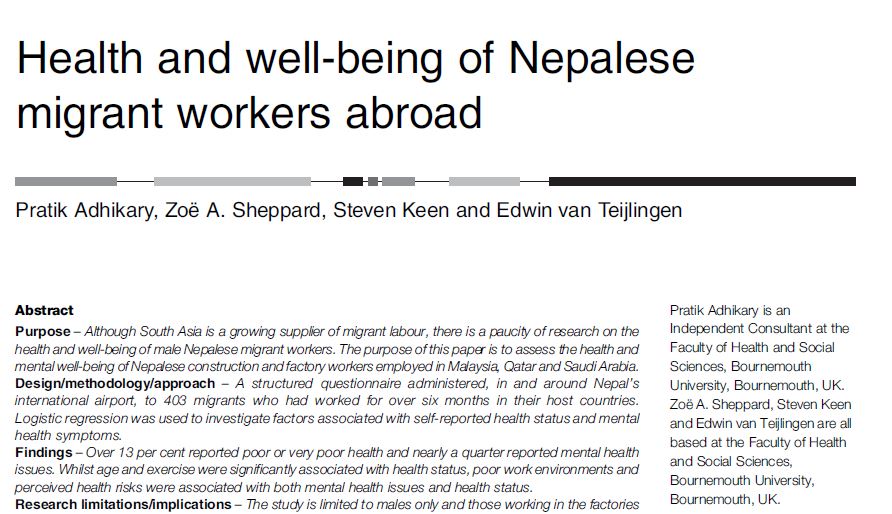
 New interdisciplinary paper on Nepal
 Horizon Europe Cluster 3 (Civil Security for Society) 2026 Calls Now Open
 MSCA Doctoral Networks 2026 Call Information Webinar
 ESRC Festival of Social Science 2026: Application Deadline Extended to Thursday 25 June 2026
 Reminder: Register for the ESRC Festival of Social Science 2026 Information Session
 ECR Funding Open Call: Research Culture & Community Grant – Apply now
 ERC Advanced Grant 2025 Webinar
 Update on UKRO services
 European research project exploring use of ‘virtual twins’ to better manage metabolic associated fatty liver disease
