Research
The Universities Minister, has delivered the first in a series of four planned speeches on how the UK can best achieve its ambition to invest 2.4% of GDP in R&D by 2027. It was a surprising speech in some ways, short on announcements, although there were some, and long on wishful thinking. We’ve pulled out some bits below. For a healthy dose of cynicism/realism we recommend the annotated version by HE for Research Professional.
Investment – To achieve our target of 2.4%, total UK R&D investment would need to rise to around £60bn in today’s money. More than double our current investment levels. This would require us to have invested an additional sum of over £80bn cumulatively each year from 2017 across the public and private sectors.
People – It doesn’t matter how much money we pump into R&D over the years ahead, it won’t make the intended difference if we don’t have the right people in place. Ensuring a strong pipeline of talent will be essential for bolstering the UK’s research prowess. We are also going to have to substantially increase the numbers of people we have working in R&D in the same period – perhaps by as much as 50%. To put that in figures, that means we need to find at least another 260,000 researchers to work in R&D across universities, across business and across industry.
International staff and students – We are making it easier for international graduates to move into skilled work. International students studying for undergraduate level and above will be able to apply for a visa three months before their course finishes – enabling them to take up skilled work after their degree. They will also be able to apply for a skilled work visa out-of-country under the same preferential conditions as they would experience if they were to apply for a visa in-country. In addition, a reformed sponsorship system will provide a simplified and more streamlined system. This will be less burdensome for employers and will enable businesses to harness the talent they need more easily. We set out a clear ambition in our International Education Strategy earlier this spring: to grow the numbers of international students studying in UK universities to 600,000 by the end of the next decade.
Supporting Researchers
Our current research culture relies on dominant power structures, where doctoral candidates and post-docs are largely dependent on supervisors or PIs for references and progression. This puts the power firmly in other people’s hands. Is it any wonder, then, that less than half of doctoral researchers report they would be likely to disclose any mental health and wellbeing issues to their supervisors? This closed culture urgently needs to change. So, I hope future joint work by the Office for Students (OfS) and Research England into the mental health and wellbeing of doctoral researchers can identify good practice to take forward in this area.
….the Concordat to Support the Career Development of Researchers, first launched in 2008. …I am pleased that an independent review of the Concordat has just taken place to ensure it is up-to-date to meet the needs of today’s researchers. And I look forward to seeing the revised version of the Concordat when it is published later this summer. As Universities and Science Minister, I am serious about taking the Concordat forward. And I am pleased to be hosting a high-level meeting with the Chair of the Concordat Strategy Group, Professor Julia Buckingham. Alongside Sir Patrick Vallance and other key sector leaders, to discuss how we can further improve research careers in the UK.
I also encourage the OfS, Research England, and UKRI as a whole to look more widely at how the implementation of current policies affect researchers on the ground. The three higher education excellence frameworks – namely the REF, TEF and the KEF – are all integral to the way we govern and fund higher education, science, research and innovation. But we need to make sure they are not disproportionately affecting early career researchers and putting extra strains on their work. The recent headlines about universities spending around £87m on non-disclosure agreements since 2017 doesn’t help us to project an image of a sector that cares for its employees.
Academia in industry
For too long, there has been a stigma in this country around pursuing non-academic research careers. So, we should never look down on early career researchers if they opt for a career outside academia. Rather, we should actively encourage our PhDs and post-docs to see the merits of pursuing an R&D career in other sectors and industries. For one, we need to stop talking about jobs outside academia as being ‘second choice careers’ or ‘Plan B options’. For our 2.4% target to work, we need people to be actively considering research careers across the entire science and innovation system.
So, isn’t it high time we start to better connect graduates with the evident skills gaps we are experiencing right across our labour market? Yet, this isn’t going to be easy when many of their main role models inside universities know very little about careers in industry. And are themselves either unaware or unconvinced of the strength of research positions outside academia. There are schemes that aim to address this issue – such as the Royal Academy of Engineering’s Visiting Professors scheme. This funds senior industry practitioners to participate in course development, face-to-face teaching and the mentoring of Engineering undergraduates at a host university. It is a great programme, but it is not widespread practice. The difficulties aren’t just on the side of universities. Some employers are unused to recruiting PhDs and don’t fully understand the benefits that those with higher academic qualifications can bring to their workforce. I think of this as the ‘graduate paradox’ – the higher the academic qualifications you have, the less professionally qualified you may seem. This, I feel, is a particular UK problem we need to address.
Gaps – We still have some way to go to eradicate gender pay gaps in the sector and increase the proportion of women in academic and research leadership. Not to mention the number of Black and Ethnic Minority role models that will inspire others and show them a research career can really be for people like them.
Additional points:
- The 41 winners of the first ever Future Leaders Fellowships have been announced. The fellowships aim to develop early career researchers who will become world-leaders in their fields, intending for their research to maintain the UK’s reputation for being at the forefront of science and innovation. The winners share £40 million, with the scheme costing £900 million over 3 years. The projects funded include using cloud computing to monitor changes of all glaciers in the Arctic and Antarctic and how children’s adventurous play can lower levels of anxiety in young people.
- First call for the new Stephen Hawking Fellowships issued. Working with the Hawking family, UKRI will support up to 50 postdoctoral scientists in theoretical physics over the next five years.
Italian Partnership – Research England have announced their partnership with the Italian National Agency for the Evaluation of the University and Research Systems, ANVUR, which will support research assessment and the evaluation of knowledge exchange in English and Italian universities. David Sweeney, Executive Chair of Research England commented: “ANVUR is at the leading edge in the international landscape of knowledge transfer assessment and it was very helpful to discuss Italy’s research evaluation.”
Master’s Loans
The DfE have published the Postgraduate Master’s Loan evaluation. The Master’s Degree Loan Scheme was launched by the Government in June 2016, and was the first time that Government provided finance to contribute to costs for postgraduate master’s study. The aims of the loan were to:
- Increase take up of master’s courses
- Enable progression onto master’s courses for those who could not afford to self-finance or would have to delay starting to save up for a master’s course
- Improve the supply of highly skilled individuals to the UK economy
The evaluation follows up the first cohort of master’s students who started in 2016/17 with the new loan and found positive outcomes.
- Data from the HESA Student Record shows that there was a substantial increase in the overall number of Master’s students enrolling at English HEIs. This growth was driven by a 36% increase in enrolments from England-domiciled loan eligible students. (However, these figures may be overinflated as 2015/16 master’s students may have deferred starting their study a year to benefit from the loan in the following year. The report notes BAME students were particularly likely to do this with 61% reporting they deferred entry specifically for this reason.)
- Most HEIs interviewed (75%) said the number of enrolments from students onto courses eligible for postgraduate loans increased in 2016/17. Among those which reported an increase in numbers, the majority (84%) attributed this at least in part to the introduction of the Master’s Loan.
- Students themselves confirmed the importance of the Loan in enabling them to study. Nearly three-quarters (72%) of students starting their course in 2016/17 felt that they would have been unable to undertake their specific Master’s course without the Master’s Loan, while around a third (36%) agreed that they would “never even thought about studying a Master’s” if the Master’s loan had not been available.
- While there were no substantial changes to the age or gender profile of students, the proportion of Black students increased substantially between 2015/16 and 2016/17 (but see above).
- Quicker – Analysis of the HESA student record indicates a trend towards a greater proportion of full-time study. While the proportion of loan-eligible England-domiciled students studying full-time remained relatively constant in the period prior to the introduction of the loan (at 54-56%), this proportion increased to 62% in 2016/17.
- Sooner – 90% of master’s loan recipients “agreed that the Master’s Loan had enabled 14 them to begin postgraduate study sooner”. Students in receipt of the Loan were more likely to have progressed from undergraduate to postgraduate study within a year (48%) than those not in receipt of the Loan (23%). The main reason for this given by students in the qualitative interviews was that without the Master’s Loan, they would have had to spend several years building their savings in order to afford it
- Students in receipt of the Loan were more likely to say that their main reason for studying was to improve their employment prospects (20% compared with 12% of those not in receipt of the Loan). Prior to loan introduction (2013/14 cohort) more stated their main motivation was interest in the subject.
- Almost all students (94%) expected to receive at least one benefit as a result of their programme, five years after completing their study. 74% believed they would be earning more money, and a similar proportion (73%) expected to have more job choices. Being in a more senior role and being in a more specialist role were each mentioned by 70% of students, and 68% anticipated they would be in a higher pay band.
- There was no change in the proportion receiving either funding from their HEI or funding from their employer to pay for tuition fees. Hence, so far, there is no indication of the Master’s Loan ‘crowding out’ other sources of funding.
- 70% of Master’s starters in 2016/17 also worked (35% FT, 35% PT) – it was only 58% that worked in 2013/14. The evaluation notes a higher proportion of starters in 2016/17 funded all or part of their tuition fees through employment than the comparator group of 2013/14. 52% of students stated that without the loan for their living expenses or fees they may not have been able to undertake the course. However, 46% would have self-funded or found other methods to fund their course leading to questions on whether the loan is providing funding for those who could have afforded the course anyway.
- Interestingly (messages for UG differential fees perhaps?) were that 41% of loan students would have changed their study to afford a masters (a) 25% choosing a cheaper course, (b) 19% choosing a different course, (c) 22% choose same course but at a different institution. BAME students were most likely (33%) to change their plans.
- The master’s loan contributes up to £10,000 towards the fees/living expenses of master’s study. However, most respondents stated it was not enough and the difficulties of working coupled with the intensity of master’s study meant they had to rely on parents to top them up financially. There are potentially messages in here about inclusivity, hidden barriers to disadvantaged students, and potentially an influence on dropout rates.
- The evaluation suggested there is evidence that the Loan will help the sustainability of the HE sector. Most HEIs benefited from increased student volumes in 2016/17 and half reported that they believe the Loan will lead to increased revenue for them. There is evidence to suggest that it has benefitted medium-tariff institutions in particular.
- There is some evidence that the Loan has had an effect of increasing fees for Master’s courses (HEIs more likely to report increases on these courses (57%) than on courses not eligible for fees (41%)). DfE note this may warrant further investigation.
TEF update
Do you know your pilot from your parliamentary review? What are the metrics used in the latest version of TEF and did you know that the criteria have changed? We’ve been updating staff at BU on the latest on the TEF, and on the staff intranet policy pages you can find links to our latest slides and a more detailed briefing note, as well as a link to BU’s submission to the Parliamentary review call for views.
Election fever
Everyone has a view on what happened in the local elections and what it means for national politics – it means get on with Brexit, it means abandon Brexit, it means everyone is just fed up and protest voting for smaller parties and independents…. Your policy team are a bit idealistic sometimes (despite watching a lot of politics), and we are subscribers to the “people are probably generally voting on local issues locally” theory. We hope so – because these local politicians will be responsible for things that will happen locally for the next 4 years. So feelings about the council mergers and hospital changes, for example, will have had an effect in Dorset and BCP.
Of course national politics will have had an impact. There may be a general dissatisfaction with the Conservatives and some of that may be Brexit-related, but it could also be driven by concerns about social care and local authority funding more generally. It doesn’t seem to make sense that across the country many people abandoned the Tories for the Lib Dems if they genuinely want a no-deal Brexit. They may have been formerly disaffected Lib Dem voters going home – but in that case they almost certainly don’t want a no deal Brexit. The focus on climate change recently will of course have helped the Greens – people voting for green candidates who will drive local changes.
If you want to look at trends, the Commons Library has a lovely map. Otherwise we suggest there is a huge risk in leaping to too many conclusions and we recommend everyone turns their mind to who they will vote for in the EU elections. There is still a chance that MEPs will take their seats and keep them for some time so they could have a voice in the EU Parliament. And here in the South-West we have some sparkling candidates. You can’t vote for them, though – because of the list system (see this Research Professional illustration if you missed it before). Tactical voting will be a thing in these elections.
Brexit is still missing
The impasse continues. It seems unlikely that there will be a breakthrough in the short term. It could be a long summer of speculation and not much happening until another frenzy of last-minute-itus breaks out in September ahead of the Halloween deadline.
Last weekend Theresa May came under further pressure to resign, or to state a specific date for her departure. TM at least thinks that the local election results were a verdict on how she (and Parliament) has handled Brexit. She apologised for poor Conservative local election results (the Conservatives lost 1,300+ seats) stating: It is clear that the voters delivered their judgment in large part based on what is happening – or not happening – at Westminster. And, as Prime Minister, I fully accept my share of the responsibility for that. Meanwhile Jeremy Hunt and Dominic Raab appeared in high-profile newspaper profile pieces over the bank holiday weekend with their families – not too subtle positioning for an upcoming leadership contest. The PM continues to refuse to set out a timetable for her departure and is unlikely to step down until the Withdrawal Agreement is passed. Her spokesperson said she is here to deliver Brexit in phase one and then she will make way for phase two.
It has been confirmed that the UK will participate in the EU elections. However apparently Theresa May intends to make a fourth attempt to pass her Brexit deal through Parliament ratifying the deal by end of June so that UK MEPs do not take their seats in July. Maybe.
Theresa May is expected to offer a customs union offer to Labour (for a temporary period); however, the Labour/Conservative front bench talks have extended beyond the original timescale and the issue of a second referendum continues to be a sticking point. There has been no breakthrough with the Government insisting the negotiations have been constructive and detailed, however, Rebecca Long Bailey (Labour) was critical stating the Government had made no movement on their red lines. Talks continue…
In the meantime:
- The UK Government has signed a deal with Ireland to guarantee reciprocal Irish and British citizens rights are retained in each country in the event of no-deal.
- EU Settlement Scheme: The EU settlement scheme is now fully open and live. The Home Office communications state that during the testing phase 95% of EU citizens were able to use the mobile app to prove their identity remotely within 10 minutes. The application link is here.
Mental Health & Well-being
HEPI have issued a policy note Measuring well-being in HE covering HE staff and students. They argue for a differentiation between mental health and well-being so that the sector can better consider and understand the broader overall health of staff and students. They recommend more data is collected and published, ideally the markers being consistent across the UK and multi-year for applicants and graduates (as well as students and staff):
“Consistency across the UK allows for comparison in well-being between the different regulatory and funding systems across the four countries. International measurements would similarly allow for comparison between different models of higher education. Data collectors should work together to enable tracking of cohorts, allowing us to track the same cohort of students and staff over time.”
Rachel Hewitt, HEPI, author of the Policy Note said: ‘If we are to get a grip on the mental health crisis in young people that is heavily impacting on universities, we need to be collecting the right information to understand it. At the moment statistics on well-being and mental health are often combined, despite these being two separate issues with different ways they can be tackled. For universities to take the necessary action to address this issue, they need to better understand what they’re dealing with.
It is shocking that we have no public information on the well-being of staff that work in our universities. If universities are collecting this information, they are not being open about what the results are showing. This is at a time when staff in universities continue to be under pressure, with increasing workloads and insecure contracts rife. We need a consistent, public dataset on the well-being of university staff.’
In the meantime, the role of sport at university has been highlighted: Wonkhe has two articles on sport via its new Student Union service. Ben Vulliarmy, CEO of the SU at the University of York, writes about their Varsity programme with Lancaster (by the way, congratulations to BU for this week’s resounding win against Solent in our own Varsity event – well played all). And Richard Medcalf of the University of Wolverhampton writes about the need for evidence if sport is to be taken seriously as a contributor to student (and staff) outcomes:
At Wolverhampton we’re trying a few small steps to make this happen. We’ve developed a university sports board to connect this agenda into the decision making bodies of the university. We’ve combined the academic provision of sport with the participatory and performance arms of our offer to students and staff, to align the intentions of both under one organisational framework. And, importantly, we’re attaching student sport engagement to our student records system so we can see if there’s any relationship between students who participate and the wider university KPIs.
Care Experienced Students
The Centre for Social Justice have released 12 By 24 revealing that despite 10 years of intervention still only 6% of care leavers are attending University. It states: Looked After Children aren’t less clever than other children they are just less lucky and a care leaver is more likely to end up in a prison cell than a lecture theatre. The publication aims to increase care leavers at universities to 12 by 24.
This report shows that too many young people growing up in care feel university isn’t for them. They told us it is simply not what happens when you leave the care system…Improving attainment at school will always be the best thing we can do to help children from disadvantaged backgrounds get on. This report sets out the extent to which care experienced children still fall behind their peers. The message from a roundtable of experts conducted during this report was clear: If we want to see more children from disadvantaged backgrounds accessing university and higher education, we need to engage our young people in care much earlier to ensure that where they have fallen behind, they are given the help they need to catch up. The evidence contained in this report shows that if we act early enough, we will see more young people leaving the care system and entering higher education. Among all the facts and figures, this report presents a simple challenge to government and the higher education sector to do more to help young people who have had the worst start in life to have the best future. Many universities are working hard to improve these figures, but this report shows that barely a third of universities have set out detailed plans to take action to change the number of care leavers on their courses.
The report goes on to state there is too much variability in the focus and efficacy of Universities care leaver support schemes. Pages 15 and 38 are key reading, chapter 6 sets out what support mechanisms universities are currently offering and chapter 7 describes the ‘gold standard’ the Centre propose and call on the DfE to endorse. Read more here.
There’s a HEPI blog by Steven Spier, Vice-Chancellor of Kingston University about their approach to care leavers (and estranged students).
Still no news from the Augar team
A Parliamentary question this week confirms (again) that it will be released “shortly”. We predict (based on our own speculation rather than inside knowledge) that it won’t be until after the EU elections. It could come quickly as a major distraction from the mess after that. Or not.
Q – Gordon Marsden: whether postgraduate (a) loans and (b) other financial assistance will be included in his Department’s response to the review of post-18 education.
A – Chris Skidmore: The government’s review of post-18 education and funding is looking at how we can ensure there is choice and competition across a joined-up post-18 education and training sector. The review’s focus includes how we can encourage learning that is more flexible (for example, part-time, distance learning and commuter study options) and complements ongoing government work to support people at different times in their lives. The independent panel will report shortly, and the government will then conclude the overall review later this year. We will not speculate about potential recommendations, as we do not wish to pre-judge the outcome of the review.
Welsh PG student finance: Wonkhe report that postgraduate students domiciled in Wales will benefit from the most generous postgraduate student finance package in the UK, according to a Welsh Government announcement this morning. The variable mixture of loans and grants available has risen from £13,000 last year to £17,000 from August this year. All eligible students will receive a non-repayable universal grant of £1,000, plus a means-tested grant of up to £5,885 for students with a household income of up to £18,370. A loan will also be available, taking the total support up to £17,000, and funds will be available pro-rata for part time students.
Consultations and inquiries
Click here to view the updated consultation and inquiries tracker. Email us on policy@bournemouth.ac.uk if you’d like to contribute to any of the current consultations or inquiries.
New consultations and inquiries this week: UUK and Guild HE consultation on the draft Knowledge Exchange Concordat, linked to the KEF. RDS will be leading on preparation of a BU response.
Other news
Financial Deficit: BBC report that the number of English universities in financial deficit increases.
Unconditional Offers: The Times reports that some universities have taken legal advice following Damien Hinds’ calls to stop “conditional unconditional” offers and reduce the number of unconditional offers made overall. HE policy legal commentator Smita Jamdar confirms that Ministers can guide but not instruct the OfS in this area and that guidance must not relate to the criteria for student admissions – something Sarah has heard the Universities Minister confirm in person. Some Universities are calling on UUK to seek a judicial review. The Guardian story is here and includes a defence of the practice as well as attacking Damien Hinds for his intervention.
Industry input: The Cambridgeshire and Peterborough Combined Authority has announced that employers are being surveyed on what sorts of courses and skills they wish to see as part of ongoing plans to develop the University of Peterborough. The vision for the University is to be a trailblazer for other higher education institutions by embedding advanced technical learning within the curriculum. The aim is for the University to provide both the skills that local businesses urgently need, while also giving young people better access to well-paid, secure jobs and improved career prospects.
Mayor James Palmer said: “For the University of Peterborough to deliver on its ambition to be aligned with the needs of the local economy, we need to ensure we are reaching out to the business community to see what their demands and skills challenges are. The Combined Authority and its partners want the University to be turning out the kinds of skills that will allow our young people to hit the ground running in the 21st Century workplace. We know our economy has significant skills shortages, and a productivity gap, and so the input of local employers will be crucial in shaping the future of the University”.
Economic Justice: The Institute for Public Policy Research has published their economic justice report Prosperity and Justice – A Plan for the New Economy. It sets out a 10 point plan for economic reform and argues that economic policy should aim for both prosperity and justice. You can read a short summary of the report here. There are four recommendations relevant to the HE sector:
- The government should introduce a ‘Technology Displacement Fund’ to support workers displaced by technology to be retrained and supported back into the labour market. diffusion of digital technologies across the economy.
- Apprenticeships are important, but firms need to be able to deploy funds for a broader range of approaches to develop the skills of their workforces. They therefore propose that the current apprenticeship levy is abolished, and replaced by a ‘productivity and skills levy’
- At the same time, there is an important opportunity to give workers a better means of increasing take-up of skills training by giving them more autonomy. They therefore recommend the introduction of Personal Training Credits, to provide low-paid workers and unemployed adults with up to £700 a year to invest in their own skills.
- The adoption of a new immigration framework aimed at supporting the UK’s economic strategy as well as the vitality and cohesion of our communities and the dignity of migrants
Subscribe!
To subscribe to the weekly policy update simply email policy@bournemouth.ac.uk
JANE FORSTER | SARAH CARTER
Policy Advisor Policy & Public Affairs Officer
Follow: @PolicyBU on Twitter | policy@bournemouth.ac.uk




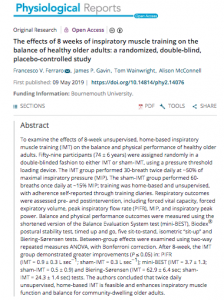 The article titled “The effects of 8 weeks of inspiratory muscle training on the balance of healthy older adults: a randomized, double-blind, placebo-controlled study” has been published by Physiological Reports.

 Alzheimer’s Research UK have opened applications to the Inspire Fund, their new public engagement grant scheme, to support more people to engage the public with dementia and research into the condition.

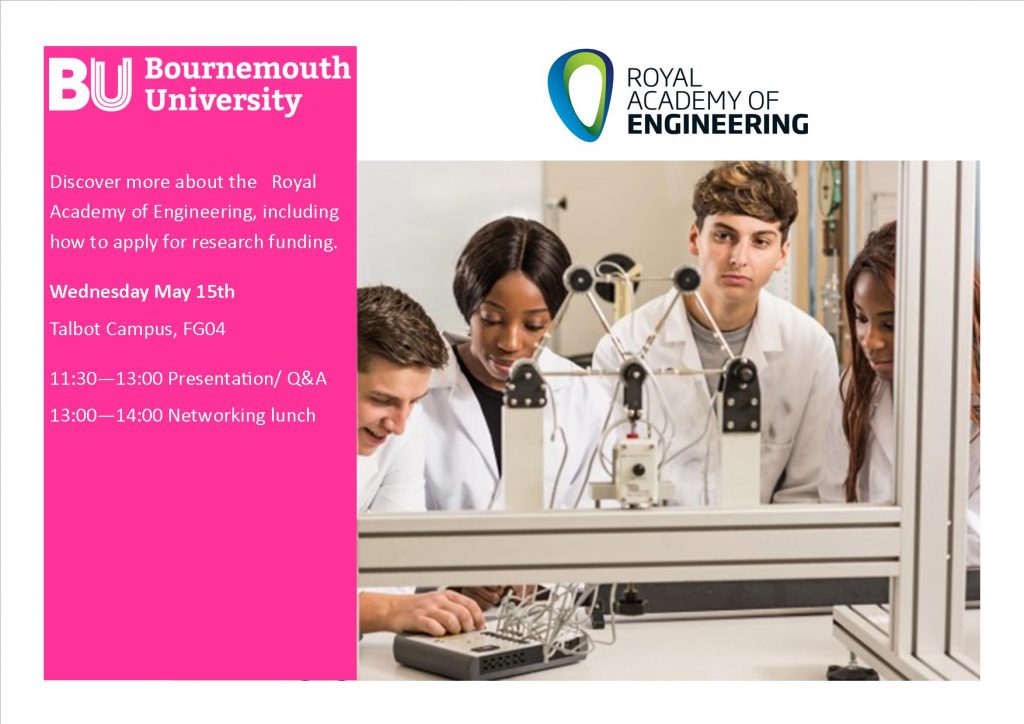 Engineering matters. It underpins our daily lives, drives economic growth, plays a critical role in addressing major societal challenges and helps ensure our readiness for the future, from providing a sustainable supply of food, water and clean energy, to advancing healthcare, and keeping us safe and secure.


 Yesterday the Nepal Journal of Epidemiology published its latest issue which included the paper on ‘Post-Traumatic Stress Disorder among the Flood Affected Population in Indian Subcontinent’ [1]. This Short Communication is co-authored by Prof. Edwin van Teijlingen and two members of the Visiting Faculty in our Faculty of Health & Social Sciences, namely: Prof. Padam Simkhada and Dr. Brijesh Sathian. The Nepal Journal of Epidemiology is an Open Access journal hence this paper is freely available for anybody with internet access to read.
















 REF mock exercise 2026 – nominate your research outputs on BRIAN
 ESRC Festival of Social Science 2026: Application Deadline Extended to Thursday 25 June 2026
 First publication for two CMWH PhD students
 SPROUT Returns: Designing Sustainability in Research Practice – Wednesday 20 May 12-2pm
 Reminder: Register for the ESRC Festival of Social Science 2026 Information Session
 ECR Funding Open Call: Research Culture & Community Grant – Apply now
 ECR Funding Open Call: Research Culture & Community Grant – Application Deadline Friday 12 December
 MSCA Postdoctoral Fellowships 2025 Call
 ERC Advanced Grant 2025 Webinar
 Update on UKRO services
 European research project exploring use of ‘virtual twins’ to better manage metabolic associated fatty liver disease