Today Discover Public Health published a new joint paper written by University Hospitals Dorset NHS Foundation Trust (UHD) and Bournemouth University staff.  This latest paper ‘The evolving relationship between public health and midwifery in the United Kingdom’ [1] appeared in the open access journal Discover Public Health. The authors are: Beth Fletcher, Public Health Lead Maternity Services at UHD, Jillian Ireland, bank midwife and former Professional Midwifery Advocate at UHD as well as Visiting Faculty in BU’s Faculty of Health, Environment & Health Sciences, and Prof. Edwin van Teijlingen, co-director of BU’s Centre for Midwifery & Women’s Health.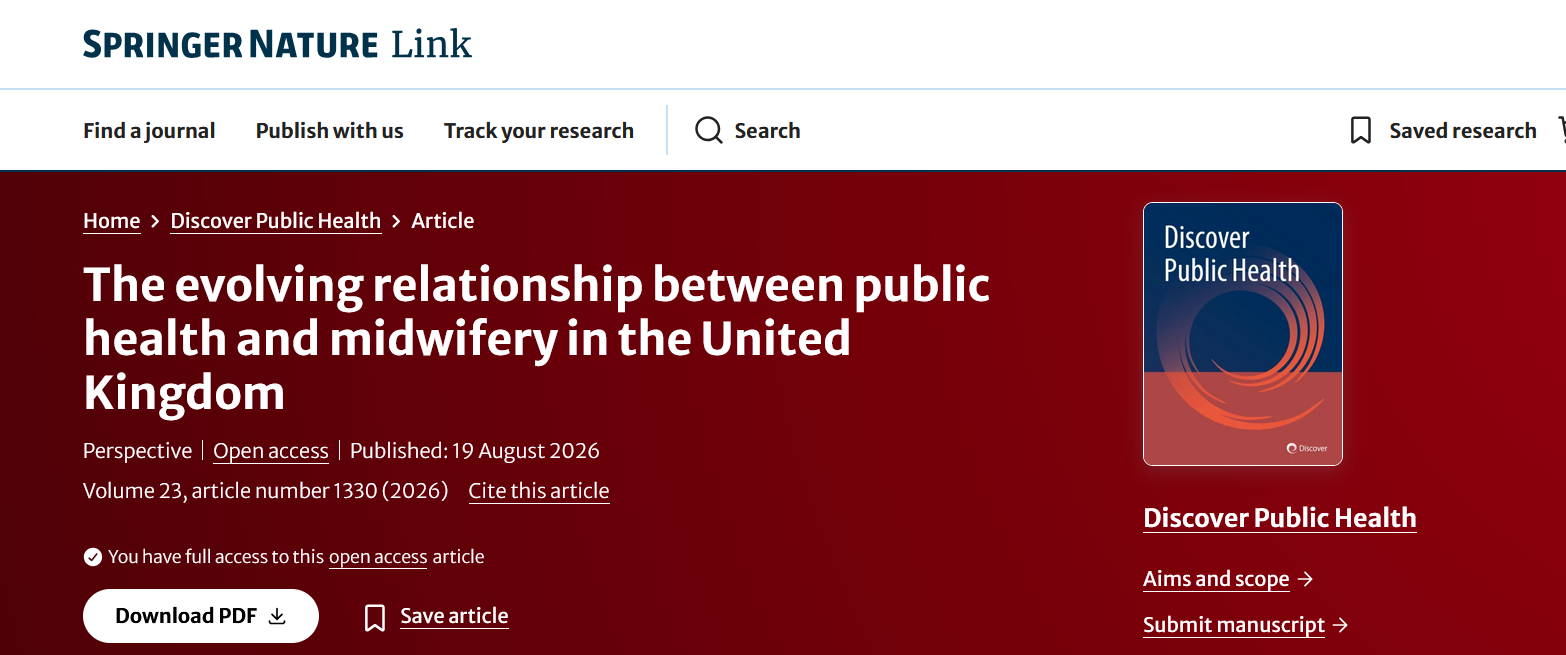
The authors had originally submitted the paper under the title ‘UK Midwifery and Public Health: Perfect partners or unhappy bedfellows?’ but one of the reviewers (and the editor) thought the more neutral ”The evolving relationship between public health and midwifery in the United Kingdom’ was better suited.
There is a cautionary tale as the authors were under the impression, at the time of submission, that Discover Public Health was still a journal in which one could publish without paying a so-called APC (article Processing Charge). It turned out that this was no longer the case, and although Bournemouth University has a deal with Springer, the publisher of Discover Public Health, this is only to the value of 15% of the APC. Since publising in the journal is expensive at £ 1,790.00 per article Bournemouth University had large additional amount.
References:
- Fletcher, B., Ireland, J., van Teijlingen, E. (2026) ‘The evolving relationship between public health and midwifery in the United Kingdom, Discover Public Health, 23;1330. https://link.springer.com/article/10.1186/s12982-026-02740-1









 National Postdoc Appreciation Week 2026: The Changing Landscape of Postdoc Careers
 NIHR Insight South West Central Conference 2026 at Bournemouth University
 BU PhD student presented at World Safety Conference in South Africa
 National Research Supervision Recognition: Apply Now & Join the Supporting Workshop on 16 September
 Horizon Europe Cluster 3 (Civil Security for Society) 2026 Calls Now Open
 MSCA Doctoral Networks 2026 Call Information Webinar
 ESRC Festival of Social Science 2026: Application Deadline Extended to Thursday 25 June 2026
 Reminder: Register for the ESRC Festival of Social Science 2026 Information Session
 ECR Funding Open Call: Research Culture & Community Grant – Apply now
 ERC Advanced Grant 2025 Webinar
 Update on UKRO services
 European research project exploring use of ‘virtual twins’ to better manage metabolic associated fatty liver disease