Category / Art & Design

Cyber Security Seminars: Suggestions for Speakers and Topics

If you have been following my previous posts then you will know that today is the final Cyber Security Seminar for this semester.  We hope you have found the seminar series interesting so far.

We are currently planning the seminars for next semester.  Please get in touch if you have suggestions for potential speakers, or topics you would like to hear more about. Although the budget we have available is modest, we will do our best to accommodate your suggestions.

Cyber Security Seminar: Approaching the Measurement of User Security Behaviour in Organisations

Our final Interdisciplinary Cyber Security Seminar this semester will take place on Tuesday, 10th December at 5pm. The seminar will take place in EB202 in the Executive Business Centre, and will be free and open to all. If you would like to attend, please register at https://www.eventbrite.co.uk/e/interdisciplinary-seminar-in-cyber-security-tickets-9688353125

Our speaker will be Dr. Simon Parkin from UCL. Simon is a Senior Research Associate in the Information Security group at University College London, contributing to the Productive Security project within the Research Institute in the Science of Cyber Security (RISCS). He was previously a member of the Innovation Team at Hewlett Packard Enterprise Security Services (HP ESS) until mid-2012. From 2007 to 2011, Simon was a Postdoctoral Research Associate in the School of Computing Science at Newcastle University, where he also obtained his PhD. His research interests include: IT-security policy management metrics, models and tools; holistic IT-security management principles, and; IT-security risk management approaches and knowledge formalisation.

Abstract: Individuals working within organisations must complete their tasks, and are often expected to do so using secured IT systems. There can be times when the expectations for productivity and security are in competition, and so how would an organisation measure the outcomes in practice? We will review a series of interdisciplinary research efforts that characterise the human factor in IT-security within large organisations, as part of a holistic view of security. There are furthermore a variety of modelling approaches and frameworks that have emerged and informed this view. We will consider the challenges that remain in affording measurement of the human factor in IT-security within organisations, and some of the changes that are required for such activities to be sustainable and effective.

Cyber Security Seminar: Shiny Expensive Things: The Global Problem of Mobile Phone Theft (David Rogers, Copper Horse)

Our next Interdisciplinary Cyber Security Seminar will take place on Tuesday, 3rd December at 5pm. Our seminars are approachable, and require nothing more than a general interest in security, and an enquiring mind.

Our speaker will be David Rogers, who is Founder and Director of Copper Horse Solutions Ltd: a software and security company based in Windsor, UK. Alongside this he teaches the Mobile Systems Security course at the University of Oxford and Chairs the Device Security Steering Group at the GSM Association. He has worked in the mobile industry for over 14 years in security and engineering roles. Prior to this he worked in the semiconductor industry. David’s articles and comments on mobile security topics have been regularly covered by the media worldwide including The Guardian, The Wall Street Journal and Sophos’ Naked Security blog. His book ‘Mobile Security: A Guide for Users’ was published in 2013. David holds an MSc in Software Engineering from the University of Oxford and a HND in Mechatronics from the University of Teesside.

Abstract: Technology in mobile devices is continuing to advance at an incredible rate, but some of the old security themes continue to persist, mobile phone theft being one of them. This talk looks at the topic of mobile phone theft and what industry’s role has been in helping to prevent it and whether that has been entirely successful. The talk looks at what could happen next and whether it is possible to standardise usable anti-theft mechanisms within devices. It will also look at technologies such as biometrics for access control and whether Police and Government actions have been adequate in dealing with the modus operandi of thieves and fencers of stolen phones.

The seminar will take place in EB202 in the Executive Business Centre, and will be free and open to all. If you would like to attend, please register at http://www.eventbrite.co.uk/e/interdisciplinary-seminar-in-cyber-security-tickets-9564165677

Can We Sell Security Like Soap? A New Approach to Behaviour Change

Our next Interdisciplinary Cyber Security Seminar will take place on Tuesday, 19th November at 5pm. Our seminars are approachable, and require nothing more than a general interest in security, and an enquiring mind.

Our speaker will be Debi Ashenden, who is a Reader in Cyber Security and Head of the Centre for Cyber Security and Information Assurance at Cranfield University, based at the Defence Academy of the UK, Shrivenham. Prior to taking up her post at Cranfield University she was Managing Consultant within QinetiQ’s Trusted Information Management Dept (formerly DERA). She has been working in cyber security since 1998 and specialises in the social and behavioural aspects of cyber security. Her research is built on a socio-technical vision of cyber security that sees people as solutions rather than as the problem. Debi is the co-author of, ‘Risk Management for Computer Security: Protecting Your Network and Information Assets’, Butterworth Heinneman (2004).

Talk Abstract: Many organisations run security awareness programmes with the aim of improving end user behaviours around information security. Yet behavioural research tells us that raising awareness will not necessarily lead to behaviour change. This talk examines the challenge of changing end user behaviour and puts forward social marketing as a new paradigm. Social marketing is a proven framework for achieving behavioural change and has traditionally been used in health care interventions, although there is an increasing recognition that it could be successfully applied to a broader range of behaviour change issues. It has yet to be applied however, to information security in an organisational context. This talk will explore the social marketing framework in relation to information security behavioural change and highlight the key challenges that this approach poses for information security managers. We conclude with suggestions for future research.

The seminar will take place in EB202 in the Executive Business Centre, and will be free and open to all. If you would like to attend, we encourage you to register at http://www.eventbrite.co.uk/e/interdisciplinary-seminar-in-cyber-security-tickets-9336229915

BFX Final Films 2013

BFX, Bournemouth’s excting new Visual Effects and Animation Festival, has finished after 6 weeks and a lot of blood, sweat and tears.  The 10 competing teams have finished their films – and they are awesome!

You can watch all of the films here: http://www.bfxfestival.com/bfx-final-films-2013/

There has been a great variety of work, completed in such a small period of time and with only 6-7 machines between them to work and render on – so their time keeping had to be spot on.  Most of these students haven’t even graduated yet.

Truly astonishing what they have managed to produce.

If you like what you see, leave a vote on Youtube; for a bit of fun we have a ‘ Best Film – Public Vote’ category.

Once again thanks to all the feedback and mentoring from lecturers at the NCCA, Arts University Bournemouth and artists from Framestore, Double-Negative, The Mill, MPC, Realise Studios, Hibbert Ralph Animation, Outpost VFX and Cinesite.

If your interested in making similar films, or how the creative industries work – check out our September Festival in Bournemouth 

The BFX Festival is organised by the VFX Hub, funded by BU’s HEIF grant.

Inventions and Intellectual Property Law comes alive at the Festival of Design and Innovation 2013

The annual Festival of Design and Innovation (FoDI) opened on Thursday 20 June 2013.  It was an opportunity for students from the School of Design, Engineering and Computing (DEC) to exhibit their innovations and creations. “A cake icing pen, a computer game controlled by brain power and a glamping pod were just some of the ground-breaking ideas and inventions on display at this year’s FoDI.”

During the academic year, final year students from DEC are paired off with final year students from the Law Department studying Intellectual Property (IP) Law.  The law students are tasked with advising their DEC clients on the protection and exploitation of their innovative creations.  The DEC clients then incorporate the advice which they have received from the ‘lawyers’ into their final year projects.

The IP-DEC Project brings Intellectual Property law to life.  It gives an opportunity for law students to apply IP Law to real-life inventions and in turn it helps the DEC client to understand the importance of strong IP protection when preparing to protect, market and exploit their various creations.

The IP-DEC Project culminates with Awards for the Best DEC Student; Best IP Student and Best IP-DEC Group sponsored by Paul Turner, a retired Patent Attorney.

The Paul Turner Prize for the best IP-DEC Group was awarded at the opening night of the Festival.  The prize was awarded to Law Students Danielle Foster and Luke Trim and DEC Students Benjamen Armstrong, George Burge, Joseph Carter, Markko Reinberg, Nicholas Cron, Thomas Clements and Thomas Reynolds.

Paul Turner with two of the winning DEC students and law students Luke Trim and Danielle Foster.

The Paul Turner Individual Prize for the Best IP Student went to Gemma Jefferies whilst the Paul Turner Prize for the Best DEC Student was awarded to Coco Canessa.  The Individual Prize winners will officially receive their awards at the Graduation Ceremony in November 2013.

The opportunity to apply Intellectual Property Law to real-life scenarios and to real-life innovations together with helping the DEC clients to grasp the importance of IP law, makes this project truly unique.

The IP-DEC Project is co-ordinated by Dr. Dinusha Mendis (Law); Dr. Tania Humphries (DEC); and Dr. Reza Sahandi (DEC).


BU Research Blog Exclusive: Design & Look of eBU leaked

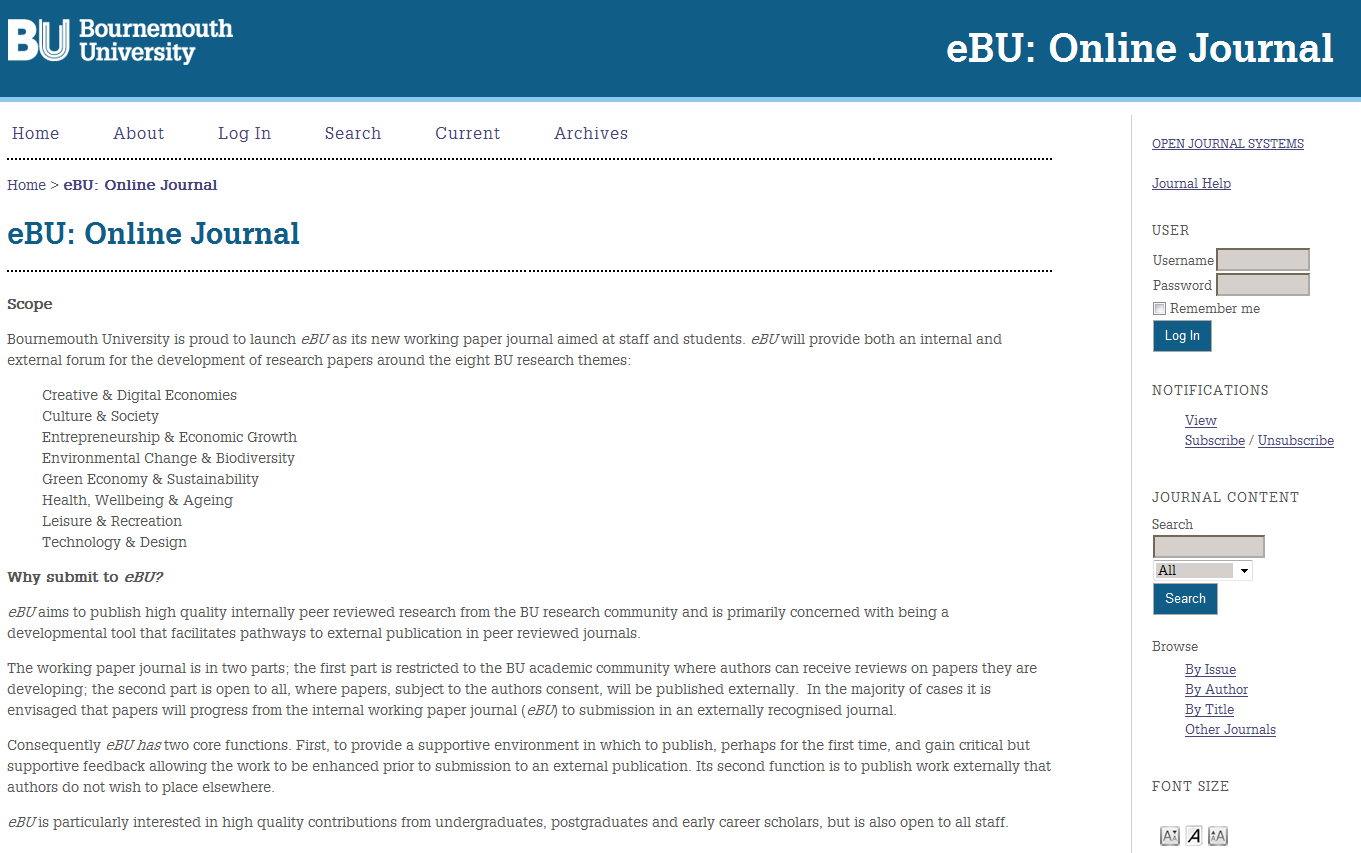
The first screenshot of the eBU interface has been exclusively leaked to the BU Research Blog, and is expected to go viral across the BU community over the next week.

eBU will provide both an internal and external forum for the development of research papers by undergraduate to Professor around the eight BU research themes:

–          Creative & Digital Economies

–          Culture & Society

–          Entrepreneurship & Economic Growth

–          Environmental Change & Biodiversity

–          Green Economy & Sustainability  

–          Health, Wellbeing & Ageing 

–          Leisure & Recreation

–          Technology & Design

Submissions will be open to immediate publication (in a safe internal environment) and open peer review by 2 appropriate BU academics. Authors will be encouraged to act upon these reviews by either reworking papers for submission to an external journal or by opting for publication on the external eBU site.

For BU academics this is a great opportunity to get critical appraisal on your research papers or ideas from colleagues. For academics it also an opportunity to encourage the submission of high quality student output, and possibly to facilitate the co-creation and co-production of publishable material to an external journal or to publish externally with eBU. For students, this is a fantastic opportunity to turn high quality essays or dissertations into scholarly outputs, which will be attractive to employers across many sectors and industries.

If you have any questions or would like to become involved in this exciting venture, please get in touch with me via email aharding@bournemouth.ac.uk or by telephone 01202 963025.