Category / Art & Design

Publishing systematic and scoping reviews to improve your research profile

With the forthcoming REF 2021 in mind we would like to encourage both staff and postgraduate students to consider writing up their literature reviews as journal articles. Systematic and scoping reviews are a great way of publishing quality publications. They are highly valued as REF submissions, especially, but not only, in the health field.

There is plenty of support at Bournemouth University: from academic colleagues, with vast experience in writing reviews, to the library team, who can advise on, for example, developing your systematic search strategy and which databases to search.


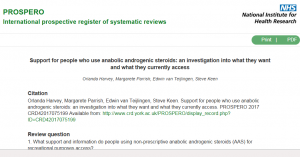
You can start with publishing your review question and research strategy on PROSPERO, international prospective register of systematic reviews. We would like to highlight just one BU example in the field of the social sciences.  FHSS PhD student Orlanda Harvey published her proposed review ‘Support for people who use anabolic androgenic steroids: an investigation into what they want and what they currently access’ late last year on PROSPERO [1].

You might like to have a look at reviews published by Bournemouth University staff, which can be found by searching BURO, our institutional repository of research outputs. Moreover, BU academics have published several methods papers on the doing and writing systematic reviews [2-4].


Information about searching the literature for systematic reviews is available on this guide by the library team.


Other pages with useful information include:


Hopefully we have encouraged you to think about publishing your literature reviews as separate articles, and to seek help early in that process!


José López Blanco & Edwin van Teijlingen


For further information, please contact:

José López Blanco, Faculty Librarian (Health and Social Sciences), Library & Learning Support, Academic Services at tel 67350 or email:  hsslibteam@bournemouth.ac.uk


References:

  1. Harvey, O., Parrish, M., van Teijlingen, E., Keen., S. (2017) Support for people who use anabolic androgenic steroids: an investigation into what they want and what they currently access. PROSPERO 2017 CRD42017075199 Available from: http://www.crd.york.ac.uk/PROSPERO/display_record.php?ID=CRD42017075199
  2. van Teijlingen E., Napper, M., Bruce, J., Ireland. J. (2006) Systematic reviews in midwifery, RCM Midwives Journal 9(5): 186-188.
  3. van Teijlingen, ER, Simkhada, B., Ireland J., Simkhada P., Bruce J. (2012) Evidence-based health care in Nepal: The importance of systematic reviews, Nepal Journal of Epidemiology 1(4): 114-118.
  4. Stewart, F., Fraser, C., Robertson, C., Avenell, A., Archibald, D., Douglas, F., Hoddinott, P., van Teijlingen, E., Boyers, D. (2014) Are men difficult to find? Identifying male-specific studies in MEDLINE and Embase, Systematics Reviews 3,78.

BU NCCA Undergraduate Student Success at SIGGRAPH’18

The 45th International Conference & Exhibition on Computer Graphics and Interactive Techniques  (SIGGRAPH’18), the international annual conference of the Special Interest Group on Computer Graphics and Interactive Techniques of the Association for Computing Machinery (ACM, the world’s foremost computing society) was held in Vancouver in August.

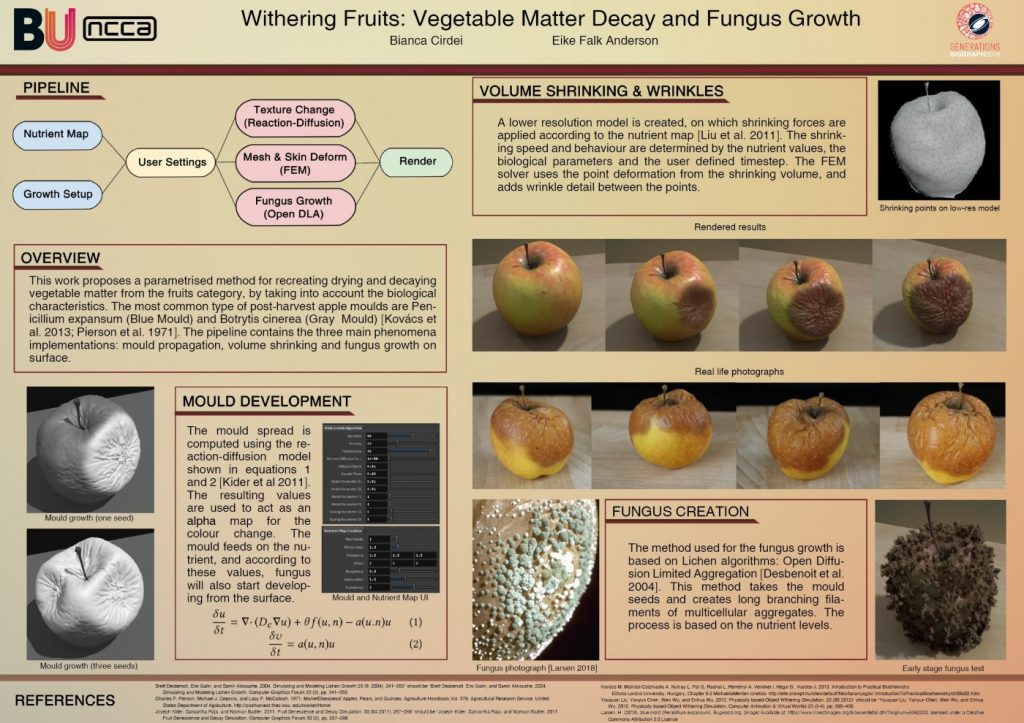
Among the work showcased at the conference was the poster “Withering fruits: vegetable matter decay and fungus growth” by Bianca Cirdei  (Computer Visualisation and Animation – CVA, Level 6) from this year’s graduating cohort from the National Centre for Computer Animation (NCCA, Faculty of Media and Communication) and co-authored by Dr Eike Falk Anderson.

Poster presented at SIGGRAPH

The work, which was based on Bianca’s Innovations Project unit results extends and improves existing methods for procedurally simulating decaying fruit for use in computer graphics and visual effects, focusing on artist directability and visual fidelity. As the resulting visuals are quite impressive, this project was also one of the ten submissions featured in the SIGGRAPH’18 posters preview video.

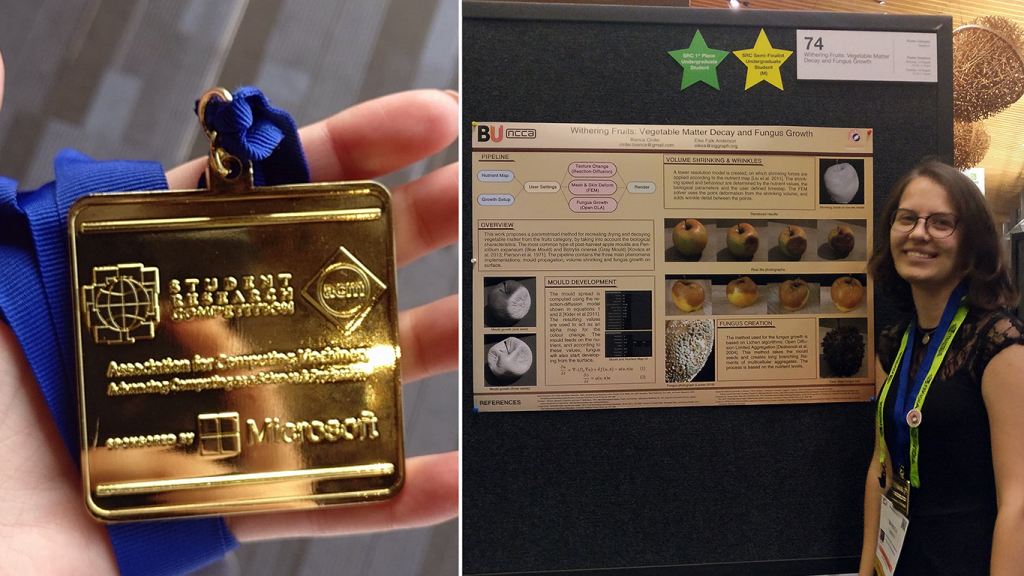
Of the 74 posters presented at this year’s SIGGRAPH conference, 16 submitted posters, including Bianca’s contribution (poster 74), were invited to the first round of the prestigious ACM Student Research Competition (SRC) sponsored by Microsoft. Bianca’s submission was one of only four European semi-finalists and of those the only one from a UK institution. After presenting the work to a panel of experts, the submission made it into the second round and after the ACM Student Research Competition Final Presentation it won first place in the undergraduate category.

1st placed Undergraduate Poster at the SIGGRAPH'18 Student research Competition

After Ben Knowles (with Dr Oleg Fryazinov) who was awarded second place at SIGGRAPH’15 for “Increasing realism of animated grass in real-time game environments“, Teemu Lindborg and Philip Gifford (with Dr Oleg Fryazinov) who were semi-finalists at SIGGRAPH’17 for “Interactive parameterised heterogeneous 3D modelling with signed distance fields” and Quentin Corker-Marin (with Dr Valery Adzhiev and Professor Alexander Pasko) who achieved second place at SIGGRAPH’17 for “Space-time cubification of artistic shapes“, this is the first time that an NCCA student has won first place in this prestigious competition.

The work will now progress to the next stage of the competition, the Grand Finals in 2019, in which the first placed entries from almost 30 major ACM conferences will compete with one another.

New publication by NCCA: 4D Cubism as a novel artistic technology

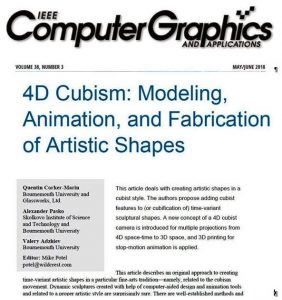
“IEEE Computer Graphics and Applications”, an influential magazine with a wide readership in both academia and industry, has just published the paper “4D Cubism: Modeling, Animation and Fabrication of Artistic Shapes”.

This multidisciplinary paper proposing a novel technology on the edge of art and science has been written by a team from the National Centre for Computer Animation (NCCA) of the Faculty of Media and Communication. The authors are Quentin Corker-Marin, Prof Alexander Pasko, and Dr Valery Adzhiev.

The paper has a non-trivial history. Initially, there was an UG student project (“Innovations” unit, “Computer Visualisation and Animation” course, Level 6) that was submitted as a Poster to the ACM SIGGRAPH 2017 conference in Los Angeles. As it was reported in the Research Blog in September 2017, Quentin was awarded there the second prize in the prestigious ACM Student Research Competition sponsored by Microsoft. Then a full-scale paper was submitted to the top magazine, and after successful peer-reviewing it was accepted and published. As to Quentin, in the end of 2017 he graduated from NCCA with a first class honours degree in computer visualisation and animation and works now in London as a 3D Artist for an award-winning production company Glassworks.

References

Locative Narrative: Location Aware Interactive Storytelling Research in Creative Technology

We would like to invite you to the latest research seminar of the Centre for Games and Music Technology Research.


Title: Locative Narrative: Location Aware Interactive Storytelling Research in Creative Technology​


Speaker: Dr Charlie Hargood

Senior Lecturer In Games Technology, SciTech


Time: 2:00PM-3:00PM


Date: Wednesday 2 May 2018


Room: TAG 02 (Tolpuddle Annex)


Abstract:

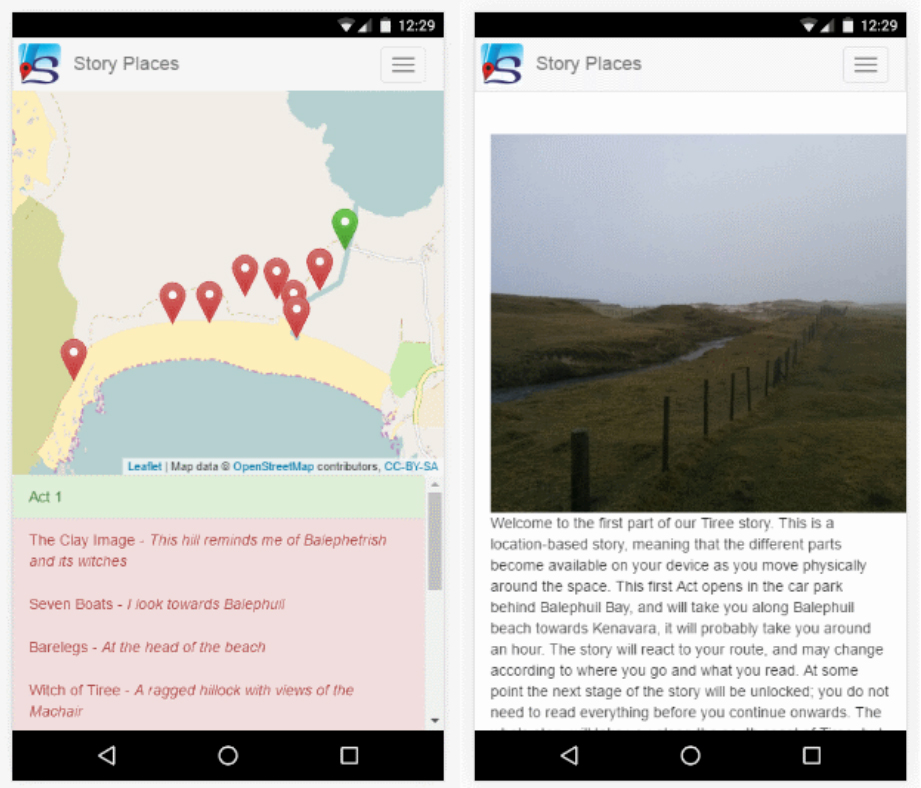
Locative Narrative is a growing research area concerned with digital interactive stories which respond to the reader’s location. In this talk we reflect on recent research in this space, its outcomes, and how it has led to the current programme of research on narrative systems within the creative technology department.


We hope to see you there.

Fake conferences are not fake news: beware predatory conferences

Introduction

Academic have been warned for a decade about predatory Open Access publishers (van Teijlingen 2014). These are commercial organisations charging academics a publication fee on submission of their manuscripts with a promise to publish their work quickly online. The problem is twofold: first, these commercial organisations don’t offer proper peer-review and editorial quality assurance; and secondly, academic are being tricked into believing the journal is a legitimate scientific publication.  The second author receives on average six to eight invitations a week to publish in this kind of predatory journals – see below for examples. The first author, who despite having not worked in an academic institution for over three years, still receives such invitations to publish in ‘Journal X’.

Predatory conferences
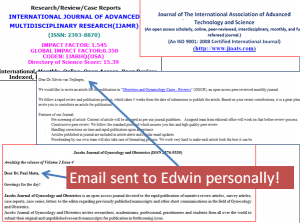
A similar phenomenon to predatory journals is the predatory conference (Moital 2014; Nobes 2017; Grove 2017). These are pretend academic conferences of questionable value, established first and foremost to make money, not for the greater good of the academic discipline.
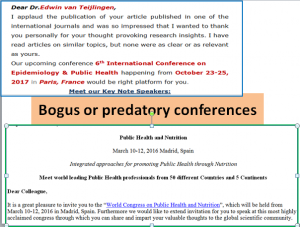
Both authors have received bogus and legitimate invitations to attend conferences. A predicament with such an invitation, which 99% of time arrives by email, is that it is not easy to distinguish between fake and real offers. For example, the first author recently received an offer (at short notice), to attend a conference in Miami in November 2017 (see below). This was on the back of an editorial he had published couple of months earlier. For a career researcher going from contract to contract, the appeal of being invited to present a keynote at a conference can be flattering, far less an honour and a boost for one’s career. Therefore, while the idea that if it seems too good to be true, is a prudent one to hold; there is also a temptation to follow through.

The author replied to the request quizzing the reason for the invite out of the blue. The answer was less than convincing, and a swift email by the author saying “Don’t tell me… You are offering me a keynote with travel and accommodation… Lol!!” called their bluff and ended correspondence.
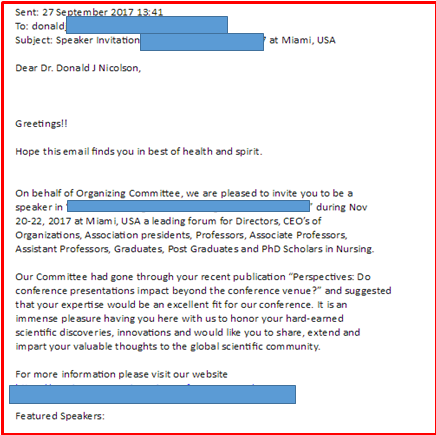
But digging a little deeper he found there was a webpage dedicated to taking payments to attend the conference. In the digital world, a fool can be easily and quickly separated from his or her money.

Of course, it may have been a real conference at a real venue, and they really wanted him to speak. But discerning this is not easy at first…

Some of the warning signs/What to look out for

  • The conference email invitation looks very convincing (if not don’t even read it!).
  • The venue is good location as Nobes (2017) highlighted, “the organizers are more interested in marketing the tourist destination rather than the academic value of the conference”.
  • The conference covers too many different aspects or topics, as if the advert is designed to catch the eye of many people as possible who are vaguely connected to the discipline.
  • Mentions on associated predatory journals and ‘important’ organisations in the discipline.
  • Email and bank accounts that don’t look professional/ official.
  • Little mention of attendance fees, but after acceptance emails demanding a high conference fee and other charges.
  • Conference organisers are not academics, or unknown names.
  • Conference does not peer-review submission/ not provide proper editorial control over presentations
  • Signs of copying of names of existing academic conferences or scientific organisation and even copying of their webpages
  • Even more advertising than normal at a scientific conference.

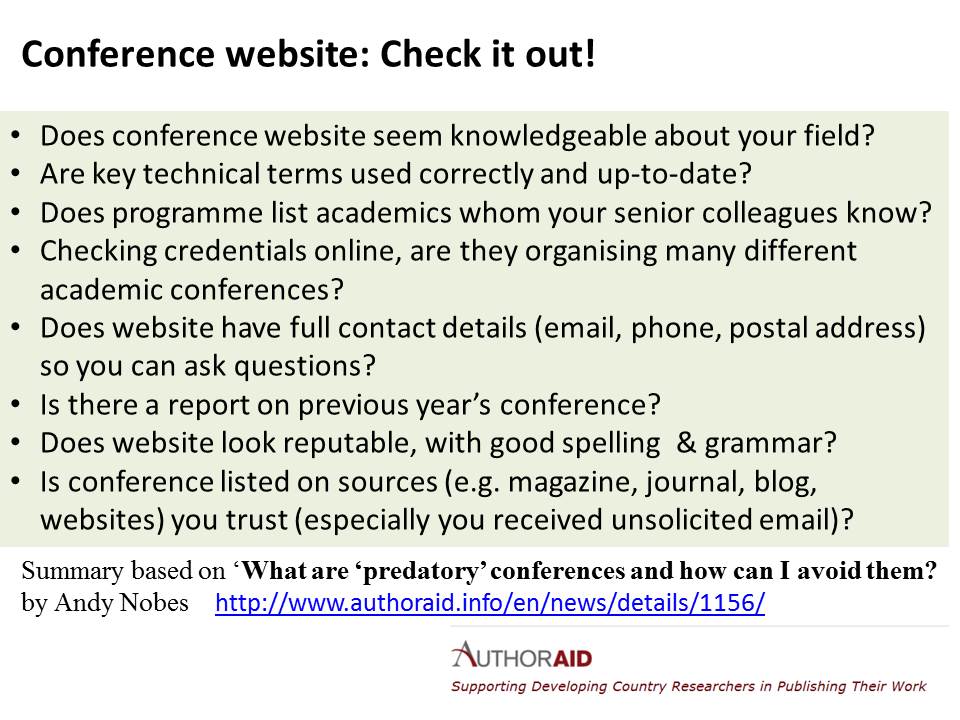
Furthermore, Andy Nobes (2017) offered some helpful advice on quality of the conference websites in the list below. Andy is based at AuthorAID, a global network providing support, mentoring, resources and training for researchers in developing countries.
Who is at risk of falling for predatory conferences?

Academics need to be aware of money-making conferences and meetings without a true commitment to science. But some academics might be more at risk than others. Young researchers, PhD students and fledgling academics, living from contract to contract may feel any conference attendance is a potential career boost. Thus, such an invitation might seem flattering and an opportunity to good to miss. A way to show that he or she is a capable and independent academic.

Final thoughts

Most academics go to conferences for a combination of presenting their work to get critical feedback, making new contacts, sharing ideas and to be inspired. With such broad combination of motivating factors, the exact purpose of conferences is difficult to ascertain because there is no a priori agreed role and value of conferences (Nicolson, 2017a). However, there is evidence that academic conferences function to facilitate commodity transactions, be that knowledge, tools, skills, reputations, or connections, which reflects the neoliberal ethos in the modern academy (Nicolson 2017b). The predatory conference can be viewed in this light, where academia is more and more focused on generating revenue. It is at best scurrilous, and worst, criminal, for organisations to make money using such a confidence trick.  Always check which conferences are organised and advertised by recognised scholarly organisations in your own discipline. If uncertain ask a more experienced academic, a senior colleague or mentor.


Donald J. Nicolson

(Health Services Researcher, NHS Fife, and Independent Scholar; twitter @_mopster )

Edwin R. van Teijlingen

(Centre Midwifery, Maternal & Perinatal Health)


References:

Moital, M. (2014) Ten Signs of a Bogus/Fake Conference.

Grove, J. (2017) Predatory conferences ‘now outnumber official scholarly events’  (26th Oct.)

Nicolson, D.J. (2017a) Do conference presentations impact beyond the conference venue? Journal of Research in Nursing. 22(5), pp.422-425.

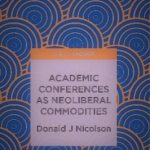
Nicolson, D.J. (2017b) Academic Conferences as Neoliberal Commodities, Palgrave Macmillan

Nobes, A. (2017) What are ‘predatory’ conferences and how can I avoid them?

van Teijlingen, E. (2014) Beware of rogue journals.
 

Performance of Gemmeleg at NIME 2017, Copenhagen

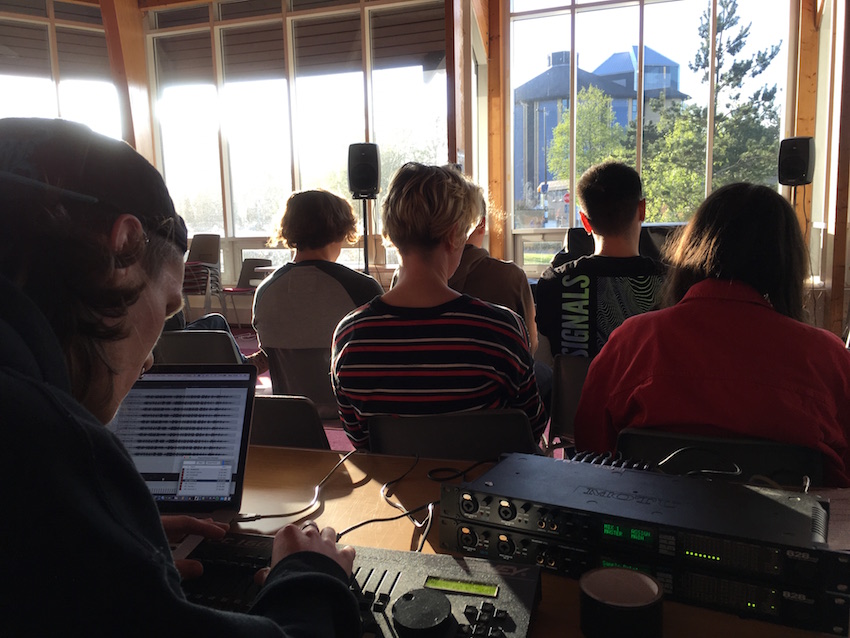
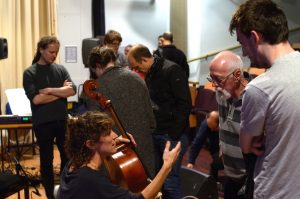
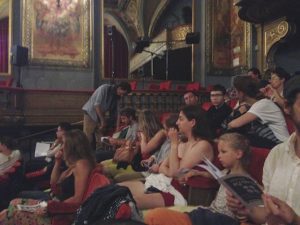
Rehearsal in the Black Diamond


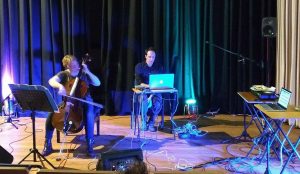
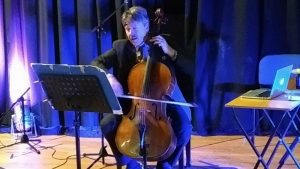
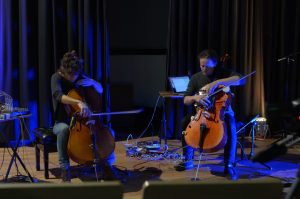
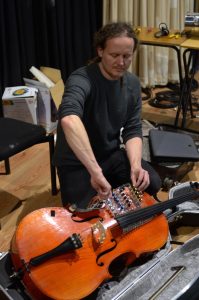
Gemmeleg is a composition by Laura Reid cellist/composer for the performance system The Feral Cello developed by Dr Tom Davis.

This piece was performed at the prestigious Black Diamond concert venue in Copenhagen as part of the international conference on New Interfaces for Musical Expression, NIME.

The Feral Cello is a performance system developed by Tom Davis that incorporates machine listening and actuated feedback to alter the response of an acoustic cello in real time during a performance. A description of the performance system was also presented as a poster at the conference.

Previous performances have been at NoiseFloor 2017, Staffordshire University.

The Black Diamond Venue

Dr Ambrose Seddon premieres new composition at Klang! Électroacoustique festival 2017, Montpellier, France

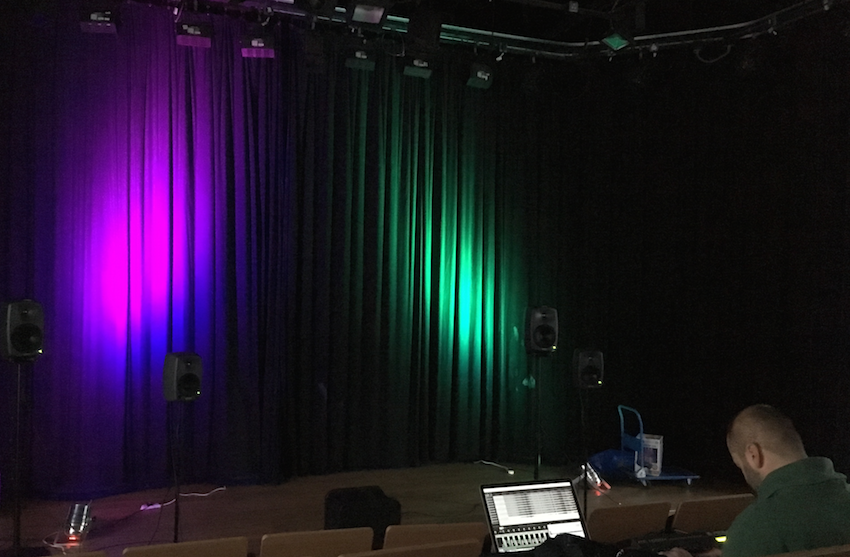
On 2nd June 2017 Ambrose Seddon (Creative Technology, EMERGE) premiered his new electroacoustic composition Traces of Play at the Klang! Électroacoustique music festival in Montpellier, France. The festival took place over five nights at Opéra Orchestre National Montpellier.

Ambrose’s work was programmed and performed alongside many respected composers from the field of electroacoustic music. The composition was created for 4 channels of audio and was spatialised (diffused) live in concert over the 58-channel Klang! ‘acousmonium’ (loudspeaker system).

Initial work on the composition was carried out during two short residencies at Elektronmusic Studion (EMS), Stockholm with support from Creative Technology.


Ambrose Seddon is a lecturer in Music and Audio Technology at BU.


British Academy Visit – reserve your place now!

british_academy_logoThe British Academy is returning to BU on 8 March 2017.  This is an invaluable opportunity to find out more about the international and domestic funding available through the organisation.  For those of you who are not familiar with the British Academy, it is the UK’s leading independent body for the humanities and social sciences, promoting funding, knowledge exchange and providing independent advice within the humanities. 

The session will last just over  1 hour (13:00-14:15) and will comprise a presentation focusing on international and domestic funding opportunities along with an overview of the British Academy, followed by a Q&A session.

Representatives of the British Academy will be available to answer any individual queries not covered in the presentation or Q&A session, and members of the Research and Knowledge Exchange Office will be on hand should you wish to discuss BU’s processes for bidding to the organisation.

Places for this event can be reserved through Organisational Development here.


Access to Music: Music Technology in Special Educational Needs Settings

Tom Davis project photo 0217

Access to Music is a HEIF funded project situated in the department of Creative Technology and the Emerge Research Group.

The aim of this project is to work collaboratively with local schools for children with Special Educational Needs (SEN) to increase access to music technology.

UK SEN schools face multiple barriers when using music and music technology to engage and improve the wellbeing of children with Severe Learning Difficulties (SLD), Profound, Multiple Learning Difficulties (PMLD) or issues such as Attention Deficit Hyperactivity Disorder (ADHD). This project will explore and identify these barriers in order to develop a suitable solution to promote and unlock new avenues for music technology for both children and music specialists in the surrounding SEN schools.

So far we has initiated links with Montacute & Linwood schools to establish collaborative projects working with a range stakeholders within these settings.  Each school has its own unique barriers to content with, so the main challenge is to come up with bespoke solutions for each setting.

Key people involved in the running of this project are Dr Tom Davis, PI,  Phil Hallet Co-I (CODA music coda.org.uk) & Dr Ane Bevan Co-I.

The project is supported by Dan Pierson who has been employed as a research assistant.

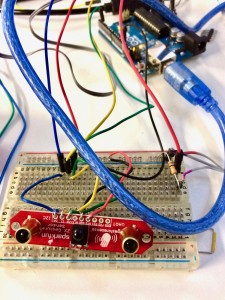
Recent activity has been a 2 day hackathon (see photo) to prototype possible technical solutions to issues identified by stakeholders.

Outcomes from this project will be presented in a number of settings including a Festival of Learning event on 8th July 2017.

Wanted! External Bid Writers

rkeo-dev-logo-banner


As part of the Research and Knowledge Exchange Development Framework, Bournemouth University is expanding its pool of external bid writing expertise, through a tendering process.

If you have worked with a good bid writer or, as an external subscriber to this blog, you have written successful research funding applications, please contactus in the Research & Knowledge Exchange Office

We are particularly interested in those who can provide short courses, one-to-one support, bid writing retreats, application review or a range of these and related activities.

Examples of key funders include:

  • British Academy
  • European Commission funds including Horizon 2020
  • Innovate UK
  • Leverhulme Trust
  • National Institutes of Health and other US Federal funders
  • Research Councils
  • Royal Society
  • Wellcome Trust
  • etc.

We look forward to hearing from you.

From Draft to REF with CEMP’s new Publishing Partnership Initiative

Do you have an incomplete paper that you’ve been sitting and can’t seem to finish? Have you recently presented at a conference, but haven’t written-up a paper out of your presentation yet? Did you get a rejection and are struggling to get motivated again? Or maybe you’ve written a couple chapters of your PhD and are hoping to turn one into a publication?

Whatever the scenario, CEMP’s new Publishing Partnership Initiative (PPI) can help you to collaborate with another researcher to turn your ideas into a viable REF-ready journal article. And did we mention, you can win a free dinner for two?


Publishing Partnership Workshop
Thursday January 26th
Talbot Campus, BU
11:00-14:00
WG 05 (Weymouth House)

To launch the initiative, this workshop will introduce the Publishing Partnership Initiative and help you find a good match to develop your REF output. We will also discuss strategies and tips for working toward REF submissions:

11:00-11:15 Introductions and coffee

11:15-11:30 Welcome to the PPI scheme (Anna and Richard)

11:30-12:00 Hear No Evil, See No Evil: What you need to know about REF and the Sterne review (Julian & Dan J)

12:00-12:45 Interactive session: Strategies for fitting writing into our busy schedules (Brad & Karen)

12:45-13:15 Academic Match.com: Finding the right journal and writing partner for your research output (Anna and Isa)

13:15-14:00 Catered planning lunch with our publishing partners

To participate: Send a 500+ word rough draft or outline of a potential research paper to afeigenbaum@bournemouth.ac.uk AND Richard rberger@bournemouth.ac.uk by Monday 23rd January 2017. This might be an abandoned draft, a conference version of a paper presentation or an outline for a possible research paper. At this stage, any draft you have might be gold, so don’t be shy!

To be a mentor or writing partner: Send an email with a list of your research and methodological areas of expertise to afeigenbaum@bournemouth.ac.uk AND Richard rberger@bournemouth.ac.uk by Monday 23rd January 2017.


Eat your Success! Partners who successfully submit a paper to a peer review journal within the 5 month time frame will receive a ‘dinner for two’ voucher to celebrate their success.*

*Voucher is worth up to £45.00. Does not cover alcoholic beverages.


We will aim to pair colleagues around expertise either in the same research area or in relation to the methodological approach. At least one partner will be accustomed to journal publishing and the REF process, as well as to the challenges facing us to find the time to research and write. In the first instance, this workshop is geared toward UoA 25, 34 and 36 entries (covering Education, Media Practice and Media Studies). For full details see: http://www.civicmedia.io/events-2/publishing-partnership-initiative/

*This project was initiated by Anna Feigenbaum and Richard Berger. It is supported by the UoA 25 development fund, CEMP, the Civic Media Hub & the Journalism Research Group.