Category / Art & Design

New publication by NCCA academics and students in the top journal

The SIAM Journal on Imaging Sciences (“SIIMSa broad authoritative source for fundamental results in imaging sciences, with a unique combination of mathematics and applications”), an influential Q1-journal with a significant Impact Factor and SJR indicator, has just published the paper “Automatically Controlled Morphing of 2D Shapes with Textures” authored by NCCA academics and students. This multidisciplinary paper proposes a novel theoretical and practical framework resulting in a suite of mathematically substantiated techniques important in the context of 2D imagery, artistic design, computer animation, and emerging streaming and interactive applications.

The paper has a rather long and non-trivial history related to the fusion of academic and student research. Initially, NCCA UG student Felix Marrington-Reeve (“Computer Visualisation and Animation” course, Level 6) undertook his R&D project within the “Innovations” unit and got some interesting results. The 8-page paper written on the basis of his project and co-authored with his supervisors Dr Valery Adzhiev and Prof Alexander Pasko, was, however, rejected in 2017 by two international conferences (they were prepared to accept a short version but the authors thought the work deserved a better fate).

After Felix’s graduation (he started working in a leading production company Framestore) Dr Oleg Fryazinov and PhD student Alexander Tereshin joined the project team. A lot of additional theoretical and practical work had been done, and in February 2019 the radically modified and extended 30-page version was submitted to SIIMS. After two-stage rigorous peer-reviewing process, in October 2019 the paper was accepted by this prestigious journal.

References:

  • Tereshin, A., Adzhiev, V., Fryazinov, O., Marrington-Reeve, F., Pasko, A. (2020). “Automatically Controlled Morphing of 2D Shapes with Textures”, The SIAM Journal on Imaging Sciences, Vol. 13, No. 1, pp. 78-107. DOI: 10.1137/19M1241581
  • Full text of the paper: http://eprints.bournemouth.ac.uk/33366/

Growing wealth of migration publications at Bournemouth University

Yesterday saw the latest publication based on Bournemouth University (BU) migration research.  The international journal BMC Public Health published our quantitative paper ‘Psychological morbidity in Nepali cross-border migrants in India: a community based cross-sectional study’ [1].  This scientific article highlights that since Nepali migrants can freely cross the border with India and hence work and stay there, they are largely undocumented. The majority of these Nepali migrant workers is involved in semi-skilled or unskilled jobs with limited labour rights and social security, which predisposes them to psychological distress. The paper assessed the prevalence of and factors associated with psychological morbidity among Nepali migrants upon their return from India.

Just a few days ago the UN Migration Agency in Nepal IOM (International Organization for Migration) published ‘Research on the Health Vulnerabilities of the Cross-Border Migrants from Nepal‘, an online report to which BU academics (Aryal, Regmi & van Teijlingen) had contributed [2].  Just recently we had published the qualitative sister paper on Nepali migrants working and living in India. [3].  Whilst Dr. Nirmal Aryal was the lead author on a paper highlighting the need for more research specifically focusing on adolescents left behind by migrant workers [4]. Earlier this year BU PhD graduate Dr. Pratik Adhikary published his latest paper from his thesis, the paper is called ‘Workplace accidents among Nepali male workers in the Middle East and Malaysia: A qualitative study’ and was published in the Journal of Immigrant & Minority Health [5].

Last year was also a very good year for BU migration research, including a systematic review on sex trafficking (perhaps the worst kind of migrant workers) [6], an earlier research paper by Dr. Adhikary with his PhD supervisors [7], and one paper on Nepali female migrants workers in the Middle-East & Malaysia [8].  Earlier BU academics published on general health issues and accidents among Nepali migrant workers in Malaysia, Qatar & Saudi Arabia [9-10], Nepali migrants in the UK [11-12] , other papers included: a call for action on Public Health [13]; a systematic review [14]; a paper on migrant workers’ spouses [15]; migrant health workers in the UK [16-17]; migration and tourism industry [18-20]; migrants and space in Italy [21-22]; an anthropological perspective on migration [23]; a media studies’ perspective [24]; and archaeological perspective [25]; and a socio-economic perspective [26].  No doubt there are several other publications I have forgotten or I am simply unaware missed in this list.


Prof. Edwin van Teijlingen

Centre for Midwifery, Maternal & Perinatal Health


References:

  1. Dhungana, R.R., Aryal, N, Adhikary, P., KC, R., Regmi, P.R., et al. (2019) Psychological morbidity in Nepali cross-border migrants in India: A community-based cross-sectional, BMC Public Health 19:1534
  2. International Organization for Migration (2019) Research on the Health Vulnerabilities of the Cross-Border Migrants from Nepal, Kathmandu, Nepal: International Organization for Migration.
  3. Regmi, P., van Teijlingen, E., Mahato, P., Aryal, N., Jadhav, N., Simkhada, P., Syed Zahiruddin, Q., Gaidhane, A., (2019) The health of Nepali migrants in India: A qualitative study of lifestyles and risks, Journal of Environmental Research & Public Health 16(19), 3655; doi:10.3390/ijerph16193655.
  4. Aryal, N., Regmi, P.R., van Teijlingen, E., Simkhada, P., Mahat, P. (2019) Adolescents left behind by migrant workers: a call for community-based mental health interventions in Nepal. WHO South East Asia Journal of Public Health 8(1): 38-41.
  5. Adhikary P, van Teijlingen E., Keen S. (2019) Workplace accidents among Nepali male workers in the Middle East and Malaysia: A qualitative study, Journal of Immigrant & Minority Health 21(5): 1115–1122. https://link.springer.com/article/10.1007/s10903-018-0801-y
  6. Simkhada, P., van Teijlingen, E., Sharma, A., Bissell, P., Poobalan, A., Wasti, S.P. (2018) Health consequences of sex trafficking: A systematic review, Journal of Manmohan Memorial Institute of Health Sciences, 4(1): 130-149.
  7. Adhikary P, Sheppard, Z., Keen S., van Teijlingen E. (2018) Health and well-being of Nepalese migrant workers abroad, International Journal of Migration, Health & Social Care 14(1): 96-105. https://doi.org/10.1108/IJMHSC-12-2015-0052
  8. Simkhada, P.P., van Teijlingen, E.R., Gurung, M., Wasti, S. (2018) A survey of health problems of Nepalese female migrants workers in the Middle-East & Malaysia, BMC International Health & Human Rights 18(4): 1-7. http://rdcu.be/E3Ro
  9. Adhikary, P, Sheppard, Z., Keen, S., van Teijlingen, E. (2017) Risky work: accidents among Nepalese migrant workers in Malaysia, Qatar & Saudi Arabia, Health Prospect 16(2): 3-10.
  10. Adhikary P., Keen S., van Teijlingen E (2011) Health Issues among Nepalese migrant workers in Middle East. Health Science Journal 5: 169-75. www.hsj.gr/volume5/issue3/532.pdf
  11. Adhikary, P., Simkhada, P.P., van Teijlingen E., Raja, AE. (2008) Health & Lifestyle of Nepalese Migrants in the UK BMC International Health & Human Rights 8(6). Web address: www.biomedcentral.com/1472-698X/8/6
  12. van Teijlingen E, Simkhada, P., Adhikary, P. (2009) Alcohol use among the Nepalese in the UK BMJ Rapid Response: www.bmj.com/cgi/eletters/339/oct20_1/b4028#223451
  13. Aryal, N., Regmi, PR., van Teijlingen, E., Simkhada, P., Adhikary, P., Bhatta, YKD., Mann, S. (2016) Injury and Mortality in Young Nepalese Migrant Workers: A Call for Public Health Action. Asian-Pacific Journal of Public Health 28(8): 703-705.
  14. Simkhada, PP., Regmi, PR., van Teijlingen, E., Aryal, N. (2017) Identifying the gaps in Nepalese migrant workers’ health & well-being: A review of the literature, Journal of Travel Medicine 24 (4): 1-9.
  15. Aryal, N., Regmi, PR., van Teijlingen, E., Dhungel, D., Ghale, G., Bhatta, GK. (2016) Knowing is not enough: Migrant workers’ spouses vulnerability to HIV SAARC Journal of Tuberculosis, Lung Diseases & HIV/AIDS 8(1):9-15.
  16. Scammell, J., 2016. Nurse migration and the EU: how are UK nurses prepared? British Journal of Nursing, 25 (13), p. 764.
  17. Sapkota, T., Simkhada, P., van Teijlingen, E. (2014) Nepalese health workers’ migration to United Kingdom: A qualitative study. Health Science Journal 8(1):57-74.
  18. Janta, H., Ladkin, A., Brown, L., Lugosi, P., 2011. Employment experiences of Polish migrant workers in the UK hospitality sector. Tourism Management, 32 (5): 1006-1019.
  19. Dwyer, L., Seetaram, N., Forsyth, P., Brian, K. (2014) Is the Migration-Tourism Relationship only about VFR? Annals of Tourism Research, 46: 130-143.
  20. Filimonau, V., Mika, M. (2017) Return labour migration: an exploratory study of Polish migrant workers from the UK hospitality industry. Current Issues in Tourism, 1-22.
  21. De Martini Ugolotti, N., 2016. ‘If I climb a wall of ten meters’: capoeira, parkour and the politics of public space among (post)migrant youth in Turin, Italy. Patterns of Prejudice, 50 (2), 188-206.
  22. De Martini Ugolotti, N., 2015. Climbing walls, making bridges: children of immigrants’ identity negotiations through capoeira and parkour in Turin. Leisure Studies, 34 (1), 19-33.
  23. Mai, N., Schwandner-Sievers, S. (2003) Albanian migration and new transnationalisms, Journal of Ethnic & Migration Studies 29(6): 939-948.
  24. Marino, S., Dawes, S., 2016. Fortress Europe: Media, Migration and Borders. Networking Knowledge, 9 (4).
  25. Parker Pearson, M., Richards, C., Allen, M., Payne, A. & Welham, K. (2004) The Stonehenge Riverside project Research design and initial results Journal of Nordic Archaeological Science 14: 45–60.
  26. Chowdhury, M., 2014. Migration, Human Capital Formation and the Beneficial Brain Drain Hypothesis: A Note. Migration & Development, 3 (2), 174-180.

More pilots please!

“More pilots please!” is not a call from British Airways, Ryanair or the Royal Air Force.  No, it a reminder to students to do more piloting in their postgraduate research projects.  Between us we have read many (draft) theses and examined over 60 PhD theses external to Bournemouth University, and it is clear to us that many students do not do enough pre-testing or piloting of their research instruments.  Perhaps they did some piloting or feasibility work for their projects but don’t write enough about it.  Or they present some feasibility or piloting in their thesis but haven’t added references to methodological texts.

The term ‘pilot studies’ refers to mini versions of a full-scale study (also called ‘feasibility’ studies), as well as the specific pre-testing of a particular research instruments such as data collection tools (i.e. questionnaire or semi-structured interview schedule). Pilot studies are key to good study design [1-6].  Conducting a pilot study does not guarantee success in the main study, but it does increase the likelihood of success. Pilot studies have several of important functions in research design and can provide valuable insights to the researcher on both tools and research processes.  We think it is telling that our most cited paper on Google Scholar is not one of our papers reporting research findings but a methods paper highlighting the importance of pilot studies [2].


Professors Vanora Hundley & Edwin van Teijlingen

CMMPH


References:

  1. van Teijlingen E, Rennie, AM., Hundley, V, Graham, W. (2001) The importance of conducting & reporting pilot studies: example of Scottish Births Survey, Journal of Advanced Nursing, 34: 289-95.
  2. van Teijlingen E, Hundley, V. (2001) The importance of pilot studies, Social Research Update Issue 35, (Editor N. Gilbert), Guildford: University of Surrey. Web:  http://www.soc.surrey.ac.uk/sru/SRU35.html
  3. van Teijlingen E, Hundley, V.(2002) ‘The importance of pilot studies’ Nursing Standard 16(40): 33-36. Web: www.nursing-standard.co.uk/archives/vol16-40/pdfs/vol16w40p3336.pdf
  4. Hundley, V., van Teijlingen E, (2002) The role of pilot studies in midwifery research RCM Midwives Journal 5(11): 372-74.
  5. van Teijlingen E, Hundley, V. (2003) Pilot study, In: Lewis-Beck, M., Bryman, A. & Liao, T. (eds.) Encyclopaedia of Social Science Research Methods, Vol. 2, Orego, Sage: 823-24.
  6. van Teijlingen E, Hundley, V. (2005) Pilot studies in family planning & reproductive health care, Journal of Family Planning & Reproductive Health Care 31(3): 219-21.


The importance of preservation and sustainability of digital data in the arts

The AHRC research project, ArtoP: The Visual Articulations of Politics in Nigeria sets out to collect and archive visual material that is produced by artists, animators, filmmakers, photographers in Nigeria around and following the elections in February 2019. As part of the project outputs, the research will culminate in a digital archive that will serve two purposes i) to preserve this collection over a period of 10 years and ii) to disseminate parts of the collection with a wider public through a web-based platform. These outputs present a number of challenges that highlight the importance of planning for digital archiving and ensuring its sustainability given the rapidity with which digital traces are created, disseminated and in turn disappear (Ernst, 2013). This post forms part of a longer paper in development that seeks to focus upon changes in archival practice in the arts, especially where contexts of contemporary image making practices tend to be based in the digital and circulate in virtual spaces. Additionally, the variances in technological landscapes across different geographies also present separate sets of challenges that a researcher may face – who has access to this data; which voices are included and excluded; how does one curate for fair access?  

Collecting Digital Images

In 2018, the ICA (Institute of Contemporary Art, Boston) ran an exhibition on ‘Art in the Age of the Internet’, that examined how ‘the internet has radically changed the field of art, especially in its production, distribution, and reception’ (Respini, 2018). This exhibition is connected to a wider ongoing discourse within the arts on digital media (Gere, 2004, 2006) and the impact this is having upon museums and galleries. Therefore it is not surprising to see that in recent years there has been a growing recognition of the urgent need to actively collect and preserve digital art and digital graphics – material which is inherently ephemeral.  Archives have been tempted to wait until a top down collections management system is developed. This has resulted in gaps in collections.There is a consensus emerging that researchers and archivists urgently need to take a DIY, active approach to collecting digital content as near to the time of its publication as possible. Unlike physical collections, there is less chance of acquiring large collections of digital content at a later date, long after the material was created. This is because material on digital platforms are fleeting, with people entrusting storage of their digital creations to third-party proprietorial platforms whose commitment to the long term preservation of material is uncertain:     

“Digital works increasingly operate within a culture that replaces ownership with access. The idea that anything is accessible anytime online changes the motivation to collect and archive within the personal sphere. Personal cultural material is now embedded in proprietary software and third party platforms where responsibility for its longevity in a fast changing technological environment is ambiguous. Certainly, the ability to capture the online object within the context which makes it meaningful recedes as time passes […] digital collecting is best approached as a process of rapid response.” (CCDP 2018) 

One only needs to think of the demise of Myspace, a once-popular social media platform and a medium for sharing artwork and music, which recently lost all content uploaded by users before 2016, to recognise how transient and vulnerable our individual and collective digital heritage is. (Hern  2019)

Capturing Context and Circulation

Another challenge in collecting and archiving digital images and artworks is capturing the contexts and the patterns of circulation which make the images meaningful. Simply saving a digital graphic as an individual image file severs the image from its context. One challenge has been in capturing the interactive web environments in which digital graphics are published, republished and commented upon by users of Web 2.0. The sharing and modification of images online by a variety of actors is increasingly rapid and dynamic. For example, people can change the meaning of an image by reposting it on social media with a different caption, presenting new opportunities for engaged political citizenship and satire (Agbo 2018). This, along with the growing availability of digital editing tools, which are often embedded within the interface of social media platforms themselves, also allow users to easily edit the visual content of images, leaving them ripe for subversion and parody. Social media users quickly respond to each other in a humorous, conversational form, in ways which reframe images, reference earlier posts and trade ‘in-jokes’. In such exchanges users demonstrate their visual literacy and quick textual wit (Dike 2018). As both the content and context of digital images is endlessly mutating, it doesn’t make sense to archive once instance of an image, or even to think in terms of individual images. A recent report by the Collecting and Curating Digital Posters (CCDP) project recommends thinking in terms of “graphic events” rather than discrete images in order to reflect the ongoing social practices in which images are referenced, negotiated and transformed.  We should capture many iterations of the same image, the way in which they have migrated, the online environments in which they are encountered, and the ways audiences have interacted and commented on the images. The CCDP project recommends using the open-source tool Web-Recorder, in which collectors ‘record’ a web session, allowing them to capture their experience of browsing a website, trace the circulation of images online and record the ways in which it was possible to interact with digital graphics within native software and social media environments. These ‘sessions’ can be saved and played back by future users of the archive using the open source Web Recorder Player.  

There are problems in capturing such phenomenon in retrospect.  The rapidly changing appearance and technological environment of social media platforms introduces temporal distortion when searching social media platforms for, say, memes produced in response to a particular political controversy in 2014. We need to capture such phenomena as soon as possible. This requires us to be active and embedded users of the web in order to spot emerging visual trends as they occur.      

‘The archival infrastructure in the case of the Internet is only ever temporary, in response to its permanent dynamic rewriting. Ultimate knowledge (the old encyclopedia model) gives way to the principle of permanent rewriting or addition. ‘ (Ernst, 2013:85)

Storage and Access: Open Source Solutions.

‘Our obsession with memory functions as a reaction formation against the accelerating technical processes that our transforming our Lebenswelt (lifeworld) in quite distinct ways. [Memory] represents the attempt to slow down information processing, to resist the dissolution of time in the synchronicity of the archive, to recover a mode of contemplation outside the universe of simulation, and fast-speed information and cable networks, to claim some anchoring space in a world of puzzling and often threatening heterogeneity, non-synchronicity, and information overload’. (Husseyn, 1994)

Any discussion of a digital archive necessitates an active engagement with technological apparatus in order to consider the relationship between a technological environment and the production of (and obsession with) memory (Husseyn 1994). Storage and preservation are key aspects to any discussion on digital archiving, and as digital technologies accelerate their pace of change, paradoxically, so must a digital archive respond to this by mitigating against it. 

Storage and preservation

A question we faced in designing the ArtoP project was which software we should use for digital preservation and storage. Digital preservation can be difficult as the file formats we may take for granted now can become obsolescent in future – the software which opens them can disappear, rendering the contents of a file irretrievable. We therefore wanted to ensure that material was packaged in stable file formats, adhered to widely agreed-upon archival standards, and was stored securely. We identified Archivematica as the ideal software for our purposes. 

Archivematica is an open source, web-based digital preservation system that is used by a variety of institutions. The fact that the software is open access and free to install and operate actually ensures greater longevity. Proprietary software, tied to the variable fortunes of individual companies, are more liable to disappear than open source projects, which enjoy the support of an active community of users and developers. 

Archivematica is not a single piece of software but rather an ecosystem containing a number of tools, components and specifications which run the ‘microservices’ necessary to preserve digital content. For example, one of the microservices performed by Archivematica is called ‘normalisation’. During normalisation the files you upload are converted into preservation-friendly formats, using an active list of stable and accessible file formats compiled and updated by the UK National Archives. This provides some insurance against the rapid cycles of change and obsolescence which characterise the life of file formats. 

Archivematica’s core functions are as follows: 

  • User submits data to Archivematica in the form of Submission Information Packages (SIPs)
  • From the SIPs, Archivematica creates Archival Information Packages (AIPs) for the long term preservation of data.
  • Archivematica stores (and backs up) AIPs
  • Archivematica creates Dissemination Information Packages (DIPs) to export content to populate an archival access system, such as Access to Memory (AtoM), Archive Space, Figleaf etc.

Ensuring Access

As mentioned earlier, another priority of the project was to make a selected range of images from the archive available for public consumption through a public archive hosted on a web-based platform. Increasingly users of archives wish to be able to actively interact with collections and desire wider access (Fossati 2009), challenges which digital access and display offers potential solutions to.  For this process we are opting for the web-based access platform Access to Memory (AtoM).  

Like Archivematica, AtoM is open source – it is free to use, free to share and free to develop. All documentation is freely available online. This is complemented by a supportive community of users, who communicate and solve problems using a google mailing list, as well as by congregating in person at the UK User Group’s meetings, which are attended by a number of archivists and librarians from prestigious UK universities.

AtoM supports the use of a choice of widely agreed-upon archival standards for describing archival objects. This enables digital images to be presented along with explanatory context, or metadata, crucial to its understanding. Using archival descriptive standards also means there is the potential for us to link the material to larger aggregators of archival holdings, and material on our access page could be discovered by people using archival search portals such as Archives Hub.

Crucially, AtoM is also integrated into Archivematica – the two systems were developed by the same company and are configured to ‘speak’ to one another.  Archivematica produces Dissemination Information Packages (DIPs) that can populate AtoM with images, video and metadata. 

We also liked how AtoM can be customised according to the diverse needs of different organisations and audiences. We aim to hold workshops in Lagos to ask for feedback from Nigerians as to how they think material should be described and presented to the public, and we will attempt to customise our AtoM page accordingly. Rather than projecting our own assumptions on the material by presenting it in certain ways, we are eager to have this determined by local knowledge and needs, as well as local technological landscapes (see below). Moreover, Atom features multi-lingual support, with the potential to add translations, making the material relevant to different audiences. Our aspiration is for the public side of the archive to be a resource for Nigerian citizens, artists and researchers. 

We are inspired by the wide range of institutions that have used and customised AtoM in creative and innovative ways to present visual context, ranging from the Glasgow School of Arts to The Chinese Canadian Artefacts Project. We are currently exploring and brainstorming ways of customising AtoM. 

Local technological landscapes 

One of the considerations we need to bear in mind when customising our web-based access system is the local technological landscapes used by our primary audience: Nigerians. Digital technology has been harnessed by Nigerian artists and citizens to make political critiques, and has afforded Nigerians with new strategic opportunities to produce and circulate indigenous knowledge within global flows of information. Many Nigerians primarily access the internet using smartphones. Thus we need to consider designing our web-based access system in ways which are suitable for mobile browsers.  Additionally, to align with the UN Sustainability Development Goals, we are keen to ensure that access to this archive for educational purposes is designed for Nigerian users and their specific technological landscape, in order for it to have the greatest impact in Nigeria (and other African countries). Therefore, we also need to ensure that our website is accessible to users whose bandwidth may be limited and for whom mobile data is a significant expense. This might involve customising file normalisation in Archivematica in order to produce lower resolution image and video files for access purposes, which will load much quicker for users with slower internet connections or limited data. 

We are still in a development phase and will be researching the local technological landscape in Nigeria further, as well as soliciting advice from Nigerians as to the form our access system should take. 

In the meantime we wanted to take this opportunity to share our experiences, and hope to forge new relations with academics that may also be considering approaches to digital archiving. We hope to see our research extending to considering a range of formats and elements that may contribute to the generation of digital still or moving images and that sit within a more complex pipelines such as those in CGI for example, and the implications of this to archival practices.

Therefore, any feedback from readers of this blogpost is of course welcome – please contact 

PI Dr. Paula Callus – pcallus@bournemouth.ac.uk

CoI Dr. Charles Gore – cg2@soas.ac.uk

RA Dr. Malcolm Corrigall – mcorrigall@bournemouth.ac.uk

Bibliography

Agbo, George Emeka, (2018).  “The Struggle Complex: Facebook, Visual Critique and the tussle for Political Power in Nigeria” Cariers D’étude Africaines 230, pp.469-89.

CCDP, (2018). Collecting and Curating Digital Posters Handbook, https://ccdgp.co.uk/index.html.  

Dike, Deborah N. (2018), “Countering Political Narratives through Nairaland Meme Pictures” Cahiers D’étude Africaines 230: pp.493–512

Ernst, W. (2013), Digital Memory and the Archive, Minnesota: University of Minnesota Press.

Gere, C. (2006), Art, Time and Technology, Oxford: Berg Publishers.

Fossati, G. (2009), From Grain to Pixel, Amsterdam: Amsterdam University Press.

Hern, A. (2019) “Myspace loses all content uploaded before 2016”, The Guardian, March 18.  https://www.theguardian.com/technology/2019/mar/18/myspace-loses-all-content-uploaded-before-2016 

Haskins, E. (2007), ‘Between Archive and Participation: Public Memory in a Digital Age’, in Rhetoric Society Quarterly, Vol.37, pp. 401-422.

Huyssen A. (1994), Twilight Memories: Marking Time in a Culture of Amnesia, London p.253.
 

What does Augar mean for the Arts and Humanities – Policy Update Supplement 7th June 2019

One thing that everyone can agree on is that the implications of Augar are ominous for the Arts and Humanities – the (historian) Minister for Universities gave a speech on Thursday which we discuss below, with some reflections on what Augar could mean for Arts and Humanities subjects in universities.

The Minister speaks

In an interesting choice of headlines, the headline on gov.uk is “Science Minister hails the importance of humanities to society”.  Of course his full title is Minister of State for Universities, Science and Innovation (and currently also Interim Minister of Stage for Energy and Clean Growth.  Like his predecessor , Chris Skidmore has also taken several titles upon himself – Sam Gyimah was famously “minister for students” and Chris Skidmore has called himself “minster for the 2.4% [investment in R&D]” and “minister for EdTEch”.  But most importantly, he adopted the title “Minister for the Arts and Humanities”.

So what did this former academic and historian say on this vital topic at the meeting of the Arts and Humanities Research Council?  The full speech is here.  It is long – and actually quite interesting.  It’s a shame really that given all the other turmoil we can’t read too much into it because he may not remain as Minister for any of this stuff for very long (as he admits in the speech).  [Did you know? The HE sector has had 5 Universities Ministers in the past 5 years. The last time a Minister lasted more than 6 years in the job was 1902 (source: HEPI – scroll to near end). ] Of course, we may be surprised, if suddenly unity breaks out amongst MPs in the face of the possibility of Nigel Farage as PM, and strong and stable government finally returns…in which case there is a lot of hope for the sector and for the Arts and Humanities in this speech.  He starts:

  • “As many of you know, I’ve attempted to try and achieve a work-life balance that involves juggling policy and public service, with a personal passion for exploring the past and continuing to write history. I continue to do so…because, like many of you here this evening, I am drawn by that overwhelming desire to understand, to comprehend, how different, how similar, previous generations are to our own, and to understand them on their own terms, for their own sake.
  • It is not something that can ever be fully measured, or its value codified by some anonymised data collection processor. Indeed, my own graduate outcome data was only salvaged at the last moment, in the final week before I turned twenty nine, when to my surprise I was elected as the Member of Parliament for Kingswood. That brought to a sudden end any hopes I might have had of my first career path of choice, and dream of entering academia.”

On Augar: “Indeed, even before the report was released, I made clear my concerns over some of the initial leaks, such as the speculation over a three-‘D’ threshold to enter university. And I’m pleased to see that proposal didn’t make the cut. If it had done so, it would have been completely regressive, and would have shut the door on opportunity for so many people whose lives are transformed by our world-leading universities and colleges.” [Yes, but it did make the cut – as a recommendation if the sector does not itself cut recruitment to “low tariff, low value” degrees.]

He makes a very important point which has been bothering your policy team: “But we must be careful not to confuse high-quality with high-value, for they are two different concepts, with two very different outcomes.  High Quality is something that we should all aspire to, whether in our work, our research, our teaching….I hope that our reforms to Higher Education, with the establishment of the Office for Students, which will be fully operational from 1 August this year, will help embed and achieve that focus on quality which must be continued.”  [In other words quality is something for the OfS regulatory regime to worry about, using TEF and other things as tools to support it.]

And then he turns to value:

  • “…data, in its current form, cannot measure everything. And until we have found a way to capture the vital contribution that degrees of social value make to our society – degrees like Nursing or Social Care – then we risk overlooking the true value of these subjects. The same goes for the Arts and Humanities.
  • Although some people around us may argue that the contribution of these disciplines to society may be less tangible, their influence is all around us. …Without people who can think outside the box or challenge ideas.  All this comes from the critical thinking that knowing about different cultures, philosophies and languages provides us….What might be ‘low value’ to one man, might to others represent money well spent on acquiring knowledge for its own sake, expanding one’s cultural horizons, learning to empathise and reflect upon the human condition, applying it to the challenges for the future.
  • There is a place for knowing which subjects have the potential to generate higher salaries in the future– not least for those students who want to make sure they make the right choice of subject and institution for them. For those who wish to know this information, it is also important to highlight the economic benefits of studying creative subjects too.
  • And, actually, the story isn’t all negative for those studying creative subjects. The latest Longitudinal Educational Outcomes (LEO) data show us that women studying creative arts, in particular, can expect to earn around 9% more on average than women who don’t go into higher education at all. And the highest returning creative arts course can significantly increase female earnings by around 79%. So, a creative education can certainly be the right choice for a number of people….After all, our Industrial Strategy recognises the importance of the Creative Sector in the UK economy, as being an absolutely vital one.”

And the role of arts and humanities in innovation:

  • “Today, we live in a world where around 50% of the UK population have a degree by the time they are 30. Still not enough in my opinion, and certainly not enough if we are to compete as a knowledge economy for the future internationally. As Universities Minister, I’m keen that nobody is deterred from pursuing a particular discipline just because it appears that studying it isn’t for people like them. This is a principle, which applies equally to the Arts and Humanities as it does to Science and Engineering. Thankfully, one mitigating factor to this is the fact that our disciplinary landscape is continually evolving. … multi-disciplinary approaches have become more desired – not just within academia itself, but by businesses, industry and government.
  • Part of this is down to our recognition of the fact that we have to tackle the world’s grand challenges now, before it’s too late. And these challenges, themselves, are not constrained within individual disciplinary boundaries. Indeed, the grand challenges we face today are formed at the intersection of the traditional disciplines – where the Arts, Humanities, Natural Sciences and Social Sciences meet…
  • The Arts and Humanities are also what makes science ‘useable’. It’s no good developing a cure for a pandemic like Ebola, for example, if you don’t have the anthropologists, the linguists or the lawyers to make the science work on the ground. To bring the product to market. To win the trust of the people. And at a time when trust in knowledge and expertise is constantly threatened by the lapping tides of populism, we need the humanities more than ever to be able to reach out and communicate the value of science and research more than ever….
  • …it is the inclusion of the humanities, running like a golden thread through all scientific collaborations and projects that will protect the future of Western science, maintaining its focus on excellence, but excellence for a human purpose.”

What does Augar mean for the Arts and Humanities?

One narrative around the Augar Review is that it has embraced, and even validated the popular narrative about “mickey mouse degrees” and universities filling low cost, high volume courses, putting “bums on seats” to subsidise other activities, doing a disservice to “overqualified graduates” who are “saddled with debt” that they can never repay.  This shocking state of affairs means that the government subsidy to higher education, in the form of direct funding and underwriting for the student loan system, in which 83% of students will not repay their loans in full, is misdirected and therefore the taxpayer is receiving poor value for money.  And, the argument goes, it is not only the taxpayer who is being ripped off, but students are too.  They are being tricked into taking courses that will not lead to better paid jobs but will instead leave them with student loans that will hold them back even further.  These are the students who should be doing technical training, apprenticeships.  They should be plumbers and bricklayers.  They have been told that they will achieve social mobility through education, and it isn’t true.

These narratives were not born with the Review of Post-18 Education and Funding in February 2018.  They became sharper once the tuition fee cap was increased to £9000 and were heightened when Labour adopted a policy of abolishing fees.  Jo Johnson raised them when launching the Green Paper in November 2015 that led to the Teaching Excellence Framework and the Higher Education and Research Act 2017.  In just one example, many of the arguments were rehearsed by Jo Johnson as Universities Minister in a speech in February 2017.  It all boils down to value for money.

But there is a terrific confusion here, as highlighted by the Minister earlier on.  The talk in Augar is all about value for money subject level.  But when people (including previous Universities Ministers (both Sam Gyimah and Jo Johnson) and the current Education Minister) talk about this, they talk not about the value of whole subjects, but of individual courses at individual universities.  And so they talk about quality.  But they don’t really mean quality either, because they talk about entry tariffs and outcomes and start talking about bums on seats.  Which is the big give away.  What they really mean is that they believe that there are too many students going to universities to do courses which are not aligned with the government’s priorities.  This is about the government wanting to choose not to invest in subjects that they believe do not add value to the economy.  Which is why Augar, which is all about money, has kept in the threat of a 3D threshold and/or a cap on student numbers (for some courses at some universities).

See this bit in Augar (page 88): “A small minority of institutions produce graduates who on average earn significantly less at age 29 than their comparators who did not attend higher education. The IFS estimate that 33 per cent of male students, and 1 per cent of female students – together making 15 per cent of all students – attended universities that had either significantly negative or statistically negligible earnings returns when these are averaged across all students at age 29.”

It goes on: “Altogether 34 per cent of courses – accounting for 29 per cent of male students – were shown to have negative returns for men at age 29 (without taking foregone earnings and interest loan repayments into account), suggesting that one in three male students who took these courses could have earned more if they had chosen a different course of study or not gone to university at all.”

Augar looked at the overall cost for the government of the sector – taking into account direct investment and the subsidy given through student loans.  For this section, Augar relied on the Institute for Fiscal Studies (IFS) analysis published in March 2019 Where is the money going? Estimating the government cost of different university degrees.  They break it down by borrower (i.e. by student, for those that take student loans) and by subject (which takes into account the number of students).  On a student by student basis, the most expensive programmes for the government – in terms of loan write-off plus direct grant are Agriculture and Veterinary Science, and Medicine, driven by teaching grants followed by Creative Arts, which is driven by loan write-offs.  The best “value” course on an individual basis is Economics, with no teaching grant and loans paid off at a higher rate.  Comms and media and other arts and humanities courses sit more in the middle.  But when they overlay the student numbers (figure 5), the picture changes, because of the comparatively large number of students studying some of the subjects with fairly large write-offs or subsidy.  This chart highlights the overall cost of the Creative Arts, but also brings biosciences, subjects allied to medicine, business and social studies to the top. For this table, Social Studies includes Politics, Anthropology, Human and social Geography, Sociology, Social Policy, Social work, Development studies (see footnote 100, page 110 of the Augar Report).  Again the best value is economics, but Veterinary Science and Foreign languages come off relatively well too, because so few students study them.

The Augar report refers to the Graduate outcomes (LEO) data for 2016-17 released in March 2019. It says (pages 87-88):

  • “Among men, the earnings premium for an Economics graduate at age 29 is 33 per cent on average, whereas a graduate in the Creative Arts will, on average, earn 14 per cent less than his peers who did not attend university. Among women, the earnings premium for a medical graduate is 75 per cent, but only 9 per cent for those graduated in the Creative Arts. 
  • The graduate premium for men is low or negative at age 29 for a sizeable minority of subjects. In addition to the Creative Arts, these include English and Philosophy, for which the premium is negative, and Agriculture, Communications, Psychology, Languages, History, Biosciences and Physical Sciences for which it is zero or very small. Women, by contrast, enjoy a graduate premium at age 29 irrespective of the subject they studied, but the premium is small for the Creative Arts, Agriculture, Social Care and Psychology.”

This is interesting but it is not comparing apples with apples.  Looking at the original DfE LEO data report you can see the problem – in that report they compare graduates in a particular subject with median earnings for all subjects.

This ignores the choices made by those students.  Students who choose creative arts degrees, on average, probably do not go on to high earning careers, based on this data.  But there is nothing to say that if they had chosen a different subject, or not gone to university at all, they would have been any higher earning.  To establish whether a creative arts degree is better than no degree at all, it could be argued that you would need to compare the employment outcomes of a creative arts graduate against a cohort of people who did not go to university but have the same background profile and prior academic attainment and are doing the same mix of jobs.  Then you would know what difference a creative arts degree made to the outcomes for that student.

But those who do not go to university undertake a wide range of careers, and on average they may earn more than those undertaking some degrees at some universities.  But that does not mean that those individual students would have earned more if they had not gone to university at all.  That’s possible, but it isn’t proved by this data, even though the data is controlled for background characteristics and prior attainment.  They might not have become plumbers, or bricklayers, they might still have pursued badly paid careers in the creative arts and individually in fact earned less than the creative arts graduates.

If all students were robotic clones, with the same potential and no personal talent, interest or individual motivation, then they would all do economics at university and become bankers or CEOs.  But that would lead to a different problem, because the world does not need that many bankers.

And see this from Tuesday’s Lords Augar discussion: Lord Storey (LD): My Lords, everybody seems to be very much in support of the Augar review. I have real reservations about the funding proposals for higher education. When the noble Lord, Lord Bassam, and my noble friend Lady Garden raised the issue of how the funding model, interest charges, the extension and all the rest will favour the rich and not the poor, the Minister kept saying that we will see it in the round. What does “in the round” actually mean? I agree with the noble Lord, Lord O’Shaughnessy, but we have to be very careful, because there are degree courses that are undersubscribed. We are seeing those courses cut, but they are courses that we need to develop, such as modern foreign languages. Fewer students are doing modern foreign languages because there are fewer studying them in secondary schools. It is the same with music. Music is hugely important to the creative industries, which is one of the major growth industries in this country, and yet we are seeing music in secondary schools, because of the EBacc, being scaled back and back. That has a knock-on implication for our universities, where music degree courses are declining as well. If we took the idea of the noble Lord, Lord O’Shaughnessy, all these courses would be cut, much to the detriment of our country.

I have argued before that using LEO to assess subjects is misleading for lots of reasons including because it only really works if all courses are vocational and all students follow their vocation.  If all law students became lawyers, all PPE students became politicians, all history students pursued an academic career (in schools or universities) and all language students became translators, interpreters or teachers then it  would be valid to compare.   Of course for some subjects there is more of a linear connection.  But for many subjects, students will go on and pursue a wide range of careers, using the generic skills that they have learned at university.   Generic skills which they may have learned more effectively because they were following a subject they were passionate about.

[In June 2018 I wrote: “[1] Whether your degree pays for itself is a function of a lot of things – such as what your degree is, and where you do it, but also what you did before you went there, where you live, where you work, the state of the national and local economy, what career path you choose now and in the future, your gender, your age, your ethnic group, your family background, your disabilities, how hard you work at university and at work, the culture, policies and success of the organisation you work for, your other life choices…and many more”]

Just as an experiment, I looked at the 13 candidates for the Tory leadership (as at 3rd June 2019).

University Politics/Economics/PPE Law Other
Oxford – 8 5 (Gyimah, Hunt, Hancock, Harper, Stewart) 1 (Raab) 2

Classics (Johnson)

English (Gove)

Post 92 – 1 1 – Hospitality management University of West London (Cleverly)
Other 3

Exeter (Javid)

Warwick (Leadsom)

Newcastle (Malthouse)

1

Queen Mary (McVey)

So is a politics degree vocational training for a career in politics?  Surely it really just shows an interest in the subject.  Certainly not all politics graduates go into politics.  And these people did not go into politics for the money.  Some of them didn’t need to, but they went into it for other reasons.  Using Wikipedia I looked at their early careers, and only 6 of them “used” their degrees (and that is stretching the point a bit): Michael Gove taking his English degree and becoming a journalist, and 5 of those with an economics aspect to their degree going on to be bankers, accountants or, in the case of Matt Hancock, an economist.

I also looked at the careers of FTSE 100 CEOs in 2017 and being fairly generous in terms of definitions (apart from other things, the choice of degree subject was more limited, looking at their ages), out of the 53 I could easily find information for, only 31 had a link between their degrees and their early career choices.  And these are clearly talented and successful people, 2/5 of whom chose to immediately pursue a career for which they had not been “trained”.

It might be easier to deal with the “problem” if it was defined more honestly.  The problem really is that the government thinks that the cost of HE is becoming unaffordable.  The effort to encourage students to make “better” choices, by giving them more and better data about outcomes and other things hasn’t really been given a chance to work but also very few people were convinced by it – because students make choices based on a whole range of factors.  Even Sam Gyimah (a  huge proponent of transparency) said when asked that students should follow their passion when choosing what to study.  So instead what we are going to get is rationing.  Rationing by subject feels like a blunt instrument, because it leaves it up to the sector to make the “sensible” decision about cutting student numbers when faced with lower fees but it may have odd effects – like making it harder for disadvantaged students to access courses in those subjects which they might have excelled in (and which might have increased their chances of exceeding median earnings in, too).  Or just reducing the quality of those programmes as they are delivered at a lower cost.

So if Augar is implemented, could we get a much more sophisticated methodology.?  Augar already talks about an institutional Student Premium for disadvantaged students.  You could see a world where there is institutional student uplift for those courses that achieve good student outcomes and loan repayment outcomes.  Maybe they could be relative outcomes, subject adjusted not just based on the median and adjusted for geographical factors.  And maybe they will find a way, as Augar suggests that they do, to measure the social value and adjust for that in the teaching grant as well.

REF Internal Review Panels – Recruiting Now!

To help us prepare for our upcoming submission to the Research Excellence Framework (REF) 2021 we are establishing a number of internal review panels to review and assess BU’s research outputs and impact case studies.

Expressions of Interest (EoI) are invited from academic staff who are interested in being a Panel Member. There will be one panel per Unit of Assessment (UOA) listed below. Those interested should identify which UOA Panel they would like to be considered for and put forward a short case (suggested length of one paragraph) as to why they are interested in the role and what they think they could bring to it. EoIs should be emailed to ref@bournemouth.ac.uk by 14th December 2018.

UOA Teams would particularly welcome EoIs from those who have:

  • Experience reviewing for previous REF stocktake exercises
  • Experience in editorship
  • Experience peer review

Full details of the role, the process of recruitment and terms of reference for the panels themselves can be found here.

Any queries regarding a specific panel should be directed to the UOA Leader. General enquiries should be directed to Shelly Anne Stringer, RKEO.

Unit of Assessment UOA Leader(s)
2 Public Health, Health Services and Primary Care Prof. Edwin Van Teijlingen
3 Allied Health Professions, Dentistry, Nursing and Pharmacy
4 Psychology, Psychiatry and Neuroscience Dr. Peter Hills
11 Computer Science and Informatics Prof. Hamid Bouchachia
12 Engineering Prof. Zulfiqar Khan
14 Geography and Environmental Studies Prof. Rob Britton
15  Archaeology Prof. Kate Welham and Prof. Holger Schutkowski
17 Business and Management Studies Prof. Dean Patton
18 Law Dr Sascha-Dominik Bachman
20 Social Work and Social Policy Prof. Jonathan Parker
23 Education Prof. Julian McDougall and Prof. Debbie Holley
24 Sport and Exercise Sciences, Leisure and Tourism Prof. Tim Rees (Sport) Prof. Adam Blake (Tourism)
27 English Language and Literature Prof. Bronwen Thomas
32 Art and Design: History, Practice and Theory Prof. Jian Chang
33 Music, Drama, Dance, Performing Arts, Film and Screen Studies Prof. Kerstin Stutterheim
34 Communication, Cultural and Media Studies, Library and Information Management Prof. Iain MacRury


PROGRAMME RELEASED for FMC Postgraduate Researcher Conference 5 Dec 2018

We are two weeks away from our Second Annual Faculty of Media and Communication PGR conference. Below you will find the programme for the conference showcasing the diverse areas of research within our PGR community that will be presented throughout the day.

Official registration for the conference on December 5th is available via Eventbrite. Registration is open for all FMCers, free, and closes November 27th. There are a limited number of tickets for the beer tasting option for Dr Sam Goodman’s Keynote, so if you are interested in securing one of those spots please register as soon as possible. Over half of those tickets have already been claimed:  https://www.eventbrite.co.uk/e/second-annual-fmc-postgraduate-researcher-conference-2018-tickets-51544624359

However, if you are not apart of the FMC and interested in these presentations don’t fret! We would love to have your presence, insights and participation on the day. If you are interested in any of our programming and have any questions please contact Alexandra Alberda (she would love to hear from you) at aalberda@bournemouth.ac.uk .

Conference Programme

9:00 – 9:30am: Registration Check-in and Wristband Collection

9:30 – 10:00: Introduction

Prof Iain MacRury, Deputy Dean for Research and Professional Practice

Prof Candida Yates, Professor for Culture and Communication

Jo Tyler, PGR Broadcast Podcast

Welcome from Conference Committee – Alex, Steve and Mel


10:00 – 11:20pm: Panel 1 – Beyond the Image: Animation and Video Games

Chair: TBD

10:00am: Bibi Ayesha Noormah Soobhany – The Machine Brain

10:20am: Nurist S. Ulfa – Revisiting Consumption Play: Digital Virtual Consumption among Child Consumer

10:40am: Alex Tereshin – Automatically Controlled Morphing of 2D Shapes with Textures

11:00am: Valentin Miu – Real-time 3D Smoke Simulation with Convolutional Neural Network-based Projection Method


11:20 – 11:40 am: Tea and Coffee and Comfort Break


11:40 – 1:00pm: Panel 2 – Augmented Reality and the Body

Chair: Jill Nash

11:40am: Miguel Ramos Carretero – Efficient Facial Animation Integrating Euclidean and Geodesic Distance Algorithms into Radial Basis Function Interpolation

12:00pm: Ifigeneia Mavridou – Designing a System Architecture for Emotion Detection in Virtual Reality

12:20pm: Mara Catalina Aguilera Canon – Interactive real-time material removal simulation for acetabular reaming training in Total hip replacement procedures

12:40pm: Farbod Shakouri – Connected Tangible Objects for Augmented Reality Narratives


1:00 – 1:15pm: 3MT Presentations

Chair: TBD

1:00pm: Aaron Demolder – Shared Perceptions: Recording 3D Video to Improve Visual Effects

1:03pm: Sydney Day – 3D Facial Reconstruction from Obscured Faces using Trained Neural Networks

1:06pm: Robert Kosk – Synthesizing Space-Time Features for Ocean Heightfields Enhancement

1:09pm: Jack Brett – Gamification of Musical Learning Experiences

1:12pm: Jo Tyler – The Aurality of the Antihero  Adaptation as curation for graphic narratives


1:15 – 2:00 pm: Lunch FG06 (for registered attendees)

  • You are encouraged to check on the Doctoral College Live Exhibition over in Kimmeridge House during this time.


2:00 – 3:40pm: Panel 3 – History Repeating Itself: Broadcasting Political Tensions

Chair: TBD

2:00pm: Hua Li – Democracy in the News!

2:20pm: Sara Aly – The Dynamics of Meso-public spheres: Media Usage in Egypt during the Uprisings

2:40pm: Searchmore (Itai) Muridzo – Managing Public Service Broadcasting in Turbulent Times: A Case of Zimbabwe’s 2017 Coup

3:00pm: Ícaro Joathan – The evolution of the permanent campaign: a general review of the criteria to measure this type of strategy

3:20pm: Ian Robertson – With God on Our Side: A Comparative Study of Religious Broadcasting in the US and the UK 1921-1995: The Impact of Personality


3:40 – 3:50pm: Tea and Coffee and Comfort Break


3:50 – 5:10pm: Panel 4 – Environments of Now: Media Perspectives

Chair: Salvatore Scifo

3:50pm: Rehan Zia – Light, Time and Magic

4:10pm: Kenneth Kang – Switching around the Constants and Variables in International Environmental Law

4:30pm: Daniel Hills – Agents’ understandings, procedures and engagements with consumer emotional state as a targeting tool within the advertising industry: A Practice Theory approach

4:50pm: Siobhan Lennon-Patience – Jaywick Fights Back – Poverty Porn or Community Resilience?


5:10 – 5:30pm: Comfort Break and Keynote Set-up


5:30 – 6:30pm: Keynote – Dr. Sam Goodman

Critical Drinking: Approaches to Interdisciplinary research practice through British Beer Culture

Chair: Alexandra Alberda

UK drinking culture is currently at the height of its renaissance. The market in craft beer and spirits is buoyant, with a raft of new independent bottle shops, breweries and distilleries opening each year, whilst supermarket alcohol aisles are heaving with a range of new options as ‘Big Beer’ conglomerates try to ride the wave of this unexpected trend. The high-street pub is likewise transformed; though many rural pubs are closing as stricter legislation on drink-driving comes into force, those in urban centres have been regenerated (for good and ill) into spaces that are increasingly egalitarian when it comes to gender, though conversely exclusive in terms of class, and wealth. However, these developments and the popularity of the drinks they advocate are not as modern as they initially appear, and in fact draw on the iconography, tastes and sensibilities of the British past, especially those of the British Empire. Through focus on the interrelation between history and the present-day, this session asks pertinent questions of a significant contemporary cultural movement. It considers Britain’s various regional, national and international drinking communities past and present, and the questions around gentrification, masculine/gendered and national identities, health, well-being and excess that exist within them, as well as analysing the links between cultural history and representation within a contemporary media context.

This talk will also illustrate how the field of ‘Drink Studies’ offers a means of bridging the fluid boundaries of humanities research across a range of disciplines, and for both scholarly and public audiences. Drawing on research conducted at the British Library India Office Archive and supported by the Wellcome Trust, the talk will draw focus on the advantages of interdisciplinarity through the lens of drinking, arguing that the development of flexible theoretical approaches to traditional subjects offer researchers new ways of working within historical studies, medical humanities, and contemporary media, culture and society. In addition, the talk will be accompanied by three tasters of modern British beers that have been chosen to pair thematically with the subjects under discussion, and to illustrate that how researchers approach a subject can be as impactful as the research itself.

Dr Sam Goodman

Senior Lecturer in English & Communication, JEC (FMC)

sgoodman@bournemouth.ac.uk

@drsamgoodman


6:30 – 7:30pm: Reception in FG06


‘Traces of Play’ in concert at SMC 2018 and NYCEMF 2018

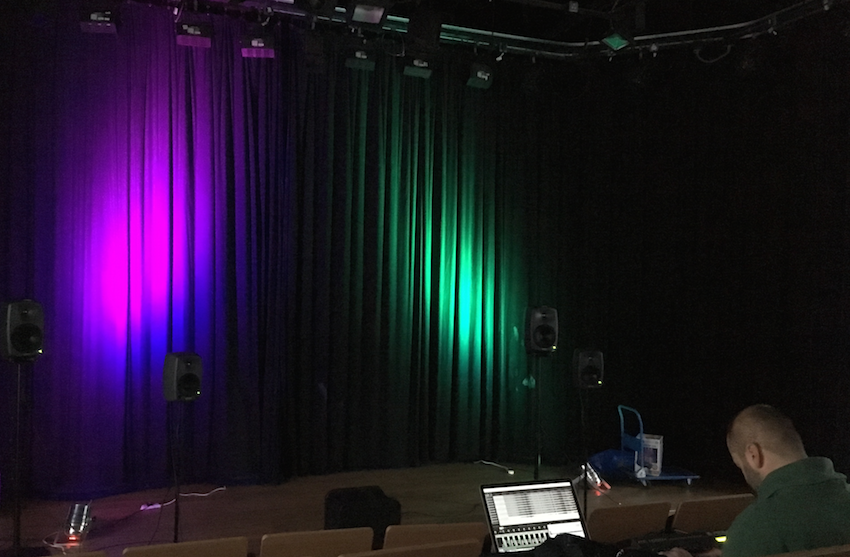
I recently presented my multichannel electroacoustic composition ‘Traces of Play’ in two international concerts. The first was at the esteemed music computing conference SMC 2018 (Sound and Music Computing) in Limassol, Cyprus. The programme featured a range of music encompassing fixed media, instruments + electronics, improvised, and mixed media works. Held in Limassol’s Rialto Theatre, this was the first ever multichannel loudspeaker concert to be staged in Cyprus. It was an honour to be involved.


The second concert was at the NYCEMF 2018 (New York City Electroacoustic Music Festival). The festival programme, scheduled over a number of days at the Abrons Arts Centre, New York, featured many established names alongside emerging artists, and this was a great opportunity to share and promote BU practice-based research. As well as diffusing (spatialising) my own work, I presented music on behalf of two composers: Antonino Chiaramonte, a doctoral researcher in the Faculty of Media and Communication here at BU; and David Berezan, Professor of Composition at the University of Manchester.


If you would like to experience surround-sound electroacoustic music in concert, we have four experimental music concerts running this year as part of the University Music programme. The first takes place on Wednesday 17th October at 7pm in the Allsebrook Lecture Theatre, Talbot Campus, and features Owen Green from the University of Huddersfield. Owen’s research focuses on improvising and composing with computers.