Category / Nursing & Midwifery
Focus Group session run at BNAC
Professor Edwin van Teijlingen will be running a Skills Building Workshop at the 14th national Nepal Study Days of the Britain-Nepal Academic Council (BNAC) in Liverpool. FHSS Professor van Teijlingen is a long-standing member of BNAC. Registration for this year’s Nepal Study Days is open now, if you are interested click here! Edwin van Teijlingen has conducted many qualitative studies and supervised many postgraduate students doing focus group research. He has published widely on qualitative methods, including research papers on Focus Group Research.1-3
Anybody interested in learning more about Focus Group Discussions as a research method should consider signing up for up for Bournemouth University’s two-day Masterclass ‘Focus Group Research‘ to be held next week Monday 18th and Tuesday 19th April in Bournemouth. Over a two-day period this Masterclass will cover the journey for a research project on focus group research. Basic previous knowledge on qualitative research will be assumed.
References:
- van Teijlingen, E.R., Pitchforth, E. (2006) Focus Group Research in Family Planning and Reproductive Health Care, J Fam Plan Reprod Health Care 32 (1): 30-32.
- Pitchforth, E., Teijlingen van, E., Ireland, J. (2007) Focusing the group, RCM Midwives J 10(2): 78-80.
- van Teijlingen, E., Simkhada, P., Stephen, J. (2013) Doing focus groups in the health field: Some lessons from Nepal, Health Prospect 12(1): 15-17. http://www.nepjol.info/index.php/HPROSPECT/article/view/8722/7111
Sustainable Development Goals (SDGs) in Nepal
This month a team of FHSS staff published their editorial in the latest issue of the academic journal Health Prospect [1]. The lead author is Dr. Pramod Regmi working in collaboration with CMMPH’s Professor Vanora Hundley, FHSS PhD students Preeti Mahato and Sheetal Sharma, and Professor Padam Simkhada from Liverpool John Moores University who is also Visiting Faculty at BU. The Sustainable Development Goals (SDGs) are the new guidance for nations and international organisations worldwide following the completion of the Millennium Development Goals (MDGs) which run from 2000 to 2015. We wrote about the MDGs and their relevance to midwifery and maternity care in a previous article [2].
Edwin van Teijlingen
CMMPH
References:
- Regmi, P.R., van Teijlingen, E., Hundley, V., Simkhada, P., Sharma, S., Mahato, P. Sustainable Development Goals: relevance to maternal and child health in Nepal Health Prospect 2016; 15(1): 9-10.
- van Teijlingen, E., Hundley, V., Matthews, Z., Lewis, G., Graham, W.J., Campbell, J., ten Hoope-Bender, P., Sheppard, Z.A., Hulton, L. Millennium Development Goals: All good things must come to an end, so what next? Midwifery 2014; 30: 1-2.
HRA Approval for NHS Research
HRA Approval is the new process for the NHS in England that simplifies the approvals process for research, making it easier for research studies to be set up. It replaces the need for local checks of legal compliance and related matters by each participating organisation in England. This allows participating organisations to focus their resources on assessing, arranging and confirming their capacity and capability to deliver the study.
Laura Purandare, Research Monitor RBCH, has kindly agreed to run a seminar on 4th May at 2pm in BG14 to explain the changes.
The session will cover:
- What HRA approval is
- The implementation of changes
- The difference it proposes to make to health research in England
- What it means for our researchers
- Key resources
The session will last approximately an hour, and Laura will be available for questions following the session. We hope to see you there.
Researching innovative pedagogy: An Evaluation of Team-based Learning
An Evaluation of Team-based Learning – 4-5pm in PG11, Wednesday 13th of April 2016
What is Team-based Learning?
Team-based Learning (TBL) is an example of the ‘flipped classroom’ concept whereby what might be described as traditional teaching content is accessed by students outside of the classroom while activities that might be termed ‘homework’ are conducted in class. In class, students have to answer questions as individuals to test them on their learning from the set pre-reading activities (termed the individual Readiness Assurance Test), then the same questions in allocated teams (team Readiness Assurance Test). Each team has a scratch card so that students can check if their agreed answer is correct (immediate feedback). Following that, teams then work on application exercises, where they have to apply their knowledge to problem-solving real-life scenarios.
Why bother with this approach?
TBL is thought to confer some advantages over traditional teaching methods in terms of student engagement and provides immediate feedback on student performance. While it does tend to mean some extra work for lecturers in terms of preparation activities, increased job satisfaction is commonly reported, and students report enjoying learning in this way. It is believed to improve critical thinking skills and in some cases improved exam performance has been reported. Further, this collaborative learning process promotes the importance of effective team-working, a skill desired of our graduates by many employers.
Do you want to find out more?
I am delivering a session on TBL at the CELebrate Conference 2016 next week. In this session, you will be introduced to TBL and get to experience a TBL session yourself! Quantitative (using the validated TBL-SAI instrument) and qualitative (focus group discussions) results from an evaluation of the implementation of TBL into a unit on the Adult Nursing degree programme will also be presented.
What to do now?
- Click here to watch this video before the session (it’s less than four minutes) -it’s a snippet from my online lecture on circulatory shock. Don’t panic if you’ve little knowledge regarding human physiology, it’s only to help illustrate the TBL approach – hopefully you’ll enjoy it!
- Then click here to book onto the session
Best wishes
Dr Jonny Branney
Congratulations to Prof. Hundley on her latest systematic review paper
This week Professor Vanora Hundley in the Centre for Midwifery, Maternal & Perinatal Health (CMMPH) published a systematic review form with her international collaborators working on early labour. The paper is called ‘Diagnosing onset of labor: A systematic review of definitions in the research literature‘ and can be found it the Open Access journal BMC Pregnancy & Childbirth. [1]
Congratulations!
Prof. Edwin van Teijlingen
Reference:
- Hanley GE, Munro S, Greyson D, Gross MM, Hundley V, Spiby H and Janssen PA (2016) Diagnosing onset of labor: A systematic review of definitions in the research literature. BMC Pregnancy and Childbirth 16: 71 http://bmcpregnancychildbirth.biomedcentral.com/articles/10.1186/s12884-016-0857-4
Bournemouth University Clinical Research Unit 2016 Newsletter Now Available
The latest newsletter from the Bournemouth University Clinical Research Unit (BUCRU) is available to download here. Take a look at the successful grant applications we supported/won last year, and what else we got up to in 2015. There is also an update from our colleagues in the Centre of Post Graduate Medical Research and Education (CoPMRE).
Don’t forget, BUCRU can provide FREE methodological advice and support in designing your research project. We’re based on the 5th floor of Royal London House so feel free to pop in and see us, call us on 61939 or send us an email.
NETNEP 6th International Nurse Education Conference, Brisbane

Four academics, Dr Susan Way, Dr Vanessa Heaslip, Ashley Spriggs and Dr Dawn Morley, from FHSS are presenting papers at the Nurse Education Today / Nurse Education in Practice Conference this week, 3rd – 6th April, in Brisbane. The conference is recognised as a leading nurse education event where cutting edge research and innovation ideas from across the world are disseminated. This year the conference has been expanded for the first time to include Midwifery Education.
The title of Dr Susan Way’s presentation is, ‘Leading with a SMiLE: Exploring a student-led clinic, practice education model for educational impact and service improvement’. The Student Midwives integrated Learning Environment (SMiLE) offers an alternative, reliable and collaborative student-led clinic practice education model for equipping midwives of the future with the knowledge, skills and competencies they will need to provide safe and effective postnatal care, to mothers, babies and their families. Early service evaluation of the clinic suggests that students found it benefitted their learning, built their confidence and gave them opportunities to develop their postnatal skills. Peer learning and teamworking relationships were also improved.
Dr Vanessa Heaslip and Ashley Spriggs present their collaborative study entitled “humanising the interview process”; an evaluation of service user/carers contribution to value based recruitment in a pre-registration adult nursing programme. The mixed-method evaluation analysed the perspectives of differing stakeholders (Candidates, SU/Carers, Academics and Practice Partners) regarding the role SU/Carer engagement in Adult Nursing Pre-registration interviews. Early findings from candidates have highlighted they value the involvement of SU/Carers in the interview process, SU/Carers add a “human dimension” ensuring a focus on the heart of nursing and its value base rather than the role of nursing and associated nursing tasks.
Dr Dawn Morley’s presentation focuses on the ‘ebb and flow model of mentoring students in practice’. Twenty one first year student nurses interviewed were insightful as to how their practice learning experience could be improved on their first placement.
The findings of her research highlighted the importance of consistently working with an expert who could encapsulate the “whole” of professional practice but who could also question and coach students through their learning experiences. The research suggested that this was best achieved through an “ebb and flow” model of mentorship where student and mentor were constantly negotiating short term learning goals and opportunities together that accommodated the challenge of workforce demands. By working and learning in this organic manner students were party to the professional decision making and observation of qualified nurses and were educated to a critical decision making level from the earliest opportunity in their clinical practice.
Professor Steve Tees, Executive Dean of the Faculty was also at the Conference in his capacity as one of the Editors of Nurse Education Today journal.
Latest BU paper sexual health & tourism
This new issue of the Nepal Journal of Epidemiology contains a systematic review by FHSS Visiting Faculty Prof. Padam Simkhada (based at Liverpool John Moores University). The review was produced in collaboration with Prof. Edwin van Teijlingen in BU’s Centre for Midwifery, Maternal & Perinatal Health (CMMPH). Their paper ‘Factors influencing sexual behaviour between tourists and tourism employees: A systematic review’ is co-written with a researcher from Green Tara Nepal and an independent Public Health Consultant based in the UK. [1] This systematic review reports on factors influencing sexual behaviour between workers in the tourism industry and tourists, including their risk perceptions when engaging in sexual activities and the knowledge of STIs (sexually transmitted infections).
This is the third paper from this group on sexual health and tourism. The previous two papers were written with BU’s Dr. Pramod Regmi. These two publications reported on sexual behaviour of male trekking guides in Nepal such as sexual interactions with tourists and locals. The qualitative paper based on interviews with trekking guides has been published in Culture, Health & Sexuality [2] and the quantitative survey paper appeared in Journal of Manmohan Memorial Institute of Health Sciences [3].
This week’s publication the Nepal Journal of Epidemiology is Open Access, hence freely available, as is the third paper listed below.
Prof. Edwin van Teijlingen
References:
- Simkhada, P.P., Sharma, A., van Teijlingen, E.R., Beanland, R,L. (2016) Factors influencing sexual behaviour between tourists and tourism employees: A systematic review. Nepal Journal of Epidemiology 6(1): 530-538.
- Simkhada, P., Bhatta, P., van Teijlingen E., Regmi, P. (2010) Sexual health knowledge, sexual relationships and condom use among male trekking guides in Nepal. Culture, Health & Sexuality 12(1): 45-58.
- Simkhada, P., van Teijlingen, E., Regmi, P., Bhatta, P., Ingham, R., Stone, N. (2015) Sexual health knowledge and risky sexual behaviour of Nepalese trekking guides. Journal of Manmohan Memorial Institute of Health Sciences 1(4): 35-42.
Blog THET volunteer on BU-led project
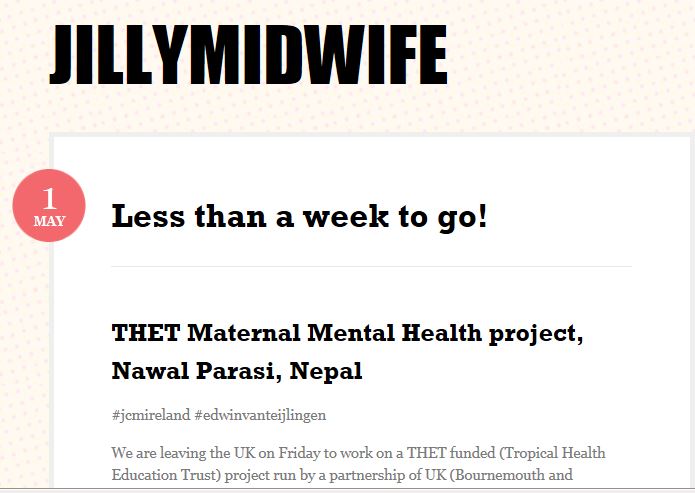
On previous occasions we have written on the BU Research Blog about our THET-funded project, for example earlier this year on the first training sessions in Nepal. Bournemouth University is leading on a project in collaboration with Tribhuvan University (the largest and oldest university in Nepal) and Liverpool John Moores University (LJMU). The project receives funding from DFID, and is managed through THET and supported locally in Nepal by a non-governmental organisation called Green Tara Nepal. We have been working with this charity for nearly ten years.
This time we would like to highlight a regular research blog written by Ish Fawcett who went out to Nepal last month as one of the UK volunteers. She has written some lovely blogs on her time in Nepal, about the training sessions as well as her general experiences of and observations on Nepal. Her blogs can be accessed here!
We would like to take this opportunity to repeat our call for volunteers. If you are a health or education professional with an interest in mental health and/or maternity care and you are interested in volunteering later this year for a week to ten days in Nepal please contact Edwin van Teijlingen (evteijlingen@bournemouth.ac.uk ).
Prof. Edwin van Teijlingen
CMMPH
FHSS paper in Journal of Neonatal Nursing
The April issue of the Journal of Neonatal Nursing will publish the latest article written by a combination of Faculty of Health & Social Sciences staff and Visiting Faculty. The paper ‘Experiences of fathers with babies admitted to neonatal care units: A review of the literature’ offers a systematic narrative review on issues affecting fathers, whose babies are admitted to neonatal units. [1] The authors include Visiting Faculty Poole Hospital NHS Foundation Trust midwife Jillian Ireland and Prof. Minesh Khashu (consultant neonatologist) and FHSS staff Jaqui Hewitt-Taylor, Luisa Cescutti-Butler, and Edwin van Teijlingen. Twenty-seven papers in this interesting review highlighted four key themes: (1) stress & anxiety; (2) information (or lack thereof); (3) gender roles and (4) emotions. This paper adds to the growing literature (and understanding) of the role and place of men in maternity care generally and for fathers of babies in neonatal care in particular.
Prof. Edwin van Teijlingen
CMMPH
References:
- Ireland, J., Khashu, M., Cescutti-Butler, L., van Teijlingen, E., Hewitt-Taylor, J. (2016) Experiences of fathers with babies admitted to neonatal care units: A review of the literature, Journal of Neonatal Nursing [pre-published]
Contact, Help, Advice and Information Network (CHAIN) Demonstration THIS COMING WEDNESDAY 23rd March 2016
CHAIN – Contact, Help, Advice and Information Network – is an online mutual support network for people working in health and social care. It gives people a simple and informal way of contacting each other to exchange ideas and share knowledge.
The online Directory can be used to identify and communicate with other members. You might wish to do this to draw from their experience, or to elicit an opinion on an issue or something you are doing. Or you might wish to find collaborators or liaise with fellow-travellers or people with specific skills or interests for a wide range of purposes. You can do this quickly and easily with CHAIN, and part of the advantage is that the people you find will usually be happy to help you if they can.
We are delighted to welcome a representative from CHAIN to BU on 23rd March at 2:30pm in Wollstone Lecture Theatre, Bournemouth House (BG10) to demonstrate how to make the most of being part of the network. All staff are welcome to attend, and please pass the invitation on to students who may be interested in learning more about what CHAIN has to offer.
Contact Lisa Gale-Andrews at lgaleandrews@bournemouth.ac.uk for more information.
BU BMC paper followed up by BMC Series Blog
Our latest paper in the international journal BMC Pregnancy & Childbirth published late last month was highlighted yesterday in a BMC Series Blog.[1] The blog post reminds us that the media plays an important role in providing the general public with information about a range of issues, including pregnancy and childbirth. The visual media, such as television, can provide planned information (education), for example in documentaries, advertising and the news. Our paper “Is it realistic?” the portrayal of pregnancy and childbirth in the media’ looked into how the representation of childbirth in the mass media affects childbirth in society as there is evidence to suggest that it can have a negative effect. BMC Pregnancy & Childbirth is an Open Access journal therefore the paper is freely available for anybody across the globe with an internet connection, for access click here.
Our paper is great example of interdisciplinary research, as celebrated at the forthcoming Interdisciplinary Research Sector Day on June 21st (see here). The authors of our paper combine expertise in media studies, midwifery, sociology and health services research. Moreover, it involved collaborations across universities (Bournemouth and Stirling) and within BU across faculties, namely the Faculty of Media & Communcation and the Faculty of Health & Social Sciences.
Ann Luce, Marilyn Cash, Vanora Hundley, Helen Cheyne, Edwin van Teijlingen & Catherine Angell
Reference:
- Luce, A., Cash, M., Hundley, V., Cheyne, H., van Teijlingen, E., Angell, C., (2016) “Is it realistic?” the portrayal of pregnancy and childbirth in the media BMC Pregnancy & Childbirth 16: 40 http://bmcpregnancychildbirth.biomedcentral.com/articles/10.1186/s12884-016-0827-x
Fusion in Action: Clinical Academic PhD scholarships jointly funded with NHS
Doing a PhD may appeal to midwives and other NHS health professionals, but it often involves having to make difficult choices. Undertaking a part-time PhD means studying on top of a busy clinical position, but starting full-time study involves stepping away from practice, which may lead to a loss of clinical skills and confidence. The Centre for Midwifery, Maternal & Perinatal Health (CMMPH) at Bournemouth University has come up with a novel solution making it easier for midwives to undertake a doctorate while still maintaining their clinical skills. This approach is highlighted in the latest publication by Dr. Susan Way and colleagues, describing a process where CMMPH collaborate with NHS partners to apply for a match-funded PhD. [1] The first partnership was with Portsmouth Hospitals NHS Foundation Trust (PHT), with later partners expanded to cover the Isle of Wight and Southampton. Currently there are negotiations with Dorset Country Hospital NHS Foundation Trust and Poole Hospital NHS Foundation Trust. Non NHS organisations have also showed an interest with the Anglo European Chiropractic College (AECC) our likely next collaborator.
This jointly funded clinical academic doctorate allows midwives to combine clinical practice with a research role, working across BU and their NHS Trust. The studentships runs for four years and PhD students will spend two days per week working as a midwife in clinical practice and three days per week working on their thesis. This set up facilitates the co-creation of knowledge. Anybody interested in developing a joint clinical academic PhD with us please contact Dr. Susan Way (sueway@bournemouth.ac.uk), Prof. Vanora Hundley (vhundley@bournemouth.ac.uk), or Prof. Edwin van Teijlingen (evteijlingen@bournemouth.ac.uk) .
In addition to providing the individual midwives with excellent education, these studentships are designed to examine an area of clinical practice identified by the collaborating organisation where the evidence is lacking and research is needed. As a consequence the research studies will be directly relevant to practice and will have a demonstrable impact in the future. Hence BU will be able to show that its research and education have a direct benefit to the wider society. Moreover, the studentships currently benefit midwifery practice by building a critical mass of research-focus practitioners, who will translate research findings into practice and so create a culture of evidence-based practice. At BU the model has also been adopted by other professional groups such as nursing, physiotherapy and occupational therapy (OT).
The result is a clinical academic doctoral studentship is probably the best practical example of BU’s concept of FUSION, since it truly fuses research, education and practice.
Susan Way, Vanora Hundley & Edwin van Teijlingen.
CMMPH
References:
- Way. S., Hundley, V., van Teijlingen, E., Walton, G., Westwood, G. (2016). Dr Know. Midwives (Spring Issue): 66-67.
Good week for FHSS publications!
This first week of March has been a good week for FHSS publications. On March 1st CMMPH Prof. Vanora Hundley published her collaborative paper ‘Do Cochrane summaries help student midwives understand the findings of Cochrane systematic reviews: the BRIEF randomised trial’.[1] With colleagues based across the UK and Ireland she surveyed over 800 midwifery students at nine universities. This results of the study can be found in the journal Systematic Reviews. This is a Gold Open Access journals, hence the paper is freely available for anybody to read across the globe. To read this paper click here!
The second FHSS publication is a chapter in a Kindle book on the Importance of public health in low- and middle- income countries, written by Dr. Puspa Raj Pant,CMMPH’s Prof. Edwin van Teijlingen, and BU Visiting Faculty Prof. Padam Simkhada.[2] Padam Simkhada is Professor of International Public Health and Associate Dean (Global Engagement) for the Faculty of Education, Health and Community at Liverpool John Moores University. The chapter is part of the Kindle book with the long title: Public Health for the Curious: Why Study Public Health? (A Decision-Making Guide to College Major, Research & Scholarships, and Career Success for the College Students and Their Parents) edited by Richard Lee Skolnik from Yale University, USA.
The third paper is by FHSS PhD student Clare Farrance with her supervisors Dr. Fotini Tsofliou and Dr. Carol Clark. This systematic review ‘Adherence to community based group exercise interventions for older people: A mixed-methods systematic review’ assessed the views and adherence of older participants attending community-based exercise programmes of over six-months duration. Reporting that evidence is still very limited, although the preliminary limited evidence is positive regarding long-term adherence rates. This paper is also Open Access, funded by BU’s Open Access fund.
Prof. Edwin van Teijlingen
CMMPH
References:
- Alderdice, F., McNeill, J., Lasserson, T.,Beller, E., Carrol, M., Hundley, V., et al. (2016) Do Cochrane summaries help student midwives understand the findings of Cochrane systematic reviews: the BRIEF randomised trial. Systematic Reviews 5:40 http://systematicreviewsjournal.biomedcentral.com/articles/10.1186/s13643-016-0214-8
- Pant, P.R., van Teijlingen, E., Simkhada, P. (2016) Importance of public health in low- and middle- income countries, In: Skolnik, R.L. (ed.) Public Health for the Curious: Why Study Public Health? (A Decision-Making Guide to College Major, Research & Scholarships, and Career Success for the College Students and Their Parents) Kindle Edition (for more details click here!)
- Farrance, C., Tsofliou, F., Clark, C. (2016) Adherence to community based group exercise interventions for older people: A mixed-methods systematic review To be published. Preventive Medicine (forthcoming)
Contact, Help, Advice and Information Network (CHAIN) Demonstration 23rd March 2016
CHAIN – Contact, Help, Advice and Information Network – is an online mutual support network for people working in health and social care. It gives people a simple and informal way of contacting each other to exchange ideas and share knowledge.
The online Directory can be used to identify and communicate with other members. You might wish to do this to draw from their experience, or to elicit an opinion on an issue or something you are doing. Or you might wish to find collaborators or liaise with fellow-travellers or people with specific skills or interests for a wide range of purposes. You can do this quickly and easily with CHAIN, and part of the advantage is that the people you find will usually be happy to help you if they can.
A representative from CHAIN will be visiting BU on 23rd March at 2:30pm in Wollstone Lecture Theatre, Bournemouth House (BG10) to demonstrate how to make the most of being part of the network. All staff are welcome to attend, and please pass the invitation on to your final year students who may be interested in learning more about what CHAIN has to offer.
Contact Lisa Gale-Andrews at lgaleandrews@bournemouth.ac.uk to book your place.
New BU multidisciplinary media & health paper out today!
Today saw the publication “Is it realistic?” the portrayal of pregnancy and childbirth in the media, a paper which is truly interdisciplinary, both in terms of its authorship as well as its topics[1]. The lead-author, Dr. Ann Luce is based in the Faculty of Media & Communication, whilst her BU co-authors Dr. Catherine Angell, Prof. Vanora Hundley, Prof. Edwin van Teijlingen and Dr. Marylin Cash are all associated with the Faculty of Health & Social Sciences. Prof. Helen Cheyne, the only non-BU co-author, is based at the University of Stirling.
The paper is a scoping review to assess the influence media have on pregnant women. Much of the academic literature discusses the influence of (reality) television, which often portrays birth as risky, dramatic and painful. Although many claim that the portrayal of childbirth has a negative effect on society, there is little research evidence to support this claim. It has been suggested that women seek out such programmes to help understand what could happen during the birth because there is a cultural void through the increasing anticipation of negative outcomes. However the impact that has on normal birth has not been explored. Our paper highlighted three key themes: (a) the medicalisation of childbirth; (b) women using media to learn about childbirth; and (c) birth as a missing everyday life event. The key conclusions are the media appear to influence how women engage with childbirth. The dramatic television portrayal of birth may perpetuate the medicalisation of childbirth, and last, but not least, portrayals of normal birth are often missing in the popular media. Hence midwives need to engage with television producers to improve the representation of midwifery and maternity in the media.
BMC Pregnancy and Childbirth is an Open Access journal so our paper is freely available to researchers, journalists, childbirth activists as well as pregnant women anywhere in the world. This paper builds on a growing number of academic papers published by staff in the Centre for Midwifery, Maternal & Perinatal Health (CMMPH) on the role the media play in health and midwifery, both in the UK [2-3] and in Nepal [4-6].
Prof. Edwin van Teijlingen
CMMPH
References:
- Luce, A., Cash, M., Hundley, V., Cheyne, H., van Teijlingen, E., Angell, C., (2016) “Is it realistic?” the portrayal of pregnancy and childbirth in the media BMC Pregnancy & Childbirth 16: 40
- Hundley, V., Duff, E., Dewberry, J., Luce, A., van Teijlingen, E. (2014) Fear in childbirth: are the media responsible? MIDIRS Midwifery Digest 24(4): 444-447.
- Hundley, V., Luce, A., van Teijlingen, E. (2015) Do midwives need to be more media savvy? MIDIRS Midwifery Digest 25(1):5-10.
- Devkota, S., Simkhada, P., van Teijlingen, E., Rai, L.D. (2012) Media use for Health Promotion: Communicating Childhood Immunisation Messages to Parents. Journal of Health Promotion 4(1): 1-9.
- Devkota, S., Simkhada, P., van Teijlingen, E., Rai, L.D. (2013) Childhood Immunisation in Nepal: Parents’ knowledge, attitudes and behaviour & implications for Health Policy. Health Science Journal 7(4):370-383.
- Devkota, S., Maharjan, H.M., van Teijlingen, E. (2015) Media and Health. In: Wasti, S.P., Simkhada, P.P. & van Teijlingen, E. (Eds.) The Dynamics of Health in Nepal, Kathmandu, Nepal: Social Science Baha & Himal Books: 169-184.
First BU paper Prof. McConnell
FHSS Professor Alison McConnell just published her latest paper ‘Inspiratory muscle training improves breathing pattern during exercise in COPD patients’ with her international co-authors from Belgium and Thailand. The paper concludes that the addition of inspiratory muscle training to a pulmonary rehabilitation programme in COPD (chronic obstructive pulmonary disease) patients with inspiratory muscle weakness resulted in a deeper and slower breathing pattern during exercise. Patients could achieve significantly higher peak work rate and exercise ventilation without increasing dyspnoea sensation.
Prof. McConnell is also author of Breathe Strong, Perform Better as well as Respiratory Muscle Training: Theory & Practice.
Congratultions,
Prof. Edwin van Teijlingen
CMMPH


New interdisciplinary research publication on Nepal
Methods of Researching Digital Harms and Cybercrime: An Interdisciplinary Symposium – Wednesday 15 July
Geography and Environmental Studies academics – would you like to get more involved in preparing our next REF submission?
Reminder: Recharge Your Research Routine Next Week for World Wellbeing Week
Horizon Europe Cluster 3 (Civil Security for Society) 2026 Calls Now Open

MSCA Doctoral Networks 2026 Call Information Webinar

ESRC Festival of Social Science 2026: Application Deadline Extended to Thursday 25 June 2026

Reminder: Register for the ESRC Festival of Social Science 2026 Information Session

ECR Funding Open Call: Research Culture & Community Grant – Apply now

ERC Advanced Grant 2025 Webinar
Update on UKRO services
European research project exploring use of ‘virtual twins’ to better manage metabolic associated fatty liver disease