Category / Health, Wellbeing & Society

Value of conference attendance?

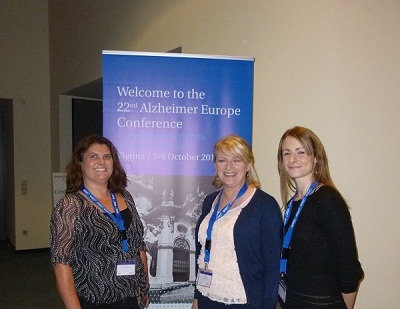
October is the month of the annual Alzheimer Europe (www.alzheimer-europe.org) meeting. This year three BUDI team members attended the rather nice setting in Vienna a draw for everyone, although we all had very different agendas and expectations. Alzheimer Europe is one of my personal favourite conferences as I’ve been going for years and it creates the opportunity to meet with new and catch up with a range of international colleagues, and is actually the main reason I go to these kind of events; yes it is good to present the work, and as a team we had two posters and three oral presentations this year, which is not bad for an Institute only in existence for 6 months, but it is the networking aspect that provides inspiration and creates new ideas and new collaborations that motivates me to go to these kind of events.

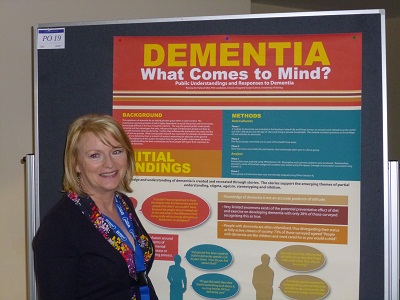
Patricia McParland is BUDI’s project manager, she has presented at a few dementia conferences in the last 3 years but for this conference her main concern was to ensure her cutting edge work doctoral work, that she is in the final throes of writing up, on public awareness of dementia is getting out there as this is an area of increasing policy concern both in the UK and internationally and many are starting to work in this particular area. As well as presenting a poster on her doctoral work that received positive attention, she presented a paper reporting on one of BUDI’s project about Dementia Friendly Tourism. The concept of Dementia Friendly Tourism has caught the imagination of many we speak to about our dementia work and this proved to be the case again in Vienna. Colleagues from France, Spain and Jersey were particularly interested in this project and keen to explore how these ideas could be applied to their regions; we will see what transpires over the coming months in the way of collaboration but this is a nice example of the added value of going to a conference.

Clare Cutler is a research assistant in BUDI and has just started her PhD exploring experiences of war and dementia, as an Early Career Researcher Clare was thrilled to be attending her first interational conference, and her excitement was contagious! but she was also rather anxious about giving her first presentation on one of BUDI’s projects, GRIID, Gateway to Rural International Innovations in Dementia, on behalf of an international team. She needn’t have worried as she went down a storm; mainly because she said at the beginning that she was nervous, this was her first presentation and then let out a big sigh as she finished. This created a huge amount of goodwill to her personally as well as her giving a presentation on an innovative interational partnership project. We had received the support of Alzheimer Disease International (www.alz.co.uk) to conduct part of this study and the opportunity for further discussion about working together to target rural areas and developing countries is another of the added value benefits that being in Vienna brought for me this year.

I presented a paper on a recently completed evaluation of a telehealth project to diagnose and follow up people with dementia living on the Shetland Isles and Grampian, rural areas of Scotland. The added value of this work relates to the INTERDEM (www.interdem.org) meeting that was held the day before the conference. (This is another example of added value by the way, going to other meetings around a conference.) Interdem is an application/invite only pan European network of highly active psychosocial researchers in the dementia field; as a member I was also able to take my BUDI colleagues in their student roles, a new doctoral and just about to complete doctoral student, to this full day meeting and they found this an amazing experience as many of the ‘names’ of long established dementia academics are part of this group which is always a buzz to meet people you’ve quoted for the first time, who offered real warmth, enthusiasm and support for their work. The Interdem meeting this time round was a mix of presentations (including one from the task force on technology and dementia that I co-lead)  and working groups developing bid ideas, collaborative papers and general brain storming about how to take forward new work in the field. The technology task force has been working on a bid around exergaming and dementia and we used the lunchtime slot to meet to work up our ideas further  (more added value) as well as updating Interdem members about our progress with this bid during the meeting itself. But we also discussed new bid ideas and telehealth, the focus of my Alzheimer Europe paper, was one of the favoured topics; one of our jobs now is to see the details of a long-awaited funding call  (JPND) due out December 2012 and get writing another EU bid.  We also agreed to write a collaborative paper on technology and dementia, but a successful meeting is one that generates new work from my point of view!

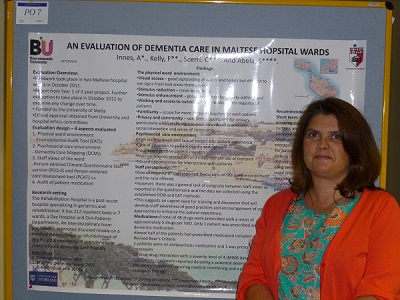
My other bit of dissemination work was a poster about ongoing research evaluating dementia care in Maltese hopsital wards. The added value about this relates to the conference venue being in Malta next year and I am sure this has partly influenced the invitation, of the Maltese Dementia Society member who is a long standing collaborator of mine as well as being the local organisor for the 2013 meeting, for me to give a plenary there next year!

So in all, the value of going to conferences for new researchers, is undoubtedly to present their work, to meet esteemed colleagues and the resultant ‘buzz’ this brings, to learn about other research in the field and to start their own networks (a good example of this is Patricia joining a writing team for a methods related paper, more added value!). For me it is a chance to catch up with people and to discuss potential new collaborations. In previous years it has also been about keeping a profile of the work of my team, this year it was about starting to create a profile for a new BU team to an international audience. I am pleased to report that all boxes were ticked this time round!

Are we born to yawn?

Yawning consistently poses a conundrum to neurologists and neuroscientists. Increasingly, evidence is found to link neurological disorders through the commonality of yawning episodes and contagious yawning. Despite discrete incidences (such as parakinesia brachialis oscitans) in brain stem ischaemic stroke patients, there is considerable debate over the reasons for yawning, with the mechanism of yawning still not fully understood. Cortisol is implicated in the stress response and fatigue; repetitive yawning may be the link between neurological disorders and with a strong correlation between yawning and a rise in cortisol levels. Evidence has now been found in support of the Thompson Cortisol Hypothesis that proposes cortisol levels are elevated during yawning [1]. Additional data is in press, and further research is planned with longitudinal consideration to neurological disorders such as multiple sclerosis and stroke. Funding for such initiatives is currently being sought.

[1] Thompson, S.B.N., & Bishop, P., 2012. Born to yawn? Understanding yawning as a warning of the rise in cortisol levels: randomized trial. Interactive Journal of Medical Research, 1(5), e4:1-9. Doi: i-www.jmr.org/2012/e4/

LAST CHANCE – sign up here for the Dementia luncheon!

Prof. Anthea Innes, the director of the Bournemouth University Dementia Institute (BUDI), is planning a dementia lunch as part of the BU Research Theme development. The BU Research Themes were launched almost a year ago at the first of the BU-wide Fusion events. The Themes are society-led, encourage cross-School working and collaboration, and will be the main vehicle through which BU research is presented externally in future.

At BU, we are proud of the way in which we demonstrate the fusion of research, education and professional practice, and Bournemouth University Dementia Institute (BUDI) demonstrates the benefits that this collaborative way of thinking can bring to our dementia work in three ways:

  1. By working across schools, it is possible to draw on the strengths of academics with a wide variety of disciplines.
  2. By working with local service providers and engaging with local people, we can strengthen, develop and consolidate links with these key stakeholders.
  3. BUDI will promote the fusion of research, education and practice. Our locally relevant evaluation and research will be combined with international research evidence so that we can develop training courses and other educational activities to inform and shape professional dementia care in the region.

Would you like to get involved in this exciting cross-school initiative? If so, please fill in the form below and we’ll sign you up. The lunch is planned for Wednesday, 28 November at La Piccolo in Lansdowne (http://www.lapiccolaitalia.co.uk/) from 1200-1400. Act fast – this is on a first-come-first-served basis and there are only a few spots left!

    Your Name (required)

    Your Email (required)

    Your School / Professional Service (required)

    How Web 2.0 might revolutionise our research

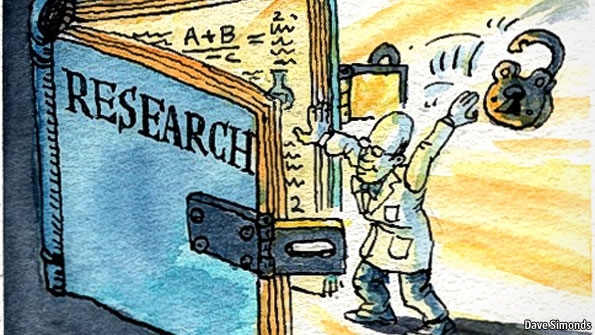
    Many of you will be familiar with the revolution that the internet is undergoing, with its growth of social networking, web applications, blogs and wikis. What I had not appreciated, until very recently, is what the full implications are for how we go about our research. I am sure that colleagues in DEC and the MediaSchoolare well ahead of the curve on this, but for the rest of us, the penny is perhaps only just beginning to drop. I recently attended a fascinating conference hosted by the European Social Simulation Association in Salzburg. This is a group of researchers united by a common interest in using computer programs to simulate human behaviour, and its implications for human society. This was very much a new arena for me; I was really attending to learn something about the agent-based modelling approaches that are the flavour of the month in these circles. But what most impressed me was the way researchers are now using web technologies to access data to explore in their models. For example, although I’d heard of “crowdsourcing” before, I’d never really seen it in practice, and what it can deliver. I was most impressed by groups using tools such as Twitter, together with mapping applications such as Google maps, to produce highly informative maps showing the movements and wellbeing of large numbers of people. A great example is what the LSE is doing to map happiness – yes, really – http://www.mappiness.org.uk/. Another example, from the University of Leeds, has been using Twitter to map the movements of commuters in and out of the city. What is perhaps most astonishing is that large numbers of people seem keen to participate in these research projects. Potentially useful tools being used by this research community include open source mapping initiatives such as Open Street Map http://www.openstreetmap.org/ and Maptube http://www.maptube.org/, as well as Survey mapper http://www.surveymapper.com/current.aspx. You might find this reference useful if you’re interested in learning more – http://ssc.sagepub.com/content/27/4/524

    Radio coverage of dementia research in Dorset

    Dementia has received a good bit of local coverage on BBC Solent over the last three days. This kicked off with a panel discussion featuring people with dementia talking about their experiences of living with dementia on Saturday ( http://www.bbc.co.uk/radio/player/p00xrth3 Feature starts 1hr 4minutes into the show)

    On Sunday morning dementia continued as a topic for discussion with the issue of how to make churches dementia friendly (available to listen to at http://www.bbc.co.uk/radio/player/p00xrtlx (Feature starts 1hr 44 minutes into the show)).

    Then on Monday morning Bournemouth University Dementia Institute were given the opportunity to talk on the News Hour about the low rate of diagnosis of dementia in Dorset and to highlight key findings from a project focusing on Dementia Friendly Tourism that Anthea Innes and Stephen Page have been leading that is currently being written up for publication. (feature starts 42 minutes into the show
    http://www.bbc.co.uk/radio/player/p00xrtsw).

    The whole notion of ‘Dementia Friendliness’ is one that is catching on in the UK and beyond with Dementia Friendly Communities being supported by the Prime Minister’s Dementia Challenge. The dementia work at BU embraces this concept and is actively applying it not only to the tourism and leisure research mentioned above but in our overall approach to our research and education work.

    BU Centre for Face Processing Disorders featured in the Independent

    Bournemouth University’s new Centre for Face Processing Disorders (supported by HEIF and Fusion funds) was recently featured in an article in the Independent newspaper,  together with quotes from BU’s Dr Sarah Bate.

    Sarah’s work to date has explored the cognitive presentation and treatment of face processing deficits in adults and children with a range of neuropsychological conditions, such as developmental or acquired prosopagnosia (face blindness), autistic spectrum disorder, and Moebius syndrome.  The Face Centre was launched in response to the large amount of media attention generated by Sarah’s research.  After Sarah’s work was featured in The Guardian newspaper and in a BBC1 documentary last year, she has been contacted by over 700 people who believe they have prosopagnosia and would like to participate in her research.  Given that most investigations into prosopagnosia to date have examined relatively small numbers of cases, Sarah now has the unique opportunity to develop large-scale academic and societal impact by having the resources to test this large patient group.

    You can read the full article in the Independent here.

    Follow the events in the Centre on their webpage or via Twitter (@BUfacecentre).

    De Hogeweyk: unique lifestyle housing for people with dementia

    I (Marilyn Cash, HSC) recently had the opportunity to visit De Hogeweyk a nursing home in the Netherlands that provides care to 152 people in the later stages of dementia. Unlike traditional nursing homes, De Hogeweyk is designed as a small self contained village with 23 individual homes, a supermarket, a hair and beauty salon, restaurant, theatre and traditional Dutch ‘brown cafe’. The homes are designed to reflect seven different typical Dutch ‘lifestyles’, identified by Motivaction a social research agency:-
    1. Traditional for residents whose identity came from carrying out a traditional profession
    2. City for “urbanized” residents whose life had been spent in the centre of the city
    3. “Het Gooi” for residents who attach importance to manners, etiquette, and external appearance
    4. Cultural: for residents who appreciate art and fine culture
    5. Christian: for residents for whom practicing their Christian religion is an important part of daily life
    6. Indonesian: a lifestyle for residents with an Indonesian background
    7. Homey: for residents who believe that caring for the family and household is important.

    De Hogeweyk allows residents to experience life as if they were living in the community but from within a safe and secure environment. Residents are able to take part in everyday activities in their homes supported by a team of staff and volunteers. They are able to walk freely through the streets and gardens which are designed to reflect normal life with street signs, streetlights, benches and squares where people can congregate. Being able to move freely around not only contributes to their health but also gives a feeling of ‘being at home’. The feeling of normality is further supported by the fact that none of the staff wear uniforms. The scheme has been designed to integrate with the local community and the facilities are open to anyone, not just to residents and their families.
    A total of 240 staff (equivalent to 170 full-time jobs) work at De Hogeweyk; this includes, nurses, nursing assistants, physiotherapists, occupational therapists, a full-time doctor and a Psychiatrist. They are supported by 120 volunteers, who are mostly retired people living in the local community. Many of the volunteers live alone and appreciate the social interaction that volunteering gives them. Residents are funded through the Dutch national insurance scheme for long-term care
    De Hogeweyk has been criticised for being a deception; but I think that most people reading this would prefer this ‘lifestyle’ to that offered by a traditional nursing home.

    Dementia

    Most of us know someone touched by dementia – a friend, relative or loved one.  As the average age of our population grows ever older, the chances are some of us will be affected.

    As such dementia is emerging as a new strategic priority for BU, with investment from our HEIF funds to create the Bournemouth University Dementia Institute, or BUDI as the team like to call it.  The team is growing rapidly working on a range of funded dementia projects with more in the pipeline. Working with the Director of BUDI Anthea Innes, Lee-Ann Fenge, Sue Barker, Vanessa Healsip, Michele Board have recently completed a review of Higher Education Dementia Curriculums on behalf of the Higher Education Dementia Network.  Work that reflects Anthea’s previous experience leading masters and undergraduate programmes in Dementia Studies and the dementia focus of social work and nursing colleagues within the School of Health and Social Care.  A number of research and knowledge exchange projects are underway including:

    • An ongoing programme of work funded by Bournemouth Borough Council involves the BUDI team delivering a range of activities via two different programmes; a ‘cupcake club’ and a technology group.  The evaluation report isn’t due until February 2013 so a lot is happening over the autumn months.
    • A BU Research Development Grant enabled an early collaboration between the Schools of Tourism and Health and Social Care.  This project led by Anthea Innes (HSC) and Stephen Page (Tourism) is currently being written up for publication and dissemination.  It is the first study to conceptualise ‘Dementia Friendly Tourism’ as an area worth investigation to try and improve the leisure opportunities for those with dementia and their families; but the project will also produce recommendations to  help advise tourism and leisure providers to enhance their provision to promote inclusion of those with dementia.
    • An international study GRIID (Gateway Rural International Initiatives in Dementia), involving partners from Australia, Canada, India, Sweden and the UK is also in the writing up stages following a policy synthesis and survey of Alzheimer Disease International (www.adi.co.uk) members.
    • European work is on-going too, focused on Malta where Anthea has long established links working on improving the quality of care offered in Maltese hospital wards
    • A multi-site NIHR project has just commenced exploring site loss and dementia for people who continue to live at home.  This is a collaboration between the Universities of York, BU, Cambridge, Worcester and consumer organisations; the Housing and Dementia Research Consortium (HDRC); Pocklington Trust supported by the Alzheimer Society and the Macular Disease Society

    But this is just the start with money being committed by many of large funding agencies this is a societal theme of the moment.  BU is part of a large FP7 grant application currently first reserve for funding, and BU is coordinating a multimillion ESRC grant application with 12 other institution due for submission this autumn.  Working locally is also very much on the agenda.  Staff in BUDI are working for example in partnership with commissioners and clinicians across Dorset to secure funding via the NHS South of England Dementia Challenge fund with BU as the evaluator for a number of innovative local projects proposed by those delivering dementia care every day.

    BUDI launched 16 May 2012 just three months ago and the progress is impressive, but there is also a long way to go to achieve its objectives of making a real contribution to improving the lives of those with dementia and those who provide support whether they be family or paid clinicians and carers.  This is not just an initiative launched from HSC but a cross BU one and I am delighted to announce the secondment of Samuel Nyman (Psychology, DEC) to BUDI to strengthen its work force and continue his existing collaboration with Anthea which includes a match funded BU PhD Studentship with Anthea Innes and Marilyn Cash which is looking at the role of gaming technology to support older men with dementia in rural areas.  BUDI is looking for staff who wish to engage from across BU and is truly multidisciplinary in its approach and reach.  There may be other who are interested in similar secondments and I would encourage them to get in touch with Anthea.  DEC and Tourism are already involved with BUDI contributing staff and time but there is huge scope for others to get involved for example in the Media School.  Why not drop Anthea a line and get in touch?

    Also starting in September is Patricia McParland as BUDI Project Manager or Engagement Consultant, a post-doc appointment is pending, PhD student Ben Hicks will start soon and we will be advertising for an Associate Director for BUDI soon.  BUDI has the full support of UET and is receiving strategic investment to make things happen quickly; dementia is of the moment as illustrated by the Prime Minister Dementia Challenge launched earlier this year and it’s for BU to cease this moment.  BUDI offers the opportunity to have a real impact, to make a difference in our society, to develop practice and research and to do it quickly.  Please get involved and get in touch with Anthea or myself directly.


    Dementia Cupcake Club – research in the community

    Throughout July and August 2012 BUDI (on behalf of Bournemouth Borough Council) have been delivering a series of sessions called the Cupcake Club at a local care scheme for people with dementia. For six weeks participants have been taking part in a variety of fun activities such as decorating cupcakes, arts and crafts, gardening and playing the Nintendo Wii. The purpose of the Cupcake Club was to provide a fun and informal environment for people with dementia to be creative and active over the summer period. The Cupcake Club has provided BUDI with a wonderful opportunity to go into the community and meet a group of interesting, funny and charismatic people. The sessions were thoroughly enjoyed by both the participants and the research team and apart from providing a lot of laughter, the sessions have shown that people with dementia are as capable as anyone else and that they are also quite good at Wii bowling!

    A second Cupcake Club group has now started and analysis of the evaluation data from both Cupcake Clubs will begin in the Autumn. All findings will be drawn together in an evaluation report for Bournemouth Bourough Council towards the end of the year. In the meantime there is a lot of fun for the BUDI team faciliating these sessions in the community and for the participants.

    The International Early Labour Research Group

    Early labour Group

    Photo (L to R): Dr Helen Cheyne (University of Stirling), Dr Mechthild Gross (Hannover Medical School), Dr Mary-Ann Davey (La Trobe University), Professor Patti Janssen (University of British Columbia), Professor Helen Spiby (University of Nottingham), and Professor Vanora Hundley (Bournemouth University). Not shown Gillian Hanley (University of British Columbia).

    Researchers from across the globe met in Stirling last week to discuss early labour research and to plan an international collaborative study. The meeting was the result of a successful Canadian Institutes of Health Research (CIHR) planning grant to bring together researchers from Canada, Australia, Germany, England and Scotland. We have met on a number of occasions in the last couple of years, but usually at a conference when time is limited, so it was a real luxury to have two full days to discuss early labour care and to plan a possible intervention for women in the latent phase of labour. Although we have all conducted studies in this area, developing a complex intervention for use in five countries raises many novel challenges. Discussion focused on the varying models of care and current guidelines – the NICE and KCND guidelines used in the UK were much appreciated by our international colleagues. We left the meeting invigorated, but also aware that there is much to do. The first step will be a special issue of Midwifery later this year dedicated to early labour and guest edited by two of the team.

    Health, Wellbeing and Ageing: BUs Research Themes as Communities of Practice

    At the most recent meeting of the Health, Wellbeing and Ageing Research, we discussed how the Ageing Strand of this theme might be developed along the principles of a community of practice (Wenger et al., 2002, 2006). Here is a summary for wider scrutiny, comment, critique and eventually consensus on how we can together move this strand forward.
    The Philosophy
    A community of practice (COP) is a “a group of people who share a concern or a passion for something they do and learn how to do it better as they interact regularly” (Wenger, 2006). Our passion is Health and Wellbeing- a salutogenic rather than pathogenic approach to health, social care and related fields. For many of us, it is the application of this to the Ageing Process and managing older age that holds our particular interest and area of expertise. The central philosophy of a COP is that members learn with and from each other. The rationale is two fold: firstly learning is linked with member wellbeing (specifically cognitive wellbeing): secondly, learning and wellbeing jointly facilitate productivity. In other words, our activities and outcomes/outputs will and do flow from communities of this type. (Wenger et al, 2002)
    Key to the development of a COP such as this one is the “practice” element. Through interacting regularly (at times virtually, at times face to face) we are building relationships and learning better ways of working together (Wenger et al., 2002, 2006). Community members engage in joint activities, helping and learning from each other, sharing information and building relationships. By practicing in this way we are developing what Wenger refers to as a shared repertoire of resources (e.g. a common definition of wellbeing; an understanding of regional, national and global policy on Ageing Well) experiences (appropriate and friendly funding sources), stories, tools (e.g., research methodologies, review techniques), ways of addressing recurring problems (e.g. dealing with ethics, dealing with rejection, holding interviews with people with impaired hearing or mobility issues)—in short a shared practice.

    The community can be moved forward practically by following the seven principles of developing a community of practice (Wenger et al., 2002). I concentrate on four here.
    1. UP THE EVOLUTION
    The development of Health, Wellbeing and Ageing should be an evolutionary process. Members differ widely in interests. Sociologists and engineers rub shoulders. Those interested in clinical trials and phenomenology share the same building! But our differences are not important. What is important is that we share an interest/expertise in Health, Wellbeing and/or older people. Rather than impose our own preconceived structures as to what projects or subgroups should be developed, projects themes are allowed to arise organically and the community’s agenda develops as members engage and disengage. For this to continue, it is essential that members know about each other’s interests and take time to interact and share these. Up to date STAFF profiles and BURO lists managed by our friend BRIAN are key to this as are student staff seminars and conferences. But as with any evolutionary process, it takes time to develop and small steps in the right direction are expected and accepted.
    2. OPENING DIALOGUE
    Through opening dialogue with those within the university and with external colleagues we are together developing a shared competence in a domain that distinguishes us from, but guides our rules of collaboration with, the range of other networks within the field (e.g. AgeUK, Help and Care, Poole and Bournemouth Borough Council, Research Councils). Creating an open dialogue between members and between members and those outside of the groups is central.. Our social media group pages AGEING at BU is a step in developing these insider and outsider discussions. http://www.facebook.com/#!/groups/106969319443779/. Twitter and much more should follow.. Technical stewards (Wenger,2010) are required to lead the community in maintaining the community through these Web 2.0 technologies, keeping us actively engaging and building internal and external relationships required to maximize our learning. These sites can serve dual purposes and promote our activity but evidence shows that if self promotion overrules the central learning objective of these sites (Terras, 2012), our e -profile withers and die. A balance is essential

    3. DIFFERENT LEVELS OF PARTICIPATION
    Community members can engage in the theme at three different levels of participation: as the core convening group, as active participating members or on the periphery watching developments. All levels are acceptable and learning about health, wellbeing and its application to Ageing can occur in any of the three. We strive however to introduce mechanisms whereby movement between core, active and peripheral participation can occur. Active participation should be encouraged but not forced, “building benches on the sidelines” for members to sit and watch until they are confident to move to the centre and take more active roles within the group (Wenger et al., 2002). An ethos of mentoring is fostered not necessarily on a one to one basis, but as a group philosophy where active and core members are cogent of the need for inclusivity and for offering opportunity to peripheral members should they wish to engage.
    4. THE COMMUNITY MUST HAVE VALUE FOR ITS MEMBERS
    Engagement is also encouraged by making explicit the value of community membership. From personal experience, being part of a community has offered us all opportunities we would not have accessed if we had not been members. The social capital generated has lead to individuals making connections to networks to which some members had links but others not (connections to external networks come from whom we know not necessarily what we know). We have been able to draw on the skills of others, (for example, the researchers amongst us have gained insight into curriculum development, faculty development and health care policy). The network has enabled us to submit bids that are cross school and cross institutional which we hope is reflected in their quality arising from this cross fertilisation of ideas and disciplines. Most importantly, we have connected to like-minded individuals and reduced our research isolation.
    Food for thought. I would welcome thoughts on whether this fits with colleagues’ vision for the Health, Wellbeing and Ageing theme. I acknowledge the input of already successful COPs into these thoughts specifically IN-2-theory and GRIN members as well as good thoughts and discussion on this topic from the HSC Health and Wellbeing Community leadership.

    Sarah Hean

    REFERENCES
    Terras, M. (2012) The verdict: is blogging or tweeting about research papers worth it? Available at: http://blogs.lse.ac.uk/impactofsocialsciences/2012/04/19/blog-tweeting-papers-worth-it/
    Wenger, E., White, N.and Smith, J.D., (2010) Digital Habitats , Portland: CPSquare
    Wenger, E., McDermott, R., & W.M. Snyder. (2002). Cultivating Communities of Practice A Guide to Managing. Boston: Harvard Business Press.
    Wenger, Etienne. (2006). Communities of Practice: a brief introduction, 1-6. Retrieved from http://www.ewenger.com/theory/communities_of_practice_intro.htm

    Join the Ageing at BU Facebook group

    The Health, Wellbeing and Ageing Research Theme invite BU staff and students interested in Wellbeing and Ageing to consider joining the AGEING AT BU facebook group. The aim of the group is to share our own work, events and reading on research, education, practice and policy that relates to older people, ageing and wellbeing. We would encourage our practice partners outside of BU to join also.

    You can join the group on Facebook here: http://www.facebook.com/#!/groups/106969319443779/

    Emerald Literati Network : 2012 Awards for Excellence

    Image of Dr Heather Hartwell

    Bournemouth University’s Associate Professor Dr Heather Hartwell has been chosen as an Outstanding Reviewer at the Emerald Literati Network Awards for Excellence 2012. Each year Emerald names and rewards the Outstanding Reviewers who contribute to the success of the journals.  Each journal’s Editor has nominated the Reviewer they believe has been that title’s most Outstanding Reviewer.

    The most Outstanding Reviewers are chosen following consultation amongst the journal’s Editors, who are eminent academics or managers. Dr Hartwell was selected for the very impressive and significant contribution she made as a Reviewer to the British Food Journal throughout 2011.

    Would you like to travel? Categories for the latest round of Winston Churchill Fellowships have been announced and there is something for everyone

    The Winston Churchill Memorial Trust is looking for people who:

    • Would benefit from experience overseas so that their effectiveness in their career or field of interest was enhanced
    • Are in a position to disseminate their new knowledge and examples of best practice for the benefit of their communities and the UK

    In the past the School of Tourism has been particularly successful in obtaining these fellowships with 4 members of staff (and 2 spouses) gaining awards. The funding is good, and being a fellow opens you up to a range of networks and opportunities that are often not normally easily accessible.

    The categories for this year are listed below, and seem to cover most areas of interest in the University.  It is important to pitch you application correctly, and there are qualifications as to who may apply (you need to be a British Citizen), so please feel free to come and have a chat.  Closing date is 2 October 2012. 

    Science, Engineering & Technology: Applications are welcome from right across this wide field, especially with respect to the popularisation of science, reverse innovation and smart growth. 

    Environment, Food & Rural Affairs: Those involved in the countryside, food production, environment and conservation, including those interested in the natural environment and biodiversity and waste management. 

    Education: Applications are sought from those working to improve the achievement of students aged 5-19, with particular emphasis on English, Maths, Science and Technology. We are also seeking applications from Deputy Head Teachers who are future Head Teachers, in a joint project with the Farmington Trust. 

    Business, Industry & Commerce: We are especially interested in those running Social Enterprises who wish to learn from models overseas, particularly in emerging markets. We’re also keen to receive applications for projects focussed on making Corporate Social Responsibility more effective.  

    Medical and Health: Applications are welcome from across this wide spectrum, especially from those with an interest in alcohol-related health issues and continuity of care, both medical and management.  

    Communities that Work: This category is for those working in all areas of developing stronger and more effective communities. (This is the second year of a joint project with The Rank Foundation). 

    The Creative Industries: Applications are welcome from anyone in this wide field wishing to research new and innovative ideas from overseas.  

    The Arts and Older People: Those providing opportunities for older people in all aspects of music, dance, drama and the fine arts. (This is the second year of a joint 3 year project with The Baring Foundation). 

    Prison & Penal Reform: Those involved in prison and penal reform and related sentencing issues, who are interested in projects that reduce re-offending and contribute to a just, humane and effective penal system. (A joint project with The Prison Reform Trust and supported by the ICPS) 

    Open: Anyone with an appropriate project not covered by other categories, including Exploration (expedition leaders only), and Music Education (a joint project with The Finzi Trust), should apply here.

    Further details at: http://www.wcmt.org.uk/