EU funding call now open!

Latest research and knowledge exchange news at Bournemouth University

Academics will be invited to apply for cohort 3 of the Knowledge Transfer Partnership Academic Development Scheme (KTPADS) from 9th November 2015.
For those who are unfamiliar with Knowledge Transfer Partnerships (KTP), they are a three-way partnership between a knowledge base (in this case, BU), a company and a graduates. There is knowledge transfer in all directions where academic knowledge embeds a new capability within a business to make it more efficient and profitable via a project managed by a graduate.
The aim of this scheme is to equip you with the necessary skills and knowledge needed to engage with business and work towards a collaborative project with a business. The end result aims to see the business using Bournemouth University as a knowledge base for a KTP. The scheme will be made up of a series of workshops on business engagement and networking opportunities with local business, it will also include regular support from the Innovate UK regional KTP Adviser and the Knowledge Exchange Adviser (KTP).
Should you be interested in this scheme or require further information, please contact KE Adviser (KTP), Rachel Clarke on 01202 961347 or email KTP@bournemouth.ac.uk
Principal Academic Dr Tim Breitbarth (Department of Sport & Physical Activity) was invited by German Football Association (DFB) to provide CSR communication expertise to its Social Responsibility Commission. Speaking yesterday, his input focused on the interlink between CSR integration and communication, and concluded with some strategic and operational suggestions. The impact of Tims’ consultation will be felt, his presentation sparked lengthy discussion and reflection amongst members of the Commission who proposed additional action and follow-up work.
Input perhaps never been more timely
At present the DFB is challenged by investigative media stories about non-transparent financial transactions in the context of hosting the 2006 FIFA World Championship. The long-standing Commission comprises of leaders of the association (e.g. vice president, director, heads of regional football associations), leaders from civil society organisations and other relevant external experts.
Expertise on CSR drawn upon by media and academic sources
Recently, Tim was interviewed a few times on his area of expertise, e.g. for the article “Where the money comes from” in Le Monde diplomatique (www.exacteditions.com/read/diplomatique/july-2015-43324/13/3). Furthermore, amongst other, he was the lead convenor of the well-attended workshop “CSR communication in sport” at the recent 23rd European Association for Sport Management in September; is the lead guest editor of the special issue “Governance and CSR management in sport” in Corporate Governance (ABS 2*), published in summer (www.emeraldinsight.com/toc/cg/15/2); and is co-organiser of and moderator at the industry-focused 1st German CSR Communications Congress, held in November (www.csr-kongress.de).
The Innovate UK KTP Advisor for our region will be on campus this Friday from 10am-12pm.
Each appointment will be 20 minutes long.
If you would like to make an appointment to talk through any KTP ideas/potential projects or existing KTP, please contact Rachel Clarke, KE Adviser (KTP) on 01202 961347 or email clarker@bournemouth.ac.uk
If you miss this Surgery, the next one will be on Friday 20th November from 10am-12pm.
Innovate UK is taking place on 9 and 10 November in central London.
Bournemouth University is a member of PraxisUnico. This membership is for the whole organisation – colleagues across the University will find it helpful to sign up to receive the mailing list to have the NewsUpdate sent to your inbox (news and information from across the sector, distributed every month to over 5000 individuals around the world). Other information channels include the website, Blog and Twitter feeds of interest.
PraxisUnico is responsible for the range of activities which facilitate the commercialisation of university, public sector and charity based research. The PraxisUnico website acts to signpost information relating to UK KT activity, expertise, success and impact – it gives Members a platform to promote to a range of stakeholders including government, industry, funders and overseas organisations – all of whom are regular visitors to the PraxisUnico website (and recipients of wider communications) as a valued information source.
As a member organisation BU can advertise items on the website free of charge – a great way to share latest news, achievements and job opportunities! Relevant content is also included in the NewsUpdate emails. Please send your content to website@praxisunico.org.uk. The website also features various a range of practical tools and resources for those working within the commercialisation profession, key resources are restricted to members only.
The annual conference will take place in Stratford-upon-Avon, 15-17 June, registration will open in the New Year.
Individuals from BU can also get involved as a volunteer by joining committees, contributing to workshops or delivering training – if this is of interest please let me know jcodling@bournemouth.ac.uk

It is estimated that some 30% of airline engines worldwide are analysed using PA’s current-generation technologies to detect fan blade defects
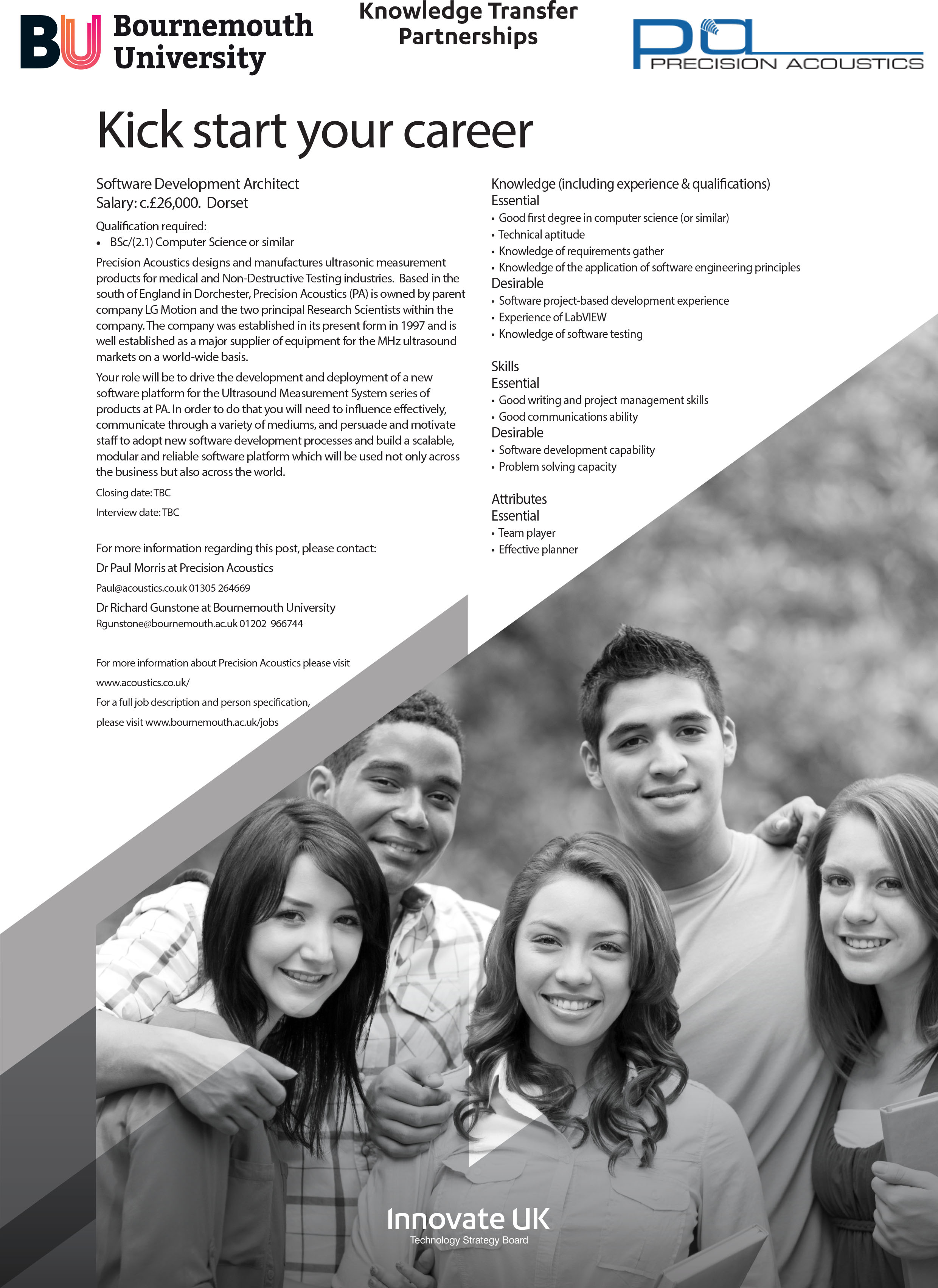
A team from the Faculty of Science and Technology, led Professor Siamak Noroozi and Dr Richard Gunstone, have successfully obtained a Grant Offer Letter (GOL) for a high-impact KTP working with Precision Acoustics Limited (Dorset).
In this blog post we discuss some of the background to this KTP, and objectives.
Precision Acoustics (PA) manufactures acoustic measurement products for the medical and Non Destructive Testing (NDT) industries and is well established as a major supplier of equipment for the (MHz) ultrasound markets world-wide. PA has a close working relationship with the National Physical Laboratory, London, and academic establishments across the UK to further R&D.
The company’s core products are acoustics measuring devices. The company already has a significant share of the world market in this area, and is now embarking on innovative industrial NDT systems working on a number of precursor projects including with Rolls Royce. The longer term objective can only be achieved if PA introduces a software capability able to devise, maintain and develop a development process that has the expected attributes of resilience, performance and integrity, supporting product deployment. This is the principal focus for the KTP, capitalising on the capability in systems design, software, and assurance within BU.
The diagnostic systems work at PA are being developed and used in numerous applications, including malaria detection. It is estimated that some 30% of commercial airliners globally use the technologies developed by PAL for analysing defects in engine fan blades, for example. Due to the inherent nature of NDT systems and the potential application areas, these application areas are likely to have societal relevance and high-impact.
A great deal of effort has been spent in designing the project to be flexible and comprehensive. This has been made possible by the capable contribution of Norman Stock, the Faculty Business Relations Officer. He has worked closely with the academic staff and also the company to present a suitable proposal to Innovate UK, who are part-funding the collaboration.
In terms of project design, the KTP incorporates the new “KTP laydown” of an integrated MRes opportunity for the Associate, combined with expectations of research activity leading to co-authored papers. This provides a route for knowledge transfer of expertise from the university to the company, in a way that delivers advantages for all stakeholders.
We look forward to providing further reports on our collaboration with PA as time progresses.
In terms of advice for others considering KTP funding, Richard highlights a few relevant points:
“Engage early with the Business Relations Officer for your Faculty. Make sure deadlines are adhered to, including submission windows with Innovate UK. Finally, clarify the project plan as early as possible, including what is achievable in the project timescale – scoping is key”
This is a monthly publication that provides a digest of useful information about funding, financing, support and events to assist creative, digital and design businesses with their innovation and growth strategies.
You can sign up to receive the newsletter in your inbox or alternatively follow the Knowledge Transfer Network group on social media.
This is a great way to get a quick heads up on what is happening in these sectors with links to further information.
Click here for more information.
Check out the latest funding opportuntities, events and news within these sectors and more.
Knowledge Transfer Networks have been set up to connect people. Aiming to speed up innovation , solve problems and find markets for new ideas.
Why not sign up to receive information relevant to your area of interest and research.
As organisations make submissions to the government’s Comprehensive Spending Review 2015, Director for Employment & Skills at CBI, Neil Carberry, outlines the case for investment in universities.
Productivity levels and skills are considered two of the greatest challenges. This is where universities and their graduates – and their relationship with UK business – come in.
The latest CBI/Pearson Education and Skills Survey, Inspiring Growth, illustrates the magnitude of the skills emergency. Two out of three businesses surveyed expect their need for staff with higher level skills to grow in the years ahead, but more than half of them fear that they will not be able to access enough workers with the required skills. Even more disturbingly, it is the high-growth, high-value, high-potential sectors which are under most pressure – including construction, manufacturing, science, engineering and technology.
UK productivity has for a long time lagged behind most other developed countries. There are a number of causes, including low skills levels in many sectors, but a fundamental driver of productivity growth is innovation, where the UK is held back by low levels of public and private investment and an unbalanced ecosystem in which the infrastructure for supporting commercial innovation does not match the world-class research base.
Click here to read the full blog post.
http://blog.universitiesuk.ac.uk/2015/09/22/the-value-of-university-business-collaborations-to-uk-economy/
Innovate UK and Defence Science and Technology Laboratory (Dstl) are to invest up to £580,000 in technical feasibility studies to stimulate innovation throughout the software development lifecycle (SDLC) while focusing on the verification and validation* (V&V) of two classes of complex systems: cyber physical systems (CPS) and systems with emergent behaviours.
This competition encourages businesses to develop appropriate ‘links’ between the behaviour of a system in the physical world and the software implementing its planned interactions. It also seeks to stimulate development of new engineering methods for systems in which a machine – rather than a human user or operator – drives the decision- making process. Such systems can be trained to recognise complex patterns and to make intelligent decisions based on existing data. They are starting to be used in sectors such as automated and autonomous vehicles, and robotics and autonomous systems (RAS). Our aim is to ensure that small and micro businesses in the UK further develop their early capabilities in this area.
Projects are open to companies of any size, but must be led by a small or micro company, working in collaboration with one or more business or research partners.
The Small Business Research Initiative (SBRI) is a well established process to connect public sector challenges with innovative ideas from industry, supporting companies to generate economic growth and enabling improvement in achieving government objectives.
SBRI provides innovative solutions to challenges faced by the public sector, leading to better public services and improved efficiency and effectiveness. It generates new business opportunities for companies, provides small and medium-sized enterprises (SMEs) a route to market for their ideas and bridges the seed funding gap experienced by many early stage companies. It supports economic growth and enables the development of innovative products and services through the public procurement of research and development (R&D).
The following is the list of recently opened & upcoming SBRI funding competitions.
Hosted by the UK Intellectual Property Office and the China-Britain Business Council
The Royal Society, 6-9 Carlton House Terrace, London SW1Y 5AG
09:00-17:00, Wednesday 21 October
Do you want to know more about obtaining and enforcing your intellectual property rights in China? Have you experienced IP issues in China and want to know more about the support networks available or how the IP system is changing? Do you work for a Chinese company looking to protect IP as you invest and do business in the UK?
The 3rd UK-China Intellectual Property Symposium is an opportunity for businesses to engage with policymakers to understand the current IP systems in both countries and to learn about future reforms.

China is a key priority of the Government’s trade and investment strategy. In 2013, UK exports to China were worth $24.5bn (£15.7bn). The Government has worked to increase two-way trade to $100 billion by the end of 2015, and within this to double UK exports to China from their 2010 level to $30 billion. The UK is on track towards achieving this goal.
An effective IP regime is crucial to the success of British businesses in China. China’s IP legal framework is improving through a rapid and relatively transparent process of legislative reform. In this dynamic context the UK Intellectual Property Office and the China-Britain Business Council, will host the 3rd UK-China IP Symposium in London at the Royal Society on 21st October. It will be opened by the UK’s Minister for Intellectual Property, Baroness Neville-Rolfe. The Symposium will cover all the intellectual property rights as well as more focused sessions on anti-counterfeiting and judicial enforcement. Each session will include a diverse panel of speakers from the British and Chinese governments, industry and academia. They will outline the latest developments and current approaches to IP in both China and the UK.
The organisers expect high level engagement from a number of UK and Chinese businesses. The delegation confirmed to attend from China includes representatives from Lenovo, ZTE, Baidu, JD.Com, Zhongguancun, Xiaomi, 360 Qikoo and Foton.
Find out more and register at the event webpage.
While many have been enjoying the last of the great British summer, the KEIT team have been working hard to ensure that BU’s research and knowledge is informed by society for the benefit of society on a number of cross institutional projects. Read on for a selection of our achievements this month:
Communicating BU’s research
Two exciting new digital features have been launched this month. The Research Photo of the Week exhibits winning photographs from the Research Photography Competition that we held earlier this year to showcase BU research. Our research spotlight feature has also just been launched in the form of a short video interview, featuring Dr Sally Reynolds whose work has recently been published in Scientific Reports.
Other research communication successes include Colin Pritchard’s research into dementia which was featured on the front page of the Times in August and has been well cited in the local and national press. Additionally, Jane Murphy and Joanne Holmes’ research into dementia and nutrition was reported in the Mirror and subsequently in the Coventry Telegraph and Evening Gazette.
Public Engagement
After the success of the Festival of Learning back in July, we’re already moving onto our next big event of the year, the ESRC Festival of Social Science. BU has supported events as part of the Festival for the past 3 years but this year, for the first time, we are officially a partner of the Festival and as such are producing many more events for the public, business and schools. Take a look at research.bournemouth.ac.uk/events for further details of activities taking place as part of the Festival, as well as for details of all our public facing activity.
Café Scientifique continues to be successful with September’s talk coming from Dr Robin Wilson from University of Southampton who discussed how we’re monitoring our environment from space and why we should care about it. Upcoming talks will feature Marine Archaeologist, Tom Cousins (October 6) and Vanora Hundley and Edwin Van Teijlingen who will explore Fear in Childbirth (November). If you’d like to be involved and have a great idea for a debate-centric talk we’d love to hear from you – just email Naomi.
The deadline for submitting your expression of interest to run a Festival of Learning event is also fast approaching so be sure to put your name and the concept of your event in online before 25 September.
Higher Education Initiative Fund (HEIF)
13 HEIF projects came to an end this summer, with some excellent outcomes including:
HEIF 5+1: The twelve new projects that secured funding in August 2015 and will run for the next 12 months are well underway. More information will be posted on the Research Blog as these evolve – so keep an eye out for updates. One of the first to go live is Building Roman Britain.
KEIT and Liam Toms within the Media & Communication Faculty are working together to co-ordinate a Creative Bournemouth event to be held at the EBC on 23 September. Professor Tim McIntyre-Bhatty will open the event and a number of speakers from the creative industries will present during the afternoon. This event will also launcha special feature on creative industires in Bournemouth published by The Drum .
Knowledge Transfer Partnerships (KTP)
We currently have five live KTP within SciTech and KTP activity at BU is on the increase with KTP leads associated with every Faculty. This is a fantastic result and we are keen to further promote the specific KTP Cyber Security call and Stratified Medicine call, both of which are due to close in early 2016.
If you’re feeling inspired by our blog post and would like to get involved with some of our projects then feel free to get in touch:
Genna West – Knowledge Exchange and Impact Manager
Rachel Bowen – Research Communications Manager
Rachel Clarke – Knowledge Exchange Adviser (KTP)
Jayne Codling – Knowledge Exchange Adviser
Naomi Kay – Public Engagement Officer
Katie Breadmore – Public Engagement Event’s Organiser
Oliver Cooke – Student Engagement Coordinator
To find out more about us and what we do, take a look at our team page.
Open call to SMEs and new entrants for industrial experiments Digital Agenda for Europe
The Digital Agenda for Europe will shortly be inviting applications for its second open call to SMEs and new entrants for industrial experiments. The call will open on 28 October 2015 and the closing date is 3 December 2015. This call aims to initiate new business and innovation opportunities between SMEs and new entrants, major cyber physical system-platform providers, and competence centres. The maximum European Commission contribution for industrial experiments per applicant is €150,000. The funding rate is 70 per cent. The maximum duration of industrial experiment is 18 months.
For more information:
https://www.eurocps.org/innovators-projects/open-calls/