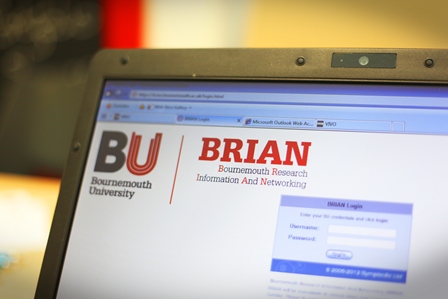
Tagged / BRIAN

BRIAN Training – 21st June

We are running two BRIAN training sessions on Friday 21st June 2013.  These  are hands-on sessions open to all academics and PGR students who want to learn more about BRIAN.

11:00 – 12:00    Studland House            S103

14:00 – 15:00    Christchurch House       CG21

If you would like to attend, please email David Biggins at BRIAN@bournemouth.ac.uk to reserve your place.

Open access publishing – common minsunderstandings!

open access logo, Public Library of ScienceReflecting on the experience of our recent mock REF exercise I noted that there were some negative views towards open access publishing that were expressed during the process. This is a little concerning considering the UK government is planning to make all outputs arising from publicly-funded research available via open access outlets by 2014 and considering the open access mandates the major research funders have as part of the terms of their grant funding (including the research councils, the Wellcome Trust and the European Commission).  In addition, the four UK funding councils are currently consulting with the sector regarding their proposal to introduce a requirement for all outputs submitted to the post-2014 REF exercise to be published on an open access basis, wherever the concept of open access is relevant.  As an institution and as individual researchers we need to ensure that we are able to comply with these requirements and that we are able to positively embrace open access publishing.

I did a bit of research and came across an excellent article by Peter Suber, Director of the Harvard Open Access Project.  In the article, Peter addresses the common misunderstandings and misconceptions about open access publishing, many of which we part of the concerns raised during the recent mock REF exercises.  I’ve selected the ones I most frequently hear and provided a summary below, and would urge you to read the article in full here – A Field Guide to Misunderstandings About Open Access.

1. “All open access is gold open access” – not at all! Gold open access refers to open access through journals and green open access is via repositories.  Suber notes that researchers often overlook the existence of green open access or think they will not be permitted by their publisher to deposit a copy of their paper in an open source repository.  At BU we have our own institutional repository, BURO, and BU researchers can add the full-text version of their papers via BRIAN.  Suber notes that between 50-70+% of journal publishers give permission for postprint achiving in repositories.  BRIAN will check the copyright of the publisher for you and let you know which version of your paper can be added to BURO. Easy peasy!

2. “Open access is about bypassing peer review” – not true!  The goal of open access is to remove access barriers, not quality filters.  Open access journals can, and usually do, use the same peer review processes, the same standards, and even the same reviewers as traditional print journals.  Many traditional print journals offer an open access route as part of publishing in their journal (hybrid publishing).

3. “Authors must choose between prestigious publication and open access” – incorrect!  There are two reasons why open access is compatible with prestige:  a gold reason and a green one.  First, a growing number of open access journals have already earned high levels of prestige, and others are earning it.  Do your part to move things along as an editor, referee, reader, and as an author, by submitting your best work to suitable open access journals.  In the meantime consider the second reason.  Most traditional print journals allow open access archiving, such as in an institutional repository.

4. “Open access makes sense for second-rate work, but not for first-rate work” – again, not true!   The idea behind this misunderstanding is this:  the best work generally winds up in the best journals, where it has the best chance of being seen.  At least it should be steered toward the best journals, where it will have the best chance of being seen.  When we add the suggestion that this path doesn’t allow open access, or that open access can’t improve upon it, then an idea that was largely true becomes completely false.  It assumes that the best journals are never open access (not true – Nature, Science and IEEE for example all offer open access options); that only journals can deliver open access (not true – green open access); that the best journals never allow open access archiving (not true – see SherpaRomeo, Science for example permits achiving of post-print of the publisher’s PDF); and that open access archiving can’t increase the visibility and impact of work published in the best journals (not true). 

Suber notes 20 other common misunderstandings about open access and his article is well worth reading!

At Bournemouth University we are committed to supporting the open access movement and have been running the BU Open Access Publishing Fund for two years now and will continue into 2013-14.  For information on accessing the Fund please visit this page – BU OAPF.

We’re interested to hear your thoughts on open access publishing!  Have you tried it, are your sceptical, are you a supporter?
Student co-authors to be captured on BRIAN

It is now possible to capture on BRIAN if a BU student has co-authored your publication.  This information is important in monitoring our strategic KPIs. 

If you have any publications which you know a BU student has co-authored, please can you ensure that not only are they in the list of authors for that publication, but that they are also added to the ‘co-author student’ field (it’s as simple as adding a name)?  This will enable the student details to be captured in the publication reports.

Many thanks for your assitance.

New to BRIAN?

If you are new to BU, have missed the Brian training sessions or just need a refresher, the BRIAN team is looking to run some training sessions for academics to help you gain the most from BRIAN.  The session covers how to set up and maintain your BRIAN profile,  how to ensure your details are correct, how to request a photo is uploaded, how BRIAN links to your external staff profile and lots more. 

These are hands-on sessions being run on both the Lansdowne and Talbot Campuses or one-to-one.  To register your interest, please email the BRIAN team (BRIAN@bournemouth.ac.uk).

New to BRIAN?

If you are new to BU, have missed the Brian training sessions or just need a refresher, the BRIAN team is looking to run some training sessions for academics to help you gain the most from BRIAN.  The session covers how to set up and maintain your BRIAN profile,  how to ensure your details are correct, how to request a photo is uploaded, how BRIAN links to your external staff profile and lots more. 

These are hands-on sessions being run on both the Lansdowne and Talbot Campuses or one-to-one.  To register your interest, please email the BRIAN team (BRIAN@bournemouth.ac.uk).

BRIAN – Depositing Full Text Articles

Full Text Articles should be uploaded through BRIAN to comply with Bournemouth University Academic Publications Policy on Open Access.

As most publishers allow the Accepted Version of journal articles to be made available this is the version we recommend authors deposit via BRIAN. The Accepted Version is the author-created final version that incorporates referee comments and is accepted for publication. It should not have the publisher’s typesetting or logo applied.

Supplementary files of various file formats can also be deposited as files or as zipped folders.  A listing of publishers, their journals and policy on archiving in BURO is provided by theSHERPA/RoMEO project; see http://www.sherpa.ac.uk/romeo.php.  BURO staff will liaise with the copyright holder regarding the inclusion of full text for other publication types.

Depositing files step by step

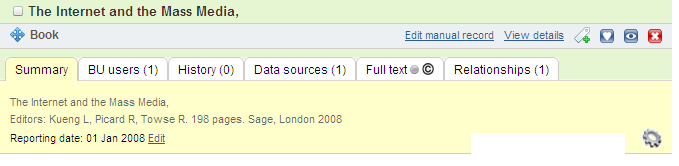
When in BRIAN, click on ‘my publications’ to see your full list of publications.  Each record will show a summary screen and below the title of each record you will see a set of six tabs. Click on the ‘Full text’ tab (the second tab from the right).


Click on the link ‘Manage full text’ where it says ‘Manage full text for this publication’.  The File management box will open. Browse and select the file(s) you wish to deposit. Click on Upload’. As indicated above, please include your final version in the first instance.

Books are rarely allowed, although some publishers will permit the use of a sample chapter.  BURO staff can liaise with the publishers on your behalf to check permissions.

Click on ‘Grant’   to confirm you are depositing the file(s) for possible dissemination via BURO. This process does not transfer copyright to BURO.  When you have deposited the files you wish to transfer to BURO click on ‘Home’ in the top left hand corner of the screen to return to your BRIAN profile home page.

If you have any queries about BRIAN, please contact BRIAN@bournemouth.ac.uk/.  If you require help assessing whether an open access version of your work can be contributed to BURO please contact your Subject Library Team or SAS-BURO@bournemouth.ac.uk.

Academic Profile Pages

Please accept our apologies whilst the Academic Profile Pages are still incorrect.  IT are working on correcting the pages.  There are issues around random question marks and brackets being added to text, as well as names.  Please bear with us whilst the work is carried out on the profile pages and we apologise for any inconvenience caused.

Academic Profile Pages update

The changes to the Academic Profile Pages this week have resulted in some glitches where not all information captured on BRIAN is being exported to the profile pages.  IT are fixing this and so please accept our apologies during this time.

Academic Profile Pages

You may have noticed that when changing the name structure on the academic profile pages, the system defaulted to your legal name and not your ‘known as’ name.  Please bear with us whilst we rectify this glitch.

If you have any other queries, please direct these to BRIAN@bournemouth.ac.uk

Thanks for your patience.

Academic Profile Page changes

I am pleased to inform you that a number of improvements were made to the Academic Profile Pages yesterday. 

  • Names are now shown in Forename and then Surname order;
  • Keywords are now displayed near the top of the page and so if you haven’t selected yours yet, please do;
  • Publications are now ordered in their sub-types, i.e. journal article, conference, book, etc.

There are other changes that will be implemented shortly and so watch this space.

Please also note that the remaining old staff profile pages (for the School of Applied Sciences and School of Tourism) will be removed shortly and replaced with the links to their current academic profile page (updated through BRIAN).  Those individuals with an old School web page will be contacted directly.

Definitions of BRIAN and BURO

Clarification is required of what BRIAN is and what BURO now does.

BRIAN

BRIAN (Bournemouth Research Information And Networking) is BU’s publication management system.  Staff can manage their research outputs on BRIAN, as well as other information such as biography, academic group, memberships, website and social media links, plus many more options.  Information input to BRIAN will be displayed in the BU staff profile web pages.  BRIAN enables a single point of data entry which will enable research information to be used in multiple places.  It will also enable BU to meet Research Excellence Framework (REF) requirements by improving administrative efficiency and data accuracy.  All academic staff automatically have a login and you can access it with your normal university username and password (you don’t need to add staff\ in front of your username).  Help and guidance can be found on the system and via the documents below.  If you have any problems accessing the system or you have any queries please contact BRIAN@bournemouth.ac.uk

If you require any help with BRIAN, please contact BRIAN@bournemouth.ac.uk

BURO

Bournemouth University Research Online [BURO] is the University’s Institutional Repository. BURO is supported by Eprints software. It gives access to academic outputs created by Bournemouth University staff and researchers. Where available BURO contains open access full text of unpublished works (pre-prints) and the author’s version of published works (post-prints).  BURO is located at http://eprints.bournemouth.ac.uk – it has a well-designed interface and is easy to use. BURO is open to anyone to search, however, only Bournemouth University staff and researchers can contribute material.  Material is contributed to BURO via BRIAN.  BURO contains records of outputs with full-text attached – a full list of outputs can be viewed in the BU staff profile web pages http://staffprofiles.bournemouth.ac.uk/.

If you require help assessing whether an open access version of your work can be contributed to BURO please contact your Subject Library Team or SAS-BURO@bournemouth.ac.uk .

I will shortly be updating the FAQ’s for BRIAN and so watch this space.

BRIAN – Improve your search settings

I’ve attended a number of BRIAN workshops recently and a common theme has emerged – BRIAN doesn’t find all of your publications available on the on-line data sources that it searches.  In investigating this further with individuals it became obvious that not all of you have optimised your search settings.  This is quick and easy to do.

From your home page, you can scroll down to view you current search settings.  If they just include your name, e.g. Garrad J, then you should input an address, e.g. Bournemouth, at the very least.  If you publish under other names or have published at other institutions then you should add these too.  Click on ‘My Search Settings’ and firstly add all combinations of your name and initials under which you publish by entering a name, e.g. Garrad Jo, and then clicking on the blue plus sign.  You can add as many names as required.  You can add previous institutions or those with which you collaborate under the address field, e.g. Swindon University, and as before, click on the blue plus sign each time you add an address.

After you have clicked the ‘save’ button at the bottom of the page, BRIAN will search within four hours.  This is all you need to do.  You don’t need to add keywords or journals as this will limit the search too much.  If you want further information then please read the BRIAN – Quick Start Guide v1.

If you are receiving hundreds of publications that are not yours, please do contact BRIAN@bournemouth.ac.uk and let us know.  We can sort this out for you.

Please note that I will be moving to RKE Operations on 1st February until mid-July and so please send all future BRIAN queries to BRIAN@bournemouth.ac.uk and not directly to me.

Thanks