Structure
The National Institute for Health Research (NIHR) is one of the largest funders of clinical research in Europe and have a number of funding streams that you can apply for in order to conduct health-related research. The NIHR then has a number of Clinical Research Networks or ‘CRNs’ that are spread out to each region of England. The local CRN is Wessex, based in Hedge End, Southampton.
The ‘Portfolio’
At the heart of CRN activities is the NIHR CRN Portfolio of studies. This consists of high-quality clinical research studies that are eligible for consideration for support from the CRN in England. Adoption onto the portfolio has a number of benefits for researchers, such as help in identifying potential research sites, access to patients and the public to carry out ‘PPI‘ and advice on recruitment strategy at any point during the study. The CRN offers support to researchers via their Study Support Service and likewise via each portfolio manager and their team. You can see a breakdown of each portfolio here on the Wessex CRN page.
The Portfolio and the NHS
Portfolio adoption is usually vital to participating NHS Trusts when considering the research studies they wish to undertake, as they are reimbursed for the resource given to conduct the study (e.g. research nurse support, data manager time).
Each CRN is given a budget for the financial year by the NIHR, which is then distributed to sites based on their recruitment figures.
Requirements
In order to be eligible for portfolio adoption, there are three criteria a study must meet:
- The study must be ‘research’ (this is stipulated, as often what’s classed as research outside the NHS setting, is sometimes a service evaluation, quality improvement etc. within the NHS – see this table);
- Have appropriate ethical approval; and Health Research Authority (HRA) Approval where required;
- Have full research funding – this has to have been awarded via open competition and by the NIHR, other areas of central Government, or an NIHR non-commercial partner (for which there is a list). If the study has received support from multiple funders, then it will be still considered automatically eligible, if one of the funding streams is the NIHR, an area of central Government or a non-commercial partner.
You can read more about study eligibility here, including research funded by overseas partners.
The Portfolio and BU
The source of research funding is the principal determinant of eligibility for NIHR CRN support and so it is encouraged that researchers seek external funding where possible and appropriate, from the NIHR, another area of central Government or one of their non-commercial partners. The amount of funding doesn’t need to substantial in order to be eligible.
For any queries to do with the portfolio or for guidance regarding implementing your research in a healthcare setting, take a look at the Clinical Governance blog. You can also get in touch with BU’s Research Ethics team with any queries.



 Wellcome have recently announced their plans to launch two new one-off calls to fund international exchange networks, and infrastructure costs for humanities and social science researchers around the world.



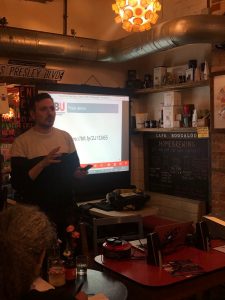
 Introducing his research to the Cafe Scientifique audience earlier this month,



 NERC/MRC/ESRC in collaboration with the Belmont Forum, have issued a call to fund transdisciplinary, end-user focused approaches to investigate and address the linkages between climate, environment and health. Projects should seek to bridge knowledge gaps, understand health risks, improve predictability, and deliver usable data, information, and innovative solutions to planners and decision makers. The following themes are prioritised for this call; food systems and nutrition; heat and health and; climate-sensitive infectious diseases.










 3C Online Social: Thursday 26 March 1–2pm – Research Culture, Community & Can you Guess Who?
 Four BU students at national midwifery conference
 INRC book roundtable/presentation by Drs Jonathan Cole and Catherine Talbot, Wednesday 22/04/2026, 13:00h, P426
 BU M.Res. student’s evidence to UK Parliamentary Women & Equalities Committee
 Prof Marahatta promoting BU-Nepal collaboration
 ECR Funding Open Call: Research Culture & Community Grant – Apply now
 ECR Funding Open Call: Research Culture & Community Grant – Application Deadline Friday 12 December
 MSCA Postdoctoral Fellowships 2025 Call
 ERC Advanced Grant 2025 Webinar
 Update on UKRO services
 European research project exploring use of ‘virtual twins’ to better manage metabolic associated fatty liver disease