Tagged / house of commons

Dr. Paul Whittington attends Technology and the SEND Reforms Roundtable in the House of Commons

Dr. Paul Whittington was invited to attend the Technology and SEND Reforms Roundtable at the House of Commons on Wednesday 8th July. The event was organised by Policy Connect through the All Party Parliamentary Group for Assistive Technology with the focus on the role of technology in SEND support and SEND teacher training incorporating technology and responsible AI. The session was held in a committee room within the Palace of Westminster and included a panel of experts from CENMAC, University of East London, LEP Academy Trust, TechEdology and Nasen, chaired by Peter Swallow MP.
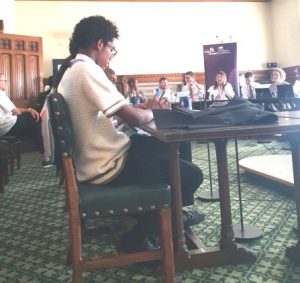
The Roundtable discussed the recent work undertaken by the Department for Education since the 2019 Education Technology Strategy. This included assessments for assistive technology and meeting digital standards by using AI and teacher training. The Government has committed £200m to provide this training including funding assistive technology lending libraries in local authorities throughout the UK. This is an important area of research for pupils with SEND as suitable assistive technology can reduce barriers and enable more individual needs to be met. The event was also an opportunity for Dr. Paul Whittington to promote the EduAbility research conducted by the Department of Computing and Engineering, involving Professor Huseyin Dogan.

The EduAbility application provides assistive technology recommendations and training for pupils with disabilities as well as teachers, support staff and parents/carers. It is therefore closely related to the SEND Reforms. Following the development of the Android application in 2025, funding was awarded from the department’s Quality Research Fund for the iOS development of EduAbility. Since March 2026, the application has been converted to the Flutter platform that allows EduAbilty to be maintained for both Android and iOS simultaneously using a shared codebase format.

Now that the application is compatible for both Android and iOS, we will be publishing EduAbility on Apple Store and Google Play Store in Autumn 2026. This will initially be as a free application, with future potential to be a paid application to support ongoing development and maintenance. Policy Connect have expressed interest in EduAbility to promote the application through their networks, including the Schools within the EdTech Demonstrator Programme. It is anticipated that Dr. Paul Whittington will attend future events organised by Policy Connect within the domain of education and assistive technology.


BU carbon pricing research cited in select committee report on the financial sector and the UK’s net zero transition

BU research on the impact of carbon pricing has featured in a House of Commons Environmental Audit Committee (EAC) report on the role of the financial sector in helping the UK achieve net zero emissions by 2050.

A cross-faculty team comprising Dr Alan Kirkpatrick and Dr Tahani Mohamed of the Business School and Dr Festus Adedoyin of the Faculty of Science and Technology submitted written evidence which has been published as part of the report, titled The financial sector and the UK’s net zero transition

Their evidence included recommendations considering the economic welfare implications of carbon emissions pricing at a national and international level, and the need for carbon border adjustment mechanisms (CBAMs) that has informed the EAC’s deliberations and subsequent recommendations to the Government.

Carbon pricing systems include carbon taxes and emissions trading systems (ETSs) in which carbon credits may be bought and sold thereby creating a ‘carbon market’ which, theoretically, could help achieve a global price for carbon.

In practice, however, carbon emissions pricing systems may encourage ‘carbon leakage’ – where businesses in countries that have more stringent carbon pricing rules try to save costs by moving production activities to countries with less demanding carbon pricing rules and hence lower costs.

CBAMs are designed to reduce carbon leakage by applying charges to take account of variations in carbon prices ruling in different jurisdictions.

The BU research team discussed the risk that CBAMs might be seen as ‘climate clubs’, reducing the competitiveness of carbon-intensive emerging economies but concluded that CBAMs are necessary to minimise carbon leakage when carbon emissions pricing systems such as the UK’s Emissions Trading Scheme are implemented.

In its report the EAC has recommended that the UK Government should develop a UK CBAM. The BU research team is continuing to analyse the impact of carbon emissions pricing on wider public wellbeing in the UK.

Read the full report – The financial sector and the UK’s net zero transition     

Jo Johnson to be quizzed on Brexit

House of Lords1The House of Commons’ Science and Technology Select Committee will today (13/7/16) hold an evidence session on the implications of Brexit for science and research. Jo Johnson will be appearing before the committee alongside Professor Philip Nelson of RCUK and several senior officials from BIS. Johnson has signalled his commitment to make Brexit work for universities, and has stated that ongoing projects such as Horizon 2020 should be carrying on as normal.

You can watch the evidence session here from 9.30am onwards.

Science Budget Report

parliament-uk-logoThe House of Commons Science and Technology Committee has published their Science Budget report today, following a recent review.  A summary of the contents can be found below.

The United Kingdom is a science superpower. In terms of both quality and productivity, our research base punches above its weight’, setting a worldwide benchmark for excellence.

Government spending on the science base has been protected since 2010, with a flat-cash- ring-fenced budget for annual ‘resource’ spending distributed by the research councils, the Higher Education Funding Council and others. Annual ‘capital’ budgets have varied. The Government has already announced that capital spending within the science budget will be protected — in real terms — up to the end of 2021. The Government’s Spending Review on 25 November will determine the science — and innovation — budget allocations for the rest of this Parliament.

The UK has fallen behind its competitors in terms of total R&D investment and this will put UK competitiveness, productivity and high-value jobs at risk if it is not reversed. The Government should produce a long term ‘roadmap’ for increasing public and private sector science R&D investment in the UK to 3% of GDP — the EU target. This would send an important signal about the long term stability and sustainability of our science and innovation ecosystem, supercharging private sector R&D investment from industry, charities and overseas investors alike.

A more robust system is needed to integrate capital and resource funding allocations. The Government should urgently review existing capital allocations to ensure sufficient resource is in place to fully ‘sweat our assets’. Sufficient resource funding will only materialise, however, with an upward trajectory in the resource budget.

The Spending Review is being conducted under present accounting protocols, dealing with capital and resource budgets for science separately. ‘ESA-10’ accounting rules will in future count resource expenditure on R&D as capital, reflecting the fact that all expenditure on science research is an investment — an asset — in future economic capacity. The Government in the Spending Review should make it clear that this rules revision will not be used as a means to change the underlying funding settlement.

The ‘dual support’ system has produced a world class and highly efficient system for scientific research. Any significant changes to this system, including the balance of funding between research councils and university funding councils, would require a clear justification, which has yet to emerge. The Government should make clear its continued commitment to the dual support system, and the previous Government’s 2010 iteration of the Haldane Principle in the forthcoming Spending Review. A significant element of research funding should continue to be channelled though both the research councils and the higher education funding authorities. Clear justification will also be needed for any significant change in funding allocations between the research councils, and we caution against a radical reorganisation which could potentially harm the research programme.

Any expansion of the innovation catapult network should not come at the expense of other innovation priorities. The Government should focus on consolidating the existing catapults, to ensure that all will have the necessary operating resource and business strategies to operate at peak capacity. To show a clear commitment to innovation more generally, the Government should ring-fence Innovate UK’s budget.

The Government should also retain the current system of innovation grants — rather than loans — as a key policy tool, alongside R&D tax credits, for de-risking innovation investment.

The Spending Review will have a profound impact on our science base and our future prosperity. We have to get it right. We have a duty to take care that our spending and structural decisions in this area do more than merely maintain the status quo. If we get our spending priorities, our policies, regulatory frameworks or our immigration policy wrong, we will be on the wrong side of history. The Government must ensure that the UK remains a scientific superpower.

The Association of Research Managers and Administrators (ARMA) submitted evidence to this report, which can be found here.

Parliamentary Science Committee want science budget protected

parliament-uk-logoThe House of Lords and House of Commons Science Committees have written to Sajid Javid, Secretary of State for Business, Innovation and Skills to ask him to protect the science budget.

An excerpt from the letter reads:

“The rumoured 40% cuts to your department’s budget pose a serious threat to Britain’s position at the cutting edge of science. We are writing to urge you to increase investment in research and development in the upcoming Spending Review and not to rush reorganisations of funding structures that could have unforeseen and long-term negative consequences.

The UK already invests significantly less of its GDP in R&D than our international competitors. We cannot afford to fall yet further. Cuts to the research base would send a very worrying signal to investors and could lead to a brain drain of our top academic talent.    

The Government’s aims to rebalance the economy and support high-value job creation are laudable, but they cannot be achieved without investment. Real-terms increases in the science budget and support for innovative businesses will leverage inward private investment and pay dividends for years to come through a healthier and happier society, and a stronger economy.”

Further comment on the letter can be found in this Research Professional article.