Over 25 years ago during my PhD research comparing the organisation of midwifery and maternity care in the Netherlands and the Northeast of Scotland I wrote a chapter comparing the history of maternity care in the two countries. I needed to write this not, as I thought at the time, to improve my thesis, but for myself to help me as a sociologist to help understand these historical developments.
In the process of researching the history of midwifery in the Netherlands I found a commemorative book by Drenth (1998) celebrating the centenary of the Dutch midwifery organisation. In this book is a footnote stating that the first chair of the KNOV (Royal Dutch Organisation of Midwives), Ms Francijntje de Kadt, lived and worked in the town of Vlaardingen in the late 19th to early 20th century (Drenth 1998). This note caught my eyes as I am born and bred in Vlaardingen.
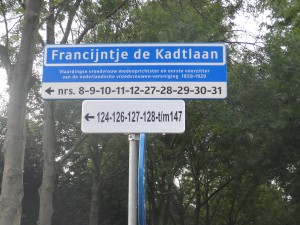
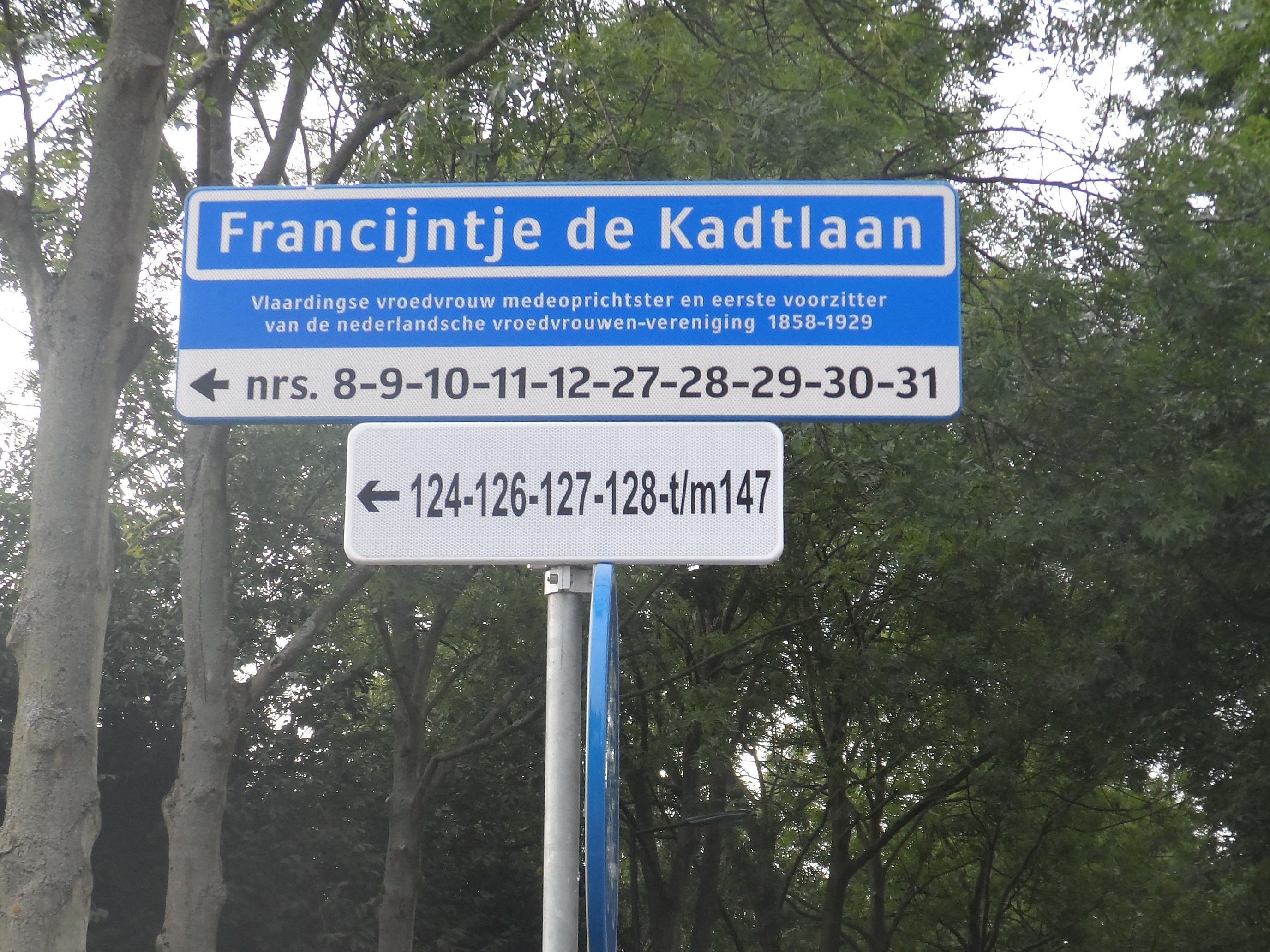
Francijntje de Kadtlaan in Vlaardingen, the Netherlands
After a bit more searching and a visit to the archives of the town of Vlaardingen I managed to dig up a little more about Francijntje de Kadt, but not an awful lot. During a family visit to the Netherlands I visited the archives of Vlaardingen to see what information they had about her. The archivist immediately recognised the name of Francijntje de Kadt, since genealogists keep finding her name as the midwife listed on their ancestors’ birth certificates. However, the archivist did not know that Francijntje de Kadt had been the first chair of the Dutch Mmidwifery organisation from its establishment in 1898 till 1926. At that point I decided to apply for a small travel grant in the History of Medicine from the Wellcome Trust. That application was successful, awarding a travel grant of £ 1,050 in 2001. My research in various archives in the Netherlands resulted in two papers (in Dutch) about Francijntje de Kadt, one in a local history journal (van Teijlingen 2003a) and one in the Dutch midwifery journal (2003b) and one about the collapse in 1921 of the midwives’ first pension fund (van Teijlingen 2002). This was for a while the end of my career as an amateur historian due to my busy day job as a health researcher and MSc coordinator at the University of Aberdeen.
Many years later (2010) I ended up talking to the burgomaster of Vlaardingen at the reception organised by the town to celebrate the fact that my father had been awarded the Dutch equivalent of an OBE. Over a drink I asked the burgomaster what the process was for suggesting a new street name in Vlaardingen. He suggested I write to the Street Name Committee with a justification why Francijntje de Kadt deserved a street name. With my recommendation I sent this committee my two Dutch publications. A few months later the secretary to the Street Name Committee wrote to say that my proposal had been accepted and that her name would be given to a street in a new development of the former local hospital grounds.
Then in mid-2015 a Dutch historian Eva Moraal came to Vlaardingen with her partner on a day trip and they ended up walking through the Francijntje de Kadtlaan. She read the subscript on the street sign (see photo) and thought ‘This woman need to have an encyclopaedia entry!’ A few days later she emailed me at Bournemouth University for further information on the live, work and achievements of Francijntje de Kadt to help her write a piece for the encyclopaedia. Two months ago Eva Moraal (2015) published her very nice contribution on Francijntje de Kadt.
So what started as a small historical study as an introduction chapter of a PhD thesis in Medical Sociology ended up with a ‘forgotten’ national midwifery leader having a street named after her in the town she spent most of her working live and her own entry in the encyclopaedia, Digitaal Vrouwenlexicon van Nederland (in Dutch: Online Women’s Lexicon of the Netherlands). What is even more interesting that this otherwise chronologically logical story is based on three major co-incidents: first, spotting a footnote in commemorative book about Vlaardingen. If Francijntje de Kadt had lived and worked anywhere else in the Netherlands other than my birthplace I would not have paid much attention. Secondly, speaking to the burgomaster of Vlaardingen and having a conversation in which street names cropped up, and thirdly, Eva Moraal who just happened to walk through the Francijntje de Kadtlaan, reading the street sign, and thinking this is an historical figure who needs better recognition.
Prof. Edwin van Teijlingen
CMMPH
References:
Drenth, P. (1998) 1898-1998. Honderd jaar vroedvrouwen verenigd, Bilthoven: KNOV.
Moraal, E. (2015) Kadt, Francijntje de, in: Digitaal Vrouwenlexicon van Nederland. URL: http://resources.huygens.knaw.nl/vrouwenlexicon/lemmata/data/Kadt
van Teijlingen, E. (2002) Ondergang eerste pensioenfonds voor vroedvrouwen (in Dutch: Decline of the first pension fund for midwives), Tijdschrift voor Verloskundigen (in Dutch: Journal for Midwives), 27(12): 684.
van Teijlingen, E.R. (2003a) Berichten – Francijntje de Kadt (1858-1929), Tijdschrift voor Verloskundigen (in Dutch: Journal for Midwives), 28(12): 630-633.
van Teijlingen, E.R. (2003b) Francijntje de Kadt (1858-1929). Vroedvrouw te Vlaardingen en eerste voorzitter van de Nederlandsche vroedvrouwenvereeniging, Tijd-schrift (in Dutch: Time-Magazine) 88: 14-23.
 Since his arrival in the Faculty of Health & Social Sciences last year postdoctoral researcher Dr. Pramod Regmi has been busy getting his publications out. Yesterday saw the latest of his articles appear in print, this time in the latest issue of the Nepal Journal of Epidemiology. The editorial, co-authored with Dr. Om Kurmi (University of Oxford) and Dr. Puspa R. Pant at the University of the West of England, addresses the growing problem air pollution in low-income countries such as Nepal. The paper is called: ‘

 The April issue of the Journal of Neonatal Nursing will publish the latest article written by a combination of Faculty of Health & Social Sciences staff and Visiting Faculty. The paper ‘Experiences of fathers with babies admitted to neonatal care units: A review of the literature’
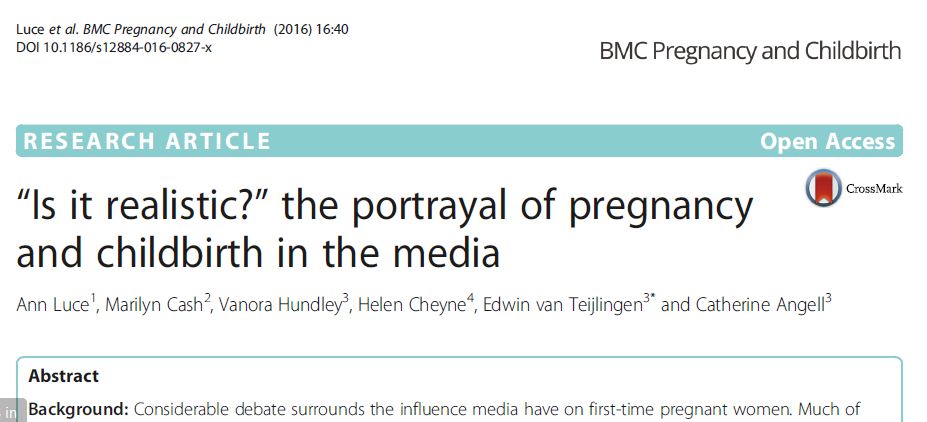
  Our latest paper in the international journal BMC Pregnancy & Childbirth published late last month was highlighted yesterday in a
  Our paper is great example of interdisciplinary research, as celebrated at the forthcoming Interdisciplinary Research Sector Day on June 21st (
 Doing a PhD may appeal to midwives and other NHS health professionals, but it often involves having to make difficult choices. Undertaking a part-time PhD means studying on top of a busy clinical position, but starting full-time study involves stepping away from practice, which may lead to a loss of clinical skills and confidence. The Centre for Midwifery, Maternal & Perinatal Health (CMMPH) at Bournemouth University has come up with a novel solution making it easier for midwives to undertake a doctorate while still maintaining their clinical skills. This approach is highlighted in the latest publication by Dr. Susan Way and colleagues, describing a process where CMMPH collaborate with NHS partners to apply for a match-funded PhD. [1] The first partnership was with Portsmouth Hospitals NHS Foundation Trust (PHT), with later partners expanded to cover the Isle of Wight and Southampton. Currently there are negotiations with Dorset Country Hospital NHS Foundation Trust and Poole Hospital NHS Foundation Trust. Non NHS organisations have also showed an interest with the Anglo European Chiropractic College (AECC) our likely next collaborator.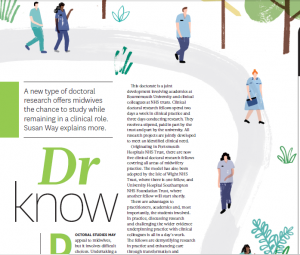
 This first week of March has been a good week for FHSS publications. On March 1st CMMPH Prof. Vanora Hundley published her collaborative paper ‘Do Cochrane summaries help student midwives understand the findings of Cochrane systematic reviews: the BRIEF randomised trial’.[1] With colleagues based across the UK and Ireland she surveyed over 800 midwifery students at nine universities. This results of the study can be found in the journal
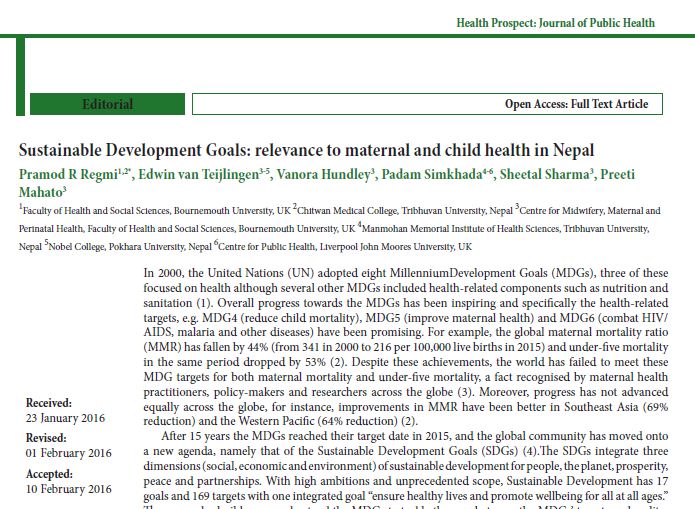
  The second FHSS publication is a chapter in a Kindle book on the Importance of public health in low- and middle- income countries, written by Dr. Puspa Raj Pant,CMMPH’s Prof. Edwin van Teijlingen, and BU Visiting Faculty Prof. Padam Simkhada.[2] Padam Simkhada is Professor of International Public Health and Associate Dean (Global Engagement) for the Faculty of Education, Health and Community at Liverpool John Moores University. The chapter is part of the Kindle book with the long title: Public Health for the Curious: Why Study Public Health? (A Decision-Making Guide to College Major, Research & Scholarships, and Career Success for the College Students and Their Parents) edited by Richard Lee Skolnik from Yale University, USA.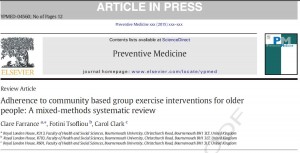











 3C Event: Research Culture, Community & Connections – Wednesday 11 November 3-4pm
 ECR Opportunities: New Development Programme, Researcher Grants & Upcoming Events
 Help us capture BU’s knowledge exchange activity HE-BCI survey 2025–26
 Verbal autopsy paper published two days ago
 ESRC Studentships for 2027 Entry: Opportunity Now Open
 Horizon Europe Cluster 3 (Civil Security for Society) 2026 Calls Now Open
 MSCA Doctoral Networks 2026 Call Information Webinar
 ESRC Festival of Social Science 2026: Application Deadline Extended to Thursday 25 June 2026
 Reminder: Register for the ESRC Festival of Social Science 2026 Information Session
 ECR Funding Open Call: Research Culture & Community Grant – Apply now
 ERC Advanced Grant 2025 Webinar
 Update on UKRO services
 European research project exploring use of ‘virtual twins’ to better manage metabolic associated fatty liver disease