Apologies for the last minute cancellation. This seminar is cancelled due to illness.
For further infomation please get in touch with Dr Mastoureh Fathi for further information.
Latest research and knowledge exchange news at Bournemouth University
Apologies for the last minute cancellation. This seminar is cancelled due to illness.
For further infomation please get in touch with Dr Mastoureh Fathi for further information.
This relates to the second pillar of the Global Agenda for Social Work and Social Development which was launched in 2012. Each of the five Global Agenda themes runs for
two years and 2016 is the second year for Promoting the Dignity and Worth of Peoples.
The theme is particularly poignant this year as we have witnessed unprecedented levels of mass migration around the world, levels of which we have not experienced since the Second World War. Images of desperate families risking their lives in an attempt to flee conflict and persecution are reported daily in the media. Many are traumatised by their experiences and face uncertain futures. In this context of human suffering it is essential to uphold the commitment to value every human life and embrace shared human experience, and social work is ideally placed to champion this approach.
Such a stance requires social workers to respect the inherent dignity and worth of every
person, and this includes respect for human rights as expressed in the United Nations Universal Declaration of Human Rights. Such an approach is underpinned by five core notions of human rights: human dignity; non-discrimination; civil and political rights; economic, social and cultural rights; and solidarity rights (Wronka, 2007).
It has been argued that social work has often blurred the line between a focus on human needs and human rights (Healy, 2008), however there is an opportunity for social work to grasp a central role in upholding the rights of all peoples across the world. If this opportunity is taken ‘ human rights provide the profession with a clear direction for a presence at the international level, while also bridging local and national issues with global concerns’ (Healy 2008:745).
World Social Work Day provides an opportunity for the global community of social work to come together through cross-national dialogue, to promote a human rights approach which is rooted in social action as a means to uphold the dignity and worth of all peoples across the global world. We therefore should not just ‘talk the talk’ about upholding the dignity and rights of all, but more importantly ‘walk the walk’ by implementing these principles into action in everyday practice.
References
Healy, L.M. (2008) Exploring the history of social work as a human rights profession, International Social Work, 51, 735-748.
Wronka, J. (2007) Human Rights and Social Justice: Social Action and Service for the Helping and Health Professions, Thousand Oaks, CA, Sage.
The event included an address from Bournemouth University’s Professor Keith Brown, and explored some of the work of the NCPQSW around financial scam prevention and at risk groups. Bournemouth University, in partnership with the Chartered Trading Standards Institute, National Trading Standards Scams Team, North Yorkshire Trading Standards, and City of London Trading Standards, has created a Financial Scamming Guide to offer advice and guidance on what to watch for and how to avoid falling foul of scamming techniques and schemes.
This guide includes a campaign to raise awareness of the risks of financial scamming, as well as calling for a more integrated approach to tackling the issues from the financial sectors. In particular the campaign asks that …..

To find out more about the work of the NCPQSW in relation to financial scamming, please CLICK HERE.
Have you thought about applying to the European Research Council (ERC) for funding? Although the funding calls are not yet open, it may be worth starting on your proposal now as calls are published every year.
Starting Grants: For 2015, a combined total of €429 million was given to 291 early-career researchers, with the greatest number (48) being awarded the UK and an overall success rate of 12%. For 2016, the ERC received 2935 applications (an increase of (+0.5%). The highest number of applications were from Physical Sciences and Engineering (1299), followed by Life Sciences (854, a decrease of -3%), and Social Science and Humanities (782, an increase of +3%).
Starting Grants are for researchers who have 2-7 years of experience since the completion of a PhD and a track record of excellence, you may be eligible for up to €1.5 million for projects lasting up to five years.
Consolidator Grant: For 2015, the ERC gave a combined €585 million to 302 successful applicants for an overall sucess rate of 15%. For 2016, the number of applicants increase by 12% from the previous call with the highest number of applications was submitted from Physical Sciences and Engineering (1075), followed by Life Sciences (713), and Social Science and Humanities (516).
The Consolidator Grant is a fund with up to €2 million available for researchers with 7-12 years of experience since the completion of a PhD who also have a demonstrable record showing scientific talent and excellence.
As part of the first phase of a two phase application process, evaluators will first judge the synopsis and CV of the applicant to see if the work is ground-breaking in nature, ambitious and feasible. The evaluators will also judge the track record of the applicant to see if they have the proven intellectual capacity (through publication), creativity (novelty) and commitment (through a track record of managing previous projects).
If you are interested in applying to these funds, please contact Emily Cieciura, the Research Facilitator for EU & International funding or your relevant faculty Funding Development Officer.
The Academy of Marketing SIG Marketing in Higher Education.
Bournemouth University
Wednesday 27 April, 2016.
Faculty of Management academics, Dr Chris Chapleo and Helen O’Sullivan (both from the Department of Marketing) are organising a one day colloquium titled ‘Contemporary Thought in Higher Education’. This colloquium will initiate discussion, drive collaboration and grow networks amongst marketing academics and HE marketers, which will promote, advance and disseminate current practices and developments in HE marketing.
Professor Jane Hemsley-Brown, from the University of Surrey, and Professor Felix Maringe, from the University of the Witwatersrand have been confirmed as keynote speakers
There will be an associated special edition of ‘The Journal of Marketing in Higher Education’.
Find out more To register interest and for more details, go to http://www.bournemouth.ac.uk/academy-of-marketing
Today, Tuesday 15th March 2016, is World Social Work Day. Whilst the growth in ‘world this’ or ‘world that’ day may cause some to groan and turn off, there is tremendous importance in World Social Work Day because of it focus on social justice, wellbeing and positive change for individuals, families, communities and states.
This year’s theme for World Social Work Day is Human Worth and Dignity, something important to all our hearts, and central to contemporary concerns as the Syrian crisis continues and, unfortunately, exemplifies the state of much of the world. As a precursor to celebrating the day, the Department of Social Science and Social Work has been fortunate to host two important international speakers. On March 3rd, our visiting fellow and co-author with Prof Jonathan Parker, Prof Dr Maria Luisa Gomez Jimenez from the University of Malaga introduced aspects of the housing crisis in Spain, outlining some of the ways in this problem might be addressed. Yesterday, Dr Bala Raju Nikku, founding director of the Nepal School of Social Work (NSSW) and visiting senior lecturer at the Universiti Sains Malaysia, where he worked alongside Prof Sara Ashencaen Crabtree and Prof Jonathan Parker, took time off from his COFUND fellowship at the University of Durham to speak about disaster social work. He used the 2015 earthquakes in Nepal as his focus. The NSSW and Dr Bala were active in providing social work support after the earthquakes and responding rapidly so that students could engage in the work and learn through service delivery, whilst being able to understand and theorise at the same time.
Human worth and dignity are central concepts which are often trivialised or ignored in contemporary society. If we are to engender social trust, positive relationships and a co-produced future not based on profit alone but on reciprocity, compassion and sustainability we must engage with these concepts. This year’s World Social Work Day helps us do so.
Jonathan Parker & Sara Ashencaen Crabtree

By Lee-Ann Fenge, Deputy Director National Centre for Post-Qualifying Social Work
It is difficult to under-estimate the importance of effective leadership and leadership style within children’s services. Children’s services represent complex areas of practice including child protection and looked after children, and services are being delivered against a backdrop of increasing fiscal restraint and budget cuts. The recruitment and retention of a skilled workforce is an
on-going challenge and as a result leaders need to be able to effectively deliver innovative responses to provide services which achieve better outcomes for children and their families.
Ofsted (the Office for Standards in Education, Children’s Services and Skills) inspect and regulate services that care for children and young people, but worryingly recent inspection figures revealed there were more “inadequate” than “good” children’s services in English local authorities. This is worrying for both local authorities and those receiving support from them.
Staff from the National Centre of Post-Qualifying Social Work at Bournemouth University, have been working in partnership with one local authority to develop a robust approach to leadership in order to enhance service delivery in children’s services. Cheshire West and Chester have committed to deliver an Aspiring Team Leader programme and an Aspiring Practice Lead programme as part of a sustainable workforce development approach. Kate Howe, from the NCPQSW, has worked with them to deliver a bespoke Masters level Leadership unit, providing added depth to the programme.
‘This outstanding leadership has resulted in good-quality services that respond to the needs of children and families quickly and effectively’ (Ofsted, 2016:2).
Ofsted suggest that it is possible to overcome some of the challenges of contemporary children’s services through innovation and robust succession planning. This includes approaches to workforce development which value ‘growing your own’, and an importance on learning and development alongside protected budgets and caseloads (Ofsted, 2015). Cheshire West and Chester’s approach to leadership appears to acknowledge these key areas and their recent Ofsted Inspection highlighted the importance of their partnership with Bournemouth University.
‘The authority is active in trying to retain staff through a staff development policy including aspiring senior practice leads and aspiring team managers’ courses, and is currently developing an aspiring senior manager course, all in conjunction with Bournemouth University’ (Ofsted, 2016: 33).
The value added of working alongside a university concerns not only the content of the learning, but also the critical role of assessment of learning. By designing clear assessment strategies based on reflective practice, it is possible to evaluate the effectiveness of learning on staff thinking and practice, and ultimately support a culture of change within the organisation.
References
Ofsted (2015) Joining the dots… Effective leadership of children’s services, Available from: https://www.gov.uk/government/uploads/system/uploads/attachment_data/file/424193/Joining_the_dots__effective_leadership_of_childrens_services.pdf
Ofsted (2016) Inspection of services for children in need of help and protection, children looked after and care leavers And Review of the effectiveness of the Local Safeguarding Children Board – Cheshire West and Chester http://reports.ofsted.gov.uk/local-authorities/cheshire-west-and-chester
Communicating Research
FMC Cross-Departmental Seminar Series 2015-16
The Faculty of Media and Communication at BU
Venue: CG17, Christchurch House, Talbot Campus, Bournemouth University, Fern Barrow, Poole, Dorset, BH12 5BB
Wednesday 16 March 2016, 3pm, CG17
A Corporate Marketing Communication – Politics and Media Guest Lecture
Anastasia Kavada, Westminster Faculty of Media, Arts & Design at the University of Westminster
Collective action and digital media: the case of Occupy
Social movements can be considered as communication phenomena, as actors emerging from conversations amongst groups and individuals which become codified in ‘texts’ of various kinds: common statements and manifestos, training resources and new ‘scripts’ that ritualize common ways of behaving, as well as new digital artefacts whose design reflects the values of the movement. This talk outlines a communication perspective on social movements by focusing on the case study of the Occupy movement. The empirical material is drawn from 75 in-depth interviews with Occupy activists in London, New York, Seattle and Boston. The talk investigates digital media as part of Occupy’s communication ecology, focusing on their use to create spaces for conversation, to delineate the boundaries between the movement and its environment, and to develop ‘texts’ that embody the shared values and codes of the movement. Examining social movements as communication phenomena also provides an insight into how power relations, both within the movement and between the movement and its allies, targets and adversaries, are shaped by communication practices. More specifically, this talk identifies six types of communication power that shaped the power relations of Occupy. Overall, in this talk I argue that viewing social movements as phenomena emerging in and through communication allows us a grounded perspective on their processes and their capacity to effect change.
Anastasia Kavada is Senior Lecturer in the Westminster Faculty of Media, Arts & Design at the University of Westminster. She is Co-leader of the MA in Media, Campaigning and Social Change and Deputy Director of the Communication and Media Research Institute (CAMRI). Her research focuses on the links between online tools and decentralized organizing practices, democratic decision-making, and the development of solidarity among participants in collective action. Anastasia’s case studies include, among others, the Global Justice Movement, Avaaz, and the Occupy movement. Her work has appeared in a variety of edited books and academic journals, including Media, Culture & Society and Information, Communication & Society.
About the series
This new seminar series showcases current research across different disciplines and approaches within the Faculty of Media and Communication at BU. The research seminars include invited speakers in the fields of journalism, politics, narrative studies, media, communication and marketing studies. The aim is to celebrate the diversity of research across departments in the faculty and also generate dialogue and discussion between those areas of research.
Contributions include speakers on behalf of
The Centre for Politics and Media Research
The Centre for the Study of Journalism, Culture and Community
Promotional Cultures & Communication Centre
Public Relations Research Centre
Narrative Research Group
Journalism Research Group
Advances in Media Management Research Group
The third Being Human festival will run 17-25 November 2016 and is now inviting applications for 2016.
The theme for 2016 is ‘Hope and Fear’. Applicants are encouraged to consider events around the theme, but they’re open to other ideas as well.
They are offering grants to support activities across the UK that communicate research in the humanities in accessible, engaging and fun ways to non-academic audiences.
There are a number of ways to get involved, from organising one event or coordinating a small programme, to becoming a Being Human ‘Festival Hub’. Have a look at the full call for applications to find out more.
Need some inspiration? Check out they gallery from last year.
The deadline for applications is 5pm May 16th.
Call for Proposals
Science Stalls for Einstein’s Garden at the Green Man Festival 2016 – Deadline 21 March
The Green Man Festival is held near the Black Mountains in Wales and attracts 20,000 festival goers. The festival has earned a reputation as one of the great independent festivals in the UK. The 2016 festival dates are 18/19/20/21 August. For more information see www.greenman.net
Einstein’s Garden is a fusion of science, art and nature. It has a diverse programme of performances, workshops and installations that use creativity, play and participation to engage people with science and research in unexpected ways. www.greenman.net/explore/areas/einsteins-garden
They are looking for organisations that would like to bring a stall to Einstein’s Garden with the aim of engaging festival audiences with science. Stalls can explore fundamental scientific ideas or phenomena, the process of science or current scientific research. It is essential that stalls include as much interactivity and participation as possible for festival goers and that they embody the creative and playful spirit of Einstein’s Garden.
The Einstein’s Garden theme for 2016 is COMPLEXITY. It is not essential for science stalls to directly relate to the theme, but it may help to shape your ideas.
The fee for standard stalls (up to 4mx4m) is £250 plus VAT. Fees for larger stalls will be negotiable on a case-by-case basis. There will be a limited number of free pitches available for small organisations.
RKEO can support you with funding attendance at the festival and cover materials, equipment, travel and subsistence expenses. – please contact Naomi Kay (nkay@bournemouth.ac.uk)
The stall must be set up by 4pm on Wednesday 17th August (for a site-wide health and safety inspection) and your stall must be open from 12 midday until 7pm on 18th August and from 10am until 7pm on 19th, 20th and 21st August. There will be no power available for stalls and no generators are allowed in Einstein’s Garden so if your stall does need power you must provide your own renewable energy.
If you would like to apply to run a science stall in Einstein’s Garden please complete the online form here: https://marcatoapp.com/forms/greenman/einsteinsgarden/new by Monday 21st March.
The Green Man Festival will provide up to 6 festival passes for successful applicants but we are unable to cover any expenses or provide meal vouchers. Please note that information about Science Stalls will be included on the Green Man Festival website but will not be included in the festival programme.
Camp Bestival
We’re also looking for potential activities to run at Camp Bestival, however these would need to be child friendly and would be more workshop based than drop ins – Please contact Naomi Kay (nkay@bournemouth.ac.uk/ 61342) for more information.
Advertise your surveys, interviews and other research studies to thousands of participants for free on Call For Participants:
Call For Participants is an online community for researchers and participants, funded by Jisc. University staff and students can use this service for free to advertise their surveys, interviews and other research studies to the public and recruit participants.
Researchers can also access other support and resources, such as webinars, guidance on communicating research to the public, ethics guidance, and case studies to support their research activities. Call For Participants is used and trusted by academic researchers from over 340 universities worldwide.
To advertise a survey, interview or other research study, visit the researcher homepage and create a study page. For resources and support for researchers visit the researcher support page, and the blog.
The HEFCE grant letter (sent from BIS to HEFCE) for funding in 2016-17 was published on 4th March and contains some information on RKE funding that you may find of interest.
REF
Research funding
Research Councils
HEIF
NCUB
You can access the full letter here: http://www.hefce.ac.uk/news/newsarchive/2016/Name,107598,en.html
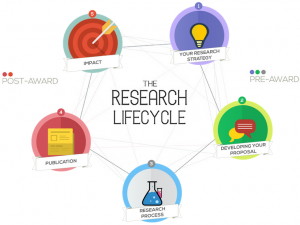
If you haven’t checked out the BU Research Lifecycle yet then you most definitely should! Our Research Lifecycle diagram is a jazzy interactive part of the BU Research Blog that shows the support and initiatives that are available to staff and students at each stage of the research lifecycle. The information is general enough so as to apply to all disciplines and you can use it to organize and identify the many activities involved in your research. You can explore the Research Lifecycle to find information on how to get started with:
1. Developing your research strategy
2. Developing your proposal
3. The research process
4. Publication and dissemination
5. Impact
RKEO will be adding to the Research Lifecycle to ensure it always contains the most up to date information to support you with planning, organising and undertaking your research.
You can access the diagram from the links in this post or from the menu bar that appears on all screens in the Research Blog.
Monday
Grant letter
HEFCE received the annual grant letter from BIS, covering 2016-17. The letter confirms moves to “retarget” student opportunity funding for the poorest students in the coming year ahead of future cuts. The grant letter also revealed that the teaching grant will be £1.539 billion in 2016-17, down from the £1.671 billion figure in last year’s grant letter. The letter also states that Hefce will take responsibility for delivering the TEF in Year 2. BIS grant letter asks Hefce to deliver TEF (THE).
Tuesday
Pay gap
According to data compiled by the University and College Union, the average gender pay gap in universities is £6,100 annually. According to the results, just eight universities pay women equally or more than men. Call for equal pay in universities (Research Professional).
Wednesday
Scotland HE Bill
A bill aimed at strengthening the management of higher education in Scotland has been passed at Holyrood. The Higher Education Governance Bill had proved controversial, with the government agreeing to cut some measures from the legislation. The bill modernises academic boards with elected chairs and an enhanced definition of academic freedom. Controversial higher education bill passed by MSPs (BBC).
Thursday
Brexit
Worries about the impact on research funding for British universities from a UK exit from the European Union have been “massively exaggerated”, according to Conservative MP Owen Paterson. Brexit research worries ‘massively exaggerated’, says Tory MP (THE).
Polls
The ‘What UK Thinks: EU Poll of Polls’ shows the average share of the vote for ‘Leave’ and ‘Remain’ in the six most recent polls of voting intentions in the EU Referendum. EU Referendum Poll of Polls. (What UK Thinks).
HE Bill
According to the Financial Times, the Prime Minister is understood to have ordered that a bill on higher education should be included in the Queen’s speech. The bill will include attempts to broaden access and create more competition between universities. (Please see pdf attached).
Immigration policy
International business students are being put off studying at UK universities because of stringent visa policies, a new report has claimed. Business schools: UK immigration policy sparks drop in students (THE).
Friday
HE Bill
The HE bill that is likely to remove barriers to new entrants to stimulate competition has been criticised by the University and College Union. Higher education bill mooted (Research Professional).
Student cap
The Economist looks at the effects of lifting the student cap in England and how different universities have responded. Stronger institutions, both new and old, are growing at the expense of weaker ones, says Emran Mian, Director of the Social Market Foundation. Open universities (The Economist).
I am delighted to share with you good news about the small grant that I was awarded from the Grants Academy at BU. It will help me to develop my research in the area of predictive analysis of complex networks.
The main goal of the project that will be a result of this small grant is to develop a robust and adaptive framework for Predictive Analysis of Complex Social Networks. Sound mysterious and you are probably asking so what?
Let me give you some background. For the first time in history, we have the possibility to process big social data about the interactions and activities of millions of individuals that can be represented as a social network. It represents an increasingly important resource yet is underutilised due to the scale, complexity and dynamics of these structures which makes them extremely difficult to model and analyse. As only recently the development of ICT technology has made collecting this data feasible, there is no coherent and comprehensive approach to analyse such networks and their dynamics which is crucial to advance our understanding of continuously changing people’s behaviour. It means that we need new approaches that will enable us to analyse and predict the future of social networks.
And now the next question that you are asking is probably: so why is it important?
Again, let me give you some examples that shed a little bit of light onto importance of my study:
a) Improving national security
The outcomes of this project will be applied in a collaborative research, with a visiting researcher, Prof. De Meo from the University of Messina, Italy, focused on Cosa Nostra analytics, for understanding of the organisation of Mafia syndicates. Application of my framework for Predictive Analysis of Complex Social Networks will contribute to the improvement of well-being and security of citizens. Results of this joint cross-disciplinary research will help law enforcement agencies and policy makers to more efficiently allocate resources in the fight against Mafia
b) Improving health and well-being
The results will also be applied in the cross-disciplinary collaborative research with a visiting researcher, Dr De Ruddere from the Ghent University, Belgium, to understand the social exclusion of patients with chronic pain. Application of my framework will facilitate the understanding of how the social networks of people with chronic pain evolve over time contributing to the improvement of the patients’ quality of life and social well-being.
If you would like to have a chat and hear more about my research please keep in touch: kmusialgabrys@bournemouth.ac.uk

The following is a snap-shot of funding opportunities that have been announced. Please follow the links for more information:
NERC
UK aquaculture initiative – innovation projects call
NERC and Biotechnology & Biological Sciences Research Council are inviting proposals for innovation projects to the UK Aquaculture Initiative, which builds on the 2014 Sustainable Aquaculture capacity-building call. Approximately £1·2m of funding is available for this call for projects that meet the needs of the UK aquaculture industry and create sustainable, tangible economic or societal benefits.
Maximum Award: £1.2m available
Deadline: 1st stage application by 26 April 2016
International opportunities fund
NERC is inviting proposals for Pump Priming and Pump Priming Plus grants to its International Opportunities Fund (IOF). The IOF scheme provides resources to NERC-supported researchers to allow them to forge long-term partnerships with overseas scientists that add value to current NERC-funded science. IOF grants are pump-priming, to help stimulate novel research collaborations.
Maximum Award: £40,000
Deadline: 19 May 2016
ESRC
ESRC/NRF Newton call – higher education in Africa
The ESRC and National Research Foundation (NRF) invite collaborative projects between the UK and South Africa which can offer additional value to existing programmes of education research. Some themes are:
Maximum Award: £630,000
Deadline: 3 May 2016
BBSRC
Future Leader Fellowship
The Future Leader Fellowship (FLF) will provide support for researchers wishing to undertake independent research and gain leadership skills. The FLF will support the transition of early stage researchers to fully independent research leaders.
Maximum Award: £300,000
Deadline: 12 May 2016
NIHR
Health technology assessment programme – commissioned call for proposal 15/167
Proposals are sought on the topic of management of knee braces in the management of knee osteoarthritis, with the specific research question: What is the clinical and cost-effectiveness of knee braces in the management of knee ostearthritis.
Maximum Award: Unspecified
Deadline: 19 May 2016
Arthritis Research UK
Career development fellowship
Career development fellowships aim to attract and retain talented postdoctoral basic scientists and allied health professionals in research relevant to arthritis and related musculoskeletal conditions, and provide them with the opportunity to develop an independent research career and progress towards higher-level appointments.
Maximum Award: Salary and research expenses
Deadline: 1 June 2016
EPSRC
Human dimensions of cybersecurity
The funder is inviting proposals which address the challenges identified at the ‘Human Dimensions of Cyber Security’ (HDoCS) workshop in 2014. The challenges are titled:
Maximum Award: up to £5 million available
Deadline: 8 June 2016
eFutures Facility award
This award is intended for researchers who have a current or recent cross-disciplinary project and require additional resources to take their idea towards commercialisation or require further investment to bridge the gap with follow-on funding.
Maximum Award: £20,000
Deadline: Unspecified
Trans-Atlantic Platform Social Sciences & Humanities
T-AP Digging into Data Challenge
This funding opportunity is open to international projects that consist of teams from at least three member countries, and must include partners from both sides of the Atlantic. Projects must address any research question in humanities and/or social sciences disciplines by using large-scale, digital data analysis techniques, and show how these techniques can lead to new insights.
Maximum Award: Unspecified
Deadline: 29 June 2016
If you are interested in submitting to any of the above calls you must contact your RKEO Funding Development Officer with adequate notice before the deadline.
For more funding opportunities that are most relevant to you, you can set up your own personalised alerts on Research Professional. If you need help setting these up, just ask your School’s/Faculty’s Funding Development Officer in RKEO or view the recent blog post here.
If thinking of applying, why not add notification of your interest on Research Professional’s record of the bid so that BU colleagues can see your intention to bid and contact you to collaborate.
BU is a member of IUSDRP – an Inter-University Sustainable Development Research Programme. As part of that network, I am sharing with colleagues information in relation to publications and forthcoming events. You may be interested in participating further and/or submitting a paper to future conferences.
LATEST PUBLICATIONS as part of the “World Sustainability Series” a) Biodiversity and Education for Sustainable Development Castro, P., Azeiteiro, U.M., Bacelar-Nicolau, P., Leal Filho, W., Azul, A.M. (Eds.) 2016 Springer, Berlin: http://www.springer.com/de/book/9783319323176 b) Engaging Stakeholders in Education for Sustainable Development at University Level Leal Filho, Walter, Brandli, Luciana (Eds.) 2016 Springer, Berlin: http://www.springer.com/de/book/9783319267326 c) The Contribution of Social Sciences to Sustainable Development at Universities Leal Filho, Walter, Zint, Michaela (Eds.) 2016 Springer, Berlin: http://www.springer.com/de/book/9783319268644
FORTHCOMING EVENTS
The Symposium on Sustainable Development Research at Universities in the United Kingdom will be helt at Manchester Metropolitan University, UK on 5th -6th April 2016. Further details can be seen at: http://www.sste.mmu.ac.uk/conferences/
The preparations for the 3rd World Symposium on Sustainable Development at Universities (WSSD-U-2016), to be held at MIT, USA on 14-16 September 2016 are in full swing. The WSSD-U series is the world´s leading international event on sustainability in higher education and accepted papers will be published in a major volume titled “Handbook of Theory and Practice of Sustainable Development in Higher Education”, to be pulished as part of the “World Sustainability Series. Research teams with innovative research projects and outputs are welcome to contact the organisers to discuss possible presentations. The details can be seen at: https://www.haw-hamburg.de/en/wssd-u-2016.html
The World Symposium on Lifelong Learning for Sustainable Development will be held in Malta on 2nd – 4th March 2017. The event is being organized based on the perceived need to explore and present concrete case studies which illustrate how lifelong learning for sustainable development can be realised. Further details can be seen at: https://www.haw-hamburg.de/en/ftz-als/events/malta2017.html
The “Sustainability and Social Science Research Symposium” will be held at the University of Michigan, United States, on May 17th-19th 2017. The Call for Papers is now open and further details can be seen at: https://www.haw-hamburg.de/en/ftz-als/events/michigan2017.html
All staff and students welcome. Please feel free to bring your lunch.
Voices of the Secret State: Human Rights Activism among North Korean
Defectors in the UK
Abstract: My paper aims to highlight the lived experiences and identity formation of North Korean defectors settled in the UK who are involved in human rights activism. Whilst violations of human rights in North Korea are well documented, human rights activism by its defectors is less well known. Since 2004, approximately 600 North Koreans have settled in the UK. Free NK, a human rights organisation born out of this settlement, has been active in illuminating the reality of North Korea whilst also working towards subverting the regime by informing its fellow remainders about the outside world through the distribution of newspapers. This paper is drawn from ongoing research on North Korean defectors living in the UK. The data is collected using life history interviews to capture their lived experiences and to identify a range of factors which have influenced their involvement in the activism whilst also seeking to find better ways of improving the wellbeing and quality of life for those activists. The presentation will focus on the in-depth story of a North Korean defector who has founded Free NK. Themes that will be addressed in this story include the reason why he has fled North Korea; the processes of getting to the UK; challenges he has faced in his human rights activism.
Dr Hyun-Joo Lim is a lecturer in Sociology and the programme leader for BA Sociology and Social Policy at BU. She is originally from South Korea and has been engaged in various research projects that explore issues around migration, ‘race’/ethnicity, gender and identity. Her previous research examined East Asian mothers in Britain.
For more information about Social Science seminar series please get in touch with Dr Mastoureh Fathi (mfathi@bournemouth.ac.uk).