In October we launched a suite of careers guidance resources for researchers and their managers. The resources include detailed guidance on how to progress from a research career to an academic career as well as information for PhD students on postdoctoral research positions. There is also information on other career pathways including administration/management within HE and research careers outside of HE. The resources have been enhanced over the past few months and now include a number of case studies for different career pathways.
/ Full archive
Research Photography Competition
Hello !
The entries to this year’s Research Photography Competition are still open for a short time !
Can you convey your research through an image?
We are looking for academics and postgraduates to tell the story of their research through a photograph, which can be used to inspire current BU undergraduates.
All submitted images will be showcased on the BU website late 2015, where staff and students will have the opportunity to vote for their favourite image/s. An exhibition will also be displayed in the Atrium Art Gallery during February 2016. Winners will then be announced during an Awards Ceremony which will take place on Thursday 4 February 2016.
How to enter the competition:
Step 1: Take your photo!
You can be as creative as you like in capturing the essence of your research. You could take a photo of your research in progress, showing how it is developed. Or you could focus on the people involved – the people behind the research, or the people benefitting from it. Unusual or artistic images are encouraged!
Step 2: Submit your photo
Submit your photo to the research email inbox, along with a 100–200 word description of your research by the 13th of January 2016.
Need inspiration?
Then take a look at our regular ‘Photo of the Week’, where you can read about the research behind the images or visit the Research Photography Competition 2015 webpages which highlight last year’s Research Photography Competition entries.
Funding for training or teaching in the EC – professional services and academic staff – is Erasmus right for you?
Did you know that our Erasmus funding is available for those who want to take training abroad as well as those who want to teach?
Every year our academic staff visit European institutions to teach, exchange ideas and build their networks.
What’s less well known is that both academic and professional services staff can apply for funding to go to a European Higher Education institution, or enterprise, to train, learn new techniques, share best practice and widen your horizons. Would you like to find out how your job or department works in other European institutions? Explore new ways of working? Come back with ideas to enhance your role?
Erasmus provides up to €1,000 towards your travel and subsistence costs when travelling to another EU member country.
Priority will be given to staff who have not previously received funding from this strand so, if you’ve never considered it before, now might be your chance!
Want to find out more?
Well, hurry! Funds are limited so do get your application in as soon as possible. Visit the FIF website for further details and for information about how to apply. You can also contact us by email with any queries.
Erasmus staff mobility – maybe it’s for you after all?!
RKEO coffee morning – pop in for a chat
Join us at our next RKEO coffee morning which will be taking place on Wednesday, 13th January. Members of the RKEO will be in the Retreat, Talbot Campus from 9.30 to 10.30am.
Come along and discuss your research plans with our RKEO team and check out how they can support you through the whole research funding process from applying through to successful project management and delivery. We can also help you find the right funding opportunity, discuss the processes relating to funding schemes, as well as identifying potential collaborators and partners to strengthen your application. We can help with public engagement, knowledge transfer opportunities and much, much more…
Do pop in for a chat with us and see how we can help you, or just pop by and enjoy a coffee and a cake.
We look forward to seeing you!
Research Professional – all you need to know
Every BU academic has a Research Professional account which delivers weekly emails detailing funding opportunities in their broad subject area. To really make the most of your Research Professional account, you should tailor it further by establishing additional alerts based on your specific area of expertise. The Funding Development Team Officers can assist you with this, if required.
Research Professional have created several guides to help introduce users to ResearchProfessional. These can be downloaded here.
Quick Start Guide: Explains to users their first steps with the website, from creating an account to searching for content and setting up email alerts, all in the space of a single page.
User Guide: More detailed information covering all the key aspects of using ResearchProfessional.
Administrator Guide: A detailed description of the administrator functionality.
In addition to the above, there are a set of 2-3 minute videos online, designed to take a user through all the key features of ResearchProfessional. To access the videos, please use the following link: http://www.youtube.com/researchprofessional
Research Professional are running a series of online training broadcasts aimed at introducing users to the basics of creating and configuring their accounts on ResearchProfessional. They are holding monthly sessions, covering everything you need to get started with ResearchProfessional. The broadcast sessions will run for no more than 60 minutes, with the opportunity to ask questions via text chat. Each session will cover:
-
Self registration and logging in
-
Building searches
-
Setting personalised alerts
-
Saving and bookmarking items
-
Subscribing to news alerts
-
Configuring your personal profile
Each session will run between 10.00am and 11.00am (UK) on the fuorth Tuesday of each month. You can register here for your preferred date:
These are free and comprehensive training sessions and so this is a good opportunity to get to grips with how Research Professional can work for you.
Editorial Journal of Asian Midwives
BU student Rachel Arnold was mentioned in the end-of-year editorial of the Asian Journal of Midwives. Rachel Arnold has conducted her PhD research in the Centre for Midwifery, Maternal and Perinatal Health (CMMPH) on midwifery and maternity care provided in a hospital in Afghanistan. Her first PhD research work was published in the prestigious medical journal BJOG [1]. Moreover, she was very recently quoted on Afghan maternal mortality data in one of the best-known newspapers globally, namely in The New York Times [2].
Prof. Edwin van Teijlingen
CMMPH
References:
- Arnold, R., van Teijlingen, E.R., Ryan, K., Holloway, I. (2015) Understanding Afghan health care providers: A qualitative study of the culture of care in a Kabul maternity hospital, BJOG 122: 260-267.
- Nordland. R. (2015) ‘Reported Gains in Afghan Maternal Health Are Found to Be Implausible’ The New York Times Dec 4th, 2015. Available from: http://www.nytimes.com/2015/12/05/world/asia/afghanistan-maternal-mortality-rate.html
Last chance – What will Marty McFly need in 25 years?
Or, to put it another way, how do we realise the transformational impact of digital technologies on aspects of community life, cultural experiences, future society and the economy’?
On 26th and 27th January 2016, RKEO will be hosting a sandpit workshop to facilitate exploration of this topic to:
- Raise awareness – interdisciplinary approaches are an integral element of research success

- Provide a space to explore ideas
- Provide a mechanism for continual peer review
- Support proposal development
- Stimulate research proposals in promising areas of research for the University
The Research Sandpit process comprises:
- Defining the scope of the issue
- Sharing understanding of the problem domain, and the expertise brought by the participants to the sandpit
- Taking part in break-out sessions focused on the problem domain, using creative and innovative thinking techniques
- Capturing the outputs in the form of a research project
To take part in this exciting opportunity, BU academic staff should complete the Sandpit Application Form and return this to Dianne Goodman by Tuesday 12th January – please note the deadline has been extended due to the festive break. Places are strictly limited.
By applying, you agree to attend for the full duration of the event – full day 26th January and half day 27th January.
This event is part of BU’s Interdisciplinary Research Week.
Field visit to birthing centre in rural Nepal
Today, as part of several related maternity-care studies, one of Bournemouth University’s (BU) researchers visited a rural birthing centre in Nawalparasi. The first photo is the view from the birthing centre showing exactly how rural it is. This particular birthing centre is based close to the Indian border. It has been supported for over a year by Green Tara Nepal, an organisation which works closely
with BU on a range of health and maternity-care projects. The birthing centre has been improved since our last visit one year ago. There now is a newly build decomposition pit for the disposal of placentas. There is a new postnatal recovery room, and the number of local women giving birth in the facility has been increasing! When we arrived a new baby had just been born an hour or so earlier (second photo with proud father on the right).
This and several neighbouring birthing centres are the focus of a PhD study by FHSS’s Preeti Mahato. She recently co-authored an editorial in Nepal Journal of Epidemiology on the role of birthing centres in post-earthquake Nepal [1]. Her PhD is supervised by Dr. Catherine Angell, Prof. Padam Simkhada, based at Liverpool John Moores University (LJMU) and who is also Visiting Faculty at BU, and Prof. Edwin van Teijlingen.
The birthing centre also lies in the area where the charity Green Tara Nepal has been supporting groups for pregnant women and their mothers-in-law. The latter is an important group as they are still key decision-makers on maternity care questions related to their daughters-in-law [2]. The birthing centre is part of a wider intervention to improve the uptake of antenatal and postnatal care and skilled attendance at delivery. BU has been involved in evaluating this intervention with Green Tara Trust (UK) and LJMU for nearly a decade.
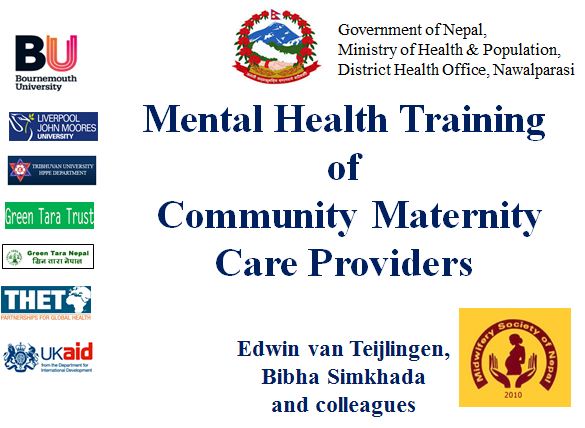
Some of the birthing centre staff will attend the mental health and maternity care training organised next week [3]. This training project is run by a consortium of BU, LJMU, and Tribhuvan University (the oldest university in Nepal). This mental health and maternity care project is supported by the Tropical Health & Education Trust (THET) as part of the Health Partnership Scheme, which is funded by the UK Department for International Development (DFID), and in the field our THET project is supported by Green Tara Nepal.
Prof. Edwin van Teijlingen
CMMPH
References:
- Mahato, P.K., Regmi, P.R., van Teijlingen, E., Simkhada, P., Angell, C., Sathian, B. (2015) Birthing centre infrastructure in Nepal post 2015 earthquake. Nepal Journal of Epidemiology 5(4): 518-519. http://www.nepjol.info/index.php/NJE/article/view/14260/11579
- Simkhada, B., Porter, M., van Teijlingen, E. (2010) The role of mothers-in-law in antenatal care decision-making in Nepal: A qualitative study. BMC Pregnancy & Childbirth 10(34) biomedcentral.com/content/pdf/1471-2393-10-34.pdf
- van Teijlingen, E., Simkhada, P., Devkota, B., Fanning, P., Ireland, J., Simkhada, B., Sherchan, L., Silwal, R.C., Pradhan, S., Maharjan, S.K., Maharjan, R.K. (2015) Mental health issues in pregnant women in Nepal. Nepal Journal of Epidemiology 5(3): 499-501. http://www.nepjol.info/index.php/NJE/article/view/13607/11007
First CMMPH editorials of 2016
Happy New Year and a healthy and successful 2016. I have the pleasure to announce the first two editorials published this year by CMMPH staff and students. Although I am slightly cheating as the editorials were really published yesterday on the very last day of 2015 in the latest edition of the Nepal Journal of Epidemiology. In my defence I didn’t have access to the internet here in Nepal until this afternoon.
The first of the two editorials focuses on small-scale community birth centres in post-earthquake Nepal [1]. The lead author of this editorial our CMMPH PhD student Preeti Mahata and all her co-authors are affiliated with BU. Dr. Pramod Regmi, Dr. Catherine Angell and Prof. Edwin van Teijlingen are FHSS staff and Prof. Padam Simkhada and Dr. Brijesh Sathian are both BU Visiting Faculty. Preeti Mahato is conducting her PhD research on birthing centres in Nawalparasi, in the south of Nepal, in an area bordering India.
The second editorial looks at ‘health’ in the recently announced new Constitution of the Federal Republic of Nepal [2]. The concept of health as a human right seems to us quite central in the Nepalese Constitution, considerably more so than in the Constitutions of the USA or the Netherlands, for example. Four of the five authors of this editorial are affiliated with BU, whilst Dr.Puspa Pant is based at the Centre for Child and Adolescent Health, at the University of the West of England.
The Nepal Journal of Epidemiology is Gold Open Access hence both editorials are freely available to everyone.
Prof. Edwin van Teijlingen
CMMPH
References:
- Mahato, P.K., Regmi, P.R., van Teijlingen, E., Simkhada, P., Angell, C., Sathian, B. (2015) Birthing centre infrastructure in Nepal post 2015 earthquake. Nepal Journal of Epidemiology 5(4): 518-519. http://www.nepjol.info/index.php/NJE/article/view/14260/11579
- Simkhada, P., Regmi, P.R., Pant, P.R., van Teijlingen, E., Sathian, B. (2015) Stipulating citizens’ fundamental right to healthcare: Inference from the Constitution of Federal Republic of Nepal 2015. Nepal Journal of Epidemiology 5(4); 516-517. http://www.nepjol.info/index.php/NJE/article/view/14257/11576
THET-funded project in Nepal
Yesterday Prof. Edwin van Teijlingen met with Nepalese collaborators from Tribhuvan University to discuss the first training session planned for THET project ‘Mental Health Training for Maternity Care Providers in Nepal‘. The target population of the project comprises community-based health-care practitioners at the level of nurse and below (there are no doctors in rural villages). The project is a collaboration between the Department of Health, Physical and Population Education at Nepal’s oldest and largest university, Tribhuvan University’s (TU), and two UK universities, Bournemouth University (BU) and Liverpool John Moores University (LJMU), and supported by our local partner, Green Tara Nepal (GTN). BU has a long history of working with GTN as well as its sister organisation Green Tara Trust (GTT), a Buddhist charity based in London. The project is funded from a grant awarded under the Health Partnership Scheme (HPS). HPS put money into health partnerships to carry out training and capacity-building projects in low-income countries, such as Nepal. HPS itself is funded by the UK Department for International Development (DfID) and managed by THET (Tropical Health & Education Trust).
Prof. Edwin van Teijlingen is one of the first volunteers together with BU Visiting Faculty Dr. Bibha Simkhada (research nurse at LJMU & practising nurse in the NHS). Together with collaborators in Nepel they will deliver the first training early in 2016 (i.e. next week) on this THET project. The first photo shows Prof. Lokendra Sherchan writing a letter of invitation to the District Public Health Officer in Nawalparasi inviting him to encourage his staff to participate in our training. The letter is beautifully handwritten in Nepali as the university is closed between terms at the moment. The second photo shows professors Shyam K Maharjan, Ram K Maharjan and Edwin van Teijlingen in discussion with Kathmandu in the background. Both photos are taken by GTN’s Samridhi Pradhan. We have published some of the background information on our project earlier this year in the Nepal Journal of Epidemiology [1].
References:
- van Teijlingen, E., Simkhada, P., Devkota, B., Fanning, P., Ireland, J., Simkhada, B., Sherchan, L., Silwal, R.C., Pradhan, S., Maharjan, S.K., Maharjan, R.K. (2015) Mental health issues in pregnant women in Nepal. Nepal Journal of Epidemiology 5(3): 499-501. http://www.nepjol.info/index.php/NJE/article/view/13607/11007
New paper by BU PhD student Preeti Mahato
Today saw the publication of an academic paper in the World Health Organization’s WHO South-East Asia Journal of Public Health by FHSS’s PhD student Mrs Preeti Mahato. The paper ‘Access to free health-care services for the poor in tertiary hospitals of western Nepal: a descriptive study’ [1] based on work conducted prior to commencing her PhD thesis in the Centre for Midwifery, Maternal and Perinal Health (CMMPH). The journal is Open Access and the paper is freely available across the globe, to access online manuscript click here!
Congratulations!
Prof. Edwin van Teijlingen
CMMPH
Reference:
- Mahato,P.K, Paudel, G.S. (2015) Access to free health-care services for the poor in tertiary hospitals of western Nepal: a descriptive study. WHO South-East Asia Journal of Public Health 4(2): 167–175.
New Public Health paper on Christmas Eve
Our latest paper and the last one for 2015, published the day before Christmas. The paper ‘Implementing Health Policy: Lessons from the Scottish Well Men’s Policy Initiative’ appeared in AIMS Public Health [1]. The paper draws on evaluation research led by Dr. Flora Douglas (University of Aberdeen). This was a set of evaluations of the Well Men’s Health projects which were part of an initiative running in many health regions (or health boards as they are called in Scotland).
The focus of this particular paper centres around the fact that little is known about how health professionals translate government health policy into action [2]. Our paper examines that process using the Scottish Well Men’s Services policy initiative as a ‘real world’ case study [1]. These Well Men’s Services were launched by the Scottish Government to address men’s health inequalities. Our analysis aimed to develop a deeper understanding of policy implementation as it naturally occurred. We used an analytical framework that was developed to reflect the ‘rational planning’ principles health professionals are commonly encouraged to use for implementation purposes.
Our analysis revealed four key themes: (1) ambiguity regarding the policy problem and means of intervention; (2) behavioral framing of the policy problem and intervention; (3) uncertainty about the policy evidence base and outcomes, and; (4) a focus on intervention as outcome. This study found that mechanistic planning heuristics (as a means of supporting implementation) fails to grapple with the indeterminate nature of population health problems. A new approach to planning and implementing public health interventions is required that recognises the complex and political nature of health problems; the inevitability of imperfect and contested evidence regarding intervention, and, future associated uncertainties.
The paper is published in an Open Access journal, so it is easily and freely available to public health professionals, policy-makers and health workers across the globe.
Prof. Edwin van Teijlingen
CMMPH
Reference:
- Douglas, F., van Teijlingen, E., Smith, W.C.S., Moffat, M. (2015) Implementing Health Policy: Lessons from the Scottish Well Men’s Policy Initiative, AIMS Public Health 2 (4): 887-905. http://www.aimspress.com/article/10.3934/publichealth.2015.4.887/fulltext.html
- Killoran, A., Kelly, M. (2004) Towards an evidence-based approach to tackling health inequalities: The English experience. Health Education Journal;63: 7-14.
Mixed methods: not without its downside?
Conducting mixed-methods research has become very popular over the past decade especially in the health research field.1-4 This development ties in with the growth in inter-disciplinary and multi-disciplinary research. Many grant applications, PhD project and the resulting papers especially in the health field apply a mixed-methods approach, where in the past a single approach would have dominated. This interest in combining methods seems to be the case even in the more traditional quantitative field of clinical effectiveness and randomised controlled trials. Whilst I find this development encouraging as a mixed-methods social scientist, it also makes me wonder whether the applicants putting forward a mixed-methods project have thought about the disadvantages or at least the opportunity costs of using such approach.
A mixed-methods approach is ‘simply’ combining two or more research methods to address a research question, i.e. what the label suggests. It is often perceived as the combining of qualitative with quantitative methods, but it can technically also be a mix of quantitative methods or a combination of qualitative methods. The advantage of a mixed-methods approach is that the different methods in the mix address different aspects of the research question and that combining these methods offers a synergetic effect. So what are the possible limitations of or barriers to mixed-methods research?
First, using a mixed-methods approach means you need an understanding of two different philosophies and how to bring the findings of these two different methods together.4-6 One requires expertise in two different research approaches, either as individual or in the team as well as someone who can do the combining of the findings. For the latter you really need someone in the team who understand the pragmatic approach commonly used in mixed-methods approaches. Otherwise there is a great risk that the original mixed-methods study will be analysed and reported as two or more separate papers each based on data from one of the methods applied in the mixed-methods study.
Secondly, you can spend your money only once, hence there are opportunity costs. Thus if the maximum grant is £200,000 or £300,000 you can’t spend the full amount on the designing a large-scale quantitative study/survey, as you need to spend a proportion of your money and your attention and time on your qualitative study.
Thirdly, and related the above, both quantitative and qualitative methods have ‘rules’ about sampling and sample-size.5 Just because you have two methods this does not mean you can necessarily do a study with a smaller sample. The sample size calculations will still say you need at least xxx participants. Similarly, although perhaps not so rigidly you need a certain number of interviews or focus groups to do you qualitative study appropriately.
Fourthly, a common mistake seems to be to add a bit of qualitative research to a larger quantitative study, perhaps a bit tokenistic.7 Often it is so obvious in a grant application that the qualitative research is an add-on, an afterthought perhaps from a reviewer in the previous failed grant application.
Finally, not all mixed-methods studies are the same, in fact each mixed-methods study is more or less unique in the way in the way it mixes and matched individual research methods.3 So although mixed-methods may be the best way to address a particular research question, your particular proposed mixed of quantitative and qualitative research might not be the most appropriate to answer the overall research question.8
As with all research methods and research proposals my recommendation is if in doubt go and find an expert for advice.6 If necessary get an expert on your team of researchers to strengthen your application.
Professor Edwin van Teijlingen
CMMPH
References:
- Barbour, R.S. (1999) The case of combining qualitative and quantitative approaches in health services research. Journal of Health Services Research Policy, 4(1): 39-43.
- Simkhada, P., van Teijlingen, E., Wasti, S.P., Sathian, B. (2014) Mixed-methods approaches in health research in Nepal, Nepal Journal of Epidemiology 4(5): 415-416.
- Plano Clark, V.L., Anderson, N., Wertz, J.A., Zhou, Y., Schumacher, K., Miaskowski, C. (2015) Conceptualizing Longitudinal Mixed Methods Designs: A Methodological Review of Health Sciences Research, Journal of Mixed Methods Research, 9: 297-319.
- MacKenzie Bryers, H., van Teijlingen, E. Pitchforth, E. (2014) Advocating mixed-methods approaches in health research, Nepal Journal of Epidemiology 4(5): 417-422. http://www.nepjol.info/index.php/NJE/article/view/12018/9768
- Bryman, A. (1988) Quality and Quantity in Social Research, London: Routledge
- Bazeley, P. (2003) Teaching mixed methods. Qualitative Research Journal, 4: 117-126.
- Maxwell, J.A. (2016) Expanding the History and Range of Mixed Methods Research, Journal of Mixed Methods Research, 10: 12-27.
- Brannen, J. (2005) Mixing methods: The entry of qualitative & quantitative approaches into the research process. International Journal of Social Research Methodology 8(3): 173-85.
Latest Major Funding Opportunities
Welcome back!
The following funding opportunities have been announced. Please follow the links for more information. 
EPSRC
Pilot call: Access to the Research Data Facility (RDF) for UK researchers
EPSRC have recognised the need to store active computational data and to be able to use this data for further scientific benefit, so are looking at giving access to storage on the national Research Data Facility (RDF).
This call is for applicants within the remit of RCUK but performing research outside of the remit of EPSRC and NERC. The total amount of storage available for this pilot call is 1000TB.
deadline dates:
Technical assessment : 29th January
Closing date: 12th February
Marine Renewable Energy KE Fellow call
NERC invites proposals for a Knowledge Exchange Fellowship in the area of marine renewable energy. NERC is seeking to invest in a suitably qualified academic to broker links between the academics and businesses within the UK marine renewable energy community, as well as with relevant regulators and policymakers.
Applicants should outline their own approach to a programme of work in the marine renewable energy sector. Further guidance on this opportunity is at the foot of this page along with instructions on how to submit the application via Je-S.
deadline dates:
17 March 2016 at 16:00
Philip Leverhulme Prizes recognise the achievement of outstanding researchers whose work has already attracted international recognition and whose future career is exceptionally promising. This call is repeated once a year.
deadline dates:
16 May 2016 at 16:00
These awards support the residency of an individual artist in a UK university or museum in order to foster a creative collaboration between the artist and the staff and/or students of that institution. The term ‘artist’ encompasses visual artists, creative writers, musicians, poets and other producers of original creative work.
The scheme brings an artist into a research and study environment where their artistic form or creative art is not part of the normal curriculum or activities of the host department. There must be a distinct contrast between the artist and host department’s expertise (for example, a poet being hosted by a physics department, a composer by a geography department). It is not the objective of the residency to provide additional teaching capacity for the host department. An artist may not apply directly – all applications must be made by the host institution.
Applications open on 8 April 2016. The closing date is 4pm on 8 September 2016
Joint Call of the JPI Urban Europe, supported by the European Commission
JPI Urban Europe’s fourth call – the ERA-NET Cofund Smart Urban Futures (ENSUF) – supported by the European Commission under the Horizon 2020 programme, is open.
Three call topics are defined:
- Concepts and strategies for smart urban transformation, growth and shrinkage
- New dynamics of public services
- Inclusive, vibrant and accessible urban communities
deadline date (pre-proposals):
15 March 2016 at 12:00 Central European Time
If you are interested in submitting to any of the above calls you must contact RKEO with adequate notice before the deadline.
Please note that some funding bodies specify a time for submission as well as a date. Please confirm this with your RKEO Funding Development Officer
You can set up your own personalised alerts on Research Professional. If you need help setting these up, just ask your School’s/Faculty’s Funding Development Officer in RKEO or view the recent blog post here.
If thinking of applying, why not add notification of your interest on Research Professional’s record of the bid so that BU colleagues can see your intention to bid and contact you to collaborate.
More events at the IRW
As well as the lectures, debates, films and music at the Interdisciplinary Research Week 2016, we have even more events that are of interest to all. These include:
Monday 25 January 2016
Ashley Woodfall
Researching with Children and Young People: Method and Mayhem
EB708, Executive Business Centre, 16:00-18:00
This ‘catalyst’ event is an opportunity for anyone with an interest in research with children and young people to:
- meet BU researchers from across the university
- share experiences and future research ambitions; and
- develop future research partnerships
Operating in a ‘bring and buy’ spirit, this event recognises the benefits of sharing knowledge and expertise across different disciplines. The event is open to all those interested in research with children and young people whatever their research interests, affiliation or tradition.
Thursday 28 January 2016
Professor Matt Bentley
Interdisciplinary Research Training Session
KG03, Talbot Campus, 09:30-11:00
This 90-minute training session will give attendees the opportunity to find out more about interdisciplinary research including:
- What is interdisciplinary research?
- What counts as a discipline?
- The reasons why it is becoming increasingly important both inside and outside the university (e.g. by funders, policy makers etc.).
- How it might impact on your research practice?
- The potential and the challenges of this type of work.
- The role it has in institutions and careers.
Click on the links above to book on to the events.
What would Marty McFly need in 25 years’ time? EB705, Executive Business Centre – For BU academics and researchers only, we also have on Tuesday 26th January (10.00 – 17.00) and Wednesday 27th January 2016 (morning only) an interactive workshop session designed to tackle a big question for modern day life – how digital technology affects different aspects of our daily lives. The session will create a collaborative space for researchers to share ideas, challenge assumptions and develop future research proposals.
To take part in this exciting opportunity, BU academic and research staff should complete the Sandpit Application Form and return this to Dianne Goodman by Tuesday 5th January. Places are strictly limited.
Inspiring lectures at the IRW
The Interdisciplinary Research Week 2016 has thought provoking and inspirational lectures that will of interest to all. These include:
Monday 25 January 2016
Professor Lee Miles
Inaugural public lecture: Entrepreneurial Resilience and Disaster Management: Where Innovation and Integration Meet?
EB708, Executive Business Centre, 18:30 for 19:00 – 20:00
BU’s inaugural lecture series returns in January 2016, with a fascinating glimpse into the world of disaster management, delivered by Professor Lee Miles, Professor of Crisis and Disaster Management. Professor Miles has carried out research into emergency and crisis management for many years and is currently exploring the relationship between innovation and resilience in successful crisis and disaster management. Click here to read more.
Thursday 28 January 2016
Inspirational Speaker: Professor Jane Falkingham, University of Southampton
EB708, Executive Business Centre, 18:00-20:00
Professor Jane Falkingham is Director of the ESRC Centre for Population Change and Dean of Social, Human and Mathematical Sciences at the University of Southampton. Through a career spanning almost 30 years, her research pursues a multi-disciplinary agenda combining social policy and population studies, which span both developed and developing countries. Much of her work has focussed on the social policy implications of population ageing and demographic change, and what this means for the distribution of social and economic welfare.
Click on the links above to book these events.
Live Migration of Virtual Machines to the Cloud and its associated issues
We would like to invite you to the latest research seminar of the Creative Technology Research Centre.
Speaker: Ibrahim Mansour
Title: Live Migration of Virtual Machines to the Cloud and its associated issues
Time: 2:00PM-3:00PM
Date: Wednesday 6th January 2016
Room: P302 LT, Poole House, Talbot Campus
Abstract: Cloud computing provides users the ability to access shared, online computing resources. However, providers often offer their own proprietary applications, interfaces, APIs and infrastructures, resulting in a heterogeneous cloud environment. This heterogeneous environment makes it difficult for users to change cloud service providers; exploring capabilities to support the automated migration from one provider to another is an active, open research area. Many standards bodies (IEEE, NIST, DMTF and SNIA), industry (middleware) and academia have been pursuing approaches to reduce the impact of vendor lock-in by investigating the cloud migration problem at the level of the VM. However, the migration downtime, decoupling VM from underlying systems and security of live channels remain open issues. This talk focuses on analysing recently proposed live, cloud migration approaches for VMs at the infrastructure level in the cloud architecture. The talk will highlight issues with flexibility, performance, and security of the approaches, including additional loads to the CPU and disk I/O drivers of the physical machine where the VM initially resides. Finally, the talk will introduce how a new approach, LibZam (Libya Zamzem) will be developed. LibZam is a tangible system that will work towards addressing the identified limitations.
We hope to see you there.
AHRC New Generation Thinkers
BU’s Dr Sam Goodman is one of the AHRC’s New Generation Thinkers. He features in this film from the Arts and Humanities Research Council (AHRC), which shines a light on the AHRC/ BBC Radio 3, New Generation Thinkers scheme.
Click on the link above to watch the film. You can also find out details about the scheme and how you can apply for 2016 in this AHRC press release.


National Research Supervision Recognition: Apply Now & Join the Supporting Workshop on 16 September
3C Event: ECR Network Café – Wednesday 16 September 2-3pm
BU geography student’s undergraduate dissertation published in international journal
Why some commons survive and others don’t
BU Research blog in 2023 grows into 2026 publication
Horizon Europe Cluster 3 (Civil Security for Society) 2026 Calls Now Open

MSCA Doctoral Networks 2026 Call Information Webinar

ESRC Festival of Social Science 2026: Application Deadline Extended to Thursday 25 June 2026

Reminder: Register for the ESRC Festival of Social Science 2026 Information Session

ECR Funding Open Call: Research Culture & Community Grant – Apply now

ERC Advanced Grant 2025 Webinar
Update on UKRO services
European research project exploring use of ‘virtual twins’ to better manage metabolic associated fatty liver disease