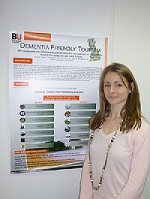
An article about face blindness (prosopagnosia) in women appeared in the Daily Mail last week, with comments from Dr Sarah Bate of the Psychology Research Centre. Sarah recently launched the Centre for Face Processing Disorders at BU with support from the University’s Fusion Fund. Read the full article here.
/ Full archive
Discourses of Inclusion and Exclusion Conference – new sustainability symposium theme
I am co-ordinating a symposium on Issues of Inclusivity in the Sustainable University at the DPR annual conference to be held at the University of Greenwich, 9-11 April, 2013. The link is here.
If DPR (Discourse, Power Resistance) is new to you, it is worth saying that DPR is an annual conference, now in its thirteenth year, with an established and increasing international reputation: in 2012 41 nations were represented at the conference. Perhaps the simplest way to tell you about the conference is to give you some links. The conference website is here. You can find a list of DPR publications here together with a link to the conference journal: Power and Education.
Please consider submitting an abstract.
Chris Shiel
Public Health: Knowledge into Action
1 day conference – 26th June 2012
Jointly hosted by BU and the NHS
Public health is at a crossroads … moving back into local authorities where it began with the appointment of the first medical officers for health. This move presents opportunities to improve health and wellbeing by taking a more integrated approach. The purpose of this one day conference was to discuss these opportunities and identify action that can be taken to improve health and wellbeing using the best available evidence. The event was very successful and well attended and included local public health practitioners, local councillors and BU staff.
For further information please contact: Ann Hemingway, Public Health Academic at Bournemouth University – ahemingway@bournemouth.ac.uk or Lindley Owen Consultant in Public Health NHS Bournemouth and Poole – Lindley.Owen@bp-pct.nhs.uk
Presentations
Study China Winter Programme 2012!
The Study China Programme, managed by The University of Manchester, is currently recruiting 200 students for the Winter 2012/2013 programme! Study China is financed by the UK government to provide a three week student experience of Chinese language, culture and business. This unique opportunity allows you to experience life as a student in this fascinating, diverse country. There are a number of bursaries available to contribute towards your own costs which are airfare and spending money, all other costs are funded by the UK government. The three partnership universities participating in this programme are :
1) Beijing Normal University
2) Fudan University ( Shanghai )
Dates:
Arrive – Sunday 16th December 2012
Depart – Saturday 5th January 2013
3) Shanghai University of Finance and Economics
Dates:
Arrive – Thursday 20th December 2012
Depart – Tuesday 8th January 2012
Eligibility: Open to Undergraduate, Masters (including PhD), Nursing Diploma, Foundation degree and HND students. You must be minimum of 18 years old at commencement of programme and holder of a valid EU/EEA passport.
Deadline: Applications will be processed on a rolling basis, it is anticipated that recruitment for this round will be completed by the end of October 2012 at the latest, so apply ASAP.
Further information & Apply: Visit the Study China website
Read about previous BU students’ experiences on Study China here

EC proposes to clamp down on funding to Brazil, China and India in Horizon 2020
The EC has proposed to restrict the number of non-EU countries which will be automatically eligible for funding under Horizon 2020. They published a strategy document yesterday, which said that like FP7, Horizon 2020 will have similar general conditions with regards to eligibility however the list of countries eligible for automatic funding will be restricted by introducing a new threshold on total GDP. This has been proposed in order to exclude large, emerging economies including, perhaps, China, India and Brazil. Funding for participants from these countries will still be possible in some cases. such as those where a reciprocal agreement is in place.
Want to find out about how BU will shape submissions for the REF? Then come to one of our open forums!
Back in July we posted a copy of the BU REF 2014 Code of Practice on the Research Blog (BU REF Code of Practice gets the green light!). The Code of Practice sets out the process that the University will take in shaping submissions for REF 2014, including how outputs, staff and UOAs will be selected for submission and is available from the BU Staff Intranet: BU REF 2014 Code of Practice.
Peng Peng has recently emailed all academic staff with a copy of the Code of Practice, as well as the procedure for raising individual staff circumstances which may have affected an individual’s ability to undertake research to their full potential during the assessment period (such as being part-time, maternity leave, or being an early career researcher).
We are holding a couple of open forums for staff to engage with the Code of Practice and the procedure for raising individual staff circumstances, and these are open to all staff to attend. You can ask questions to a select panel from the internal REF management team, including Prof Matthew Bennett, Julie Northam, Peng Peng Ooi, James Palfreman-Kay, Judith Wilson and a number of the UOA Leaders.
This is an excellent opportunity to ask any questions you have regarding the REF!
Two open forums are planned, details are:
Talbot Campus
Date: 27 September 2012
Time : 11.30am to 1.00pm
Venue: The Wallace Lecture Theatre, Weymouth House
Lansdowne Campus
Date: 11 October 2012
Time: 3.00pm to 4.30pm
Venue: EB306, Executive Business Centre
There is no need to book – simply turn up!
Would you like to learn more about Scopus and BRIAN? Then come along to one of our workshops!
The aim of these workshops is to support academic colleagues to learn more about Scopus and BRIAN, and how they can use these systems to monitor their publication impact, identify where to publish, identify potential collaborators and also to help them to ensure their Scopus and BRIAN profiles are up to date and optimised. Matthew Bennett will do an initial presentation about the two systems and this will be followed with the opportunity for participants to look through their own Scopus and BRIAN profiles together with Library and RKEDO (formerly RDU) staff.
They will take place on both the Lansdowne and Talbot Campuses on the following dates:
1 October 10am – 11am CG21 Talbot Campus
10 October 2:30pm – 3:30pm S102 Lansdowne Campus
15 October 10am – 11am CG21 Talbot Campus
23 October 2:30pm – 3:30pm S102 Lansdowne Campus
31 October 9am – 10am S102 Lansdowne Campus
Please book a place if you would like to attend by following this link
Forthcoming event on Older People and one on Bioeconomy in the EU
Older People in an Inclusive Europe Event: Coventry University is organising an event entitled ‘Older People in an Inclusive Europe’, which will take place in Brussels on 8 October 2012.The event will include presentations and debates within the broad context of research related to the ageing society, including a presentation from the European Commission on ‘Horizon 2020: Delivering a Better Society for Older People in Europe’. The event will also launch Coventry University’s Age Research Centre and its Ageing Society initiative.
Conference on Partnering for the Bioeconomy in European Regions: The EC is hosting a conference on the role of EU regions in implementing the EU’s Bioeconomy Strategy (published in February 2012). This will take place in Brussels on 12 October 2012. The event is intended to provide information and highlight the opportunities for regional stakeholders on the local initiatives and investment possibilities in the EU bioeconomy research and innovation areas.
Bells, Offices & Rejection
I can’t admit to having had a good morning so far; the fire alarm was being test continuously for over 30 minutes when I first got in, my emails are down and I have a long day of meetings in front of me! Anyway, I hear you all asking about the great ‘office-less experiment’, well I would if it was not for the bells ringing in my head!
In fact it is going very well. I had three productive days last week working in the various coffee shops around campus and met a lot of people I wouldn’t normally have and performed a few introductions to connect people up afterwards. The feedback has also been very positive and the support fantastic. On a personal level I have found it quite hard work and have to admit to being a bit tired at the end last week. The laptop screen is a bit small, our IT systems did not cover themselves in glory and the phone reception in the atrium is frustrating, but despite these slight irritations I had a very productive week. So far this week I had a day solid of meetings Monday and a ULT away day in Christchurch, but the atrium beckons again later today.
On a different note, yesterday was not the greatest of days – the away day was fine, but then I got the news that a paper I had submitted a couple of weeks ago to Science had been bounced. Rejection is never easy to deal with, even when you are half expecting it and is the norm with the most prestigious journal of them all. Somehow I had convinced myself that this paper stood a chance, but no it was dammed by the phrase ‘most suitable for a specialist journal’. I shouldn’t be that surprised, to stand a chance in Nature or Science one has to have something that is truly headline grabbing – goldfish eats boy! But still rejection is not great and I thought I would share my feeling on it.
I used to do these sessions on the Releasing Research & Enterprise Potential on dealing with paper rejection in which I used to say that the true test is ‘how one deals with things in adversity’. I do believe that this is true and within half an hour of circulating the rejection letter to my co-authors we had agreed a new destination for the paper and I will start the task of re-formatting the paper this evening. Despite this I must admit to having a bit less bounce today than usual even if the set back in the greater scale of things is trivial. Perhaps it is the prospect of the having to do more work to re-cast it for the new destination, or the memory of the early mornings and late evenings (working around the day-job) at the end of August spent shaping the paper. No doubt by lunch time when the bells have stopped ringing in my ears I will feel more positive. Rejection is part of academic life, you win some and you lose some, but let’s be honest it is the bit that sucks!
ApSci’s Genoveva Esteban and Andrea Galotti get ‘stuck in’ with their research fieldwork!
Dr Genoveva Esteban collecting water samples at East Stoke Fen (Wareham). This research is in partnership with the Dorset Wildlife Trust to link science with conservation. Dr Esteban’s investigates ‘cryptic’ biodiversity, i.e. the biological diversity that is invisible to the naked eye, which includes microbes and other small-sized organisms that constitute the basis of food chains.
Dr Andréa Galotti is investigating a new biological tool to control nuisance insects (e.g. midges) that grow in drinking and other water systems. The research in is partnership with SembCorp Bournemouth Water.
Book your place on the BU EU Showcase Event
I am really looking forward to the forthcoming EU Showcase Event; last year’s event was a tremendous success and this year’s will be even bigger and better!
We all know the importance of getting involved in EU funding as national funds dwindle, greater importance is placed on international collaborations and of BUs strategic focus on internationalisation. This event will celebrate our successful EU award holders who will share their tips for engaging in EU funding.
We have presentations on schemes to help you start your EU career (Christos Gatzidis on the Leonardo scheme of the Lifelong Learning Programme and Bogdan Gabrys and Rob Britton on Marie Curie schemes) and schemes for those already engaged (Anthea Innes on applying for an FP7 grant and Adrian Newton on being a Partner in an FP7 consortium). We also have top tips on how to network effectively to become involved in EU funding (from the very experienced Dimitrios Buhalis and Cornelius Ncube). Finally I will be launching 3 very exciting internal EU focused funding competitions at this event to help you engage in EU funding and we have presentations from those who won funding through 2 of these schemes last year.
The informal and informative event will be opened by Matthew Bennett in Kimmeridge House on 14th November. Plenty of coffee, tea, lunch and cake provided and due to the restriction of room size, registration is essential. This takes only 10 seconds on the Staff Development website.
The event will be finished in plenty of time for you to drive/ catch the uni bus to the Executive Business Centre (EBC) to hear the Inaugural Lecture Dementia: personal journey to policy priority by HSC’s Prof. Anthea Innes.
This Friday! Seen but Seldom Heard: Taking disability, poetry and the human voice to the next level
This Friday marks the 2nd event in the series of “Seen but Seldom Heard” events that are helping to give young disabled people a voice through poetry. Taking place in the Marconi Lecture Theater at Talbot Campus this event features voices of professional performance poets alongside the students from the Victoria Education Centre performing their work.
‘Seen but Seldom Heard’ is an on-going collaboration between academics from Bournemouth University, pupils from Victoria Education Centre and performance poets, Liv Torc and Jonny Fluffypunk, which enables young people living with a disability to find a voice through poetry. The teenagers involved have produced potent and emotive poems which explore perceptions and representations of disability within society using their own individual and collective experiences. Find out more on their website along with examples of poems produced by the young people and a taste of what the event will involved.
After the stunning success of their inaugural event at the ICCI360 Arena in Weymouth you don’t want to miss out on this opportunity to see these performances so please RSVP now to reserve your place! The performance will begin at 5:00pm and will be followed by a drinks reception where a poetry book will also be available for purchase with proceeds going towards the funding of a Poet in Residence at Victoria Education Centre.
Where: Marconi Lecture Theatre
When: 5pm Friday 21st September
Cost: Free but you should RSVP now to reserve your place!
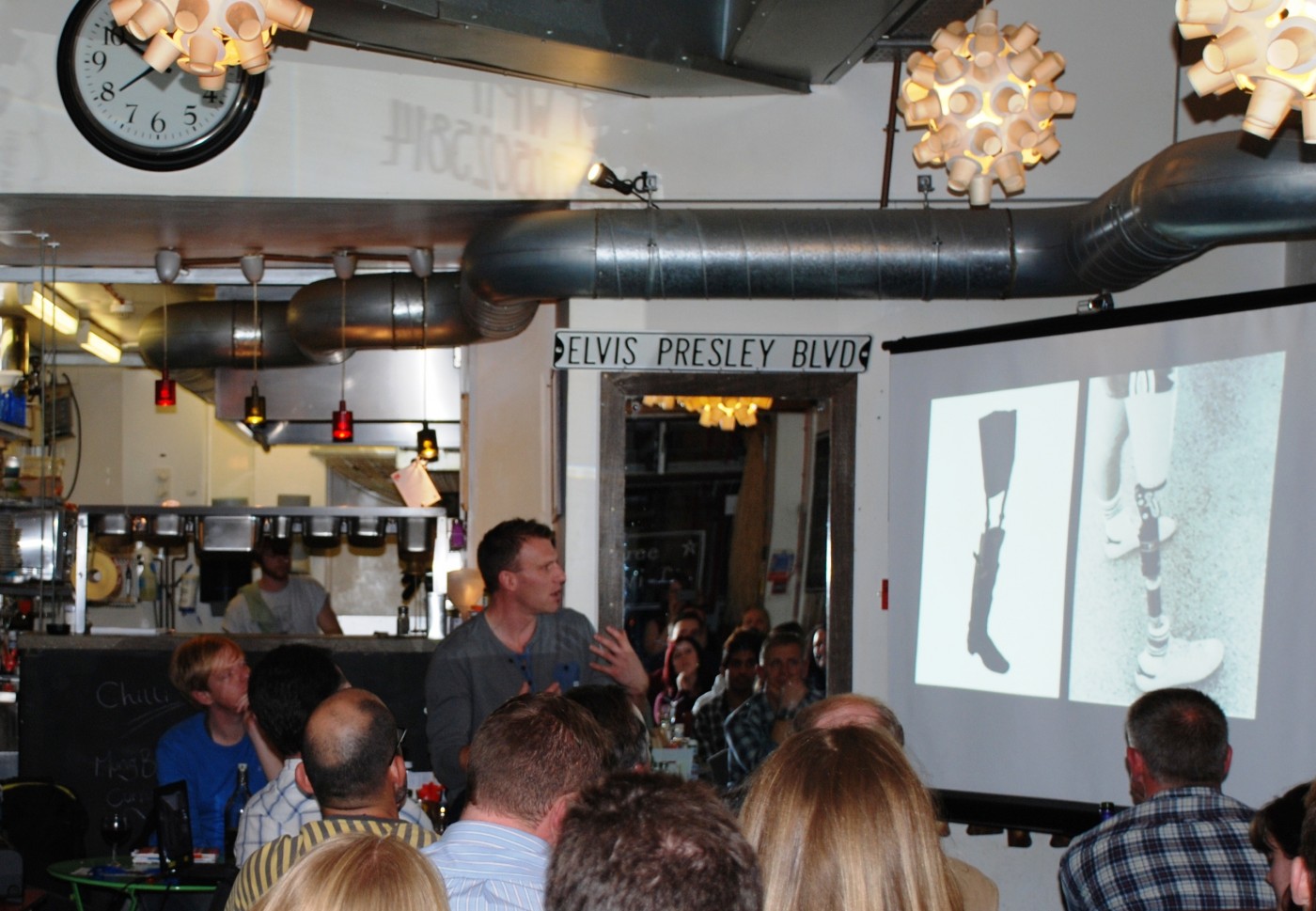
Cafe Scientifique Talk Update- The Fastest Men On No Legs: Oscar Pistorius, prosthetic limbs & the role of technology in elite sport
For years debate has circulated around Oscar Pistorius and allowing him to compete in able bodied events at the Olympics when he may or may not have an unfair advantage. Most recently he sparked further debate himself in the criticisms of the length of Alan Oliveira’s blades directly after his defeat in the 200m Paralympic final. So what’s the difference? Does running on prosthetics give you an advantage over the able bodied, or simply level the playing field? Can longer blades give you the advantage over the other competitors?
Cafe Scientifique’s second event, coming up on Tuesday 6th Novemeber, Bryce Dyer, a senior lecturer in Product Design at Bournemouth University, will attempt to answer some of these questions.
Bryce will discuss and explore the recent controversy surrounding the use of prosthetic limbs in elite sport, what we know, what we don’t and how what was once initially seen as disability is now redefining sport as we know it, before allowing you time to ask him any questions you may have.
Prof. Edwin van Teijlingen visits Nepal for further fieldwork on the maternity care project!
Prof. Edwin van Teijlingen (School of Health & Social Care) visiting Nepal again in june 2012 for further fieldwork for the maternity care project funded by Greer Tara Trust (http://www.greentaratrust.com/). As part of this project in the rural areas of Daichhinckali and Chhaimale, Green Tara Trust promotes education and understanding in all aspects of maternal and child healthcare to over 10,000 people.
Bournemouth Univeristy in close collaboration with the University of Sheffield is involved in the evaluation of this health promotion intervention. The photos show Prof. van Teijlingen conducting fieldwork in rural communities.
Missed the FP7 Security info day? Don’t worry, all the info is online!
As you know, BU subscribes to UKRO who kindly attended the FP7 Security infoday and compiled key tips and information presented at the day. You can access this on the specific UKRO webpage for the Security InfoDay. Don’t forget we have our UKRO advisor Jo coming to visit in November and she can tell you how to make the most out of your UKRO account
New Library Resource: full text access to Nature.com
You will be delighted to discover that The Library have been able to make funds available to purchase a site licence to the full text of the journal Nature at Nature.com. Full text access is current year plus a rolling 4 year archive. This is complemented by access from 1997 to date (with a 12 month embargo) on Academic Search Complete and Medline Complete.
Notes on access:
- on-campus access is IP-authenticated (therefore automatic);
- off-campus
- via A-Z of e-journals link – access is via proxy server (user will be prompted for their BU login);
- user goes direct to Nature.com – login by following the Login via your institution links;
- via mySearch
- for the latest 12 months the user will need to follow the LinkSource link and if off-campus login by following the Institution login links
- earlier content back to 1997 there will be a pdf link to the content on Academic Search Complete.
For help using e-journals, e-books, bibliographic databases (such as Scopus and Web of Science), bibliometrics and reference management contact the Library Subject Team for your School.
Fusion Investment Fund: Strengthening the Links of Bournemouth University with China
The University has provided 360 degree of support to encourage staff to participate in various research activities. The Fusion Investment Fund (FIF) is a brilliant opportunity to seed future research development projects and forge collaborations with internal and external partners. I was inspired to apply the FIF through a number of interesting discussions with Prof. Jian J. Zhang looking at the evidence of the increasing influence from China in both economic and scientific worlds. Links with Chinese institutions will no doubt benefit Bournemouth University through various education and scientific research activities. I also owe my gratitude to the continuous support and encouragement from Dr. Corrina Dickson, Prof. Barry Richard and Prof. Mathew Bennett during the preparation of my FIF application.
The FIF allows me to develop network activities leading to the establishment of a strategic partnership between the National Centre for Computer Animation (NCCA) of Bournemouth University (BU) and the University of Electronic Science and Technology of China (UESTC), and to create opportunities in joint research, enterprise and education endeavours. UESTC has been among the top ranked Chinese universities, and has been the best educational base in China for computer science and electronic engineering. It is located in Chengdu, one of the largest cities in Western China. The formation of the strategic partnership will strengthen the link of BU to China and in particular will bring BU’s influence that is currently absent to the western part of China.
I have been in contact with Prof. Zhiguang Qin (UESTC), Dean of School of Information and Software Engineering and Dean of School of Computer Science and Engineering, and the international office of UESTC to discuss possibilities on collaboration at various levels since 2010. Strong interest has been identified on the development of hardware and software algorithms of haptic devices for virtual reality applications, where the research excellence of UESTC in computer science, as a complementary element, matches well with the expertise of the NCCA in virtual reality and computer animation. The collaboration can be further extended to cover other research topics based on the mutual interest of both institutions.
Christina Koutra visits Peru and Vietnam to conduct her research fieldwork on Corporate Social Responsibility
Business School’s Christina Koutra took these photos during her fieldwork in Peru and Vietnam in 2010 and 2011 successively. Christina’s research is part of a research monograph which is currently in press and it incorporates three case studies a) Ghana, b)Vietnam, and c) Peru. The book is entitled: More than Corporate Social Responsibility (CSR): Implications of CSR for tourism development and poverty alleviation in less developed countries: a Political Economy Perspective. The fieldwork, which was funded by the Business School, was used to discuss two of the three case studies.
The picture above was taken during Christina’s fieldwork in Peru. Specifically in the Village of St Francisco which is based in the Ucayali region in the basin of Amazon. The Shipibo people, a Peruvian ethnic minority lives there. Tourism is developed around the ethnic minority and also ethno-medicine and Shamanism.
The other photos were taken in Vietnam in the village of Ta Phin, which is based in Sa Pa, Vietnam. The Red Dao (pronounced as Zao) and the Black H’mong ethnic minorities live there. Tourism is developed around the ethnic groups.


New Nepal scoping review on maternal & neonatal health
Fourth INRC Symposium: From Clinical Applications to Neuro-Inspired Computation
Writing policy briefs
Upholding Excellence: The Concordat to Support Research Integrity
ECR Funding Open Call: Research Culture & Community Grant – Application Deadline Friday 12 December
MSCA Postdoctoral Fellowships 2025 Call
ERC Advanced Grant 2025 Webinar
Horizon Europe Work Programme 2025 Published
Horizon Europe 2025 Work Programme pre-Published
Update on UKRO services
European research project exploring use of ‘virtual twins’ to better manage metabolic associated fatty liver disease