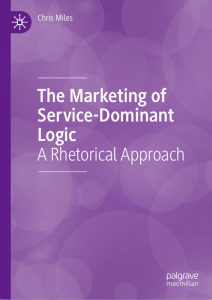
Dr. Chris Miles, Principal Academic in Marketing & Communication at Bournemouth University, has just published The Marketing of Service-Dominant Logic: A Rhetorical Approach, with Palgrave Macmillan.
Service-Dominant logic can be described as a mind-set for a unified understanding of the purpose and nature of organizations, markets and society. A concept that was first introduced by Vargo and Lusch in 2004, S-D logic has generated not just a vast host of journal articles and books but has established an expanding sphere of influence across marketing scholarship. In this book, Dr. Miles uses a rhetorical approach to investigate the ‘marketing’ of Service-Dominant logic, asking how the formulation and presentation of the logic aids in its persuasive promotion. In doing so, the book explores the lexicon choices, metaphors, symbols, and persuasive gambits that have resonated so strongly with marketing academia, with the aim of understanding how these elements work together in a compelling narrative that delivers the logic’s core value proposition of transcendence.
Dr. Miles investigates how these rhetorical strategies have evolved as the S-D logic framework has developed, examining the revisions to its foundational premises and axioms and the introduction of new perspectives such as systems theory. It is the first book-length rhetorical analysis of a single strand of marketing discourse and as such, it serves as a showcase for the methodology, the insights it can provide, and its value for marketing scholarship.
Cover of The Marketing of Service-Dominant Logic: A Rhetorical Approach
The British Academy Early Career Researcher Network brings together ECRs across the humanities and social sciences disciplines, regardless of their funding source or background.
ECR and Interdisciplinarity in the Medical Humanities
This ECR-focused event brings together researchers in Medical and Health Humanities at Bournemouth from across the faculties of Health & Social Science, Media & Communication and Science & Technology, inviting them to highlight and address the main challenges of working within this varied and interdisciplinary field.
It will feature an expert roundtable and open discussion, followed by breakout groups and opportunity for networking activity for ECRs.
Suggested topics for speakers to address include, but are not limited to:
Research and knowledge exchange in MH
Publishing (choosing the right journal for MH research, collaborative writing)
Bidding (where to bid, what for and how to construct productive teams and partnerships)
How to work effectively together but also maintain a sense of disciplinary identity
What experiences have participants had and how has this affected your research career to date?
Imposter syndrome
Work/life balance
ECR and Interdisciplinarity in the Medical Humanities
Wed 21 Feb 202411:30 AM – 3:30 PM at Talbot Campus
Please find more information for this event and book your placehere
Today we received notice that our paper ‘The impacts of decentralisation on health systems: a systematic review of reviews’ has been accepted by the international journal BMJ Global Health.[1] This review of reviews was produced as part of the Nepal Federal Health System Project, examining the consequences for the health system of Nepal’s move to a federal government structure. This is a joint project (2020-2024) led by the University of Sheffield and in collaboration with Bournemouth University, the University of Huddersfield, Manmohan Memorial Institute of Health Sciences (MMIHS) and PHASE Nepal. This longitudinal interdisciplinary study is funded by the UK Health Systems Research Initiative [Grant ref. MR/T023554/1] and has resulted in four previous publications. [2-5]
The latest paper is a review which synthesizes evidence generated by previous reviews on the impact of decentralising health system governance on the six WHO (World Health Organization) health system building blocks. We systematically searched for reviews exploring the impact of decentralisation on the health system from five databases. Reviews, both systematic and non-systematic, published in the English language from 1990 to February 2022 were included. Nine reviews, each addressing slightly different questions, contexts and health system issues, were synthesised. They showed that devolution can have positive or negative impacts on the health system and its components. Moreover, impact assessments are significantly affected by complexities surrounding decentralisation and health system concepts: their dynamic mechanisms, inconsistent and often differently operationalized health system and health system component variables, and methodological challenges. For the WHO health system components, more negative than positive impacts were reported. The reviews highlight the importance of closely assessing (pre-)existing (political and non-political) characteristics of countries and their health systems to better understand impacts. This review of reviews concludes that decentralisation can have a negative or a positive impact on the health system and its components; the impacts are shaped by pre-existing country contexts. Generating conclusive and generalisable evidence of the impacts of decentralisation on health systems is challenging. Whilst decentralisation may seek to enhance community engagement and improve the responsiveness of decision-making, it has the potential to create serious challenges to the health system, the manifestations of which are likely to be context-specific.
Prof. Edwin van Teijlingen
CMWH
Sapkota, S., Dhakal, A., Rushton, S., van Teijlingen, E., Marahatta, S.B., Balen, J., Lee, A. for the Nepal Federal Health System Team (2023) The impacts of decentralisation on health systems: a systematic review of reviews, BMJ Global Health (forthcoming)
Wasti, S.P., van Teijlingen, E.,Rushton, S., Subedi, M., Simkhada, P., Balen, J. for the Nepal Federal Health System Team (2023) Overcoming the Challenges Facing Nepal’s Health System During Federalisation: An Analysis of Health System Building Blocks, Health Research Policy & Systems21(117) https://doi.org/10.1186/s12961-023-01033-2
Sapkota, S., Panday, S., Wasti, S.P., Lee, A., Balen, J., van Teijlingen, E., Rushton, S., Subedi, M., Gautam, S., Karki., J., Adhikary, P., Marahatta, S., Simkhada, P., for the Nepal Federal Health System Team (2022) Health System Strengthening: The Role of Public Health in Federal Nepal, Journal of the Nepal Public Health Association 7(1):36-42.
Adhikary, P., Balen, J., Gautam, S., Ghimire, S., Karki, J., Lee, A.C.K., Marahatta, S.B., Panday, S., Pohl, G., Rushton, S., Sapkota, S., Simkhada, P.P., Subedi, M., van Teijlingen, E. for the Nepal Federal Health System team (2020) The COVID-19 pandemic in Nepal: Emerging evidence on the effectiveness of action by, and cooperation between, different levels of government in a federal system, Journal of Karnali Academy of Health Sciences 3 (3): 1-11.
Rushton, S., Pandey, S., van Teijlingen, E., Subedi, M., Balen, J., Karki, J., Simkhada, P. on behalf of the Nepal Federal Health System Team (2021) An Investigation into the Impact of Decentralization on the Health System of Nepal. Journal of Manmohan Memorial Institute of Health Sciences, 7(1): 3–14. https://doi.org/10.3126/jmmihs.v7i1.43146
This research event will take place in the unique setting of one of Bournemouth’s celebrated pubs, Poole Hill Brewery, at 5.30-7.00 pm on Weds 13 December.
As you sip through the pub’s fine beers, Dr Redden will examine the novel range of ways in which craft beer is portrayed as better than most booze and how craft culture is becoming entwined with NoLo (no and low alcohol) and the rise of “mindful drinking”. He will then discuss how public health interventions increasingly involve sophisticated understandings of alcohol culture change. The event will feature responses from Professor Darren Lilleker and Dr Sae Oshima.
The Month in Research is our new monthly round-up sharing research and knowledge exchange successes from across the previous month, showcasing the amazing work taking place across BU.
Your achievements
Thank you to everyone who has used the online form to put forward their achievements, or those of colleagues, this month.
BU was part of a successful £15.3m bid which now enables colleagues to bid for prestigious ESRC-funded doctoral studentships through our position in the South West Doctoral Training Partnership (SWDTP). Read more.
Professor Dimitrios Buhalis (Business School) received the Great Sea Award 2023 – Research in Innovative Sustainable Tourism Solutions at the Mediterranean Tourism Awards. Read more.
Professor John Oliver (Faculty of Media and Communication) delivered a keynote speech to over 1,000 delegates at the Digital Agenda Summit in Cyprus. Read more.
Funding
Congratulations to all those who have had funding for research and knowledge exchange projects and activities awarded this month. Highlights include
Dr Kathryn Collins (Faculty of Health and Social Science) has been awarded c.£186,000 by the National Institute for Health Research (NIHR) for their project Exploring the feasibility of using neuromuscular electrical stimulation for lower limb weakness after stroke
Professor Anna Feigenbaum (Faculty of Media and Communication) has been awarded c.£24,000 by the NHS for their project Co-creating storytelling artefacts on the Secure Data Environments project
Dr Alex Fry (Faculty of Health and Social Science) has been awarded c.£30,000 by the Church of England for their project Understanding the Wellbeing of Disabled Clergy
Publications
Congratulations to all those who have had work published across the last month. Below is a selection of publications from throughout November:
Content for The Month in Research has been collected using the research and knowledge exchange database (RED), the Bournemouth University Research Online (BURO) repository and submissions via The Month in Research online form. It is by no means intended to be an exhaustive list. All information is correct as of 27.11.23.
Please use The Month in Research online form to share your highlights and achievements, or those of colleagues, for the next monthly round-up.
Congratulations to Dr. Hyun-Joo Lim on the publication of her latest book North Korean Women and Defection: Human Rights Violations and Activism which was published last week by Bristol University Press. The book covers the recent North Korean diaspora which has created female refugee groups fighting for the protection of women’s rights. Presenting in-depth accounts of North Korean women defectors living in the UK, this book examines how their harrowing experiences have become an impetus for their activism. Dr Hyun-Joo Lim, who is Principal Academic in Sociology in the Faculty of Health and Social Sciences, reveals how North Korean women defectors’ have an Utopian dream of a better future for fellow North Korean women. This dream is vital in their activism. Unique in its focus on the intersections between gender, politics, activism and mobility, the book will inform debates on activism and human rights internationally.
We’ve extended the deadline for expressions of interest for REF roles in Social Work and Social Policy until Wednesday 6 December 2023. Further information below…We are currently recruiting to a number of roles to help support preparation for our next REF Submission to Social Work and Social Policy. The deadline for expressions of interest is theThe roles are recruited through an open and transparent process, which gives all academic staff the opportunity to put themselves forward. Applications from underrepresented groups (e.g. minority ethnic, declared disability) are particularly welcome. We are currently preparing submissions to thirteen units (otherwise known as UOAs). Each unit has a leadership team with at least one leader, an output and impact champion. The leadership team are supported by a panel of reviewers who assess the research from the unit. This includes research outputs (journal articles, book chapters, digital artefacts and conference proceedings) and impact case studies. We currently have vacancies in the following roles: Impact Champion –20 – Social Work and Social Policy Output Champion – 20 – Social Work and Social Policy x2
All roles require a level of commitment which is recognised accordingly with time to review, attend meetings, and take responsibility for tasks.
Undertaking a UOA role can be enjoyable and rewarding as two of our current champions testify:
“As UOA Outputs Champion you develop a detailed knowledge of all the great work that colleagues are doing related to the subject, and the different outlets used for disseminating their work. As an outputs committee member, you also get to know what research is going on across BU, and it’s interesting to see the differences between disciplines. It’s a good way develop your knowledge of the bigger picture of BU’s research, and also to understand the importance of REF and how it works in practice. You do spend quite a bit of time chasing colleagues to put their outputs on BRIAN for REF compliance but hopefully they forgive you!”
Professor Adele Ladkin – UOA 24 Output Champion
“As a UoA 17 impact champion, I work closely with the UoA 17 impact team to encourage the development of a culture of impact across BUBS. I try to pop into Department / research group meetings when I can to discuss impact, and I’ve enjoyed meeting people with a whole range of research interests. Sometimes it can be tough to engage people with impact – understandably; everyone is busy – so it’s important to be enthusiastic about the need for our BU research to reach the public. Overall, the role is about planting the seeds to get researchers thinking about the impact their work might have in the future (as well as the impact they have already had, sometimes without realising!)”
Dr Rafaelle Nicholson – UOA 17 Impact Champion
How to apply
All those interested should put forward a short case (suggested length of one paragraph) as to why they are interested in the role and what they think they could bring to it. These should be clearly marked with the relevant role and unit and emailed to ref@bournemouth.ac.uk by Wednesday 6 December 2023.
Further detail on the roles, the process of recruitment and selection criteria can be found here:
Cathy Beresford, nurse and PhD student, was invited to speak with people affected by liver disease at a support group meeting run by LIVErNORTH: The Charity for Liver Patients on 22nd November. Cathy’s research is exploring care experiences in advanced liver disease, through the perspectives of people with lived experience, their carers and the professionals who work with them. Please get in touch for more information at cberesford@bournemouth.ac.uk. The presentation recording is available at
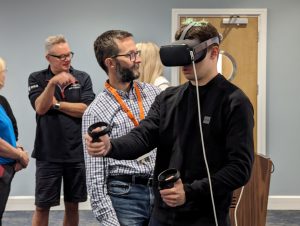
The BFX Festival 2023, one of the UK’s largest visual effects, animation and games festivals, took place between 20 and 25 November 2023. The eleventh annual event was hosted this year at the Hilton Bournemouth and across the Talbot Campus. Organised by Bournemouth University, the Festival featured a dynamic programme, including speaker series, panels, screenings, masterclasses and workshops as well as valuable networking opportunities and recruitment events. It served as a knowledge-sharing and inspiration hub, bringing together professionals, academics, students, enthusiasts as well as non-specialists.
Reflecting industry trends, speakers highlighted noteworthy topics including but not limited to virtual production, digital humans, cinematics in games, storytelling, virtual reality, creature design, production rendering and the future of VFX. A dominant subject addressed by almost all presenters throughout the Festival was generative AI and its impact on industries. We certainly will continue to hear more of this ongoing discussion in the future.
Among industry professionals, university researchers also contributed to the Festival. As part of a synchronous academic symposium, renowned academics as well as postgraduate researchers of the National Centre for Computer Animation (NCCA) were given the opportunity to present their findings to the audience. Researchers from the Centre for Applied Creative Technologies (CfACTs), which is part of NCCA, participated as well, adding a scholarly dimension to industry talks.
Because of the strict no photo and recording policy, understandably due to copyrighted and in-progress materials, the audience could not capture the remarkable atmosphere of the presentations. However, please find below sneak peeks from the event photographer and BU student, Sam Coombes.
These one hour sessions are aimed at all academic staff who are new to, or experienced at, supervising research degree students and are interested in expanding their knowledge of a specific aspect or process in doctoral supervision. Each session will be led by a senior academic or a service representative who will introduce and facilitate the topic. Staff will benefit from discussions aimed at sharing best practice.
Milestone Panel Member: What’s my Role? This discussion will be led by Dr Ian Jones, BU Business School. This session is focused on expanding individuals’ knowledge on the processes and responsibilities involved in being a panel member for a Probationary or Major Review. Staff attending this session will have gained additional knowledge of the role of panel members and be aware of the relevant sections of the Code of Practice for Research Degrees.
Update: This session is to be rescheduled
Administrative Checks for Examiners of Vivas: Right to Work Checks and Other Challenges (UKCGE Event)
You are warmly invited to the first BU Sonic Arts concert of 2023/24. Come and experience the magic of immersive, spatial music and sound!
We are delighted to welcome composer Jonty Harrsion, an inspirational and acclaimed figure in electroacoustic music. This is a rare opportunity to hear Harrison’s work projected on our multichannel loudspeaker system, here in Bournemouth University’s Screening Room, Poole Gateway Building, Talbot Campus. The programme will be a historical retrospective, charting his evolving compositional practice, moving from stereo to 8-channel, to extensive multichannel, and then to ambisonic sound. Jonty is Emeritus Professor of Composition and Electroacousitc Music at University of Birmingham.
The UK Council for Graduate Education (UKCGE) is the representative body for postgraduate education and research. As BU is a member of the UKCGE, staff can attend online events free of charge.
See below for details on next week’s online event:
Session
Details
Date, Time & Book
What is the impact of doctoral research in the Arts, Humanities and Social Sciences?
This online discussion, run in collaboration with The British Academy, will examine the impact of doctoral research in the arts, humanities and social sciences.
Prof. John Oliver (FMC) recently delivery a keynote speech to over 1000 delegates at the 6th Digital Agenda Summit in Cyprus. The talk, titled the Fog of Streaming Wars, examined the subscription video on demand (SVOD) market which has seen explosive growth in recent years with global revenues reaching US$154bn in 2022.
He argued that a new phase of low-growth competitive rivalry is emerging with global and local European players fighting for market share and that future growth will be achieved by merger and acquisition in an industry that will inevitably consolidate.
Other keynote speakers taking to the main stage included the President of Cyprus, the Head of Global Communications & Marketing at Google DeepMind & Space X, and the Global Lead of Design Communication at BMW.
Prof. Oliver is a leading academic in the field of media management and a former President of the European Media Management Association. He has a successful track record in delivering world class impact from his research which has informed the UK Government’s Innovation Strategy, UK communications policy and regulation, and influenced the public policy debate on internet regulation. His research into ‘strategic transformations in the media’ resulted in multi-million pound investments made by FTSE 100 firms.
Prof. Oliver currently serves as an advisor to the Parliamentary Office of Science & Technology’s Horizon Scanning & Foresight Committee.
Dr José Blázquez writes for The Conversation about the upcoming live-action film of The Legend of Zelda and some of the potential challenges adapting this beloved videogame…
The Legend of Zelda film: past adaptations have gotten Link’s character wrong
The Legend of Zelda (first produced in 1986) is one of the most beloved videogames around the world, so when Nintendo announced the development of a live-action movie a couple of weeks ago, it inspired a lot of speculation (and fear) about how they might pull off a film.
Despite being haunted by the infamous adaptation made 30 years ago, the recent The Super Mario Bros. Movie was a global family hit. However, for some fans – myself included – it failed to deliver a compelling story about its central characters, which are some of the most iconic in videogame history. If Nintendo’s aim is to put smiles on every fan’s face, then adapting The Legend of Zelda will be a real challenge.
Set in a fantasy medieval world, the game series follows Link, an Hylian elf-like hero, and Zelda, princess of the kingdom of Hyrule. The stories differ from game to game, but often involve Link’s quest to rescue Zelda, defeat Ganon (the main antagonist of the series) and save Hyrule. They also tend to feature stories around the Triforce, a divine artefact formed by three equilateral triangles, each of which represent a virtue (power, wisdom and courage). The triangles can grant a wish to players who possess them all.
There is not a magic formula for a good adaptation and the process is made more complicated by such a vast, narrative-rich source material. Like many other fans, I would like to see a film that echoes what I felt when playing the games and preserves its DNA.
Losing Link
The original game was first released in 1986 and since then, another 19 games have followed (excluding spin-offs, remakes and re-releases). The latest instalment, The Legend of Zelda: Tears of the Kingdom, has become one of the most lucrative.
From the vibrant landscapes and welcoming inhabitants of Hyrule to the daunting puzzles in dungeons and caves, feelings and emotions are the essence of Zelda’s storytelling. Recent titles have provided an expanded view of the settings, underpinned by open worlds offering a vast array of side quests, locations, monsters and non-playable characters.
A major part of getting the adaptation “right” will be in how the film chooses to portray Link.
Link is an archetype of a hero. He is brave, pure and communicates non-verbally in the games. His muteness is one of his most recognisable traits and one which helps anyone to identify with the character during the gameplay.
Although we barely know anything about his past, Link is somehow given depth by the players’ actions, who decide if they want to spend hours talking and helping villagers in side quests or embody an introvert hero who simply sticks to the main plan. This approach used in the games is not easily transferable to other media and, unsurprisingly, previous adaptations diverted from this path.
Earlier official adaptations of the game series were deemed non-canonical and distanced themselves from the source material in different aspects and degrees.
Many Zelda games have their own manga adaptations, which follow the original game storylines and add depth and provide backstories to the main characters. In the manga, Link talks, expresses emotions with facial expressions and is given a more rounded personality. We also learn about his past, providing more context about how the hero came to be.
The animated series was released in 1989, alongside Super Mario Bros. Super Show!, and lasted only 13 episodes due to the negative reception. In this adaptation, Link has brown hair and eyes (in contrast to his blonde hair and blue eyes in the games) and is chatty and immature.
While protecting the kingdom and the Triforce of Wisdom from Ganon, he is truly invested in flirting with Zelda, who – far from being a damsel in distress – rejects all his attempts to get a kiss. This diverts from the games, which have never depicted Zelda as Link’s love interest.
In Hollywood’s hands
In 2015, The Wall Street Journal reported that Netflix was preparing a live-action series based on The Legend of Zelda, which was described as “Game of Thrones for a family audience”. This was eventually denied by Nintendo.
Game of Thrones is notoriously dark, bloody and highly sexual, it’s hard to imagine what it looks like re-imagined as family entertainment. The Zelda series does feature more complex stories, which sometimes get quite dark (such as Twilight Princess and Majora’s Mask).
However, it’s difficult to imagine Nintendo moving away from light, family fun – it’s what they do best. Players will also expect them to produce a film with a PG rating. They tried a flirty Link before and it didn’t quite work – here’s hoping they leave that iteration alone.
Nothing has yet been said about the plot of the film adaptation, but Nintendo has confirmed that it will be directed by Wes Ball (The Maze Runner trilogy). It will be produced by Shigeru Miyamoto – co-creator of the game series and one of the most influential and acclaimed game designers of all time – and Avi Arad, chairman of Arad Productions Inc. The company has been involved in a long list of videogame, anime and comic adaptations. Miyamoto has also said that he has been working on the theatrical adaptation for many years.
It seems to be in safe hands and hopefully Nintendo has learnt from past failures. The least we can hope for is that with Miyamoto on board the legendary world of Zelda will be able to inspire similar feelings in viewers as the games have for nearly 40 years.
Looking for something good? Cut through the noise with a carefully curated selection of the latest releases, live events and exhibitions, straight to your inbox every fortnight, on Fridays. Sign up here.
Congratulations to Professors Sara Ashencaen Crabtree and Jonathan Parker on the publication of their book chapter ‘Social work with children and human rights’ in the edited collection Change Agents: An interprofessional book about children with disabilities in Tanzania and Norway [1].
The chapter explores human rights in social work with children, based on cases from several countries in the world. Human rights and social justice differ across countries and cultures. This is complicated further in respect of children who are dependent and as a result potentially vulnerable. This chapter discusses the balance between protection of the child versus allowing the child to be exposed to “risky” situations and develops a model for complex human rights social work with children.
The book also has a chapter by former BU staff member Prof. Sarah Hean, who is currently linked with the University of Stavanger in Norway.
Congratulations on this Open Access publication!
Prof. Edwin van Teijlingen
Reference:
Parker, J. & Ashencaen Crabtree, S. (2023) Social work with children and human rights, In: Change Agents: An interprofessional book about children with disabilities in Tanzania and Norway, Siv E. N. Sæbjørnsen, Mariana J. Makuu, & Atle Ødegård (Editors), Scandinavian University Press, pp.55-75.
Country and Culture Insights: India – 12 December, 9am-10:30am, F109 (Talbot campus) Country and Culture Insights: Nigeria – 12 December, 10:30am-12pm, F109 (Talbot campus)
The sessions will take place both online and on campus. Staff are encouraged to attend in person if possible.
The workshop objectives are:
• To enhance understanding of the countries, cultures and education systems that our largest cohorts of international students come from;
• To develop awareness of some specific cultural differences and identify ways in which BU staff can help students from these countries to adjust;
• To highlight individual variations and experiences, alongside generalised cultural “norms”.
The workshop will include:
• A live virtual presentation from the Association of Commonwealth Universities on the Nigerian/Indian student market, education system and culture, plus any other relevant socio-economic factors that impact the student experience;
• Panel discussion featuring Indian/Nigerian participants;
• Open Q&A session on intercultural experiences and communication challenges.
Facilitated by:
Caroline Earth, Orientation and Cultural Adaptation Officer
Jana Kuncova, Head Of International Mobility And Experience
Alastair Morrison, Head of International Partnerships
Thursday 7 December 2023, 13.00 – 15.00, F305 (Talbot campus)
This workshop is for anyone working with international students at BU, (both academic and professional services staff) who would like to learn more about cross-cultural communication. Look out for another blog post on spotlight sessions on India and Nigeria the following week on 12 December, with participation from the Association of Commonwealth Universities (ACU).
The workshop objectives are: • To increase awareness of the importance of intercultural communication in the higher education context. • To provide you with practical strategies for integrating cross-cultural communication skills into both your written and verbal interactions with international students. • To promote a culturally inclusive environment that benefits both students and staff.
The workshop will include: • Exploring cultural theory and how this informs our interactions with international students • Discussing ‘culture shock’ and its potential impact on students • Practical tips about how to communicate effectively with international students
Facilitated by: Caroline Earth, Orientation and Cultural Adaptation Officer Jana Kuncova, Head Of International Mobility And Experience Alastair Morrison, Head of International Partnerships
The 16 days between 25 November, the International Day for the Elimination of Violence against Women, and 10 December, Human Rights Day, are known as the 16 Days of Activism against Gender-Based Violence Campaign, a time to galvanize action to end violence against women and girls around the world (UNESCO).
This international campaign aims tackle domestic abuse and raise awareness. Domestic violence and abuse disproportionately impacts women and girls and marginalised communities, therefore, this campaign seeks to address such issues as equality.
Why are well telling you about this?
Apart from raising awareness of this campaign. The Soroptimists have hired a space in The Avenue in Bournemouth Town Centre and invited Dr Olanda Harvey and Dr Louise Oliver to show case some of Bournemouth University’s research focusing on Domestic Abuse but also to conduct research. The exhibition will be open until 30th Nov.
We have put up a Problem Tree and Solution Tree for members of the public to write their views on about Violence Against Women and Girls. The Problem and Solutions Trees are a useful approach for this type of research because it is a visual method, in which one tree looks at the current challenges faced and the other looks at what could be done.
The Bournemouth Arts College also have some really interesting and hard-hitting artwork on the theme of VAWG, and the public are being invited to vote for their favourite.
Finally, the Soroptimists are running other events this week, for more information follow this link.
If you are in Bournemouth over the next week, please do join in.
Where to find the event: Bournemouth Town Centre, upstairs in the arcade about the Works and HMV.
BU staff can login below:
Other services
Don’t miss a post!
Subscribe for the BU Research Digest, delivered freshly every day.