 The European IPR Helpdesk has published a fact sheet on the IP rules under FP7 projects: “Introduction to IP rules in FP7 Projects”. The document aims to provide the reader with an easy and practical overview of these rules, as well as the terminology commonly used.
/ Full archive
Latest EU energy related funding
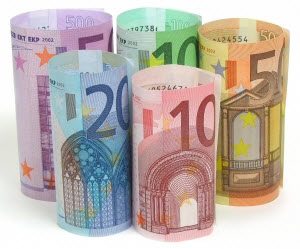 European Energy Efficiency Fund: this fund will invest in energy saving, energy efficiency and renewable energy projects, particularly in urban settings, with the aim of achieving at least a 20 per cent energy saving or an equivalent reduction in carbon dioxide and other greenhouse gas emissions. The fund will offer a wide range of funding streams such as senior and junior loans, guarantees or equity participation to local, regional and, under certain conditions, to national public authorities to promote sustainable energy investments. At its launch, the fund is worth a total of €265m with contributions from the European Investment Bank and national financial institutions.
Eco-innovation projects: this funding supports the market penetration of an environmental product, service, management practice or process with a proven track record, but which has not yet been fully marketed. The indicative budget for this call is €36 million and funding will provide up to 50 per cent of a project’s costs over a period of 36 months. Closing date: 8 September 2011.
Assessment of scenarios and options towards a resource-efficient Europe: proposals should identify inefficient uses of resources that cut across different sectors and policy areas at meso- and macro-economic level and quantitatively assess the potential for, and effects of, efficiency improvements within systems. Funding is worth between €700,000 and €750,000 over 24 months. Deadline: 22.08.11.
Multilateral Research on Material Efficiency: Proposals are invited on the topic of Interdisciplinary Program on Material Efficiency – A first step towards sustainable manufacturing. This call will be supported by €10 million over a three year period and it is hoped that between eight and ten collaborations will be funded.
Commission proposes €80bn for Horizon 2020
 The next Framework Programme – Horizon 2020 – will be worth €80.2 billion if the European Commission gets its way, the proposal for the 2014-2020 EU budget has shown. This would represent a 46 per cent increase on the budget of Framework 7, which runs from 2007 to 2013 and is worth about €56bn. In a statement announcing the budget proposal, the Commission said that the increase is meant to boost Europe’s economy and shows a lasting commitment to research, science and innovation.
Europe 2020: latest Structural Funds update
 The latest EU proposals reveal several key issues for UK Structural Funds which are summarised below.
Less money for the UK: the amount received by the UK is likely to fall (as GDP is higher than in other Member States). The overall budget for the structural funds at EU level will remain roughly the same (€376 billion); the greatest proportion will be earmarked for poor areas below 75% of the EU GDP average (unlikely to be any in England). The levels of total investment will still be significant and all areas will continue to have at least some access to funds.
New opportunities for part of England: there is opportunity for some areas of England to benefit from greater levels of structural funding. In the current programme, areas were either identified as rich (competitiveness) or poor (convergence) with some phasing in areas in between, receiving levels of funding accordingly. From 2014 it is proposed a new transition category be created between the two, at the level 75%-90% GDP, which would receive greater levels of funding than competitiveness areas. All other areas, with a GDP above 90%, will continue to benefit from competitiveness funding as they do now.
Tightening priorities: structural funds may be targeted at a fewer number of EU priorities. Competitiveness and transition areas will be required to focus economic development spending (ERDF) on energy efficiency, renewable energies, SME competitiveness and innovation. It is also proposed at least half of structural funds must be spent on skills development projects (ESF) in next programme round.
Stronger performance management: the EU will negotiate a partnership contract with the UK government, setting out a commitment for spending structural funds to address priorities and progress will be assessed through a performance framework measuring outcomes.
New funds for research, infrastructure and education: a range of expenditure lines will be integrated into three new EU-wide programmes: a ‘Connecting Europe Facility’ is proposed to offer €40 billion into transport, energy and ICT infrastructure projects; ‘Horizon 2020’ will integrate a range of research and innovation funds into a single €80 billion programme; and a single education and youth programme of €15.2 billion will integrate the range of youth development, learning and exchange funds.
Rural development: the rural development element of the Common Agricultural Policy (CAP) will receive €89.9 billion from 2014-20, and will be subject to similar performance and conditionality measures like structural funds. Funding for farm payments is proposed at €281.8 billion, roughly the same as current. The EU will make proposals permitting flexibility between the rural development and farm payment funds.
More coordinated spending: a common strategic framework for ERDF, ESF, the rural development programme will aim to join up the strategic ambitions of the different funds, as driven by the EU2020 strategy.
Financial engineering instruments: proposals place more emphasis on using the EU budget to leverage additional private sector investment.
Simplified administration: proposals aim to simplify, speed up and improve administration and delivery, requiring that both the EU and member states commit to radical simplification.
Negotiation timetable: proposals must be agreed unanimously by Member States, who are working towards an agreement for the end of 2012. Alongside this, important detail for each of the individual funds will be published in the autumn 2011, and Government is beginning to plan how funding programmes will be administered in England.
Excellent example of public engagement in research, resulting in societal impact
 Today is my first day back in the office after a road trip from Vancouver to Los Angeles, taking in many exciting cities, national parks, activities, etc en route. From spotting killer whales in the San Juan Islands to making the most of tax free shopping in Portland to hydrobiking in Long Beach harbour, I’ve packed in lots of fun! One of the coolest things we did, however, was to go to the La Brea Tar Pits at the Page Museum in Los Angeles.
 The La Brea Tar Pits is one of the world’s most famous fossil localities, recognized for having the largest and most diverse assemblage of extinct Ice Age plants and animals in the world. Whilst I was walking around the museum looking at skeletons of giant sloths and sabretooth tigers, a fossilised mammoth tooth (the size of my head) and a display of 404 dire wolf skulls, I had a eureka! moment. The museum is an excellence example of transparent research that engages the public and results in huge societal impact.
The entire research lifecycle is onsite and visible to visitors, including information on:
- how the research is funded and why it is important to society
- how different disciplines are working collaboratively
- the tools and techniques used
- how the research is changing our understanding of evolution and science
- how different community groups are engaging with the research
- examples of research outputs produced
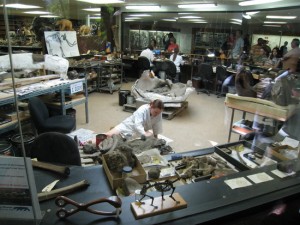
Through windows at the Page Museum Laboratory, visitors can watch bones being cleaned and repaired. Visitors can also visit Pit 91 and see a tar pit being excavated.
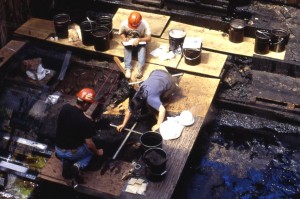
The Museum periodically canvasses visitor opinions and surveys changes in public understanding to ensure that research impact is being maximised and to justify the public funding that makes the research possible.
Evidently this integration of engagement, access to research and demonstrable societal impact is easier in some disciplines than others but research shouldn’t be taking place behind closed doors in universities; members of the public should be involved throughout the research lifecycle. This is a key strategy of Research Councils UK (RCUK) and other major funding bodies (such as Defra and the Royal Society). You can access the Concordat on Engaging the Public with Research here.
not quite EU but China & UK sign new agreement!
Scientific and technical collaboration between the United Kingdom and China has expanded further with the signing of a new agreement covering sectors including energy, advanced engineering and life sciences. The Science and Technology Facilities Council (STFC) and the China Guanghua Science and Technology Foundation have signed a Memorandum of Understanding (MOU), coinciding with the meeting in London of Prime Minister David Cameron and Chinese Premier Wen Jiaba o.
o.
Digital Hub event on 19th July
The launch event for the Digital Hub is drawing near and we have over 70 registrations and growing interest and publicity. This event is primarily aimed at external organisations and is designed to showcase BU research related to the creative and digital economy. We’ve got a great program lined up and a fantastic keynote speaker who is also an ex-BU graduate. More information is available at : http://digital-day-bournemouth-university.eventbrite.com/ and it would be great if you know of any businesses and organisations who would benefit from attending the event if you could push this link and information out to your networks. As there are already a lot of staff participating in the event from 5 different schools we are not opening it up to general staff registration, however if you would like to find out more about the Hub please email : thedigitalhub@bournemouth.ac.uk

ERAB: The European Foundation for Alcohol Research grants available
 These fund any aspect of biomedical or psychosocial research into beer or alcohol. Grants are worth €50,000 per annum over one to two years and the deadline is 10th April 2012.
How difficult is getting FP7 funding? Not too hard for some UK and EU fraudsters!
 Nature has reported that the European Anti-Fraud Office are currently in the process of prosecuting project consortia who received EU grants for fake research projects. The fraud was committed by a number of beneficiaries who appear to have made up entire research projects, including whole research teams, fictitious companies and subcontractors, and won EU grants for these projects. It appears that the projects were designed solely to obtain the funds and that no actual research activity was carried out.
Four collaborative projects under in the ICT area were terminated by the European Commission, and several individuals were charged for the fraud. Further projects are currently being investigated in the UK, France, Greece, Austria, Sweden, Slovenia and Poland.
It should be stressed that this is a very rare and unusual example of fraud in EU grants, especially when it comes to research grants, and it seems it is never possible to completely prevent fraud, even with the already very strict and robust systems in place for the Framework Programme. Overall, there continues to be a lot of support for simplification of the EU funding programmes including for greater acceptance of own (nationally approved) accounting systems, clarity and consistency.
How to find partners for EU Projects
 European Commission projects usually require partners, with the number and geographical location varying for each call. A useful tip to remember when considering your partner options is that a consortium should include a good balance of sectors industry, academia, user groups etc) and that all partners should be well-matched to the activities in the proposal.
You can find partners through your existing contacts, by reviewing previously awarded FP6 and FP7 projects, by searching/ advertising on the UKRO website ,
by seeking the assistance of the relevant UK National Contact Point and by attending EU conferences and project evaluations, by scanning the CORDIS website.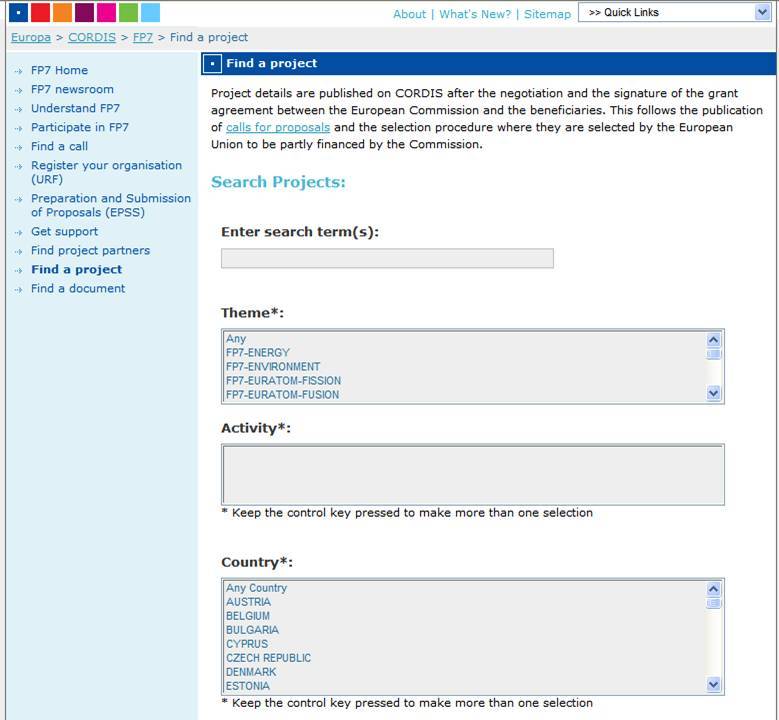
The best and most effective way to become involved in FP7 consortia however, is to join European Technology Platforms (ETPs). These are groups of industry-led stakeholder forums who explore Europe’s key challenges. ETPs define the EU Strategic research agenda and then bid for European Commission funds (through FP7 etc) to address these. The biggest players in the field across Europe belong to these groups and obviously as they set the research agenda, they are increduibly successful at winning FP7 funds for research. Joining these groups will not only open you to a plethora of partners but also will allow you to contribute in shaping the research agenda of Europe (which you can then address through funding). Some of the major ETPs are listed below with hyperlinks to their webpages:
Advanced Engineering Materials and Technologies
Advisory Council for Aeronautics Research in Europe
Embedded Computing Systems
European Biofuels Technology Platform
European Construction Technology Platform
European Nanoelectronics Initiative Advisory Council
European Rail Research Advisory Council
European Road Transport Research Advisory Council
European Space Technology Platform
European Steel Technology Platform
European Technology Platform for the Electricity Networks of the Future
European Technology Platform for Wind Energy
European Technology Platform on Smart Systems Integration
European Technology Platform on Sustainable Mineral Resources
Farm Animal Breeding and Reproduction Technology Platform
Food for Life
Forest based sector Technology Platform
Future Manufacturing Technologies
Future Textiles and Clothing
Global Animal Health
Industrial Safety ETP
Integral Satcom Initiative
Mobile and Wireless Communications
Nanotechnologies for Medical Applications
Networked and Electronic Media
Networked European Software and Services Initiative
Photonics21
Photovoltaics
Plants for the Future
Robotics
Sustainable Nuclear Technology Platform
Sustainable Chemistry
Water Supply and Sanitation Technology Platform
Waterborne ETP
Zero Emission Fossil Fuel Power Plants
ESRC Update – Demand Management, Restructuring & Collaboration
 With reduced budgets and the resulting increase in competition, times are tough in the search for RCUK funding. Dr Richard Shipway attended a number of ESRC events recently and highlighted some key messages from the Council.
There was a 12% cut in real terms to the ESRC’s programme budget and a 23% cut to their administration budget.
The ESRC has indicated they will have 3 priority areas for funding:
- Global economic performance and sustainable growth
- Influencing behaviour and informing interventions
- Vibrant and fair society.
Demand Management
The ESRC aren’t introducing strict demand management measures at this stage but they are monitoring the situation closely. At the moment they are encouraging universities to regulate internally so there are fewer applications but of a higher quality reaching the Council. More information on the introduction of their intial measures is available on the ESRC’s website.
The ESRC has a useful section on their website providing grant writing advice to applicants.
BU also has our own internal peer review service to help you with applications.
Restructuring of Schemes
The Council have integrated the post-doc fellowships and first grants sheme to create the new Future Leaders Scheme which is aimed at outstanding early career researchers. The call has recently been announced and closes on 15th Sept 2011.
International Partnership and Networking Scheme 2011 has been launched. This is aimed at fostering the development of long-term relationships with overseas social scientists in areas of interest that are of direct relevance to ESRC’s current strategic priorities. The closing date is 12th Oct 2011.
They will be streamlining their funding with fewer but more flexible research competitions. Small grants are phased out and standard grant thesholds are increased. Resources will be focused on larger and longer grants – ambitious social science.
Economic and Societal Impact
Creating, assessing and communicating impact are central to all of the ESRC’s activities. It is very important to consider this when putting together a proposal to the ESRC.
International Collaboration
The ESRC is very keen to promote international collaboration. They have a ‘Rising Powers’ programme to encourage collaboration with China, India and Brazil (deadline of 8 Sept 2011). The Council also allow international academics to be listed as co-investigators on the grants of UK universities, more info can be found here.
EU Intellectual Property/ technology transfer funding
EIB-universities proposal for three new research action sponsorships: projects should cover European intellectual property regimes and their impact on technology transfer/IP finance; analysis of investment needs in infrastructure sectors; the rising of credit risk in microcredit: origins, warning signals, current state and future prospects. Funding of up to €100,000 per year is available for a period of three years. Deadline 16.09.11
FP7 Cooperation Theme: what subjects are covered?
 The Cooperation theme is divided into 11 different topics; clicking on the hyperlink below will display the focus of the calls covered under each of these.
Health
Food, Agriculture, Fisheries and Biotechnology
Energy
ICT (Computing)
NMP(Nanosciences)
Socio-Economic Sciences & Humanities
Transport
Security
Space
Joint Technology Initiatives (JTI)
Public-Private Partnerships
FP7 Security 2012 Call update and slides from Info Day available!
 The FP7 Security Call will be published on 20 July 2011 and new features to be included in the 2012 Work Programme are:
- a new aspect of the 2012 Security Work Programme is the inclusion of pilot funding for Pre Operational Validation;
- an open topic for SMEs has been included in the 2012 Work Programme: SEC.2012.7.2-1 “Advancing contemporary laboratory forensic methods & equipment”. Under this topic at least 50% of the EC funding needs to go to SMEs;
- assistance in finding partners for FP7 Security proposals will be available on-line at the Partnering Platform website, operated (and quality controlled) by the German National Contact Point.
Slides are available from an ICT Security Info Day which was held at Aston University Business School last week.
EU funding: not as hard as you might think to win
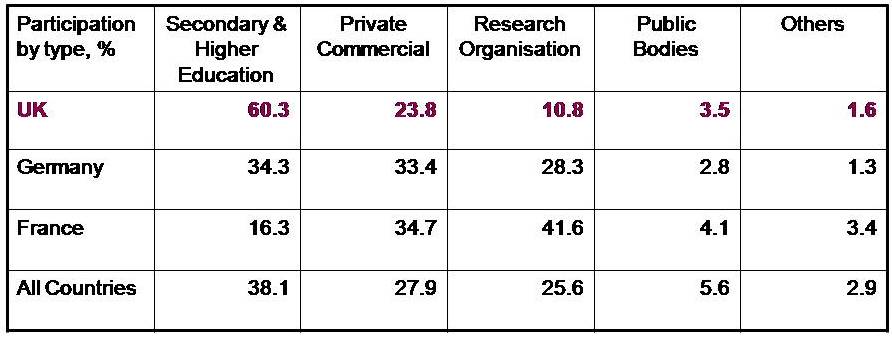
 The UK as a whole does pretty well when it comes to obtaining EU funding. We receive the second largest share of FP7 funding; €2.28 billion (equivalent to 14.4% of the total FP7 funding) and we are involved in more successful projects than France and Germany (41.0% of all grant agreements in FP7). As you can see from this table, the UK has obtained a great deal of funding from the FP7 Cooperation fund.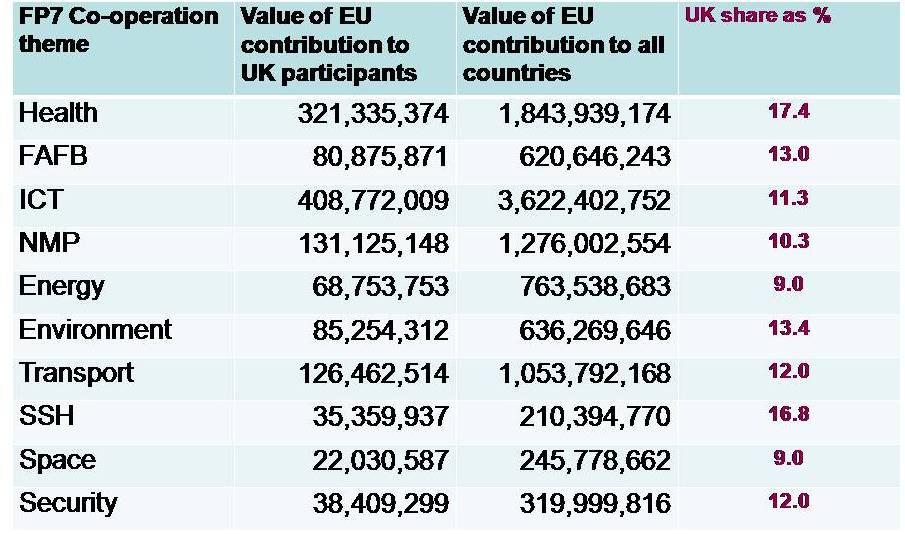
Over the next few months, I will be posting tips on how to find funding, how to write proposals, find partners etc. to help you to begin to explore the EU as a good source of funding.
EU energy related funding available
 EU Eco-innovation projects funding: to support the market penetration of an environmental product, service, management practice or process with a proven track record, but which has not yet been fully marketed. The indicative budget for this call is €36 million and funding will provide up to 50 per cent of a project’s costs over a period of 36 months. Deadline 08.09.11
EUROGIA+ funding call: projects should develop innovative energy technologies that will reduce the carbon footprint of energy production and use, with a focus on solar, wind, biomass, geothermal and energy efficiency. Deadline 14.09.11
Design options for sectoral carbon market mechanisms and their implication for the EU ETS: projects should help to improve understanding of different options for key design elements of the sector-wide carbon market mechanisms, as well as assessing the implications of recognising credits from such pilots for use under the EU ETS. Funding is worth between €180,000 and €200,000 over nine months. Deadline 16.08.11
Integration of renewable energy in Europe: project should provide quantitative and qualitative analysis of the electricity market, the transmission network and the distribution network in its ability to adapt to higher penetration of electricity from renewable energy. Funding covers approximately 500 person-days. Deadline 23.08.11
HEFCE funding of £10 million to cut carbon emissions
 The Revolving Green Fund (RGF) is open for proposals to reduce carbon emissions. There are two strands of funding both with a deadline of October 17th.
Strand 1 targets small-scale projects to improve energy efficiency and will aim to reach a broad range of institutions.
Strand 2 will make up to £3 million available for exemplary retrofit projects. These flagship initiatives will inform research, promote skills development and market growth in the relevant technologies – they must also demonstrate potential to capture and disseminate learning that will be of benefit across the higher education sector.
FAQs about the fund are available online.
Bedtimes and Pensions: Conference showcases the wealth of longitudinal research
The Understanding Society BHPS Conference 2011 was held at the University of Essex by the Institute for Social and Economic Research (ISER). Over two days, the conference brought together researchers from all over the world to present and discuss a variety of research, using data primarily from two of Britain’s most comprehensive household longitudinal studies.
BU staff can login below:
Other services







Recent posts
BU research Funding opportunities EU
 ESRC Studentships for 2027 Entry: Opportunity Now Open
- Personal Reflection on Sharing Research Through Art: Collaborating to Understand Ageing in a Digital World
 SONAMONI contributions to Safety Conference 2026 in South Africa
- REF adds ‘midwifery’ to Unit of Assessment 3 name
 Three CMWH presentations at Berlin conference
 New interdisciplinary paper on Nepal
 Horizon Europe Cluster 3 (Civil Security for Society) 2026 Calls Now Open
 MSCA Doctoral Networks 2026 Call Information Webinar
 ESRC Festival of Social Science 2026: Application Deadline Extended to Thursday 25 June 2026
- Apply now to take part in the 2026 ESRC Festival of Social Science
 Reminder: Register for the ESRC Festival of Social Science 2026 Information Session
 ECR Funding Open Call: Research Culture & Community Grant – Apply now
- MSCA Postdoctoral Fellowships 2025 Call
 ERC Advanced Grant 2025 Webinar
- European Migration Research and Impact – Invitation to a Roundtable Discussion
- MSCA Postdoctoral Fellowships 2025
 Update on UKRO services
 European research project exploring use of ‘virtual twins’ to better manage metabolic associated fatty liver disease
 Research Information Network
- Physical Sciences Case studies: information use and discovery
- Information handling in collaborative research: an exploration of five case studies
- Information literacy monitoring and evaluation
- Data centres: their use, value and impact
- Heading for the open road: costs and benefits of transitions in scholarly communications