Dr Beukes (CEMIS, US), Dr S Bachmann (BU) and Prof Liebenberg (CEMIS, US)
Latest research and knowledge exchange news at Bournemouth University


Dr Beukes (CEMIS, US), Dr S Bachmann (BU) and Prof Liebenberg (CEMIS, US)
The chapter is called, “Interplay between lipid mediators and the immune system in the promotion of brain repair”, and looks at the interactions of omega-3 and omega-6 fatty acids with endocannabinoids in neuroinflammation, neurogenesis and brain aging.
The brain is highly enriched in docosahexaenoic (DHA) and arachidonic (ARA) acids, omega-3 and omega-6 polyunsaturated fatty acids (PUFAs), respectively. DHA and other long-chain omega-3 PUFAs are precursors of anti-inflammatory and pro-resolving mediators, whereas ARA is precursor of inflammatory eicosanoids, but also pro-resolving mediators. The endocannabinoid system comprises a group of bioactive lipids, receptors and enzymes involved in their synthesis and degradation. 2-archidonoylglycerol (2-AG) and anandamide (AEA) are the primary agonists of cannabinoid receptors in the brain, substrate for enzymes such as cyclooxygenases, lipoxygenases and cytochrome P450 mixed function oxygenases, which release ARA upon hydrolysis. The aging brain has impaired ability to balance protective and detrimental effects of the immune system and chronic low-grade neuroinflammation is a contributor to cognitive impairment and development of neurodegenerative diseases. There is a complex interplay between omega-3 and omega-6 PUFAs, the endocannabinoid system and the immune system. This chapter summarises current evidence of this interplay and discusses the therapeutic potential in the promotion of brain self-repair.
Dr Simon Dyall’s Bioactive Lipids Research Lab conducts research investigating the role of bioactive lipid mediators in brain protection and repair across the lifespan and following neurotrauma.
The book, Role of the Mediterranean Diet in the Brain and Neurodegenerative Disease” is edited by Farooqui T. and Farooqui A., and is due for publication 1st November 2017 by Academic Press. Paperback ISBN: 9780128119594
Yogarajah Nanthagaopan has successfully completed the first PhD in Project Management from the Faculty of Management. He was supervised by Dr Nigel L. Williams and Professor Stephen Page and his thesis was titled: A Resource Based Perspective on Project Management in NGOs. Dr Nanthangaopan has returned to his native Sri Lanka and is the current Head of Economics and Management department and Coordinator for the BBM in Project Management degree program at the Faculty of Business Studies, Vavuniya Campus of the University of Jaffna, Sri Lanka.
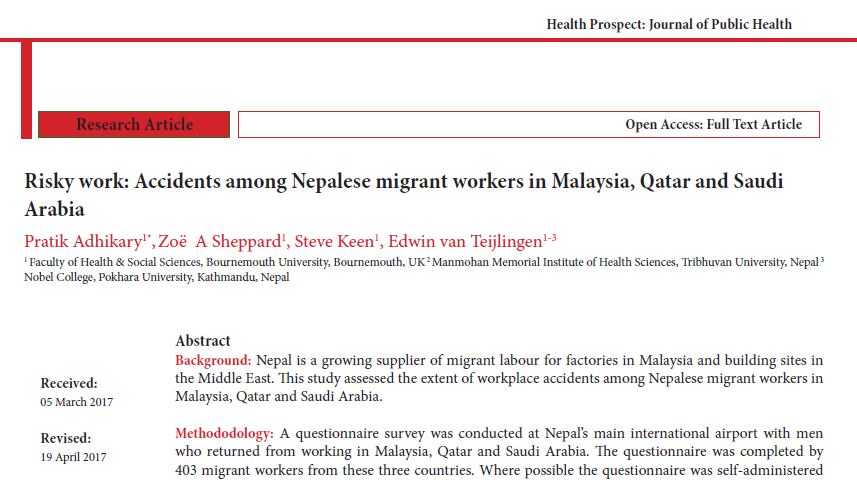
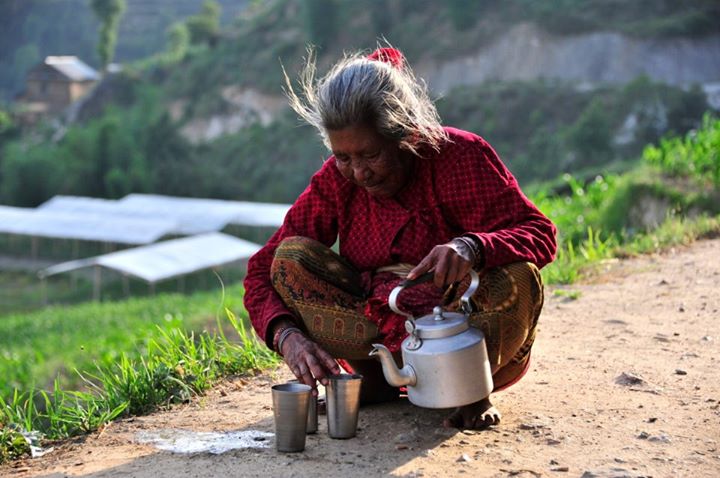
Next months sees the publication of our latest article on research ethics in developing countries [1]. Our paper argues that despite a significant increase in health research activity in low-and middle-income countries (LMICs) in recent years, only limited work has been done to address ethical concerns. Most ethics committees in LMICs lack the authority and/or the capacity to monitor research in the field. This is important since not all research, particularly in LMICs region, complies with ethical principles, sometimes this is inadvertently or due to a lack of awareness of their importance in assuring proper research governance. With several examples from Nepal, this paper reflects on the steps required to obtain informed consents and highlights some of the major challenges and barriers to seeking informed consent from research participants. At the end of this paper, we also offer some recommendations around how can we can promote and implement optimal informed consent taking process.
The paper is co-written by six authors, and interestingly five are graduates of the University of Aberdeen. These Aberdeen University graduates are currently affiliated with five different universities. Four of who are based in the UK at: the University of Liverpool, the University of the West of England, the University of Oxford, and in Bournemouth University’s Centre for Midwifery, Maternal & Perinatal Health (CMMPH) and one in the USA: Georgetown University. The sixth co-author, Nirmal Aryal, is currently a PhD student at the University of Otago in Dunedin (New Zealand). Whilst Liverpool-based researcher Dr. Pramod Regmi is heading back for Bournemouth University to become a lecturer in International Health in the Faculty of Health & Social Sciences this autumn.
Prof. Edwin van Teijlingen
CMMPH
Reference:
Kun Qian is a PhD candidate in the National Centre for Computer Animation, Faculty of Media and Communication. He has been working on computer graphics, game, vfx and virtual reality technologies for more than 10 years. He will deliver a talk on his research of surgery simulation at 7pm, 25th July at K103, as part of the BCS Animation and Game Development SG event. The detail can be found at http://www.bcs.org/content/ConWebDoc/58181 . It is free for all the attendees, everybody is welcome. Please register at the link above, because we will bring some refreshment based on the number of registrations.
Abstract: With the development of computer graphic and haptic devices, training surgeons with virtual reality technology has proven to be very effective in surgery simulation. Due to the various unsolved technical issues, the laparoscopic surgery simulation has not been widely used. Such issues include modelling of complex anatomy structure, large soft tissue deformation, frequent surgical tools interactions, and the rendering of complex material under the illumination. A successful laparoscopic surgery simulator should integrate all these required components in a balanced and efficient manner to achieve both visual/haptic quality and a satisfactory refreshing rate. In this talk, we propose an efficient framework integrating a set of specially tailored and designed techniques, ranging from deformation simulation, collision detection, soft tissue dissection and rendering. This framework can be used as a low level engine for surgery simulation by integrating and optimizing modern creative technologies.
Dr. Xiaosong Yang, MBCS
Associate Professor of Computer Animation
National Centre for Computer Animation
Faculty of Media and Communication
Bournemouth University
http://staffprofiles.bournemouth.ac.uk/display/xyang
Clinical Services Journal highlighted our recent research report on Community Hospitals, see article here!. The NIHR research has been conducted by RAND Europe, the European Observatory on Health Systems & Policies, and Bournemouth University [1].
Our report concluded that community hospitals could play a more active role in meeting the challenges facing the NHS, in particular in larger hospitals. The notion of a Community Hospital in the UK is evolving from the traditional model of a local hospital staffed by general practitioners and nurses and serving mainly rural populations. Along with the diversification of models, there is a renewed policy interest in Community Hospitals and their potential to improve integrated care. However, there is a need to better understand the role of different models of Community Hospitals within the wider health economy and an opportunity to learn from experiences of other countries to inform this potential.
Prof. Edwin van Teijlingen
CMMPH
Reference:
REF 2021 and outcome of Stern Review – staff selection
A blog from David Sweeney on Wonkhe sets out the approach to staff selection post Stern. At BU we wanted all staff to be returned to avoid pressure on the sector to shift staff to teaching only contracts. The new definition will be “all staff with a significant responsibility for research”. Only one output per staff member will be required. “We will expect institutions to develop codes of practice setting out their processes for identifying staff in scope for submission. In no case is there a requirement to focus this discussion on the formal contract of employment, and we would expect codes of practice to be clear on this point.”
More information:
The four REF 2021 Main Panel Chairs (designate) are:
Horizon 2020 underwritten – The safeguarding of Horizon 2020 was been trailed on several occasions during 2016 but with limited details. However, on Tuesday Jo Johnson confirmed the government’s commitment to underwrite the funding for all successful bids made by UK applicants for Horizon 2020 projects before the UK exits the EU. Jo Johnson said:
“I appreciate that the UK’s decision to leave the EU has caused uncertainty for the research community. Nobody in Europe benefits from the loss of research competitiveness that may occur if we let ourselves get distracted from maintaining research excellence through collaboration; it fundamentally underpins the way it is done today. This is why the UK government acted quickly to underwrite competitively bid for EU funding. I will now aim to provide clarification on how this will work as I want to put any uncertainty to rest.” Source
The underwriting applies to both projects that are on-going at the point of the UK’s EU exit, and funding that is applied for before the UK’s exit and is subsequently successful. It also includes Horizon 2020 calls with two-stage procedures, as long as the first application is submitted before the UK leaves the EU. Updated FAQs are expected to be issued in due course.
TEF, subject level TEF and teaching intensity
Jo Johnson has announced that LEO (long-term employment data) would be included in the TEF going forwards. The year 3 provider-level submission specification will be published later this year. Institutions with three-year TEF awards (most institutions) do not have to resubmit in year 3 but can choose to.
He also announced that the OfS would start early – in January 2018.
Jo Johnson has announced the subject level TEF pilots and the specification has been published – “the biggest improvement TEF will make to the information on offer to students will be to produce ratings at subject-level. We know that most students choose their subject first, and then choose between providers offering that subject. Students need to know how a provider’s teaching quality will relate to them in the subject they are looking to study“
You can read more about subject level TEF on the BU policy intranet pages – there is a useful Wonkhe article here.
There will also be a pilot for a teaching intensity measure – collecting data on contact hours, staff-student ratios and class sizes through institutional declarations and a student survey.
Student contracts – In his speech on 20th July, Jo Johnson announced that the OfS would be asked to look at requiring universities to enter into contracts with students – going beyond the current guidance from the CMA and others.
Tuition Fees – This week tuition fees continued to receive much attention in the media, an emergency debate was held on Wednesday, and Jo Johnson spoke out on Thursday.
In his speech on 20th July, Jo Johnson rejected calls for changes to the tuition fee system. He highlighted “three big misconceptions”:
In his speech, the minister highlights steps on value for money:
This week Shadow Chancellor of the Exchequer John McDonnell weighed in on the wider tuition fees speculation confirming it is very unlikely that a Labour government would be able to afford to write off all of the debt of graduates who are repaying their fees. This is estimated to cost in the region of £100bn. However, it is probable that the Labour Party will continue to talk about their ambition to abolish fees for future cohorts of students. Read more in Jane’s blog for the Lighthouse Policy Group.
The Russell Group have called for changes to repayment arrangements, including interest rates, repayment thresholds and proposing a salary sacrifice scheme so that repayments are from tax-free income.
Research Professional focus on the challenges to Labour during the emergency debate; and the UCU report which states middle-life mid-earners will lose more than 50% of the earnings between tax, NI and student loan repayments (article: Student debt creates ‘mid-life tax crises’.
EU Withdrawal (Repeal) Bill – in response to the government’s publishing of the EU (Withdrawal) Bill the first ministers of Scotland and Wales have issued a joint statement expressing disappointment that former EU powers would not devolve to the Welsh Assembly and Scottish Parliament. In the statement, there were hints that both devolved assemblies may withhold legislative consent. This would not block the passage of the bill although it would be politically embarrassing for the Westminster government. Campaign groups such as the3million have also taken to social media to raise awareness of a clause that allows the UK government to restrict the right of EU citizens in the event of “no deal”.
International Students – there was an interesting piece in Research Professional from Paul Blomfield MP re: net migration figures. It seems unlikely that Conservative MPs will want to precipitate a crisis, however strongly they feel about international students; better to wait until the new proposals on immigration come out – we haven’t seen the Bill yet that was announced in the Queen’s speech (although that may be mostly about Brexit) and the long promised consultation on wider immigration issues from October’s party conference has not emerged either (this may be in the long grass, given the focus on Brexit and related EU immigration matters).
Opportunities to raise the issue include debates in the Lords (not yet scheduled) on:
Meanwhile Germany has reported the goal to significantly increase international student volume by 2020 has already been achieved. This autumn 355,000 additional students will study in a German university. The German Academic Exchange Service states Germany is now the fifth most popular destination. Source.
Comprehensive Universities? – In a paper published on 20th July by the Higher Education Policy Institute (HEPI), Professor Tim Blackman, the VC of Middlesex University calls for a new comprehensive model in higher education.
The paper points out the inconsistency between the intense scrutiny given to selective schools (the recent grammar schools debate) and the approach taken in universities – “Instead, the less selective institutions are labelled ‘low status’ and social mobility measures are focused on small numbers of young people from low-income families gaining places in very selective ‘high status’ universities”. As with grammar schools, it is argued “highly-selective universities are damaging not only less selective universities but also the average achievement of all students.”
So the paper proposes steps to introduce the a comprehensive model for HE:
And, a financial incentive – it proposes that universities with high percentages of students from the top 1-3 social classes pay a levy from their fair access pot which allows universities with lower percentages of such students to offer facilities that would attract those students (not scholarships or free places). And the Russell Group could keep some to support their new open access students.
Research Professional report on the HEPI paper: Universities ‘should be fined for low socioeconomic diversity’.
Industrial Strategy Commission have analysed the Government’s industrial policy and published their findings in the report Laying the Foundations
On Research and skills (page 35 of the report) it critiques:
In Significant skills challenges it establishes:
For a quick yet overall more rounded picture of the full report read the Shortcomings on pages 13-16 and the Executive Summary on pages 4-5.
Student Retention
The Social Market foundation and the UPP Foundation have issued a report about student retention. The main story which was covered in the press related to students from ethnic minority and disadvantaged backgrounds that are more likely to drop out of university.
They recommend:
They also suggest some actions for universities:
Higher level Apprenticeships – This week the Department for Education published an update on vocational qualification showing the greatest increase in apprenticeship participation was at ‘higher level’ with 58,200 in 2016/17, a rise of over 50% on 2015/16.
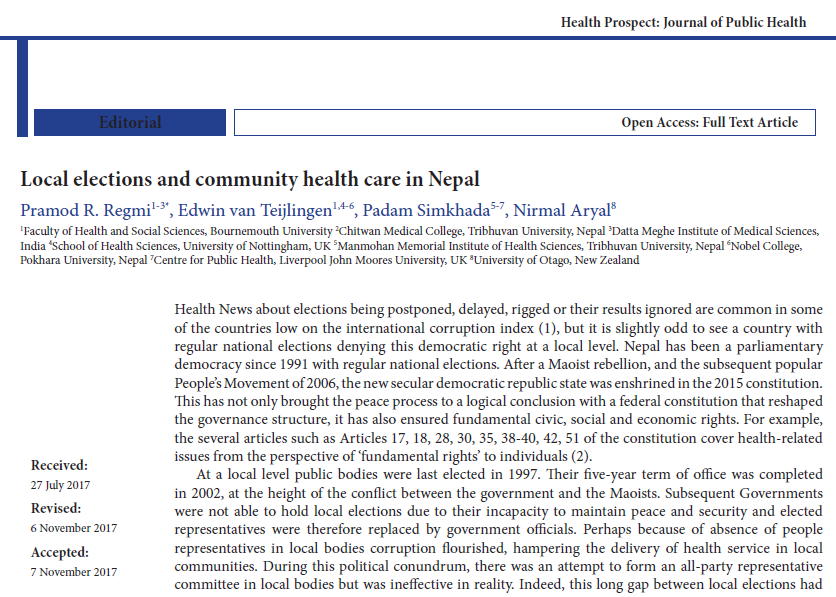
BU professor Edwin van Teijlingen from the Centre for Midwifery, Maternal & Perianal Health (CMMPH) had the honour of being invited to speak at a workshop ran yesterday by the Sheffield Institute for International Development. The workshop ‘Nepal: Reconstruction, Resilience and Development’ was organised by the University of Sheffield.
Prof. Edwin van Teijlingen spoke about endemic corruption in Nepal and opportunities that are offered by disasters such as earthquakes for more corruption. He pointed out that there is little research on corruption in Nepal, despite its low ranking on the international Corruption Perceptions Index. The presentation can be viewed here: Nepal earthquake corruption 2017 . 
He pointed out that disasters are confusing events with often loads of money and relief aid arriving under chaotic conditions. Immediate emergency aid needs to be distributed to unknown people (‘those affected’), in difficult to access areas, under often chaotic socio-political conditions.
He also reminded the audience that corruption (and corrupt behaviour) are not limited to low-income countries. He highlighted the Ariana Grande case in Manchester (UK) where thousands falsely claimed to have been at the original attacked concert when applying for a ticket for the Manchester One Love concert.
This month has been exceptionally good for BU publications in the field of midwifery and maternity care. Two PhD students has their articles published in international academic journals, one member of staff had a textbook chapter published, an interdisciplinary team has been accepted for publication in the British Journal of Midwifery, and a member of the Centre for Midwifery, Maternal & Perinatal Health (CMMPH) co-authored this month’s editorial in the Journal of Asian Midwives as well as an epidemiology paper on the HPV (Human Papilloma Virus) in Nepal. 
The first of this success story was CMMP PhD student Preeti Mahato whose her latest paper ‘Factors related to choice of place of birth in a district in Nepal’ appeared in the Elsevier journal Sexual & Reproductive Healthcare [1]. The second PhD paper was also based on research in Nepal this time by Sheetal Sharma whose paper ‘Evaluation a Community Maternal Health Programme: Lessons Learnt’ appeared in Journal of Asian Midwives [2]. The textbook chapter was by Dr. Jenny Hall who contributed a chapter to the latest edition of Mayes Midwifery , which is the classic midwifery textbook and now in its 15th edition [3]. The interdisciplinary paper is by Angela Warren, service user and carer coordinator PIER partnership, Dr Mel Hughes, principal academic in social work, academic lead for PIER partnership, and Dr Jane Fry and Dr Luisa Cescutti-Butler who are both senior lecturers in midwifery in the Centre for Midwifery, Maternal & Perinatal Health (CMMPH) [4]. The latest issue of the Nepal Journal of Epidemiology carried a CMMPH co-authored paper on the HPV in young women in Nepal [5]. The final piece, an editorial, appeared yesterday in the latest issue of the Journal of Asian Midwives [6].

Congratulations to all authors!
Prof. Edwin van Teijlingen
CMMPH
References:
Congratulations to Sheetal Sharma whose latest article appeared in today’s new issue of Journal of Asian Midwives [1]. Sheetal wrote the paper ‘Evaluation a Community Maternal Health Programme: Lessons Learnt’ with her PhD supervisors Dr. Catherine Angell, Prof. Vanora Hundley, Prof. Edwin van Teijlingen and Prof. Padam Simkhada (Liverpool John Moores University & FHSS Visiting Professor) and the director of Green Tara Nepal Mr. Ram Chandra Silwal and the founder of Green Tara Trust, London, Dr. Jane Stephens. The Journal of Asian Midwives is an Open-Access journal hence this article is freely available across the globe.
Reference:
Sharma, S., Simkhada, P., Hundley, V., van Teijlingen, E., Stephens, J., Silwal, R.C., Angell, C. (2017) Evaluation a Community Maternal Health Programme: Lessons Learnt. Journal of Asian Midwives. 4(1): 3–20.
We have the honor to have Prof. Marina L. Gavrilova here on our campus to deliver a talk on Biometric Recognition, recognizing a person by determining the authenticity of a specific characteristic – biometric features, such as Physiological Biometrics (face, fingerprint, hand, ear, Iris, palm print, hand vein, tooth, retina etc.), Behavioural Biometrics (voice, gait, signature, key-stroke dynamics, etc) and Social Biometrics (Twitter, Flickr, etc). The talk will discuss various problems in biometric data acquisition, feature matching, multi-modal fusion, pattern recognition, etc.
Title: The Social Aspects of Biometric Recognition through Human Perception
Speaker: Prof. Marina L. Gavrilova, Department of Computer Science, University of Calgary
Venue: CREATE LT, Fusion Building, Talbot Campus, Bournemouth University, Fern Barrow, Poole, Dorset, BH12 5BB
Time: 14:30-15:30 Wednesday 26th July 2017
Abstract: Our society continues to undergo tremendous growth with respect to all aspects of information access and sharing. It had a profound effect on the way we, humans, and the whole society lives, works and interacts in business and social settings. The information being shared through social networks, on-line communities, games, software development tools, e-mails, blogs, posts, etc. is enormous. It also ranges in type: text, images, hyperlinks, likes, network connections, etc. What’s more, human social, behavioral and even cognitive traits are becoming more and more visible through interlinking of heterogeneous communications in on-line and off-line settings and even in our visual preferences. This phenomenon gave rise to the rise of a new concept: Social Biometrics, that attempts to understand and extrapolate trends related to all aspects of human social activities. The talk is devoted to definitions, examples, case studies and very recent research trends in this domain. The introduced concepts will be further illustrated through two case studies: establishing identity of Twitter users through social networks analysis, and gender recognition of Flickr users based on human aesthetic preferences.
Marina L. Gavrilova is a Full Professor in the Department of Computer Science, University of Calgary. Dr. Gavrilova’s research interests lie in the areas of biometric security, cognitive sciences, pattern recognition, social networks, and cyberworlds. Prof. Gavrilova is the founder and co-director of the Biometric Technologies Laboratory and SPARCS lab, with over 200 publications, including the World Scientific Bestseller (2007): Image Pattern Recognition: Synthesis and Analysis in Biometrics and IGI (2013) book Multimodal Biometrics and Intelligent Image Processing for Security System. She is a Founding Editor-in-Chief of Transactions on Computational Science journal, Springer, and an Associate Editor of the Visual Computer and the International Journal of Biometrics. Prof. Gavrilova has given invited lectures at leading international conferences (3AI, CW, WSCG, GRAPHICON, PSC, ICCI*CC, MIT, ICBAKE, etc), and appeared as guest at DIMACS Rutgers University/Bell Labs, USA; Microsoft Research, Redmond, USA; Samsung Research, South Korea; SERIAS Purdue University, USA, among other universities.
http://pages.cpsc.ucalgary.ca/~marina/HomePHP/index.php
Thanks.
Dr. Xiaosong Yang
http://staffprofiles.bournemouth.ac.uk/display/xyang
Congratulations to Faculty of Health & Social Sciences (FHSS) PhD student Folashade Alloh and Dr. Pramod Regmi, newly appointed lecturer in International Health. They just published ‘Effect of economic and security challenges on the Nigerian health sector’ in the journal African Health Sciences. The paper is Open Access and can be found here!
Well done!
Prof. Edwin van Teijlingen
CMMPH
Congratulations to Preeti Mahato, PhD student in the Centre for Midwifery, Maternal & Perinatal Health, on the publication of her latest paper ‘Factors related to choice of place of birth in a district in Nepal’ in the Elsevier journal Sexual & Reproductive Healthcare [1]. The paper based on her research work in Nawalparasi, southern Nepal. This new paper is the third paper form Preeti’s PhD work [2-3].
Reference:
Sport management researcher Dr Tim Breitbarth (Department of Sport & Physical Activity) was one of only six awardees of the prestigious UEFA Research Grant Programme 2016/17, which supports all 55 UEFA member associations to further develop their own activities and projects. Tim’s project entitled “#SocialResponsibility in #Football: Mapping Perceptions and Expectations through Social Media Conversations across Europe”, is a longitudinal, large-scale analysis of social media across ten languages.
Besides delivery of interim and final reports, Tim was invited to the House of European Football (UEFA’s headquarter) in Nyon, Lake Geneva to present his project’s findings to the UEFA Research Grant Jury chaired by Dr Michel D’Hooghe (amongst other, current chairman of the Medical Committee of FIFA and UEFA and an ex-member of the FIFA Council). The audience comprised of renowned academics, UEFA managers interested in the topic and representatives of the European football federations, so that Tim – for example – has been invited to present to the Croatian Football Association.
Creating more impact
Next will be to promote the new knowledge throughout academia and practice, and to create further impact on the level of international and national federations as well as club level. Set avenues include:
Tim is a leading expert in corporate social responsibility in sport and, amongst other, the lead guest editor of the European Sport Management Quarterly (ABS 3***) upcoming 2019 special issue “Social Responsibility and the European Sport Context” (http://explore.tandfonline.com/pages/cfp/resm-cfp-social-responsibility-and-the-european-sport-context)
Dr Tim Breitbarth (Principal Academic and Global Engagement Lead, Department of Sport & Physical Activity) is available at tbreitbarth@bournemouth.ac.uk
The Health Services Journal published a commentary this week on Community Hospitals [1]. This online article is written by Dr. Emma Pitchforth who is based at RAND Europe in Cambridge (& BU Visiting Faculty), Prof. Edwin van Teijlingen (Faculty of Health & Social Sciences) and Dr. Ellen Nolte based at the European Observatory on Health Systems and Policies. 
The authors highlight the recently completed NIHR study on Community Hospitals [2]. The notion of a Community Hospital in the UK is evolving from the traditional model of a local hospital staffed by general practitioners and nurses and serving mainly rural populations. Along with the diversification of models, there is a renewed policy interest in community hospitals and their potential to deliver integrated care. However, there is a need to better understand the role of different models of community hospitals within the wider health economy and an opportunity to learn from experiences of other countries to inform this potential.
With ease of access and a sense of homeliness, there is potential for Community Hospitals to be better integrated into NHS in England. The authors suggest that a more strategic role for ‘traditional’ Community Hospitals might be timely within the NHS in England. They further conclude that if challenges around Community Hospitals are addressed and their within the English health system is properly defined, they could provide positive benefits to the health service. It seems that, if done correctly, Community Hospitals could be a traditional solution to help address some of the modern day challenges of the NHS.The full NIHR report is Open Access and can be found here!
Last year the research team had already published a scoping review article from the NIHR study [3].
References:
Golf occupies a prominent place in the global sport community and BU is one of only a few universities offering a full degree course on golf management. Dr Tim Breitbarth (Department of Sport & Physical Activity) is the lead editor of the first book that introduces the fundamentals of golf business and management from a truly international perspective. 30 authors from 6 continents are covering key topics such as media, club management, sponsorship and retail, at elite and non-elite levels. Already, the book has received endorsement from the top of the golf sector, namely Guy Kinnings (Global Head of Golf, IMG) and Martin Slumbers (Chief Executive, The R&A).
With sections exploring the development of golf on every single continent, this book presents the latest thinking on current issues in golf, ranging from sustainability and innovation to global governance. Each chapter incorporates helpful features for students including learning objectives, discussion questions, guides to further reading, recommended websites and insights from industry voices.
Essential reading
This book co-edited together with Sebastian Kaiser-Jovy (Heilbronn University, GER) and Geoff Dickson (AUT, New Zealand) is essential reading for students of any golf-related degree course or professional accreditation programme, and will also be of interest to those studying or working in sport business, sport management and sport tourism. Underpinned by up-to-date literature, golf researchers will also find the book a useful starting point.
Contributors range from internationally renowned academics such as professors David Shilbury (Deakin University, AUS) and Karen Danychuk (Western University, CAN) to a senior vice president at Club Managers Association of America (USA) and managers at PricewaterhouseCoopers (Switzerland) and Brazilian Golf Federation. Also, ex-BU PhD student associate professor Brendon Knott (SA), BU honorary PhD Eddie Bullock (UK) and BSc sport management golf alumni Luke Frary (UK) have contributed their golf expertise.
For more information, including contents, contributors and purchasing options, see: https://www.routledge.com/Golf-Business-and-Management-A-Global-Introduction/Breitbarth-Kaiser-Jovy-Dickson/p/book/9781138957176
Dr Tim Breitbarth (Principal Academic and Global Engagement Lead, Department of Sport & Physical Activity) is available at tbreitbarth@bournemouth.ac.uk
Reviews by Guy Kinnings (Global Head of Golf, IMG) and Martin Slumbers (Chief Executive, The R&A)
“In 1960, a handshake between Mark McCormack and Arnold Palmer became the foundation of not just golf management but modern sport business. In 2017 and beyond, we must all work toward addressing some of the challenges that the sport naturally has to overcome to evolve and remain relevant. With, for example, the re-introduction of golf to the 2016 Olympics, the momentum is on our side. There is great opportunity in global golf.”
“One of the key challenges for the golf industry is to be alive to the changing demands of people’s modern day lifestyles, particularly when research demonstrates that a younger generation of golfers would like to play alternative, shorter forms of the game in a quicker time. It is also important that we educate golf’s current and future executives about effective business and management practices and this book will have an important role to play in that regard.”
Final year sport management student Mats Hjertum and his teammate Stian Pettersen from our partner university, the Norwegian School of Sport Science, have been shortlisted in a business competition involving Germany’s most successful football club FC Bayern Munich and global consumer goods giant Procter & Gamble. Teams from as far as New Zealand submitted their innovative ideas around fan experience and mediaisation in football. Mats and Stian are mentored by management academic Dr Tim Breitbarth.
Watch their great team presentation video that prominently features BU by clicking on the below picture.
They are now invited to spend four days with FC Bayern Munich around the Audi Cup at the beginning of August (pre-season competition involving Bayern Munich, Liverpool, Atletico Madrid and Napoli) to meet stakeholders of the business competition, including Bayern executive board members, the general manager of P&G Germany, and the managing partners of Futury, the idea generator and test factory for new and digital business models which brokers the business competition. Importantly, Mats and Stian will pitch their idea for substantial funding and mentorship in the final phase. Amongst other, part of their experience will be an exclusive tour of Allianz Arena and tickets for all matches of the competition.
Unfortunately, the second team led by BU sport management student Sahil Kamble did not make the cut despite a strong business, sports and engineering skills portfolio within their team of three and also an exciting technology-driven proposal.
With the initial lead for the competition coming through Dr Carly Stewart, this is the first time Bournemouth University sport students have been involved in such an international business competition. Besides Tim’s mentorship, Mats and Sahil commented that their approach to this competition and their business thinking benefitted from the experience of the intense multi-day and fast-paced international student management game in Cologne, organised as part of their final year strategic sport management unit.
For more information, contact Dr Tim Breitbarth (Principal Academic and Global Engagement Lead, Department of Sport & Physical Activity) at tbreitbarth@bournemouth.ac.uk
1-day BU conference examining the effect of adverse events on surgeons, 8th September 2017
A group of BU researchers are working in partnership with Royal Bournemouth Hospital to carry out research examining the consequences of complications and errors on surgeons’ lives. On September 8th 2017 we are holding a one day conference to highlight the effects of dealing with adverse events. We have been fortunate in attracting eminent speakers from around the UK to contribute to the conference which will be held at the Executive Business School on the Lansdowne Campus.
Speakers will present the latest research in the area, share insights from their surgical careers and personal experiences, and consider how better support and training can be provided for surgeons.
If you are interested in attending (attendance is free for BU staff) or would like to know more please visit www.surgeonwellbeing.co.uk or contact Professor Siné McDougall (smcdougall@bournemouth.ac.uk; ext. 61722).