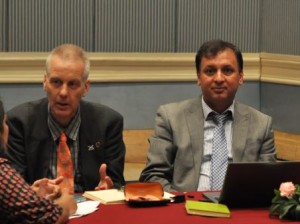
 At a television interview this morning in Kathmandu I was asked how many papers I had published on health and health-related issues in Nepal. I told the interviewer from BTV Business that it was around 90 to a hundred. Coming back to Green Tara Nepal office I decide to update the list of papers on Nepal to make sure I had not lied too much on TV.
Adding up the papers, editorials and, to a lesser extent, book chapters I was pleasantly surprised that there were 25 on maternity care & midwifery, 18 on sexual & reproductive health, nine on infectious diseases, five on non-communicable diseases, six on nutrition & child health, three on mental health, two on migration and a further mixture of 38 on topics such as health systems, research methods, or health & education capacity building. If I have not double counted any of the papers that a grand total of 106. Most are co-authored with BU Visiting Faculty Prof.Padam Simkhada (from Liverpool John Moores University), many with PhD students conducting projects in Nepal and, more recently with BU post-doctoral fellow Dr. Pramod Regmi.
Prof. Edwin van Teijlingen
CMMPH
Reference (by topic)
Maternal & Neonatal Health & Midwifery
- Simkhada, B, van Teijlingen E, Porter, M, Simkhada, P. (2006) Major problems and key issues in Maternal Health in Nepal (Review article), Kathmandu University Medical Journal, 4(2): 261-266. kumj.com.np/ftp/issue/14/Major-problems-and-key-issues-in-maternal-health-in-Nepal.pdf
- Dhakal, S., Chapman, G., Simkhada, P., van Teijlingen E., Stephens J., Raja, A.E. (2007) Utilisation of postnatal care among rural women in Nepal, BMC Pregnancy & Childbirth 7(19). Web: biomedcentral.com/content/pdf/1471-2393-7-19.pdf
- Simkhada, B., van Teijlingen E., Porter, M., Simkhada, P. (2008) Factors affecting the utilisation of antenatal care in developing countries: a systematic review of the literature, Journal of Advanced Nursing 61(3): 244-260.
- Teijlingen van, E., Simkhada, P., Ireland, J. (2010) Lessons learnt from undertaking maternity-care research in developing countries. Evidence-based Midwifery 8(1): 12-6.
- Simkhada, B., Porter, M., van Teijlingen, E. (2010) The role of mothers-in-law in antenatal care decision-making in Nepal: A qualitative study. BMC Pregnancy & Childbirth 10(34) biomedcentral.com/content/pdf/1471-2393-10-34.pdf
- Baral, Y.R, Lyons, K., Skinner, J, van Teijlingen, E. (2010) Determinants of skilled birth attendants for delivery in Nepal Kathmandu University Medical Journal 8(3): 325-332. http://www.kumj.com.np/issue/31/325-332.pdf
- .Acharya, D.R., Bell, J., Simkhada, P., van Teijlingen E., Regmi, P.R. (2010) Women’s autonomy in decision-making for health care: A demographic study in Nepal. Reproductive Health 9(15) reproductive-health-journal.com/content/pdf/1742-4755-7-15.pdf
- Dhakal, S., van Teijlingen, E., Simkhada, P., Dhakal, K.B., Stephens J., Chapman, G., Raja, A.E. (2011) Antenatal care among women in rural Nepal: A community-based study. Online Journal of Rural Nursing & Health Care 11 (2): 76-87. http://rnojournal.binghamton.edu/index.php/RNO/article/view/20/17
- Dhakal, S., van Teijlingen, E., Raja, A.E., Dhakal, K.B. (2011) Skilled care at birth among rural women in Nepal: practice & challenges Journal of Health, Population & Nutrition 29 (4): 371-378.
- Simkhada, P.P., van Teijlingen, E, Sharma, G., Simkhada, B., Townend, J. (2012) User costs and informal payments for care in the largest maternity hospital in Kathmandu, Nepal, Health Science Journal 6(2): 317-334. hsj.gr/volume6/issue2/6212.pdf
- Baral, Y.R, Lyons, K., Skinner, J, van Teijlingen, E.R. (2012) Maternal health services utilisation in Nepal: Progress in the new millennium? Health Science Journal 6(4): 618-633. hsj.gr/volume6/issue4/644.pdf
- Joshi, R., Sharma, S., van Teijlingen, E. (2013) Improving neonatal health in Nepal: Major challenges to achieving Millennium Development Goal 4, Health Science Journal 7(3): 247-257. http://www.hsj.gr/index.files/Page1421.htm
- Bogren, M., van Teijlingen, E., Berg. M. (2013) Where midwives are not yet recognised: A feasibility study of professional midwives in Nepal, Midwifery 29(10): 1103-1109.
- Simkhada, B., van Teijlingen, E., Simkhada, P., Porter, A.M., Wasti, S.P. (2014) Why do costs act as a barrier in maternity care for some, but not all women? A qualitative study in rural Nepal, International Journal of Social Economics 41 (8): 705-713.
- Bogren, M.U., Bajracharya, K., Berg, M., Erlandsson, K., Ireland, J., Simkhada, P., van Teijlingen, E. (2013) Nepal needs midwifery, Journal of Manmohan Memorial Institute of Health Sciences (JMMIHS) 1(2): 41-44. nepjol.info/index.php/JMMIHS/article/view/9907/8082
- Simkhada, B., Sharma, A., van Teijlingen, E., Silwal, R.C., Simkhada, P. (2015) Exploring Maternal Mortality Reduction. In: Wasti, S.P., Simkhada, P.P. & van Teijlingen, E. (Eds.) The Dynamics of Health in Nepal, Kathmandu, Nepal: Social Science Baha & Himal Books: 95-121.
- Simkhada, B., Porter, M., Teijlingen van E. (2011) My mother-in-law tells me what to do, Midwives (official magazine of the Royal College of Midwives) issue 4: 34-36.
- Teijlingen van, E., Simkhada, B., Simkhada, P. (2013) Midwifery and maternity care in Nepal: the vital link, The Practising Midwife 16 (10): 24-27.
- Milne, L., van Teijlingen, E., Hundley, V., Simkhada, P., Ireland, J. (2015) Staff perspectives of barriers to women accessing birthing services in Nepal: A qualitative study BMC Pregnancy & Childbirth 15:142 biomedcentral.com/1471-2393/15/142
- Sathian, B De A, Simkhada P, Malla K, Ghosh A, Basnet S, Roy B (2015) Time Trend of Pneumonia in under Five Children of Nepal. American Journal of Public Health Research 3 (4A), 27-30
- Mahato, P., van Teijlingen, E., Simkhada, P., Angell, C. (2016) Birthing centres in Nepal: Recent developments, obstacles and opportunities, Journal of Asian Midwives 3(1): 18-30. http://ecommons.aku.edu/cgi/viewcontent.cgi?article=1033&context=jam
- Mahato, P.K., Regmi, P.R., van Teijlingen, E., Simkhada, P., Angell, C., Sathian, B. (2015) Birthing centre infrastructure in Nepal post 2015 earthquake. Nepal Journal of Epidemiology 5(4): 518-519. http://www.nepjol.info/index.php/NJE/article/view/14260/11579
- Sharma, S., van Teijlingen, E., Hundley, V., Angell, C., Simkhada, P. (2016) Dirty and 40 days in the wilderness: Eliciting childbirth and postnatal cultural practices and beliefs in Nepal BMC Pregnancy & Childbirth 16: 147 https://bmcpregnancychildbirth.biomedcentral.com/articles/10.1186/s12884-016-0938-4
- Sharma, S., van Teijlingen, E., Belizán, J.M., Hundley, V., Simkhada, P., Sicuri, E. (2016) Measuring What Works: An impact evaluation of women’s groups on maternal health uptake in rural Nepal, PLOS One 11(5): e0155144 http://journals.plos.org/plosone/article?id=10.1371%2Fjournal.pone.0155144
- Regmi, P., van Teijlingen, E., Hundley, V., Simkhada, P., Sharma, S., Mahato, P. (2016) Sustainable Development Goals: relevance to maternal & child health in Nepal. Health Prospect 15(1):9-10. www.healthprospect.org/archives/15/1/3.pdf
Sexual & Reproductive Health
- Simkhada, P., Bhatta, P., van Teijlingen E. (2006) Importance of piloting a questionnaire on sexual health research (Letter), Wilderness & Environmental Medical Journal, 17(4): 295-296. wemjournal.org/wmsonline/?request=get-document&issn=1080-6032&volume=017&issue=04&page=0295#Ref
- Simkhada, P., Bhatta, P., van Teijlingen E., Regmi, P. (2010) Sexual health knowledge, sexual relationships and condom use among male trekking guides in Nepal. Culture, Health & Sexuality 12(1): 45-58.
- Acharya, D.R., van Teijlingen E.R., Simkhada P. (2009) Opportunities & challenges in school-based sex & sexual health education in Nepal. Kathmandu University Medical Journal 7(4): 445-453 Web: http://kumj.com.np/ftp/issue/28/445-453.pdf
- Regmi P., Simkhada, P.P., van Teijlingen E. (2010) “Boys Remain Prestigious, Girls Become Prostitutes”: Socio-Cultural Context of Relationships & Sex among Young People in Nepal, Global Journal of Health Science 2(1): 60-72. http://ccsenet.org/journal/index.php/gjhs/article/viewFile/3951/4542
- Simkhada, B., Porter, M., van Teijlingen, E. (2010) The role of mothers-in-law in antenatal care decision-making in Nepal: A qualitative study. BMC Pregnancy & Childbirth 10(34) biomedcentral.com/content/pdf/1471-2393-10-34.pdf
- Baral, Y.R, Lyons, K., Skinner, J, van Teijlingen, E. (2010) Determinants of skilled birth attendants for delivery in Nepal Kathmandu University Medical Journal 8(3): 325-332. http://www.kumj.com.np/issue/31/325-332.pdf
- Regmi, P., Simkhada, P., van Teijlingen E. (2010) Dating and Sex among Emerging Adults in Nepal. Journal of Adolescence Research 26 (6): 675-700.
- Ghimire, L., van Teijlingen E. (2009) Barriers to utilisation of sexual health services by female sex workers in Nepal, Global Journal of Health Science 1(1): 12-22 web address: http://ccsenet.org/journal/index.php/gjhs/article/viewFile/93/1062
- Regmi, P., Simkhada, P., van Teijlingen (2008) Sexual and reproductive health status among young people in Nepal: opportunities & barriers for sexual health education & service utilisation, Kathmandu University Medical Journal 6(2): 248-256. http://kumj.com.np/ftp/issue/22/248-256.pdf
- Regmi, P., van Teijlingen, E, Simkhada, P., Acharya, D. (2010) Barriers to sexual health services for young people in Nepal. Journal of Health Population & Nutrition 28: 619-627.
- Acharya, D.R., Bhattarai, R, Poobalan, A, van Teijlingen E.R., Chapman, G. (2010) Factors associated with teenage pregnancy in South Asia: a systematic review. Health Sciences Journal 4 (1): 3-14. web address: hsj.gr/volume4/issue1/402.pdf
- Ghimire, L., Smith, W.C.S., van Teijlingen, E. (2011) Utilisation of sexual health services by female sex workers in Nepal, BMC Health Services Research 11: 79 biomedcentral.com/content/pdf/1472-6963-11-79.pdf
- Ghimire, L., Smith, W.C.S., van Teijlingen, E., Dahal, R., Luitel, N.P. (2011) Reasons for non- use of condoms and self-efficacy among female sex workers: A qualitative study in Nepal, BMC Women’s Health 11: 42 biomedcentral.com/content/pdf/1472-6874-11-42.pdf
- Simkhada, P., van Teijlingen, E., Acharya, D.R., Schildbach, E., Silwa, P.R., Shrestha, J., Pandey, P.L. (2012) Sexual and reproductive health of adolescents in rural Nepal: Knowledge, attitudes and behavior. Nepal Population Journal 17(16): 3-10.
- Simkhada, P., van Teijlingen, E., Regmi, P., Bhatta, P., Ingham, R., Stone, N. (2015) Sexual health knowledge and risky sexual behaviour of Nepalese trekking guides. Journal of Manmohan Memorial Institute of Health Sciences 1(4): 35-42
- Acharya, D.R., Regmi, P., Simkhada, P. van Teijlingen, E. (2015) Modernisation and Changes in Attitudes towards Sex and Relationships in Young People. In: Wasti, S.P., Simkhada, P.P. & van Teijlingen, E. (Eds.) The Dynamics of Health in Nepal, Kathmandu, Nepal: Social Science Baha & Himal Books: 63-94.
- Simkhada, P.P., Sharma, A., van Teijlingen, E.R., Beanland, R,L. (2016) Factors influencing sexual behaviour between tourists and tourism employees: A systematic review. Nepal Journal of Epidemiology 6(1): 530-538. nepjol.info/index.php/NJE/article/view/14735/11952
- Regmi, P.R., van Teijlingen, E. (2015) Importance of Health and Social Care Research into Gender and Sexual Minority Populations in Nepal. Asia-Pacific Journal of Public Health 27(8): 806-808. http://aph.sagepub.com/content/27/8/806.full
Infectious diseases
- Wasti, S.P., Simkhada, P., van Teijlingen E. (2009) Antiretroviral treatment programmes in Nepal: Problems and barriers. Kathmandu University Medical Journal 7(3): 306-314 web address: http://kumj.com.np/ftp/issue/27/306-314.pdf
- Wasti, S.P., Randal, J., Simkhada, P.P., van Teijlingen, E. (2011) In what way do Nepalese cultural factors affect adherence to antiretroviral treatment in Nepal? Health Science Journal 5(1): 37-47.
- Wasti, S.P., van Teijlingen E., Simkhada, P., Randall, J., Baxter, S., Kirkpatrick, P., Vijay Singh Gc. (2012) Factors influencing adherence to antiretroviral treatment in Asian developing countries: a systematic review, Tropical Medicine & International Health 17(1): 71-81. http://onlinelibrary.wiley.com/doi/10.1111/j.1365-3156.2011.02888.x/pdf
- Wasti, S.P., Simkhada, P., Randall, J., van Teijlingen, E., Freeman, J. (2012) Factors influencing adherence to antiretroviral treatment in Nepal: a mixed-methods study. PLoS ONE 7(5): e35547. doi:10.1371/journal.pone.0035547. plosone.org/article/fetchArticle;jsessionid=9F031521BFD51A9FA385083CE75F8072?articleURI=info%3Adoi%2F10.1371%2Fjournal.pone.0035547
- Wasti, S.P., Simkhada, P., van Teijlingen, E. (2012) Ethical and Practical Challenges in Conducting Fieldwork on a Sensitive Topic (HIV) in Nepal, In: Loubere, N., Morgan, R., Kruckenberg, L., De Beukelaer, C. & Hernandez Montes De Oca, P. (eds.) RiDNET Practical Fieldwork Notes, Leeds: Researchers in Development Network (RiDNet), University of Leeds,Vol.1: 9.
- Wasti, S.P., Simkhada, P., Randall, J., van Teijlingen, E., Freeman, J. (2012) Barriers to & facilitators of antiretroviral therapy adherence in Nepal: a qualitative study. Journal of Health, Population & Nutrition 30(4): 410-419. jhpn.net/index.php/jhpn/article/view/1492/893
- Devkota, S., Simkhada, P., van Teijlingen, E., Rai, L.D. (2012) Media use for Health Promotion: Communicating Childhood Immunisation Messages to Parents. Journal of Health Promotion 4(1): 1-9.
- Wasti, S.P., Simkhada, P.P. & van Teijlingen, E. (Eds.) (2015) Socio-Cultural Aspects of HIV/AIDS. In: The Dynamics of Health in Nepal, Kathmandu, Nepal: Social Science Baha & Himal Books: 47-62.
- Wasti, S.P., Simkhada, P.P, Randall, J., van Teijlingen E. (2009) Issues & Challenges of HIV/AIDS Prevention & Treatment Programme in Nepal, Global Journal of Health Science 1(2): 62-72. http://ccsenet.org/journal/index.php/gjhs/article/viewFile/2460/3474
Non-Communicable Diseases
- Adhikary, P., Simkhada, P.P., van Teijlingen E., Raja, A.E. (2008) Health and Lifestyle of Nepalese Migrants in the UK BMC International Health and Human Rights 8(6). Web address: biomedcentral.com/1472-698X/8/6.
- Gyawali, B., Keeling, J., van Teijlingen, E., Dhakal. L., Aro, A.R. (2015) Cervical Cancer Screening: Ethical Consideration, Medicolegal & Bioethics 5: 1-6
- Gyawali, B., Neupane, D., Sharma, R., Mishra, S.R., van Teijlingen, E., Kallestrup, P. (2015) Prevalence of type 2 diabetes in Nepal: Systematic review & meta-analysis from 2000 to 2014 Global Health Action 8: 29088 globalhealthaction.net/index.php/gha/article/view/29088/pdf_189
- Sathian, B. , De, A. ,van Teijlingen, E., Simkhada, P. , Banerjee, I. , Roy, B. , Supram, H. , Devkota, S. , E, R. (2015). Time Trend of the Suicide Incidence in India: a Statistical Modelling. American Journal of Public Health Research, 3(5A), 80-87. http://pubs.sciepub.com/ajphr/3/5A/17/index.html
- Regmi, P.R., Kurmi, O., Aryal, N., Pant, P.P., Banstola, A., Alloh, F., van Teijlingen, E., (2016) Diabetes prevention and management in South Asia: A call for action. International Journal of Food, Nutrition & Public Health (IJFNPH) 8(2): 107-116. http://www.wasd.org.uk/download/diabetes-prevention-and-management-in-south-asia-a-call-for-action/
Nutrition & Child Development
- Singh, S., Rajendra Kumar, B., Simkhada, P., van Teijlingen E. (2007) Health status & health needs of the orphan children in Kathmandu, Nepal, Journal of Nepal Health Research Council 5(2): 39-48.
- Singh, S., van Teijlingen E.R., Simkhada, P. (2007) Health status and health needs of the orphan children in Kathmandu, Nepal: The findings of a pilot study, Stupa: Journal of Health Sciences 3 (1&2): 44-54.
- Devkota, S., Simkhada, P., van Teijlingen, E., Rai, L.D. (2013) Childhood Immunisation in Nepal: Parents’ knowledge, attitudes and behaviour & implications for Health Policy. Health Science Journal 7(4):370-383.hsj.gr/volume7/issue4/743.pdf
- Acharya, J., van Teijlingen, E., Murphy, J., Hind, M. (2015) Study of nutritional problems in preschool aged children in Kaski District in Nepal, Journal of Multidisciplinary Research in Healthcare 1(2): 97-118. http://dspace.chitkara.edu.in/jspui/bitstream/1/560/1/12007_JMRH_Acharya.pdf
- Subedi, Y.P., Simkhada, P., van Teijlingen, E. (2016) Where is Nepal in the Demographic Transition within the wider context of the Nutrition Transition? Open Journal of Social Sciences 4: 155-166. http://file.scirp.org/pdf/JSS_2016052310320947.pdf
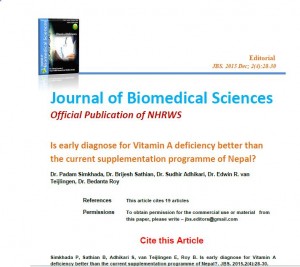
- Simkhada, P., Sathian, B., Adhikari, S., van Teijlingen, E., Roy, B. (2015) Is early diagnose for Vitamin A deficiency better than the current supplementation programme of Nepal? Journal of Biomedical Sciences 2(4):28-30. http://www.nepjol.info/index.php/JBS/index
Mental Health
- Simkhada, P., van Teijlingen E., Winter, R.C., Fanning, C., Dhungel, A., Marahatta S.B. (2015) Why are so many Nepali women killing themselves? A review of key issues Journal of Manmohan Memorial Institute of Health Sciences 4(1): 43-49.
- Simkhada, P.P., van Teijlingen, E., Marahatta, S.B. (2015) Mental health services in Nepal: Is it too late? Journal of Manmohan Memorial Institute of Health Sciences 1(4): 1-2.
- van Teijlingen, E., Simkhada, P., Devkota, B., Fanning, P., Ireland, J., Simkhada, B., Sherchan, L., Silwal, R.C., Pradhan, S., Maharjan, S.K., Maharjan, R.K. (2015) Mental health issues in pregnant women in Nepal. Nepal Journal of Epidemiology 5(3): 499-501. http://www.nepjol.info/index.php/NJE/article/view/13607/11007
Migration / Occupational Health
- Adhikary, P., Keen, S., van Teijlingen, E. (2011) Health Issues among Nepalese migrant workers in the Middle East. Health Science Journal 5: 169-175. hsj.gr/volume5/issue3/532.pdf
- Sapkota, T., Simkhada, P., van Teijlingen, E. (2014) Nepalese health workers’ migration to the United Kingdom: A qualitative study. Health Science Journal 8(1): 57-74.
Other (including: health systems, research methods, capacity building)
- Simkhada, P, Shyangdan, D, van Teijlingen E, Kadel, S, Stephen, J., Gurung, T. (2013) Women’s Knowledge & Attitude towards Disability in Rural Nepal. Disability & Rehabilitation 35(7): 606-613. http://informahealthcare.com/doi/abs/10.3109/09638288.2012.702847
- van Teijlingen, E.R., Simkhada, B, Ireland J, Simkhada P, Bruce J. (2012) Evidence-based health care in Nepal: The importance of systematic reviews, Nepal Journal of Epidemiology 1(4): 114-118.
- Kirkpatrick, P., van Teijlingen E. (2009) Lost in Translation: Reflecting on a Model to Reduce Translation and Interpretation Bias, The Open Nursing Journal, 3(8): 25-32 web address: bentham.org/open/tonursj/openaccess2.htm
- van Teijlingen, E., Simkhada, P., Stephen, J., Simkhada, B., Woodes Rogers, S., Sharma, S. (2012) Making the best use of all resources: developing a health promotion intervention in rural Nepal. Health Renaissance 10(3): 229-235. healthrenaissance.org.np/uploads/7141_24852_1_PB.pdf
- Simkhada, P., van Teijlingen, E., Pokharel, T., Devkota, B., Pathak, R.S. (2013) Research Methods Coverage in Medical & Health Science Curricula in Nepal, Nepal Journal Epidemiology 3(3): 253-258. nepjol.info/index.php/NJE/article/view/9185
- van Teijlingen E.R., Simkhada, P.P. (2012) Ethical approval in developing countries is not optional, Journal of Medical Ethics 38: 428-430.
- Devkota, B., van Teijlingen, E. (2012) “Why did they join?” Exploring the motivation of rebel health workers in Nepal Journal of Conflictology 3(1): 18-29. http://journals.uoc.edu/index.php/journal-of-conflictology/article/viewFile/vol3iss1-joc/vol3iss1-joc
- Simkhada, P., van Teijlingen, E., Devkota, B., Pathak, R.S., Sathian, B. (2014) Accessing research literature: A mixed-method study of academics in Higher Education Institutions in Nepal, Nepal Journal of Epidemiology 4(4): 405-14. nepjol.info/index.php/NJE/article/view/11375
- van Teijlingen, E, Simkhada, P., Wasti, P.P. (2015) Nepal is Changing: Modernisation and Diversity in Healthcare. In: Wasti, S.P., Simkhada, P.P. & van Teijlingen, E. (Eds.) The Dynamics of Health in Nepal, Kathmandu, Nepal: Social Science Baha & Himal Books: 1-15.
- Devkota, B., van Teijlingen, E. (2015) Exploring Rebel Health Services during the Maoist People’s War. In: Wasti, S.P., Simkhada, P.P. & van Teijlingen, E. (Eds.) The Dynamics of Health in Nepal, Kathmandu, Nepal: Social Science Baha & Himal Books: 122-130.
- Devkota, S., Maharjan, H.M., van Teijlingen, E. (2015) Media and Health. In: Wasti, S.P., Simkhada, P.P. & van Teijlingen, E. (Eds.) The Dynamics of Health in Nepal, Kathmandu, Nepal: Social Science Baha & Himal Books: 169-184.
- Simkhada, P., van Teijlingen, E., Wasti, S.P. (2015) Final thoughts. In: Wasti, S.P., Simkhada, P.P. & van Teijlingen, E. (Eds.) The Dynamics of Health in Nepal, Kathmandu, Nepal: Social Science Baha & Himal Books: 222-228.
- Devkota, B., van Teijlingen E. (2007) Basic health as peace dividend in post-conflict Nepal, Journal of HEPASS, 3(1): 21-23.
- Simkhada, P., van Teijlingen, E. (2010) Higher education in Nepal: Several challenges ahead. Diaspora, 3 (1): 44-47.
- Simkhada, P., Baral, Y.R., van Teijlingen E. (2010) Health & Medical Research: A Bibliometric Review, Asia-Pacific Journal of Public Health 22(4): 492-500 web address http://aph.sagepub.com/content/22/4/492.full.pdf+html
- Devkota, B., van Teijlingen E. (2010) Demystifying the Maoist Barefoot Doctors of Nepal, Medicine, Conflict & Survival 26(2): 108-123.
- Devkota, B., van Teijlingen, E. (2010) Understanding effects of armed conflict on health outcomes: the case of Nepal. Conflict & Health 4 (20) http://www.conflictandhealth.com/content/4/1/20
- van Teijlingen E., Simkhada, B., Porter, M., Simkhada, P., Pitchforth, E., Bhatta, P. (2011) Qualitative research methods and its place in health research in Nepal, Kathmandu University Medical Journal 9(4): 301-305.
- van Teijlingen, E., Simkhada, P., Stephen, J. (2013) Doing focus groups in the health field: Some lessons from Nepal, Health Prospect 12(1): 15-17. http://www.nepjol.info/index.php/HPROSPECT/article/view/8722/7111
- Neupane, D., van Teijlingen, E., Khanal, V., Mishra, S.R., Kallestrup, P. (2013) Involving Nepali academics in health research Health Prospect 12 (2): 21-23. http://www.nepjol.info/index.php/HPROSPECT/article/view/9868/8056
- van Teijlingen, E., Ireland, J., Hundley, V., Simkhada, P., Sathian, B. (2014) Finding the right title for your article: Advice for academic authors, Nepal Journal of Epidemiology 4(1): 344-347.
- Devkota, B., van Teijlingen E. (2009) Politicians in Apron: Case study of Rebel Health Services in Nepal, Asia-Pacific Journal of Public Health 21(4): 377-384.
- Simkhada, P., van Teijlingen E., Kadel, S., Stephens, J., Sharma, S., Sharma, M. (2009) Reliability of National Data Sets: Evidence from a Detailed Small Area Study in Rural Kathmandu Valley, Nepal. Asian Journal of Epidemiology 2(2): 44-48.
- Bhatta, P., Simkhada, P., van Teijlingen E., Maybin, S. (2009) A questionnaire study of VSO volunteers: Health risk & problems encountered. Journal of Travel Medicine 16(5): 332-337.
- P., Teijlingen van, E. (2012) Role of Individual Academics & International Universities in Health Research in Nepal (Guest Editorial), Nepal Journal of Epidemiology 2(2): 179-181. http://www.nepjol.info/index.php/NJE/article/view/6572/5364
- van Teijlingen, E., Benoit, C., Bourgeault, I., DeVries, R., Sandall, J., Wrede, S. (2015) Learning from health care in other countries: the prospect of comparative research, Health Prospect 14(1): 8-12. nepjol.info/index.php/HPROSPECT/article/view/13036/10525
- Ireland, J., van Teijlingen, E., Kemp, J. (2015) Twinning in Nepal: the Royal College of Midwives UK and the Midwifery Society of Nepal working in partnership, Journal of Asian Midwives 2 (1): 26-33. http://ecommons.aku.edu/jam/vol2/iss1/5/
- Sharma, S., Joshi, P., van Teijlingen, E. (2015) ‘Nepenglish’ or ‘Nepali English’: A new version of English? Asian Journal of Humanities & Social Sciences 4(2): 188-193. ajssh.leena-luna.co.jp/AJSSHPDFs/Vol.4%282%29/AJSSH2015%284.2-21%29.pdf
- Simkhada, P., van Teijlingen, E., Wasti, S.P., Sathian, B. (2014) Mixed-methods approaches in health research in Nepal (editorial) Nepal Journal of Epidemiology 4(5): 415-416.
- Sharma, A, Tuladhar, G., Dhungel, A., Padmadharini, van Teijlingen, E., Simkhada, P. (2015) Health Promotion: A review of policies and practices in Nepal, Public Health Perpective 5(2): http://phpnepal.org/index.php?listId=941#.VO4Qvn9tXkd
- Simkhada, P., Lee, A., van Teijlingen, E., Karki, P., Neupane, C.H. (2015) Need and importance of health protection training in Nepal, Nepal Journal of Epidemiology (editorial) 5(1): 441-43. nepjol.info/index.php/NJE/article/view/12373/10032
- Pant, P.R., van Teijlingen, E., Simkhada, P. (2015) Importance of public health in low- and middle- income countries. In: Vaidya, K., ed. (2015) Public Health for the Curious: Why Study Public Health? Canberra: The Curious Academic Publishing. ISBN 9781925128581
- Simkhada, P., van Teijlingen, E., Pant, P.R., Sathian, B., Tuladhar, G. (2015) Public Health, Prevention & Health Promotion in Post-Earthquake Nepal, Nepal Journal of Epidemiology 5(2): 462-464. nepjol.info/index.php/NJE/article/view/12826
- Simkhada, P., Regmi, P.R., Pant, P.R., van Teijlingen, E., Sathian, B. (2015) Stipulating citizens’ fundamental right to healthcare: Inference from the Constitution of Federal Republic of Nepal 2015. Nepal Journal of Epidemiology 5(4); 516-517. http://www.nepjol.info/index.php/NJE/article/view/14257/11576
- Regmi, P.R., Aryal, N., Pant, P.R., van Teijlingen, E., Simkhada, P., Devkota, B. (2015) Priority public health interventions and research agendas in post-earthquake Nepal. South East Asia Journal of Public Health 5(2): 7-12. http://www.banglajol.info/index.php/SEAJPH/article/view/28307/18835
- Sahay, G., Devkota, B., van Teijlingen, E.R. (2016) Rebel Health Services in South Asia: Comparing Maoist-led Conflicts in India & Nepal, Sociological Bulletin 65(1):19-39.
- Regmi, P.R., Aryal, N., van Teijlingen, E. (2016) Childbirth in the exam centres in Nepal: An overlooked Public Health issue!, Health Prospect 15(1): 20-21. http://www.nepjol.info/index.php/HPROSPECT/article/view/14745/11954
- van Teijlingen, E., Sathian, B., & Simkhada, P. (2016). Zika & Nepal: a far greater risk for its population than to individuals. Medical Science 4(2): 312-313. http://www.pubmedhouse.com/journals/ms/articles/1064/PMHID1064.pdf

 The Harding and Pritchard paper titled ‘UK and Twenty Comparable Countries GDP-Expenditure on Health 1980-2013: The Historic and Continued Low Priority of UK Health-Related Expenditure’, and published in the













 Verbal autopsy paper published two days ago
 ESRC Studentships for 2027 Entry: Opportunity Now Open
 SONAMONI contributions to Safety Conference 2026 in South Africa
 Three CMWH presentations at Berlin conference
 Horizon Europe Cluster 3 (Civil Security for Society) 2026 Calls Now Open
 MSCA Doctoral Networks 2026 Call Information Webinar
 ESRC Festival of Social Science 2026: Application Deadline Extended to Thursday 25 June 2026
 Reminder: Register for the ESRC Festival of Social Science 2026 Information Session
 ECR Funding Open Call: Research Culture & Community Grant – Apply now
 ERC Advanced Grant 2025 Webinar
 Update on UKRO services
 European research project exploring use of ‘virtual twins’ to better manage metabolic associated fatty liver disease