A series of Fusion Investment Funds since 2013 has enabled Amanda Korstjens and Ross Hill (Department of Life & Environmental Sciences) to develop a multi-stakeholder network in Sumatra and the UK, and establish a multi-cultural learning platform which provides BU staff and students with unique access to research, professional practice and education opportunities in tropical ecology and conservation. This began with an emphasis on primates, however further Fusion Investment Funding over 2015-16 has enabled us to expand this to include the critically endangered Sumatran elephant (Elephas maximus sumatranus), focusing on human-wildlife conflicts and mitigation, and thus broadening the scope, sphere of influence and practical applications of the network and its learning platform.
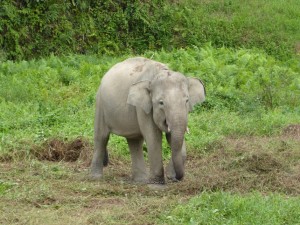
Human-elephant conflict is a major issue in northern Sumatra resulting from habitat loss and fragmentation. A key factor that decides the potential for conservation and for mitigating Human-elephant conflict is the availability of suitable habitat, and therefore it is critical to determine how elephants are responding to the degradation and rapid loss of their habitat. In order to do this, we need to have a better understanding of their home ranging, habitat use patterns and foraging strategies to understand their response to habitat change. We also need to understand the perception and values of local communities, and to identify positive means of providing support to help balance human-elephant relationships. An opportunity related to this is the potential for ecotourism development in the region. Ecotourism is a sustainable, non-invasive form of nature-based tourism that focuses primarily on educative experiences for visitors and direct economic benefit for local people. This FIF funded Staff Mobility Network project involved funding for Ross Hill, Amanda Korstjens and Susanna Curtin to visit Sumatra to establish a new collaborative network for Human-elephant conflict mitigation work, and to publicise our work via workshops and international conferences.
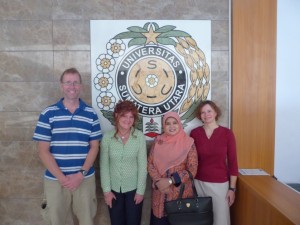
We made a highly successful two-week visit to Indonesia during January 2016. We held meetings with the Head of International Affairs at both Syiah Kuala University in Banda Aceh, and University Sumatra Utara in Medan, to cement institutional relations and start the process of establishing a Memorandum of Agreement between our universities. Such was the level of support and interest from Syiah Kuala University that we also met both the Vice Rector for Academic Affairs (Dr Sofyan) and Rector (Prof Rizal), and after our visit they posted a very positive report on social media (click here).
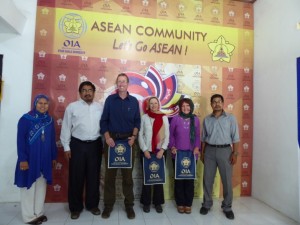
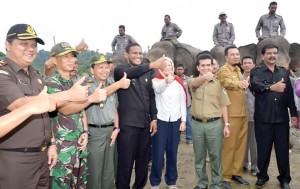
We also visited the regional offices of HAkA (Hutan, Alam dan Lingkungan Aceh) in Langsa, in order to establish a working relationship and research plan for elephant habitat modelling and mitigation of human-elephant conflict. We met with Rudi Putra (Chief Conservationist) and Tezar Pahlevie (Regional Manager) to identify a field site and protocol for elephant tracking by GPS collar, and were invited to attend the opening ceremony of the Conservation Response Unit field site at Serbajadi, Aceh Timor. This was attended by dignitaries including the District (Aceh Timor) and/or Provincial (Aceh) Heads of Forestry, Conservation, Police, Military, Public Prosecution, and the Mayor. This event received considerable local coverage in the media (and through social media), helping to establish BU at the centre of activities and generating considerable good will. We have established this field area as the focal study site for our developing human-elephant conflict project, and our post-doctoral researcher (Gaius Wilson) is there now beginning the process of data collection.
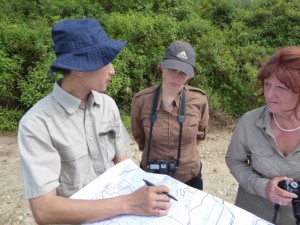
In addition to putting in place the network and working relationships for our elephant project, we also met with our collaborators at the Sumatran Orang-utan Conservation Programme (SOCP), including Ian Singleton (Director of Conservation) and Matthew Nowak (Director of Biodiversity Monitoring) to discuss research plans for our PhD and MRes students. We also made a successful field reconnaissance visit at our Sikundur field site, travelling up the Besilang River into primary rainforest to establish the potential of extending primate research into undisturbed forest. In Medan we visited the SOCP orang-utan quarantine and rehabilitation centre (The Sanctuary), meeting with Jess McKelson, the Quarantine Director and Project Manager of the Orang-utan Haven and Wildlife Conservation Education Centre, establishing possibilities for both research and professional practice student placements.
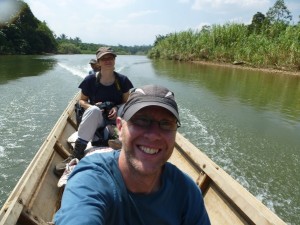
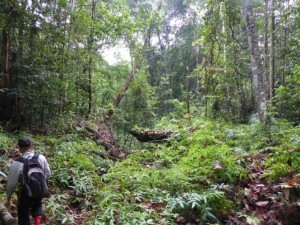
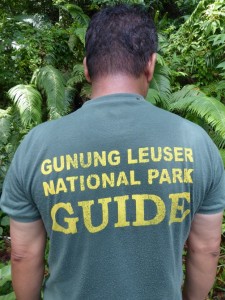
Finally, we also visited the tourist area of Bukit Lawang to experience the role that tourism currently plays in orang-utan conservation to identify possibilities for an eco-tourism approach. We visited key sites and interviewed Zefri Chandra, Operations Manager of the only eco-lodge in the area, to gain an understanding of the difficulties and wider context of fulfilling an eco-tourism ethos in an environment where surrounding lodges and even the visiting foreign tourists do not particularly uphold or value this approach.
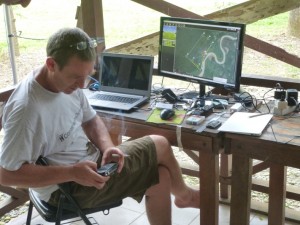
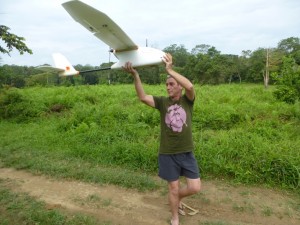
A second successful visit to Sumatra took place during June 2016, with a mostly educational focus, but tying in with the research and conservation practice aims of the learning platform. A previous research blog describes this international field trip (click here). Also during this visit to Sumatra, as a separate activity to the under-graduate field course, I was able to receive training from Graham Usher (SOCP) in the flying and configuration of unmanned aerial vehicles (UAVs) for remote surveying of field sites at a landscape scale. This was part of the two-way knowledge exchange at the heart of the learning platform that this and previous FIF SMN awards have helped to establish.
In order to publicise our conservation research work at Sikundur, Amanda Korstjens attended the joint meeting of the International Primatological Society and the American Society of Primatologists, in Chicago, during August 21-27, 2016. She presented a poster on the LEAP project which was well received. For a brief report on the IPS-ASP conference, click here).
Please contact us if you would like to know any more information about our work in northern Sumatra, relating to primates, elephants, human-wildlife conflict or eco-tourism. Further information can be found on our LEAP project website (http://go-leap.wix.com/home).
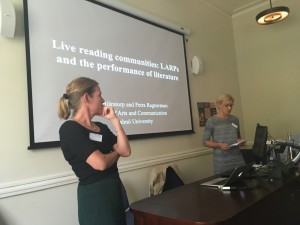
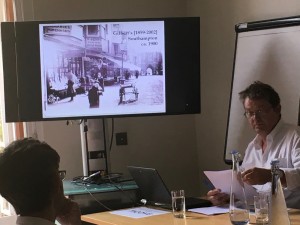
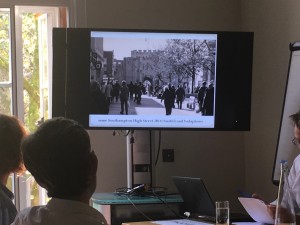


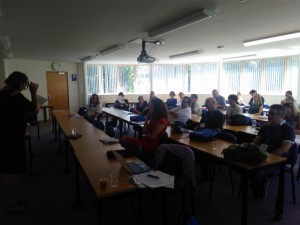
 nd Leisure Education and Research) annual conference which took place in the historic town of Canterbury, between 13-16 September, on “Tourism, Lifestyles and Locations”.
 Uber, Amazon, AirBnB, Netflix… The Internet has had many impacts to the economy. Not only to the consumer market, but widely across the service sector. There is a large amount of integration and automation to enable things like instant order confirmations. Work in these aspects of business processes is quite well established in the service sector.
 aths and many hundreds cases of injuries among Nepalese workers in these countries excluding India. For example, the Foreign Employment Promotion Board of Nepal recently reported that 1002 Nepalese migrant workers died in the 6 GCC countries and Malaysia in the last Nepalese calendar year, of which 357 (36%) were documented as cardiac related. However, in a quarter of deaths, the cause was unknown. Postmortem examination of migrant workers in many destination countries is not carried out and official records of the destination countries tend to record these deaths as being ‘from natural causes’. Information on underlying causes, such as heat stress on construction sites, is often not available.



 Public Health England has launched a









 Verbal autopsy paper published two days ago
 ESRC Studentships for 2027 Entry: Opportunity Now Open
 SONAMONI contributions to Safety Conference 2026 in South Africa
 Three CMWH presentations at Berlin conference
 Horizon Europe Cluster 3 (Civil Security for Society) 2026 Calls Now Open
 MSCA Doctoral Networks 2026 Call Information Webinar
 ESRC Festival of Social Science 2026: Application Deadline Extended to Thursday 25 June 2026
 Reminder: Register for the ESRC Festival of Social Science 2026 Information Session
 ECR Funding Open Call: Research Culture & Community Grant – Apply now
 ERC Advanced Grant 2025 Webinar
 Update on UKRO services
 European research project exploring use of ‘virtual twins’ to better manage metabolic associated fatty liver disease