Industrial Strategy
The Creative Industries Sector Deal has been announced. You can read the document here.
The press release says:
- As part of a Creative Industries Sector Deal, to be announced today by the Digital and Culture Secretary Matt Hancock, Business Secretary Greg Clark and Co-Chair of the CIC, Nicola Mendelsohn, more than £150 million is being jointly invested by government and industry to help cultural and creative businesses across Britain thrive.
- A Cultural Development Fund will also be launched for cities and towns to bid for a share of £20 million to invest in creative and cultural initiatives. The power of culture and creative industries to boost economic growth is evident across the country…[NB Bournemouth is identified as high growth]
- The Sector Deal aims to double Britain’s share of the global creative immersive content market by 2025, which is expected to be worth over £30 billion by 2025. To seize on the opportunity of this expanding market, government is investing over £33 million in immersive technologies such as virtual reality video games, interactive art shows and augmented reality experiences in tourism.
- Britain is already leading the way in developing immersive technologies. PWC has predicted that the UK’s virtual reality industry will grow at a faster rate than any other entertainment and media industry between 2016 to 2021, reaching £801 million in value, and that by 2021 there will be 16 million virtual reality headsets in use in the UK.
- Improving the nations skills is at the heart of the government’s modern Industrial Strategy and to ensure the industry has the skilled workers it needs to deliver this, up to £2 million will be made available to kickstart an industry-led skills package, including a creative careers programme which will reach at least 2,000 schools and 600,000 pupils in 2 years. A new London Screen Academy, with places for up to 1000 students, will also open in 2019.
New Quality Code published
After a consultation proposing changes to the UK Quality Code for HE, (you can read BU’s response here) the QAA have published the new, very short Code. There’s some commentary on Wonkhe here. It really is short – in a 7 page document there is only one real page of content – but there is more guidance to come.
HE Review
To inform our BU response to the HE Review all staff and students are invited to consider the issues in this (anonymous) 5-minute survey. Please take a look at the survey questions as we’d like to hear from as many staff and students as possible. You don’t have to answer all the questions! The major review of HE will shape the HE system, including how universities are funded for years to come. The survey will be available to staff and students until Friday 20th April.
The Department for Education also published a research report by Youthsight on the influence of finance on higher education decision making
Amongst its findings:
- University was the only option considered by the majority of applicants (75 per cent), especially those applying to the higher-tariff universities (78 per cent). This was consistent across socio-economic backgrounds. Getting a job and travelling were the main alternatives considered by applicants
- Financial factors were not the biggest influence on the final decision to apply to university. The most important factors were the desires to be more employable, to achieve the qualification and to pursue an interest in a subject. This was the case for applicants from both the higher and the lower socio-economic groups.
- Lower socio-economic group applicants placed a higher importance on grants, bursaries and living costs than applicants from higher socio-economic groups, although finance still remained a secondary influence on their decision to apply to university.
- The course offered (82 per cent of applicants), university reputation (58 per cent), and potential for high future earnings (41 per cent) were the most commonly cited major influences on applicants’ choices about where to study.
- Differences in bursaries offered, tuition fees charged and the ability to continue living at home were secondary factors when choosing where to study. These factors accounted for three of the bottom four of eleven factors tested that might influence which university to choose. However, they were more important for lower socio-economic group applicants.
- The maintenance loan, repayment threshold and particularly maintenance grants and university assistance were more important to members of the lower socio-economic group than the higher socio-economic group in alleviating cost concerns.
And the government have published the outcomes of their 2014/15 student income and expenditure survey. There is a lot of data and there are lots of interesting charts, including figure 2.6 (the influence of financial support on my decisions), table 3.7 (what support English domiciled students received by mode of study), figure 4.3 (breakdown of total student expenditure (this one excludes the tuition fee but there is also a chart that includes it), figure 4.4 (total expenditure and housing costs).
The data from both these reports will be pored over to support responses to the HE review.
Freedom of speech
The Joint Committee on Human Rights has published its report into free speech in universities. The Committee has also published its own guidance for universities and students:
Charity Commission Response: Charity Commission responds to Joint Committee on Human Rights
The Committee don’t identify many actual cases of free speech having been prevented but note a “chilling effect” (it’s hard to prove a negative, of course). The report identifies factors that potentially limit free speech in universities:
- regulatory complexity
- intolerant attitudes, often incorrectly using the banner of “no-platforming” and “safe-space” policies
- incidents of unacceptable intimidating behaviour by protestors intent on preventing free speech and debate
- student Unions being overly cautious for fear of breaking the rules
- unnecessary bureaucracy imposed on those organising events
- fear and confusion over what the Prevent Duty entails
- unduly complicated and cautious guidance from the Charity Commission.
Recommendations
- That an independent review of the Prevent policy is necessary to assess what impact it is having on students and free speech, after evidence the Committee took demonstrated an adverse effect on events with student faith groups
- That the Charity Commission, which regulates student unions as registered charities, review its approach and guidance, and that its actions are proportionate and are adequately explained to student unions and don’t unnecessarily limit free speech
- That the Office for Students should ensure university policies proactively secure lawful free speech and are not overly burdensome
- That student societies should not stop other student societies from holding their meetings. They have the right to protest but must not seek to stop events entirely
- That while there must be opportunities for genuinely sensitive discussions, and that the whole of the university cannot be a “safe space.” Universities must be places where open debate can take place so that students can develop their own opinions on unpopular, controversial or provocative ideas
- Groups or individuals holding unpopular opinions which are within the law should not be shut down nor be subject to undue additional scrutiny by student unions or universities.
Chair of the Committee, Harriet Harman MP, said:
- “Freedom of speech within the law should mean just that – and it is vital in universities. Evidence to the Joint Committee on Human Rights showed that there is a problem of inhibition of free speech in universities. While media reporting has focussed on students inhibiting free speech – and in our report we urge universities to take action to prevent that – free speech is also inhibited by university bureaucracy and restrictive guidance from the Charity Commission. We want students themselves to know their rights to free speech and that’s why we’ve issued a guide for students today.”
Some particular points to note:
- 41 The imposition of unreasonable conditions is an interference on free speech rights. We do not, for example, consider it a reasonable condition that, if a speaker gives an assurance that their speech will be lawful, they be required to submit a copy or outline of their speech in advance.
- 42 In our view, freedom of expression is unduly interfered with:
- when protests become so disruptive that they prevent the speakers from speaking or intimidate those attending;
- if student groups are unable to invite speakers purely because other groups protest and oppose their appearance; and
- if students are deterred from inviting speakers by complicated processes and bureaucratic procedures.
It is clear that, although not widespread, all these problems do occur and they should not be tolerated.
- 60 Whilst there must be opportunities for genuinely sensitive and confidential discussions in university settings, and whilst the original intention behind safe space policies may have been to ensure that minority or vulnerable groups can feel secure, in practice the concept of safe spaces has proved problematic, often marginalising the views of minority groups. They need to co-exist with and respect free speech. They cannot cover the whole of the university or university life without impinging on rights to free speech under Article 10. When that happens, people are moving from the need to have a “safe space” to seeking to prevent the free speech of those whose views they disagree with. Minority groups or individuals holding unpopular opinions which are within the law should not be shut down nor be subject to undue additional scrutiny by student unions or universities.
- 91 Universities must strike a balance to ensure they respect both their legal duty to protect free speech and their other legal duties to ensure that speech is lawful, to comply with equalities legislation and to safeguard students. It is clearly easier to achieve this if debate is carried out in a respectful and open way. But the right to free speech goes beyond this, and universities need to give it proper emphasis. Indeed, unless it is clearly understood that those exercising their rights to free speech within the law will not be shut down, there will be no incentive for their opponents to engage them in the debate and therefore to bring the challenge that is needed to develop mutual understanding and maybe even to change attitudes.
- 93 It is reasonable for there to be some basic processes in place so that student unions and universities know about external speakers. Codes of practice on freedom of speech should facilitate freedom of speech, as was their original purpose, and not unduly restrict it. Universities should not surround requests for external speaker meetings with undue bureaucracy. Nor should unreasonable conditions be imposed by universities or student unions on external speakers, such as a requirement to submit their speeches in advance, if they give an assurance these will be lawful.
Migration Advisory Committee report on EEA and non EEA workers
The Migration Advisory Committee (MAC) has published its interim update on the impact of EEA and non-EEA workers in UK labour market. This is the first MAC inquiry of two – the second one is the one about students, this was more general and about workers across all sectors.
The update sets out a summary of the views expressed by employers and of the regional issues raised. They add that “these themes seem the best way of summarising the views expressed to us but should not be taken to imply that the MAC endorses a sectoral and/or regional approach to post-Brexit migration policy.” The MAC has also published the responses to their call for evidence, broken down by sector.
The report includes the following findings:
- The vast majority of employers do not deliberately seek to fill vacancies with migrant workers. They seek the best available candidate.
- Employers often reported skill shortages as one reason for employing EEA migrants.
- Many EEA workers are in jobs requiring a high level of skill that take years to acquire. But, some of the claims about necessary skill levels seemed exaggerated.
- Within occupations, EEA migrants are better educated than their UK-born counterparts.
- The MAC view is that, from the economic perspective this does amount to saying that it is sometimes possible to hire a given quality of worker for lower wages if they are an EEA migrant than if they are UK-born.
- To the extent that EEA migrants are paid lower wages than the UK-born this may result in lower prices, benefitting UK consumers. Our final report will also consider these possible impacts.
- Many responses argued that a more restrictive migration policy would lead to large numbers of unfilled vacancies. The MAC view is that this is unlikely in anything other than the short-term.
- The MAC view is that it is important to be clear about what the consequences of restricting migration would be.
Research bodies update
This week is the launch of UKRI – it is worth looking at their objectives.
.The Council for Innovate UK has been announced. The members are:
- Sir Harpal Kumar, who will serve as Senior Independent Member through his role as UK Research and Innovation’s Innovation Champion and work closely with the board
- Dr Arnab Basu MBE, Chief Executive, Kromek Group plc
- Baroness Brown of Cambridge DBE FREng FRS (Julia King)
- Professor Juliet Davenport OBE, Chief Executive, Good Energy
- Dr John Fingleton, Chief Executive, Fingleton Associates
- Priya Guha, Ecosystem General Manager, RocketSpace UK
- Dr Elaine Jones, Vice President, Pfizer Ventures
- Professor John Latham, Vice-Chancellor of Coventry University
- Sir William Sargent, Chief Executive, Framestore
- Stephen Welton, Chief Executive, Business Growth Fund
The REF panels have also been announced – follow this link to see the lists.
Parliamentary Questions
Q Andrew Percy MP
To ask the Secretary of State for Education, whether his Department is taking steps to ensure that prospective undergraduates understand the potential effect of their choice of course on their prospects post-graduation.
- A Sam Gyimah MP The department is working to make destinations and outcomes data more accessible to prospective students, to help them compare opportunities and make informed choices about where and what to study.
- On the 12 March 2018, I announced an Open Data Competition. It will use government data on higher education providers so that tech companies and coders can create websites to help prospective students decide where to apply. This competition will build on the government’s Longitudinal Educational Outcomes (LEO) dataset, which gives information on employment and salaries after graduation.
- Alongside this, my right hon. Friend, the Secretary of State has requested that the Office for Students include LEO data on the Unistats website as soon as possible.
Q Angela Rayner MP To ask the Secretary of State for Education, what estimate his Department has made of the value of plan 1 student loans that will not be repaid.
- A: Sam Gyimah MP: It is estimated that the value of the plan 1 student loan book that will not be repaid was £13.1 billion as at 31 March 2017, when future repayments are valued in present terms. The face value of the plan 1 student loan book was £42.8 billion at this time. This information is in the public domain and published on page 155 of the Department for Education’s 2016-17 Annual Report and Accounts which can be found at:
- https://www.gov.uk/government/publications/dfe-consolidated-annual-report-and-accounts-2016-to-2017.
Q Angela Rayner MP: To ask the Secretary of State for Education, with reference to the written ministerial statement of 31 October 2017 on government asset sale, HCWS205, what methodology his Department used to decide which loans from the plan 1 loan book would be sold.
- A Sam Gyimah MP: The loans sold in December 2017 were a selection of loans from the plan 1 loan book issued by English Local Authorities that entered repayment between 2002 and 2006.
- These loans had the longest history of repayments, the longest servicing history and the most accurate data on borrowers’ historic earnings. This information allowed the government to most accurately value these loans for sale.
- The government’s objective when issuing loans to students is to allow them to pursue their education regardless of their personal financial situation. Once this objective has been met, however, retaining the loans on the government’s balance sheet serves no policy purpose. These loans could be sold precisely because they have achieved their original policy objective of supporting students to access higher education.
- Pursuant to Section 4 of the Sale of Student Loans Act 2008, a report on the sale arrangements was deposited in the House libraries on 7 December 2017 (deposit reference DEP2017-0778): https://www.parliament.uk/depositedpapers.
Q: Angela Rayner MP: To ask the Secretary of State for Education, with reference to the written statement of 6 December 2017 on Government Asset Sake, HCWS317, what assessment he has made of the net fiscal effect of the sale of the student loan book after accounting for reduced income arising from lost repayments.
- A: Sam Gyimah MP: The government only sells assets when it can secure value for money for taxpayers from doing so. In assessing the value for money of the sale, the government took into account repayments foregone on the loans sold. In executing the sale, we achieved a price that exceeded the retention value of the loans sold, calculated in line with standard HM Treasury green book methodology.
- Selling financial assets, like student loans, where there is no policy reason to retain them, where value for money can be secured and where borrowers are not impacted is sound asset management. The sale ensures government resources are being put to best use and is an important part of our plan to repair public finances.
- Pursuant to Section 4 of the Sale of Student Loans Act 2008, a report on the sale arrangements was deposited in the House libraries on 7 December 2017 (deposit reference DEP2017-0778): https://www.parliament.uk/depositedpapers.
Subscribe!
To subscribe to the weekly policy update simply email policy@bournemouth.ac.uk
JANE FORSTER | SARAH CARTER
Policy Advisor Policy & Public Affairs Officer
Follow: @PolicyBU on Twitter | policy@bournemouth.ac.uk
 Will you be applying to the Acorn Fund (Acceleration Of Research & Networking) for Early Career Researchers?
 The UKRI Future Leaders Fellowship scheme (FLF) aims to develop, retain, attract and sustain research and innovation talent in the UK. Providing up to seven years of funding, for at least 550 early-career researchers and innovators, the scheme will tackle difficult and novel challenges.


 Every BU academic has a
 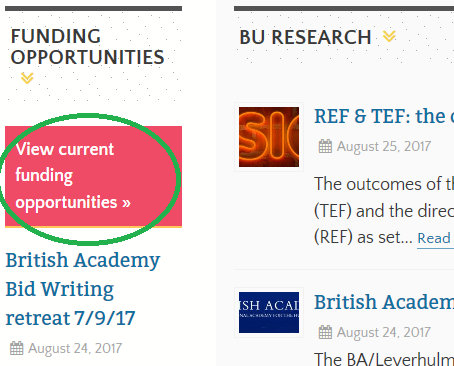 By clicking on this box, on the left of the Research Blog home page just under the text ‘Funding Opportunities‘, you access a






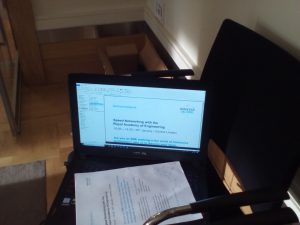 Proposers – Siemens, Deloitte, European Space Agency, Jaguar Land Rover and Reed Smith. The Proposers list their challenges and organisations (about 30 reps attended) apply to pitch their ideas to each Proposer. The Proposers are set up in 5 tables and each organisation is given 5 minutes to present. The Hostess rings a bell and they have to move on to the next Proposer.
 Have you noticed this box on the BU Research Blog?

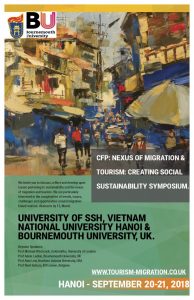







 National Research Supervision Recognition: Apply Now & Join the Supporting Workshop on 16 September
 3C Event: ECR Network Café – Wednesday 16 September 2-3pm
 BU geography student’s undergraduate dissertation published in international journal
 Why some commons survive and others don’t
 BU Research blog in 2023 grows into 2026 publication
 Horizon Europe Cluster 3 (Civil Security for Society) 2026 Calls Now Open
 MSCA Doctoral Networks 2026 Call Information Webinar
 ESRC Festival of Social Science 2026: Application Deadline Extended to Thursday 25 June 2026
 Reminder: Register for the ESRC Festival of Social Science 2026 Information Session
 ECR Funding Open Call: Research Culture & Community Grant – Apply now
 ERC Advanced Grant 2025 Webinar
 Update on UKRO services
 European research project exploring use of ‘virtual twins’ to better manage metabolic associated fatty liver disease