We’re still in the mid-June lull before the July storm we mentioned last week, however, the Skills and Post-16 Bill was debated at length in the Lords with disgruntlement over the lack of substance and missing details. Lord Storey’s Essay Mills Bill has a twin introduced by Chris Skidmore in the Commons. TEF awards have been extended, but are so out of date for some (most) institutions that the OfS has told the HE sector to stop promoting their awards. And Horizon Europe opened for business alongside Committee concern that the Government’s Horizon commitment is more mothballs than moolah.
Skills and Post-16 Education Bill
We have a summary of the Second Reading debate within Parliament on the Skills and Post-16 Education Bill here. It was a long (6 hour) session so look out for the bold type in the summary where we highlight the most interesting points. In brief influential points were made in relation to:
- Questions about the role of local skills plans within the Bill and their interaction with a wider range of training providers other than FE colleges
- Loan funding (and funding cuts) being part of the reason for the decline in adult learning
- The Bill shouldn’t separate creative subjects and the humanities from technical subjects and the sciences.
- Caution about how modular learning connects together in practice.
- Careers advice and support including regular face to face support. It was also noted that careers hubs were included in the White Paper but do not feature in the Bill.
- Calls for the lifetime skills guarantee to be made law with automatic funding rights.
- Calls to limit apprenticeship funding for those aged over 25 to a quarter of the total pot.
- Criticism that while the Bill was aspirational, the Government have not provided detail on the funding, nor long term commitments.
Wonkhe contemplate the discussion in this blog: Peers wanted to discuss policy, but had to debate a skeletal bill. The blog highlights some important points:
- David Willetts [former Universities minister] referred to an “artificial conflict” between vocational and academic sectors, noting that there were many universities that have more than 70 per cent of their students studying work-linked courses that met standards and requirements set by professional bodies and employers.
- Jo Johnson [former Universities minister]… cautioned against the likely attempts to limit access to creative courses – which would “starve the supply of talent” to a range of economically and socially important employment sectors because of a preference for other sectors that offered higher salaries.
- …Tellingly, Johnson described the Treasury habit of assessing educational value by loan repayment rates as “reductive”, but few expected him to take aim at a “bewildering” range of regulatory bodies with responsibilities in post-16 education. Having given life to the beleaguered Office for Students, he seemed surprisingly keen to bring about a single – joined up – regulator.
- On the crucial ‘local’ aspect: What’s curious (especially post-Covid when we are all statistical and administrative geography nerds…) is that “local” will be self-defined – the vision seems to be that groups will spontaneously form and apply to the Secretary of State for approval. The expectation is that bodies active in that local area (mayoral authorities, councils, LEPs…) would be involved.
Wonkhe summarise the overall feel of the outcome well: It is clear that we shall see a number of amendments at committee – Mike Watson noted these might include bringing other stakeholders into the “employer centred” LSIP process, and limiting some of the powers given to central government to control what is taught and where. Aims were welcomed, detail was sought.
Wonkhe also commented that pushback can be expected at further stages of the parliamentary process on the sheer scale of powers over provision centralised around the Secretary of State. They also tell us that Politics.co.uk has an opinion piece arguing that inconsistencies and exceptions in the Higher Education (Freedom of Speech) Bill could grant space for extremists to thrive.
The debate triggered several media pieces on highlighting the Government’s key messaging around the Bill. A Prospects opinion piece is anti-HE expansion, pro-apprenticeship, and argues that successful arts graduates have failed as they could have earned more studying something else. The article continues along the current Government party line:
- the rapid expansion of creative courses in recent decades is one of the main reasons why more than three-quarters of students will now never fully pay back their student loans, leaving the Treasury with an expected write off of taxpayer liabilities worth £28.8bn in 2049-50, according to current forecasts.
- Of course, higher earnings are not the only reason why people study and creative arts courses offer society much more than just an economic dividend. This is particularly true in a place like Falmouth… that produced some of the best British artists of the last century. But it did so well before it converted to university status and sextupled the size of its student body compared to 1990s levels. The mistake is to think that artistic endeavour, or a whole other panoply of vocational pursuits, are best served through university expansion and funded by debt.
One wonders if the same arguments about value for money will be made once degree apprenticeships attract the same debt as a standard undergraduate degree.
THE also covered this angle in Local people: In the UK, Conservative MPs’ backing for new universities in their areas, despite Tory criticism of expansion at national level, has been seen as affirming that higher education must stress its local economic impact if it wants to build a “common dialogue” with the governing party.
Funding: Last Friday Gavin Williamson announced funding aimed for adults to access more, high-quality alternatives to university degrees under new measures to boost the nation’s skills and job prospects. He confirmed £18 million new Growth Funding for FE & HE – providers bid for funding for equipment and to develop business links leading to skills training in certain sectors.
Tied in with the announcement are the previously announced £10 million for Institutes of Technology and £2 million of modular training aimed at future skills gaps. Overall the three funds try to jump start higher technical skills training for adults. Some of the sector rhetoric around the announcements talk of diverting students away from degrees and into higher technical provision, however, Nick Hillman, Director of HEPI, suggests the Government needs to focus on the capable adults that did not progress beyond level 3.
UUK said: Expanding higher technical courses is a positive move which will increase choice for learners of all ages and help employers meet their skills needs as the nation looks to rebuild from the impact of COVID-19. Universities have been involved with developing these qualifications and many universities are ready to scale up their alternatives to the traditional three-year degree. UUK is working closely with government, employers and local partners to help make these qualifications a success.
Engineering Recommendations for local agenda: The Institution of Engineering and Technology have published Addressing the STEM skills shortage challenge exploring the ways local authorities can help train and equip people with the skills their region needs.
Their recommendations which are most relevant to HE are:
- UK Government should work more closely with the higher education sector and training providers to ensure funding is allocated on the quality of courses available, not the quantity of students on each course.
- Local authorities should initiate discussions between academic institutions and industry to ensure the right skills and training are available for adoption of new technologies as they emerge.
- Local authorities should take a lead in encouraging a diverse mix of people into the profession through locally targeted schemes.
- Professional engineering institutions (PEIs) and industry bodies should work with local government to ensure there’s a wider and updated provision of careers advice, particularly around engineering. This should include information on the variety of routes into engineering, such as vocational study.
Parliamentary Question: STEM skills shortages
Research and knowledge exchange
Business value and performance: At the end of last week HESA published data showing how HEIs interacted with business and the wider community in 2019/20. Including:
- business and community services
- social, community and cultural engagement
- intellectual property, start-ups and spin offs
- regeneration and development
- strategies, approaches and infrastructures
You can see how BU performed compared nationally and within the south west region.
And this week the National centre for Universities and Business found that universities’ interaction and engagement with business and external partners grew despite the pandemic (Aug 2019 to Jul 2020).
- UK university income from interactions rose compared to the previous year, totalling £5.2 billion
- 3067 patents were granted – up by 14.6% from 2018-19
- 16505 licenses were granted – up by 29.8% from 2018-19
- 174 newly registered spinouts – up by 4.2% from 2018-19
However, University income from knowledge exchange activities with businesses fell compared to the previous year to £909m
Dr Joe Marshall, Chief Executive of NCUB, said:
- The new HE-BCI survey results released today show that despite the challenges caused by the Covid-19 pandemic, universities’ have put significant effort into supporting and maintaining their partnerships with their communities and businesses. They have also continued to boost their research commercialisation activities. Across a range of indicators, universities have ramped up activity and engagement in a clear sign of their centrality in combatting the crisis and leading recovery.
- Though the survey results showcase the resilience shown by universities and their important contribution to the economy and society, there are still challenges ahead. Universities did report declines in their interaction with both large businesses and SME’s in 2019-20, almost certainly driven by the pandemic. This is concerning, as university-business interaction is key to economy recovery, to keeping the UK competitive in global markets and to meeting decarbonisation and health-related goals. Experience from the 2008 recession shows that nations that invest in R&D are able to boost productivity, improve livelihoods, and drive forward economic recovery. To help build back better, now is the time for Government, businesses and universities to invest in, not away from, collaboration, research and innovation.
Quick News
KEF: UKRI presented at a recent Universities Policy Engagement Network event on KEF: What next? If you missed the event you can view the slide deck here.
Horizon Europe applications opened. Meanwhile the Commons European Scrutiny Committee has highlighted a £14 billion gap in funding for the UK’s contribution to the Horizon Europe research funding programme. Questions had been raised by the Committee to Amanda Solloway…[who] estimates…the up-front cost of the pan-European fund to the Treasury to be £15bn over the seven-year programme. The programme will then invest the majority of this back into UK science projects. However, the report found that just £1bn of this has so far been committed following correspondence with Ms Solloway.
At the G7 the UK and America agreed to strengthen collaboration in science and technology through a new partnerships and a new era of strategic cooperation in the field:
- The partnership will explore a number of areas for cooperation including research, innovation and commercialisation; defence, security, law enforcement and intelligence; and making sure technology is used as a force for good around the world. Officials from both countries will work to develop the partnership over the course of the next year.
- It aims to strengthen cooperation in areas such as the resilience and security of critical supply chains, battery technologies, and emerging technologies including artificial intelligence (AI) and to improve the accessibility and flow of data to support economic growth, public safety and scientific and technological progress.
- It will see the countries work towards a new statement of intent to help realise the full potential of quantum technologies, which use the properties of quantum physics to dramatically improve the functionality and performance of devices, develop proposals on future technology such as 6G and strengthen collaboration on digital technical standards.
- The two nations have also committed to continue to broaden collaboration on science and technology to help facilitate world-class research and influence the rules, norms and standards governing technology and the digital economy.
Former universities minister, Chris Skidmore, writes for conservative home: To keep up with our G7 colleagues, we must increase our spending on innovation and research. The success of “Global Britain” now depends on matching countries that have transformed their economies towards innovation and research. I would now go further— and suggest if we wish to keep up with our G7 colleagues, the forthcoming Innovation Strategy should set a definite timetable for three per cent, and beyond to 3.5 per cent of GDP being spent on R&D. To fail to achieve this in contrast to the other major world economies be setting ourselves up to fail.
Cutting the aid budget is still news. Polling company Savanta ComRes reveal public perception showing support for the cuts.
Click into this link to view the chart more easily.
Parliamentary Questions
- Not much more detail on the £20 million for ECRs
- Artificial Intelligence intellectual property
Admissions
Research Professional’s Sunday reading discusses tracking the CAG cohort. The CAG cohort are the subgroup of home undergraduate applicants for 2020 entry who only secured places at their firm choice institutions after the algorithmic adjustment (which originally had them missing their grades) was removed.
- …tracking the CAG cohort might help inform future debates about merit and fair admissions. We believe that the CAG cohort provides a unique opportunity to test the robustness of algorithmically adjusted grades versus those determined through centre assessments and, consequently, to provide insights into higher education’s admissions practices and decisions.
- institutions are well positioned to monitor the CAG cohort relative to the ‘mainstream’ cohort, to enable a better understanding of the extent to which A-level grades—both the initial algorithmically adjusted and subsequent CAG-only ones—are proving to be a good predictor of students’ ability to succeed and thrive in their ‘firm choice’ institution.
- We should also gain insights into the impact that these late admissions decisions had on applicants’ emotional connection to the institutions to which they had applied, visited and perhaps prepared to attend and, ultimately, how this might have affected their sense of belonging. And we will develop a better understanding of what additional support—if any—has been or will be required for this cohort to succeed.
- As always—and particularly during the pandemic and beyond—a multitude of factors will contribute to the student experience, retention and success, but might it be possible to isolate the impact of factors associated with entry grades and context? While the complexities involved may mean that any conclusions are tentative and nuanced, tracking the experience and outcomes of the CAG cohort has the potential to inform the evolution of fair admissions to higher education.
- Should the prospect of a minimum tariff entry standard re-emerge…then there is an even greater imperative to assure ourselves, our applicants and the wider public that, in the light of emerging evidence, these well-established practices remain fit for purpose.
Contract Cheating – Essay Mills
You’ll be aware that Lord Storey continues his crusade to ban essay mills in his latest Private Member’s Bill on the Lords. His Bill is scheduled for a second reading (a debate) next week. Chris Skidmore (former universities minister) has introduced his own private members bill on the topic. It has raised the profile of the issue but the Bill is last in a very long queue for parliamentary time (and PMBs in the either the Lords or the Commons rarely make it into law).
The volume of PMBs on this topic over the years is interesting as they have provided several opportunities for the Government to support the ban on essay mills. Moreover, the Higher Education and Research Act was an ideal opportunity to change the law incorporating it within the wider changes for the HE sector and legislative amendments were proposed to this effect. However the Government repeatedly stated they’d prefer a non-legislative route (tasking QAA and NUS to tackle it including providing guidance). Given the Government’s focus on quality of teaching and education and on value for money it is a little surprising they don’t seem willing to take a stronger stance. The House of Lords Library have produced a briefing note on essay mills to inform the debate. It is an excellent paper and contains the history and key points in short form. Give it a read if you want to understand or catch up on this topic.
We remind you in this context of a Paul Greatrix blog from March for Wonkhe on banning essay mills – it’s time to act and has interesting content on how the legal ban in Australia has worked. It is a good quick read, and the comments to the article are a must.
Times Higher Education has an article – Monopoly fears: The UK’s competition regulator is to investigate Turnitin’s proposal to buy out its last major rival in global academic integrity services.
Access & Participation
Outreach: NEON published The outlook for outreach stating that from 2022-23 the total invested in activities to support those from disadvantaged backgrounds to enter HE will fall unless there is continued funding provided for the national Uni-Connect programme. They also highlight few HE institution’s APP contain specific targets for certain underrepresented groups and comments on the lack of collaboration between providers for shared targets. The NEON press release contains a short summary.
Social disadvantage impact on educational outcomes: The Centre for Progressive Policy published Re-examination Expanding educational opportunities for every child stating it maps the ways in which social disadvantage affects educational outcomes among children and young people, impacting their progression through the education system and ultimately their employment prospects.
- Students from disadvantaged backgrounds are nearly twice as likely to fail to achieve a level 4 in their maths and/or English GCSE compared to students from non-disadvantaged backgrounds.
- 38% of those from non-disadvantaged backgrounds continue into higher education (HE), while only 25% of those from disadvantaged backgrounds will do the same.
- 58% of students with low prior attainment at GCSE will continue into a further education (FE) college or other FE provider, where funding fell by 24.5% between 2010/11 and 2018/19.
You can read more and explore further charts here.
Mental Health
UCAS published the student mental health report Starting the Conversation stating there is still more work to do to smash the myths and stigma around mental health, and to highlight the support available to students in higher education.
- 250% increase in the number of applicants who report their mental health condition to UCAS. (3.7% of all UK applicants declared a mental health condition in their application to study in 2020 – up from 0.7% in 2011.)
- Despite the above increase UCAS estimates that over 70,000 students may enter HE every year with a mental health condition, but 49% do not disclose this.
- UCAS suggests a common reason students do not disclose is due to a lack of understanding about what the data will be used for, and the belief it will impact on their chances of receiving a university offer.
- UCAS are keen to promote positive disclosure and highlight OfS information which finds students with mental health conditions tend to have lower rates of continuation, attainment, and progression into skilled work or further study.
- Women are 2.2 times more likely to declare a mental health condition than men.
- Alongside engineering, medicine and dentistry courses have the lowest declaration rates with only 1.4% of accepted applicants sharing an existing mental health condition.
- Some LGBT+ students are around six times more likely to share a mental health condition, and care experienced students are almost three times as likely. UCAS state this underlines the value of recognising how mental health intersects with other characteristics and support needs.
- One in five students research support specifically for an existing mental health condition before they apply, and more than one in four look at the provision of general mental health and wellbeing service.
UCAS sets out next steps in fostering an environment of positive disclosure in the report.
- A joined-up, cross-sector communications campaign to unify messaging – to promote the benefits of declaring a mental health condition, create a culture of positive disclosure, align terminology, and address lingering misconceptions and knowledge gaps.
- Targeted action in subject areas with low declaration rates to reassure students that sharing a mental health condition will not affect their chances of receiving an offer. Particular emphasis should be given to medicine and dentistry courses so students feel confident that sharing this information will not have implications for their fitness to practise requirements.
- Continued implementation of the Stepchange framework and the University Mental Health Charter in universities and colleges, with UCAS to develop good practice in collaboration with Universities UK and HELOA to support this work.
- Student mental health to be a key consideration in discussions around admissions reform – UCAS’ proposed variation of the post-qualification offer model would allow for the early transfer of information, give the student time to develop a trusting relationship with the university or college, and start the conversation about support ahead of transition.
Work UCAS is undertaking:
- Reviewing how UCAS collects information about a student’s mental and/or physical health conditions and other support needs, including ongoing collaboration with sector bodies and expert organisations.
- Implementing additional fields in the applications (e.g. caring responsibilities, estrangement) to facilitate a greater understanding of students’ support needs, and how these may intersect with mental health.
- Improving fluidity in the UCAS application to allow students to share information at any point during their application journey.
- Enabling students to select multiple impairments and conditions so they can provide universities and colleges with more accurate and meaningful information about their support needs.
- UCAS to undertake further research in 2022 to understand the experiences of students who follow different routes for sharing information regarding their mental health
Rosie Tressler, CEO of Student Minds, said:
- Once you’re at university or college, asking for help with your mental health needs to feel as simple as saying you’re trying to find the right book in the library. We know that universities and colleges are working towards comprehensive whole-institution approaches to mental health, which will support and enable disclosure of health conditions at any and every stage of the student journey.
- The more our future students see how ingrained a mental health and wellbeing strategy is within and across an institution, the more confident they will feel that they are entering an inclusive environment that celebrates difference as a strength.
- I’m encouraged that our sector is heading in the direction in which this is the reality for all. This long-term investment is crucial especially as we know that many challenges will have been exacerbated by and will outlast the pandemic. For any student that is looking for support through this difficult period, we encourage you to visit our Student Space, where you can find out about the services at your institution, access guidance and a range of services.
Wonkhe have blogs on the topic:
- The gap between those suffering from mental health problems and those declaring it is still too large, says Clare Marchant.
- David Kernohan talks a lot of sense in What should we take from new figures on student mental health? He tackles the criticism levelled at the sector about why university students wellbeing ratings are below that of the wider population:
- …So, if you took a sample of young (largely female) humans who are not (yet) educated to degree level; and then put them in rented accommodation where they felt lonely and isolated, and then ensured they had limited earning and spending power – you would expect to find a lot of people with depressive symptoms. And you do.
- I make this point at length to emphasise that higher education itself is unlikely to be the problem – the demographics and living conditions of those studying in higher education are all massive risk factors. And this is why it is essential we get students to share underlying problems…as soon as possible – ideally at the application stage.
Mental health is also touched upon in the ONS recent data below.
Covid
2021/22 students: Many Covid questions about the 2021/22 academic year remain unanswered however Research Professional meander through the key points in So close, far away tackling what the start of term may look like, whether students will be vaccinated, the chaos that might ensue relating to students received the second jab in a different location, the start of term migration, and speculating what the Government may have in mind.
After the PM bungled his response to a question on student vaccination at the big press conference on Monday (asked about students getting two jabs in time for next term, he didn’t seem to have any idea, despite having just announced that all over 18s will have had one jab by 19th July, which would seem to be a good start, and was the response in fact provided by Sir Patrick Vallance). Anyway, 18 year olds can now book that first jab. And the PM, perhaps stung by accusations that he is ignoring the young, has taken to youtube (radical) instead. Wonkhe’s Jim Dickinson has a take here:
MPs protesting about Covid restrictions: A familiar set of Dorset MPs are amongst those continuing to rebel against the latest Covid restrictions. Conservative Home note that [at 49] “That’s the biggest Covid rebellion since December 2, when 53 Tory backbenchers opposed the tiering plan. The number of those who would vote against a further extension would almost certainly rise.”
Research Professional delve a little deeper in university finances amongst the turbulence of the pandemic: Till debt do us part.
The Office for National Statistics published the latest experimental statistics from the Student Covid-19 Insights Survey (the impact of coronavirus on HE students) for the period 24 May to 2 June 2021.
- 29% of students said they had engaged with mental health and well-being services since the start of the Autumn 2020 term; among the most frequently specified services used were GP or primary care (47%), online university services (40%), and NHS or Improving Access to Psychological Therapies (IAPT) programme (29%).
- The most frequently specified mental health and well-being services students would use in the future, in the first instance, were GP or primary care (25%) and online university services (10%).
- 61% of students who were in HE prior to the outbreak of the pandemic reported that the lack of face-to-face learning had a major or moderate impact on the quality of their course; 52% said that the pandemic had a major or significant impact on their academic performance.
- Most students (81%) said that they were living at the same address as they were at the start of the Autumn 2020 term; this has statistically significantly decreased since early May 2021 (86%).
- There was a statistically significant increase in the proportion of students reporting that they had at least one COVID-19 test (even without symptoms) in the previous seven days (38%) compared with April 2021 (30%).
- The proportion of students who have already received at least one vaccine dose (33%) also significantly increased compared with April 2021 (28%).
- Average life satisfaction scores among students continued to increase at 5.9 (out of 10) in late May 2021, following the improvements seen in April 2021 (5.8); average scores remained significantly lower than the adult population in Great Britain (7.1).
TEF
Last week the OfS announced a pause to the TEF while they consult and consider changes. Current TEF awards have been extended (again) and universities were told to remove TEF references from their marketing and campus promotions after September 2021 (a late decision as many universities have already published their future student material). Given that people (including us) have been pointing out that something would need to be done about the TEF awards expiring this summer, this late notice announcement is disappointing.
Here is what we wrote on this blog on 27th November 2020.
- So what is the situation with the TEF? The current awards were all extended to 2021. The OfS announced in January 2020 that they would not run a TEF exercise this year. But what is going to happen when those existing awards run out at the end of this academic year? It’s all a far cry from September 2019 when the Secretary of State was encouraging the OfS to get on with things and run an extra TEF in 2020
- … Will there be a gap? Or will the existing awards be extended again – at which time the year two awards given in Spring 2017 based on data from the three previous years start to seem a bit long in the tooth.
Concerns about timing remain. The OfS haven’t launched the consultation on it yet – and the recent OfS blog said that we should not expect this until November. Even with an institutional only process (no subject level), in order to get results before summer 2022, the time for the new exercise will be very short if the framework is only settled in the new year. Anyone involved in writing their previous submissions will be anxiously recalling the challenging December/January 2017/18 and not looking forward to the repeat. Or another extension is on the cards.
If you are wondering what the new TEF might look like, the 27th November blog set out our ideas pre the release of the Peace review, and we summarised the Pearce review and the government response, and possible next steps in our blog on 21st January 2021.
Inquiries and Consultations
Click here to view the updated inquiries and consultation tracker. Email us on policy@bournemouth.ac.uk if you’d like to contribute to any of the current consultations.
New consultations and inquiries this week:
- AGCAS consultation/survey on Raising The Standard Of Work Experience Opportunities (also covers placements). Questions here.
- DCMS call for evidence into the Safety of journalists. Consultation document
Other news
Universities Minister, Michelle Donelan, spoke at the at the British Council’s Going Global Conference galloping through the Government’s current policies and international student matters in short order. The speech itself is unremarkable.
STEM diversity: Dods tell us new findings from an external evaluation of artificial intelligence (AI) and data science postgraduate conversion courses funded by the Office for Students (OfS) shows a high proportion of enrolments from women, black and disabled students.
The data shows that nearly half (46%) of the total UK students are women, compared with 27% on computing postgraduate taught masters courses previously 23% are black students (12%) and 20% are disabled (16%). This is much higher than the tech workforce as a whole.
£13.5 million funding was allocated to the programme, consisting of £3.5 million to assist with course costs and £10 million to deliver 1,000 scholarships worth £10,000 each, aimed at women, black students and disabled students, among other groups considered to be underrepresented in higher education.
The programme aims to enrol at least 2,500 students by autumn 2023. At the end of the first year, the programme is over halfway to achieving that target with 1,315 students enrolled on courses. Of the 170 scholarship students who were from the UK, nearly three quarters (74%) were women, a quarter (25%) were disabled and 40% were black.
Antisemitism: UUK published Tackling antisemitism: practical guidance for universities. The guidance makes recommendations on actions universities can take to tackle antisemitism. The briefing suggests there is limited understanding of antisemitism and that is can be under reported alongside issues with complaints processes. It also explores online harassment and provides four case studies.
Nursing & Health professions: A parliamentary question on Clinical knowledge and skills training (nurses and health professionals).
Subscribe!
To subscribe to the weekly policy update simply email policy@bournemouth.ac.uk. A BU email address is required to subscribe.
External readers: Thank you to our external readers who enjoy our policy updates. Not all our content is accessible to external readers, but you can continue to read our updates which omit the restricted content on the policy pages of the BU Research Blog – here’s the link.
Did you know? You can catch up on previous versions of the policy update on BU’s intranet pages here. Some links require access to a BU account- BU staff not able to click through to an external link should contact eresourceshelp@bournemouth.ac.uk for further assistance.
JANE FORSTER | SARAH CARTER
VC’s Policy Advisor Policy & Public Affairs Officer
Follow: @PolicyBU on Twitter | policy@bournemouth.ac.uk




 The call closes on Friday 11 June 2021.
 The festival offers a fascinating insight into some of the country’s leading social science research and how it influences our social, economic and political lives – both now and in the future. The
 Bournemouth University is an official festival partner and will run several events as part of the festival. Applicants should apply directly to BU’s Public Engagement team, NOT to the ESRC.

 A collaborative project between Bournemouth University and the University of Strathclyde has been shortlisted at this year’s
 Although ecosystem collapse could clearly have major implications for human society, it has only recently become the focus of scientific attention. I became interested in the topic through my research on ecosystems near to Bournemouth, specifically the New Forest National Park and the county of Dorset. In the New Forest, we found that the ancient beech woodlands are collapsing throughout the Park, which is having a devastating effect on the wildlife associated with them. The main cause appears to be climate change, although high herbivore pressure is adding to the problem. In Dorset, we found that a number of ecosystems have been dramatically transformed over the past 80 years or so. Back in the 1930s, there were extensive areas of species-rich chalk grassland, for example, which has now largely disappeared, owing to the spread of arable agriculture. So the problem of rapid environmental change is happening everywhere, including on our own doorstep here in Dorset.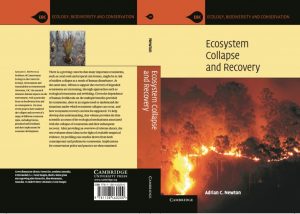
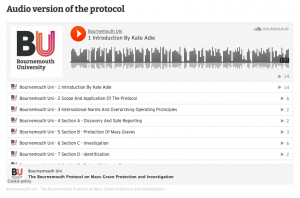 Kate Adie, broadcaster, author and the University’s fifth Chancellor is familiar with sites of conflict and destruction. In her introduction to the
 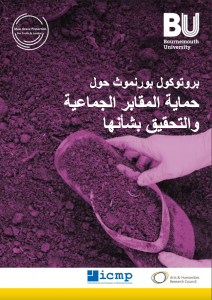 morate Mass Graves Day in Iraq, the International Commission on Missing Persons (ICMP) presented the recently published Bournemouth Protocol on Mass Grave Investigation and Protection to Iraqi authorities involved in efforts to account for missing persons.







 3C Event: Research Culture, Community & Connections – Wednesday 11 November 3-4pm
 ECR Opportunities: New Development Programme, Researcher Grants & Upcoming Events
 Help us capture BU’s knowledge exchange activity HE-BCI survey 2025–26
 Verbal autopsy paper published two days ago
 ESRC Studentships for 2027 Entry: Opportunity Now Open
 Horizon Europe Cluster 3 (Civil Security for Society) 2026 Calls Now Open
 MSCA Doctoral Networks 2026 Call Information Webinar
 ESRC Festival of Social Science 2026: Application Deadline Extended to Thursday 25 June 2026
 Reminder: Register for the ESRC Festival of Social Science 2026 Information Session
 ECR Funding Open Call: Research Culture & Community Grant – Apply now
 ERC Advanced Grant 2025 Webinar
 Update on UKRO services
 European research project exploring use of ‘virtual twins’ to better manage metabolic associated fatty liver disease