The Bournemouth Media School conference ‘Reality Television: Media Convergences and Narrative Futures’ has just finished, taking place between July 5-6. Funded by the Media School’s Narrative Research Group, and drawing a wide range of international contributors, we were delighted with the outcomes. Key note speakers Reader Deborah Jermyn (University of Roehampton) and Professor Helen Wood (DeMontfort University), offered great insight, respectively, into aspects of (post) feminism, and the significance of labour use and exchange within the reality television genre. Notably Helen Woods discussion on ‘precarious labour’, whilst identifying key contexts of gender performance within the the reality television programme ‘Georgie Shaw’, offered stimulating insight into aspects of commodity, and the objectification of male and female sexual agency. Also Nouredinne Miladi’s (Qatar University) discussion of ‘Arab Idol’ offered great insight into the transgressive potential of factual television in considering the recent support for the Palestinian winner of the ‘Arab Idol’ series. In addition Anne Ganzert’s (University of Konstanz, Germany) examination of convergence and branding, foregrounding a case study on Kandi Burruss, was highly insightful. Offering a new perspective on participatory audiences and examining the television phenomenon ‘Gogglebox’, Richard McCulloch’ of University of East Anglia considered new layers of audience identification and issues of celebrity. Every paper was a delight, and generally there was a great sense of camaraderie in the conference cohort, stimulated by the social event in the evening, where the great sunny weather offered even more optimism. Significantly the conference offered great benefits in the exchange of ideas, and this will be extended as the conference organisers Chris Pullen and Peri Bradley, are working on an edited collection focusing on the subject area. Additionally it is intended that this will be the first of a series of annual conference events on the study of reality television. Finally thanks again to Bronwen Thomas (of the NRG) not only for supporting us, but also for creating the Twitter feed #realitybu – this became a very engaging focal point, adding to both the academic and social benefit.
Category / Publishing
Caught Somewhere in Time: Research takes Ages! (Demystifying the research process part 1)
We got a book contract today. And what a herculean effort that feels; talk about delayed gratification. My friend/co-editor and I first discussed the idea 2 years ago, when we saw a publisher’s call for proposals. Yeah that sounds cool, we thought. So we worked out our broad ideas and the people that we wanted to contribute. Our focus was mainly on early career scholars who are producing some real ‘cutting edge’ research and we invited them to submit work for review. My co-editor and I then worked on the narrative that would frame the book, as well as finding out that all important information that publishers want to know: who will buy it. Probably around 6 or so months after our original conversation and discussion with series editors we were ready to submit our proposal.
And then we waited.
About six months later we got back in touch with the series editors, ‘any news from the publishers’….’we’ll get back to you’
And so we waited.
Then we got a reply to the effect that the proposal had been lost and then under a pile somewhere and then the person involved had been on holiday etc but they would get back to us with comments.
And so we waited.
This was now about 18 months after our original idea. And so we decided to approach another publisher. We did this in December last year.
As the contributors were mainly early career scholars,the publishers asked us to invite someone ‘famous’ to get involved. You can imagine our surprise, and delight, when not only did we get one of, if not THE leading scholar in the discipline to write our foreword. And then it just got a bit better. We invited one of the leading activists in the field to write an afterword. And she said yes 🙂
The publisher then asked to provide a sample chapter. I wrote the first draft of this in January on the writing workshop that we held. By the end of January we had our ‘famous’ people in place, our sample chapter and what we thought was a good proposal in place. Our editor at the publishers was set to go off on holiday in March, and so she assured us she would get back touch by the end of February.
And then we waited.
The reviewers were slow, one disappeared and a new one had to be found. We got reviewers comments back in May. We revised our introductory sample chapter in light of these comments and resubmitted to the publisher within about two weeks.
We then had a (relatively short wait)
The chapter and proposal went back out to review, and we were then asked, would we do the minor things the reviewers asked. Of course, we said (a pragmatic) YES!
And so, today, 2 years after we first chatted through our ideas, and then planned our book, we have a contract. And of course it doesn’t end there. We now have to collect the chapters, get them reviewed. If we can get this done by next Easter, we are setting ourselves ambitious goals. From manuscript submission to holding the book in your hands includes copyediting, indexing, proofs to read, and of course the print run. And of course, before all of that it has to go back out for review. This can take anything from 9-18 months.
Our book is therefore likely to have a 2015 publication date (if we are lucky) which given we acted upon our original idea in 2011, does feel rather a long time!
Gender in 21st Century Popular Culture:the Politics of being a woman in the 21st century, editors Heather Savigny & Helen Warner (Basingstoke:Palgrave) may well be coming eventually to a bookstore near you.
with thanks to my early career colleagues in CMC, the Media School and Iain MacRury
Research Ethics: Insights from the Centre for Midwifery, Maternal & Perinatal Health and the Centre for Social Work, Sociology & Social Policy
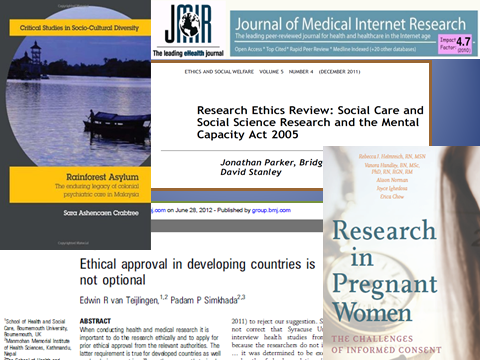
Collage of research ethics contributions
Academics based in HSC have experience in a wide-range of research. In the process of reflecting on all aspects of the research process several members of HSC have published about ethical issues that they have had to address in their own research. This BU Blog highlights some of these key HCS papers which may help fellow academics and students across the globe address similar ethical questions. HSC has a history of publishing on research ethics, Professor Emerita Immy Holloway wrote about the researcher who may have a dual role, or even conflicting role, as researcher and health care professional (1). More recently, several midwifery researchers in the Centre for Midwifery, Maternal & Perinatal Health wrote about the issues facing practitioners doing research in the field where they work, especially concerning the similarities and differences between professional ethics and research ethics (2-3). Negotiating ethical paths cleaved by competing concerns between protecting research participants and over-managing the ethical process is tricky.
In her book Rainforest Asylum: The enduring legacy of colonial psychiatric care in Malaysia Dr. Ashencaen Crabtree in the Centre for Social Work, Sociology & Social Policy, addresses the problematic issue of gate-keepers in research together with the ethics of critical observation of abuse (potential or actual), as well as the ethics of advocating on behalf of research participants (4).
The fear that the ethical application process in the UK is becoming more and more cumbersome and bureaucratic has been widely recognised as highlighted by Prof. van Teijlingen and colleagues (5-6).
Research ethics review processes are also considered in terms of access to participants regarded as ‘vulnerable’ in a recently published paper by Dr. Ashencaen Crabtree (7) of ethnographers working in health settings who are seeking to understand the context of care and patient/service user experiences. She concludes that paternalistic control of participation on the grounds of ethical protection of vulnerable people seriously disenfranchises potential participants in preventing them from being able to share their relevant, lived experiences as recipients of service provision.
Prof. van Teijlingen and BU Visiting Fellow Dr. Padam Simkhada highlighted that the social, cultural and economic contexts in which research is conducted often differ between developing and developed countries. However they stress that researchers need to apply for research ethics approval to the relevant local authority, if national legislation requires one to do so (8).
A new and challenging area of research is the use of discussion boards as a source of research data. In their paper Dr. Bond and BU colleagues discuss both practical and ethical dilemmas that arise in using such data (9). In earlier research, Prof. Parker of the Centre for Social Work, Sociology & Social Policy, highlighted some of the benefits and dangers of using email and the Internet for research as the potential for electronic media continues its rapid growth (10).
Obtaining informed consent is something that all researchers need to consider. However, in some research situations obtaining consent can be particularly challenging. Prof. Hundley and colleagues discuss the ethical challenges involved in conducting a cluster randomised controlled trial, where consent needs to be considered at a number of levels (11). In a second paper issues of consent during pregnancy, where there is the potential for harm to two participants, are considered (12).
In research into the implications of the Mental Capacity Act 2005 for social research, Prof. Parker explored the contested meanings and difficulties associated with informed consent in social research, highlighting some of the challenges raised by an almost unquestioned acceptance of biomedical research ethics in social research and questioning whether potential ‘harm’ is different in this context (13, 14). This research has led to further explorations of the potential for ethical covert research by Prof. Parker and Dr. Ashencaen Crabtree.
The way forward
There a plenty of challenges to research ethics in both the health and social care sectors. Ethical considerations relate to technological developments such conducting research over the Internet or the analysis of tweets. HSC staff will continue to publish on a range of moral dilemma as well as practical issues related to research ethics. Moreover, academic from the two centres are planning a Masterclass on research ethics to be held in early 2014.
References
- Holloway, I., Wheeler, S. (1995) Ethical Issues in Qualitative Nursing Research, Nursing Ethics 2: 223-232. Web address: http://nej.sagepub.com/content/2/3/223.full.pdf+html
- Ryan, K., Brown, B., Wilkins, C., Taylor, A., Arnold, R., Angell, C., van Teijlingen, E. (2011) Which hat am I wearing today? Practicing midwives doing research, Evidence-Based Midwifery 9(1): 4-8.
- van Teijlingen, E.R., Cheyne, H.L. (2004) Ethics in midwifery research, RCM Midwives Journal 7 (5): 208-10.
- Ashencaen Crabtree, S. (2012) Rainforest Asylum: The enduring legacy of colonial psychiatric care in Malaysia, London: Whiting & Birch.
- van Teijlingen, E., Douglas, F., Torrance, N. (2008) Clinical governance and research ethics as barriers to UK low-risk population-based health research? BMC Public Health 8(396) Web address: www.biomedcentral.com/content/pdf/1471-2458-8-396.pdf
- van Teijlingen, E. (2006) Reply to Robert Dingwall’s Plenary ‘Confronting the Anti-Democrats: The unethical Nature of Ethical Regulation in Social Science, MSo (Medical Sociology online) 1: 59-60 Web address: www.medicalsociologyonline.org/archives/issue1/pdf/reply_rob.pdf
- Ashencaen Crabtree, S. (2013) Research ethics approval processes and the moral enterprise of ethnography. Ethics & Social Welfare. Advance Access: DOI:10.1080/17496535.2012.703683
- van Teijlingen E.R., Simkhada, P.P. (2012) Ethical approval in developing countries is not optional, Journal of Medical Ethics 38 :428-430.
- Bond, C.S, Ahmed, O.H., Hind, M, Thomas, B., Hewitt-Taylor, J. (2013) The Conceptual and Practical Ethical Dilemmas of Using Health Discussion Board Posts as Research Data, Journal of Medical Internet Research 15(6):e112) Web address: http://www.jmir.org/2013/6/e112/
- Parker, J. (2008) Email, ethics and data collection in social work research: some reflections from a research project, Evidence & Policy: A Journal of Research, Debate & Practice, 4 (1): 75-83.
- Hundley, V, Cheyne, HC, Bland, JM, Styles, M, Barnett, CA.. (2010) So you want to conduct a cluster randomised controlled trial? Lessons from a national cluster trial of early labour, Journal of Evaluation in Clinical Practice 16: 632-638
- Helmreich, R.J., Hundley, V., Norman, A., Ighedosa, J., Chow, E. (2007) Research in pregnant women: the challenges of informed consent, Nursing for Women’s Health 11(6): 576-585.
- Parker, J., Penhale, B., Stanley, D., 2010. Problem or safeguard? Research ethics review in social care research and the Mental Capacity Act 2005. Social Care & Neurodisability, 1 (2): 22-32.
- Parker, J., Penhale, B., Stanley, D. (2011) Research ethics review: social care and social science research and the Mental Capacity Act 2005, Ethics & Social Welfare, 5(4): 380-400.
Vanora Hundley, Sara Ashencaen Crabtree, Jonathan Parker & Edwin van Teijlingen
Comment on BU Blog leads to academic publication
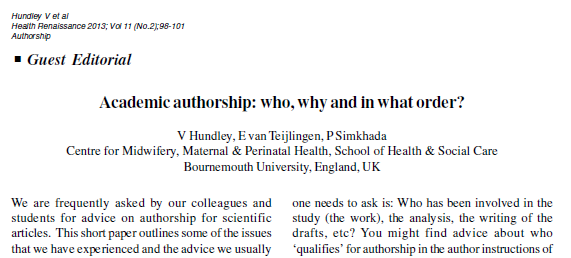
Paper by Hundley et al. published 2013
Last year Prof. Matthew Bennett1 raised some interesting issues about academic authorship on this award-winning BU Blog. Authorship is an issue that many academic colleague see as challenging. On September 27th, 2012 two of us replied to this blog by adding some of our own observations on the web. 2 Having penned our online comments we discussed the issue with BU Visiting Faculty Dr. Padam Simkhada Senior Lecturer in International Health at ScHARR, University of Sheffield (www.shef.ac.uk/scharr/sections/ph/staff/profiles/padamsimkhada). Between the three of us we came to the conclusion that the issue of academic authorship can be very confusing as well as tricky.
We discussed a wide-range of issues around academic authorship, including who should be an author and who should not be so, the order of authors, and that there are different conventions between different academic disciplines. Being academic we rapidly came to the conclusion that there was a paper in this. We drafted our ideas, searched the literature for other discussions on authorship, general guidelines on authorship, etc. We wrote the paper and submitted it to the academic journal Health Renaissance; an Open-Access journal, which is freely available world-wide. The editor liked it and published our paper ‘Academic authorship: who, why and in what order?’ this month as a guest editorial. 3
We would like to highlight that there are two separate messages in the publication of this paper. The first message is about academic scholarship; some of our colleagues may find the content of this paper is a useful guide in deciding authorship order, or at least in helping to open the debate about who should be included as co-author and who is not eligible. The second message is more about academic citizenship, namely that messages on the BU Blog and even comments in reply to other people’s messages may contain useful information to the wider academic community and should be taken further. Our message here is don’t see the BU Blog as an end point, see it as a stepping stone to the wider academic world!
Prof. Edwin van Teijlingen*, Prof. Vanora Hundley* & Dr. Padam Simkhada**
* Centre for Midwifery, Maternal & Perinatal Health, HSC, Bournemouth University
** ScHARR, The University of Sheffield
References:
1. Bennett, M. (2012) What’s in a list?, BU Research Blog, http://blogs.bournemouth.ac.uk/research/2012/09/27/whats-in-a-list/?utm_source=digest&utm_medium=email&utm_campaign=daily
2. Hundley, V., van Teijlingen, E. (2012) Response to What’s in a list?, http://blogs.bournemouth.ac.uk/research/2012/09/27/whats-in-a-list/#comment-17234
3. Hundley, V., van Teijlingen, E., Simkhada, P. (2013) Academic authorship: who, why and in what order? Health Renaissance 11 (2):98-101 www.healthrenaissance.org.np/uploads/Download/vol-11-2/Page_99_101_Editorial.pdf
eBU staff drop in sessions to be held in each school
I am pleased to announce that I am holding drop in sessions in each school for the BU community to ask questions about eBU: Online Journal.
These sessions will be:
Mon 24th June – DEC 12 -2pm in P411
Mon 24th June – School of Applied Sciences 2-4pm in C122
Tues 25th June – HSC 9-11am in the Wellbeing Centre, B112 Bournemouth House
Tues 25th June – Business School 2-4pm in EB205
Thurs 27th June – School of Tourism 1.30-3.30 in P410
Fri 28th June – Media School 8-10am in CAG04

Open access publishing – common minsunderstandings!
 Reflecting on the experience of our recent mock REF exercise I noted that there were some negative views towards open access publishing that were expressed during the process. This is a little concerning considering the UK government is planning to make all outputs arising from publicly-funded research available via open access outlets by 2014 and considering the open access mandates the major research funders have as part of the terms of their grant funding (including the research councils, the Wellcome Trust and the European Commission). In addition, the four UK funding councils are currently consulting with the sector regarding their proposal to introduce a requirement for all outputs submitted to the post-2014 REF exercise to be published on an open access basis, wherever the concept of open access is relevant. As an institution and as individual researchers we need to ensure that we are able to comply with these requirements and that we are able to positively embrace open access publishing.
I did a bit of research and came across an excellent article by Peter Suber, Director of the Harvard Open Access Project. In the article, Peter addresses the common misunderstandings and misconceptions about open access publishing, many of which we part of the concerns raised during the recent mock REF exercises. I’ve selected the ones I most frequently hear and provided a summary below, and would urge you to read the article in full here – A Field Guide to Misunderstandings About Open Access.
1. “All open access is gold open access” – not at all! Gold open access refers to open access through journals and green open access is via repositories. Suber notes that researchers often overlook the existence of green open access or think they will not be permitted by their publisher to deposit a copy of their paper in an open source repository. At BU we have our own institutional repository, BURO, and BU researchers can add the full-text version of their papers via BRIAN. Suber notes that between 50-70+% of journal publishers give permission for postprint achiving in repositories. BRIAN will check the copyright of the publisher for you and let you know which version of your paper can be added to BURO. Easy peasy!
2. “Open access is about bypassing peer review” – not true! The goal of open access is to remove access barriers, not quality filters. Open access journals can, and usually do, use the same peer review processes, the same standards, and even the same reviewers as traditional print journals. Many traditional print journals offer an open access route as part of publishing in their journal (hybrid publishing).
3. “Authors must choose between prestigious publication and open access” – incorrect! There are two reasons why open access is compatible with prestige: a gold reason and a green one. First, a growing number of open access journals have already earned high levels of prestige, and others are earning it. Do your part to move things along as an editor, referee, reader, and as an author, by submitting your best work to suitable open access journals. In the meantime consider the second reason. Most traditional print journals allow open access archiving, such as in an institutional repository.
4. “Open access makes sense for second-rate work, but not for first-rate work” – again, not true! The idea behind this misunderstanding is this: the best work generally winds up in the best journals, where it has the best chance of being seen. At least it should be steered toward the best journals, where it will have the best chance of being seen. When we add the suggestion that this path doesn’t allow open access, or that open access can’t improve upon it, then an idea that was largely true becomes completely false. It assumes that the best journals are never open access (not true – Nature, Science and IEEE for example all offer open access options); that only journals can deliver open access (not true – green open access); that the best journals never allow open access archiving (not true – see SherpaRomeo, Science for example permits achiving of post-print of the publisher’s PDF); and that open access archiving can’t increase the visibility and impact of work published in the best journals (not true).
Suber notes 20 other common misunderstandings about open access and his article is well worth reading!
At Bournemouth University we are committed to supporting the open access movement and have been running the BU Open Access Publishing Fund for two years now and will continue into 2013-14. For information on accessing the Fund please visit this page – BU OAPF.
We’re interested to hear your thoughts on open access publishing! Have you tried it, are your sceptical, are you a supporter?
BU Research Blog Exclusive: Design & Look of eBU leaked
The first screenshot of the eBU interface has been exclusively leaked to the BU Research Blog, and is expected to go viral across the BU community over the next week.
eBU will provide both an internal and external forum for the development of research papers by undergraduate to Professor around the eight BU research themes:
– Creative & Digital Economies
– Culture & Society
– Entrepreneurship & Economic Growth
– Environmental Change & Biodiversity
– Green Economy & Sustainability
– Health, Wellbeing & Ageing
– Leisure & Recreation
– Technology & Design
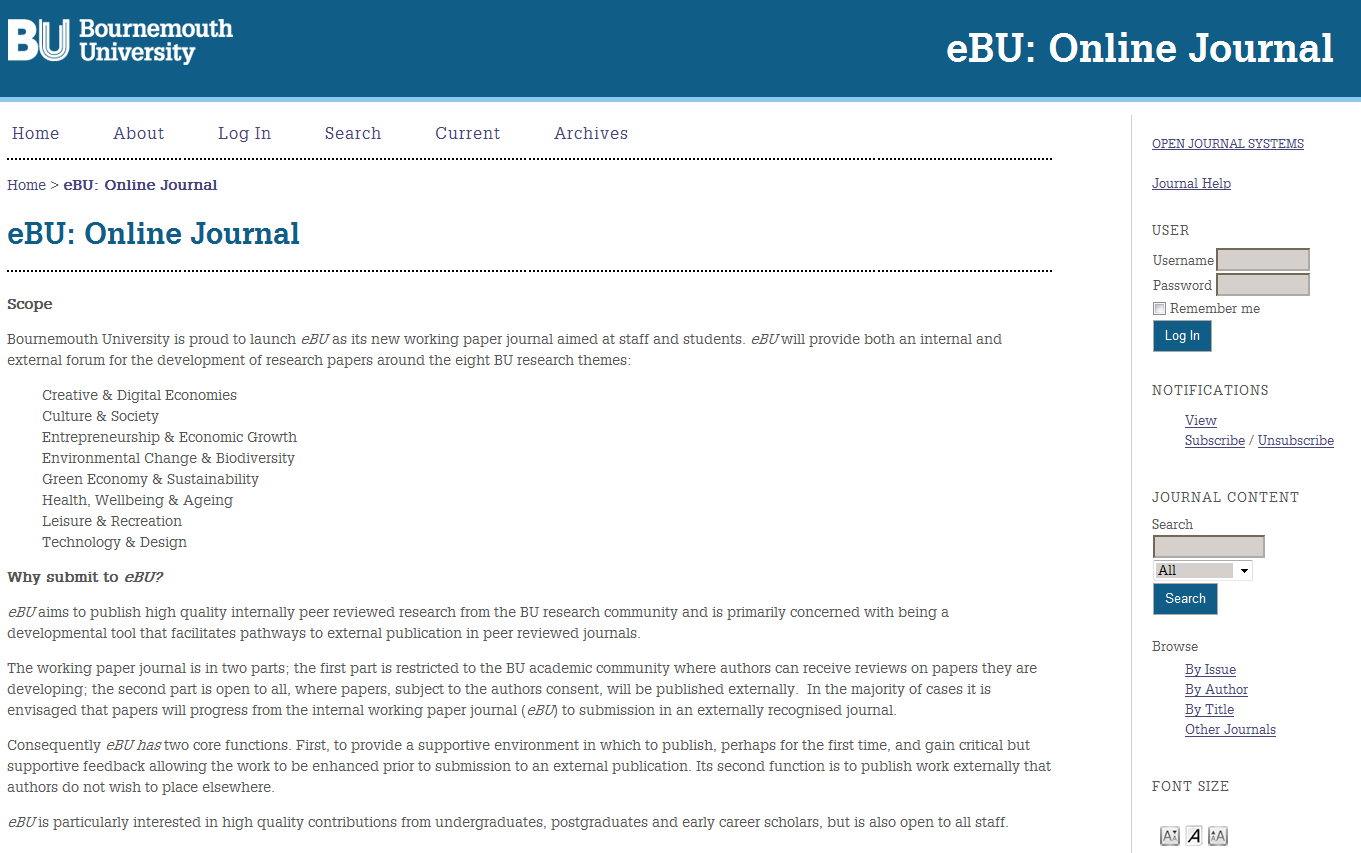 Submissions will be open to immediate publication (in a safe internal environment) and open peer review by 2 appropriate BU academics. Authors will be encouraged to act upon these reviews by either reworking papers for submission to an external journal or by opting for publication on the external eBU site.
For BU academics this is a great opportunity to get critical appraisal on your research papers or ideas from colleagues. For academics it also an opportunity to encourage the submission of high quality student output, and possibly to facilitate the co-creation and co-production of publishable material to an external journal or to publish externally with eBU. For students, this is a fantastic opportunity to turn high quality essays or dissertations into scholarly outputs, which will be attractive to employers across many sectors and industries.
If you have any questions or would like to become involved in this exciting venture, please get in touch with me via email aharding@bournemouth.ac.uk or by telephone 01202 963025.
Publish empirical or experimental data early whilst letting theory mature?
My colleagues and I have written several papers to help budding researchers about the process of writing and publishing academic papers (Hundley, & van Teijlingen 2002; van Teijlingen 2004; Pitchforth et al. 2005; van Teijlingen et al. 2012; Simkhada et al. 2013). For all researchers – students and staff alike publishing research findings is important as new insights will add to the existing knowledge base, advance the academic discipline and, in the case of applied research, perhaps improve something in the lives of others such as, well-being, the economy or the environment. Apart from this general/altruistic drive to add to knowledge, the advice academics give our postgraduate students is: to get your study published as soon as possible. The two main reasons for publishing early are: (a) getting into print to potentially help your careers; and (b) staking once claim as an authority in the field and/or publishing your findings before someone else does.
As always there are exceptions to the rule. As academics we agree that trying to get into print early is a good personal strategy for an early researcher or a postgraduate student especially for those working with empirical or experimental data. However, occasionally it is better to wait and give the underlying idea in the paper time to develop and mature. The kind of paper that often improves with time is one based on theory. Let me share a personal example: a theoretical paper from my PhD (awarded by the University of Aberdeen in 1994). This paper started life as a theory chapter in my PhD thesis (van Teijlingen 1994). This chapter on models of maternity care was not the strongest part of my thesis and it took me another decade of fine-tuning to get it into a state worth publishing. The paper ‘A Critical Analysis of the Medical Model as used in the Study of Pregnancy and Childbirth’ was finally published in Sociological Research Online, the original online-only Sociology journal in the world (van Teijlingen 2005). The wait was worthwhile as the paper is today (May 2013), eight year after publication, the seventh ‘most viewed articles during the past eight weeks’ in the journal (see: http://www.socresonline.org.uk/stats/top20.html).
In conclusion, it is generally sound advice to new researchers and postgraduate students to publish early. Occasionally though, waiting and giving your paper time to improve through discussion with colleagues, presenting the ideas at conferences and on blogs may lead to a better final product.
Prof. Edwin van Teijlingen
Centre for Midwifery, Maternal & Perinatal Health
School of Health & Social Care
References
Hundley, V., van Teijlingen E. (2002) How to decide where to send an article for publication? Nursing Standard 16(36): 21.
van Teijlingen (1994) A social or medical comparison of childbirth? : comparing the arguments in Grampian (Scotland) and the Netherlands (PhD thesis), Aberdeen: University of Aberdeen. Available online in the British Library (search for: uk.bl.ethos.387237 ).
Teijlingen van, E. (2004) Why I can’t get any academic writing done, Medical Sociology News 30 (3): 62-6.
van Teijlingen, E. (2005) A Critical Analysis of the Medical Model as used in the Study of Pregnancy and Childbirth, Sociological Research Online 10(2) Freely available online at: www.socresonline.org.uk/10/2/teijlingen.html.
Pitchforth, E., Porter, M., Teijlingen van, E.R., Forrest Keenan, K. (2005) Writing up and presenting qualitative research in family planning and reproductive health care, Journal of Family Planning & Reproductive Health Care 31 (2): 132-135.
Teijlingen van, E., Simkhada. P.P., Simkhada, B., Ireland, J. (2012) The long and winding road to publication, Nepal Journal Epidemiology 2(4): 213-215. http://nepjol.info/index.php/NJE/article/view/7093
Simkhada, P., van Teijlingen, E., Hundley, V. (2013) Writing an academic paper for publication, Health Renaissance 11 (1): 1-5. www.healthrenaissance.org.np/uploads/Pp_1_5_Guest_Editorial.pdf
eBU: Online Journal
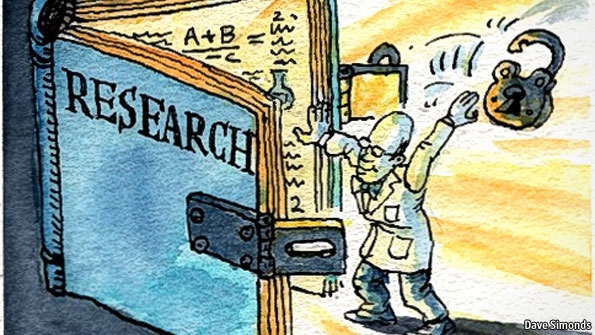 Following on from my last post ‘Developing a Working Paper at BU’ in January of this year, we are now within sight of having an exciting new online journal at BU. eBU will provide both an internal and external forum for the development of research papers by undergraduate to Professor around the eight BU research themes:
– Creative & Digital Economies
– Culture & Society
– Entrepreneurship & Economic Growth
– Environmental Change & Biodiversity
– Green Economy & Sustainability
– Health, Wellbeing & Ageing
– Leisure & Recreation
– Technology & Design
Submissions will be open to immediate publication (in a safe internal environment) and open peer review by 2 appropriate BU academics. Authors will be encouraged to act upon these reviews by either reworking papers for submission to an external journal or by opting for publication on the external eBU site.
For BU academics this is a great opportunity to get critical appraisal on your research papers or ideas from colleagues. For academics it also an opportunity to encourage the submission of high quality student output, and possibly to facilitate the co-creation and co-production of publishable material to an external journal or to publish externally with eBU. For students, this is a fantastic opportunity to turn high quality essays or dissertations into scholarly outputs, which will be attractive to employers across many sectors and industries.
It is anticipated that author guidelines will be circulated in the coming weeks, and staff and students alike should begin to think about how they could submit to eBU.
If you have any questions or would like to become involved in this exciting venture, please get in touch with me via email aharding@bournemouth.ac.uk or by telephone 01202 963025
An Introduction to the BRAD Framework and Development Sessions
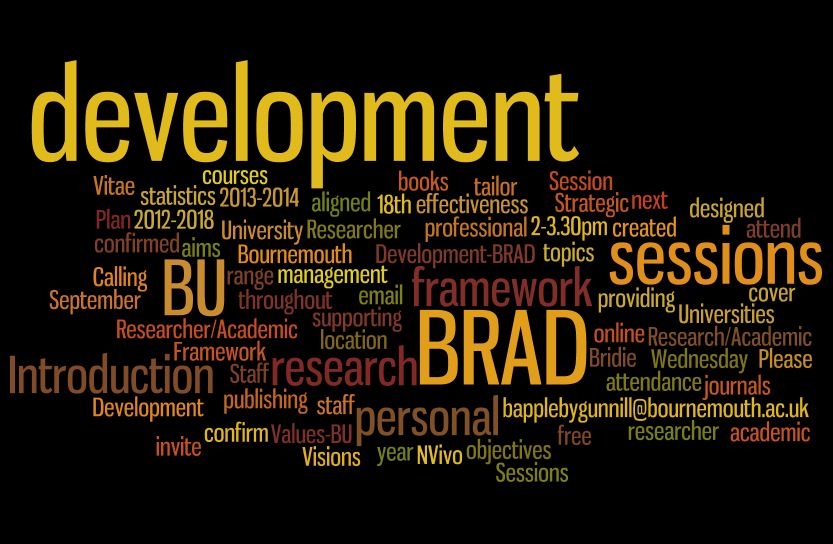 Calling all BU Researcher Staff,
We invite you to: An Introduction to the BRAD Framework and Development Sessions– Wednesday the 18th of September 2-3.30pm (location to be confirmed).
The University has created Bournemouth Researcher/Academic Development-BRAD. BRAD is a tailor designed research development framework with supporting development sessions, for BU’s Research/Academic staff. The aims and objectives of BRAD are aligned to the Universities Strategic Plan 2012-2018, our Visions & Values-BU 2018, and Vitae’s researcher development framework. BU is providing professional and personal development sessions and online courses throughout the next academic year 2013-2014, which are all free to attend. The development sessions will cover a range of topics, from statistics, NVivo, personal effectiveness, research management and publishing in journals and books.
Please email Bridie at: bapplebygunnill@bournemouth.ac.uk to confirm your attendance to the Introduction to BRAD Session
BRIAN – Depositing Full Text Articles
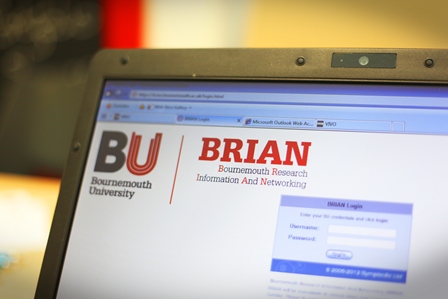 Full Text Articles should be uploaded through BRIAN to comply with Bournemouth University Academic Publications Policy on Open Access.
As most publishers allow the Accepted Version of journal articles to be made available this is the version we recommend authors deposit via BRIAN. The Accepted Version is the author-created final version that incorporates referee comments and is accepted for publication. It should not have the publisher’s typesetting or logo applied.
Supplementary files of various file formats can also be deposited as files or as zipped folders. A listing of publishers, their journals and policy on archiving in BURO is provided by theSHERPA/RoMEO project; see http://www.sherpa.ac.uk/romeo.php. BURO staff will liaise with the copyright holder regarding the inclusion of full text for other publication types.
Depositing files step by step
When in BRIAN, click on ‘my publications’ to see your full list of publications. Each record will show a summary screen and below the title of each record you will see a set of six tabs. Click on the ‘Full text’ tab (the second tab from the right).
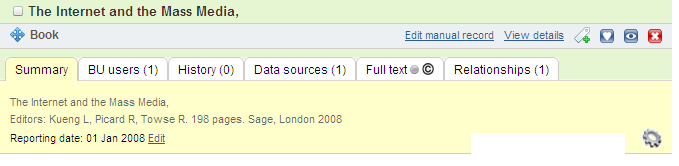
Click on the link ‘Manage full text’ where it says ‘Manage full text for this publication’. The File management box will open. Browse and select the file(s) you wish to deposit. Click on Upload’. As indicated above, please include your final version in the first instance.
Books are rarely allowed, although some publishers will permit the use of a sample chapter. BURO staff can liaise with the publishers on your behalf to check permissions.
Click on ‘Grant’ to confirm you are depositing the file(s) for possible dissemination via BURO. This process does not transfer copyright to BURO. When you have deposited the files you wish to transfer to BURO click on ‘Home’ in the top left hand corner of the screen to return to your BRIAN profile home page.
If you have any queries about BRIAN, please contact BRIAN@bournemouth.ac.uk/. If you require help assessing whether an open access version of your work can be contributed to BURO please contact your Subject Library Team or SAS-BURO@bournemouth.ac.uk.
MERJ / HEA Researchers’ Retreat
I’m pleased to share with you more details about a forthcoming ‘researchers’ retreat’ at Birmingham City University on May 17th: http://www.heacademy.ac.uk/events/detail/2013/17_May_MERJ
The free event is hosted by the Media Education Research Journal (co-edited by myself and Richard Berger) at BCU, and funded by the Higher Education Academy. The purpose of the retreat is to bring together ‘would be’ media education researchers / writers for networking, support and feedback on ideas. MERJ editorial board members will be attending to share their experiences.
House of Lords & Open Access
Derek Ager wrote an absolutely lovely book called the Nature of the Stratigraphic Record which has become a seminal work within the field of earth history. He alike n’s the stratigraphic record to the life of a solider in the trenches; long periods when not much happens punctuated by periods of blind terror! At times I sometimes think this resembles the life of a Pro Vice Chancellor and yesterday was one of the those days of terror. I gave evidence in front of the House of Lords Science & Technology Committee with respect to Open Access publishing.
They are currently investigating the implementation of the Open Access policy which was endorsed by Government and RCUK funding bodies following publication of the Finch report. Of particular interest are the issues around article processing charges referred to by the acronym APC’s. You may recall if you are an avid reader of the blog that the UK has endorsed following the Finch Report so-called Gold Open Access in which the author pays an upfront fee so that the reader can have unrestricted open access on publication. The exact opposite from the current subscription based model. The so-called Green Open Access model based on the use of institutional and subject based repositories is favoured by many within the academic community but not directly by government policy. The cost estimate of the shift to Gold Open Access is variously placed at between £30 and £50 million and imposes an increased burden on already stretched research funds. In theory in the long term subscript charges should fall but given that the UK contributes just 6% of global published output it is unlikely to happen quickly. In September 2012 the Government arbitrarily gave £10 million to support 30 research intensive institutions and in November announced interim measures to come into force from April 2013. Rather than simply support all RCUK grant holders the government adopted a complex algorithm which favours research intensives. The algorithm calculates ‘direct labour costs’ in RCUK funded projects as a proxy for ‘staff effort’ and uses this to calculate an APC value. The more ‘effort’ within a grant the more APC’s one apparently requires to publish that work. So if you have lots of RCUK grants, with lots of staff costs within them you get more cash, irrespective of the quality or nature of that research. Despite the fact that approximately 20% of BU’s research is RCUK funded and is outstanding we don’t exceed the £10k threshold and therefore will not receive any APC funding.
The obvious result of such a policy is off course to favour research intensive institutions and is yet another unintended driver towards research concentration in the UK. One of the most useful things that the University Alliance, the mission group to which BU belongs, has ever done is the report it published in June 2011 on the perils concentrating research funding. This is a beautiful and influential piece of work that demonstrates comprehensively that there is no link between research quality and the size of a research group; quality shines out wherever it is within the sector. Quality can drive growth, but size does not necessarily drive quality.
So sandwiched between the PVC’s for Oxford and Imperial I felt somewhat out of place but was able to hold my own, and make the points that I wished to make drawing attention to the challenge that institutions like our own, that don’t currently receive APC support, face and to draw attention to issues of research concentration. So where does that leave our own staff? It is worth noting that we launched our own APC or Open Access fund two years ago and that demand has grown by 32% over that time and we are committed as an institution to ensuring that our researchers can publish in the most appropriate place for them to be read and cited irrespective of whether it is open access or not. It is likely that we will double our Open Access Fund again this year and are committed to finding the funds to do so.
UK specialists welcome launch of ORCID as tool to identify researchers
 Jisc joins organisations from across the UK higher education network to welcome the launch of the Open Researcher and Contributor Identifier (ORCID).
There are more academic articles being published than ever before and more authors working together. In order to be able to identify an author correctly a unique identifier is needed that can then link to each author’s publications. ORCID provides this link and if widely used would:
• Ensure researchers get credit for their own work • Ensure researchers and learners looking for information will be able to find academic papers more accurately • Enable better management of researcher publication records, making it easier for them to create CVs, reduce form filling and improve reporting to funders • Create a means of linking information between institutions and systems internationally • Enable researchers to keep track of their own work with funders, publishers and institutions around the world.
It also provides researchers with their own ORCID. Researchers are able to control how much information it holds about them and who that is shared with. The adoption of ORCID is a solution to the current challenges of being able to search for work accurately. By researchers volunteering to adopt its usage it could improve discoverability and accurate referencing.
Neil Jacobs, programme director, Jisc comments: “We welcome the consensus that has been achieved on this issue, which should pave the way for a better research system, less work for researchers re-keying details, and more efficient operations across the sector. We recognise that this is only the start and that work needs to be done to implement ORCID in the UK. However, we have a solid beginning and we look forward to working with our partners across the sector to build on it.”
Alongside Jisc, the organisations below are encouraging the adoption of ORCID:
• The Association of Research Managers and Administrators (ARMA) • The Higher Education Funding Council for England (HEFCE) • The Higher Education Statistics Agency (HESA) • Research Councils UK (RCUK) • The Universities and Colleges Information Systems Association (UCISA) • The Wellcome Trust.
Find out more about the benefits of ORCID on Jisc’s website. <http://www.jisc.ac.uk/whatwedo/programmes/di_researchmanagement/researchinformation/orcid.aspx>
Read Jisc programme director, Neil Jacobs opinion piece in Research Information <http://www.researchinformation.info/news/news_story.php?news_id=1029>
Developing a working paper at BU
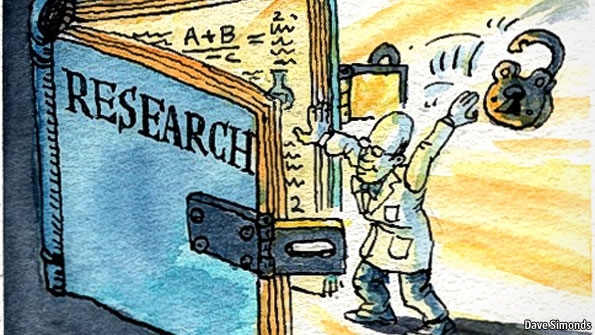 I would like to make you aware of an exciting development at BU.
A multi-disciplinary group of BU academics has been meeting over the last 6 months in order to design a online journal that is capable of acting as a central focus for the dissemination of the high quality research and scholarly outputs from UG and PG dissertations, post graduate researchers, early career researchers and established academic staff. The group has designed a developmental working paper online journal that will support ‘would be’ authors and their potential publications. Although particular emphasis has been given to maximising high quality outputs of UG and PG students and early career academics, this online journal will be capable of supporting the potential of all those engaged in research and scholarship at BU.
Below are a series of Q & As:
What’s the name of the working paper?
The provisional title is eBU: Working Papers Online
How is the working paper structured?
The working paper will not be limited to any one discipline or allied to any one particular methodology, but will aim to publish articles driven by the key BU Research Themes: (Creative and Digital Economies, Culture and Society, Entrepreneurship and Economic Growth, Environmental Change and Biodiversity, Green Economy and Sustainability, Health, Wellbeing and Ageing, Leisure and Recreation, Technology and Design). Apart from the build-up to launch, the working paper will have no deadlines or specific calls for papers. Instead, the working paper will work on a rolling submission process.
A set of author guidelines and details about formats are currently being considered and written. However, the guidelines are likely to accommodate a wide range of formats.
What are the submission processes for staff and students?
It is envisaged that staff will act as gatekeepers and encourage undergraduate and master’s students to submit high quality work into a format this is publishable. Post-graduate researchers and academic members of staff will be able to submit papers on their own accord.
After a short review from the editorial board, two designated BU academics will provide an initial quality check. The paper will then be uploaded to the internal intranet working paper site. This will allow any member of staff or student to read and offer feedback. However, within a few weeks the two designed reviewers will then provide a more comprehensive and detailed critical review. All reviews will take place in a safe, secure and INTERNAL environment. After a detailed review, students will then be encouraged to make any recommended changes and submit to external publication/or make their work available to be published on external working paper website.
This working paper is set to go live in March.
Further information
If anyone is interested in becoming involved in helping to create this online journal, and/or at an editorial level please get in touch with Andrew Harding (aharding@bournemouth.ac.uk), Andrew Adams (aadams@bournemouth.ac.uk) or Fiona Knight (fknight@bournemouth.ac.uk).
RCUK to provide some universities with a block grant for open access publishing costs
 We’ve added posts to the Blog previously about the outcome of the Finch Report (Accessibility, sustainability, excellence: how to expand access to research publications) (access previous posts here) which was published on 18th June 2012 and came out of the Working Group on Expanding Access to Published Research Findings, chaired by Dame Janet Finch. On 16th July 2012 the Government announced that it has accepted the recommendations of the report. The report recommended a balanced programme of action to enable more people to read and use the publications arising from research, and to accelerate the progress towards a fully open access environment, particularly for all government-funded research.
Upon publication, the Report generated some negative reaction from Russell Group institutions concerned about the cost implications given the output of their staff and the high proportion of RCUK funding they receive. The Government has responded to this by providing funding to some institutions to support the costs of OA publishing. This approach so far has been two-fold:
1) In September 2012 the Government announced funding of £10 million, understood to have come out of budget underspends, to support a number of research-intensive universities to kick-start the transition to OA publishing and setting up funds to meet the costs of APCs (Read the BIS announcement here: http://news.bis.gov.uk/Press-Releases/Government-invests-10-million-to-help-universities-move-to-open-access-67fac.aspx). The funding will support 30 institutions, selected on the basis of their combined QR funding and RCUK income. BU did not meet the threshold and will unfortunately not receive any funding from this initiative.
2) In November 2012 RCUK announced block grant funding to support selected universities to support open access publishing costs from RCUK-funded grants (read the RCUK announcement here: http://www.rcuk.ac.uk/media/news/2012news/Pages/121108.aspx). Payments will be made from April 2013 to March 2015, with a mid-term review to assess the system is working. Grants have been calculated for individual universities based on the proportion of direct labour costs awarded on grants that they have received from April 2009 to March 2012. These labour costs have been used as a proxy of research effort leading to the generation of publications. Only universities that are eligible for a block grant of £10k or more will receive funding. RCUK have confirmed that unfortunately BU does not meet the threshold of £10k and will not receive any funding from this initiative.
Although BU has missed out on both block grants we are continuinging to support open access publishing, supported by a central, dedicated budget specifically set up to pay open access publication fees (BU Open Access Publication Fund). This has been live since April 2011; its use will continue to be monitored and the budget increased to cover the increasing demand from BU academics wishing to publish via open access routes. There is no doubt that this fund will need to grow substantially over the next few years to cater for the changes in train.
 Green open access publishing is of course possible using our own institutional repository BURO which is now even more accessible given the new interface provided by BRIAN which tells academics the publisher’s rules on self-archiving for each output when they log into the system; it is hoped this will increase the proportion of full-text articles available in BURO.
BU is encouraging all academics to continue to embrace open access publishing at least as part of the dissemination strategy for all current grants and to ensure that they bid for open access funds as part of future grants as this becomes possible (it is already possible with some funders, including Research Councils).
RDU Small Grant Fund Winner- Update
In November 2011 I (Joanne Mayoh) was the recipient of one of the first BU Research Development Fund (RDF) Small Grant Scheme prizes. This award gave me the opportunity to travel to Champaign (Illinois) in May 2012 to present a paper at the International Congress of Qualitative Inquiry. The budget covered my travel to Illinois, hotel accommodation, conference fees for the five day event, and sustenance costs during this time. As an early career researcher, who has only started publishing within the last few years, this was an excellent chance for me to receive support to present internationally, and engage in essential networking and profile building.
In addition to the conference paper, this opportunity resulted in targeting networking with a number of influential methodologists, and the submission of two journal articles, and a further (accepted) conference abstract in collaboration with a newly formed contact. This new associate is one of the most experienced mixed methodologists currently publishing within my target journals, and is therefore an invaluable connection for at this stage in my career.
The process of applying for RDF funding was extremely simple and one that I would recommend my colleagues engaging with if they have any need for a small grant. I would definitely apply to this fund in the future to support conference attendance, research support or general networking. Overall it was a wonderful experience, and I am very grateful for the support from BU and the Research Development Unit.
Make this month, your Royal Society month!
To celebrate the ‘Open Access Week’, the Royal Society Publishing content will be free for all to access until the 29th November 2012 !!
!!
So if there is an article you have been meaning to read, now is the time to read it; if you have recently published an article in a Royal Society journal, now is the time to share that research with your peers.
The Royal Society is a Fellowship of the world’s most eminent scientists and is the oldest scientific academy in continuous existence. Apart from promoting science and its benefits, recognising excellence in science and supporting outstanding science, their other priorities include providing scientific advice for policy, fostering international and global cooperation and education and public engagement, clearly spanning their collective scope wider than just science.
The Royal Society publishes nine journals covering the broad spectrum of the life sciences, physical sciences and cross-disciplinary sciences. These journals have great impact and are becoming increasingly powerful within the sector.
So make full use of this month and get as much as you can by visiting these journals.
1. Open Biology
3. Journal of the Royal Society Interface
BU staff can login below:
Other services







Recent posts
BU research Funding opportunities EU
 Verbal autopsy paper published two days ago
 ESRC Studentships for 2027 Entry: Opportunity Now Open
- Personal Reflection on Sharing Research Through Art: Collaborating to Understand Ageing in a Digital World
 SONAMONI contributions to Safety Conference 2026 in South Africa
- REF adds ‘midwifery’ to Unit of Assessment 3 name
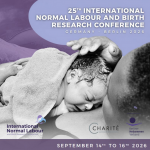 Three CMWH presentations at Berlin conference
 Horizon Europe Cluster 3 (Civil Security for Society) 2026 Calls Now Open
 MSCA Doctoral Networks 2026 Call Information Webinar
 ESRC Festival of Social Science 2026: Application Deadline Extended to Thursday 25 June 2026
- Apply now to take part in the 2026 ESRC Festival of Social Science
 Reminder: Register for the ESRC Festival of Social Science 2026 Information Session
 ECR Funding Open Call: Research Culture & Community Grant – Apply now
- MSCA Postdoctoral Fellowships 2025 Call
 ERC Advanced Grant 2025 Webinar
- European Migration Research and Impact – Invitation to a Roundtable Discussion
- MSCA Postdoctoral Fellowships 2025
 Update on UKRO services
 European research project exploring use of ‘virtual twins’ to better manage metabolic associated fatty liver disease
 Research Information Network
- Physical Sciences Case studies: information use and discovery
- Information handling in collaborative research: an exploration of five case studies
- Information literacy monitoring and evaluation
- Data centres: their use, value and impact
- Heading for the open road: costs and benefits of transitions in scholarly communications