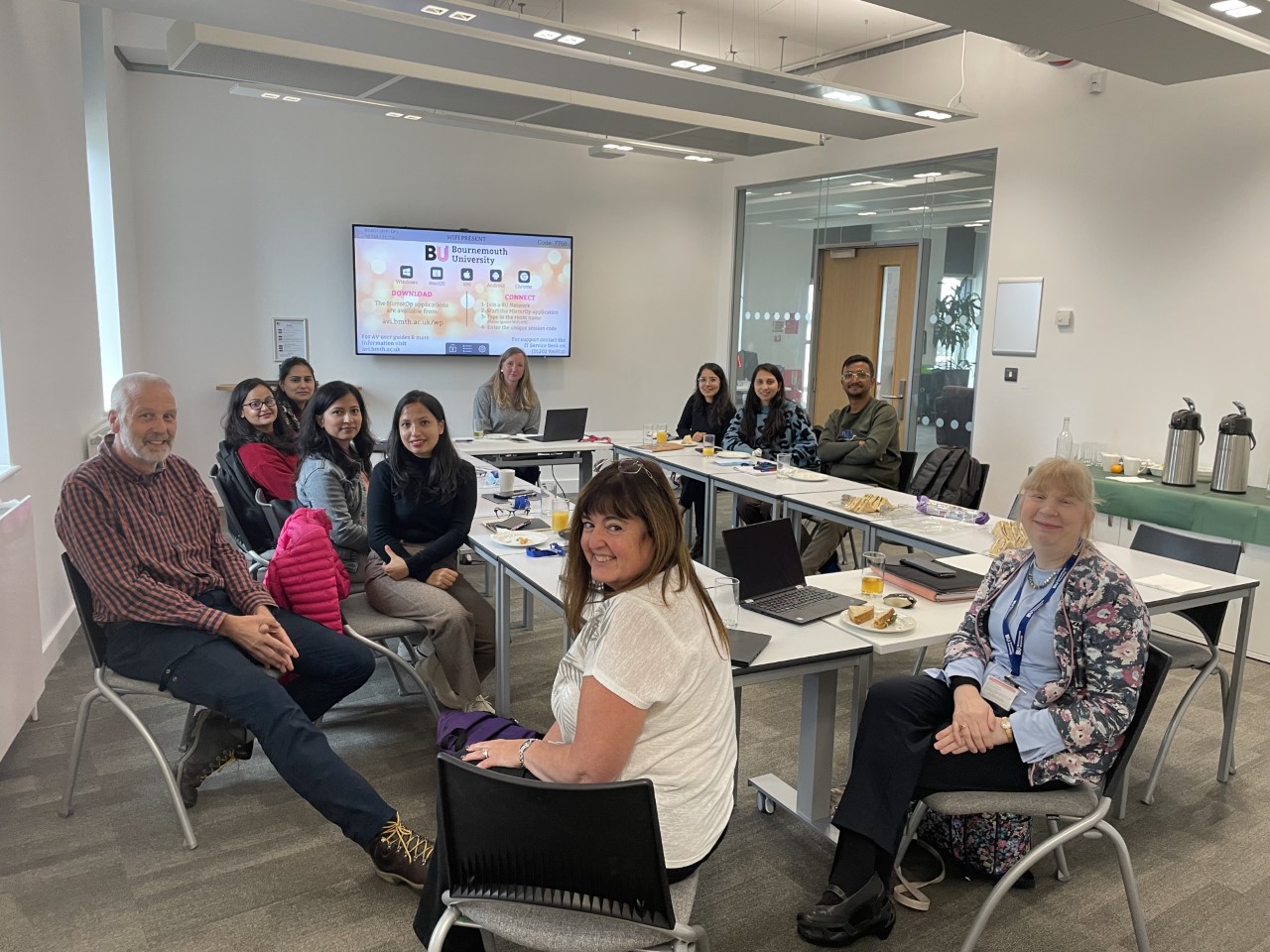
Yesterday (10th August) Prof. Sujan Marahatta from Manmohan Memorial Institute of Health Sciences (MMIHS) gave an insightful talk under the title ‘Response to COVID-19 in Nepal’ to colleagues at Bournemouth University. Prof. Marahatta arrived in the UK yesterday morning and straight off the bus from Heathrow airport came to present in the Bournemouth Gateway Building. He is at Bournemouth University as part of the ERASMUS+ Key Action 107 which includes the exchange of academic staff and students between the UK and Nepal, between BU and MMIHS. His talk covered his role in writing the official report ‘Responding to COVID-19’.
He also spoke about the various joint studies conducted between MMIHS and academics in BU’s Faculty of Health & Social Sciences. These collaborations include a range of BU academics, Dr. Pramod Regmi, Dr. Catherine Angell, Dr. Preeti Mahato (who recently moved to Royal Holloway), Prof. Carol Clark, Prof. Edwin van Teijlingen, Dr. Nirmal Aryal, Dr. Shanti Shanker, and Prof. Vanora Hundley.
Erasmus+ is the European Commission’s flagship for financial support of mobility for Higher Education students, teachers and institutions. The British Councill is the funding agency in the UK and coordinates the funding at a national level. BU is proud to be part of Erasmus+.
Postgraduate researchers and supervisors, hopefully you have seen your monthly update for the researcher development e-newsletter sent last week. If you have missed it, please check your junk email or you can view it within the Researcher Development Programme on Brightspace.
The start of the month is a great time to reflect on your upcoming postgraduate researcher development needs and explore what is being delivered this month as part of the Doctoral College Researcher Development Programme and what is available via your Faculty or Department. Remember some sessions only run once per year, so don’t miss out.
Are you interested in finding out about the NIHR RfPB funding
programme? Join our online seminar on 1st September 2022 from
12.00pm – 2.00pm
About the seminar
The seminar will be hosted by the NIHR Research Design Service and will provide a great opportunity to hear from members of the RfPB programme team and funding panel, as well as from successful applicants. There will also be information about the RDS and the support available for people who are applying to the programme.
Who is the seminar for?
Researchers and health and social care professionals who want to learn more about the RfPB programme and the support available to them.
What will the seminar cover?
• An overview of the RfPB programme
• What the funding panel look for in an application
• Experience of previous successful applicant(s)
• Including Patient and Public Involvement (PPI) in your application
• Including Equality Diversity and Inclusion (EDI) in your application
• How the NIHR RDS can support applicants
How to book a place
Please register via this link.
The full programme and further details will be sent nearer to the date of the seminar.
We can help with grant applications to National peer reviewed funders. We advise on all aspects of developing an application and can review application drafts as well as put them to a mock funding panel (run by RDS South West) known as Project Review Committee, which is a fantastic opportunity for researchers to obtain a critical review of a proposed grant application before this is sent to a funding body.
Contact us as early as possible to benefit fully from the advice
Have you had a total hip replacement? If so, you could participate in a new BU research study which aims to determine whether a daily walk is beneficial after total hip replacement surgery.
We are looking for adults who are 3-6 months past their hip replacement surgery and currently don’t wear an activity monitor (such as a Fitbit).
You’ll need to visit BU for a series of tests and wear an activity monitor (which will be provided) for five weeks while undertaking a series of outdoor walking. You’ll also need to keep an activity diary.
Most analysis of Cameroon’s Anglophone crisis has been skewed towards the socioeconomic, cultural and political ramifications of the conflict.
But, based on my work on natural, environmental hazards and disaster management in Cameroon over the past two decades, I would argue that the environment in the Anglophone region is a silent casualty of the conflict. And it has largely been ignored.
Our recently published research on the crisis showed that over 900,000 people had been internally displaced. Eighty percent of the inhabitants of villages that were conflict hot spots had fled into adjacent forests. The research investigated the consequences of the Cameroon Anglophone crisis and determined it to be an acute complex emergency.
These developments are leaving huge environmental footprints and causing serious damage. This will get worse if the armed conflict escalates into a “complex disaster emergency”.
I have identified six environmental consequences of the Cameroon Anglophone crisis. These range from failures in environmental governance to increases in deforestation, unmet measures in Cameroon’s climate action plan, poor municipal waste management, the effects of scorched earth tactics and the impact of improvised explosive devices.
There is a need to address these environmental oversights and build them into resolving the crisis. This would prevent the environmental legacies of the armed conflict from haunting the region’s population after the crisis has ended.
The fallout for the environment
One of the effects of the fighting since 2016 was that it brought conservation activities to a halt in the country’s biodiversity hot spots in the Anglophone regions. Cameroon has around 14 national parks, 18 wildlife reserves, 12 forest reserves and three wildlife sanctuaries hosting rare and threatened species.
Before the crisis, many of these protected areas were still in a pristine condition because Cameroon had less tourism than other regions of Africa.
But the crisis has stalled several environmental projects.
For example, violence forced environmentalists and NGOS operating in the Tofala Hill Wildlife Sanctuary in Lebialem to flee. The Tofala Hill Wildlife Sanctuary is home to the critically endangered Cross River gorillas and other endangered wildlife like the African chimpanzee and elephant.
These gorillas are also under increased threat from militias such as the “Red Dragons” which have set up camps within the sanctuary (see Figure 1).
Likewise, efforts to protect the Mount Cameroon National Park, which hosts endangered primates, have been hampered. This poses a threat to the Nigerian-Cameroon chimpanzee, which already faces extinction.
Figure 1: Landscape of the Lebialem Highlands hosting the Tofala Hill Wildlife Sanctuary. GSAC (2022)
Insecurity in areas hosting wildlife has led to a rise in uncontrolled illegal hunting. Poaching of endangered chimpanzees (see Figure 2) and elephants increased in the Tofala Hill Wildlife Sanctuary and the Takamanda and Korup National Parks after state rangers and eco-guards fled.
Figure 2: Endangered ape species in Cameroon’s protected reserves. Photo by Julie Langford courtesy of the Limbe Wildlife Centre.
The rise in the number of internally displaced people has had a number of consequences.
Deforestation has risen as relocated communities have cut down trees to provide shelter and firewood.
They are also putting pressure on access to water. Toilet facilitates are inadequate in areas hosting large numbers of people. Drilling of wells, sometimes in unhygienic surroundings, and defecation in streams are also responsible for the poor water quality in the region.
The southwest region has recently experienced a cholera epidemic.
Thirdly, measures in Cameroon’s climate action plan have been halted by the crisis. The measures include providing fertilisers and improved seeds to farmers; installing renewable energy in rural areas; and restoring mangrove forests along the Limbe coast.
Fourthly, the crisis has worsened the problem of municipal waste management.
Separatists have threatened to burn the garbage collection company, HYSACAM. Some of its workers have been attacked. This has affected the collection of municipal waste in Bamenda and Buea, capitals of the Anglophone northwest and southwest regions.
Fifth, military forces are using scorched earth tactics that could create serious environmental harm. The military has destroyed houses, crops and livestock in several villages perceived to be strongholds of militia groups.
Likewise, militias have destroyed property owned by the state and that of civilians suspected to be colluding with security forces.
Satellite images from February and March 2021 confirm the destruction of multiple villages in the northwest region.
Lastly, the use of improvised explosive devices by militia groups against Cameroon’s military vehicles has been increasing and getting more sophisticated.
Explosive remnants and munitions can make the land uninhabitable, severely harm wildlife, and contaminate the soil and watercourses. Clearance of devices can also cause localised pollution, soil degradation and negative land use consequences.
Figure 5: Military vehicle destroyed by IED. Photo courtesy of SBBC (2022).
Next steps
Contingency plans being put in place by the Cameroon government for a potential complex disaster emergency should consider the environmental aspects of the conflict.
First it’s necessary to empirically diagnose the environmental ramifications and how they can be resolved.
When seeking political solutions to the crisis, stakeholders should also incorporate measures to mitigate the environmental consequences.
Are you interested in mental health research and engaging with researchers across Wessex?
Join us for a seminar (6 October 2022) given by Professor Sam Chamberlain, Professor of Psychiatry, University of Southampton and NIHR ARC Wessex Mental Health Research Hub Lead.
He will highlight projects currently supported through the Mental Research Hub, as part of the NIHR ARC Wessex. The Hub aims to bring together researchers from different disciplines and partners throughout the region to plan and conduct research and look at ways to implement findings at the point of care. It also encourages and support new research talent through mentorship, internships, a summer school, and new post-doctoral positions.
This seminar will provide a valuable opportunity to find out more about the Mental Health Research Hub, engage with researchers in Wessex to develop new research and potentially be involved with current projects.
Please sign up asap using this Eventbrite link (venue to be confirmed)
If you’re interested in sharing your scientific research with a friendly public audience – complete our form.
We’re currently organising our series of Café Scientifique events for Oct 2022 – July 2023 and we’re looking for people interested in getting involved. Café Scientifique is a public event format, popular around the world, where anyone can come along to explore the latest research in science and technology in a casual café setting. Following a short presentation by a researcher, there is plenty of time for questions and discussion from a varied public audience.
Taking place on a weekday evening, Café Scientifique events run monthly from June (excepting August and January). They’re organised centrally by the BU Public Engagement with Research Team, part of Research Development and Support (RDS). It’s a fantastic opportunity to get experience in engaging with the public in a friendly atmosphere and gain surprising insights into your own work.
We welcome academics at all career stages, although this is particularly valuable for those just getting started in engaging with the public. We also encourage collaboration between less experienced and more experienced public speakers – to provide a valuable learning experience with the support to keep things going smoothly.
Regarding your research – although we use a broad definition of ‘science’, the audience do have certain expectations from the name, so we do not tend to feature research outside of the broad ‘science’ theme.
Whether we will be able to host your talk, and at the time you want, depends on several factors including the subject matter, timing and other events, so completing this form does not guarantee you will be able to take part. If everything does align, we will be in touch to invite you to speak at an upcoming event.
Other ways to get involved
We’re looking to involve a wider range of people from across BU to make our Café Scientifique series a success and a true BU community project. As well as speaking, you could get involved in a number of flexible ways;
Hosting events – every Cafe Sci event needs a host – to welcome the audience, introduce the speakers and keep the questions flowing. This is a great opportunity for someone to develop skills and experience interacting with the public, as well as being an enjoyable way to meet other people.
Helping to organise events – whether it’s finding speakers, helping polish a presentation, promoting these events far and wide and more – we’d welcome any BU staff or students who’d like to help out with various bits behind the scenes on these events. This is a great way to dip your toes in the world of public engagement, gain experience in organising events and work on a fun project with others across BU.
If you have any questions about speaking at, or are interested in helping to host or organise these events, then please get in touch with the public engagement team at publicengagement@bournemouth.ac.uk. There’s no commitment, we can start from there and see what would work best for everyone.
Emergency services experts are being sought to share their expertise and research or act as a Committee specialist adviser.
A Parliamentary Committee is preparing for a piece of work on the challenges emergency services in the UK face, and whether greater collaboration within and between emergency response services could present solutions and provide services that are better for the user. The Committee’s secretariat is looking for researchers with expertise in this area, including people working on individual services, and anyone studying different models of how emergency and/or blue-light responders collaborate.
Researchers can feed into the work by:
* submitting written evidence,
* giving oral evidence, or
* working as a specialist adviser for the Committee.
For the specialist adviser role, the team are looking specifically for people with expertise covering multiple emergency services. The specialist adviser role would be completed alongside your BU duties one day per week and is paid (not voluntary).
Complete this short Microsoft form with your details to express interest in supplying your research evidence to inform the Committee’s work or to work as the specialist adviser.
The form will ask for your personal details and for you to:
Outline your expertise (max. 100 words)
Provide a link to your BU profile
If possible, to provide a link to a video or recording of you speaking publicly
Some more information on the Specialist Adviser role:
The deadline is Thursday 1 September 2022 (to express interest in providing evidence or applying for the specialist adviser role). After 1 September, once the Committee begins its work, there will be more opportunities to submit written evidence and / or express an interest in giving oral evidence through the Committee’s webpages.
Contact Sarah in BU’s policy team for more information or support.
FHSS hosted a highly successful event on 28th July 2022 to celebrate the achievements from REF 2021 and journey ahead, as we’re already in the next REF period, finished off by scrumptious ice cream!
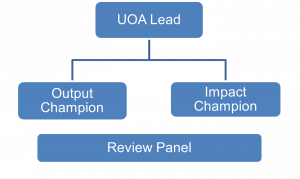
Shelly Anne Stringer and the BU RDS impact team joined UoA3, UoA20 and UoA24 leads/deputies to share the results. There was some great discussion and opportunities highlighted for staff engagement including impact workshops.
There will be more upcoming training opportunities:
8th September, two hour impact case study workshop by Amanda Lazar
15th September, getting started with impact workshop by Beth Steiner/Amanda Edwards
12th October, Evidencing impact workshop by Beth Steiner/Amanda Edwards
Please also see research blog for more details and/or contact BU RDS – Shelly Anne Stringer (Research Excellence Manager) sastringer@bournemouth.ac.uk
Are you a Christian and do you identify with at least one religious organisation?
Do you live in Bournemouth, Christchurch or Poole?
Is your place of worship in Bournemouth, Christchurch or Poole?
Can you please take 10 minutes to fill out a survey?
If you answered “yes” to the above questions, we would like to invite you to participate in a survey to access the roles of faith-based organisations in mitigating the climate change crisis in Bournemouth, Christchurch, and Poole.
The recent publication of REF2021 results has focused attention on developing effective pathways to research impact. Academics have a responsibility to share evidence to influence policy and practice for the benefit of patients, service users and wider society. A newly formed group, the UK network of Professors in midwifery and maternal and newborn health, intends to do just that.
Hosted by the Council of Deans of Health, the group brings together professors in midwifery and maternal and infant health to advise and inform the development of health services, education and research strategy and policy related to midwifery and maternity services. The aim being to improve the health and well-being of women, babies and families in the UK and globally.
The group will be hosting a series of webinars and other events to influence and engage with policymakers. In addition, the group will be helping to develop research capacity and capability.
Members of the UK network of Professors in midwifery and maternal and newborn health.
The Doctoral College are pleased to announce the imminent introduction of ProGRess the new research degree progression monitoring system.
ProGRess will go live in the next few weeks. The new improved online system will be replacing ResearchPAD and will be available to postgraduate researchers (PGRs), supervisors, and administrators.
The benefits of the new system include:
Integrated progress documents and status forms with key details pre-populated
Automatic email reminders to PGRs, supervisors, and academics involved in the process
Automatic recalculation of milestone dates in case of any changes
Greater reporting functionality.
What is happening to ResearchPAD?
IT Services will migrate all user data from ResearchPAD to ProGRess. The date for this will be selected to limit any potential impact and IT Services will work diligently to make the transition as smooth as possible. Once all migration and archive activities are successfully completed, ResearchPAD will be permanently decommissioned.
What next?
PGRs and supervisors, please keep an eye on your email for updates and important information leading up to ProGRess going live including details on how to access the system, user guides and training sessions.
In the interim, if you have any questions, please do not hesitate to contact us.
Every BU academic has a Research Professional account which delivers weekly emails detailing funding opportunities in their broad subject area. To really make the most of your Research Professional account, you should tailor it further by establishing additional alerts based on your specific area of expertise. The Funding Development Team Officers can assist you with this, if required.
Research Professional have created several guides to help introduce users to Research Professional. These can be downloaded here.
Quick Start Guide: Explains to users their first steps with the website, from creating an account to searching for content and setting up email alerts, all in the space of a single page.
User Guide: More detailed information covering all the key aspects of using Research Professional.
Administrator Guide: A detailed description of the administrator functionality.
In addition to the above, there are a set of 2-3 minute videos online, designed to take a user through all the key features of Research Professional. To access the videos, please use the following link: http://www.youtube.com/researchprofessional
Research Professional are running a series of online training broadcasts aimed at introducing users to the basics of creating and configuring their accounts on Research Professional. They are holding two monthly sessions, covering everything you need to get started with Research Professional. The broadcast sessions will run for no more than 60 minutes, with the opportunity to ask questions via text chat. Each session will cover:
Self registration and logging in
Building searches
Setting personalised alerts
Saving and bookmarking items
Subscribing to news alerts
Configuring your personal profile
Each session will run between 10.00am and 11.00am (UK) on the second Tuesday of every other month. You can register here for your preferred date:
These are free and comprehensive training sessions and so this is a good opportunity to get to grips with how Research Professional can work for you. Previous recordings can be found here if you can’t attend a session.
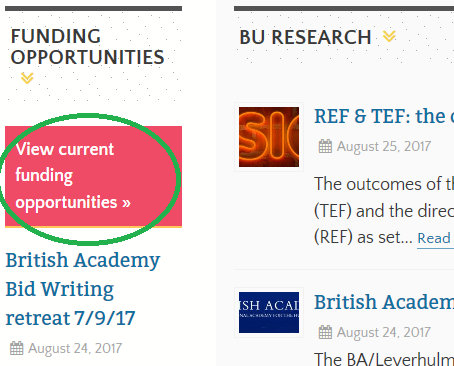
Have you noticed the pink box on the BU Research Blog homepage?
By clicking on this box, on the left of the Research Blog home page just under the text ‘Funding Opportunities‘, you access a Research Professional real-time search of the calls announced by the Major UK Funders. Use this feature to stay up to date with funding calls. Please note that you will have to be on campus or connecting to your desktop via our VPN to fully access this service.
Over the last few months, Dr Paul Whittington (Lecturer in Assistive Technology) has participated in three public engagement events to promote their assistive technology research currently being conducted at BU.
Dr Whittington was invited to attend an event at the Ace Centre, Abingdon, where Layla Moran MP was present to learn about the charity work at Ace Centre. The Ace Centre specialises in providing alternative and augmentative communication devices for people with disabilities. This was another opportunity for Dr Whittington to discuss their recent research on EduAbility, an Android application to provide assistive technology recommendations and training, to teachers, support staff, parents and carers. During this visit, Dr Whittington viewed the products that are supplied by the charity to assist in communication and hear the experiences from a user of this technology who attended the event. EduAbility received positive feedback from Layla Moran MP and Ace Centre, who acknowledged that there is a need for this type of application. EduAbility is currently being evaluated by local special educational needs and mainstream schools and is anticipated to be released publicly later in the year. The development of this application has been funded through the Faculty, as well as grants from Mazars Charitable Trust and the Alice Ellen Cooper Dean Charitable Foundation.
In July, Dr Whittington was invited to participate in the Panel at the Disabled Students Forum 2022. The Forum is organised by Inside Government and provides best practice guidance on improving accessibility of teaching and learning, as well as enhancing student experience for those with disabilities in higher education. The theme of the Panel was ‘Using the Latest Assistive Tech Innovations and Ideas to Support Teaching and Learning, and Enhance the Student Experience’ and this was an opportunity for Dr Whittington to address the delegates with his assistive technology experience and views on the current challenges in the sector. The Forum is specifically designed for the higher education sector and the delegates include Heads of Student Services, Disability Advisors, Student Engagement Managers and Senior Lecturers.
A third recent assistive technology event, 2nd Workshop in Diversity, Accessibility and Inclusivity in Cyber Security (DAI) at the BCS HCI 2022 Conference, was organised by academics from the Departments of Computing and Informatics (including Dr Whittington and Dr Dogan). This was held as a virtual Workshop alongside the main Conference at Keele University. Dr Whittington and Dr Dogan had a paper accepted at this Workshop, which focused on the development and evaluation of Authentibility Pass. This is a second Android application that enables people with disabilities to communicate their authentication and accessibility requirements to organisations.
We anticipate holding the 3rd DAI Workshop at the BCS HCI Conference next year, which may have a broader assistive technology theme. At the end of 2022 or early 2023, we are also planning an International Assistive Technology Symposium, an opportunity for academics, organisations and charities to present their assistive technology research. We will be organising this event in collaboration with our research partners in Malaysia, Malta, South Africa, Turkey, UK and USA and will update with further details.
Solarizing the Moon: Essays in Honour of Lionel Sims (Archaeopress, 2022) gathers contributions from thirteen anthropologists, archaeologists and cultural astronomers that delve into three key areas: (1) Anthropology and Human Origins, (2) Prehistory and Megalithic Monuments, and (3) Theoretical Developments. These represent the research interests of our colleague Prof Lionel Sims (Emeritus, University of East London), who passed away in 2021, and which this volume celebrates.
More details, including a free download of the introduction, can be found here.
Would you like to be involved in research that uses new, exciting digital health technologies?
If this sounds appealing, then we would like to invite you to become a participant in our research, which is organised in conjunction with Xim Ltd. developers of the Lifelight app.
You will be asked to attend Bournemouth Gateway Building on 1 occasion for 30 minutes and receive a £5 lunch voucher to be used at any BU catering outlet. If you don’t know your blood pressure we will require another 5 minute session for pre-screening, but if you work in one of our BU buildings we may be able to come to you for the pre-screening.
Please see the attached research poster for more details. If you would like to know more, then snap the QR code to read the full participant information sheet or contact Malika Felton
(mfelton@bournemouth.ac.uk) to be emailed a copy. Should you wish to take part, then please contact the research team expressing your interest.
According to UK Research Office (UKRO), the UK Government has announced a new package of measures to support applicants to Horizon Europe affected by the delays in association. The measures aim to ensure the stability for UK researchers and businesses and their European partners.
The measures will only come into force if the UK is unable to associate to Horizon Europe and will ensure that there is no funding gap. The UK government remains committed to a strong research collaboration with Europe and has reiterated that association remains its preferred outcome. The UK Government is ready to formalise association to EU programmes at the earliest opportunity.
The main message from the Government to the UK academics and research institutions remains the same – UK organisations can continue to apply to Horizon Europe in line with the European Commission’s ‘Q&A on the UK’s participation in Horizon Europe’ document.
The General Annexes attached to the main Horizon Europe work programme (2021-2022) ensure that UK applicants are treated as if the UK is an associated country throughout the process, from admissibility and eligibility to evaluation, up until the preparation of grant agreements. However, grant agreements can only be signed by UK participants if the association has come into force. Before that, normally, UK organisations will receive grant funding from the UK Government.
To finish this update and the whole academic year on an optimistic note, I am glad to tell you that in July 2022 BU academics have been awarded two Horizon Europe collaborative grants. This is amazing – congratulations!
UPDATE: just after publication of this blog we received information the from European Commission that the third Horizon Europe grant has been awarded to BU in July.
I wish all academics to enjoy the rest of the summer and keep promoting their research ideas in way of developing and submitting external grant applications. Majority of RDS pre-award staff will also be enjoying summer holidays in August to continue providing support after their return.
P.S. the recording and presentation from this year’s last funding briefing (Horizon Europe: Searching for funding opportunities and finding a call) is available on Brightspace. See you in September funding briefings again!
Exercising with Epilepsy, Friday 29th July, 12.30pm, online
Join psychology lecturer Dr Sarah Collard at a free online event this Friday to hear how her research is challenging the assumptions around exercising with epilepsy. Dr Collard was awarded ACORN funding to explore the physical activity levels of people with epilepsy in the UK. The project aimed to:
Establish self-reported physical activity and levels of sedentary behaviour.
Obtain epilepsy-related factors and socio-demographic information.
Investigate the associations between epilepsy-related factors, socio-demographics, and physical activity.
In the online discussion, Dr Collard will outline her findings so far, which will provide important data for people with epilepsy and their families and carers, as well as medical professionals and those working in the fitness and leisure sector.
To join the discussion and hear her findings, sign up here.
BU staff can login below:
Other services
Don’t miss a post!
Subscribe for the BU Research Digest, delivered freshly every day.