Following a successful upgrade, BRIAN is now up and running again and functioning as normal.
Do send an email to BRIAN@bournemouth.ac.uk if you encounter any issues.
Latest research and knowledge exchange news at Bournemouth University
Following a successful upgrade, BRIAN is now up and running again and functioning as normal.
Do send an email to BRIAN@bournemouth.ac.uk if you encounter any issues.
The positive effect of cold water on health is known since Hippocrates claimed water therapy reduced lassitude, and Thomas Jefferson was a keen advocate of a daily cold water foot bath to maintain his ‘good health’. Surveying a large cohort of outdoor swimmers indicates that cold water immersion is associated with improvements in mental health, musculoskeletal, cardiovascular, and respiratory conditions. However, the effects of cold water on brain activity are largely unknown.
We hypothesise that short exposure to whole-body cold-water immersion leads to changes in functional connectivity between frontal and limbic areas that are critical for executive control and emotion processing. To test this hypothesis, a collaborative team of researchers from the Department of Psychology Bournemouth University (Professor Hana Burianova, Dr. Ala Yankouskaya, Dr. Marina Kilintari), the Faculty of Science and Health at Portsmouth University (Dr. Heather Massey), UHD (Dr. Ruth Williamson, Deputy Chief medical officer UHD, Visiting Professor Bournemouth University) and Institute for Medical Imaging and Visualisation (John Totman, MRI Business and Operations Manager at IMIV and Dr. Jamie Franklin, Head of Institute For Medical Imaging and Visualisation and Associate Professor) launched a study supported by QR Research fund and IMIV Pump Priming at BU.
The project is the first of a group of feasibility studies looking at fMRI as a tool to assess the impact of various interventions in brain function. Originally framed around the described mental health benefits of cold water swimming, the team is also interested in developing protocols to assess interventions in a variety of conditions affecting mental wellbeing with consideration of it providing a quantifiable research methodology for future studies. 
The team is looking for healthy volunteers aged 18-45 to take part in the study. Please contact ruth.williamson@uhd.nhs.uk for more information.
Using immersive and non-immersive virtual reality to distract children with moderate to severe eczema from itching.
Project team: Dr Heidi Singleton, Professor Steven Ersser, Professor Debbie Holley. Associate Professor Xiaosong Yang. Dr Emily Arden-Close. Yaqing Cui- (Research Assistant and software developer), Professor Liz Falconer (Virtual Heritage Ltd), Dr Sarah Thomas, Amanda Roberts (Nottingham Support Group for Carers).

Child aged 5 years using Oculus Quest 2™ Headset
The aim of this project was to co-create immersive and non-immersive VR based on the guided imagery approach to managing moderate to severe eczema, targeted at children aged between 5 and 11 years of age.
Co-creation and Evaluation
Through online surveys (n=6) and semi-structured interviews (n=6), children worked with software developers to codesign the VR Chillout software. Children selected settings, interactions, music and sound effects that they felt would best help them relax and be distracted from their eczema.
Two resources were developed for evaluation: a relaxing 360 video of a woodland scene (click the image to view the interactive video on Youtube) and immersive VR mobile phone games:

Games for mobile phones – (a) Lobby (b) Snowy World (c) Flying over Sakura
For the Oculus Quest 2™, three games were developed. The first game ‘Lovely Fruit Grocery’ provides an immersive interaction experience with cartoon animals, via haptic controllers. The second game is ‘Hand Jet Flying’, which not only keeps the subject’s hand busy but also produces a highly immersive VR experience. The third game is ‘Nature Wonderland’, which focuses on presenting a visually and acoustically immersive and peaceful VR environment with animals, water, and natural elements.
Key findings
“The animals were very realistic. I enjoyed playing with them and giving them food to eat. I loved the VR games; I feel they helped me to forget my itching.”
(Child aged 11)
Next steps
Links
VR Chillout Software Show Reel
On 8th July a group of 33 first year undergraduate nursing students attended a dementia themed workshop, led by Dr Michelle Heward from the Ageing and Dementia Research Centre (ADRC), to gain insight into the lived experience of dementia. The day included an Alzheimer’s Society Dementia Friends session and simulation activities from the Dementia Education And Learning Through Simulation 2 (DEALTS2) programme, including the A Walk Through Dementia virtual reality app.
DEALTS2 uses an experiential learning approach to put trainees into the ‘shoes of a person with dementia’ to gain an insight into how the condition impacts on the person. In 2017, Health Education England commissioned the ADRC team to replace their original DEALTS programme with a new and improved version aligned to the learning outcomes of the national Dementia Training Standards Framework. Our research demonstrates that the training programme is being used nationally in acute care settings and has effectively increased trainer knowledge of dementia and confidence to utilise innovative training approaches (Heward et al., 2021). On the day it was great to see the students engaging positively with the innovative training approaches to gain a unique understanding of the lived experience of dementia.
The dementia day is part of a simulation programme being delivered by the Clinical Skills Nursing team at Bournemouth University. The simulation programme has been designed and created in response to a current shortage of nursing placements due to the ongoing COVID-19 pandemic. The placement has allowed the students access to varying specialist nurses and healthcare providers, from Nutrition Nurse specialists to Advanced Clinical Practitioner nurses working within the Air ambulance service, giving the students access that they may not have encountered within their practice.
I am really pleased to announce the publication of our paper ‘Don’t be a waster! Student perceptions of recycling strategies at an English University’s halls of residence’ in the International Journal of Sustainability in Higher Education. Joseph Dixon, a former sociology student at Bournemouth University, worked alongside myself to publish research that he undertook concerning recycling behaviours among students. The paper can be accessed at Emerald EarlyCite https://www.emerald.com/insight/content/doi/10.1108/IJSHE-10-2020-0383/full/html.
UK government’s innovation strategy: Intellectual property
eBulletins and Newsletters
NIHR News and Research July 2021
NHS England and NHS Improvement – In Touch
Funding Opportunities
Latest NIHR funding calls
Evidence Synthesis Programme
Incentive Awards Scheme 2021
Programme Development Grants
Competition 31
Your local branch of the NIHR RDS (Research Design Service) is based within the BU Clinical Research Unit (BUCRU) should you need help with your application. We advise on all aspects of developing an application and can review application drafts as well as put them to a mock funding panel (run by RDS South West) known as Project Review Committee, which is a fantastic opportunity for researchers to obtain a critical review of a proposed grant application before this is sent to a funding body.
Contact us as early as possible to benefit fully from the advice
Feel free to call us on 01202 961939 or send us an email.
At BU we promote and celebrate the work done to engage public audiences with BU research.
The public engagement with research team in Research Development and Support (RDS) can help promote your event to relevant audiences through our regular newsletter and social media channels. It also helps us to stay informed on the public engagement work being carried out by BU.
Please note: we are keen to promote BU public engagement with research activity wherever possible, but completing this form does not guarantee that we will be able to promote your event. To be considered for inclusion, your event or activity must be;
Event descriptions may be edited for consistency in style with other content. If you have any questions about this process, please contact us.
We will re-share this form once a month.
Just a reminder that BRIAN will be unavailable to users today and tomorrow, Monday, 2nd August and Tuesday, 3rd August for a scheduled upgrade.
If you need any help using the new system or if you encounter any problems after the upgrade, please do send an email to BRIAN@bournemouth.ac.uk and a member of staff will be able to assist you.
In the meantime, if you do have general queries relating to the upgrade, please get in touch with BRIAN@bournemouth.ac.uk
Further information will be available once BRIAN is up and running again following the scheduled upgrade.
Every BU academic has a Research Professional account which delivers weekly emails detailing funding opportunities in their broad subject area. To really make the most of your Research Professional account, you should tailor it further by establishing additional alerts based on your specific area of expertise. The Funding Development Team Officers can assist you with this, if required.
Research Professional have created several guides to help introduce users to Research Professional. These can be downloaded here.
Quick Start Guide: Explains to users their first steps with the website, from creating an account to searching for content and setting up email alerts, all in the space of a single page.
User Guide: More detailed information covering all the key aspects of using Research Professional.
Administrator Guide: A detailed description of the administrator functionality.
In addition to the above, there are a set of 2-3 minute videos online, designed to take a user through all the key features of Research Professional. To access the videos, please use the following link: http://www.youtube.com/researchprofessional
Research Professional are running a series of online training broadcasts aimed at introducing users to the basics of creating and configuring their accounts on Research Professional. They are holding monthly sessions, covering everything you need to get started with Research Professional. The broadcast sessions will run for no more than 60 minutes, with the opportunity to ask questions via text chat. Each session will cover:
Each session will run between 10.00am and 11.00am (UK) on the second Tuesday of each month. You can register here for your preferred date:
These are free and comprehensive training sessions and so this is a good opportunity to get to grips with how Research Professional can work for you.
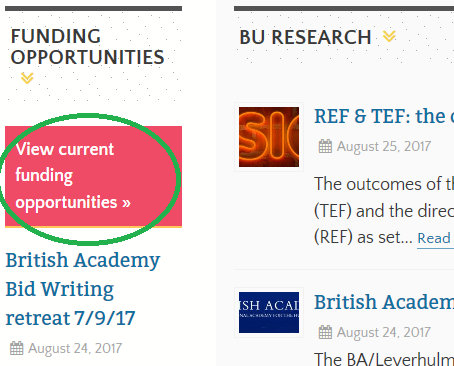
By clicking on this box, on the left of the Research Blog home page just under the text ‘Funding Opportunities‘, you access a Research Professional real-time search of the calls announced by the Major UK Funders. Use this feature to stay up to date with funding calls. Please note that you will have to be on campus or connecting to your desktop via our VPN to fully access this service.
The European Commission (EC) has published the draft of the Annotated Grant Agreement, which includes additional explanations for each article of the corporate Model Grant Agreement. It reflects the new corporate structure of the General Model Grant Agreement and equally will be used for all centrally managed EU programmes that have already migrated (or will soon migrate) to the Funding & Tenders Portal.
EC adopted the main Horizon Europe (HEU) Work Programme for 2021-2022 in mid-June and consequently published the final version on the Funding & Tenders Portal. Consequently, many of the first calls for proposals, worth €14.7 billion, have already opened. There are several updates planned to the Work Programme, in particular in the autumn, to clarify the eligibility conditions for topics that were under discussion in Cluster 4 ‘ Digital, Industry and Space’ where some restrictions to protect the Union’s strategic assets, interests, autonomy or security apply.
Following the recent Horizon Europe Cluster 4 Digital Brokerage Event held by Ideal-ist, the network of National Contact Points for ICT research and the Enterprise Europe Network, the online partnering system remains open to book scheduled and ad hoc meetings until the first call deadlines (21 October 2021). In addition, resources from the European Commission’s Horizon Europe information events are available online: Cluster 1 Health Info Day, Cluster 2 Culture, Creativity & Inclusive Society Info Day, Cluster 5 Climate, Energy & Mobility Info Day and Cluster 6 Food, Bioeconomy, Natural Resources, Agriculture & Environment Info Day.
As of 30 July 2021, Switzerland is treated as a non-associated third country in Horizon Europe. Consequently, researchers based in Switzerland are currently only able to participate in a Horizon Europe, the Euratom programme and the Digital Europe Programme proposal as an associated partner from a third country.
Funding for researchers and innovators based in Switzerland for their participation in collaborative projects will be provided by the Swiss Government for all 2021 calls of Horizon Europe and the Euratom programme. The State Secretariat for Research and Innovation (SERI) has published a financial guarantee on their website.
So, a Swiss partner is eligible to participate in collaborative projects, though the consortia have to make sure that the minimum eligibility criteria, excluding Switzerland, is met for each proposal.
You can find the most recent information on the current status of Switzerland within HEU and relevant materials for researchers on the State Secretariat for Education, Research and Innovation website.
According to Research Professional, EC has completed its second round of talks on association to Horizon Europe with a group of non-EU countries. Armenia, Georgia, Israel, Moldova, Albania, Bosnia and Herzegovina, Kosovo, North Macedonia, Montenegro and Serbia, Tunisia, Turkey and Ukraine have all now completed their second round of talks. The final round of negotiations is expected to take place from the end of August to mid-September, with a target of signing association agreements by the end of 2021.
On 17 June, the EC announced it had given provisional associated access to Horizon Europe to the Faroe Islands, Iceland, Morocco, Norway and the UK.
Negotiations on UK association have already been concluded as part of a broader agreement on trade and other relations with the bloc.
As it was announced earlier this week, there will be no funding briefings in August with those returning in September. However, RDS Research Facilitators will continue updating the Major Opportunities pipeline on a weekly basis, so you have access to the latest funding opportunities. The pipeline is available on the I Drive at RDS\Public\Funding Pipeline.
Let me wish you all to enjoy the rest of the summer and do not hesitate to contact me with questions related to EU and international funding.

Screenwriter, Misan Sagay
On 5 May 2021, as part of the guest-speaking series in the Media Production department here at Bournemouth University, Dr. Samantha Iwowo had the opportunity of inviting Hollywood screenwriter, Misan Sagay, for a conversation with students and academics. This British-Nigerian filmmaker is a member of the Academy of Motion Pictures Arts and Sciences and BAFTA, respectively, and also chairs the Academy European Committee. One of Misan’s screenplays, Belle (2013), chronicles the life of Dido Elizabeth Belle Murray, a true-life aristocratic woman of mixed heritage in 18th Century UK. Produced by TSB Entertainment and BFI, and distributed by Fox Searchlight, Belle is a seminal work on the filmic discussions of aristocratic persons of colour in the history of the United Kingdom. Amongst such growing conversations is the Netflix drama series, Bridgerton (2020 – ongoing), produced by Shonda Rhimes.
In this piece, Iwowo reflects on the conversation with this filmmaker, via the themes: The business of screenwriting; research in screenwriting and writing black stories. Misan’s writing journey is also invited, herein.
The Business of screenwriting
Misan discussed screenwriting as an art requiring an artistic voice, as well as an enterprise. This was in response to a question by BA Film student, Ben Francis, who wanted to know what her writing schedule was like: “Is it a classic nine-to-five job or is the screenplay done in hours when you feel creative?” Misan would share that the problem comes when it is approached only as an art, rather than recognising that it is also a business, underpinned by contracts. In this regard, therefore, the place of awaiting a writing inspiration becomes counterproductive: “If you wait for it [inspiration], it doesn’t come”, she said.
For Misan, getting into the habit of writing every day helps inspiration: “I think you should keep going and then it will come”, and developing this habit enriches the perspective that one is “a working scriptwriter, working to schedule.” She reminded that the job of screenwriting is often not appreciated for the “enormous task” of critical thinking it involves, thus requiring writers to enforce that discipline. The filmmaker’s position is shared by the Post-graduate Media Production, Framework here at BU, which fosters that directors respect the vision of the screenwriter, as screenwriting is not “putting one word after another” (Vieira 2009, p145), as Hollywood Executive, Irvin Thalberg, is on the record for saying.
Research in screenwriting
One of the questions which Deputy Head of Department (dHoD), Dr. Phil Mathews asked Misan was what she considered to be her process of writing a screenplay. The writer highlighted she ensures that relatively sufficient research time is written into her screenplay contract: “Lots of people want you to just get on with it – ‘start writing’ but that is not how it works.” Her choice of methodology entails primary (archival) research unlimited to maps, sculptures, paintings, and registers. According to Misan, this is particularly important when writing black stories. It comes across that her leaning towards source materials stems from this observation: “In England, we need to broaden our view of history.” Thus, she prefers “listening to the early voices.”
From some of Misan’s previous conversations, one can understand that by “early voices”, the filmmaker means, for instance, that when writing on the contributions of minoritised soldiers to WW I and II, one must prioritise data from “records of regiments” (Sagay, in Tillis 2015), rather than secondary sources which may reduce non-white soldiers to “footnotes.” Her example of the ethical research needed for balanced racial representation in historic films, echoes David Olusoga’s documentary, Unremembered (2019), which illuminates the sparse recognitions of black and Asian service personnel who died fighting for the British empire. Misan’s advice is equally strengthened by the recent apology by Defence Secretary Ben Wallace (Guardian News, 2021), on behalf of the British Government for its erasure of these minoritised war heroes.
Do you want new ideas on how to grow your business? Or do you have an idea but don’t know how to execute it effectively? Virtual Coworker can help you hire virtual assistants who can introduce fresh ideas and perspectives to your business.
Writing black stories
Misan also touched on the complex process of writing black stories aimed at diverse audiences. Such writing often requires a substantial “amount of world-building.” According to the writer, this becomes necessary for certain reasons: “Many audiences are not familiar with the black experience or are familiar with the false way they’ve been told it.” The decision of Misan to follow a career in filmmaking was instructed by observing underrepresentation and misrepresentation of black persons – especially women – in progressive positions. In point of fact, during the Oscars’ Dialogue roundtable, in September 2020, she said: “I did not see women who look like me, who behave like I do.” During her visit to BU, she iterated this. By this submission, Misan speaks for several minoritised persons who have long highlighted this gap in screen works.
Some of the works through which the screenwriter mediates issues of black representation, include her 1999 screenplay, The Secret Laughter of women, starring Hollywood’s Nina Long and British actor, Colin Firth. It underscores the determination of a young Nigerian mother in France, to be nurture an inter-racial relationship despite the reluctance of her family. Another is her 2005 script-adaptation of the momentous 1937 novel by Zora Neale Hurston, Their Eyes Were Watching God. Media mogul, Oprah Winfrey, would produce this piece which also stars Oscar award-winning actress, Halle Berry. In their collaboration on this film, Oprah Winfrey and Misan appeared to demonstrate they share a common storytelling trajectory – articulating narratives about black people, which are not confined to a history of enslavement and suffering, but of beautiful aspects of life unlimited to love and wellbeing.
Did this reflection mention that Misan has journeyed into filmmaking from practising as a medical doctor, in the Accident & Emergency (A&E) centre? While some persons may term this an unusual track into the arts, she prompts that there is a connection between screenwriting and writing a medical report as a physician, because, like a movie trailer, a medical report has to be written in a compelling format. Indeed, the last words, belong to the writer:
“[In medicine] A patient tells you a story, and you then have to, as a doctor, tell that story to other doctors or a specialist who you want to do some procedure on the patient, hence you must have the skill to tell the story in a concise, interesting way.” (Sagay in Tillis, 2015)
Filmography
Bridgerton, Season 1, 2020. [drama series]. Netflix. 25 December 2014.
The unremembered: Britain’s forgotten war heroes, 2019. [documentary]. Directed by John Deol. UK: Channel4.
Bibliography
Guardian News, 2021. UK defence secretary addresses parliament on war graves report – watch live. YouTube. Available from: https://youtu.be/VQaPXamfiK0 [Accessed 12 May 2021].
Hurston, Z. 1937. Their eyes were watching god. Philadelphia: J.B Lippincott.
Oscars, 2020. Lulu Wang, Misan Sagay, Elle-Máijá Tailfathers & more. Academy dialogues: Owning our stories. YouTube. Available from: https://youtu.be/DWnQXaQwKcg [Accessed 3 May 2021].
Parks, S., Smith, B., and Sagay, M. 2004. Their eyes were watching god.
Sagay, M. 1999. The secret laughter of women. Available from: https://www.scripts.com/script.php?id=the_secret_laughter_of_women_17700&p=2 [Accessed 12 July 2021]
Sagay, M. 2013. Belle. Available from: https://www.scriptslug.com/assets/uploads/scripts/belle-2013.pdf [Accessed 12 July 2021]
Tillis, D. 2015. Full length: Interview with Misan Sagay screenwriter – belle & their eyes were watching god. YouTube. Available from: https://youtu.be/EcuiII83RIE [Accessed 3 May 2021]
Vieira, M. 2009. Irving Thalberg: Boy wonder to producer prince. California: University of California Press.
Dorset ICS Innovation Hub
To help improve health and social care outcomes, equity and accessibility across Dorset, University Hospitals Dorset NHS Foundation Trust is implementing a Dorset Innovation Hub. It will seek to address the unique challenges of caring for the population of Dorset, and the need to innovate and transform care.
The Hub will support adoption of proven innovations across the Dorset ICS. It will coordinate horizon scanning approaches and prioritise which innovations to bring to Dorset for rapid adaptation and adoption, at scale. A core project team of innovation multidisciplinary professionals will be assisted by a wider well-established network of subject matter experts.
Details of the Call
The Innovation Hub recognises that there is a plethora of improvement, transformation and innovative workstreams being undertaken and it has therefore been agreed that an open call would be made to partner organisations such as Bournemouth University so that each could made one request for priority support.
Priority Support Available
The Innovation Hub is seeking to support a range of local priorities across health and social care in the process towards implementation and adoption via the following ways:
Therefore, if you have a health or social care related project that supports these local priorities and which would benefit from additional priority support to speed its implementation and adoption, you are strongly encouraged to submit your project for nomination.
Eligibility
Bournemouth University will nominate one project to go forward for priority support consideration by the Innovation Hub core project team.
Nomination assessment criteria
All projects submitted before the deadline will be evaluated using the following scoring criteria:
Application Process and Timescales
To apply, please complete and submit the application form to Lesley Hutchins (Research Commercialisation Manager) at innovate@bournemouth.ac.uk by 17:00 Friday 20 August 2021. Applications submitted after this time will not be considered.
Completed applications describing eligible projects will be reviewed by BU members of the Dorset Innovation Hub and the DDPPRs after the application deadline.
The nominated project will be informed and announced on the BU Research and Faculty blogs. BU’s nomination will be submitted to the Dorset ICS Hub for consideration on or before Tuesday 31 August 2021.
The Dorset Innovation Hub core project team will then approve which projects will be taken forward in their Tuesday 28 September 2021 meeting. If selected by the Innovation Hub, the BU nominated project’s Principal Investigators will be notified shortly thereafter.
Important: The Dorset ICS Open call for priority support may be promoted elsewhere. Please do not submit your application to any of these other portals as it will not be eligible for nomination. BU applications should only be submitted to innovate@bournemouth.ac.uk
Find out more
If you have any questions, please email Lesley Hutchins (Research Commercialisation Manager) at innovate@bournemouth.ac.uk

FAIR guiding principles for data resources (SanguaPundir 2016) CC-BY-SA
FAIR aims to improve the value and impact of research data by ensuring it is Findable, Accessible, Interoperable and Re-useable. All data produced by researchers at BU should be FAIR, and many journals and funders have made it a condition for successful submission or grant applications. Over a series of posts I will look at each one and explain what this means for the data you produce. Click here if you want to read the previous posts on Findability, Accessibility and Interoperability.
Reusable
Imagine you have found a promising dataset to use in a study. It is freely available to download, and it is in an open format you can use. However, your heart sinks when the spreadsheet opens only to discover that it makes no sense! The column headings are in code, and the figures in the table are meaningless…
Most data are only reusable if they come with appropriate labels or documentation. Most repositories require a READ ME file to be deposited along with the data. The question you should ask is:
“If I were to access this dataset as someone with no prior association with the project, what information would I need to make sense of the data and to use it in my own study with confidence”?
The answer to this question will vary from project to project. Examples include:
In addition to this sort of contextual information, an appropriate license should be applied to your data when it is deposited. The license will make clear under what conditions the data can be re-used. Creative Commons licenses are the most common. The CC-BY license, for example, will allow re-use for any reason provided the data creator is acknowledged (cited).
For more information visit the Library’s Research Data Management guide or email bordar@bournemouth.ac.uk.
Dan Bailyes
Faculty Librarian (FMC) and LLS lead for Research Data Management (RDM)
References
SanguaPundir., 2016. FAIR guiding principles for data resources [image]. Wikimedia Commons. Available from: https://commons.wikimedia.org/wiki/File:FAIR_data_principles.jpg [Accessed 08 July 2021].
Professor Sam Porter, Dr Sally Lee, Dr Zoe Sheppard and Tracy Glen are the supervisory team supporting Suzanne Sheppard in a new project on cancer and sexuality. This project is aiming to develop an intervention to support healthcare professionals along with patients and their partners discuss sexual concerns following cancer treatment. This mixed methods study will take place at Dorset County Hospital NHS Foundation Trust.
The PhD is part funded by Fortuneswell Cancer Trust, Bournemouth University and the NIHR Applied Research Collaboration Wessex.
Yesterday Dr. Pramod Regmi, Dr. Shovita Dhakal Adhikari, Dr. Nirmal Aryal and Prof. Edwin van Teijlingen, all based in the Faculty of Health & Social Sciences, presented at the tenth Annual Kathmandu Conference on Nepal & the Himalaya. Their paper ‘Moral panic and othering practices during Nepal’s COVID-19 Pandemic (A study with returnee migrants and Muslims in Nepal)’ was co-authored by Dr. Sharada Prasad Wasti from the University of Huddersfield and Shreeman Sharma (Department of Conflict, Peace & Development
Studies, Tribhuvan University, Nepal). The presentation was partly based on research funded by the British Academy.
How well does BU currently support public engagement? What are we doing well, and are there areas that we could quickly and efficiently target to make a big difference?
We’re looking to answer those questions and others, to take stock and plan where to focus our efforts. We’ve created a survey to seek feedback from as many members of BU staff as possible – academic and professional services.
We’ll analyse the results using the NCCPE’s EDGE Tool, and will share our results for discussion in the next academic year.
To share your feedback, complete the short survey below. It should only take a few minutes and all questions are multiple-choice. Your responses are completely anonymous. We require you to be signed into a BU account only to ensure that all responses are from BU staff.
We appreciate the time taken to complete this survey, so are offering the chance to win a £50 Love2Shop e-Gift Card, redeemable at 40+ retailers. At the end of the survey you’ll be directed to a separate form to collect your details for the prize draw.
The survey closes on Friday 13 August, so please provide feedback before then. If you have any questions about the survey, please contact publicengagement@bournemouth.ac.uk
As part of the Active Ageing Evaluation project, a qualitative study was conducted between March-July 2020 by the Bournemouth University Clinical Research Unit (BUCRU) that explored how the LiveWell Dorset behaviour change service influences older adults’ physical activity behaviour.
In this study, telephone interviews were carried out with 12 individuals aged 55 to 65 who had accessed the support of the LiveWell Dorset service to increase their physical activity levels, to gain their views and experiences of the service.
Participants highlighted a number of key factors regarding how LiveWell Dorset coaches influenced their physical activity behaviour. These included using a broad range of behaviour change techniques such as goal setting and activity planning, providing opportunities to receive social support, and displaying a kind, non-judgmental and empathetic attitude.
An open access journal article detailing the full results of this study has just been published in Public Health in Practice, which can be found here.
– Andy Powell (Lead investigator, Active Ageing Evaluation project)
The RDS Funding Development Briefings have occurred weekly, on a Wednesday at 12 noon since January 2021.
Thank you to those of you who have joined us to discuss the latest funding opportunities, ask questions, and share your research ideas. We will be taking a break over August, with the briefings returning in September.
Over August, we will still update the Major Opportunities pipeline on a weekly basis so you have access to the latest funding opportunities. The pipeline is available on the I Drive here: I:\RDS\Public\Funding Pipeline. The Research Facilitators will still be available over the summer to discuss your research bidding plans, so please do get in touch when required.
Details of the Funding Development Briefings for 2021/22 will be available shortly. Please email RKEDF@bournemouth.ac.uk to receive the Teams invite for these sessions.
We hope you have a restful summer, and look forward to seeing you in September!