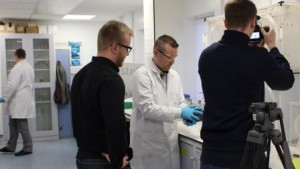
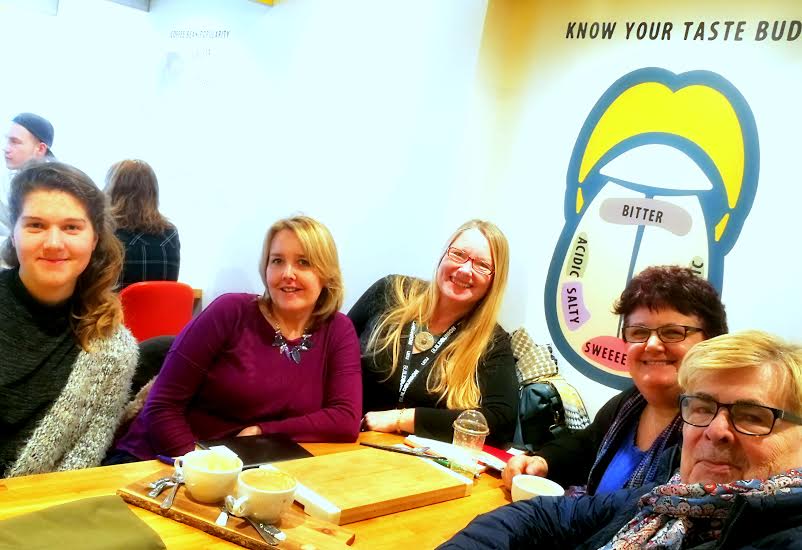
CQR Photo-elicitation “In Conversation” Seminar Wed 1pm
Latest research and knowledge exchange news at Bournemouth University
Bournemouth University will be hosting a Public Involvement seminar series throughout March and April, which focusses upon the public/patients working with staff to: 1) prioritise research; 2) advise upon project methodology; 3) design recruitment campaigns; 4) develop research materials; and 5) promote the impact of findings.
Patient and Public Involvement (PPI) has broad application to research beyond Health and Social Care, allowing the public actively act as participants. Direct benefits to researchers include: ensuring research quality, credibility and relevance; public accountability and insights; and enhancing research funding.
Students, staff and the public are invited to the seminar series. UGR and PGR students attending three or more seminars will be eligible to apply for an opportunity to run their own PPI advisory group with hip-replacement patients. This will be supported by ORI and the Department of Sport and Physical Activity, and has ongoing potential for conference presentation and journal article preparation.
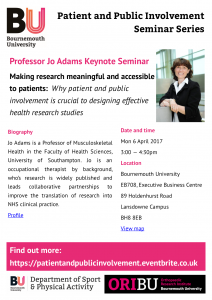
Patient & Public Involvement (PPI) Seminar Series
Location EB708, Executive Business Centre, Lansdowne Campus
Monday 6th March, 3-4.30 pm
Why PPI is crucial to designing effective health research studies
Professor Jo Adams, Professor Musculoskeletal Health, University of Southampton
Wednesday 15th March, 3-4.30 pm
Importance of public involvement in research design: an orthopaedic case study
Lisa Gale-Andrews & Dr Zoe Sheppard, Faculty of Health and Social Sciences, Bournemouth University
Monday 3rd April, 3-4.30 pm
Recruiting and supporting participants to engage in meaningful PPI
Dr Mel Hughes & Angela Warren, Carer and Service User Partnership, Bournemouth University
Monday 24th April, 11-12.30 pm
How can today’s patient help research tackle tomorrow’s health challenges?
Simon Denegri National Director, Patients and the Public in Research (INVOLVE)
Book your place now: https://patientandpublicinvolvement.eventbrite.co.uk
Refreshments are available and there will be plenty of time for discussion at the seminar end. Any questions please contact:
Dr James Gavin
Email jgavin@bournemouth.ac.uk
Phone +44 (0)1202566303
Established in 2015, Bournemouth University’s Orthopaedic Research Institute (BUORI) is at the forefront of developing virtual reality training and robots that will allow surgeons to perform hip replacements in this world and beyond.
As part of his inaugural lecture, Professor Robert Middleton, Head of BUORI, will share his research into developing virtual reality training for surgeons, which allows them to practice in the space in front of them – or even in space!
After the lecture, you’ll have the chance to see some of the state-of-the-art training equipment being used by BUORI and even try your hand at virtual surgery.
Professor Middleton joined Bournemouth University in 2015, while continuing to practise as a Consultant Orthopaedic Surgeon at the Royal Bournemouth Hospital and working as the Director of Trauma at Poole Hospital. His extensive clinical experience helps to inform his research and the direction of Bournemouth University’s Orthopaedic Research Institute (BUORI).
Bournemouth University’s inaugural lecture series aims to celebrate new professorial appointments and the depth and breadth of research produced by the university. For further information on the inaugural lecture series, please visit www.bournemouth.ac.uk/public-lecture-series
About the event
To book your free ticket, click here.
Venue: Executive Business Centre, Holdenhurst Road.
Date: Wednesday 12 April.
Time: 6:30pm for a 7pm lecture start.
Refreshments will be provided at the event.
For more information about the event, please contact Rachel Bowen at rbowen@bournemouth.ac.uk.
Jo Johnson spoke at a UUK conference today and made a number of important announcements:
HE and Research Bill – As mentioned above, the amendments continue to accumulate for the Lords report stage of the HE bill with the latest government amendments yet to be published. See the latest round up from Wonkhe here. One joint government and Labour amendment (to replace the opposition amendment passed in the House of Lords) defines institutional autonomy, and a number of others require the OfS to protect that autonomy. The definition that is proposed is set out below:
Other proposed opposition amendments include:
The HEFCE grant letter is out, with extensive coverage. Research Professional report that:
BTEC students – the Higher Education Policy Institute (HEPI) have issued a report on BTECs and Pearson have blogged for them. The report concludes that “Students arriving at university with BTECs account for much of the growth in students from the lowest participation neighbourhoods and other under-represented groups over the past decade. But those with BTECs face a ‘glass ceiling’ – for example:
The report makes the following policy recommendations:
Lifelong learning – The University Alliance issued a report on lifelong learning which calls for a number of actions, including setting up a UCAS style system for adult learning courses, reintroducing individual learning accounts and providing additional loans. They also mention accelerated degrees and suggest broadening the apprenticeship levy to cover such course.
Essay Mills – Jo Johnson called this week on universities to do more to stop students buying custom written essays online. He has asked the QAA to prepare guidance for universities and information for students to help combat the use of ‘essay mills’ websites as well as other forms of plagiarism and for the QAA to take direct action against those marketing the services. It looks as if the guidance will focus on making sure that universities have policies and sanctions in place.
“The Universities Minister has asked for guidance aimed at universities and information for students to help combat the use of these websites, as well as other forms of plagiarism. The Quality Assurance Agency (QAA) has also been tasked to take action against the online advertising of these services and to work with international agencies to deal with this problem.
The Minister is calling for the guidance to include tough new penalties for those who make use of essay mills websites, as well as the need to educate students about the potentially significant negative impacts on their future career if they are caught cheating.
Universities Minister Jo Johnson said: “This form of cheating is unacceptable and every university should have strong policies and sanctions in place to detect and deal with it“. Essay mill websites threaten to undermine the high quality reputation of a UK degree so it is vital that the sector works together to address this in a consistent and robust way.””
Brexit – The Department for Business, Energy and Industrial Strategy (BEIS) has published the terms of reference and membership of its “high level stakeholder working group on EU exit, universities, research and innovation”.
“The overarching purpose of the group is to provide a forum for BEIS, DfE, DExEU, and a broad range of UK representatives of the universities, science, research and innovation communities to discuss issues of common interest in approaching the UK’s exit from the EU. The emphasis will be on considering all factors related to research and innovation that need to be taken into account as government policy develops.”
Membership includes Jo Johnson, Madeleine Atkins, Nicola Dandridge, and the chairs of Million Plus, the Russell Group, GuildHE and the University Alliance, a couple of VCs and PVCs from the devolved administrations (Heriot-Watt, Ulster, Cardiff) and representatives of a number of science bodies such as the Royal Academy of Engineering, the Campaign for Science and Engineering and others, CBI, RCUK, UKRI. And Sir Mark Walport in his current role as the Government Chief Scientific Adviser. Interestingly, none of the bodies represented are arts or social sciences bodies, which continues to demonstrate the apparent assumption in all of these groups on research as an activity that is only relevant to STEM.
Competition and Markets Authority (CMA) have intervened following a complaint to OIA from students that didn’t receive sufficient notice that compulsory modules had been introduced to their course. While UEA was not considered by OIA to have breached its rules the CMA have asked UEA to change its policy and consider the introduction of compulsory modules as a substantial change which would require greater timeliness of notice in future. CMA’s intervention is seen as a landmark intrusion by some. The CMA request is discussed further by Jim Dickinson and Paul Greatrix on Wonkhe. UUK also have a blog on the subject.
Researchers from the Advances in Media Management (AiMM) research cluster have had 8 Abstracts (a 100% success rate) accepted for the forthcoming European Media Management Association conference in Belgium. This was a notable success for the group, bearing in mind that the rejection rate for all conference submissions was 24%. AiMM put their success down to research mentoring and introducing an internal peer review system within the group.
Congratulations go to: Dr Chris Chapleo (Media Branding), Dr Joyce Costello (CSR Practices in Media Firms), Dr Mona Sayed Esfahani (Media Branding); Graham Goode (Brand Orientation in Media Companies); Conor O’Kane (The Media Economics of Privacy); Dr John Oliver (Digital Media Transformations).
Are you interested in getting to know the local community, and sharing your research and expertise with others? Do you have exciting research to talk about or would you like to gain some valuable experience in public engagement?
Join us in a lead up to Festival of Learning and be part of RNLI College Food and Drink Festival on 30th April! The festival is focused on great quality food, sourced and produced here in Dorset, and supports Mayday campaign, which is a nationwide community fundraising campaign.
There is a community theme to the Festival so we’re looking for activities that may be of interest to the local community or are around community based research. We’d also be keen to take along any food and drink related activities about. However, if your activity is not directly related then we’d still love to hear from you. Please drop me an email on jpawlik@bournemouth.ac.uk to express your interest in joining us and I will be able to provide you with more details.
We’re also looking for activities for Poole Maritime Festival and are looking forward to hearing from you! To find out more please click here.
On Thursday 2nd March 2017 Professor Edwin van Teijlingen (CMMPH – Professor Of Reproductive Health, BU) will be presenting one of the ‘Leading Innovation Masterclasses’ on Research & Funded Interventions.
In a very competitive field, the chances of successfully gaining a research grant can be somewhere in the region of one in twelve. In this session Professor van Teijlingen will explain how it may be possible to increase the chances of getting research funds through intervention grants. It will take place at the Lansdowne Campus 14:00-15:30 and you can book a place by emailing od@bournemouth.ac.uk
Other sessions in the series include:
Details of these can be found on the Staff Intranet
Dr
James Gavin is running a free series of seminars on patient and public involvement (PPI).
This series will highlight the importance of PPI throughout the research cycle, from design to dissemination. PPI is gaining importance to identify treatments that meet people’s needs and are more likely to be adopted in practice.
Speakers will share insights on involving the public as partners to improve: relevance, quality, study protocol design and the communication of findings in health research. The speakers are from a variety of roles in occupational therapy, mental health, social work, health demographics, education and national health governance.
To find out more information and to book your place please click here.
| Date | Location | Time | Speaker | Seminar Title |
| Monday 6 March 2017 | EB708, Lansdowne Campus | 3.00-4.30pm | Professor Jo Adams | Making research meaningful and accessible to patients: Why PPI is crucial to designing effective health research studies |
| Wednesday 15 March 2017 | EB708, Lansdowne Campus | 3.00-4.30pm | Lisa Gale-Andrews & Dr Zoe Sheppard | Importance of public involvement in research design: an orthopaedic case study |
| Monday 3 April 2017 | EB708, Lansdowne Campus | 3.00-4.30pm | Dr Mel Hughes & Angela Warren | Recruiting and supporting participants to engage in meaningful PPI |
| Monday 24 April 2017 | EB708, Lansdowne Campus | 11.00am-12.30pm | Simon Denegri | How can today’s patient help research tackle tomorrow’s health challenges? |
This article was originally published on The Conversation. Read the original article.
If you’d like to pitch your own article idea to The Conversation, please contact either newsdesk@bournemouth.ac.uk or rbowen@bournemouth.ac.uk.
Grzegorz Kapuscinski, Lecturer in Marketing Management, Bournemouth University
Terrorist attacks are designed to intimidate and change behaviour. It should be no surprise then that we allow fear to be a great motivator when we plan trips abroad. News of an attack is a vivid factor as we decide where to travel with our families, perhaps to places of which we know little else. Efforts by reporters to appeal to our concerns end up feeding us the prompts to avoid certain countries or cities, hammering an often crucial tourism industry in the process.
Ever since real-time news coverage brought the horror of the 2001 World Trade Center attacks into people’s homes, global audiences have become used to watching such events unfold on screen. Recently, we have witnessed shootings at Port El Kantaoui beach, near Sousse in Tunisia in 2015, the Bataclan attack in Paris in the same year, and the New Year’s Eve nightclub shootings in Istanbul less than two months ago.
These are all key holiday destinations. The tactics used and the damage inflicted may differ, but every attack has the potential to stop us in our tracks. This is clearly of huge significance to the tourism and hospitality sectors.
The first problem is obvious. Uncertainty around safety often translates into avoidance of those places considered dangerous. Holidays are postponed or cancelled. Ultimately, limitations are placed on tourists’ freedom of mobility.
Unsurprisingly, the tolerance of potential physical harm is low in discretionary travel, where other options are readily available and the destination can be incidental. Terrorism has served to highlight the fragility of the tourism industry: the displacement of holidaymakers has caused severe economic losses. In Tunisia, where tourism accounts for 15% of GDP, the effect has been stark, with 2016 revenues cut by half from a year earlier.
In Turkey, which suffered from a wave of attacks during 2016, the Association of Turkish Travel Agencies has predicted a negative impact on tourism revenues of £2-2.5 billion.
In truth, many potential holiday destinations will have a recent or more distant history of safety issues of one kind or another. In an era of uncertainty, under pressure of time, family member concerns, and the risk of financial loss, many tourists turn to the news media for explanation. The question is, how do we arrive at our final decisions?
Years of study on the psychology of risk suggests that the way the public assess danger has much more to do with stuff like emotional responses, their perceived level of control, or their familiarity with a hazard, than official statistics.
News stories of new and emerging hazards often entail multiple storylines, especially in times of conflicting accounts and factual uncertainty. These act as qualitative indicators of risk that allow audiences to simplify complexity and categorise the situation as involving more or less danger. And so terrorism which is framed as religious extremism can appear irrational, beyond compromise and uncontrollable, and can lead to higher levels of perceived risk.
One recent study I carried out with Bournemouth Professor Barry Richards has shown that small variations in news reports can lead to significant changes in leisure tourists’ risk perception. We all have our own unique set of experiences that dictate how we digest news. However, it seems likely that tourists, who instinctively seek to minimise risk will – after years of exposure to coverage – share a deep pool of associations to terrorist attacks: why they are carried out, and who is likely to be targeted. This allows them to create a coherent picture, a mental shortcut which feeds decision making around a fraught and complex task.
It can come down to details. One experiment in the study mentioned above suggests that if articles emphasise the proximity of a bomb explosion to points of tourist interest, or reference other events where tourists were harmed, then there tends to be a greater judgement of risk. It’s the same for an alleged link to religious extremism as opposed to other things, such as a domestic separatist movement.
We are also sensitive to accounts from the general public when assessing risk related to terrorism. Reports which quote reactions from local people and which stress the relative newness of the problem, and a lack of confidence in maintaining order and normality, lead to higher estimations of risk. Portrayals of the incident that stress resilience decrease perceived risk.
This doesn’t mean that the media has an agenda in pushing an intimidating interpretation of these events, or that audiences can be easily influenced. The point is that journalists who report on these tragic incidents do so in a style that seeks to resonate with the audience. That means using templates which appear to give information which helps us protect ourselves and our loved ones. It is this transaction which can end up devastating a country’s tourism revenues.
In fact, interviews I carried out with my colleague after the study demonstrated that news consumers have become able to do the job themselves. Even when exposed to reports that aim to soften perceived risk, the audience can use examples of other events when tourists were targeted to interpret destinations as particularly dangerous. For example, a report that stressed a focus on military targets in remote areas of a destination was met with distrust by a tourist who believed the information was intended to downplay the magnitude of risk to Western tourists.
Those “gut feelings” we use to make difficult decisions like this under pressure may actually be wired in from exposure to news coverage. The hard bit is to acknowledge that and manage our responses to emotive and vivid content which can cloud reason and lead us to over- or underestimate risk.
Recent work from Bournemouth University indicates that these non-native pitcher plants are consuming bumblebees but their current impact is limited.
In a bog in Dorset grow a small patch of the strange, alien like forms of the invasive pitcher plant Sarracenia purpurea. It is adapted to the poor soils of American wetlands and therefore supplements its diet with insect prey, luring them in with the promise of sweet nectar.
Photo by Anita Diaz
It is not every day that an invasive plant species also counts as predator and this can prove a challenge for management. The pitchers are one such case and a research team from Bournemouth University have been investigating the impact these invaders are having on the native bumblebees. They have done this by looking at the contents of the pitcher’s
traps.
Their results showed that no rare bumblebee species were found in the sampled pitchers from 2012-14. In 2013 the pitchers were found to be consuming a considerable amount of bumblebees (101 bees in the 170 pitchers sampled), however, very few bumblebees were caught in 2012 and 2014. Bumblebees also seem to be attracted to pitchers where the pitchers grow in higher density, suggesting that the bumblebees are treating the pitchers as they would another floral resource, despite individuals being trapped.
It is quite probable that the bumblebees feed off the flowers of the pitcher plants, as they do in the plant’s native America, as well as the nectar from traps. It is also likely you see flowers online due to the low capture rate of pitchers (around 1 in 100 insects get caught), and the majority of visiting bumblebees are getting a ‘free meal’ in a bog habitat with limited other resources.
‘It could very well be that the sugar rich solution produced by the pitchers, coupled with the low trapping rate of pitchers, is worth the risk to our native bees’ Dr Liz Franklin
Photo by Anita Diaz
It is important to prevent the spread of invasive plants like S. purpurea, as they can have a drastic impact on our native plant life and wildlife, however in a sensitive bog habitat with Site of Special Scientific Interest (SSSI) status, removal could cause severe damage to the native habitat and risk the further spread of the invasive. It is hoped that this work will help inform when and where management of S. purpurea is needed in its invasive populations around Europe
Although further work needs to be done on the interactions between invasive pitcher plants and their native prey, the pitchers might not be as bad for our bogs and their fauna as first thought, although it will be important to keep an eye on them.
Want to find out more, visit our open access article
Hi all,
This is just a quick post to introduce myself – I started in January as a Post-doctoral Research Fellow in the Faculty of Human Sciences and Public Health, and am working on the Implementing Nutrition Screening in Community Care for Older People (INSCCOPe) project (led by Professor Jane Murphy).
This project explores factors that may promote or inhibit successful implementation, and embedding in routine practice, of a new procedure for screening and treatment of malnutrition by integrated community teams (ICTs). The procedure is currently in development as part of service improvement work within Southern Health NHS Foundation Trust, and the INSCCOPe project will run in parallel. The project will run for 14 months, and is informed by Normalisation Process Theory (NPT) (http://www.normalizationprocess.org/).
I’ve been made to feel very welcome in my short time at BU, and look forward to meeting new people in the faculty in future. Below is a short summary of my background and current research/development interests.
Kind regards,
Mike.
(p.s. apologies if you’re seeing this for the second time – I initially sent this around the HSS-staff list by mistake)
Dr. Mike Bracher (Post-doctoral Research Fellow, INSCCOPe project)
Faculty of Health and Social Sciences, Department of Human Sciences and Public Health, Bournemouth University.
Background:
Current research interests and professional development aims:
My research interests are in the uses of data from applied health research to drive improvements in healthcare by:
My current professional development aims include:
A reminder that the deadline for academic applications is 1st March 2017.
Academics are invited to submit applications for the semester-based round of the SRA programme.
The academic applications will be assessed against the following criteria which you will need to demonstrate within the application form:
Approved academic applications will be advertised as SRA positions to students with student applications being received, processed and managed centrally within RKEO and distributed to the relevant academics after the closing date. The academics will be responsible for shortlisting, interviewing and providing interview feedback to their own candidates. Successful students will need to complete monthly timesheets, signed by their supervisor for payment and processed by the relevant Faculty.
These SRA vacancies will be available to taught BU students only, where SRA applicants must be able to work in the UK, be enrolled during the time of their assistantship and also have an average grade of over 70%. Staff are permitted to have multiple SRAs.
If you have any queries, please contact Rachel Clarke, KE Adviser (KTP and Student Projects) – sra@bournemouth.ac.uk
The Research and Knowledge Exchange Office (RKEO) invite all ‘new to BU’ academics and researchers to an induction.
This event provides an overview of all the practical information staff need to begin developing their research plans at BU, using both internal and external networks; to develop and disseminate research outcomes; and maximising the available funding opportunities.
Objectives
Indicative content
For more information about the event, please see the following link: http://blogs.bournemouth.ac.uk/research/research-lifecycle/developing-your-proposal/
The sixth induction will be held on Tuesday, 7th March 2017 on the 4th floor of Melbury House.
| Title | Date | Time | Location |
|---|---|---|---|
| Research & Knowledge Exchange Office (R&KEO) Research Induction | Tuesday 7th March 2017 | 9.00 – 12.00 | Lansdowne Campus |
9.00-9.15 – Coffee/tea and cake/fruit will be available on arrival
9.15 – RKEO academic induction (with a break at 10.45)
11.25 – Organisational Development upcoming development opportunities
11.30 – Opportunity for one to one interaction with RKEO staff
12.00 – Close
There will also be literature and information packs available.
If you would like to attend the induction then please book your place through Organisational Development and you can also visit their pages here. We will directly contact those who have started at BU in the last five months.
We hope you can make it and look forward to seeing you.
Regards,
The RKEO team
On 10 February, the Faculty of Media and Communication’s Dr Shelley Thompson gave an intervention to a UN event on the impact of media on gender and science.
The conference was held simultaneously in New York City at the UN Headquarters and Malta at the Ministry of Social Dialogue, Consumer Affairs and Civil Liberties. Speaking from Malta, Shelley discussed some of the early findings of her research on the under representation in news of women scientists as experts on nanotechnology. She also linked her work to broader research on under representation of women’s voices in news and politics.
The event was part of the UN’s International Day of Women and Girls in Science, which aims to raise awareness of gender bias in the sciences. It was chaired by Malta’s Minister of Social Dialogue, Consumer Affairs and Civil Liberties, Dr Helena Dalli, MP, and featured speakers from around the world, including UN ambassadors, politicians, policymakers, NGOs, women scientists, and girls aspiring to be scientists.
Shelley is a member of the Centre for Politics and Media Research, which engages in interdisciplinary research from a range of fields to consider pressing questions in 21st Century politics.
CALL FOR PARTICIPANTS
Two-day workshop: Politics in a post-truth era
10th – 11th July 2017, Bournemouth University
The concept of post-truth, where facts are deemed less important than beliefs, is one that has recently been frequently invoked when making sense of the modern political campaigning environment. The suggestion is that political campaigns exploit and reinforce strongly held beliefs, encouraging the disavowal of contrasting facts, in order to undermine support for the arguments of opponents.
Post-truth has become most associated with campaigns that invoke more populist arguments. Such arguments give voice to privately held beliefs, often hidden by norms of societies which reinforce pejorative stereotypes based on religious and racial differences, gendering of roles and discussing myths of us (as a nation and people) and the others whose differences mark them as not us. Hence there are far-reaching implications of such practices for democratic societies.
The workshop will explore the underlying themes and implications of this phenomenon.
KEY QUESTIONS
1) Is post truth really new, or simply a synonym for the exaggerations and spin long associated with the techniques of political campaigns? Or have political campaigns been proven to lie more?
2) What does a post-truth campaign look like, how is the communication constructed to tap into belief systems and feed the dynamics of a post-truth (belief-based) political environment?
3) Why might beliefs have more power in influencing voting behaviour than more fact, logic or reason based arguments?
4) How does post-truth link to the models of a marketised and professionalised campaign environment?
5) What does post-truth tell us about the current and future state of democratic engagement and of democracy itself?
CONTRIBUTIONS
Contributions need not be full papers, rather informed arguments that promote discussion – although they should have the potential to be full or part papers. The workshop seeks to tease out what post-truth means, how this is encouraged during political campaigns, its root causes, impacts on election outcomes and, importantly, what are the implications for democracy.
PUBLICATION
The longer-term aim is to develop an edited collection of work that would include solo-authored or joint publications from participants that address these questions. The volume will be published in the Palgrave series Political Campaigning and Communication.
DATES
The event will be held on July 10th and 11th with a workshop dinner on the evening of the 10th. There will be no attendance costs – the venue, refreshments and evening meal will be covered jointly by funding from the Centre for Politics and Media Research and the PSA Political Marketing Group. Participants should expect to cover travel and accommodation. The venue will be the Bournemouth University’s Executive Business Centre close to Bournemouth train station.
ABSTRACTS
Interested participants should propose their participation by offering a short 200-300 word abstract that summarises the main points of the argument, case studies and evidence drawn upon and the broader socio-political implications into which their argument offers insights. The deadline for abstracts is 1600hrs GMT on Friday 6th April 2017. Please email them to dlilleker@bournemouth.ac.uk
Jeff Bray, Bournemouth University and Heather Hartwell, Bournemouth University
This article was originally published on The Conversation. Read the original article.
If you’d like to pitch your own article idea to The Conversation, please contact either newsdesk@bournemouth.ac.uk or rbowen@bournemouth.ac.uk.
Eating out is bad for us. Studies have shown that food provided outside the home contains more calories and more fat, especially saturated fat. The trouble is, many of us are eating this food every day without really realising what’s in it.
In recent years great efforts have been taken to help us understand the composition of packaged food. The clear marking of allergens, ingredients lists and “traffic light” indicators on the front of packs show retail customers how much fat, saturated fat, sugar and salt are contained. However, there is an important gap in this admirable trend.
Those of us who eat our lunch in a workplace canteen find it a lot more difficult to access the kind of information that leads to informed choices. And canteens can play a critical role in terms of healthy eating. They are a captive, sometimes subsidised, setting that is often used to provide the main meal of the day. In effect, many of us are eating out five times a week without really acknowledging it.

So how many of us are using these canteens? Well, three quarters of workers in the UK stay at work over lunchtime, with 31% eating at a workplace canteen. That’s more than 7m of us. While nutritional and allergen labelling is now widespread in our supermarkets, workplace canteens rarely provide such information in an easily accessible format. Influencing dietary behaviour here could be instrumental in reducing employees’ risk of developing chronic diet related diseases such as type 2 diabetes or obesity. It should give companies and organisations healthier, happier and more productive employees.
The personal and economic benefits are clear. Health, simply put, can contribute to an organisation’s value. And we have got used to knowing: there is growing consumer interest in information on food eaten out of the home. This includes the nutritional content of dishes, the origin of ingredients and the presence of possible allergens. It could easily be argued that it is a fundamental right to know what we are eating.
New EU regulation requires the clear labelling of the presence of 14 allergens for pre-packaged food and food served. The 2010 Patient Protection and Affordable Care Act, in the US goes further, requiring nutritional information to be posted in restaurants and large fast food chains. There are similar requirements in Ireland. However, more can be done in workplace canteens to ensure that diners are able to make informed choices. Where dish information is available, it is often not provided in a consumer-friendly way. Possibly as a consequence of this, studies have found that the increased presence of data is not always having a strong influence on consumer choice.

So how can we change this? Currently, most information on food offered at work is printed out on a menu card or information board. If you’ve ever eaten in a canteen you will know how cursory the glances are from busy staff to these sources. And if you do take the time to look, the information is normally limited to a description of the dishes with little nutritional or other enhanced information available.
It means that each diner has to work hard to find the information that is relevant to them. After all, the ideal nutritional intake of a manual worker will be quite different than for staff who just push pens or hammer keyboards for a living. What is healthy for one diner might not be so ideal for the next. The need for a personalised approach to providing information is clear, and the solution might lie in our pockets.
Technology, most notably apps on our mobile phones, have been shown to have good potential for providing detailed but clear individualised information. People will happily interact with a well-designed bit of software where they wouldn’t hunt down the printed menu.
That is why a pan-European partnership between industry and academia has developed the FoodSMART project. This project is developing a smart phone app, which uses detailed dish data uploaded by the caterer to provide you with personalised information. You can tailor the information to your particular dietary requirements and preferences and it should allow the lunchtime crowd to assess their food intake precisely and efficiently. It can also make individual recommendations to help diners improve their health and well-being. All you have to do is scan a QR code with your phone to access the menu and all of this enhanced dish information.
Any initiative encouraging us to eat more “attentively” can help to reduce calorie intake. Enhanced information also allows those with food intolerances and specific dietary needs the freedom to eat away from home with ease. The millions of us who eat at a workplace canteen have been left in the dark while other initiatives help to shape our lifestyle choices. So whether you download an app, hunt down the menu cards or interrogate the canteen staff, it is probably time we did something about a five-day-a-week habit that could be damaging our health.
The following funding opportunities have been announced. Please follow the links for more information:
Arts and Humanities Research Council, GB
The AHRC invites applications for its Follow-on Funding for Impact and Engagement Scheme (FoF): Highlight Notice for AHRC’s Four Themes, which seeks to encourage innovative applications that explore new, unanticipated, pathways to impact which have emerged or evolved from research undertaken under AHRC’s four Themes: Science in Culture; Translating Cultures; Digital Transformations; and Care for the Future.
Maximum award: £100,000. Closing date: 4pm, 26/04/17.
Biotechnology and Biological Science Research Council, GB
The Biotechnology and Biological Sciences Research Council invites applications for the David Phillips fellowships, which provide support for researchers to establish their first independent research group. Applicants must show high potential and be able to demonstrate they are on an upward trajectory, with clear evidence of strong scientific outputs and leadership qualities required to establish their own fully independent programme of research. Awards are for five years, and include personal salary and a significant research support grant to enable fellows to establish their own independent research group. Please check call details for eligibility.
Maximum award: £1million. Closing date: 4pm, 11/05/17.
The Biotechnology and Biological Sciences Research Council invites applications for its Future Leader Fellowships, which will provide support for researchers wishing to undertake independent research and gain leadership skills. The Fellowship will support the transition of early stage researchers to fully independent research leaders.
Maximum award: £300,000. Closing date: 4PM, 11/05/17.
Medical Research Council, GB
The Department of Biotechnology DBT) in India, in collaboration with Department of International Development (DFID), the Economic and Social Research Council (ESRC) and the Medical Research Council (MRC), are pleased to announce a second joint call to fund global health research addressing the health needs of women and children globally. Research will impact the ability to prevent, diagnose and manage prevalent chronic and infectious diseases facing women and their unborn children in low- and middle-income settings. Research addressing these health issues will aim to have a positive effect on the life-course of the mother and her unborn children. Proposals should only address the following issues; Anaemia (including Iron, Folate and B12 deficiency related conditions); Sexually transmitted diseases; Gestational diabetes mellitus and; Hypertensive disorders. To support the development of these trilateral partnerships a £4000 travel grant will be available to successful applicants after the concept proposal stage in order to support the full proposal development process. Interested parties must submit a concept proposal by 4pm, 12/04/17.
Maximum award: Not specified. Closing date: Invited full proposals by 4pm 14/09/17.
Natural Environment Research Council, GB
NERC, the Engineering & Physical Sciences Research Council (EPSRC) and India’s Department of Science and Technology (DST) jointly invite proposals to a new three-year research programme to improve water quality. The programme aims to improve water quality by providing a better understanding of the sources and fate of different pollutants and by supporting the development of management strategies and technologies to reduce pollution levels. Proposals are sought for collaborative research projects involving researchers from both the UK and India. Interested parties must submit a notice of intent by 4pm, 30/03/17 to be eligible.
Maximum award: £450,000 (80% fEC) for UK component with equivalent in terms of research effort from DST for the Indian Component. Closing date: 4pm 26/04/17.
Royal Society, GB
The Royal Society offers Newton International Exchanges to international researchers with funding towards travel, subsistence and research expenses for either a one-off short visit to explore opportunities for building lasting networks, or for bilateral visits to strengthen emerging collaborations. Awards are currently available to researchers in Malaysia, Mexico, South Africa, Thailand and Turkey. Collaborations should focus on a single project with an overseas-based scientist (“the Applicant”) and UK-based scientist (“the Co-applicant”).
Maximum award: £12,000. Closing date: 15/03/17
If you are interested in submitting to any of the above calls you must contact RKEO with adequate notice before the deadline. Please note that some funding bodies specify a time for submission as well as a date. Please confirm this with your RKEO Funding Development Officer . You can set up your own personalised alerts on Research Professional. If you need help setting these up, just ask your Faculty’s Funding Development Officer in RKEO or view the blog post . If thinking of applying, why not add notification of your interest on Research Professional’s record of the bid so that BU colleagues can see your intention to bid and contact you to collaborate.
The research*eu results magazine published by the Community Research and Development Information Service (CORDIS) is looking for European projects to feature in its publications. Research*eu results is published 10 times a year, featuring results from the most successful EU-funded research and development projects. The magazine covers projects in Biology and Medicine, Social Sciences and Humanities, Energy and transport, Environment and society, IT and telecommunications, Industrial technologies, and Space.
If you have a completed EU-funded project and would like to get your results published please contact the CORDIS editorial team at editorial@cordis.europa.eu. Priority is given to those projects which have resulted in the development of a new technology with potential for commercialisation over the next few years, or in potentially game-changing research for a specific field of science.