In today’s post we give a case study of how Bournemouth University Clinical Research Unit (BUCRU) recently supported the development of a grant application.
Case study
We recently supported a Programme Development Grant (www.ccf.nihr.ac.uk/PGfAR/PDG/Pages/default.aspx) application to the National Health Service (NHS) National Institute for Health Research (NIHR). The Unit receives funding from the NIHR to be the Dorset Office of the NIHR Research Design Service (RDS), and thus can support local researchers in the University and the NHS to develop their funding applications. The topic of this grant application was early warning systems for use in an obstetric setting. Early warning systems are used by clinical staff in hospital to identify clinical problems before they get too serious, for example by regularly monitoring vital signs such as blood pressure. The purpose of Programme Development Grants is to fund preliminary work ahead of a larger Programme Grant for Applied Research (PGAR; www.ccf.nihr.ac.uk/PGfAR/Pages/Home.aspx).
This support involved:
- Providing methodological input in systematic reviews, surveys, qualitative designs, quantitative designs notably a sample size calculation, and trial design.
- Patient and public involvement (PPI) – the team has a designated person supporting PPI.
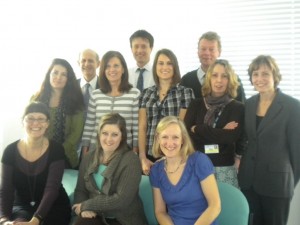
- Team development – a strong team needed to be developed with the appropriate skill mix to deliver the programme of research. Four members of BUCRU became co-applicants on the proposal bringing methodological expertise in systematic reviews, qualitative research, quantitative research, and PPI support. Via our link with the RDS we also have access to health economist support. Collaborations were initiated with the Wessex Health Innovation and Education Cluster (HIEC; www.wessexhiecpartnership.org.uk/) to gain support in the educational/ training aspects of the research.
- Liaison – we liaised with a number of different organisations, such as Research and Knowledge Exchange Operations for costing the Bournemouth University (BU) costs, the NHS host organisation that will be responsible for the research, and the Market Research Group (MRG; https://mrg.bournemouth.ac.uk/) who were involved to support the administration and data entry for the survey component of the project.
- Identification of appropriate funding schemes.
- Obtained peer review from RDS colleagues across the region to provide feedback on the suitability of the funding scheme and the ‘readiness’ for submission. This service is usually provided through regular Scientific Committee meetings that act as ‘mock’ funding committees (www.rds-sw.nihr.ac.uk/scientific_committee.htm).
Quote from lead applicant: “Without the expertise and assistance of BUCRU staff it would not have been possible to even contemplate applying for a large and competitive grant such as the NIHR Programme Development Grant” .
Please contact us for support with health research:
Louise Ward (administrator):
Bournemouth University Clinical Research Unit
R505 Royal London House
Christchurch Road
Bournemouth BH1 3LT
Tel: 01202 961939


 Dr Joanne Mayoh




 Dr Lorraine Brown
 Congratulations to BU’s
  As part of Mental Health Week here at BU
  As part of Mental Health Week here at BU Dr
  and District branch, acting as their Patron and I organise their publicity. We are working on a number of local projects, not least looking to establish closer ties between BU and the Samaritans. A number of our students volunteer to work at the Branch. The Samaritans have a presence at several BU events. We are currently working with several people at BU to establish a crisis nightline, and training (any) staff who have contact with students who may need emergency help (we have already had some crises with the current BU student intake). We are also looking to work closely with other agencies and charities locally. Some of this may lead to research opportunities, exploring ways in which mental illness, stress and despair can be reduced in our community. I am planning a number of projects focusing on suicide and mental health (including the particular problems faced in rural communities).
 I am supervising a PhD project (Research student – Lauren Kita), working with the perinatal team within Dorset HealthCare University NHS Foundation Trust. We are exploring the extent that poor sleep may pose a risk factor for postnatal depression. We will be examining sleep objectively, using state-of-the-art EEG equipment, and subjectively, using sleep diaries. Women with a history of depression will compared to women without such a history, during pregnancy and at weeks 4 and 12 after the baby is born. The mother’s mood and other mental indicators will also be measured.
 The first closing date for the BU Research Development Fund – Small Grants Scheme (RDF-SGS) is 31 October 2011.
 I am sure that you would wish to join with me in congratulating both
  Come and find out all about open access publishing!



 The eTourism Lab,
  While there is agreement that charities nowadays have a greater need for marketing, there is little agreement on how they should be approaching marketing and especially when it comes to the adoption of Social Media; research has shown that they are lagging behind as they are waiting to see how others use this new technology. Today, charities of any size can take advantage of Social Media tools to showcase their organisation to the world without relying on huge budgets. Money is no longer the decision factor, creativity is. Getting a head start and expanding your Instagram presence buy choosing to
  Little research has actually been carried out on marketing from a non-profitable organisation’s point of view. Bournemouth University is experimenting with Internet and Social Media to try and classify a best practice for charities to help them engage and create awareness about the problem and how people can help make a change. Facebook and Twitter are primarily used to raise awareness and create story telling. As relationships are the foundation for Social Media sites they are key for charities in order to engage further with their stakeholders. So far our attempts have been successful and we have found that followers are engaging with us through Social Media and we are now looking into ways of raising money through the various platforms to help fund new projects around the world. Using social media strategically will be critical for organisations of the future and the expertise of the eTourism Lab will be widely used for all organisations engaging.







 ECR Opportunities: New Development Programme, Researcher Grants & Upcoming Events
 Help us capture BU’s knowledge exchange activity HE-BCI survey 2025–26
 Verbal autopsy paper published two days ago
 ESRC Studentships for 2027 Entry: Opportunity Now Open
 SONAMONI contributions to Safety Conference 2026 in South Africa
 Horizon Europe Cluster 3 (Civil Security for Society) 2026 Calls Now Open
 MSCA Doctoral Networks 2026 Call Information Webinar
 ESRC Festival of Social Science 2026: Application Deadline Extended to Thursday 25 June 2026
 Reminder: Register for the ESRC Festival of Social Science 2026 Information Session
 ECR Funding Open Call: Research Culture & Community Grant – Apply now
 ERC Advanced Grant 2025 Webinar
 Update on UKRO services
 European research project exploring use of ‘virtual twins’ to better manage metabolic associated fatty liver disease