We are wishing our colleagues, students, researchers and collaborators from South Asia a Happy New Year today. The best wishes for the Bangla New Year 1433 and for the Nepali New Year 2083!
Professors Edwin van Teijlingen and Vanora Hundley
Latest research and knowledge exchange news at Bournemouth University
We are wishing our colleagues, students, researchers and collaborators from South Asia a Happy New Year today. The best wishes for the Bangla New Year 1433 and for the Nepali New Year 2083!
Professors Edwin van Teijlingen and Vanora Hundley
Saturday 8th November was the final day of the national Festival of Social Sciences (FoSS), which was supported by the Economic and Social Research Council (ESRC). Many universities across the Uk organised a wide-ranging set of events.
Bournemouth University (BU) organised six events, and on the last day it put up a public-engagement event around its Sonamoni research project at the Royal National Lifeboat Institution (RNLI) building in Poole.
Drowning is the leading cause of death for children aged 6-24 months in Bangladesh, yet it rarely receives the same attention as other global health issues. The Sonamoni project, led by Bournemouth University and the Centre for Injury Prevention and Research, Bangladesh (CIPRB), is an interdisciplinary collaboration with the University of Southampton, the University of the West of England (UWE), the RNLI, and Design Without Borders (DWB) in Uganda. 
This £1.6m project has been made possible thanks to a grant from the UK’s National Institute for Health & Care Research (NIHR) through its Research and Innovation for Global Health Transformation programme. Sonamoni is in the process of developing practical, community-based solutions to reduce drowning among 6-24 months’ old children.
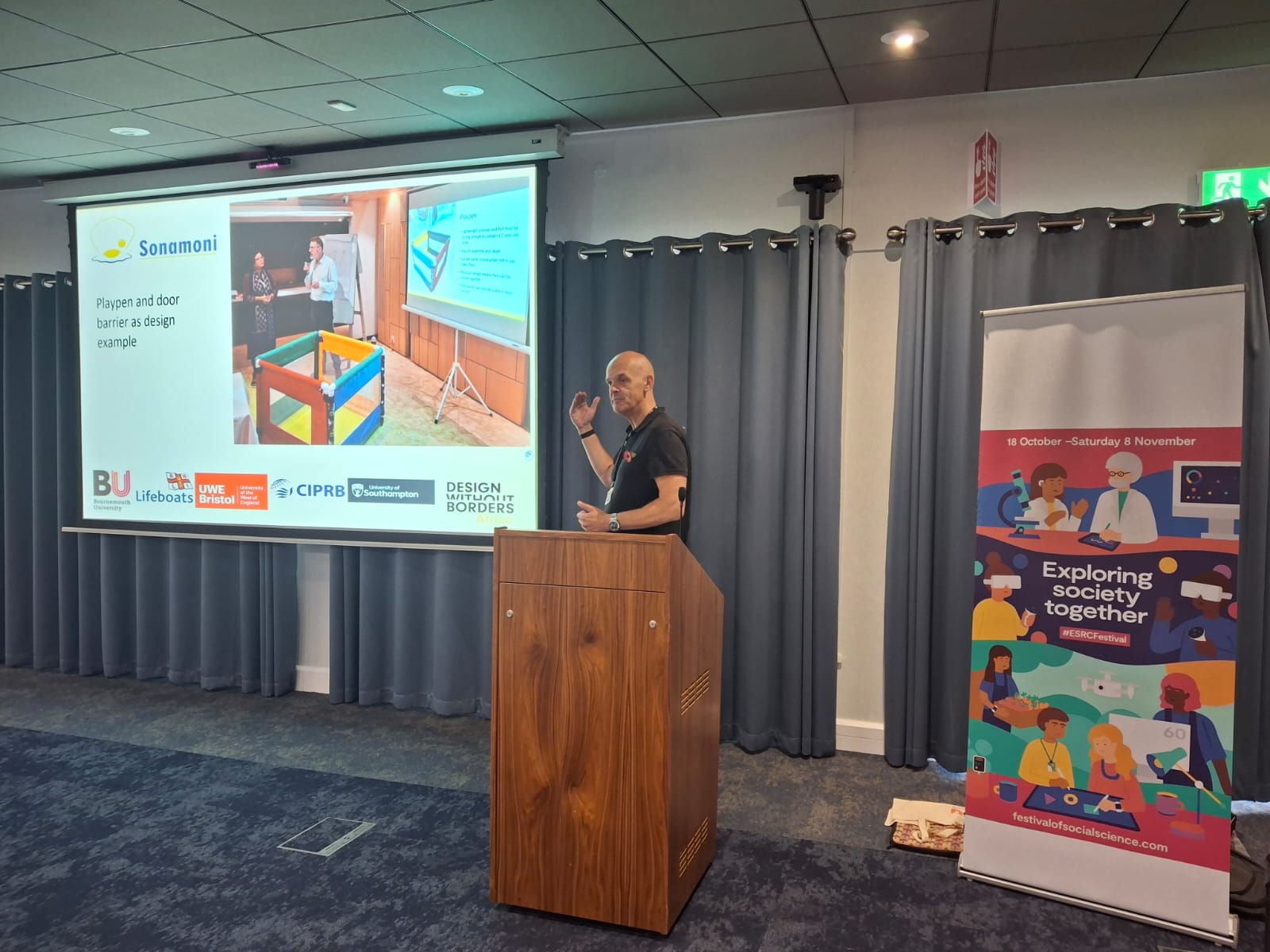
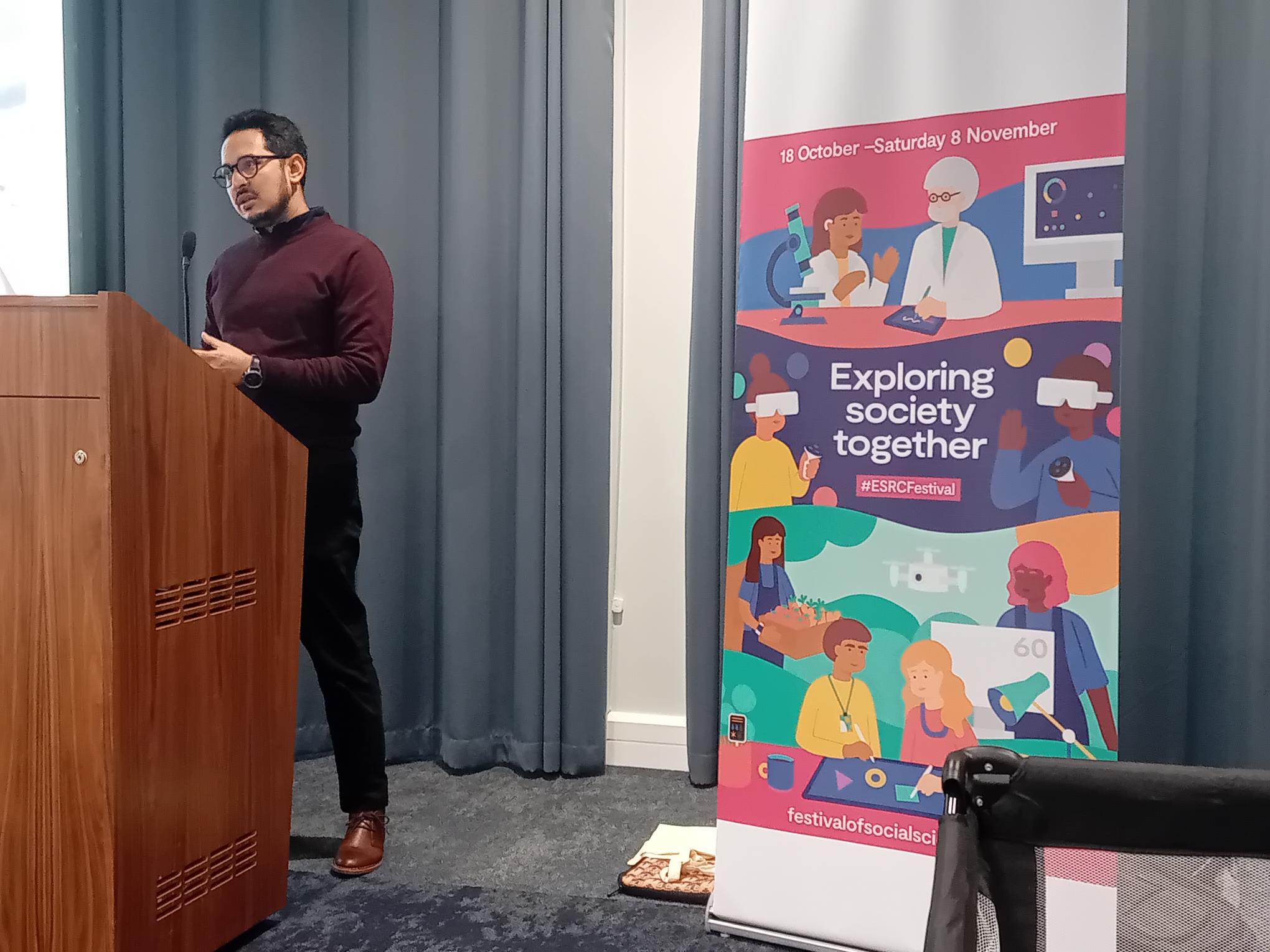
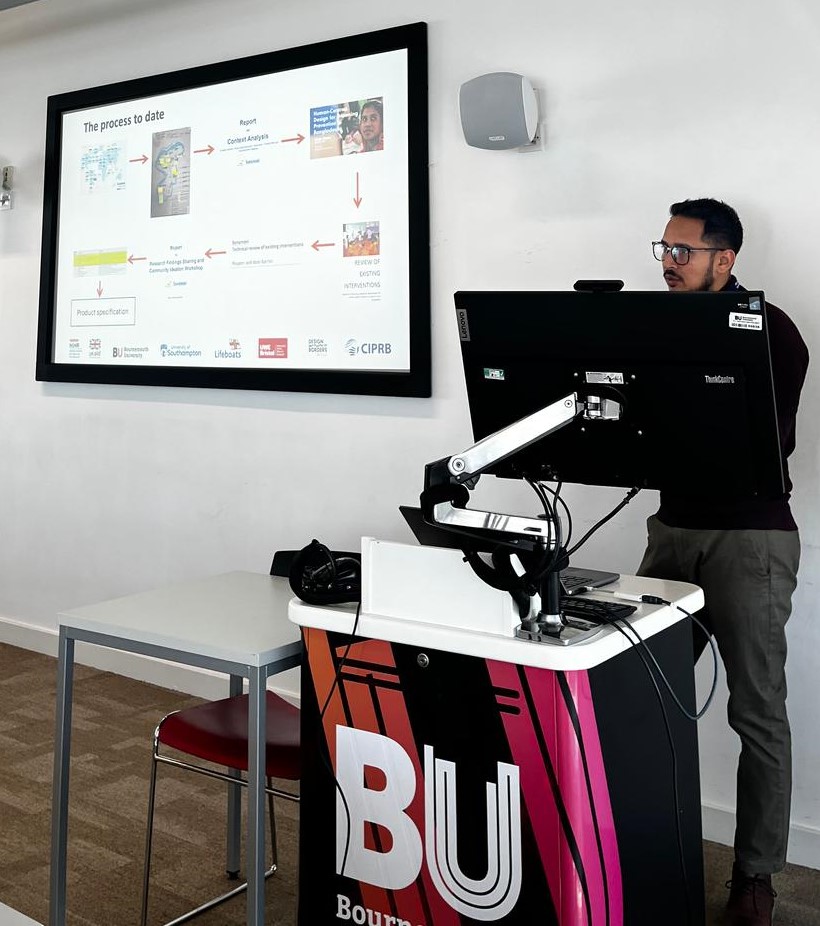
The FoSS event at the RNLI earlier this month was presented by BU academics John Powell and Edwin van Teijlingen with a major contribution from BU’s PhD student Md. Shafkat Hossain, whose doctoral studies focuses on the local community’s understanding of, and engagement with, the Human-Centred Design element of the Sonamoni project. Prof. van Teijlingen, from BU’s School of Health & Care, introduced the project and he highligthed the harmony between the different social science disciplines of the members of the international research team as well as the interdisciplinary nature of this collaboration. The FoSS event was prepared and supported by BU’s Yasemin Oksel Ferraris and Claire Fenton.
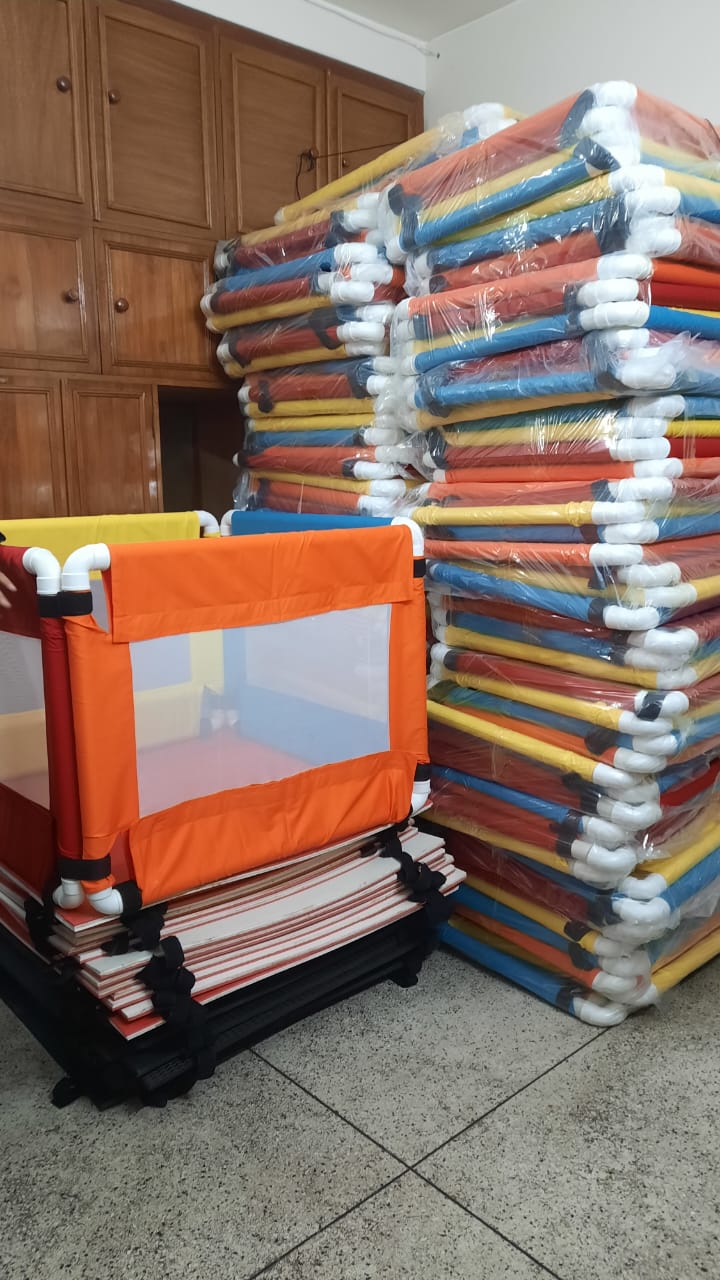
One of the ideas generated by the Sonamoni project, which involves local community involvement at all stages of the study, is a low cost playpen to keep young children save. John Powell MBE outlined the Human-Centred Design process and the eight potential solutions it generated.
The FoSS event on the Saturday morning focused particulary on the design stages of the playpen, from concept to a model that could be tested in the field in rural Bangladesh. The colourful first batch of playpens in the photo are ready to be taken to families to be tested in the two field sites. The audience of the FoSS event was particularly interested ways the researchers in Bangladesh managed to get and keep the community involved in this very applied research.
Prof. Edwin van Teijlingen
Centre for Midwifery and Women’s Health
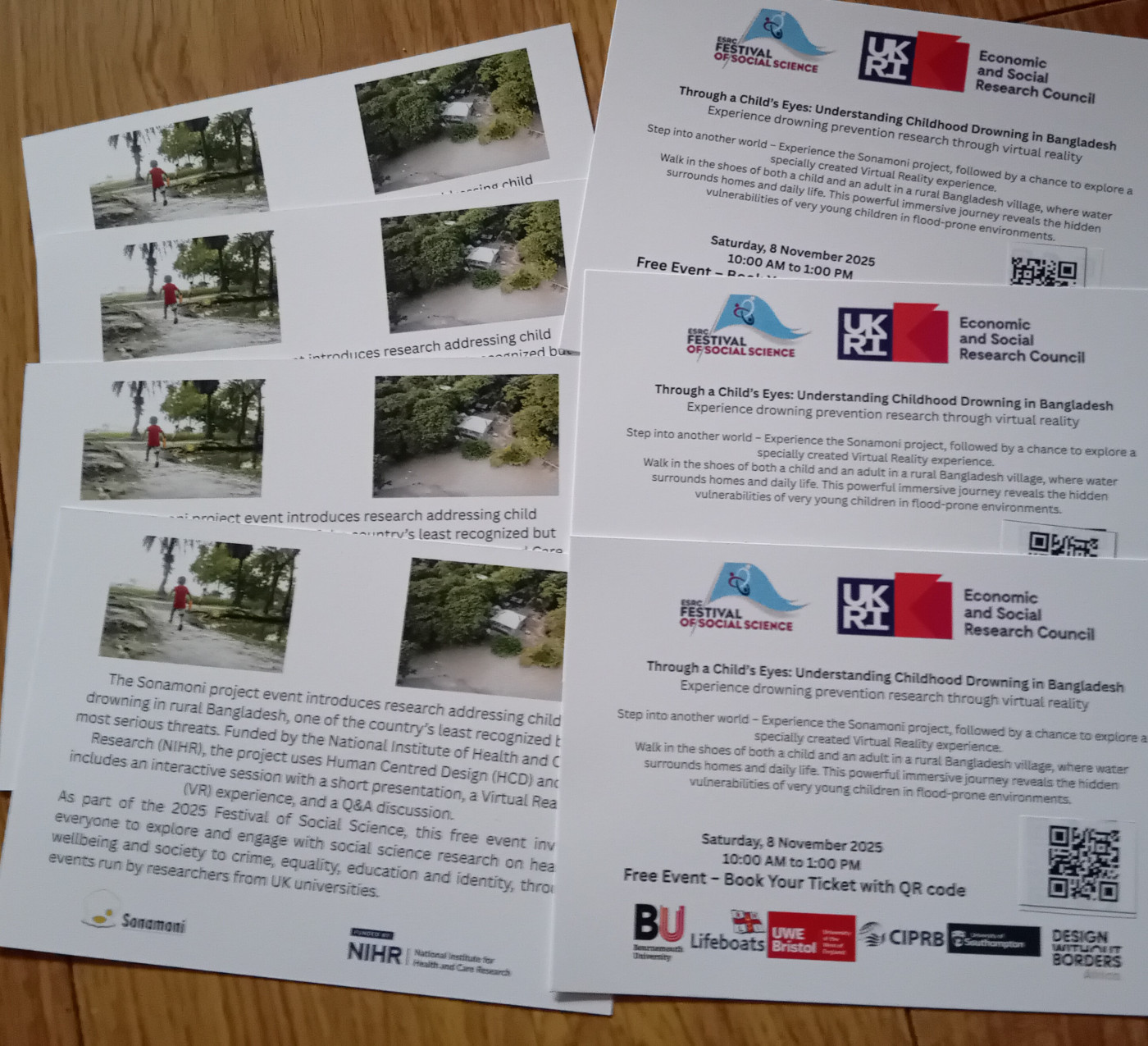
Yesterday we received the postcards to advertise our Festival of Social Sciences (FoSS) ‘Sonamoni’ event which will be held in the beautiful RNLI building on West Quay Road in Poole on Saturday 8th November. This public event focusing on drowning prevention in Bangladesh is free and can be booked online, click here! The FoSS is a UK-wide festival every autumn. It is funded by the Economic and Social Research Council (ESRC) to promote social science research with the general public. The FoSS comprises events ranging from exhibitions, lectures and panel debates through to performances, guided walks and workshops. We would like to thank the ESRC for its support for its support, which includes producing the postcards, and the coffee and teas to be served at the RNLI on Saturday November 8th.
The Sonamoni Project is dedicated to reducing drowning deaths among newly mobile children (under 2 years) by working closely with rural communities in Bangladesh. Using human-centred design (HCD) techniques, the project is identifying solutions, developing prototypes, and assessing their effectiveness. This exciting project is funded by the UK National Institute for Health and Care Research (NIHR) using UK aid from the UK government to support the improvement of global health through high-quality research.
Sonamoni is coordinated by Bournemouth University in collaboration with our partners: the University of the West of England (Bristol), the University of Southampton, and the Royal National Lifeboat Institution (RNLI), Design Without Border (DWB) in Uganda and the Centre for Injury Prevention and Research, Bangladesh (CIPRB).
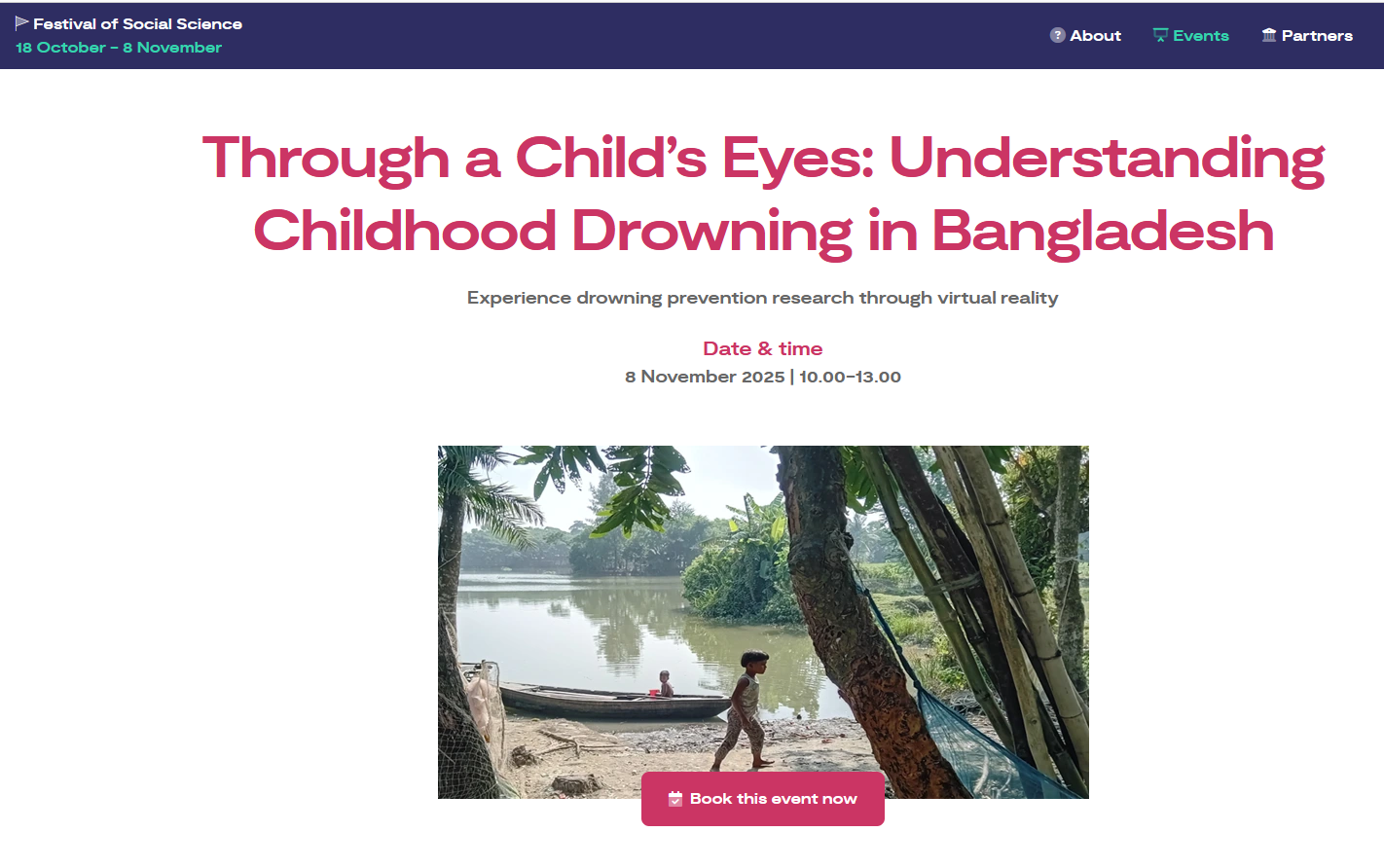
Bournemouth University is participating in the 2025 ESRC Festival of Social Science (FoSS), with a workshop about the Sonamoni project. Sonamoni is being coordinated by Bournemouth University (BU) and it is a collaboration with the Centre for Injury Prevention and Research (CIPRB) in Bangladesh as well as the University of the West of England (UWRE), Bristol, the University of Southampton, Design Without Borders (DWB) in Uganda, and the Royal National Lifeboat Institution (RNLI). Our FoSS event on drowning prevention research will be at the RNLI in Poole on the morning of Saturday 8th November. Tickets for this free event are available, to book yours, click here!
FoSS is a UK-wide festival that takes place every autumn, funded by the Economic and Social Research Council (ESRC). It’s all about sharing social science research with the public in fun and engaging ways—through talks, workshops, exhibitions, performances and more. The festival consists of a series of events run each autumn, delivered by ESRC’s ‘festival partners’, higher education institutions spread across the UK. Events range from exhibitions, lectures and panel debates through to performances, guided walks and workshops.
The Sonamoni Project is dedicated to reducing drowning deaths among newly mobile children (under 2 years) by working closely with rural communities in Bangladesh. Using human-centred design (HCD) techniques, the project is identifying solutions, developing prototypes, and assessing their effectiveness. The project is funded by the UK National Institute for Health and Care Research (NIHR) using UK aid from the UK government to support global health research. The project has Dr. Aminur Rahman (at CIPRB) as its Bangladesh lead, with BU’s Prof. Edwin van Teijlingen as the UK lead. It also includes a BU-registered PhD project by Md. Shafkat Hossain. The interdisciplinary team at Bournemouth University covers all three faculties through: Dr. Mavis Bengtsson, Dr. Kyungjoo Cha, Dr. Mehdi Chowdhury, Dr. Yong Hun Lim, Mr. John Powell, and Prof. Edwin van Teijlingen.
The 2025 NIHR Global Health Research Academy Member event will take place on Tuesday 13th and Wednesday 14th May. The NIHR recognizes that career progression is a common challenge for early-career researchers. This year the event’s theme is ‘Empowering Early-Career Researchers: Navigating Careers in Global Health’. This two-day online event aims to equip participants from across the globe with the skills and knowledge to navigate and build a career in global health research.
Bournemouth University staff and students participating in the NIHR Research and Innovation for Global Health Transformation Call 4: Drowning Prevention for newly mobile infants under 2 years in Bangladesh programme have been invited. This NIHR-funded project is called Sonamoni and BU’s student Md. Shafkat Hossain, whose PhD assessed the work in Bangladesh, is one the participants, as is our colleague from Bangladesh Notan Dutta. In the afternoon BU’s Edwin van Teijlingen who will be chairing a session on ‘Funding & Grant Writing’.
Sonamoni is being coordinated by Bournemouth University in collaboration with the Centre for Injury Prevention and Research (CIPRB) in Bangladesh as well as the University of the West of England, Bristol, the University of Southampton, Design Without Borders (DWB) in Uganda, and the Royal National Lifeboat Institution (RNLI). This project, with Prof. Dr. Aminur Rahman (at CIPRB) as Bangladesh lead, includes the above mentioned BU-based PhD project. The interdisciplinary team at Bournemouth University covers three faculties through: Dr. Mavis Bengtsson, Dr. Kyungjoo Cha, Dr. Mehdi Chowdhury, Dr. Yong Hun Lim, Mr. John Powell, and Prof. Edwin van Teijlingen.
The Department of Design and Engineering at Bournemouth University has a reputation for its Human-Centred Design (HCD) work. In our interdisciplinary Sonamoni project we have HCD at its centre. The Sonamoni project is coordinated by Bournemouth University in collaboration with the University of the West of England (Bristol), the University of Southampton, and the Royal National Lifeboat Institution (RNLI), Design Without Border (DWB) in Uganda and Centre for Injury Prevention and Research, Bangladesh (CIPRB). The interdisciplinary team at Bournemouth University covers three faculties and six academics: Dr. Mavis Bengtsson, Dr. Kyungjoo Cha, Dr. Mehdi Chowdhury, Dr. Yong Hun Lim, Mr. John Powell, and Prof. Edwin van Teijlingen.
Last month two staff from CIPRB, Notan Chandra Dutta and Mirza Shibat Rowshan visited DBW in Uganda, as part of so-called South-South learning. Their objective was to share (1) knowledge and experience of using HCD techniques and (2) best practices of drowning prevention in both countries. Utilizing HCD techniques, Sonamoni is working to identify and prioritize potential solutions, develop prototypes, and assess the acceptability of the interventions to reduce drowning deaths among old children under two in Bangladesh.
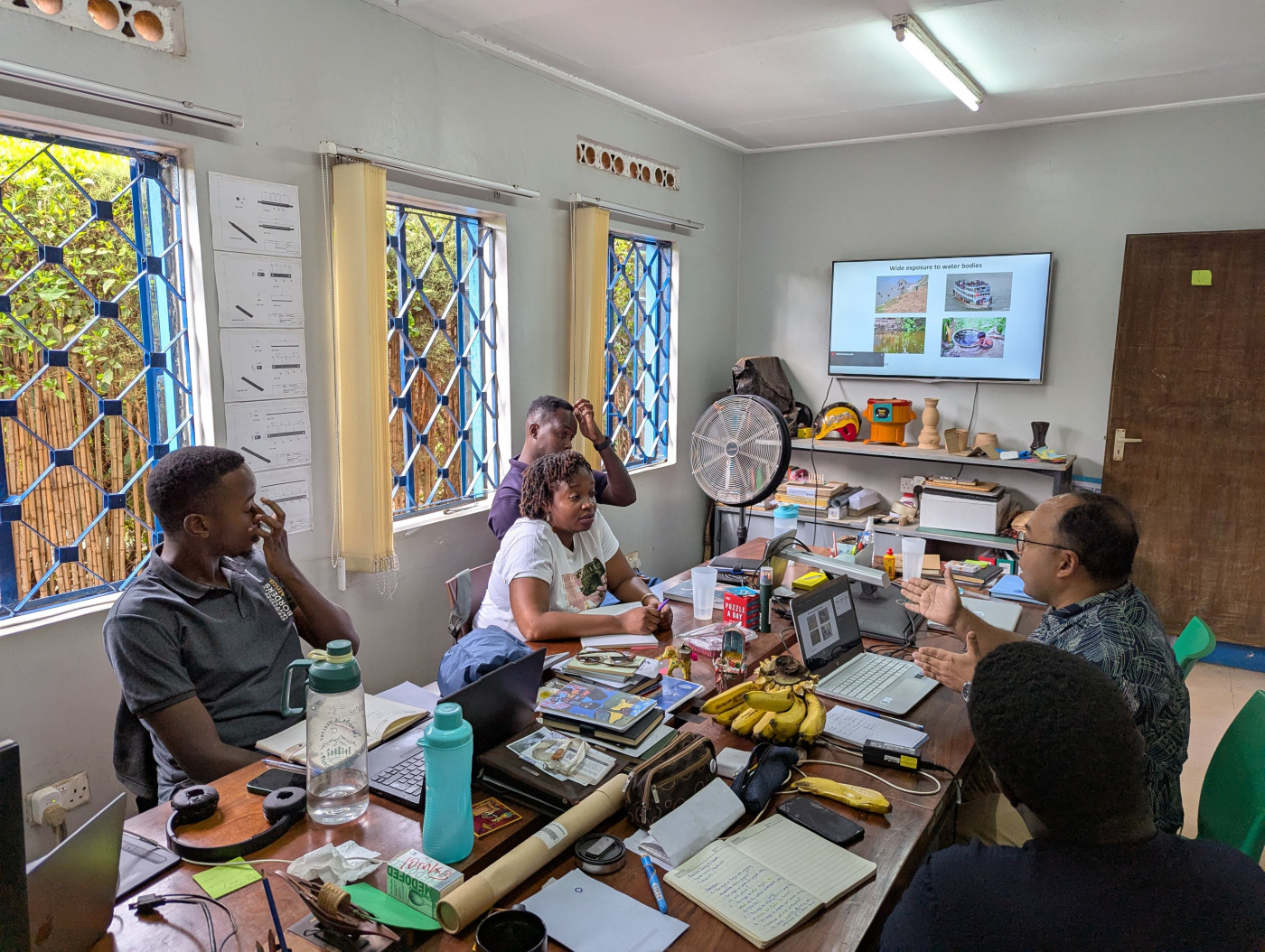
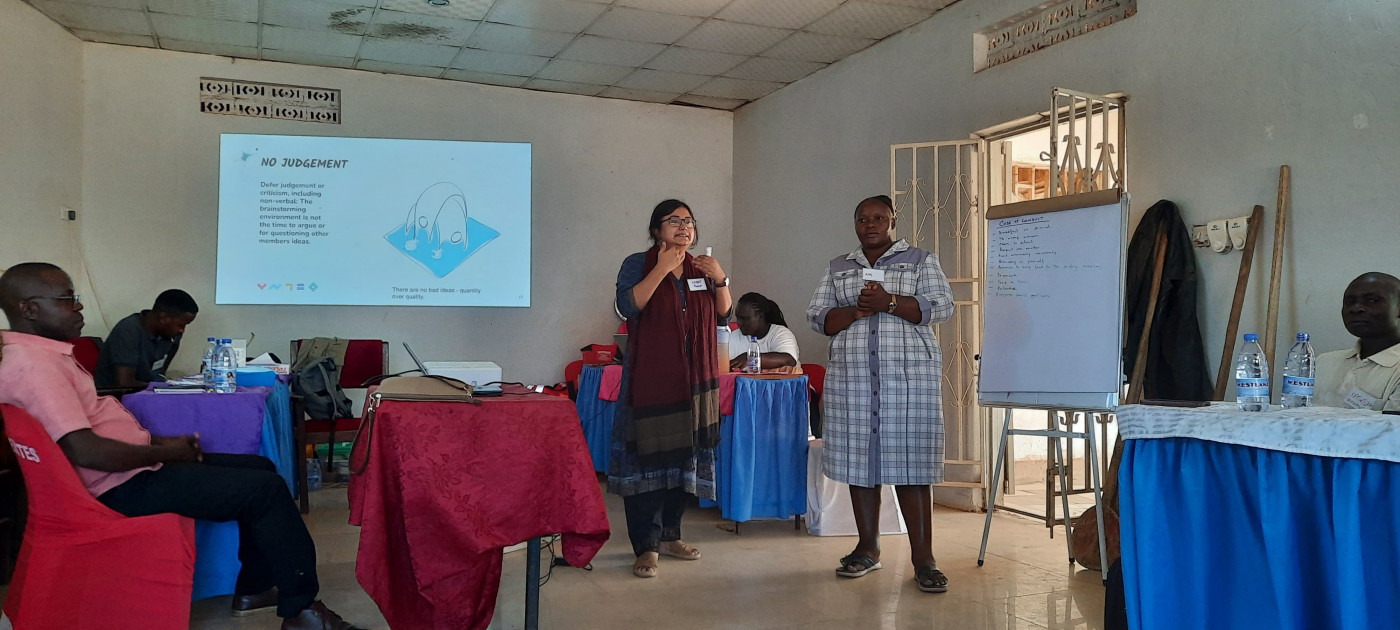
During the visit, Notan and Shibat participated a four-day ideation workshop with the fisher community near Lake Victoria, organized by DWB. In the workshop, different HCD tools were used along with other group activities to generate and refine ideas for the solutions. The generated ideas were recorded by visualization tools. Notan and Shibat also attended a session on the principles of creative facilitation of HCD, including the need to understand the problem, role of the facilitator and other stakeholders. Various visualization tools were discussed, e.g. ‘journey maps’, ‘stakeholder map’, ‘context map’ and different types of sketches. Notan shared CIPRB’s experiences of managing the best drowning prevention practices and its challenges from Bangladesh context.
This international project funded by the National Institute for Health and Care Research (NIHR) through their Research and Innovation for Global Health Transformation programme, also includes a BU-based PhD student, Mr. Md. Shafkat Hossein. Last week Shafkat presented our Sonamoni project in lecture to BU Engineering students at Talbot campus.
Prof. Edwin van Teijlingen
The Sonamoni Project is working with communities in rural Bangladesh utilizing human-centered design (HCD) techniques. These design principles have been applied for many years in designing consumer products and, more recently, in the fields of health and social systems. The research project is identifying solutions to reduce the number of drowning deaths in newly mobile children (6-24 months), developing prototype, and assessing the acceptability and usability of potential interventions. This interdisciplinary project is coordinated by Bournemouth University in collaboration with the Centre for Injury Prevention and Research, Bangladesh (CIPRB), the University of the West of England, the Royal National Lifeboat Institution (RNLI), the University of Southampton, and Design without Borders Africa (DwB) from Uganda. Our Sonamoni project has been made possible thanks to a grant from the National Institute for Health and Care Research (NIHR) through their Research and Innovation for Global Health Transformation programme.
As part of the Sonamoni project we arranged some serious South-South learning by facilitating a visit to DwB in Uganda in early march by two of our Bangladesh-based team, namely Notan Chandra Dutta, Research Manager and Mirza Shibat Rowshan, HCD Specialist. DwB applies HCD approaches to complex challenges faced by communities in low and middle-income countries. To gain greater insights into HCD activities the researchers from Bangladesh visited one site near Lake Victoria to observe data collection with fishermen, transporters, and local leaders. Notan and Shibat co-facilitated a four-day long Design Community Advisory Board (DCAB) workshop on the “Enhancing Fisherfolk Safety” project where fishermen, boat owners, transporters, traditional weather forecasters, health workers were the participants. To prevent drowning, HCD was applied in the workshop to generate ideas and share solutions of the lake site community from Lake Victoria of Mayuge district. Lessons learnt from the visit by two staff of CIPRB can further enrich the Sonamoni Project implementation in Bangladesh. The NIHR really values research capacity building and South-South learning in its funded projects, as well as North-South leaning, of course.
Prof. Edwin van Teijlingen
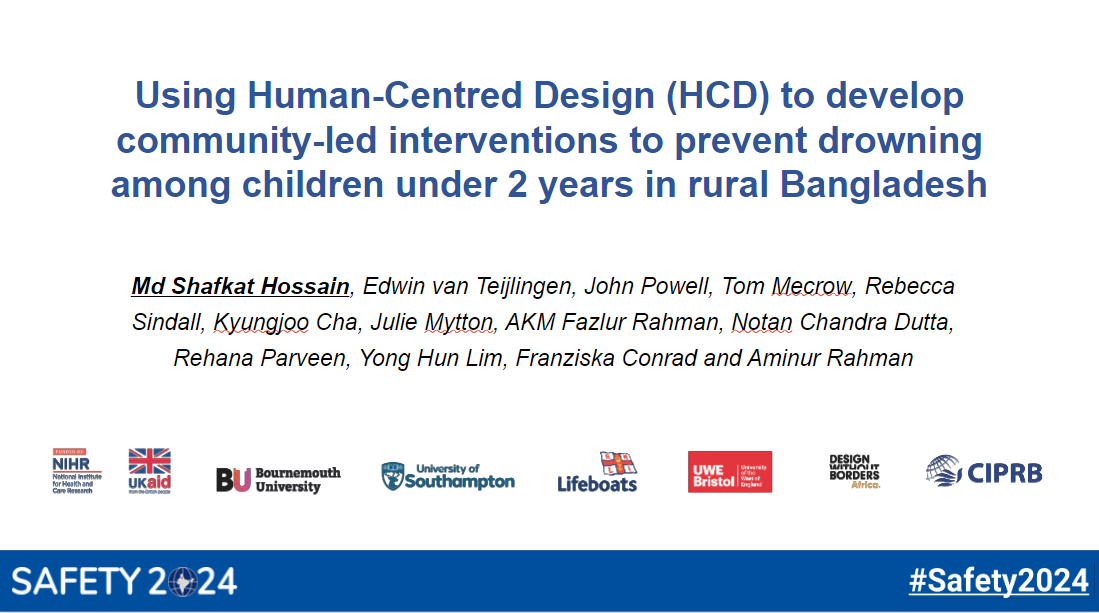
Thank you very much for all those who attended last Wednesday’s monthly online session organised by BU’s Centre for Midwifery & Women’s Health (CMWH). This event featured PhD student Mr. Shafkat Hossein who spoke about his thesis research ‘Using Human-Centred Design (HCD) to develop community-led interventions to prevent drowning among children under the age of 2 in rural Bangladesh’.
His work is part of an interdisciplinary study called ‘Sonamoni’ in which BU collaborates with CIPRB (Centre for Injury Prevention and Research, Bangladesh), the University of the West of England (in Bristol), the University of Southampton, the Royal National Lifeboat Institution (RNLI), and Design Without Borders (DWB) in Uganda. Sonamoni aims to design and develop interventions to reduce the number of young children drowning in Bangladesh.
This public health project is funded by the National Institute for Health and Care Research (NIHR) through its Research and Innovation for Global Health Transformation programme. For more information, visit the NIHR website.
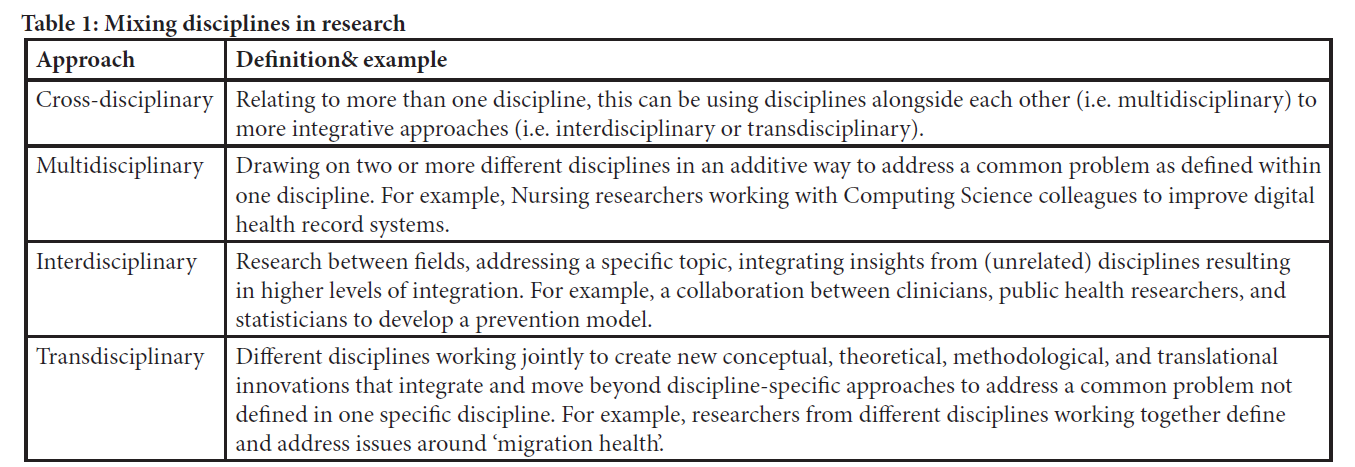
The second speaker at the CMWH event was Prof. Edwin van Teijlingen, who spoke about trials and tribulations of conducting, running and managing interdisciplinary studies. His talk was largely based on three three published papers co-written with BU academic and Faculty of Health & Social Sciences Visiting Faculty members on interdisciplinary or multidisciplinary working [1-3]. There are, of course, differences between multidisciplinary, and interdisciplinary and the even more integrated level of working called transdisciplinary. At the same time the individual member of an interdisciplinary team needs to have individual field-based expertise in their own discipline, e.g. sociology, nursing, chemistry or law to bring required knowledge and skills to that team.
References:
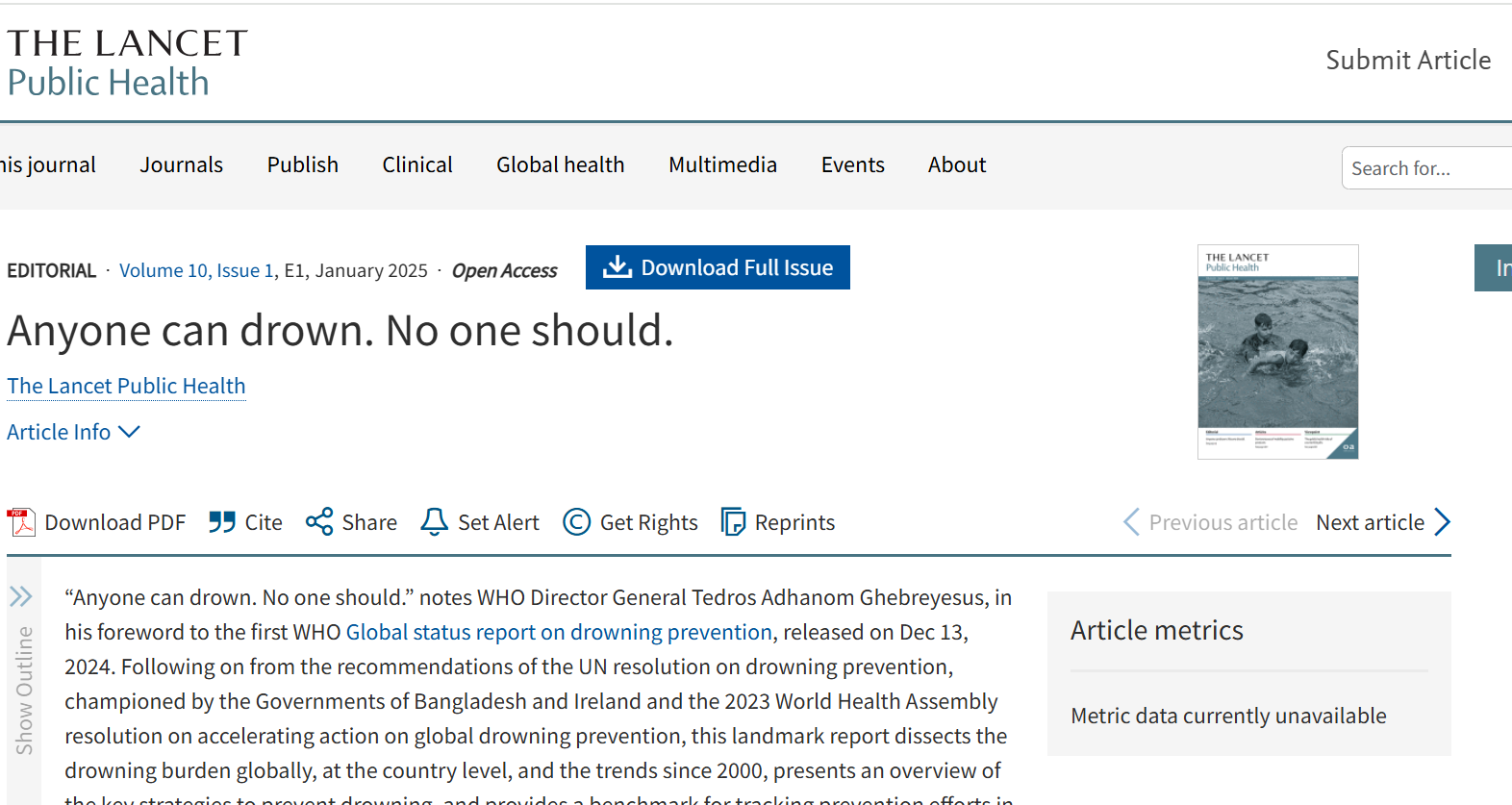
The first editorial of The Lancet Public Health [1] highlights a public health issue close to our work in Bangladesh, namely the risk of drowning, especially in young children. “Anyone can drown. No one should” are the words of the Director General of the World Health Organization (WHO) in its first Global status report on drowning prevention, published two weeks ago (Dec. 2024). According to The Lancet Public Health this landmark report dissects the drowning burden globally, at the country level, and the trends since 2000, presents an overview of the key strategies to prevent drowning, and provides a benchmark for tracking prevention efforts in the future. Importantly, this report sheds light on a tragic, neglected, mostly preventable public health issue.
We are grateful to The Lancet Public Health for raising this important issue in 2025, since Bournemouth University (BU) is currently engaged in research project in this field called ‘Sonamoni’. This an interdisciplinary study is a collaboration with CIPRB (the Centre for Injury Prevention and Research, Bangladesh), the University of the West of England (in Bristol), the University of Southampton, the Royal National Lifeboat Institution (RNLI), and Design Without Borders (DWB) in Uganda. Sonamoni aims to design and develop interventions to reduce the number of young children drowning in Bangladesh.
This public health project is funded by the National Institute for Health and Care Research (NIHR) through its Research and Innovation for Global Health Transformation programme. For more information, visit the NIHR website.
The interdisciplinary team at BU includes three faculties and six member of staff: Dr. Mavis Bengtsson, Dr. Kyungjoo Cha, Dr. Mehdi Chowdhury, Dr. Yong Hun Lim, Mr. John Powell, and Prof. Edwin van Teijlingen. We recently published the first paper ‘Drowning Prevention should be a Public Health Issue in Nepal related to this project [2].
References:
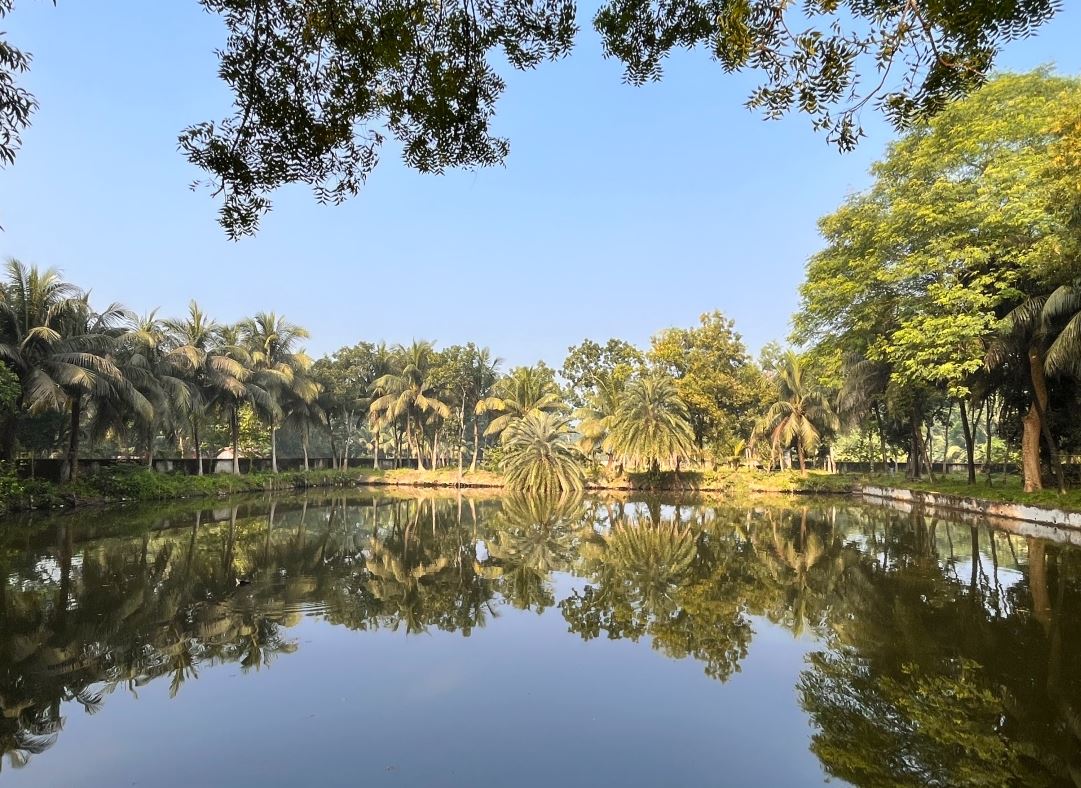
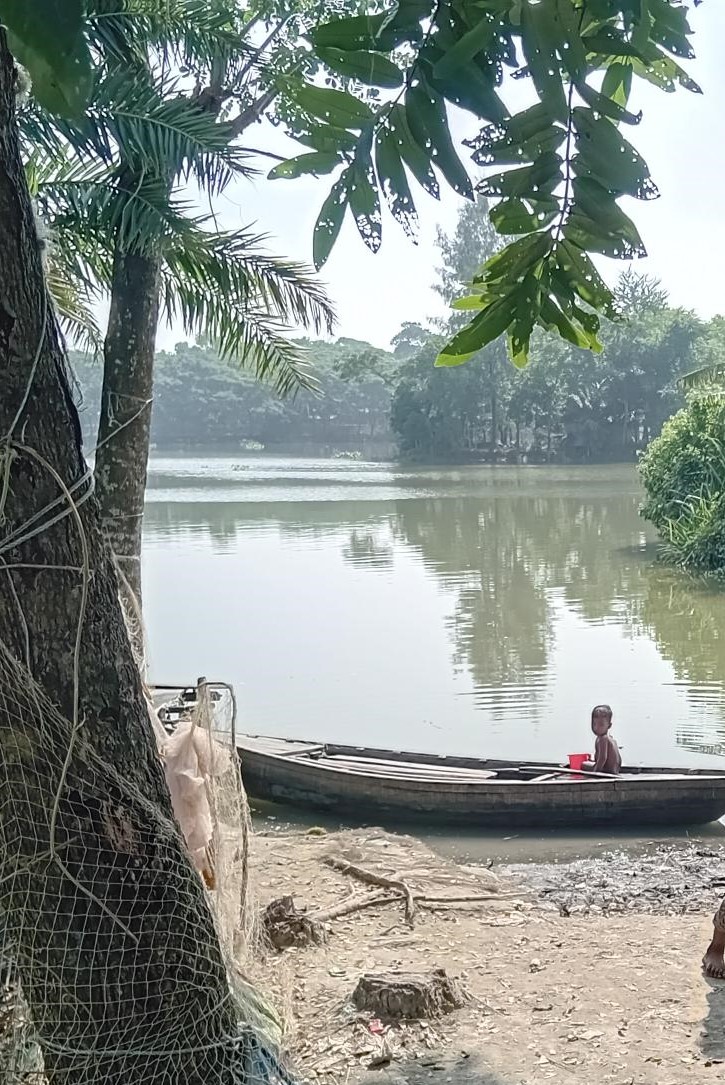
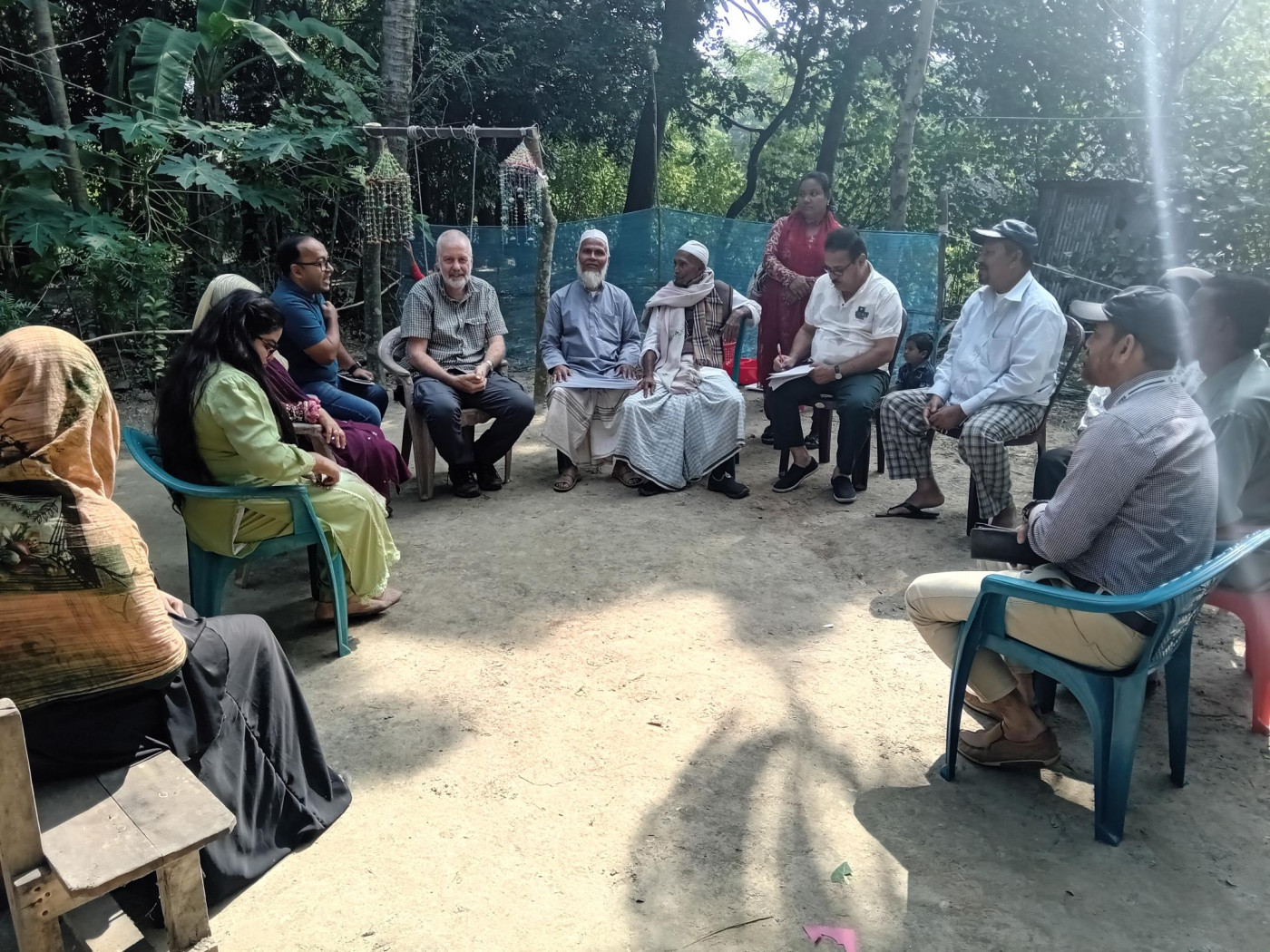
This week I had the pleasure of visiting one of the two major research sites of our Sonamoni project. Sonamoni is jointly coordinated by Bournemouth University in collaboration with the Centre for Injury Prevention and Research, Bangladesh (CIPRB), the University of the West of England, Bristol, the University of Southampton, Design Without Borders (DWB) in Uganda, and the Royal National Lifeboat Institution (RNLI). We are working to reduce drownings among newly-mobile children, generally those under two years old. This £1.6m project has been made possible thanks to a grant from the National Institute for Health and Care Research (NIHR) through their Research and Innovation for Global Health Transformation programme. Yesterday CIPRB staff Prof. Dr. Aminur Rahman and Mr. Notan Chandra Dutta took me to the field site in Kalapari in rural Bangladesh.
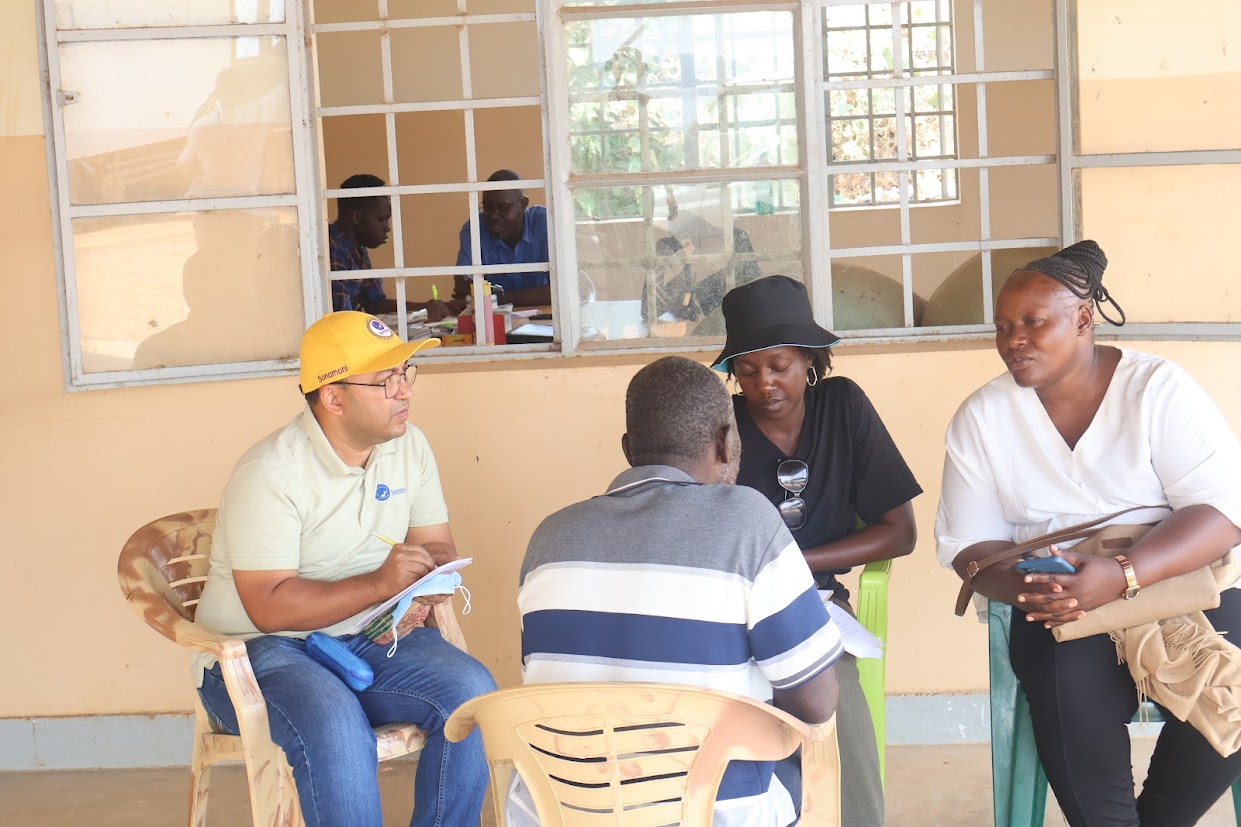
This was my first ever visit to Bangladesh despite earlier attempts to go out there two and three decades ago. This visit included an outdoor meeting with a Village Injury Prevention Committee (VIPC) with whom CIPRB has been working for years in harmony.
The Bournemouth University team comprises staff from three faculties: Dr. Mavis Bengtsson, Dr. Kyungjoo Cha, Dr. Mehdi Chowdhury, Dr. Yong Hun Lim, Mr. John Powell, and Prof. Edwin van Teijlingen, and Ph.D. student Mr. Md. Shafkat Hossain. For more information about our ongoing research in Bangladesh, please visit the NIHR website.
Prof. Edwin van Teijlingen
Centre for Midwifery & Women’s Health (CMWH)
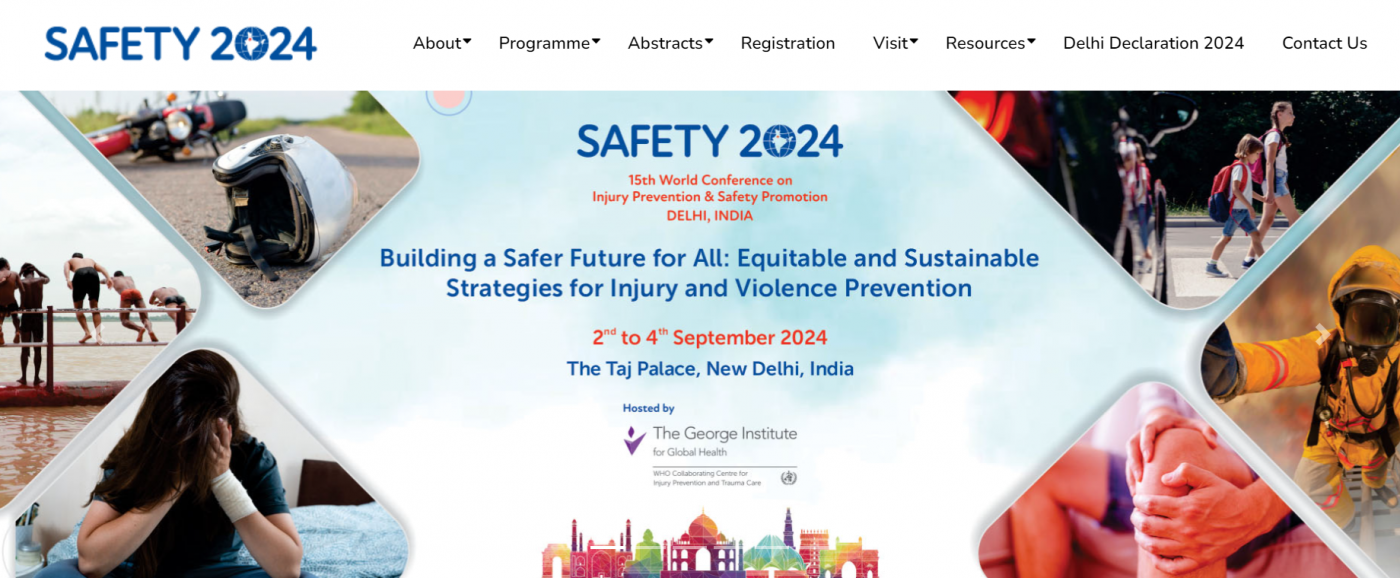
Bournemouth University PhD student Md. Shafkat Hossain has been invited to attend the international Safety 2024 conference in India in September. The 15th World Conference on Injury Prevention & Safety Promotion (Safety 2024) will be held 2-4 September at the Taj Palace in New Delhi. Safety 2024 global event will focus worldwide attention on safety and injury prevention. This conference will gather international experts in the field with a united goal of “Building a safer future for all: Equitable and sustainable strategies for injury and violence prevention”.
Shafkat will be presenting this PhD work to date under the title ‘Using Human-Centred Design (HCD) to develop community-led interventions to prevent drowning among children under the age of 2 in rural Bangladesh’. Mr. Md. Shafkat Hossain who has been selected by Bloomberg Philanthropies as one of the Emerging Leaders in Drowning Prevention programme.
This programme has been designed to create a cohort of younger leaders to join national and international efforts to raise awareness and strengthen solutions and political commitment towards drowning. This programme is hosted by the Global Health Advocacy Incubator and provides a unique opportunity for people like Shafkat to develop leadership skills in drowning prevention, and be a part of a global community working to reduce drowning deaths. This first group of Emerging Leaders includes people from Bangladesh, Ghana, India, Uganda, United States and Vietnam.
Shafkat’s PhD study is part of the interdisciplinary Sonamoni study. Sonamoni is coordinated by BU in collaboration with Centre for Injury Prevention and Research, Bangladesh (CIPRB), the University of the West of England, Bristol, the University of Southampton, Design Without Borders (DWB) in Uganda, and the Royal National Lifeboat Institution (RNLI). We are working to reduce drownings among newly-mobile children, generally under two years old. This £1.6m project has been made possible thanks to a grant from the National Institute for Health and Care Research (NIHR) through their Research and Innovation for Global Health Transformation programme.
For more information about our ongoing research in Bangladesh, please visit the NIHR website.
Prof. Edwin van Teijlingen & Dr. Mavis Bengtsson
Centre for Midwifery & Women’s Health
Rejection is a key part of an academic’s life. Typically, your scientific paper gets rejected at least one before getting accepted for publication. Whilst it is common knowledge among academics is that your average grant application has a chance of about one in eight, and Innovate UK Smart grants have a “public” success rate of just 5%. As academics we all have to learn to live with ‘failure’ . However, when we received a rejection this week to be part of the ESRC (Economic & Social Research Council) Festival of Social Science 2024 for our research project Preventing drowning of children under two in Bangladesh: An interdisciplinary approach, it was a first!
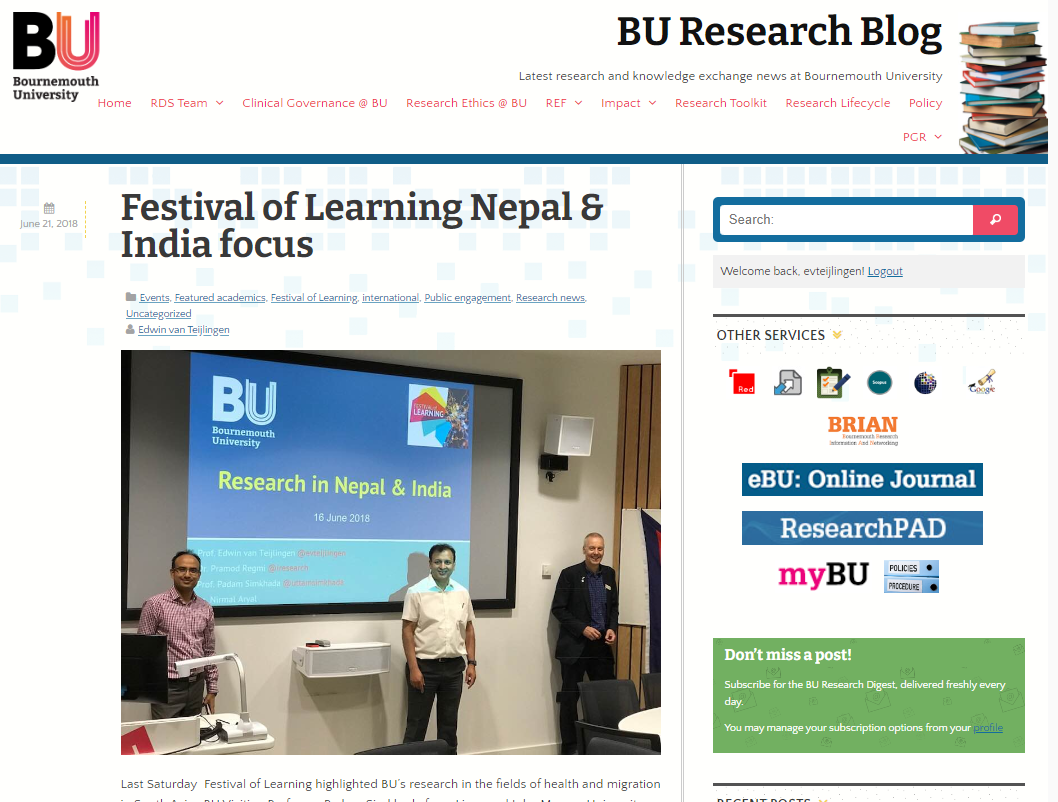
We thought we had a decent chance as (1) our interdisciplinary team includes an anthropologist, an economist and a sociologist. (2) This year the call for Festival of Social Science was for a joint Bournemouth University and the University of Southampton programme, and our NIHR (National Institute for Health Research)-funded Sonamoni project is an international joint project between Bournemouth University and the University of Southampton, working with the University of the West of England, the RNLI (Royal National Lifeboat Institute), CIPRB in Bangladesh and Design Without Borders in Uganda. (3) We had included an element of Virtual reality as this year’s festival theme will be ‘Our Digital Lives’. Finally, (4) I have been successful before in the past applying for inclusion into the ESRC Festival of Learning, for example highlight our research in Nepal and India in 2018

or our Breastfeeding Debate in the 2017 Festival of Learning. Obviously past success is no guarantee for future success! Hopefully, we have better luck next year when we have more results to present in a knowledge exchange event like this.
Prof. Edwin van Teijlingen
Centre for Midwifery & Women’s Health (CMWH)
Staff in the Faculty of Health & Social Sciences at Bournemouth University (BU) would like to take this opportunity to congratulate the charity the RNLI (Royal National Lifeboat Institution) on its 200th anniversary! Some of us have personal experience of working with the RNLI. For example, Adam Bancroft, Programme Lead in Paramedic Science and Senior Lecturer in Paramedic Science, in the Department of Midwifery & Health Sciences has been a lifeboat volunteer Adam and his wife Paula were both volunteer crew at Tower RNLI on the banks of the river Thames, which is still the busiest RNLI station in the UK. They would commit to at least two shifts a month where they would be at a state of readiness to launch at moments notice on the pier, ready to respond. 
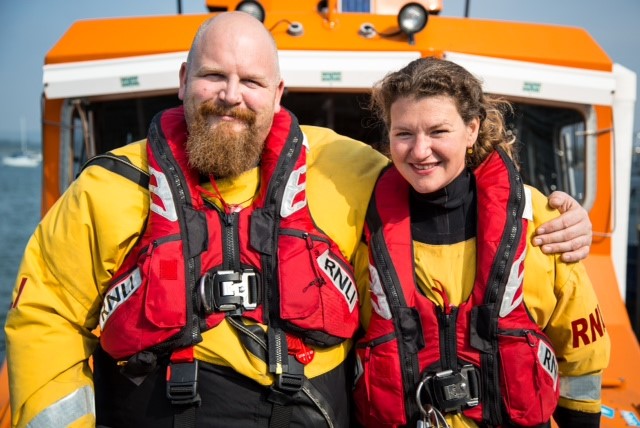
In a very different way of working with the RNLI, BU academics currently are involved in a collaborative research project with RNLI to prevent the drowning of toddlers under the age of two in rural Bangladesh. This project called Sonamoni. BU is leading this interdisciplinary study of nearly £1.7 million funded by the UK National Institute for Health and Care Research (NIHR). 
Congratulations to BU’s PhD student Mr. Md. Shafkat Hossain who has been selected by Bloomberg Philanthropies as one of the Emerging Leaders in Drowning Prevention programme. This programme has been designed to create a cohort of younger leaders to join national and international efforts to raise awareness and strengthen solutions and political commitment towards drowning. This programme is hosted by the Global Health Advocacy Incubator and provides a unique opportunity for people like Shafkat to develop leadership skills in drowning prevention, and be a part of a global community working to reduce drowning deaths. This first group of Emerging Leaders includes people from Bangladesh, Ghana, India, Uganda, United States and Vietnam. Each Emerging Leader will be expected to participate in monthly sessions, both online and in person. The programme includes funding for Shafkat to attend the World Conference on Drowning Prevention in Perth, Australia in December 2023 (wcdp2023.com/) and the World Conference on Injury Prevention and Safety Promotion in Delhi, India in September 2024 (worldsafety2024.com/).
Shafkat’s PhD research focuses on aspects of the Human-Centred-Design element of the Sonamoni project.
Bournemouth University and the Centre for Injury Prevention and Research, Bangladesh (CIPRB) jointly lead research into the prevention of children drowning deaths in Bangladesh. The project, called ‘Sonamoni’, is being coordinated by BU in collaboration with the University of the West of England, Bristol, the University of Southampton, and the Royal National Lifeboat Institution (RNLI). We are working with CIPRB to reduce drownings among newly-mobile children, generally under two years old. This £1.6m project has been made possible thanks to a grant from the National Institute for Health and Care Research (NIHR) through their Research and Innovation for Global Health Transformation programme. For more information, visit the NIHR website.
CMWH
Worldwide drowning has caused over 2.5 million deaths in the last decade. The overwhelming majority of these deaths (90%) happen in low-middle-income countries. Globally, the highest drowning rates occur among children aged 1–4 years.
To mark this year’s World Drowning Prevention Day, the World Health Organisation (WHO) is raising awareness of drowning interventions such as teaching school-age children basic swimming water safety and safe rescue skills. Drowning is a public health issue, through their World Drowning Prevention Day campaign, WHO will be reminding people that: “Anyone can drown, but no one should.”
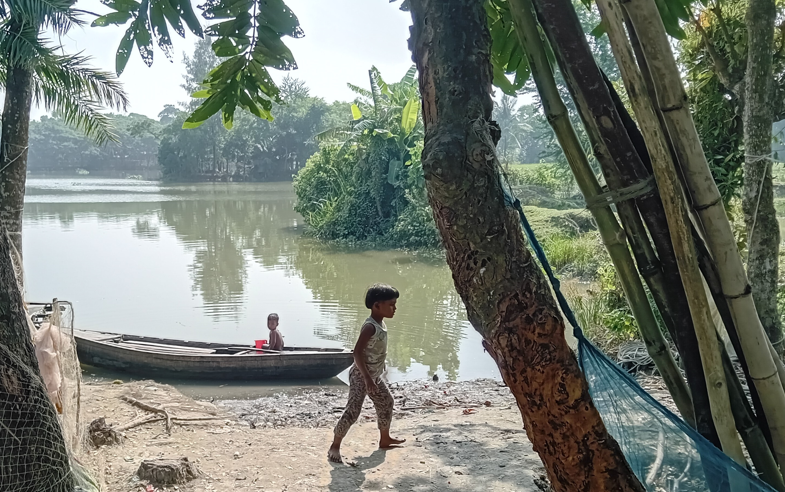
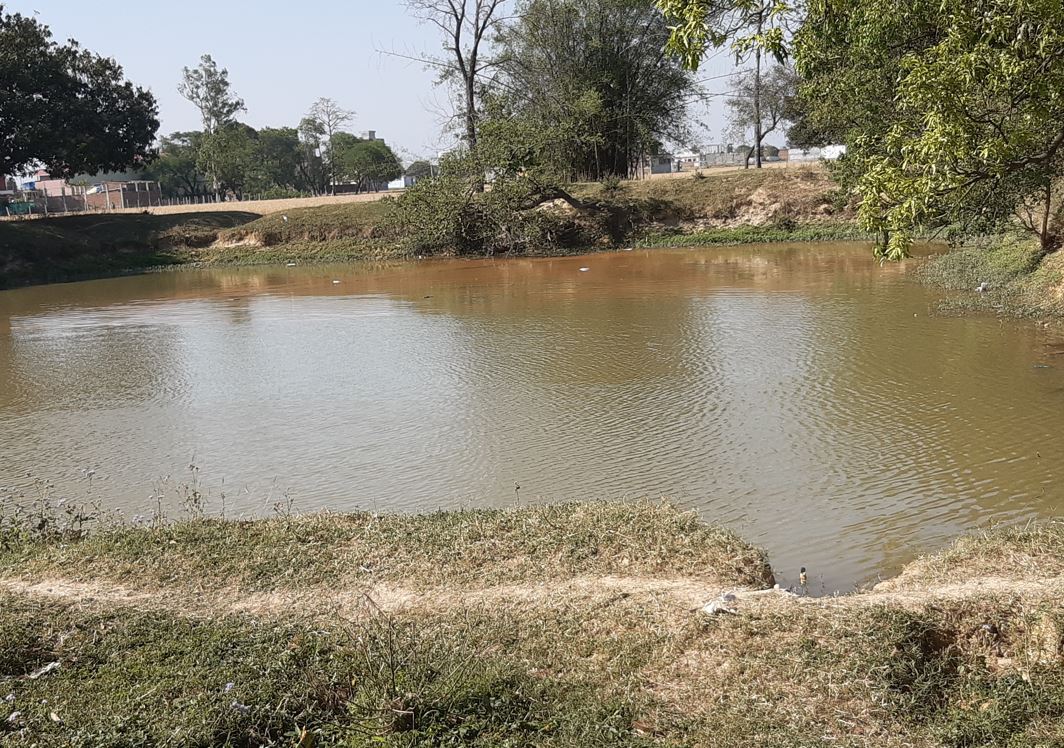
In Bangladesh, drowning is the leading cause of death in children over the age of one. Globally, the country has one of the highest rates of drowning, especially among children. Additionally, the risk of drowning in rural areas is twice as likely in comparison to cities. Some of the reasons for this are due to access to hazards, e.g., because there are a significant number of ponds and ditches, creating natural drowning hazards for very young children.
Bournemouth University and the Centre for Injury Prevention and Research, Bangladesh (CIPRB) jointly have received funding for research into the number of children drowning deaths in Bangladesh. The project, called ‘Sonamoni’, is being coordinated by Bournemouth University in collaboration with the University of the West of England, Bristol, the University of Southampton, and the Royal National Lifeboat Institution (RNLI). We are working with CIPRB to reduce drownings among newly-mobile children, generally under two years old. The project, with Prof. Dr. Aminur Rahman as Bangladesh lead, includes a PhD project by BU’s Mr. Shafkat Hossain. Shafkat’s thesis focuses on aspects of the Human-Centred-Design element of the Sonamoni project.
This £1.6m project has been made possible thanks to a grant from the National Institute for Health and Care Research (NIHR) through their Research and Innovation for Global Health Transformation programme. For more information, visit the NIHR website.
The interdisciplinary team at Bournemouth University cover three faculties supported by the following academics: Dr. Mavis Bengtsson, Dr. Kyungjoo Cha, Dr. Mehdi Chowdhury, Dr. Yong Hun Lim, Mr. John Powell, and Prof. Edwin van Teijlingen.
Prof. Edwin van Teijlingen
Centre for Midwifery & Women’s Health (CMWH)
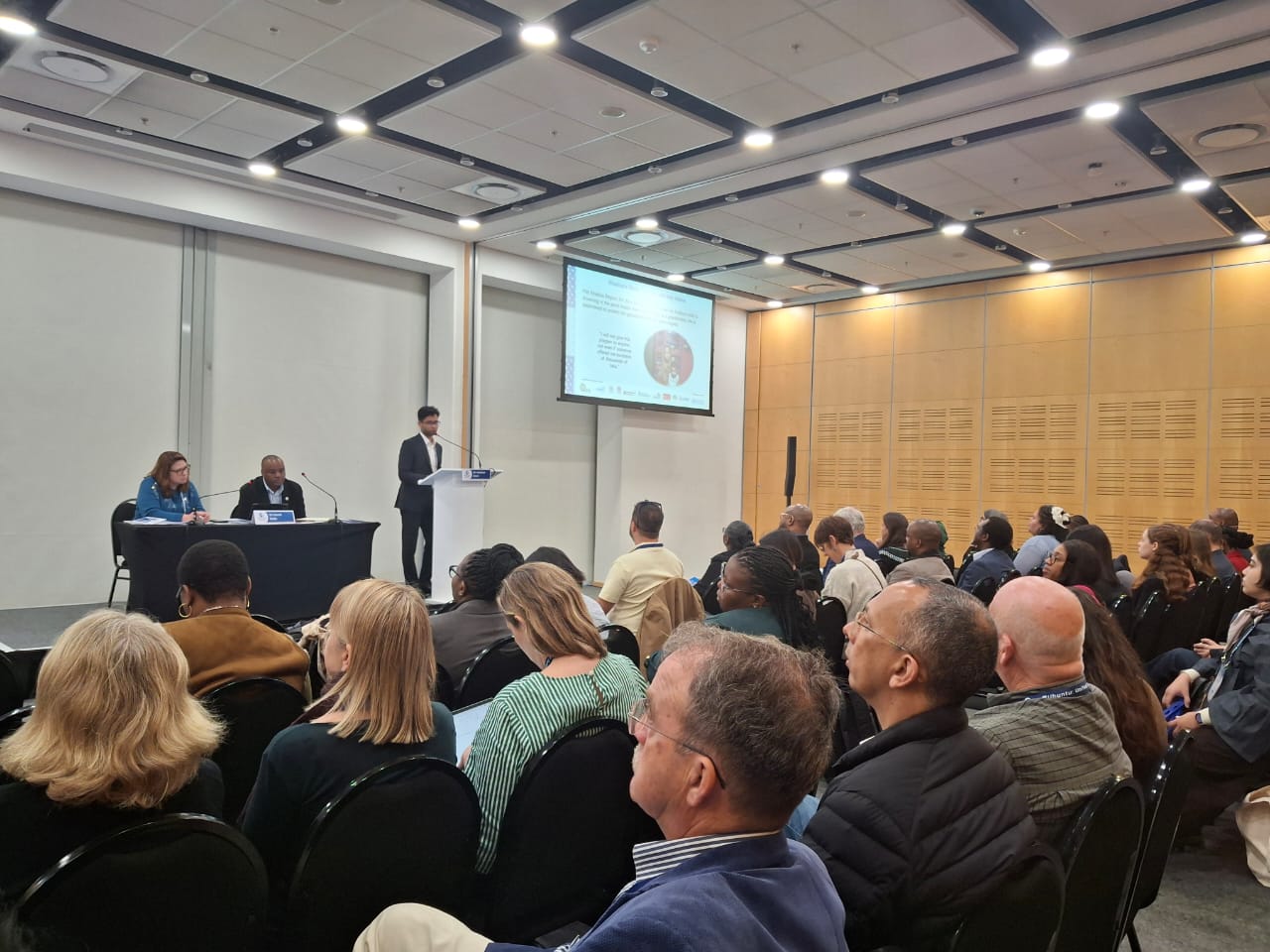
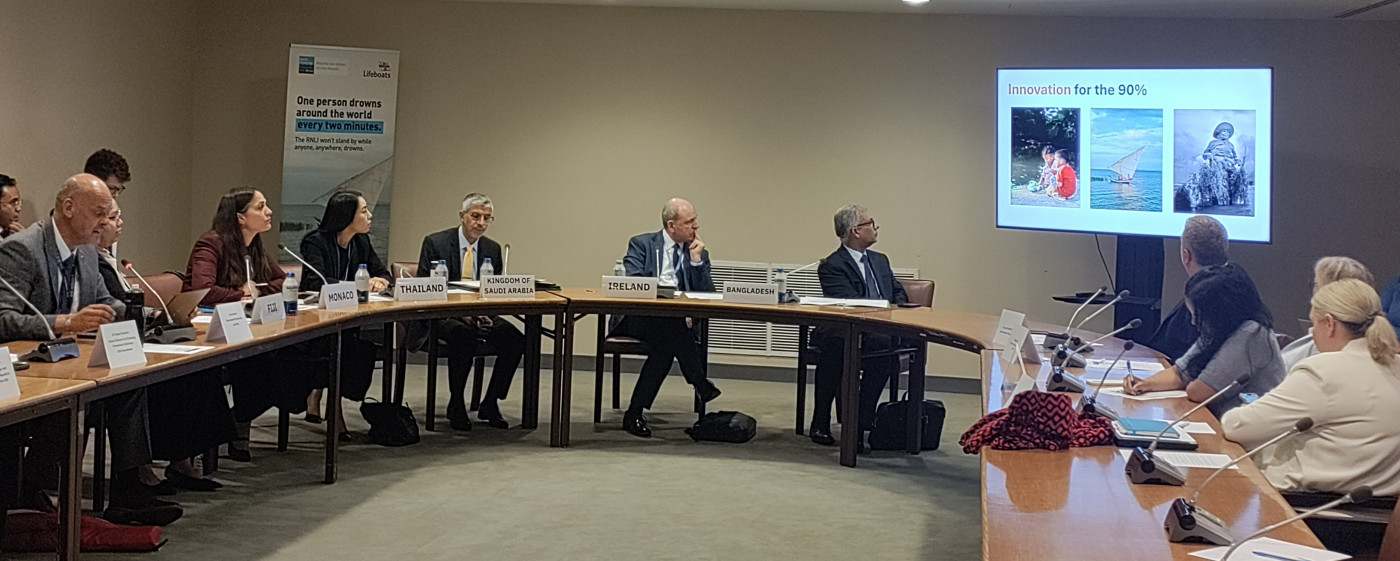
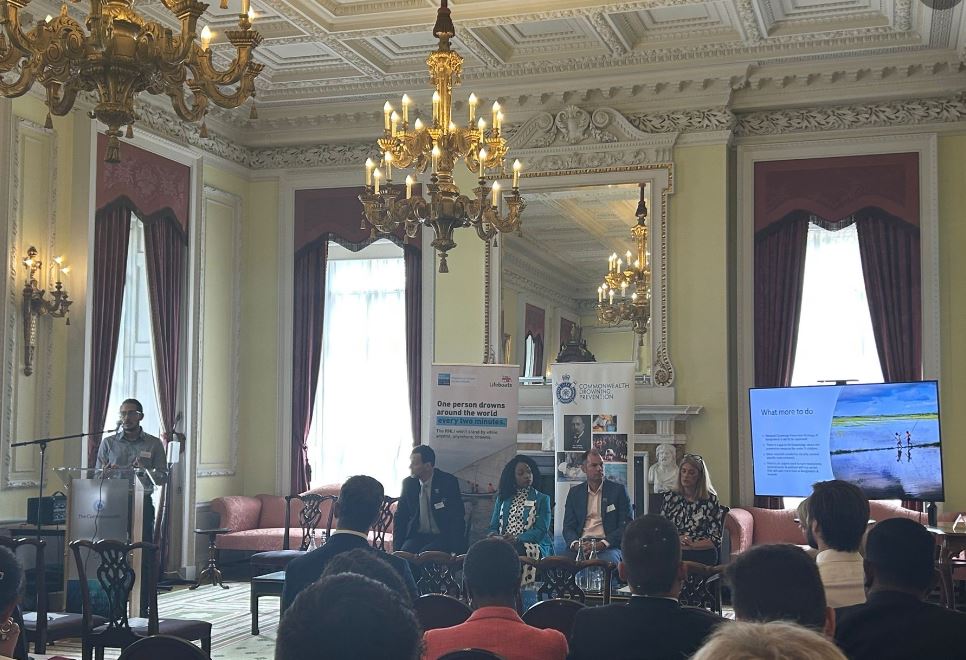
FHSS PhD student Md. Shafkat Hossain was invited last week to speak at the event’Accelerating Action on Global Drowning Prevention’ in London. On the 12th July the Royal Life Saving Society (RLSS) hosted a meeting on 12 July at Marlborough House, home of the Commonwealth Secretariat. This event was a partnership with the Royal National Lifeboat Institution (RNLI), and included presentations from Dr David Meddings, Drowning Prevention Lead at the World Health Organization. Our PhD student Md Shafkat Hossain presented in the event, which was well attended by staff from various High Commissions in London, representatives from the NIHR Global Health Research Programme, UNICEF, the Ministry of Health and Social Care, the International Maritime Organisation.
Shafkat spoke about Bangladesh’s experience of and contribution to drowning prevention. He introduced the NIHR-funded Sonamoni project with the title ‘Prevention of drowning for under-2 years old in Bangladesh’.
The Sonamoni project has been made possible thanks to a grant from the National Institute for Health and Care Research (NIHR) through their Research and Innovation for Global Health Transformation programme. For more information, visit the NIHR website. Bournemouth University (BU) is the joint lead organisation for the project with Centre for Injury Prevention and Research, Bangladesh (CIPRB) with as key partners the RNLI, the University of West of England, and the University of Southampton. BU’s involvement spans three faculties, namely the Faculty of Health & Social Sciences, the Faculty of Science & Technology and the Bournemouth University Business School.

Prof. Edwin van Teijlingen
Centre for Midwifery & Women’s Health (CMWH)
Late in 2022 we started a new interdisciplinary study funded by the UK National Institute for Health and Care Research (NIHR). The research aims to reduce the deaths of newly-mobile toddlers from drowning in rural Bangladesh. This project called Sonamoni is being co-ordinated by Bournemouth University in collaboration with the University of the West of England, Bristol, the University of Southampton, the Poole-based Royal National Lifeboat Institution (RNLI) and the Centre for Injury Prevention and Research, Bangladesh (CIPRB).
In Bangladesh, drowning is the leading cause of death in children between one and two years old. This low-income country has one of the highest rates of drowning, especially among children in the world. The risk of drowning in rural areas is twice that in cities, because there are significant numbers of ponds and ditches, creating natural drowning hazards for very young children. CIPRB has implemented several effective drowning prevention solutions focused on children over the past 15 years, including a successful daycare model to keep young children safely away from water. However, enrollment and attendance rates for children under two years (those at the highest risk of accidental drowning) have been low.
The team will be working with communities to apply human-centred design techniques in Bangladesh. Together they will identify and prioritise potential solutions, develop prototype interventions, and assess the acceptability and usability of proposed interventions.
This research is an excellent example of BU’s FUSION. BU endeavours to bring together Research, Education and Practice to create something that is greater than the sum of its parts. FUSION is central to our Bangladesh project, the Research is focusing on social sciences and public health, the Education is around health education of people in rural communities as well as training of the research team members, whilst Practice will be the outcome of the human-centred design approach, when we test the best interventions. 

The £1.6m project has been made possible thanks to a grant from the NIHR through their Research and Innovation for Global Health Transformation programme. For more information, visit the NIHR website. NIHR uses aid from the UK government to support global health research.
Prof. Edwin van Teijlingen
CMMPH (Centre for Midwifery, Maternal & Perinatal Health)