Dr Martyn Polkinghorne added an excellent post a couple of weeks ago about Knowledge Transfer Partnerships (KTPs). Following on from this David Kilburn, Head of Business Development and Associate Professor (Enterprise) in the School of Tourism, has added this post about how KTPs with BU helped local SME Dorset Cereals.
I have been involved in KTP schemes for about 8 years and during that time I have written 11 successful 2 year classic schemes and 6 short KTP schemes.
 Basically the KTP scheme is a partnership between BU and a company whereby knowledge is transferred both ways – from the university to the company and vice versa. An Associate – a graduate from anywhere in the world – is employed for 2 years on average and has 2 supervisors, 1 from BU and 1 from the company.
The Associate also receives structured training and development on quarterly training days set up by the funding body, Momenta.
Seven of the classic KTP schemes have been with food related companies such as Dorset Cereals (2), Fudges Bakery, Chococo, Olives Et Al, Cowdry’s Bakery, Sandridge Farmhouse Bacon and Sun Cottage Wholefoods.
All of the above KTP schemes have been successful but the double scheme at Dorset Cereals was particularly successful and quadrupled the business within two years.
There now follows a more detailed overview of the Dorset Cereals success story.

Dorset Cereals is now the UK’s leading provider of muesli following the successful completion of two Knowledge Transfer Partnerships with Bournemouth University.
The Dorchester-based company, which produces flakes, granola, porridges, bars and slices as well as muesli, hired University graduates to help develop its marketing and production functions. And on the back of Bournemouth University’s support Dorset Cereals has nearly quadrupled the size of its business.
When Managing Director Peter Farquhar arrived at Dorset Cereals in 2005 there was no marketing function – and having seen a story about another company which had worked with the University on a knowledge transfer programme and received an emarketing mail shot from David Kilburn, Head of Business Development, Mr Farquhar got in touch with David at Bournemouth’s School of Services Management (now the School of Tourism). “We had an outrageous plan that would see us become the UK’s leading muesli provider and together with the University we identified two big gaps that needed plugging,” he said. “One was around the relationship with our consumers, particularly the website, where we had no expertise in the business, and the second was around production capacity and processes which we needed to change to meet the planned volume growth.”
 Bournemouth University graduate Harriet McKay – who has since been appointed as the company’s Communications Manager – was brought in to deliver the marketing support. “When I started, the website was plain and there was absolutely no reason for customers to come back to the site,” Harriet explained. “I worked with the team at Dorset Cereals and their design agency to create a new website that would create more visits and importantly communicate their brand values. Before the University’s involvement the company had 16,000 emails on its database, now we have over 200,000. It’s been a fantastic success story.”
The company, which had access to University academic expertise around web marketing and database development, also commissioned a second knowledge transfer programme to up production targets. “We brought in new equipment and employed new staff, but ultimately we needed to change the way we worked on the factory floor and the University helped us to improve our production capacity and processes,” Mr Farquhar said. “The University’s involvement has been pivotal to our successes – frankly we couldn’t have got to the stage we are without the involvement of Bournemouth’s staff and students.”
 Dr Martyn Polkinghorne, Bournemouth University’s Knowledge Transfer Programmes Centre Manager, said the partnership with Dorset Cereals was a good example of what the University can bring to business. “Businesses should be more aware that universities have the capability to make a direct impact on their bottom line, as we have in this case. Here at Bournemouth we have particular expertise in supporting the food and drink sector, as well as many other key specialisms which firms are tapping into.”
David Kilburn
Associate Professor Enterprise
Head of Business Development
School of Tourism
For further information on KTPs, view the following webpages:

 Vitae
Vitae
 With many of the leading journals in the field of Tourism and related studies now recording rejection rates in excess of 90%, the pressure is on all of us with an interest in publishing in such journals to enhance our level of engagement with the variety of alternative research methodologies available to us and to deepen our level of knowledge of those deemed most appropriate; as well as to improve the level of rigour with which we apply them in our work! In addition to constructive criticism from panel members of the level of conceptual and theoretical engagement in many papers reviewed for RAE2008, feedback from reviewers points to methodological weaknesses in papers submitted and a sense of frustration over the a lack of rigour and an apparent unwillingness to try contemporary approaches.
  Richard Brooks and Katherine Timms, Officers from CRE Operations, recently attended a training session called Total Proposal run by Aron Cronin, director of GIC limited. GIC limited is an international management and business consultancy specialising in business development and training services.


 This blog is a reflection of the BU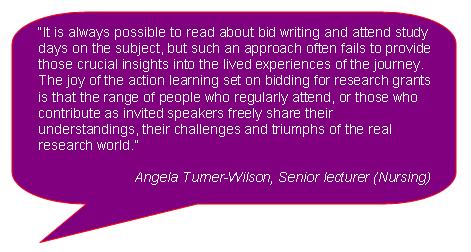
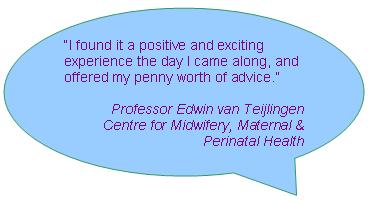 This 6-month programme which commenced February 2011 has already made an impact. One afternoon per month the group of 10 postdoctoral academics, drawn from each of the research centres in the School, engage with the professoriate in learning the skills of bidding for research grants, sharing the lessons learned, as well as the challenges and the pitfalls. Whilst there are key areas addressed during the programme, essentially the action learning group is informal with the programme content arising from queries and suggestions from the group itself. The atmosphere offers an air of excitement and is informal and very informative with a buzz of spontaneity and active discussion. The testimonials provided here show just how useful the programme has been to participants as well as to the HSC professoriate.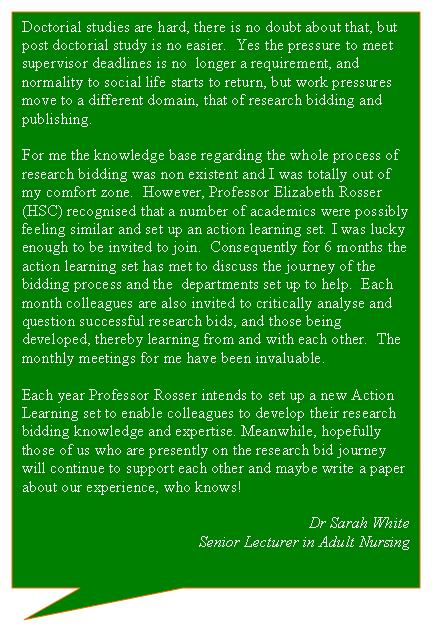
 We are delighted to offer a bespoke GrantCraft Research Workshop Day on May 11th 2011, facilitated by Dr Martin Pickard, a specialist in writing and supporting research proposals (particularly EU). Sessions will be held on grant writing skills, impact and benefit, how to write a Marie Curie proposal and the management of EU projects. You can attend as many sessions as you like throughout the day. To read more on each session and to make a booking see our
  In a week’s time I will have the great pleasure to open the School of Applied Sciences’ Postgraduate Research Conference. I was delighted that I was asked to give a keynote, not only because it is a nice way of making myself known to students, since I only arrived at BU in January, but also to share some thoughts about the way we do research. Whilst universities require some original research in the final year undergraduate dissertation, and to a much greater extent in Master’s programmes, it is at PhD level where we expect the clear evidence of intellectual independence, of playful recombination of knowledge, which will allow candidates to go beyond current established borders of thought, and to push scientific progress, something that is always happening at the fringes.







 ESRC Studentships for 2027 Entry: Opportunity Now Open
 SONAMONI contributions to Safety Conference 2026 in South Africa
 Three CMWH presentations at Berlin conference
 New interdisciplinary paper on Nepal
 Horizon Europe Cluster 3 (Civil Security for Society) 2026 Calls Now Open
 MSCA Doctoral Networks 2026 Call Information Webinar
 ESRC Festival of Social Science 2026: Application Deadline Extended to Thursday 25 June 2026
 Reminder: Register for the ESRC Festival of Social Science 2026 Information Session
 ECR Funding Open Call: Research Culture & Community Grant – Apply now
 ERC Advanced Grant 2025 Webinar
 Update on UKRO services
 European research project exploring use of ‘virtual twins’ to better manage metabolic associated fatty liver disease