/ Full archive

Starting with Uncertainty: Teaching Technology Entrepreneurship Through Civic Immersion

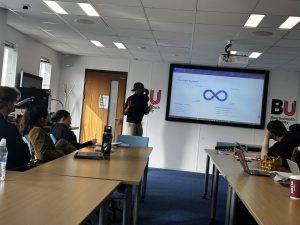
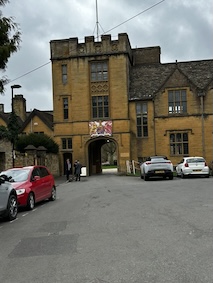
MBA students on Bournemouth University’s Level 7 unit Entrepreneurship: Technology-Driven Ventures & User-Centred Business Solutions began their learning journey not in a lecture theatre, but in Sherborne, Dorset at the stunning Sherborne Boys School.

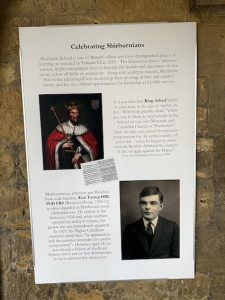
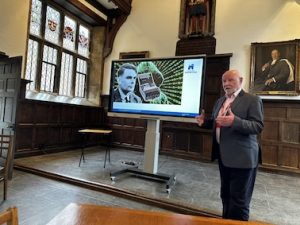
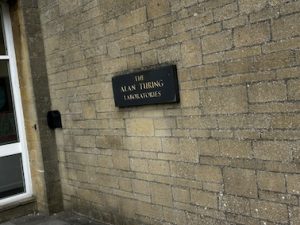
Hosted by the steering committee behind the emerging Turing Centre initiative,  our students were immersed in a live civic project inspired by the legacy of Alan Turing. The Turing Centre vision is explicitly future-facing: to inspire young people in digital technology, create an innovation hub and enterprise zone, support pathways into employment and skills, and function as a social, cultural, and economic asset for Sherborne and beyond . Rather than analysing this as a completed case , students encountered an evolving initiative shaped by institutional constraints, funding realities, stakeholder ambitions, and technological uncertainty. After exploring Sherborne’s historical and civic context, they worked in teams on four strategic challenges: translating vision into a viable business model, developing fundraising logic, shaping promotion and positioning, and evaluating financial, economic, and social sustainability. Their proposals were presented directly to members of the steering group.

This was not accidental. It reflects a deliberate pedagogical choice.

Entrepreneurship education has, for some time now, been trying to move beyond the “inspiration” model,  the idea that if students feel energised enough, something entrepreneurial will magically happen. Contemporary scholarship instead emphasises competence, judgement and disciplined practice (Neck & Corbett, 2018). Hägg and Gabrielsson’s (2020) systematic review traces this shift clearly: from knowledge transmission to experiential and practice-based designs. But they also sound a note of caution. Experience alone is not enough. Without theoretical integration, it risks becoming energetic but shallow.

Kolb’s (1984) experiential learning cycle — experience, reflection, conceptualisation, experimentation — is frequently invoked in business education. Yet critics have long warned that “learning by doing” can quietly become “doing without thinking” (Kayes, 2002). Morris (2020) similarly argues that Kolb’s framework is often applied in a simplified manner, neglecting the epistemic depth required for higher-order learning. In other words, activity is not the same as analysis.

The Sherborne engagement was therefore designed not as a field trip in the traditional sense, nor as consultancy theatre, but as structured immersion before interrogation. Students encountered ambiguity first; stakeholder tensions, funding constraints, institutional realities, technological ambition, and only afterwards will they begin systematically analysing what they have seen. Over the two weeks beginning 2 March, that initial immersion will be subjected to scrutiny. Entrepreneurship theory, user-centred design frameworks, and sustainability debates will not sit alongside the experience; they will probe it. Assumptions made in Sherborne will be tested. Enthusiasm will be examined. Gaps in evidence will be exposed.

Assessment design is crucial in holding this intellectual line. Research on authentic assessment demonstrates that tasks resembling professional practice enhance capability only when academic standards remain explicit and evaluative judgement is foregrounded (Villarroel et al., 2018). In this unit, students are required not merely to propose a technology-enabled, user-centred venture, but to justify its feasibility, scalability, ethical implications, and community impact through scholarly argument.

This matters particularly in technology entrepreneurship, where uncertainty, adoption dynamics and unintended consequences are structural features rather than unfortunate accidents. Pittaway and Cope (2007) argue that effective entrepreneurship education must expose learners to uncertainty while supporting reflective sensemaking. The Sherborne visit functions precisely as such a productive disorientation.

For this MBA cohort, Sherborne now becomes an anchor point. They are not beginning with abstract frameworks detached from context. They are beginning with lived complexity. The task ahead is not to apply tools mechanically, but to develop disciplined judgement by integrating technology, commercial logic and community value with intellectual rigour rather than optimism alone.

Experiential learning, when critically structured and theoretically grounded, does not dilute academic depth. It sharpens it.


References:

Hägg, G., & Gabrielsson, J. (2020). A systematic literature review of the evolution of pedagogy in entrepreneurial education research. International Journal of Entrepreneurial Behavior & Research, 26(5), 829–861. https://doi.org/10.1108/IJEBR-04-2018-0272

Hägg, G., & Kurczewska, A. (2016). Connecting the dots: A discussion on key concepts in contemporary entrepreneurship education. Education + Training, 58(7/8), 700–714. https://doi.org/10.1108/ET-12-2015-0115

Kayes, D. C. (2002). Experiential learning and its critics: Preserving the role of experience in management learning and education. Academy of Management Learning & Education, 1(2), 137–149. https://doi.org/10.5465/amle.2002.8509336

Kolb, D. A. (1984). Experiential learning: Experience as the source of learning and development. Prentice Hall.

Morris, T. H. (2020). Experiential learning – A systematic review and revision of Kolb’s model. Interactive Learning Environments, 28(8), 1064–1077. https://doi.org/10.1080/10494820.2019.1570279

Neck, H. M., & Corbett, A. C. (2018). The scholarship of teaching and learning entrepreneurship. Entrepreneurship Education and Pedagogy, 1(1), 8–41. https://doi.org/10.1177/2515127417737286

Pittaway, L., & Cope, J. (2007). Entrepreneurship education: A systematic review of the evidence. International Small Business Journal, 25(5), 479–510. https://doi.org/10.1177/0266242607080656

Villarroel, V., Bloxham, S., Bruna, D., Bruna, C., & Herrera-Seda, C. (2018). Authentic assessment: Creating a blueprint for course design. Assessment & Evaluation in Higher Education, 43(5), 840–854. https://doi.org/10.1080/02602938.2017.1412396

REF Code of Practice consultation is open!

On Wednesday 25 February, we opened a staff consultation on our draft Research Excellence Framework (REF) 2029 Code of Practice. All colleagues are invited to engage in the consultation and to provide feedback to shape our REF submission approach.

All the information about the consultation and the full Code of Practice can be found on the Research and Innovation Services pages on the Staff Hub.

What is the REF?

The Research Excellence Framework (REF) is the UK’s system for assessing the excellence of research in UK higher education institutions (HEIs). The next exercise is REF 2029.

The purpose of the REF is to:

  • Inform the allocation of block-grant research funding to HEIs based on research quality
  • Provide accountability for public investment in research and produce evidence of the benefits of this investment
  • Provide insights into the health of research in HEIs in the UK.

The REF is an expert review process. Higher Education Institutions (HEIs) make submissions in specific subject areas, known as Units of Assessment (UoAs). Each submission is assessed by an expert sub-panel, working under the guidance of main and advisory panels.

Why is the REF important?

The REF is a national exercise which enables HEIs and researchers to showcase the excellent research which is being undertaken and the impact that research is having. In REF 2021:

  • 94% of BU research was found to be internationally recognised or above, with 19% found to be world-leading in quality
  • 95.7% of our research was found to be delivering considerable impact or above, with 31.5% achieving an outstanding impact score.

The REF is very important to BU, both in terms of funding and reputation. REF results are used in university ranking tables and we currently receive over £6 million per year in quality-related research (QR) funding because of our performance in the last REF.

What is the Code of Practice?

A Code of Practice (CoP) is a mandatory requirement for REF 2029, which sets a minimum standard for participation. Higher Education Institutions wishing to make a submission to REF 2029 must have a CoP approved by the funding bodies.

We need to submit our CoP to Research England between 11 and 15 May 2026.

What does it cover?

BU’s CoP sets out the processes we will follow for submission to REF 2029. It describes our policies and procedures for:

  • identifying teaching and research contracts with Significant Responsibility for Research (SRR)
  • identifying research-only contracts with research independence (RI)
  • allocating contracts to UoAs
  • the selection of outputs for submission.

Consultation timeline

The consultation will run for three weeks, from 25 February to 18 March. Alongside publishing the full CoP and associated FAQs, we will be hosting the following events to provide further information on the REF and the CoP:

  • Wednesday 4 March, 2pm to 3pm, online
  • Tuesday 10 March, 3pm to 4pm, Lansdowne Campus, S108, Studland House and online
  • Friday 13 March, 10am and 11am, Talbot Campus, Share Lecture Theatre, in-person only.

These events are open to all staff and will provide an opportunity to ask questions and discuss the proposals in more detail.

An online Padlet is also available through the Research and Innovation Services pages to enable anonymous feedback.

We encourage everyone to get involved, ask questions and provide feedback to refine our CoP and shape our REF submission approach.

BU Leads AI-Driven Work Package in EU Horizon SUSHEAS Project

[SUSHEAS logo]Bournemouth University is proud to be a key partner in the EU-funded research project SUSHEAS (Sustainable Production of High Entropy Alloys from Secondary Metals), which aims to enable more sustainable and efficient production of High Entropy Alloys (HEAs) using secondary metals such as scrap and recycled materials.

HEAs are chemically complex multi-component alloys with strong potential for future high-performance applications. However, most current HEA production relies heavily on virgin raw materials, leading to high energy consumption, cost, and environmental impact. SUSHEAS addresses this challenge by developing new sustainable production methods supported by international academic–industrial collaboration and staff exchanges.

Bournemouth University leads Work Package 2 (WP2), which focuses on advancing the state of the art through computational and AI-driven approaches. WP2 aims to develop new alloy composition options that can better tolerate impurities often found in recycled metals, while still meeting desired performance requirements.

This includes the use of advanced tools such as Machine Learning (ML), Artificial Intelligence (AI), CALPHAD modelling, and Finite Element Analysis (FEA) to optimise alloy chemistry and processing conditions, supporting more sustainable and scalable HEA manufacturing.

Dr Paul de Vrieze and Dr Lai Xu, as project leader and co-project leader, bring complementary expertise in AI-driven digital twins, smart manufacturing, and enterprise systems integration. Their research contributes the digital intelligence layer needed for sustainable manufacturing, enabling reasoning-based AI models and digital simulations to optimise manufacturing processes, energy use, and material flows—particularly when incorporating advanced or secondary materials.

Through SUSHEAS, Bournemouth University is helping to shape the future of sustainable advanced materials production and supporting the development of greener manufacturing technologies for Europe.

[group foto]

Group foto


Expand Your Impact: Collaboration and Networking Workshops for Researchers

Building Partnerships and Strengthening Professional Networks.

Are you looking to turn your research into real-world partnerships or grow your professional circle? This March, we are hosting two practical workshops designed to help researchers at all stages build stronger connections.

Both sessions are actionable; you’ll walk away with the tools to communicate your value and build a support system that fuels your research goals.

Collaborating with External Partners

Thursday 12 March, 10am-12pm

Create Lecture Theatre, Fusion Building, Talbot Campus

Building long-term partnerships with industry and government doesn’t happen by accident. In this cross-faculty session, Rachel Clarke, Matt Desmier, and Finn Morgan will share practical examples of how BU teams have successfully aligned their expertise with external needs.

Why attend?

  • See how successful BU partnerships were actually built
  • Learn how to start conversations that lead to meaningful collaborations
  • Discover how your data and research can fit into wider, high-impact initiatives

Find out more and register on Eventbrite

Developing Professional Researcher Networks

Tuesday 17 March, 9:30am-12:30pm

Online

Networking is a skill, not a personality trait. Join facilitator Margaret Collins for a half-day session focused on the strategy and confidence needed to grow your professional visibility.

Overview of the session

  • Strategic Analysis: Auditing your current network and finding the gaps
  • Confident Communication: Refining your professional introduction and mastering “small talk”
  • Managing Anxiety: Practical tools to handle the stress sometimes associated with networking
  • Body Language: Using non-verbal cues to communicate more effectively

Find out more and register on Eventbrite

The Researcher Development Hub serves as your central resource for all professional growth opportunities. 

If you have any questions, please contact the Researcher Development and Culture Team researcherdevelopment@bournemouth.ac.uk

3C Event: Research Culture, Community & Can you Guess Who? Thursday 26 March 1-2pm

The Doctoral College invites BU’s research community to a relaxed online social centred on Culture, Community, and Connection

This 3C event offers a playful break from the academic routine with a “Guess Who?” game where your work takes centre stage. Submit an image that best represents your research along with a 7-word description of your work, then join us online to see who can match the clues to the right researcher.

Whether you contribute, or join as an audience member, it’s a fantastic way to share your work creatively and spark new collaborations

Event Details

Thursday 26 March

1-2pm

Online

Find out more and register here

We’re looking forward to seeing you there!

If you have any questions about the event, please get in touch with the Research Development & Culture Team: researcherdevelopment@bournemouth.ac.uk

New Social Work text with BU editors

Congratulations to Jonathan Parker, Ivan Gray, Andrew Morris and Sally Lee, the editors of the fourth edition of Newly-Qualified Social Workers: A Practice Guide to the Assessed and Supported Year in Employment [1].  This new edition has eleven chapters.  Apart from the various chapters produced or co-produced by the editors, this 2026 text also include a chapter by two further Bournemouth University academics, including Dr. Richard Williams and Dr. Louise Oliver.  The latter contributed ‘Chapter 7: Research and NQSW: Developing yourself as a research minded and critically reflective practitioner’.

Congratulations!

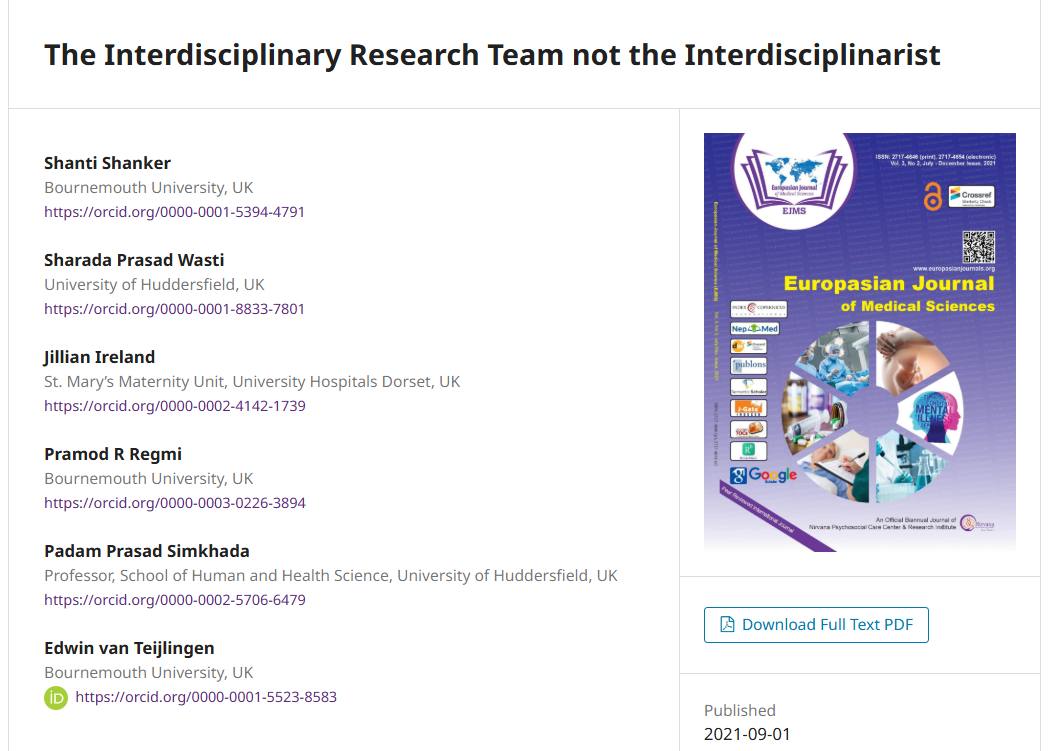
Prof. Edwin van Teijlingen

Faculty of Health, Environment & Medical Sciences


Reference:

  1. Parker, J., Gray, I., Morris, A. and Lee, S. (eds.), Newly-Qualified Social Workers: A Practice Guide to the Assessed and Supported Year in Employment (4th edn.), London: Learning Matters, SAGE, 2026.

Beyond Academia: Exploring Career Options for Early Career Researchers – Online Workshop

Enhance your professional growth with this upcoming researcher development and research culture opportunity for ECRs

Beyond Academia: Exploring Career options for ECRs

Wednesday 25 February, 1:30 – 4:30 pm

Online

Facilitated by Margaret Collins from Training for Universities

This engaging, practical 3-hour workshop supports early-career researchers considering their next professional chapter. Whether moving by choice or necessity, many researchers are now seeking meaningful, fulfilling alternatives to the traditional academic path. This session helps participants recognise their transferable skills, explore a wider range of careers options, and build the confidence to take their next steps, both inside and outside academia.

Find out more and register here

For more opportunities, explore the Researcher Development Hub and catch up on our February Newsletter.

If you have any questions, please contact the Researcher Development and Culture Team researcherdevelopment@bournemouth.ac.uk.

UKCGE Recognised Research Supervision Programme: Deadline Approaching

Whether you are a seasoned supervisor or just starting out in supervision, professional recognition is a powerful way to validate your expertise and contribute to a thriving research culture at Bournemouth University.

The UK Council for Graduate Education (UKCGE) offers a national accreditation programme that allows you to benchmark your practice against the Good Supervisory Practice Framework.

Why apply?

UK universities are increasingly prioritising supervisor development to enhance research culture and doctoral support. The Research Supervisor Recognition Programme (RSRP) encourages supervisors at all levels to engage in structured self-reflection, using the Good Supervisory Practice Framework to identify strengths and target areas for growth.

Key benefits of RSRP Awards:

  • Structured Self-Reflection: Evaluate your methods and decision-making.
  • Benchmarked Excellence: Map your practice against national standards.
  • Professional Growth: Identify clear pathways for improvement, whether applying for Full or Associate awards.

With over 30 BU supervisors already recognised, now is the perfect time to join their ranks.

Which pathway is right for you?

The Research Supervisor Recognition Programme offers two levels based on your current experience:

Award Level Eligibility
Recognised Supervisor (Full Award) For those who have supported doctoral candidates all the way through to final examination and completion
Recognised Associate Supervisor (Associate Award) For those who haven’t yet seen a candidate through to completion, or who supervise in an informal capacity

Steps to apply

1. Write your reflective account

You will need to write a reflective account of your supervisory practice aligned with the Good Supervisory Practice Framework.

Submit your application using the relevant form:

Recognised Supervisor Reflective Account Form  Word 56.37KB

Recognised Associate Supervisor Reflective Account Form Word 55.72KB

Find out more about structured self-reflection

2. Gather your references and supporting documentation

To authenticate your reflective account, you are required to provide supporting documentation.

For the Full Award, you will need:

  • A reference from a former doctoral candidate.
  • A reference from a colleague who knows about your supervisory practice (e.g., a co-supervisor).

For the Associate Award, you will need:

  • A reference from a colleague who knows about your supervisory practice (e.g., a co-supervisor).
  • A Supervision Observation report.

Forms for Referees:

3. Seek formal approval

Before your application can move to the final review stage, a formal approval email must be sent from your Associate Dean Research, Innovation and Enterprise directly to researcherdevelopment@bournemouth.ac.uk 

Key information

Peer-reviewed feedback: Applications are reviewed by a two-person panel. You will receive detailed, actionable feedback regardless of the outcome.

Fully funded: The Doctoral College is covering the full cost of applications for all BU supervisors.

Support for your application: Access the guidance and tips shared during our recent Supervisory Lunchbite workshop here.

FAQs:UKCGE | Frequently Asked Questions

Important Deadlines

Internal BU Deadline: 9am, Monday 16 March 2026

UKCGE Deadline: Friday 20 March 2026

Expected Outcome: June 2026

Complete applications should be submitted to Julia Taylor (Doctoral College) at researcherdevelopment@bournemouth.ac.uk

High five! New FishE papers support the evidence base for conserving threatened species and habitats

Providing the evidence base to support conservation actions that protect species and habitats in aquatic ecosystems is a key task in the Fish Ecology and Conservation Research Cluster (FishE). This week, five articles published or accepted for publication will contribute strongly to this evidence base, with the work co-created with a number of funders and collaborating organisations.

Sotiris Meletiou’s PhD is on the conservation biology and management of the critically endangered European eel in Cyprus – which is at the eastern edge of their range and far away from their spawning grounds in the Sargasso Sea (Atlantic Ocean). Until now, an eel management plan was not required for Cyprus as any eels present were not believed to metamorphose into adult silver eels and not emigrate back to their spawning grounds. Sotiris’ new paper in the Journal of Fish Biology demonstrates that silver eels are indeed present in Cyprus and do attempt to emigrate to sea, and so should drive the formation of a management plan that should result in greater eel protection and conservation in the eastern Mediterranean.

Simone Cittadino’s research is assessing how freshwater fish respond to saline incursion events from the sea into lowland rivers. these events driven by high spring tides, exacerbated by climate change driven rising sea levels and weather events. His new paper in Hydrobiologia assesses the general movements of a key fish species in the Norfolk Broads, the common bream, highlighting the importance of high habitat connectivity for their movements across this large protected wetland. This work will provide a strong basis for the rest of his PhD research.

Phillip Haubrock, a Marie Curie Incoming postdoctoral Fellow, identified how conservation efforts across the world have been affected by research that is limited by political borders and the restricted availability of data. He and his co-authors argue in Conservation Biology that supra-national and better open-data governance should be capable of overcoming this and lead to better conservation outcomes.

Two articles just accepted for publication this week also contribute strongly to the conservation evidence base. Jonas Palder’s first publication from his PhD was accepted in the Canadian Journal of Fisheries and Aquatic Sciences, which assessed the increased mortality risk for threatened European shads caused by human constructed barriers within rivers. Robert Britton worked with Gabby Valle, one of our School’s 2024/25 MSc Biodiversity Conservation students, to get her research project data published, which was assessing the risk of a biological invasion in Britain by the globally invasive and ecologically damaging common carp. Their manuscript has also just been accepted for publication in the Journal of Fish Biology.

Congratulations to all involved!

Turning research into art


This sculpture tells the untold story of life with a feeding tube — a presence both vital and alien, a lifeline that nourishes while carving its own path through the body. Like ivy, it winds and clings, sometimes tender, sometimes sharp, always there. It does not ask permission. It heals, disrupts, and transforms” (Mahtab Grimshaw).


Local artist Mahtab Grimshaw created this striking and thought‑provoking sculpture after meeting with Sue Green and Carolyn Wheatley (Chair of PINNT) to discuss the findings from a recent national survey exploring what people living with home enteral nutrition (HEN), and their carers, really need to feel supported.

The survey

The number of people requiring home enteral nutrition (HEN) is increasing, creating a need for effective support services. This study explored what people with enteral tubes and their carers in the UK want from services to help them manage at home. A questionnaire survey with 243 respondents revealed inadequate pre-discharge training, inconsistent information, variable professional support, and significant impact on daily life. Key needs identified included comprehensive training, consistent advice, regular reviews, emergency support, and psychological care. Findings highlight the need for standardised pathways and quality indicators to ensure equitable, high-quality HEN support across the UK (Green et al., 2025).

Turning research into art

To share these findings we responded to an internal BU call for proposals to collaborate with a local artist through the BU-BEAF ART Co. initiative. Our aim was to transform data and lived experience into something that would resonate with healthcare professionals and those unfamiliar with the realities of enteral feeding.

The result is Graft, the Twining Linb —a powerful sculpture that has already travelled to Wales, appeared at the BAPEN Annual Conference, and even met the Welsh Minister. Later this year, she will be heading to an international conference in Scotland.

Thank-you to the BU organisers (Prof Mel Hughes and Dr Gladys Yinusa) for backing this project, and to Mahtab Grimshaw for bringing this research to life in such an original and impactful way.

Sue Green, School of Health and Care, Faculty of Health, Environmental and Medical Sciences.

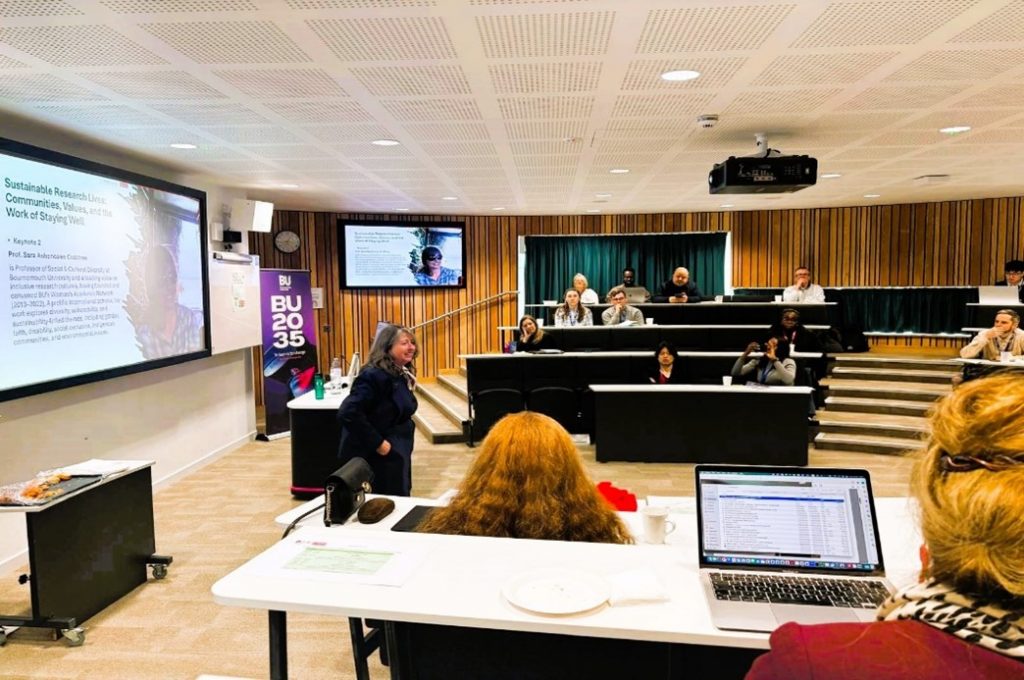
SPROUT: From Sustainable Research to Sustainable Research Lives

BRIAN upgrade and new look

Following a routine upgrade last week, BRIAN is now accessible for use.

Users will notice that the navigation menu has been repositioned from the top of the screen to a new, left-hand sidebar. The heading bar, and the navigation items included in it, have been consolidated into the sidebar to enable quicker access to essential features and content, and help users more effectively locate the information they need.

Old view

New view


The updated navigation introduces improved interaction patterns, providing a more dynamic and intuitive browsing experience.

  • Hovering over the new left-hand sidebar will expand the first layer of navigation.
  • Within this expanded menu, you’ll find various sections that can be further explored by mousing over them, revealing additional nested layers where applicable.
  • For sub-sections containing more detailed options, these are now presented as nested menus that are collapsed by default, allowing for cleaner navigation while still providing access to lower levels of detail with a simple click.
  • Additionally, you can interact with the logo to trigger the menu to open without needing to maintain a hover state.


In addition, the new ‘Find a Page’ search box now appears prominently at the top of the sidebar, allowing users to search for and jump directly to any page without navigating through sections.


We hope the new features will improve your BRIAN experience.

For any questions, email BRIAN@bournemouth.ac.uk

A different way of external examining

Last month I had the honour of chairing a committee to review the first three years of the MSc in Midwifery in the Netherlands.  Since all Higher Education Institutions (HEI) in the Netherlands offer this joint degree there is only one in the country.  This national collaboration meant there were very few academics working in the field of midwifery who can claim to be independent.  All midwifery educators/academic midwives are employed by one of the HEIs participating in the joint Master’s degree. Hence, two of the four committee members, including myself came from abroad.

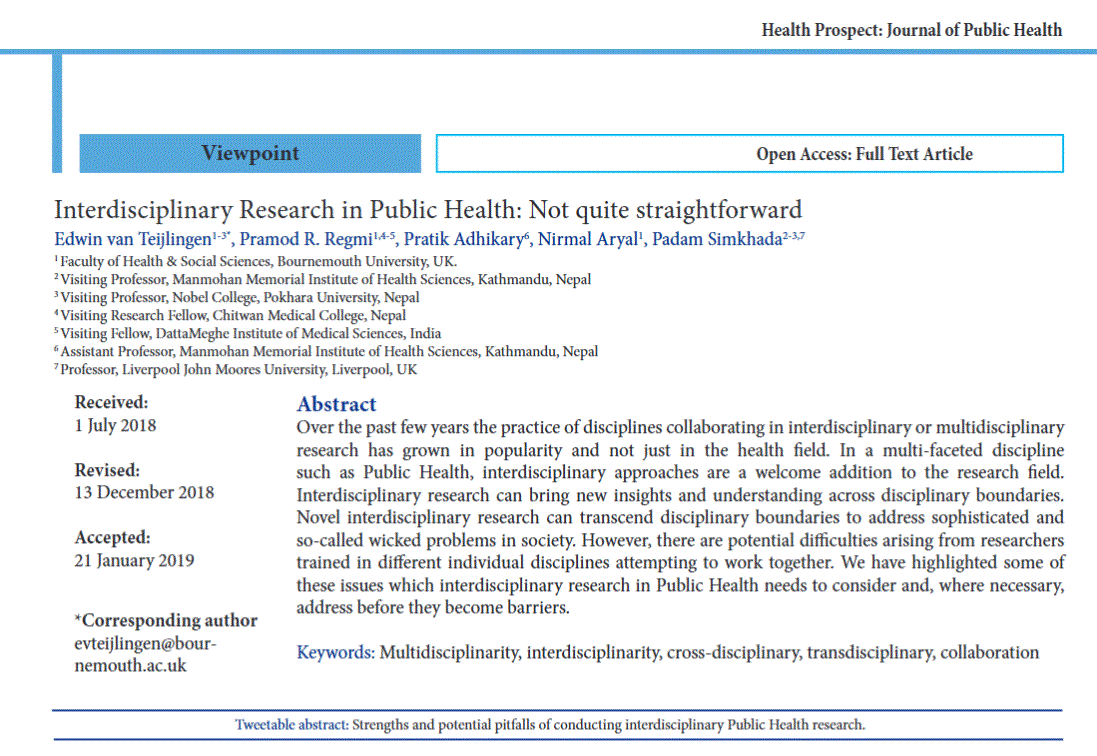
Today’s blog highlights that there is a different way to the UK version of external examining as a form of quality control in Higher Education.  In the UK each undergraduate programme, or year in a programme, or module has its own external examiner, who is appointed typically for three years to act as independent assessor.  External examiners typically reviews all education aspects of the programme/module and discuss their assessment examiners’ meetings held at the host university.  For more details on external examining in the UK, see also:”Acting as External Examiners in the UK: Going Beyond Quality Assurance[1].

The Netherlands and Flemish-speaking Belgium has a single cross-national organisation which is responsible for assessing the quality of higher education degrees.  This organisation, the NVAO [Accreditation Organisation of the Netherlands and Flanders], has an accreditation system that covers Associate Degree, Bachelor’s, and Master’s programmes in the Netherlands.   First, there is the need for initial accreditation of a new programme, valid for a period of six years.  Secondly, the accreditation of an existing programme, which, following a positive assessment, is valid indefinitely, as long as the programmes passes the six-yearly assessment by a panel of independent experts (peers engaged by the NVAO).  Between these periodic assessments there is no equivalent of the UK’s annual external examiners’ meeting.

Reference:

  1. Poobalan, A., Simkhada, P. & van Teijlingen, E. (2021), “Acting as External Examiners in the UK: Going Beyond Quality Assurance“, In: Sengupta, E., Blessinger, P., Ssemwanga, A. & Cozza, B. (Ed.) The Role of External Examining in Higher Education: Challenges and Best Practices (Innovations in Higher Education Teaching and Learning, Vol. 38), Emerald Publishing Limited, Bingley, pp. 13-23. https://doi.org/10.1108/S2055-364120210000038002

Prof. Edwin van Teijlingen

The Sports Therapy Team advancing rehabilitation

Rehabilitation and performance professionals came together at BU for an evening dedicated to the future of technology‑enhanced rehabilitation, exploring how data‑driven tools are reshaping assessment, treatment and return‑to‑play strategies.

Matt Best, Lecturer in Sports Therapy in the School of Allied Health and Exercise Science, and Sam Chapman, Strength And Conditioning Coach shared their practical approach to criteria‑based rehabilitation, offering insight into the methods they apply daily within both teaching and applied practice at the Physical Performance Hub.

Southampton FC First Team Physiotherapist Luke Thomas delivered a focused deep dive into calf injuries, covering prognosis, structured rehab planning and the testing frameworks that support decision‑making in elite football environments.

The VALD team rounded out the evening with hands‑on demonstrations, giving attendees the chance to experience best‑practice testing workflows and explore how technology can elevate clinical and performance outcomes.

Thank you to all presenters, partners, and attendees for contributing to such a valuable and forward‑thinking event, strengthening our community and reinforcing BU’s civic role in shaping safe and effective practice.