Last chance to submit…
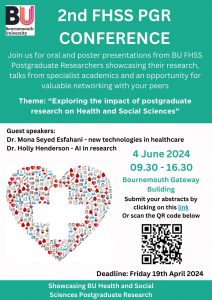
The Conference Committee welcome all PGRs in HSS to submit an abstract to present at the 2nd annual department conference, which will be held on Tuesday 4th June.
Latest research and knowledge exchange news at Bournemouth University
Last chance to submit…
The Conference Committee welcome all PGRs in HSS to submit an abstract to present at the 2nd annual department conference, which will be held on Tuesday 4th June.
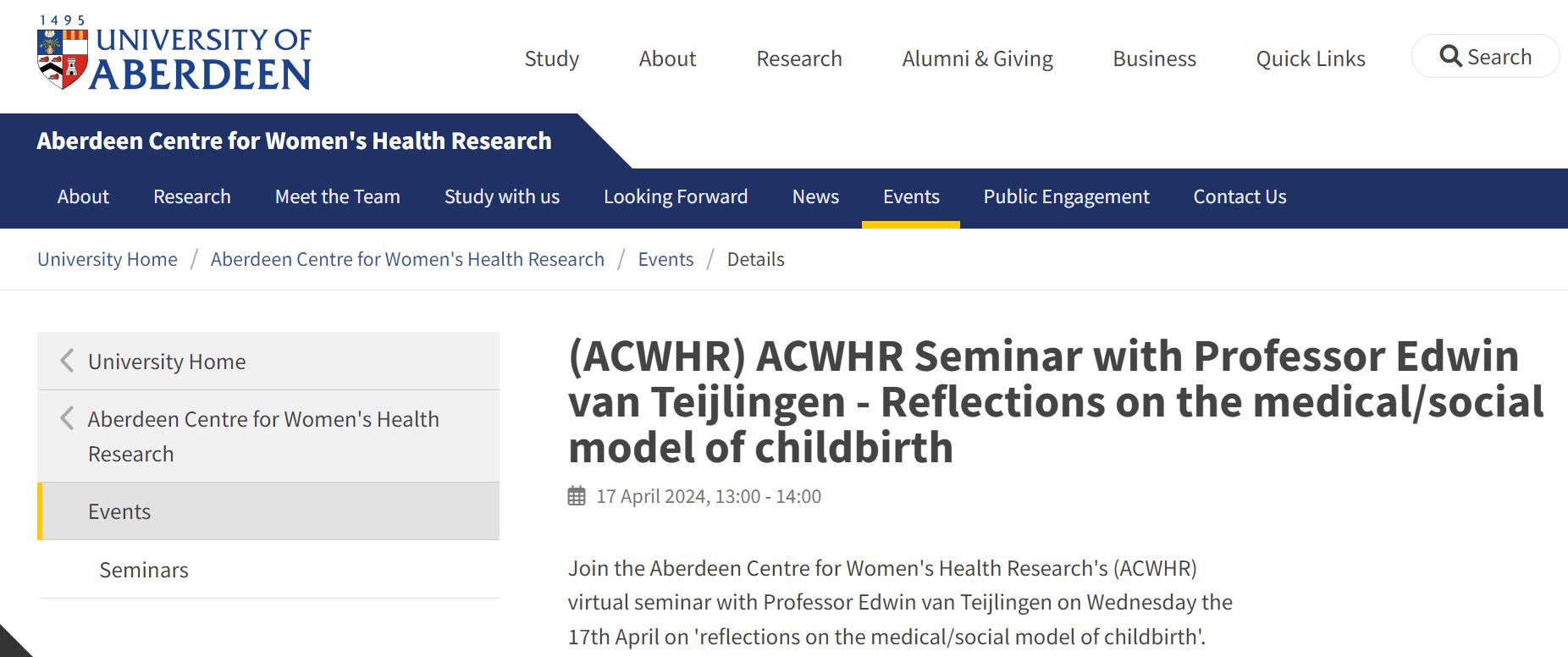
Looking forward to speaking at the University of Aberdeen this week, unfortunately not in person. This one-hour session coming Wednesday lunchtime will focus on the ‘medical/social model of childbirth‘. Please contact Kelly Gray at the University of Aberdeen (kelly.gray@abdn.ac.uk) for the Teams link to join!
Prof. Edwin van Teijlingen
Centre for Midwifery & Women’s Health
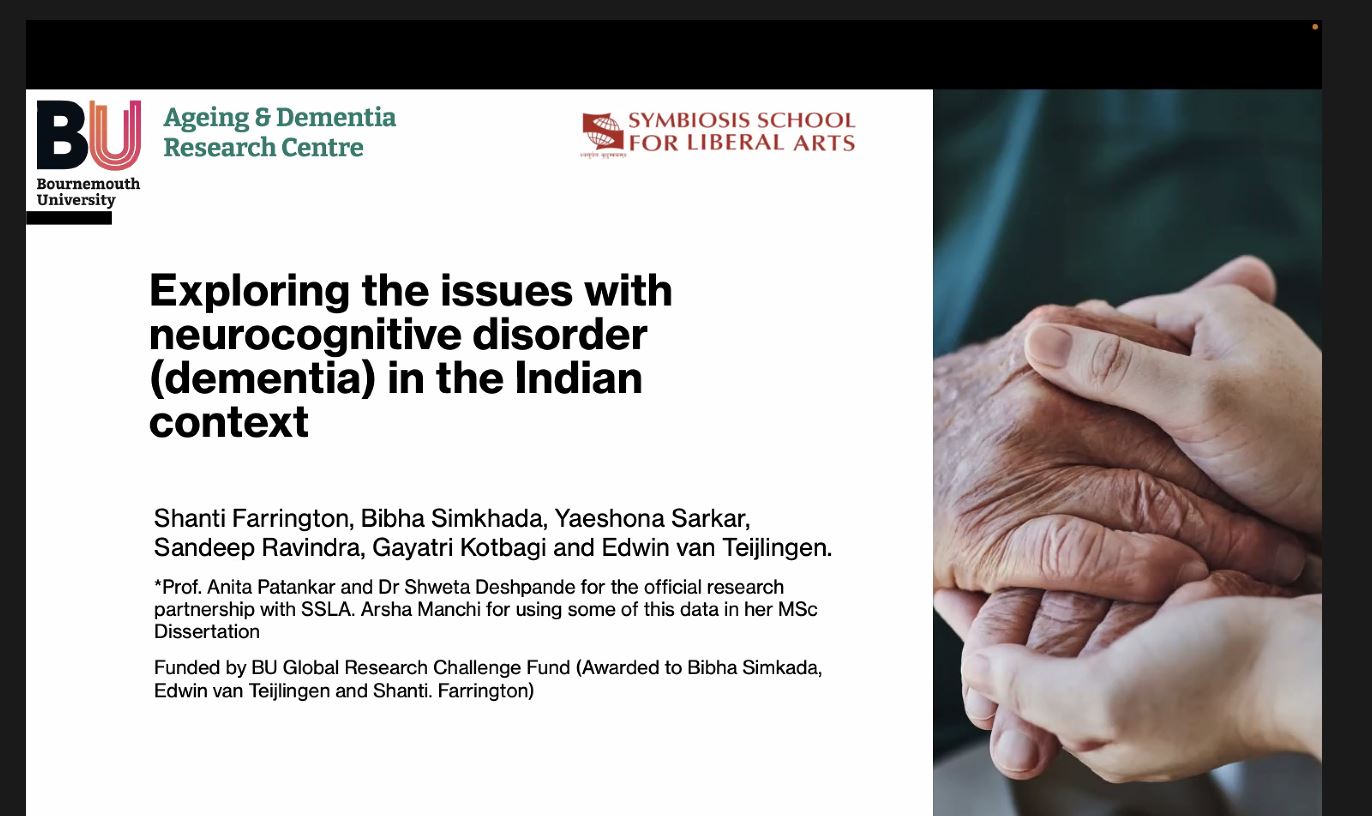
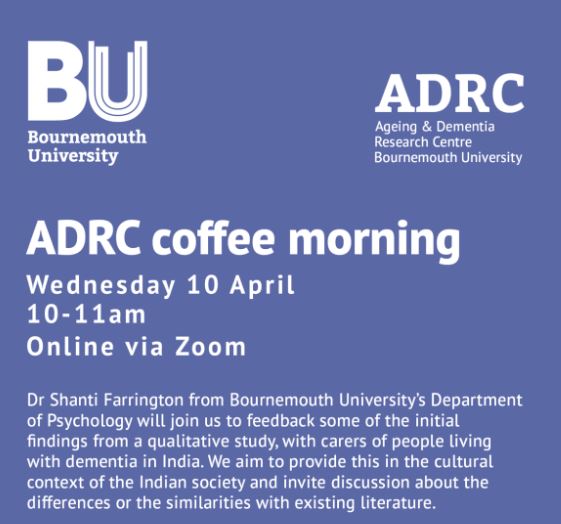
Today Dr. Shanti Farrington, Principal Academic in Psychology, presented our research work on dementia in India today. She was invited to speak to the ‘Research Participation Group of the Ageing & Dementia Research Centre (ADRC) at Bournemouth University. She addressed a range of interesting issues, for example she spoke about lack of training of health care workers in dealing with people living with dementia, but also in lack of experience in diagnosing different forms of dementia. She also spoke about the lack of experts neurologists in India, and the ageing population in this vast country.
The discussion with the online audience also covered the role of diet in prevention of dementia and the limitations of using online health promotion material and general information on dementia in English, where some many languages are spoken. The underpinning research was largely funded by GCRF (Global Challenges Research Fund).
Prof. Edwin van Teijlingen
CMWH (Centre for Midwifery & Women’s Health)
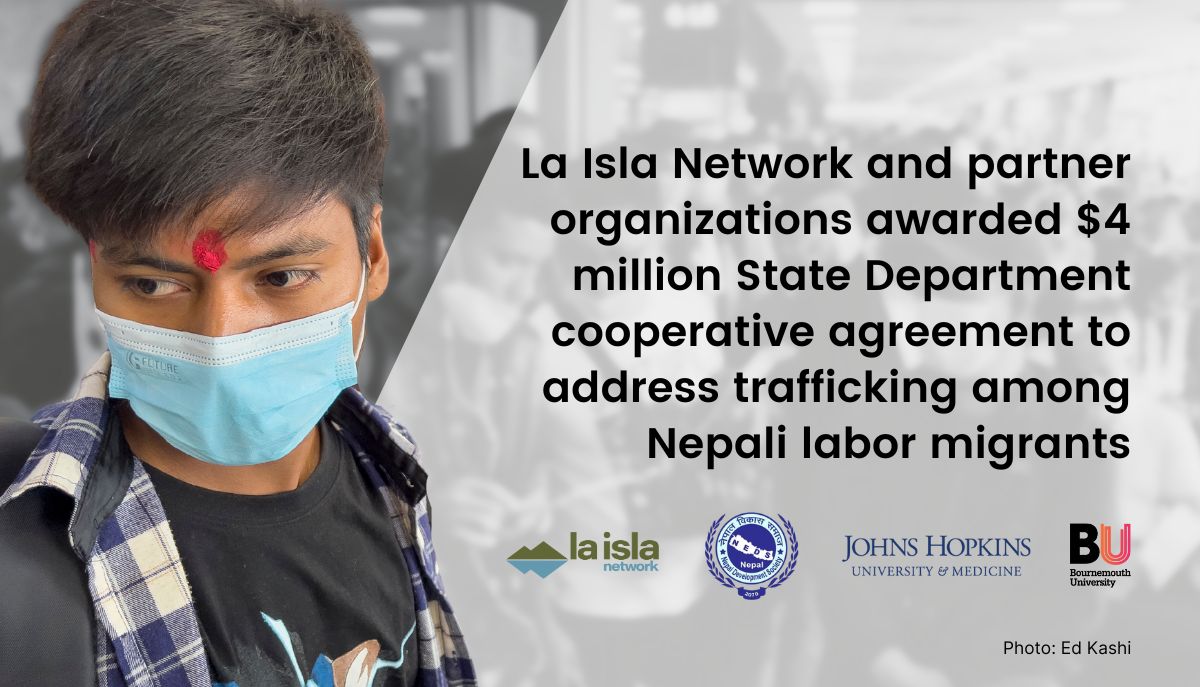
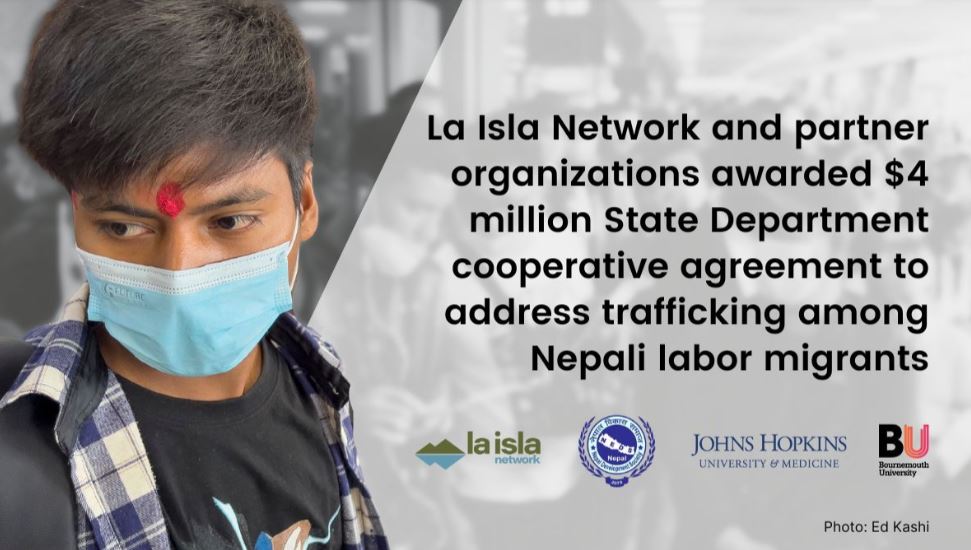
Last week for the first time in over a year I received a request for a mass media interview in the UK on our research. On Easter Monday (1 April) I received an email to appear on Sky TV that very evening to speak about migrant workers and kidney health. this seemed to fit in very nicely with our recently completed study on kidney health funded by the charity The Colt Foundation, and our on-going Ensure-Nepal project funded by the U.S. Department of State’s Office.
After a lot of hassle and finally speaking to the TV research assistant over the phone it turned out Sky TV really wanted an expert to talk about poor people in South Asia selling kidney, despite what they had put in the email invitation on their interest in kidney health of migrant worker. In the end it felt like a few hours wasted on my Bank Holiday Monday. 
Then to my surprise I received a call on Wednesday from BBC Radio Scotland to speak about what babies can hear in the womb and the importance of singing lullabies. Unfortunately, I had to put that request down as this is really not my area of expertise as Professor of Reproductive Health.
Requests to appear on the media to speak about once research seem to be like buses. As the old saying goes, you wait ages for a bus and then two (or more) come along at once. And in this case, NOT only did two turn up, but they were wrong buses anyway!
Prof. Edwin van Teijlingen
Centre for Midwifery & Women’s Health (CMWH)
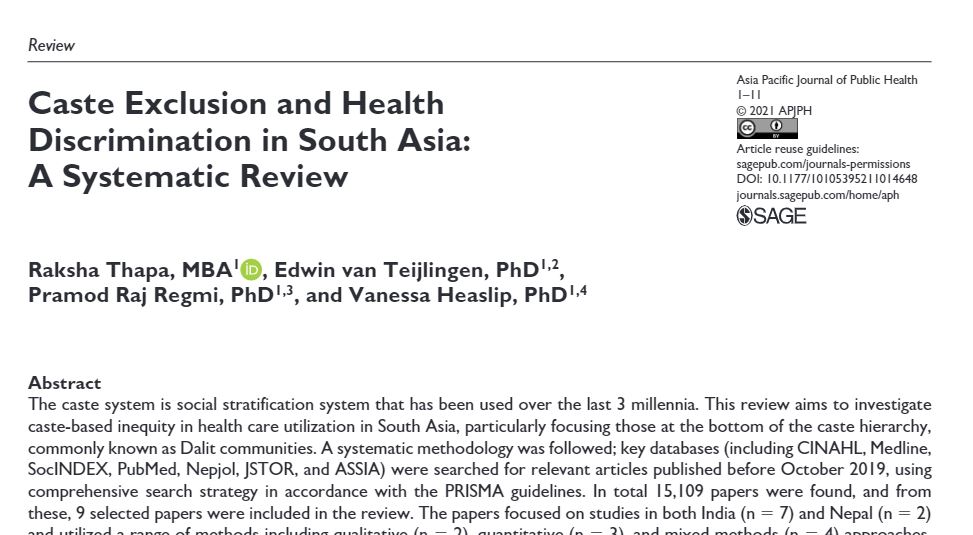
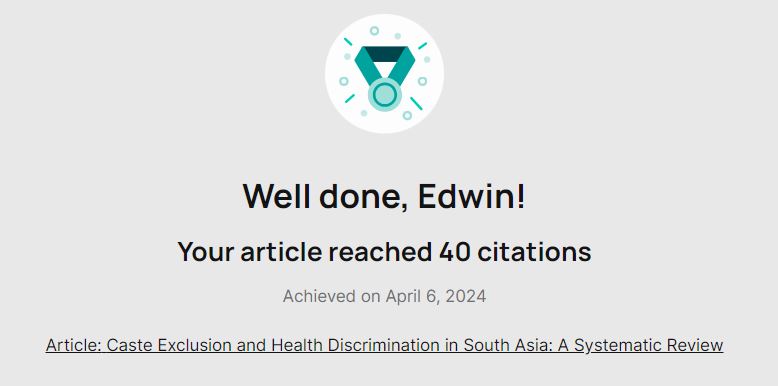
Today ResearchGate notified us that our paper ‘Caste Exclusion and Health Discrimination in South Asia: A Systematic Review’ has been cited 40 times [1]. This paper is based Dr. Raksha Thapa’s work for her Ph.D. in FHSS. This postgraduate project focused on caste-based inequity in health care utilization in Nepal, particularly focusing on people at the bottom of the caste hierarchy, commonly known as Dalit communities. Her Ph.D. study was supervised by Dr. Pramod Regmi, Principal Academic in the Department of Nursing Sciences, Prof. Vanessa Heaslip Professor of Nursing and Healthcare Equity at the University of Salford and Prof. Edwin van Teijlingen in the Centre for Midwifery & Women’s Health (CMWH). Raksha published two further papers from her thesis [2-3].
References:
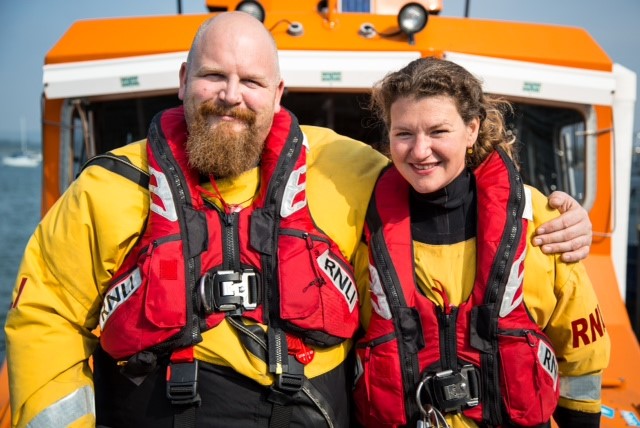
Staff in the Faculty of Health & Social Sciences at Bournemouth University (BU) would like to take this opportunity to congratulate the charity the RNLI (Royal National Lifeboat Institution) on its 200th anniversary! Some of us have personal experience of working with the RNLI. For example, Adam Bancroft, Programme Lead in Paramedic Science and Senior Lecturer in Paramedic Science, in the Department of Midwifery & Health Sciences has been a lifeboat volunteer Adam and his wife Paula were both volunteer crew at Tower RNLI on the banks of the river Thames, which is still the busiest RNLI station in the UK. They would commit to at least two shifts a month where they would be at a state of readiness to launch at moments notice on the pier, ready to respond. 
In a very different way of working with the RNLI, BU academics currently are involved in a collaborative research project with RNLI to prevent the drowning of toddlers under the age of two in rural Bangladesh. This project called Sonamoni. BU is leading this interdisciplinary study of nearly £1.7 million funded by the UK National Institute for Health and Care Research (NIHR). 
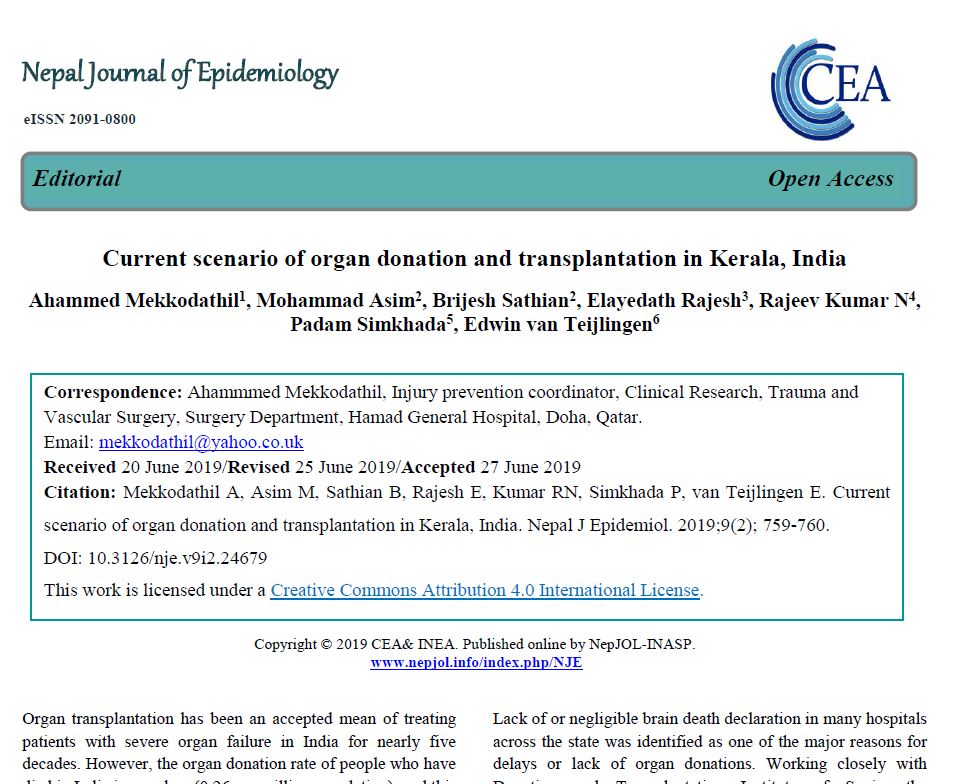
As part of the special issue in Frontiers in Public Health on ‘Evidence-based approaches in Aging and Public Health’ the guest editors included 15 academic papers. These 15 contributions to the Special Issue were introduced in placed in perspective in our editorial ‘Editorial: Evidence-based approaches in Aging and Public Health‘ [1] which was accepted for publication two days ago. The guest editors included two Visiting Faculty to FHSS: Prof. Padam Simkhada and Dr. Brijesh Sathian.
Prof. Edwin van Teijlingen
Centre for Midwifery & Women’s Health (CMWH)
Reference:
Yesterday my co-author Dr. Orlanda Harvey received an email from a sociology journal informing her that “The below co-author name is not matching with the separate title page provided and in the submission. If Van is the middle name please update the name in the author’s account. Name in separate title page appears as Prof Edwin van Teijlingen….Name in site appears as vanTeijlingen, EdwinPlease address the above issue before resubmitting the manuscript.”
If you have an odd name in English you will have to get used to this kind of misunderstanding. This is the second time this is happening when submitting a paper this month! Interestingly with a different variant of my name. A migration and health journal argued to me co-author that my name on ORCID was ‘Edwin van Teijlingen’ but on Scopus ‘van Teijlingen, Edwin Roland’. the journal then asked that we change it.
To add more example on the inflexibility of online systems, my greatest surprise a few years ago was that I could not add my Dutch family name ‘van Teijlingen’ with a small ‘v’ on the online booking web pages of the Dutch airline KLM.
What’s In A Name? A name is but a name, and to quote Shakespeare: A rose by any other name would smell as sweet.
Today we received a copy of the book Appreciating Health and Care in the post. This book has a sub-title ‘A practical appreciative inquiry resource for the health and social care sector’ and refers to the work led by Bournemouth University’s Dr. Rachel Arnold. Appreciative Inquiry values people’s expertise and vision and can motivate people to see the world differently and instigate positive change. Rachel been the lead author on several publications around Appreciative Inquiry [1-3].
Prof. Edwin van Teijlingen
Centre for Midwifery & Women’s Health (CMWH)
References:
Drs. Pramod Regmi and Nirmal Aryal in the Department of Nursing Sciences published a new paper with colleagues from Malaysia, Thailand, and the Philippines in PLoS ONE under the title ‘Assessing the basic knowledge and awareness of dengue fever prevention among migrant workers in Klang Valley, Malaysia’. [1] Globally, 390 million dengue virus infections occur per year. In Malaysia, migrant workers are particularly vulnerable to Dengue Fever (DF) due to mosquito breeding sites exposure and poor health literacy. This study reports on assessing the current Dengue Fever knowledge, attitudes and practices (KAP). The paper identifies strategies to promote awareness around Dengue Fever among migrant workers in Malaysia. Most respondents were male, working in the services industry, had completed high school, aged between 30–39 years and with less than ten years work experience in Malaysia. Overall, respondents’ knowledge was positively correlated with attitude but negatively with practices. Older respondents, who had completed higher education, obtained higher knowledge scores. Similarly, those with working experience of >20 years in Malaysia obtained higher attitude scores. Respondents with a previous history of Dengue Fever strongly considered the removal of mosquito breeding sites as their own responsibility, hence tended to frequently apply preventive measures. Respondents’ knowledge was also positively correlated to their understanding of Dengue Fever information sourced from social media platforms.
Congratulations!
Prof. Edwin van Teijlingen
Reference:
This book employs both ethnographic and secondary, archival data, drawing on a rich, fascinating trove of original material from the pre-1940s to the present day. It offers a unique historiographic study of twentieth century Methodist missionary work and women’s active expression of faith, practised at the critical confluence of historical and global changes. The study focuses on two English Methodist missionary nursing Sisters and siblings, Audrey and Muriel Chalkely, whose words and experiences are captured in detail, foregrounding tumultuous socio-political changes of the end of Empire and post-Independence in twentieth century Kenya and South India.
This work presents a timely revision to prevailing postcolonial critiques in placing the fundamental importance of human relationships centre stage. Offering a detailed (auto)biographical and reflective narrative, this ‘herstory’ pivots on three main thematic strands relating to people, place and passion, where socio-cultural details are vividly explored. 
Prof. Edwin van Teijlingen
Centre for Midwifery & Women’ Health (CMWH)
Publisher Routledge announced the forthcoming edited volume Menstruation in Nepal: Dignity Without Danger, which is edited by Sara Parker, Madhusudan Subedi and Kay Standing. This book examines the complexities of menstrual beliefs and practices in Nepal. Taking an interdisciplinary and intersectional approach, it explores and promotes the rights of women, girls and people who menstruate, to a dignified and healthy menstruation. I had the honour of being asked to write some of the blurb for this exciting book. Partly, because of our wide-range of health services and health promotion research in the country and partly because of our previous paper on reusable sanitary towels in the aftermath of the 2015 earthquake in Nepal [1].
Prof. Edwin van Teijlingen
Centre for Midwifery & Women’s Health
Reference:
Two days ago ResearchGate informed us that that the paper ‘Midwifery-led antenatal care models: mapping a systematic review to an evidence-based quality framework to identify key components and characteristics of care‘ has reached 40 citations. This paper, co-authored by Bournemouth University’s Professors Vanora Hundley and Edwin van Teijlingen, was originally published in 2016 in BMC Pregnancy & Childbirth [1]. Both Vanora and Edwin are based in the Centre for Midwifery & Women’s Health (CMWH) in the Faculty of Health & Social Sciences.
The same team wrote a separate paper the following year on ‘Antenatal care trial interventions: a systematic scoping review and taxonomy development of care models’ [2]. Interestingly, ResearchGate tells us this paper has been read fewer times and cited ‘only’ 21 times to date.
Reference:
Worldwide there is a growing interest in multidisciplinary and interdisciplinary research. This overview paper addresses some of the pitfalls and barriers to being an interdisciplinary researcher. Being involved in interdisciplinary research is not an easy option for an individual discipline expert. It requires individual skills, ability to see beyond one’s discipline and perhaps personality characteristics such as a great team player. Interdisciplinary research may involve a mixed-methods approach underpinned by conflicting, and according to some incommensurable, research philosophies. The paper uses some examples from our own experiences of working in interdisciplinary teams to illustrate its potential.
On Valentine’s Day we received a message from ResearchGate that our paper ‘The Interdisciplinary Research Team not the Interdisciplinarist’ has received 2,000 reads.
Prof. Edwin van Teijlingen
Reference:
Shanker S, Wasti SP, Ireland J, Regmi PR, Simkhada PP, van Teijlingen E. (2021) The Interdisciplinary Research Team not the Interdisciplinarist. Europasian J Med Sci.;3(2):111-5. Available from: https://www.europasianjournals.org/ejms/index.php/ejms/article/view/317
Yesterday we received the proofs of the recently accepted paper ‘Improved Water, Sanitation and Hygiene Facilities at School and their Effect on Educational Achievement in Basic Level Students in Nepal’ [1]. Luckily these are only the proof pages as my family name is misspelt, and the paper still lists the old name of our Centre for Midwifery and Women’s Health, which was, of course, the correct name at the time of submission.
The last time I published a paper on hygiene was also with colleagues in Nepal seven years ago, this time it was on menstrual hygiene [2].
Prof. Edwin van Teijlingen
Centre for Midwifery & Women’s Health 
References:
Congratulations to Mr. Musa Lewis Nhlabatsi whose paper ‘Clinicians’ barriers to screening and diagnosing diabetes distress in patients with type 1 and 2 Diabetes Mellitus: a systematic review’ has just been accepted by the African Journal of Health Sciences [1].This systematic review’s initial search identified 1,579 studies, but only four primary studies from three countries met the inclusion criteria. The studies reported five barriers: (1) lack of knowledge, (2) lack of time, (3) lack of accessibility to mental health services, (4) lack of motivation and (5) patients’ denial of their diabetes distress. The two most reported barriers were lack of knowledge and time. In conclusion this review identifies critical barriers to the underdiagnosis of diabetes distress by clinicians and highlights the need for policymakers and organisations to conduct pragmatic research to understand clinicians’ experiences in assessing diabetes distress in various healthcare settings to improve diabetes management.
The paper developed from his work on the Systematic Review Module for Masters student. Earlier Musa won The Department of Medical Science and Public Health Award in July 2023 and he graduated in November 2023.
Congratulations!
Profs. Vanora Hundley and Edwin van Teijlingen
Reference:
New paper on migrant workers from Nepal was published this week in KMC Journal. The paper ‘Risk Perception and Protective Health Measure Regarding COVID-19 among Nepali Labour Migrants’ Returnee from India’ has Shanti Khanal as lead author [1]. The journal is Open Access, hence freely available online across the globe. The paper examines the association between risk perception and protective behaviour regarding COVID-19 in returnee migrant workers. A total of 384 returnee migrants, based in a quarantine centre on return from India, participated in the study. Using the health belief model (HBM) as a theoretical framework, a structured interview questionnaire was designed and administered. A further three health workers were interviewed face-to-face.
The study showed that the perceived risk of COVID-19 among participants was medium to low. Participants perceived few barriers and had low self-efficacy levels compared to other constructs. This study further showed that participants were more likely to follow a range of protective health behaviours, but not found all. The study revealed a significant association between all risk perception constructs and protective behaviours (p=< 0.05). This study accordingly highlighted a significant relationship between the respondents’ risk perception level and protective health behaviours. The study envisaged that public awareness of risk to the people who returned from India is essential to increase risk perception during the outbreak.
The study works towards fulfilling SDGs (Sustainable Development Goals), especially ‘Good health and well-being’ (SDG 3) and Decent work and economic growth (SDG 8).
Prof. Edwin van Teijlingen
Centre for Midwifery & Women’s Health (CMWH)
Reference:
Our article ‘Understanding health education, health promotion & public health’ [1] is getting read according to ResearchGate. This conceptual/ theoretical paper was published open access in late 2021 in the Journal of Health Promotion and it reached 4,500 reads yesterday. Whilst the web side of the journal suggests today that the PDF of the paper has been downloaded 8,511 times.
Prof. Edwin van Teijlingen
Centre for Midwifery & Women’s Health (CMWH)
Reference: