Internal support and funding available for your public engagement event/activity. Not just for social scientists/ ESRC funding recipients.
The call for event proposals is open for the Economic and Social Research Council’s Festival of Social Science 2021.
 The call closes on Friday 11 June 2021.
At the time of running this call for proposals, it is not known for certain that in-person events will be possible or practical at the time of the festival in November. As a result, you may propose either;
- An event/activity that is will be held online/remotely, or can otherwise be delivered within measures restricting events.
OR
- An in-person event or activity, with an online/remote backup plan.
About the ESRC Festival of Social Science
When
For the first time, the Festival will run for the whole month of November 2021.
What
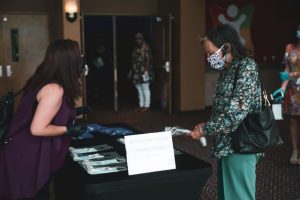 The festival offers a fascinating insight into some of the country’s leading social science research and how it influences our social, economic and political lives – both now and in the future. The website for the 2020 Festival shows the breadth and variety of activities that are possible.
This year represents the 19th ESRC Festival of Social Science. Taking place over the whole month of November 2021, the festival is back at Bournemouth University for the tenth year running.
The celebration of the social sciences takes place across the UK – via public debates, conferences, workshops, interactive seminars, film screenings, exhibitions and much more.
Events can target a variety of non-academic audiences including young people, the public, third sector, business or government.
The festival provides an excellent opportunity for BU researchers to try their hand at public engagement with research. Support for events is provided by BU’s Knowledge Exchange and Impact Team and funding of up to £1,000 is available to deliver your event.
Environment/ COP26 Theme

The UN Climate Change Conference (COP26) takes place in November 2021. The ESRC are particularly keen to see participating institutions hold events that combine social science with an environmental theme. In particular;
- inspiring action – what can be done to improve our environment and reduce climate change
- individual or local changes that can make a difference with respect to climate change
- relatable stories about individuals and climate change from around the world
Although encouraged, adhering to the environment/ COP26 theme is not mandatory for your proposal. Other social science themes are still welcome
How to apply
 Bournemouth University is an official festival partner and will run several events as part of the festival. Applicants should apply directly to BU’s Public Engagement team, NOT to the ESRC.
1. Download and read the applicant guidelines
2. Download and complete the application form
3. Submit your form by email to publicengagement@bournemouth.ac.uk
The call closes on midnight Friday 11 June 2021.
If you would like to discuss your event idea, please contact the Public Engagement Team, who can support you to design your event.
Who can apply?
Applications are open to BU researchers based in the UK, and may involve any outside partners. Applicants need not be social science researchers, but the planned event/activity must feature BU social science research.
What’s involved in organising a festival event?
- Deciding on the intended outcomes and audience for your event
- Designing the format of your event
- Investigating an appropriate venue for your event that will be appropriate to your audience
- Identifying and inviting your attendees
- Advertising your event via your networks, website and social media channels
- Setting up and delivering your event on the day
- Using your social media channels to create discussion at and around your event
- Evaluating your event to see if you achieved your intended outcomes
- Celebrating your event successes – perhaps with a BU research blog post
What support is available?
The Public Engagement Team can advise and support you on all aspects of your event – from proposal stage through to delivery. We can help you with identifying and addressing your audience, planning a successful event, marketing to the right people and maximising impact. We can advise on online engagement, including choosing a platform, measuring impact online, and finding an audience. For in-person events we can advise on venues, travel, catering, registration. We can also support your event on the day – online or in-person.
The ESRC will advertise your event on their website and social media. They will also provide banners and materials for your event, if possible, to brand it as part of the Festival
Find out more
Read the Applicant Guidelines for more detail and conditions. Contact publicengagement@bournemouth.ac.uk with any questions.



 A collaborative project between Bournemouth University and the University of Strathclyde has been shortlisted at this year’s

 Although ecosystem collapse could clearly have major implications for human society, it has only recently become the focus of scientific attention. I became interested in the topic through my research on ecosystems near to Bournemouth, specifically the New Forest National Park and the county of Dorset. In the New Forest, we found that the ancient beech woodlands are collapsing throughout the Park, which is having a devastating effect on the wildlife associated with them. The main cause appears to be climate change, although high herbivore pressure is adding to the problem. In Dorset, we found that a number of ecosystems have been dramatically transformed over the past 80 years or so. Back in the 1930s, there were extensive areas of species-rich chalk grassland, for example, which has now largely disappeared, owing to the spread of arable agriculture. So the problem of rapid environmental change is happening everywhere, including on our own doorstep here in Dorset.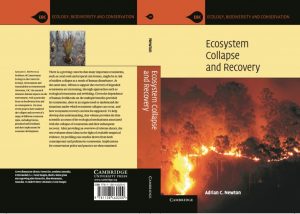
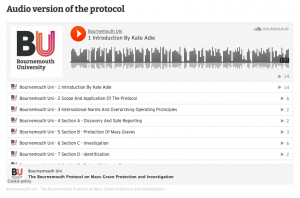 Kate Adie, broadcaster, author and the University’s fifth Chancellor is familiar with sites of conflict and destruction. In her introduction to the
 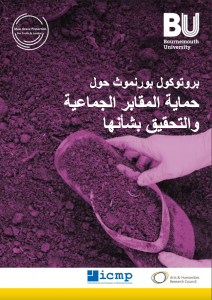 morate Mass Graves Day in Iraq, the International Commission on Missing Persons (ICMP) presented the recently published Bournemouth Protocol on Mass Grave Investigation and Protection to Iraqi authorities involved in efforts to account for missing persons.









 First publication for two CMWH PhD students
 Opportunities to support our REF preparations
 SPROUT Returns: Designing Sustainability in Research Practice – Wednesday 20 May 12-2pm
 Innovative Approaches to Doctoral Supervision: Selected Case Studies
 3C Event: Research Culture, Community & Canapés-Tuesday 19 May 1-2pm
 Apply now to take part in the 2026 ESRC Festival of Social Science
 Reminder: Register for the ESRC Festival of Social Science 2026 Information Session
 ECR Funding Open Call: Research Culture & Community Grant – Apply now
 ECR Funding Open Call: Research Culture & Community Grant – Application Deadline Friday 12 December
 MSCA Postdoctoral Fellowships 2025 Call
 ERC Advanced Grant 2025 Webinar
 Update on UKRO services
 European research project exploring use of ‘virtual twins’ to better manage metabolic associated fatty liver disease