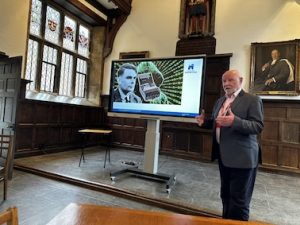
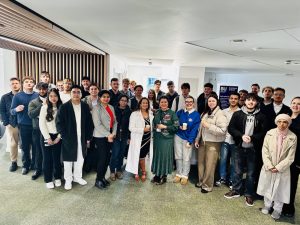
MBA students on Bournemouth University’s Level 7 unit Entrepreneurship: Technology-Driven Ventures & User-Centred Business Solutions began their learning journey not in a lecture theatre, but in Sherborne, Dorset at the stunning Sherborne Boys School.
Hosted by the steering committee behind the emerging Turing Centre initiative, our students were immersed in a live civic project inspired by the legacy of Alan Turing. The Turing Centre vision is explicitly future-facing: to inspire young people in digital technology, create an innovation hub and enterprise zone, support pathways into employment and skills, and function as a social, cultural, and economic asset for Sherborne and beyond . Rather than analysing this as a completed case , students encountered an evolving initiative shaped by institutional constraints, funding realities, stakeholder ambitions, and technological uncertainty. After exploring Sherborne’s historical and civic context, they worked in teams on four strategic challenges: translating vision into a viable business model, developing fundraising logic, shaping promotion and positioning, and evaluating financial, economic, and social sustainability. Their proposals were presented directly to members of the steering group.
This was not accidental. It reflects a deliberate pedagogical choice.
Entrepreneurship education has, for some time now, been trying to move beyond the “inspiration” model, the idea that if students feel energised enough, something entrepreneurial will magically happen. Contemporary scholarship instead emphasises competence, judgement and disciplined practice (Neck & Corbett, 2018). Hägg and Gabrielsson’s (2020) systematic review traces this shift clearly: from knowledge transmission to experiential and practice-based designs. But they also sound a note of caution. Experience alone is not enough. Without theoretical integration, it risks becoming energetic but shallow.
Kolb’s (1984) experiential learning cycle — experience, reflection, conceptualisation, experimentation — is frequently invoked in business education. Yet critics have long warned that “learning by doing” can quietly become “doing without thinking” (Kayes, 2002). Morris (2020) similarly argues that Kolb’s framework is often applied in a simplified manner, neglecting the epistemic depth required for higher-order learning. In other words, activity is not the same as analysis.
The Sherborne engagement was therefore designed not as a field trip in the traditional sense, nor as consultancy theatre, but as structured immersion before interrogation. Students encountered ambiguity first; stakeholder tensions, funding constraints, institutional realities, technological ambition, and only afterwards will they begin systematically analysing what they have seen. Over the two weeks beginning 2 March, that initial immersion will be subjected to scrutiny. Entrepreneurship theory, user-centred design frameworks, and sustainability debates will not sit alongside the experience; they will probe it. Assumptions made in Sherborne will be tested. Enthusiasm will be examined. Gaps in evidence will be exposed.
Assessment design is crucial in holding this intellectual line. Research on authentic assessment demonstrates that tasks resembling professional practice enhance capability only when academic standards remain explicit and evaluative judgement is foregrounded (Villarroel et al., 2018). In this unit, students are required not merely to propose a technology-enabled, user-centred venture, but to justify its feasibility, scalability, ethical implications, and community impact through scholarly argument.
This matters particularly in technology entrepreneurship, where uncertainty, adoption dynamics and unintended consequences are structural features rather than unfortunate accidents. Pittaway and Cope (2007) argue that effective entrepreneurship education must expose learners to uncertainty while supporting reflective sensemaking. The Sherborne visit functions precisely as such a productive disorientation.
For this MBA cohort, Sherborne now becomes an anchor point. They are not beginning with abstract frameworks detached from context. They are beginning with lived complexity. The task ahead is not to apply tools mechanically, but to develop disciplined judgement by integrating technology, commercial logic and community value with intellectual rigour rather than optimism alone.
Experiential learning, when critically structured and theoretically grounded, does not dilute academic depth. It sharpens it.
References:
Hägg, G., & Gabrielsson, J. (2020). A systematic literature review of the evolution of pedagogy in entrepreneurial education research. International Journal of Entrepreneurial Behavior & Research, 26(5), 829–861. https://doi.org/10.1108/IJEBR-04-2018-0272
Hägg, G., & Kurczewska, A. (2016). Connecting the dots: A discussion on key concepts in contemporary entrepreneurship education. Education + Training, 58(7/8), 700–714. https://doi.org/10.1108/ET-12-2015-0115
Kayes, D. C. (2002). Experiential learning and its critics: Preserving the role of experience in management learning and education. Academy of Management Learning & Education, 1(2), 137–149. https://doi.org/10.5465/amle.2002.8509336
Kolb, D. A. (1984). Experiential learning: Experience as the source of learning and development. Prentice Hall.
Morris, T. H. (2020). Experiential learning – A systematic review and revision of Kolb’s model. Interactive Learning Environments, 28(8), 1064–1077. https://doi.org/10.1080/10494820.2019.1570279
Neck, H. M., & Corbett, A. C. (2018). The scholarship of teaching and learning entrepreneurship. Entrepreneurship Education and Pedagogy, 1(1), 8–41. https://doi.org/10.1177/2515127417737286
Pittaway, L., & Cope, J. (2007). Entrepreneurship education: A systematic review of the evidence. International Small Business Journal, 25(5), 479–510. https://doi.org/10.1177/0266242607080656
Villarroel, V., Bloxham, S., Bruna, D., Bruna, C., & Herrera-Seda, C. (2018). Authentic assessment: Creating a blueprint for course design. Assessment & Evaluation in Higher Education, 43(5), 840–854. https://doi.org/10.1080/02602938.2017.1412396



































 REF Code of Practice consultation is open!
 BU Leads AI-Driven Work Package in EU Horizon SUSHEAS Project
 Evidence Synthesis Centre open at Kathmandu University
 Expand Your Impact: Collaboration and Networking Workshops for Researchers
 ECR Funding Open Call: Research Culture & Community Grant – Apply now
 ECR Funding Open Call: Research Culture & Community Grant – Application Deadline Friday 12 December
 MSCA Postdoctoral Fellowships 2025 Call
 ERC Advanced Grant 2025 Webinar
 Update on UKRO services
 European research project exploring use of ‘virtual twins’ to better manage metabolic associated fatty liver disease