 The ESRC website lists its Festival events for 2015 and amongst the interetsing events is a record number of BU events! The full list can be found on the ESRC webpages, click here!
Pathways to impact: part deux!
7 November 2015 | Bournemouth | Event

This event aims to engage participants who attended a previous one-day ESRC Festival of Science event which took place in 2012 entitled, “Pathways to Impact: ageing, diversity, connectivity and community”.
9 November 2015 | Bournemouth| Event
Children will have the chance to take part in a creative mapping exercise using coastal artefacts and pictures to create their own sensory and emotional maps of the topic, starting with the question of ‘how does it make me feel to be here?’
10 November 2015 | Bournemouth | Event
Older people are increasingly at risk of falling victim to financial scams that target vulnerable people, including mass marketing fraud via post, telephone or email and doorstep fraud.
This event will give practitioners, agencies and members of the public, the opportunity to come together to learn more about the threats posed.
11 November 2015 | Bournemouth | Event
This event asked the question:
- what meanings of place and space are constructed by secular or non-specifically religious and religious visiting of church buildings?
11 November 2015 | Poole | Event
Bournemouth University Dementia Institute (BUDI) will bring dementia awareness to life through running creative activities including a performance from the BUDI Orchestra – made up of people affected by dementia and musicians – poetry and technology such as IPads and Nintendo Wii.
12 November 2015 | Bournemouth | Event
Are British children disadvantaged compared to children in other Western countries? An analysis of data from global sources compares the standards of mortality, poverty and health funding for children and adults in Britain vs. those in 20 other Western countries.
12 November 2015 | Bournemouth | Event
One year ago, in October 2014, the UK Government introduced major changes to the Copyright Law with the aim of promoting innovation and creativity. These included a range of exceptions and limitations benefiting users as well as educational and cultural institutions.
12 November 2015 | Bournemouth | Event
These exhibitions run over the course of three days presenting a showcase of Bournemouth University research projects demonstrating our research impacts on social and community wellbeing and our concern for diverse groups and work with a wide variety of stakeholders.
12 November 2015 | Poole | Event
A group of researchers from Bournemouth University are researching the lived experience of students entering higher education from and in ‘non traditional’ contexts. By bringing together research, educational practice and students as research co-creators, a unique lens is created through which to observe the question.
12 November 2015 | Bournemouth | Event
The 5-a-day campaign went global after a recommendation from the World Health Organisation that we should all be eating a least 400g of fruit and vegetables per day. Variations on this message are repeated in countries all across the world. But does the message cause more confusion than good?
13 November 2015 | Bournemouth | Event
These exhibitions run over the course of three days presenting a showcase of Bournemouth University research projects demonstrating our research impacts on social and community wellbeing and our concern for diverse groups and work with a wide variety of stakeholders.
14 November 2015 | Bournemouth | Event
These exhibitions run over the course of three days presenting a showcase of Bournemouth University research projects demonstrating our research impacts on social and community wellbeing and our concern for diverse groups and work with a wide variety of stakeholders.
Prof. Edwin van Teijlingen
CMMPH
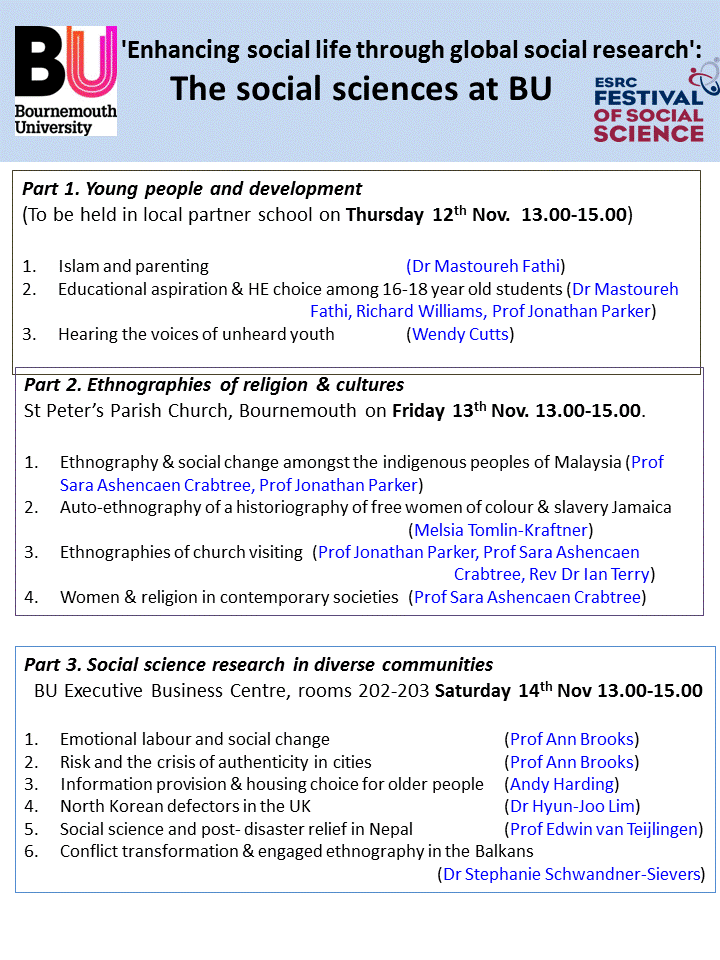 Get some of these interesting presentations in your diary now ‘Enhancing social life through global social research’:The social sciences at BU. For details click here!


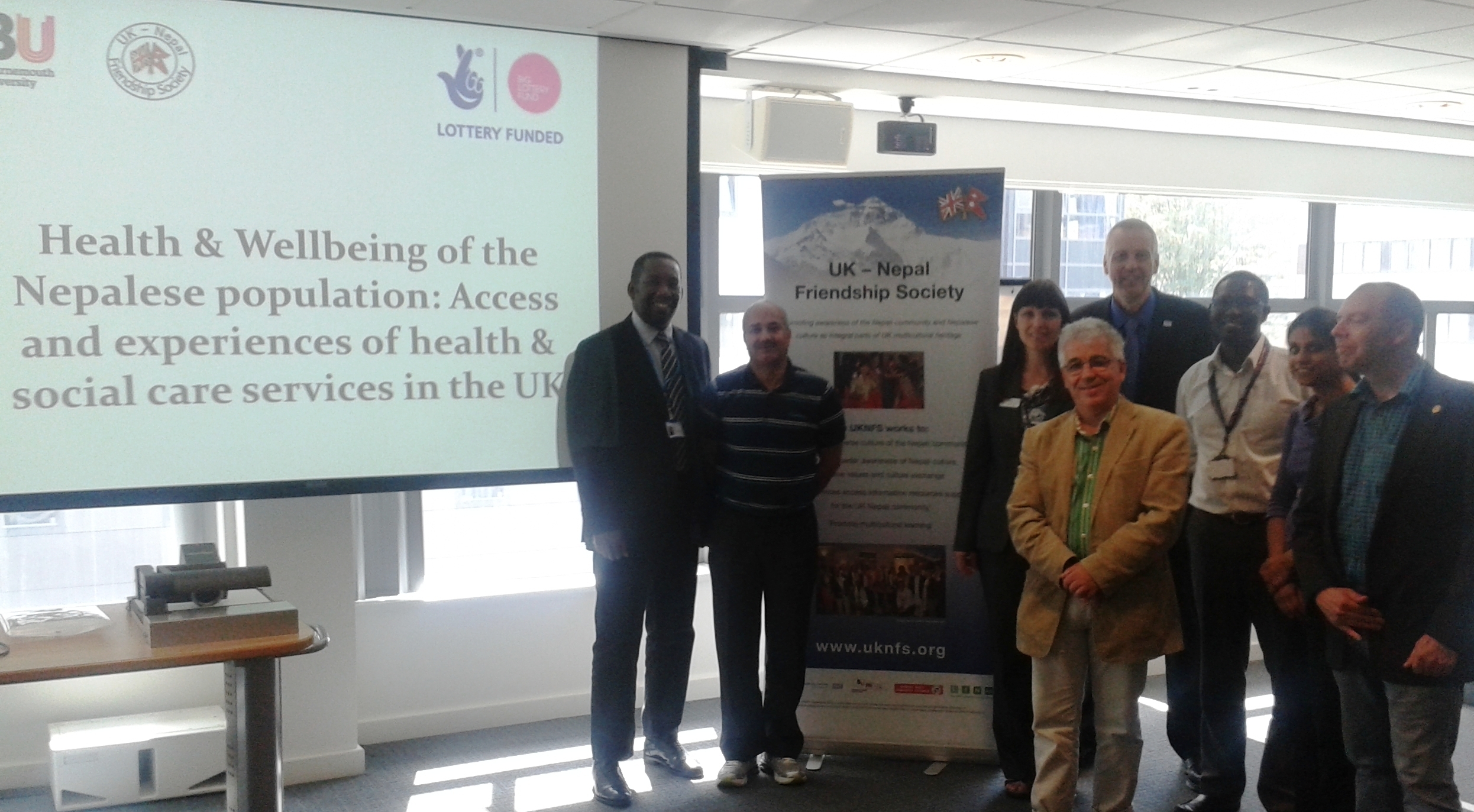
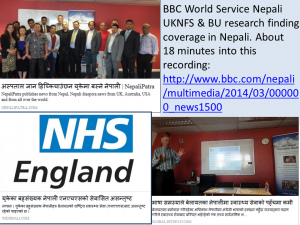 uth Asian and broader Black & Minority Ethnic (BME) communities in the UK.



![InnovateUK_LogoA_Interim_RGBx320govuk[1]](http://blogs.bournemouth.ac.uk/research/files/2014/12/InnovateUK_LogoA_Interim_RGBx320govuk1.jpg)









 3C Event: Research Culture, Community & Connections – Wednesday 11 November 3-4pm
 ECR Opportunities: New Development Programme, Researcher Grants & Upcoming Events
 Help us capture BU’s knowledge exchange activity HE-BCI survey 2025–26
 Verbal autopsy paper published two days ago
 ESRC Studentships for 2027 Entry: Opportunity Now Open
 Horizon Europe Cluster 3 (Civil Security for Society) 2026 Calls Now Open
 MSCA Doctoral Networks 2026 Call Information Webinar
 ESRC Festival of Social Science 2026: Application Deadline Extended to Thursday 25 June 2026
 Reminder: Register for the ESRC Festival of Social Science 2026 Information Session
 ECR Funding Open Call: Research Culture & Community Grant – Apply now
 ERC Advanced Grant 2025 Webinar
 Update on UKRO services
 European research project exploring use of ‘virtual twins’ to better manage metabolic associated fatty liver disease

