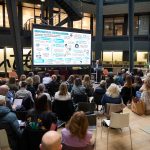
In response to an open email invitation, a group of social scientists from across BU met on Tuesday 17 March to discuss prospects for inter-Faculty collaboration. As in previous meetings between FMC and HSS colleagues, it was apparent that there were opportunities for more collaborative work than currently exists, and that there is considerable enthusiasm for developing links. A growing presence of the social sciences in BU, and of BU in the social sciences, was felt to be essential to BU’s development as a university with a rich intellectual community. If you haven’t received the report from this meeting by email, and would like to do so, please email Prof. Barry Richards (brichards@bmth.ac.uk)
Category / Leisure, Recreation & Tourism
Pars pro toto: Sports’ Cologne relationship as an example for a successful Erasmus+ partnership
Ever since BU has built relationships with German Sport University Cologne – arguably, the leading global sport university – in 2012 it has been an evolving partnership in terms of student exchange, teaching and research collaboration as well as other academic and industry-oriented work.
Recently, lead contact Dr Tim Breitbarth’s visit has further maintained and widened this link. Mainly, he taught on international sports marketing and management Masters courses; discussed potential future collaborative teaching formats (such as the already co-organized international student management games); met with current BU exchange students in Cologne; and outlined a joint paper on ‘sponsorships as B2B relationships’ based on empirical data from a student dissertation; and defined the direction for a submission to the Marie Skłodowska-Curie Research Fellowship Programme.
Why Erasmus? Why Europe?
There is much going for strategically developing Erasmus links, especially if departments seek to extent relationships with European partners beyond student exchange only (arguably, both the core and a starting point). Firstly, it steers EU money towards BU (for both students and staff). Secondly, travel is usually much cheaper than to overseas destinations, so more interaction is likely (and: likely to be funded). Thirdly, there are lots of EU research funding opportunities that require/encourage collaboration within Europe. Fourthly, there is much intercultural learning available for students (and staff). Also, after all, 60% of UK trade is with Europe.
For a variety activities reported on this partnership see the following links on the BU Research Blog and the Faculty of Management Blog (may be search for ‘Cologne’):
http://blogs.bournemouth.ac.uk/research/author/tbreitbarth/
https://microsites.bournemouth.ac.uk/tourism/category/sport-management/
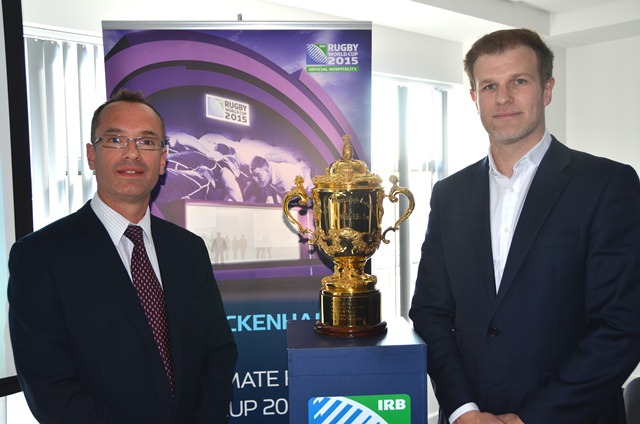
Webb Ellis Cup visits Bournemouth University
The BU Centre for Entrepreneurship was delighted to welcome Rob Wingrove from RTH2015, who manage and operate the Official Hospitality programme for Rugby World Cup 2015, to the Executive Business Centre on the 23rd April.
Rob delivered a fascinating presentation which looked into three years of planning and development to deliver one of the largest commercial hospitality programmes for any global sporting event, and the marketing strategy and tactics implemented to achieve a forecast of over £110m in sales.
The audience were also delighted to have the opportunity to get up close to the Webb Ellis Cup, rugby’s most coveted prize, which had just returned from a journey around 15 countries as part of an international celebration of rugby.
Rugby World Cup 2015 is estimated to inject nearly £1bn into the British economy in 2015. With over 2.3m tickets up for sale, a global TV audience of 4bn and a record sponsor programme, Rob provided an interesting and detailed insight into how they have created one of the biggest corporate hospitality programmes in history in a saturated market.
Mark Painter, Centre for Entrepreneurship Manager, said, ‘we were absolutely delighted when Rob confirmed he would be able to find time in his busy schedule to visit us here at the Executive Business Centre. It was fascinating finding out more about the vital role hospitality will play in the success of RWC2015 and it was of course wonderful that Rob was able to bring along the Webb Ellis Cup’.
Mark added, ‘the feedback from the attendees was extremely positive and it is clear everyone really enjoyed the event.’
Rugby World Cup, the third largest global sporting event behind the Olympics and Football World Cup, takes place in England and Cardiff between 18 September and 31 October. The tournament will be hosted in 13 venues in 11 cities across the country.
The BU Centre for Entrepreneurship runs regular seminars and forthcoming events can be found at www.bucfe.com
New paper on obesity research
Colleagues associated with the Health Economics Research Unit (HERU), Health Services Research Unit (HSRU) and the Rowett Institute of Nutrition and Health (all based at the University of Aberdeen), the Nursing, Midwifery & Allied Health Professional Research Unit (University of Stirling), the Scottish Collaboration for Public Health Research & Policy (SCPHRP) based at the University of Edinburgh and the Centre for Midwifery, Maternal and Perinatal Health (CMMPH) at Bournemouth University published their latest paper on obesity research. The paper ‘A systematic review of the cost-effectiveness of non-surgical obesity interventions in men’ is published in the journal: Obesity Research & Clinical Practice. This systematic review summarises the literature reporting the cost-effectiveness of non-surgical weight-management interventions for men. Studies were quality assessed against a checklist for appraising decision modelling studies. This research is part of the larger ROMEO study.
Prof. Edwin van Teijlingen
Faculty of Health & Social Sciences
Reference:
Boyers, D., Avenell, A., Stewart, F., Robertson, C., Archibald, D., Douglas, F., Hoddinott, P., van Teijlingen, E., A systematic review of the cost-effectiveness of non-surgical obesity interventions in men, Obesity Research & Clinical Practice (online first)
EU Radar – Societal Challenges – Food security, sustainable agriculture and forestry, marine and maritime and inland water research and the bioeconomy
The following EU Horizon 2020 Societal Challenges’ calls are all closing after April 2015. If you are thinking of applying to any of these calls, please contact RKEO Funding Development Team as soon as you are able, so that we can help you with your submission.
The date given is the deadline with all closing at 17:00 Brussels local time unless stated otherwise
Food security, sustainable agriculture and forestry, marine and maritime and inland water research and the bioeconomy
Innovative, sustainable and inclusive bioeconomy – 11/06/15
Sustainable food security – 11/6/15
Blue Growth: unlocking the potential of the seas and oceans – 11/6/15
General / Multiple Topics
Horizon 2020 dedicated SME instrument phase 1 and phase 2 – deadlines – 17/6/15, 17/9/15 and 25/11/15
Please check the specific topics within this call which may meet your research funding needs.
For more information on EU funding opportunities, contact Paul Lynch or Emily Cieciura, in the RKEO Funding Development Team.
Upcoming CfE Event: The Business of Rugby World Cup 2015
Thursday 23 April 2015
5:30pm arrival for a 6pm start
Executive Business Centre, 89 Holdenhurst Road, Bournemouth, BH8 8EB
We are delighted to be welcoming Rob Wingrove from RTH2015 who manage and operate the Official Hospitality programme for Rugby World Cup 2015 to the BU Centre for Entrepreneurship.
Rob will be joining us to talk about the Official Hospitality programme Rugby World Cup 2015.
Rugby World Cup 2015 is estimated to inject nearly £1bn into the British economy in 2015. With over 2.3m tickets up for sale, a global TV audience of 4bn and a record sponsor programme how do you create one of the biggest corporate hospitality programmes in history in a saturated market. This presentation looks into three years of planning and development to deliver one of the largest commercial hospitality programmes for any global sporting event, and the marketing strategy and tactics implemented to achieve a forecast of over £110m in sales.
This is a free event for businesses, BU students, BU staff and BU Alumni. Refreshments will be provided, to find out more or to book your place please use the link below:
http://bucfe.com/events/the-business-of-rugby-world-cup-2015/
Brief Review of 3rd International Week Sport Management
Organized by Dr. Tim Breitbarth from the Sport Academic Group (FM) for the 3rd time after October 2012 and 2013, the 3rd International Week Sport Management saw international visitors contributing to the research culture, knowledge transfer and student experience on campus.
Beginning of March, Dr Christopher Huth (Senior Lecturer in Sport Events and Governance, Bayreuth University), Konstantin Druker (Lecturer in Sport Management at our Erasmus partner university SRH Heidelberg) and Kasper Roe Iversen (PhD researcher at University of Southern Denmark) provided guest presentations on Level C to Level M on sport fandom, turnaround management in sport organisations and sport sponsorship.
As part of the Business Research Seminar Series Research and the Roundtable International Sport Business, Dr Huth and Mr Druker presented their research projects on crowdfunding as a new means of financing professional/amateur sport organisations and a stakeholder analysis of the German Golf League.
In addition, Tim inspired the very strong PhD researcher audience at the Business Research Seminar Series with his assessment of the strengths and weaknesses of the form of a PhD thesis, a shortened version of a conference keynote presentation he held in 2014, including reflections on how to keep your sanity and make progress.
Beyond the teaching and research spheres, much discussion on career and administrative aspects of higher education in different countries/at different universities was facilitated. Joint journal and special interest publications are in the pipeline.
Read about 2013 here:
http://blogs.bournemouth.ac.uk/research/2013/11/04/sport-students-learn-about-employability-of-their-european-peers-and-more/
Read about 2012 here:
http://blogs.bournemouth.ac.uk/research/2012/10/09/bournemouth-universitys-school-of-tourism-host-international-week-with-new-erasmus-partner-universities/
The second fusion funded GeoNet event
For our second GeoNet seminar guest lecturers Paul Sochaczwski and David Hallmark joined us to discuss the work and contributions of scientist and activist Alfred Russell Wallace. Paul recounted Wallace’s heroic journey to Rio Negro and South-Asia where he collected over 125,000 species, including orang-utans, birds of paradise, butterflies and beetles. This epic journey was no mean feat for Wallace, self-financing his travels over a distance of over 22,000km. He had to overcome many obstacles including language barriers, identifying new species without taxonomy books, preserving and protecting his species collection and shipping them safely back to England.
David Hallmark carried on the interesting discoveries of Wallace by discussing the extent of his role in the development of the Theory of Selection from a legal perspective. The question of whether Charles Darwin outright stole Wallace’s idea or whether he ‘developed’ and ‘adapted’ it was discussed. Darwin became obsessed with losing priority after Wallace sent him his Ternate Paper in 1858 and thus published his own work (on the origin of species) a year later without acknowledging Wallace. David suggests that Darwin deliberately omitted Wallace, claiming the 600+ page book as an abstract to avoid having to provide attribution. After hearing the evidence provided by David from witnesses, Darwin’s personal quotes, diary edits, and the timeframe of each scientists published papers it appears that Darwin did commit plagiarism rather than just the mistaken performance of an academic.
I personally found it interesting that David considered how many academics felt that Darwin deserved to have priority due to classist attitudes at the time. However, Wallace may have agreed, and thus stepped aside in order for the more influential and powerful Darwin to establish the Theory of Natural Selection and to contradict religious beliefs at the time.
The controversial topic sparked up an interesting discussion amongst the audience, with Darwin’s integrity as a scientist and a man coming under critique. Interestingly the audience still felt empathy towards Darwin despite the evidence suggesting that he had ‘stolen’ Wallace’s idea. The conclusion seemed to be that Wallace was regarded as a ‘reluctant hero’ who himself accepted Darwinism as an ‘adopted’ idea.
However, perhaps the real question is whether the world could handle or accept Wallace as the originator of the Theory of Selection and what effects this would have on current attitudes towards scientists and societies already present mistrust.
So the next time you have a lecture in Bournemouth University’s Wallace lecture theatre you’ll know it’s named after Alfred Russel Wallace!
Charlotte Unwin (intern to GeoNet)
An investigation into the importance of set plays within the Barclays Premier League
The interest in football goes well beyond the boundaries of it’s academic field. Such are the financial incentives and rewards in the modern game, professional football clubs now leave no stone unturned in their attempts to increase their performances on the field, win matches and increase their league position. This is the wider context for a recent submission to eBU: Online Journal, BU’s internal working paper journal designed around immediate publication and open peer review.
Based on an analysis of all 1,053 goals scored in the 2009/10 season, Jamie Osman, Andrew Callaway and Shelley Broomfield consider, ‘Just how important are set plays to teams competing in the Barclays Premier League?’.
The paper is open for wider comment and review from the BU community, and can be found here: http://ebu/index.php/ebu/article/view/36
GeoNet climate change event and next seminars
GeoNet, the fusion-funded interdisciplinary seminar project, held our first lunchtime session ‘A conversation about climate change’ recently. We were really pleased to see the Coyne so packed out (come early next time to be sure of getting a cookie!) with a wide range of students, PGRs and staff from across the university. Short talks to introduce the panel members (covering both the impacts of climate change and how these are communicated) were followed by a very interesting discussion. We considered how terms are often used out of context or incorrectly (for example the ‘Anthropocene’ in the geological sense of the word would be classified after the fact). It was also interesting for me personally to discover why there is often false balance in the media when climate change is discussed – the reporters have to use a political template (because climate change is a politicised subject) and this template calls for equal representation of the views of all sides. Of course this results in a poor representation of the state of scientific knowledge.
We also discussed the right of non-scientists to enter the debate – this is based on a democratic right to have an opinion but not necessarily on knowledge. The cult of celebrity was an interesting topic, not something that I expected to be discussing in the context of climate change, but perhaps we need more celebrities to support David Attenborough in representing environmental change. Leading on from this, we discussed whether scientists should have more media coverage. Whilst this might seem an obvious way of increasing public knowledge, it could backfire because scientists have a general lack of media training, lack of experience in delivering ‘soundbites’ and have to acknowledge uncertainty, which can negatively affect the public perception of them as experts. We decided that social media might be the answer, as it is not bound by the politicised template and can provide a platform for scientists to talk about their findings, as well as allowing discussions to enable understanding of what uncertainty actually means.
Our next two events are The Hero’s Journey of Alfred Russel Wallace in Southeast Asia from 18.00-19.30 on the 10th March in Barnes Lecture Theatre and Low carbon cities: why and how from 12.00-13.00 on the 17th March in TAG02. Tea, coffee and cookies will be provided at both and active participation is encouraged!
Booking is necessary for the 10th March via http://www.eventbrite.co.uk/e/the-heros-journey-of-alfred-russel-wallace-in-southeast-asia-tickets-13409922439 (free to BU staff and students)
Recent methods papers at BU
I
n the past six weeks we saw the publication of three methods papers by BU academics. BU’s Joanne Mayoh and her colleague Anthony J. Onwuegbuzie in the USA published a paper on mixed-methods approaches in phenomenology.1 They argue that phenomenological research methods work extremely well as a component of mixed-methods research approaches. The purpose of this article is twofold, they provide: (1) a philosophical justification for using what they label mixed-methods phenomenological research (MMPR); and (2) examples of MMPR in practice to underline a number of potential models for MMPR that can practically be used in future research.
In the Faculty of Health & Social Sciences Catherine Angell and Jane Hunt with Professor Emerita Jo Alexander offer methodological insights into the ‘draw and write’ research method. 2 Their literature review identified that the method has been used inconsistently and found that there are issues for researchers in relation to interpretation of creative work and analysis of data. As a result of this, an improvement on this method, entitled ‘draw, write and tell’, was developed in an attempt to provide a more child-orientated and consistent approach to data collection, interpretation and analysis. This article identifies the issues relating to ‘draw and write’ and describes the development and application of ‘draw, write and tell’ as a case study, noting its limitations and benefits.
Finally, BU Visiting Faculty Emma Pitchforth and CMMPH’s Edwin van Teijlingen together with Consultant Midwife Helen MacKenzie Bryers published a paper advocating mixed-methods approaches in health research.3 This paper outlines the different paradigms or philosophies underlying quantitative and qualitative methods and some of the on-going debates about mixed-methods. The paper further highlights a number of practical issues, such as: (1) the particular mix and order of quantitative and qualitative methods; (2) the way of integrating methods from different philosophical stance; and (3) how to synthesise mixed-methods findings. This paper is accompanied by an editorial in Nepal Journal of Epidemiology. 4
Professor Edwin van Teijlingen
Centre for Midwifery, Maternal & Perinatal Health
References:
- Mayoh, J., Onwuegbuzie, A.J. (2015) Toward a Conceptualization of Mixed Methods Phenomenological Research, Journal of Mixed Methods Research 9(1): 91-107.
- Angell, C., Alexander, J., Hunt, J.A. (2015) ‘Draw, write and tell’: A literature review and methodological development on the ‘draw and write’ research method. Journal of Early Childhood Research, 13(1): 17-28.
- MacKenzie Bryers, H., van Teijlingen, E. Pitchforth, E. (2014) Advocating mixed-methods approaches in health research, Nepal Journal of Epidemiology 4(5): 417-422.
- Simkhada, P., van Teijlingen, E., Wasti, S.P., Sathian, B. (2014) Mixed-methods approaches in health research in Nepal (editorial) Nepal Journal of Epidemiology 4(5): 415-416.
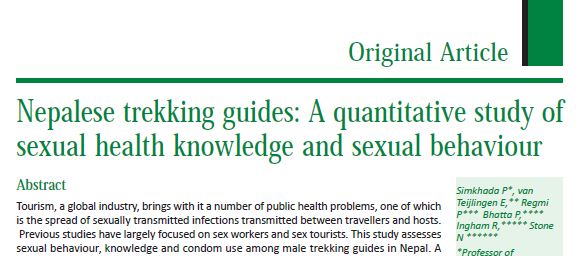
Tourism, a global industry, brings with it a number of public health problems, one of which is the spread of sexually transmitted infections transmitted between travellers and hosts.
Previous studies have largely focused on sex workers and sex tourists. This latest paper ‘Nepalese Trekking Guides: A Quantitative Study of Sexual Health Knowledge And Sexual Behaviour’ published yesterday in the Journal of Manmohan Memorial Institute of Health Sciences assesses sexual behaviour, knowledge and condom use among male trekking guides in Nepal. 
A self-administered questionnaire survey (n=324) was conducted using snowball sampling amongst men working as mountain trekking guides in Nepal. Most respondents (59%) had initiated sex before the age of 18. Most (84 %) reported sexual relations with a woman other than their partner, 46% reported foreign partners, 43% had Nepalese partners, and 28% had concurrent foreign and Nepalese partners. Most (70 %) reported ever having sex with a foreign woman and two-thirds had had sexual intercourse with foreign women in the previous 12 months. Participants’ age, education status, age of first sex, smoking and drinking habits and English proficiency were significant predictors of having sex with foreign women.About 60% reported condom use during their most recent occasion of extra-martial sex. A similar proportion had used a condom during last sexual intercourse with a foreign woman. The likelihood of condom use was associated with a guide’s age, educational level, ethnicity, age of first sex and work experience. Most trekking guides reported sexual relations with foreign women as well as irregular use of condoms. Although sexual health knowledge about among trekking guides is high, some misconceptions still result in unsafe sex. Hence there is an urgent need to revise the existing training for trekking guides and implement appropriate health promotion programmes.
Reference:
Simkhada, P., van Teijlingen, E., Regmi, P., Bhatta, P., Ingham, R., Stone, N. (2015) Sexual health knowledge and risky sexual behaviour of Nepalese trekking guides. Journal of Manmohan Memorial Institute of Health Sciences 1 (4): 35-42.
Prof. Edwin van Teijlingen
CMMPH
GeoNet Launch with climate change event
The fusion funded GeoNet project holds its first event on Tuesday the 3rd of February. The project aims to bring together staff and students from across the university with mutual interests via a series of events, including some lunchtime panel debates and a series of external speakers. GeoNet is very inclusive and anyone with an interest is welcome to come and take part. The events are designed to encourage conversation and interaction, with plenty of audience participation. Our first event is;
A conversation about climate change
Coyne Lecture Theatre
Tues 3rd February, 1-2pm
Come along to the Coyne on the 3rd Feb to join in the first of eleven planned GeoNet events. Join panellists who research the science of climate change and its impacts (John Stewart, Andrew Ford and Pippa Gillingham from the Department of Life and Environmental Sciences) and those who research how best to communicate it (Einar Thorsen, Nathan Farrell and David Fevyer from the Media School) in conversation to find out more about their work. We want this session to be as interactive as possible and there will be lots of opportunities to ask questions and help us as we try to learn from each other.
Tea, coffee and cookies will be provided and all are welcome!
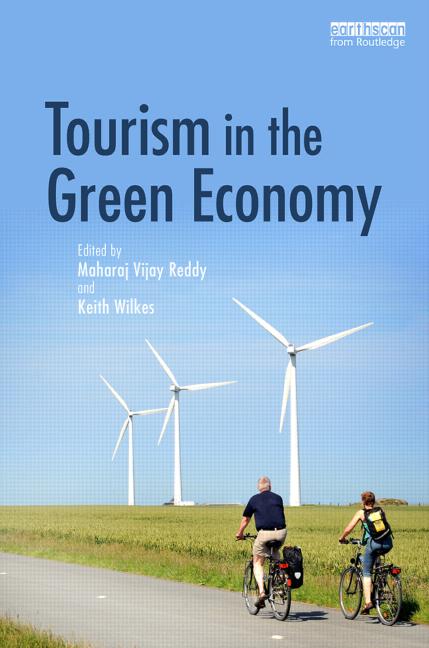
A forthcoming book from the new Faculty of Management receives endorsements from UNDESA, UNEP, UNESCO and the European Commission
The concept of the green economy has entered mainstream policy debates and been endorsed by the United Nations, other international institutions and forums, such as the G-20. The Rio+20 UN summit specifically draw attention to the green economy approach in the context of sustainable development. The role of tourism sector will continue to be crucial in the post-2015 sustainable development agenda. However, there are ambiguities about how tourism and allied industries can maximize their contribution to human well-being and ensure environmentally sustainability, embracing issues of political economy, geography and business ethics.
In this context, the forthcoming book “Tourism in the Green Economy” (Routledge, 2015) edited in line with BU research themes has been received externally as one of the many examples of our fusion agenda enriching the world. The book received valuable endorsements from key international organisations advancing sustainable development policy and actions worldwide.
“Building on the outcome of Rio+20, the United Nations Department of Economic and Social Affairs, through its Division for Sustainable Development, has been working closely with the UN system, in particular, the World Tourism Organization and United Nations Environment Programme to advance sustainable tourism in the context of sustainable development and more specifically in national planning processes. In this regard, initiatives by the academic world to help policy makers and practitioners develop a better understanding of the dynamic and concrete linkages between tourism and sustainable development are therefore of great importance. This publication addresses the potential role that tourism could play towards a green economy. It also provides good practices, policy orientations as well as implications for future research in this area. The publication is therefore a timely and important input for tourism and sustainability stakeholders.” – Nikhil Seth, Director, Division for Sustainable Development, United Nations Department for Economic and Social Affairs, United Nations Secretariat.
“This publication offers an objective assessment of the challenges faced by green economy and their application to the tourism sector, as well as opportunities for promoting a global and local sustainable tourism through resource efficiency, green jobs and sustainable consumption and production patterns. Tourism stakeholders will find inspiration in this book, from its multiple case studies, in defining and promoting methods and tools for implementing sustainable tourism while valuing local resources and educating the tourist community.” – Dr Arab Hoballah, Chief of the Sustainable Consumption and Production Branch, UNEP.
“We welcome this publication which covers the topic of tourism and in particular the aspect of sustainable tourism with the aim of providing useful insights on how tourism could adapt to green economy, and how to make tourism more sustainable” – Francesca Tudini, Head of Tourism Policy Unit, European Commission.
“This publication brings new insights into the need to green the rapidly-growing tourism industry. The case studies show the challenges and opportunities common to both developed and developing countries, echoing UNESCO’s efforts to build inclusive green societies and sustainable tourism through Biosphere Reserves, World Heritage (including marine) sites, and Geoparks.” – Dr Wendy Watson-Wright, Executive Secretary, Intergovernmental Oceanographic Commission; and Assistant Director General a.i., Natural Sciences, UNESCO.
The book provides consensus about what the green economy entails, the important role tourism can play in a green economy, responsible business practices from many countries, on-going and emerging research initiatives that will enable tourism’s transition to a green economy. For more details and full list of chapters, please visit: http://www.routledge.com/books/details/9780415709217/
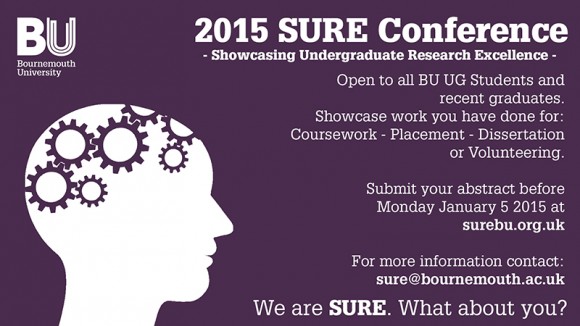
Showcasing Undergraduate Research Excellence – SUREBU 2015: call for submissions
SUREBU is a Fusion funded project aimed at showcasing the best of BU’s undergraduate research. Research is broadly defined and could include work towards an undergraduate essay or dissertation, work carried out as part of a volunteer or work placement, or activities for an academic society. Not only are research skills a central part of undergraduate study and academic life, but they are also vital skills for any future career. By encouraging undergraduate students to think critically and develop their skills, research will help to enhance their student experience and increase their employability upon graduation.
The call for submissions is now open, and all BU undergraduate students – from all schools and courses – are eligible to apply. Examples of research could be anything from preparing for a dissertation or an essay to work carried out during a placement year to volunteering or work with academic societies. The main criteria is that evidence of the student’s own critical thinking can be demonstrated. As well as developing new skills, this is a good opportunity to enhance their CVs through a conference presentation, publication of abstract or even being the winner of awards and prizes.
To get involved, register on SUREBU’s website and submit an abstract. Abstracts should be a maximum of 300 words, with a title no longer than 150 characters. The deadline for submission is 5th January 2015. If you know of a student or recent graduate who would be eligible to submit, do encourage them to apply!
CEMP Bulletin December 2014
Here’s the new CEMP research bulletin – several projects underway and some new opportunities included.
Usual terms apply, contact Julian or Richard in CEMP or the CEMP Fellow in your group or CEL to chat about anything here.
Reminder For All Consumer Researchers – December Meeting of Consumer Research @ BU
Just over a month ago we held a very successful meeting bringing together consumer researchers from a wide range of disciplines across the University. Our ‘Hands-On Information Sharing Session’ made it clear that there was tremendous potential for cross-disciplinary research and that as a united group we could not only act as a forum for research and ideas but also to provide a platform for interaction with industry.
This is a reminder that our next meeting is going to be held on:-
Wednesday, 3rd December in CG01, Christchurch House between 3-5pm. [Please note the change in venue.]
Anyone who is doing consumer research of any description is welcome (e.g. consumer behaviour, retail, marketing, advertising, psychology, consumer neuroscience …) and there will be coffee and mince pies to help our consumer thinking along.
At this meeting we will be begin to identify groups or clusters of researchers, to discuss potential collaborations, and discuss plans for the future.
So if you think this might be of interest, please do come along next Wednesday. If you are unable to make this meeting but are interested in being involved please email us to let us know and we will keep you informed about future events.
Jeff Bray (Tourism; jbray@bournemouth.ac.uk) Juliet Memery (Business School; jmemery@bournemouth.ac.uk) Janice Denegri-Knott (Media School; JDKnott@bournemouth.ac.uk) Siné McDougall (SciTech; smcdougall@bournemouth.ac.uk)
ST academic swaps British winter with busy schedule in warm Brazil
Dr. Miguel Moital, Senior Lecturer in Events Management in the School of Tourism, is currently visiting Brazil to speak at three universities. The trip started with a keynote speech at the II Scientific Forum of Gastronomy, Tourism and Hospitality organised by UNIVALI – Itajai Valley University, Santa Catarina state. His presentation on “Innovation in gastronomic events: developing creative proposals using supply mapping” closed the Forum. The keynote presentation builds partially on the material developed for the Event & Leisure Innovation unit that Miguel has lead at BU for 7 years. The audience consisted of undergraduate and postgraduate students, academic staff as well as tourism professionals.
Besides his keynote speech, Miguel lead two research workshops for masters and doctoral tourism students which focused on defining the scope of the research. He also met the Pro-Vice-Chancellor for Post-Graduate Research where the development of a MoU between BU and UNIVALI was discussed. UNIVALI is the leading tourism post-graduate education provider in Brazil, offering the highest ranked Masters in tourism and one of the only two doctoral programmes in tourism available in the country.
In his second stop, Miguel will deliver a guest lecture at UNIRIO – Federal University of the State of Rio de Janeiro, whose campus sits next to the Sugar Loaf attraction. His third and final stop involves delivering two guest lectures at UFRN – Federal University of Rio Grande do Norte in Natal, north-east Brazil. UFRN also has a leading role in tourism post-graduate studies, offering a Masters in tourism (there are only 8 in Brazil) and the other of the two doctoral programmes in tourism. BU is developing closer ties with UFRN, with one of its tourism academics coming to Bournemouth for her post-doctoral study, which will be supported by Miguel and Dr. Luciana Esteves from the Faculty of Applied Sciences.


Congratulation on newly published systematic review
Equitable Partnerships in Global Health Research
New Nepal-based paper published last week
Congratulation to HEMS colleagues on their new book!
Book edited by BU academics published
Horizon Europe Cluster 3 (Civil Security for Society) 2026 Calls Now Open

MSCA Doctoral Networks 2026 Call Information Webinar

ESRC Festival of Social Science 2026: Application Deadline Extended to Thursday 25 June 2026

Reminder: Register for the ESRC Festival of Social Science 2026 Information Session

ECR Funding Open Call: Research Culture & Community Grant – Apply now

ERC Advanced Grant 2025 Webinar
Update on UKRO services
European research project exploring use of ‘virtual twins’ to better manage metabolic associated fatty liver disease