The emergence of Hybrid Threats and Hybrid War as new security challenges of the 21st Century – from its early examples in Israels war against Hezbollah in 2006 to Russia’s War in Eastern Ukraine. Dr. Sascha Dov Bachmann, Associate Professor in Law, Co-Director of BU’s Conflict, Rule of Law and Society( https://research.bournemouth.ac.uk/centre/conflict-rule-of-law-and-society/) presented at the 24th Annual SLS-BIICL Conference on Theory and International Law at the British Institute of International and Comparative Law in London. He argues that Hybrid War is more than Compound Warfare by utilising new technologies of cyber and Hybrid Threats. His work on teh subject was recently published as HYBRID WARS: THE 21st-CENTURY’S NEW THREATS TO GLOBAL PEACE AND SECURITY in the South African Journal of Military Studies, http://scientiamilitaria.journals.ac.za/pub/article/view/1110/1107.
Tagged / BU research
New paper by PhD student Sheetal Sharma
Sheetal Sharma, PhD student in the Centre for Midwifery, Maternal and Perinatal Health (CMMPH), published her latest paper this week in the Asian Journal of Social Sciences & Humanities [1]. The paper ‘Nepenglish’ or ‘Nepali English’: A New Version of English? raises the question whether we are beginning to see a new variant of English.
The paper is co-authored with Mrs. Pragyan Joshi from the United Nations Development Programme (UNDP) in Kathmandu and BU Prof. Edwin van Teijlingen. Sheetal’s PhD research focuses on the evaluation of a large-sclae maternity care improvement intervention in rural Nepal.
The paper is based on listening to people in Nepal speaking English and reading their writing in English. English is a living language and different native and non-native speakers develop English in slightly different ways. This paper argues that it is time to consider whether we should study the English spoken by native-Nepali speakers (Nepenglish) as a separately developing variant of English. The question is particularly intriguing since Nepali English bears such a similarity with Indian English, as both are largely based on originally Sanskrit-based languages. The focus is particularly on how native-Nepali speakers express themselves in English.
Reference:
- Sharma, S., Joshi, P., van Teijlingen, E. (2015) ‘Nepenglish’ or ‘Nepali English’: A new version of English? Asian Journal of Humanities & Social Sciences 4(2): 188-193. www.ajssh.leena-luna.co.jp/AJSSHPDFs/Vol.4%282%29/AJSSH2015%284.2-21%29.pdf
Prof. Edwin van Teijlingen
CMMPH
What do Fishbone, Amusement Park and Apigee have in common?
They are all tools for digital storytelling. On Thursday May 14th, the Fusion-funded, inter-faculty BU Datalabs team presented at Interdisciplinary Research Week. Guests from across the University and beyond came to learn about digital storytelling and how visual data stories can better communicate the significance of research findings to policy-makers and the public.
Weathering the rain, the event kicked off with a reflective exercise called ‘Analogue Twitter.’ Participants were asked to write down a story of their research in 140 characters or less. From sports management to midwifery, research stories spanned the disciplines.
To get things going, Senior Lecturer in Digital Storytelling, Dr. Brad Gyori brought his expertise in interactive media, and his experience as the Head Writer of the Emmy award winning show Talk Soup, to introduce the audience to the many storytelling patterns that have emerged with the rise and innovation of digital platforms. Digital storytelling can range from Fishbone narratives that have one main linear narrative with suggested diversions, to the Amusement Park that offers loosely clustered, different perspectives with no central hub, as we see in Highrise: Out of my Window.
Next up, Dr. Anna Feigenbaum, a Senior Lecturer from the Faculty of Media and Communications, introduced the audience to the power of storytelling with maps and infographics. Drawing from her own tear gas project and others’ expertise, she explored how visuals can act as ‘infobait’, drive curiosity, and interrupt dominant narratives.
After lunch, BU Datalabs project partner Malachy Browne from the social media journalism outfit reportedly shared insights and strategies for using online tools to do investigative research, share your findings, and dig deeper into social data. From apigee for APIs to mine social media data, to wolframalpha that can return the weather from any date in history, Browne made connections between the tools of his trade and the possibilities for expanding our digital methods in academia.
For more information on the BU Datalabs project, email: afeigenbaum@bournemouth.ac.uk If you would like to get involved, we will be hosting a meeting open to all staff and students in early July. Details to follow.
Latest Major Funding Opportunities
The following funding opportunities have been announced. Please follow the links for more information:
Biotechnology and Biological Sciences Research Council, GB
The Biotechnology and Biological Sciences Research Council, together with the Medical Research Council, the Engineering and Physical Sciences Research Council and the Economic and Social Research Council, invites outline proposals for its Diet and Health Research Industry Club. Funding enables UK universities and institutes to carry out research that will enhance understanding and facilitate the development of products with health and nutrition benefits, and help address diet-related health issues in the longer term. Research proposals must address at least one of the challenges: Understanding the relationship between food processing and nutrition; designing foods to maintain and improve health; understanding food choice and eating behaviour to improve health through diet. Maximum award: Not specified. Closing date: 4pm, 01/07/15 for outline proposals. Full proposals are by invitation.
Economic and Social Research Council, GB
The Economic and Social Research Council, the Medical Research Council, the Arts and Humanities Research Council, the National Council of State Funding Agencies (CONFAP) and the Conselho Nacional de Desenvolvimento Científico e Tecnológico (CNPq) invite applications for their Healthy Urban Living call and the Social Science of the Food-Water-Energy Nexus, under the Newton Fund. For the Healthy Urban Living stream, all proposals must address the theme of health inequalities and justice and one or more of the following areas: urban design, planning housing and infrastructure; communities, culture and heritage; leadership, governance and institutions. The total fund from the Research Councils is £2.5m, with matched equivalent for Brazilian partners. For the Social Science of the Food-Water-Energy Nexus stream, proposals should clearly identify one or more of these themes as the focus of the research project and demonstrate how it will be applied to the development of the Social Science of the Food-Water-Energy Nexus: Measuring, modelling and understanding the Nexus; innovation for sustainable transformations; the political economy and governance of the Nexus; human welfare, development and the Nexus. The total fund from the Research Councils is £1.25m, with matched equivalent for Brazilian partners. Maximum award: Not specified. Closing date: 4pm, 02/07/15.
Engineering and Physical Sciences Research Council, GB
The Engineering and Physical Sciences Research Council and Innovate UK invite expressions of interest to attend their state of the art in simulation and design workshop. This aims to identify the state of the art in fundamental simulation and modelling techniques that can help improve the design process within engineering design, and to enable users to progress in their use of these tools and determine key areas of need not currently being addressed by research programmes. The workshop will be held on 16 July 2015. The workshop will focus on the areas of optimisation, multiphysics, materials modelling and multiscale, with challenges identified in the sectors of automotive, aerospace, energy, built environment, healthcare technologies, electronics, and the process industries of chemicals and food.Awards cover reasonable travel and subsistence costs, including accommodation, refreshments and meal costs. Maximum award: Not specified. Closing date: 4pm, 10/06/15.
Innovate UK, GB
Innovate UK, Biotechnology and Biological Sciences Research Council and the Engineering and Physical Sciences Research Council invite expressions of interest for the fourth round of their Early-stage Translation studies, under the Industrial Biotechnology Catalyst. This supports research and development for the processing and production of materials, chemicals and bioenergy through the sustainable exploitation of biological resources, including tissues, enzymes, and genes from organisms that include algae, marine life, fungi, microorganisms and plants, and accelerate commercialisation. Projects must be pre-competitive and academic-led. Funding is only available to academics in line with the standard BBSRC and EPSRC eligibility rules. Total project costs should be between £2m and £5m and projects should last between three and five years. Maximum award: £5m. Closing date: 12pm, 05/08/15 for expressions of interest.
Medical Research Council, GB
The Medical Research Council, together with the Economic and Social Research Council, the Brazilian Council of State Funding Agencies and the Brazilian National Council for Scientific and Technological Development, invite proposals for the UK-Brazil Neglected Infectious Diseases Partnership. The initiative will provide funding for collaborative research projects, focussed on neglected infectious diseases in Brazil. Proposals may focus on Dengue Fever and other vector-borne diseases, Leishmaniasis, Chagas Disease, Leprosy, Schistosomiasis, Omtestinal Helminth Infectious, Rotaviruses and emerging viruses. Projects should last between two and three years. Maximum award: Not specified. Closing date: 01/06/15.
Natural Environment Research Council, GB
The Natural Environment Research Council invites applications for its Industrial CASE Studentships. This scheme promotes collaboration between the research community and the end users of research. Applicants must demonstrate excellent science research along with the potential for societal or economic impact through strong collaboration with the non-academic partners and the provision of high quality training in research skills. The CASE partner must be an end user organisation that can use the outputs of research in developing business, technology, regulation, policy or social and environmental enterprise, within the public, private or third sector. The CASE partner must have a base in the UK. Maximum award: Not specified. Closing date: 4pm, 08/07/15.
Please note that some funding bodies specify a time for submission as well as a date. Please confirm this with your RKEO Funding Development Officer
You can set up your own personalised alerts on Research Professional. If you need help setting these up, just ask your School’s/Faculty’s Funding Development Officer in RKEO or view the recent blog post here.
If thinking of applying, why not add notification of your interest on Research Professional’s record of the bid so that BU colleagues can see your intention to bid and contact you to collaborate.
Seminar on political violence today
The Politics and Media Research Group in FMC has a very stimulating guest speaker lined up for this afternoon (Monday). Dr. Jeffrey Murer is Lecturer on Collective Violence at the University of St. Andrews, in the School of International Relations. He is unusual for an IR specialist in that he draws deeply on ideas from psychoanalysis in his studies of violent political conflict. The title of his talk is “The Politics of Splitting: Anxiety, Loss and the Anti-Semitic, Anti-Roma Violence of Contemporary Hungary”. While focussing on the situation in Hungary, his talk will illustrate how an interdisciplinary, psycho-social approach can be applied to generate insights into violence in many other contexts.
The talk will be in P406. It will start at 5.00 and be followed, until 6.30, by questions and discussion.
All staff and students are welcome.
Fear in childbirth: is the media responsible?
Join us to celebrate the breadth and excellence of Bournemouth University’s research as part of Interdisciplinary Research Week this May. This is an opportunity to spark new collaborations and ideas among our diverse research community.
This year we have a week long programme of lectures, demonstrations, discussions and a film, which will showcase the fantastic research which is being undertaken at the university.
This is the tenth in a series of blog posts which will highlight the events you can join throughout the week. The tenth event of the programme will take place on Friday 15th May, Professor Vanora Hundley, Dr Ann Luce & Professor Edwin van Teijlingen will discuss if fear is increasingly cited as a reason for rising rates of intervention in childbirth, with women allegedly opting for operative birth to avoid going through labour. Explanatory factors are said to include previous negative birth experiences, but increasingly the way that childbirth is portrayed by the media is suggested to be having a significant effect on women’s perceptions and raising anxiety with regard to the birth process. This lecture reports the findings from interdisciplinary research exploring the impact of the mass media on women’s views of childbirth.
This event will take place on Talbot Campus in KG03 from 2.00pm-4.00pm, with refreshments available from 4.00pm. You can book your place by clicking here.
From ivory tower to silver screen: academics engaging with filmmakers for impact and to reach a wider audience
Join us to celebrate the breadth and excellence of Bournemouth University’s research as part of Interdisciplinary Research Week this May. This is an opportunity to spark new collaborations and ideas among our diverse research community.
This year we have a week long programme of lectures, demonstrations, discussions and a film, which will showcase the fantastic research which is being undertaken at the university.
This is the eigth in a series of blog posts which will highlight the events you can join throughout the week. The eigth event of the programme will take place on Thursday 14th May, Screening of RUFUS STONE (30 minutes) followed by Q & A with Project Lead, Executive Producer and Author of the film, Dr Kip Jones. Bournemouth University1s Gay and Pleasant Land? project was part of the national New Dynamics of Ageing Programme funded by Research Councils UK. The project investigated ageing and gay life in rural South West England and Wales. Research Team: Dr K. Jones, L-A. Fenge, R. Read & M. Cash
This event will take place on Talbot Campus in Stevenson Lecture Theatre from 2.00pm-3.30pm, with refreshments available from 13.30pm. You can book your place by clicking here.
Turning numbers into narratives: an introduction to digital storytelling with data
Join us to celebrate the breadth and excellence of Bournemouth University’s research as part of Interdisciplinary Research Week this May. This is an opportunity to spark new collaborations and ideas among our diverse research community.
This year we have a week long programme of lectures, demonstrations, discussions and a film, which will showcase the fantastic research which is being undertaken at the university.
This is the seventh in a series of blog posts which will highlight the events you can join throughout the week. The seventh event of the programme will take place on Thursday 14th May, Digital transformations in communications have led to the increasing popularity of data visualisations and the use of maps and other multimedia interactives for representing complex data. Often, these visual data stories can better communicate the significance of research findings to policy-makers and the public. Beyond engendering greater comprehension, this turn to the visual can also tap into our emotions and cultural values. In this Masterclass, we will introduce the audience to the emerging interdisciplinary field of data storytelling research. Drawing on a range of contemporary examples, we will present a variety of techniques and technologies for creating data stories.
This event will take place on Talbot Campus in KG01 from 11.00pm 2.00pm, with lunch available from 12.30pm. You can book your place by clicking here. 
14:Live with Dr Lauren Kita
Hello!
Thank you to everyone who attended 14:Live on the 7th May, it was an extremely fascinating half an hour with Dr Lauren Kita.
Lauren Kita gave an exciting insight into how we can explore the science behind the mind-body connection to empower you with ways of managing everyday stress, during the talk, Dr Lauren Kita also gave some examples to some simple techniques (such as mindfulness and breathing exercises) that can help you to better manage your stress.
14:Live will be returning to Talbot Campus in september. So look out on the Research Blog and the student portal events page for updates on when 14:Live will be returning, we look forward to seeing you all again in September were there will again be 30 x tokens for a FREE Papa Johns pizza!
Would being a speaker at 14:Live interest you? or do you just want to find out more about student engagement with research events, if so, please feel free to contact ssquelch@bournemouth.ac.uk
Nepal earthquake follow-up
Shortly after the earthquake in Nepal I posted on the BU Research blog as we have a long-standing presence in Nepal. We have been working there for nearly ten years, conducting research largely around community-based interventions. Several Bournemouth University colleagues (and many based elsewhere) have indicated that they have donated (or will do so) to our intervention partner, the UK-based Buddhist charity Green Tara Trust. Thank you everyone for this generous support. It has brought tents and food to rural communities in an area where we have been working for eight years. The support also has had an incredible effect on our Nepalese team, raising their spirit and encouraging them in their relief efforts.
Donations to Green Tara Trust from individuals have just reached £35,000. As there is always the question how best to support victims in such disasters, I would like to show how supporting a small existing local organisations has direct benefits. Green Tara staff in Nepal supplied medicines, blankets and basic food supplies such as rice, lentils and cooking oil for a period of one month to 130 of the poorest families in in the hills in and around Pharping within days after the earthquake when the after-shocks were still going on. Please, note the guys carrying huge sacks of rice up the mountain at the left hand side of the lorry bringing the Green Tara relief. Loads of places in the affected rural areas can only be reached by foot making the relief effort more difficult.
As we have been working with women’s groups in the community for years Green Tara staff know who the poorest people and where to find them. In addition, they provided tents to 200 families who have lost their homes. One very local solution (rather than flying in tents from the UK) was purchasing the tents elsewhere in Nepal. As we have a second field site in a part that is hardly affected by the earthquake near the Indian border, staff there bought hundreds of tents covers, put them on a bus to Kathmandu where local Green Tara staff picked them up and took them rural areas in the hills near Pharping.
Government-controlled health posts in rural Nepal often run out of medical supplies even before the earthquake. Therefore, Green Tara Nepal donated several boxes of essential medicines to two health posts in the area in case of outbreaks of infections, such as diarrhea or respiratory tract infections. Most of the time I would complain about the fact that you can buy just about any kind of medicine under sun over the counter in pharmacies shops in Nepal, but on this occasion is was very helpful.
Thank you again for keeping those affected by the earthquake in your thoughts. You can donate to Green Tara!
Prof. Edwin van Teijlingen
CMMPH
Human navigation: a cognitive neuroscience approach
Join us to celebrate the breadth and excellence of Bournemouth University’s research as part of Interdisciplinary Research Week this May. This is an opportunity to spark new collaborations and ideas among our diverse research community.
This year we have a week long programme of lectures, demonstrations, discussions and a film, which will showcase the fantastic research which is being undertaken at the university.
This is the sixth in a series of blog posts which will highlight the events you can join throughout the week. The sixth event of the programme will take place on Wednesday 13th May, Dr Angela Gosling & Dr Jan Wiener the ability to navigate within complex and rapidly changing environments is a crucial skill humans possess and one that most of us take for granted. Recent reports suggest that increasing numbers of people have deficits to core navigation abilities; current estimates suggest 6 million people in EU countries, a number expected to rise in coming years. Research currently underway in the Navigation Lab at Bournemouth University is aimed at addressing some of the current issues in human navigation. Our novel research focus makes use of state-of-the art eye-tracking and electrical neuroimaging technology to investigate neural and cognitive functions in virtual navigation environments.
This event will take place on Talbot Campus in Barnes Lecture Theatre from 4.00pm-5.30pm, with refreshments available from 5.30pm. You can book your place by clicking here.
VeggiEat: a voyage of discovery
Join us to celebrate the breadth and excellence of Bournemouth University’s research as part of Interdisciplinary Research Week this May. This is an opportunity to spark new collaborations and ideas among our diverse research community.
This year we have a week long programme of lectures, demonstrations, discussions and a film, which will showcase the fantastic research which is being undertaken at the university.
This is the fifth in a series of blog posts which will highlight the events you can join throughout the week. The fifth event of the programme will take place on Wednesday 13th May,Dr Ann Hemingway will be discussing how a continuing challenge is to understand how the intricate range of drivers affect the food intake of teenagers and older people the two groups in society who have the lowest vegetable intake across the lifespan. Research led by BU and being undertaken across Europe is trying to tackle this challenge, the learning from this cross disciplinary work and the intended and actual outcomes of the research so far will be discussed.
This event will take place on Talbot Campus in Barnes Lecture Theatre from 2.00pm -3.30pm, with refreshments available from 3.30pm. You can book your place by clicking here.
BU final year students present at 5th Annual Promotional Communications Conference
Some 44 advertising, marketing, public relations, and politics and media undergraduates present their dissertation research at the Fifth Annual Promotional Communications Conference on 20 May at the Executive Business Centre.
The conference is a capstone event for the Corporate and Marketing Communications Department (CMC) within the Faculty of Media and Communication and is an opportunity to showcase the work of our undergraduate dissertation students. This year we expect more than 100 delegates, including our students and staff, but also industry partners and some mums and dads.
They’ll hear papers on the latest industry issues and trends from our students. Students are presenting their research on topics including what it means to be and the implications of brands being ‘cool’, the cost of unpaid internships on the advertising industry, using social media to communicate science, attitudes toward and the stigmatization of mental illness, how lad culture also hurts men, impulse buying on line, and so much more.
And we’ll all be treated to talks from two outstanding industry representatives: Camilla Kemp, COO at M&C Saatchi and BU Public Relations graduate Rosie Warin (’09), who is is co-Managing Director of Global Tolerance.
“We created the conference to offer students an opportunity to share the work they’ve done on a project that culminates their studies, and we enjoy showcasing that hard work,” said Dr Richard Scullion, CMC head of department.
The department, which offers undergraduate and postgraduate taught degrees in advertising, marketing communications, public relations, and politics and media, created the conference as an opportunity for students to choose to, in addition to the written dissertation, present their research to colleagues on their course, academics and guests from the promotional communications industries. And again this year we’ll welcome proud parents and friends to the event.
In addition to the conference, CMC launched the Journal of Promotional Communications in 2013. The journal is an open-access, online journal that, since the first edition, accepts submissions from undergraduates and postgraduates from BU and beyond. Research published there can come from a variety of disciplines, such as marketing, advertising, PR theory, consumer culture and behaviour, political communications, media studies, sociology, cultural studies, and management.
So far, the journal has published three issues of student work. The latest edition, Volume 3, Issue 1, was published in April and includes some articles where students and staff co-authored papers.
Again this year, the top papers from the 2015 Promotional Communications conference will be published in the journal.
The students presenting at the conference are among the more than 200 final-year students in CMC who have worked for months on their individual research projects. CMC students can choose to write a traditional dissertation of 10,000 words or write a research paper in the style of an 8,000-word journal article and deliver a 20-minute paper at the student conference.
Dr Janice Denegri-Knott, Dr Carrie Hodges, Dr Dan Jackson, Dr Richard Scullion and Dr Shelley Thompson organize the conference.
The social sciences at BU
In response to an open email invitation, a group of social scientists from across BU met on Tuesday 17 March to discuss prospects for inter-Faculty collaboration. As in previous meetings between FMC and HSS colleagues, it was apparent that there were opportunities for more collaborative work than currently exists, and that there is considerable enthusiasm for developing links. A growing presence of the social sciences in BU, and of BU in the social sciences, was felt to be essential to BU’s development as a university with a rich intellectual community. If you haven’t received the report from this meeting by email, and would like to do so, please email Prof. Barry Richards (brichards@bmth.ac.uk)
New paper by Dr. Mastoureh Fathi
Congratulations to Mastoureh Fathi for her latest paper: “I Make Here My Soil. I Make Here My Country” in Political Psychology.
Prof. Edwin van Teijlingen
CMMPH
We regret to inform you ….
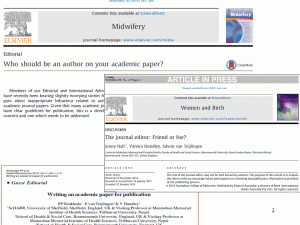
It is always disappointing for an academic author to receive a rejection letter. Today I received yet another one from Midwifery (published by Elsevier). Sometimes I think academic publishing in good journal is not getting any easier over time. Neither does the experience of having over two hundred peer-reviewed academic papers make a rejection easier to deal with. This was my third paper in a row that got rejected by Midwifery. All three papers were rejected on resubmission, so a lot of extra work had gone into these papers after the initial peer review and the editor’s feedback. These three papers where led by three different postgraduate students (Sharma, Baral & Burton) as first authors, and in each case co-authored by myself and different BU academics and/or from other universities.
Midwifery is the journal in which I have published more papers than any other journal (see top blue piece of pie in ‘Documents by source’) as reported on SCOPUS today (26 April 2015). Moreover, I am co-author of one of the top five most downloaded papers in Midwifery for 2014 (see recent BU Research Blog), and this paper is also the most cited Midwifery paper since 2010! Still I manage to have three papers rejected in a row.
What is does show to me is that the journal’s peer review system is robust (i.e. blind and impartial) because I am also a member of Midwifery’s editorial committee. I think it is back to the drawing board and discuss with each set of authors what the next step should be for our papers. To be fair we had a paper published already this year in Midwifery, namely: Grylka-Baeschlin, S., van Teijlingen, E.R., Stoll, K., Gross, M.M. (2015) Translation and validation of the German version of the Mother-Generated Index and its application during the postnatal period. Midwifery 31(1): 47–53.
As an editorial board we try continuously to maintain a high quality of papers to be published in our journal, and we would like to encourage potential authors to keep submitting their papers to Midwifery.
Prof. Edwin van Teijlingen
CMMPH
Major earthquake in Nepal: Help needed
Yesterday’s earthquake, with a magnitude of 7.9 on the Richter Scale, killed thousands of people. It is now 9 AM on Sunday morning and just had a report from friends in Nepal about a major after shock whilst the number of reported deaths is increasing by the hour. The number of causalities in rural areas will only become known over the next few weeks, because of the remoteness of some of the affected areas and the damage to infrastructure (roads, power cables, telephone, and internet links). We know from previous disasters in low-income countries like Nepal that help will be slower to reach rural areas.
The Government of Nepal has asked for international aid and the first aid arrived yesterday from neighbouring India. Yesterday the United States has made one million US$ available for the most immediate aid according to USAID, whilst the Belgian government activated its so-called B-Fast team (Belgian First Aid & Support Team). Like many countries, the UK has offered support. These big relief efforts are vital, especially for the immediate support in finding people under the rubble, and bringing in clean water, blankets, food, medicine and other supplies.
Only last month we published an editorial arguing that Nepal needs a greater focus on health protection to tackle emerging public health ha
zards.1 In this editorial we observed that “whilst Nepal has made some head way in disaster planning, much of this seems to be focused mainly around earthquake disaster planning only.” The coming weeks and months we teach us to what extent this earthquake disaster management has been effective.
Researchers at BU have been working in Nepal for over ten years and in that period, have come to know many people and made lots of friends. We are worried about those we know personally, friends across Nepal, especially in our field sites, former and current Green Tara Nepal staff, the shop keepers next door to the Green Tara office, former and current students, and so on. Like so many people our first reaction was that we need to do something, starting with collecting money for the people of Nepal. We have decided that unlike a general appeal for help, like many friends of Nepal will set up over the next few days across the globe, we would stick to what we are good at: (a) improving maternity care in rural Nepal; and (b) stimulating health promotion. The former because women will continue to become pregnant and babies will continue to be born, the latter because the risk is that any disaster relief will focus on the here and now. Moreover, we want our disaster relief to be based on the same principles as outlined in Table 1 as the rest of our work.2
Table 1: Underlying philosophy of the Green Tara programme
The desired intervention or programme needs to be:
|
Donations can be made to Green Tara Trust (London) through the official donation web page:
This money will be used to implement sustainable low-cost, health intervention projects, working in close collaboration with local communities. There need to be projects on the ground now which are focusing immediately on the long-term preventative approach.
Please give generously!
Karunamati (Green Tara Trust, UK)
Padma Dharini (Green Tara Trust, UK)
Padam Simkhada (Liverpool John Moores University & Green Tara Nepal)
Edwin van Teijlingen (Bournemouth University, UK)
References:
- Simkhada, P., Lee, A., van Teijlingen, E., Karki, P., Neupane C.H. (2015) Need and importance of health protection training in Nepal, Nepal Journal of Epidemiology (editorial) 5(1): 441-443.
- van Teijlingen, E., Simkhada, P., Stephen, J., Simkhada, B., Woodes Rogers, S., Sharma, S. (2012) Making the best use of all resources: developing a health promotion intervention in rural Nepal. Health Renaissance 10(3): 229-235.
Leverhulme Trust visit, 29 April, now open for bookings
The Leverhulme Trust visit on 29 April is now open for bookings – please visit the Staff Development & Engagement Pages to book.
Are you interested in bidding to Leverhulme Trust for research funding or finding out a bit more about what they expect to see in an application? If so, come along to our visit from Jean Cater of the Leverhulme Trust on 29 April, 12-2pm.
In the meantime, if you’d like to find out more about the Leverhulme Trust, see http://www.leverhulme.ac.uk.


ESRC Festival of Social Science 2025 – Reflecting back and looking ahead to 2026
3C Event: Research Culture, Community & Cookies – Tuesday 13 January 10-11am
Dr. Chloe Casey on Sky News
Final Bournemouth University publication of 2025
On Christmas Day in the Morning…
ECR Funding Open Call: Research Culture & Community Grant – Application Deadline Friday 12 December

MSCA Postdoctoral Fellowships 2025 Call

ERC Advanced Grant 2025 Webinar
Horizon Europe Work Programme 2025 Published
Update on UKRO services
European research project exploring use of ‘virtual twins’ to better manage metabolic associated fatty liver disease