We are delighted to announce that the British Academy will again be returning to BU onTuesday the 6th March 2018.
This is an invaluable opportunity to find out more about the international and domestic funding available through the organisation. For those of you who are not familiar with the British Academy, it is the UK’s leading independent body for the humanities and social sciences, promoting funding, knowledge exchange and providing independent advice within the humanities.
The session will last just over 1 hour (12:30pm-13:30pm) and will comprise a presentation focusing on international and domestic funding opportunities along with an overview of the British Academy and any recent developments, followed by a Q&A session.
Representatives of the British Academy will be available to answer any individual queries not covered in the presentation or Q&A session, and members of the Research and Knowledge Exchange Office will be on hand should you wish to discuss BU’s processes for bidding to the organisation.
Places for this event can be reserved through Organisational Development here
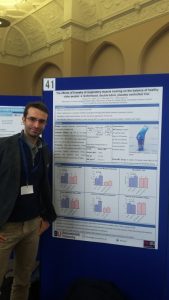
Few weeks after Café Scientific (details here: http://blogs.bournemouth.ac.uk/research/?p=64189), I received an email from Devon Biddle and Sacha Gardener regarding the opportunity to be interviewed on the importance of public engagement activities and how my projects had benefited from them, not only during the recruiting process but also in expanding my research horizon and raising awareness on what I am doing (details here: http://blogs.bournemouth.ac.uk/research/?p=53295 )
Therefore, in just a couple of days, thanks to the staff of the Orthopedic Research Institute who provided the location, we started shooting, and here is part of the interview:
I would like to thank Davon, Sacha and all the BU staff for this interview, it was great, and I really hope that helps to have more people involved in public engagement activities.
Following the full script of the interview.
Could you tell us a little bit of your self
My name is Francesco Ferraro, and I am a PhD Student here at Bournemouth University. Currently, I am working on a project which aims to understand the effects of inspiratory muscles training on balance and functional mobility for healthy older adults. The goal is to develop an innovative and effective training for falls prevention.
Before arriving here at BU, I obtained a Bachelor Degree in sports science from University of Rome Foro Italico while in the meantime I was working as a football coach and after I moved to Naples for complete my Master Degree in sports science prevention and wellness. There I worked on motion analysis in young adults, while in the meantime I was a trainer of the Italian Federation of Weightlifting.
Could you tell us your favourite public engagement opportunity at BU?
It is hard to tell, I have enjoyed all the events in which I took part including Pint of Science, Café Scientific, The Festival of Learning, lecturing at University of Third Age and others.I gained something from each of them, and I gave something at each of them. But if I have to pick one, and only one I would say the Festival of Learning. Among all the events FOL is the one who gives you the opportunity to meet all kind of people.
You have the opportunity to explain your research to a very young audience, as well as people with excellent knowledge in your field, while surrounded by members of the BU Staff, BU students and colleagues that are there to help you and motived you.
Why do you find public engagement a good asset to both your research and the community?
My study aims to understand the effect of inspiratory muscle training on balance and functional mobility. My final purpose is to develop a strategy to prevent falls accidents in people over 65.
Therefore it is a research for the community as any other research, especially in health and social science, is done for the people. Hence what would be the point to work for the community and do not explain to them what you are doing? As researchers we have the opportunity to share with others much more than a picture on Twitter, or Instagram, we have the opportunity to share knowledge, ideas and instead of likes, we will have more questions, more curiosity and the chance to give to the audience our ideas.
At Café Scientifique, the public was really engaging in the fact your research was trying to better the wellbeing of the older generation. Why do you think people are so engaged in your research?
At Café Scientifique I was able to give to them my idea. Instead of explaining right away what my research does I told them the idea behind it and why is important to research on it. The reason why we had a great respond must be sought in my past years of work in the public engagement.
Any research is fascinating in is way, but is crucial to share it with others, not only peers and experts but also with the people for which the research is done.
You use your public engagement to advertise the need for participants in your current research, is this an effective way of getting the participants you need?
Yes, it is. But it is not the reason why I do public engagement. I have been introduced to public engagement by my supervisors: Alison McConnell, James Gavin and Thomas Wainwright with the aim to share what learned and discuss it with others.
If you were to advice new researchers about public engagement, what would you say to them?
Do it if you want to do it.
Public engagement is not easy especially if you do it because you “have to”. Do it if you want to share your research if you want to challenge yourself, if you want to meet the community then you will make a great event. You must have the right motivation if you do it just to “hunting” participants it won’t be neither correct or fun, and people will understand, with the result that you and your research will lose trust.
What do you gain most from public engagement?
Motivation – to work more for the community, to help people to learn and understand what we are doing here at the BU and how it helps their wellbeing.
Confidence – have the opportunity to talk to 50, 100 or even 200 people at each event, has grown my confidence inside and outside the University.
Knowledge – I do believe that everyone has a story to tell and you can learn a lot from it. I am always surprised at the questions that I receive.
People curiosity drives my curiosity as well and helps me to think and re-think at my research.
What are you going to do next?
I do have a couple of projects going on, but I will take part in the next Festival of Learning (third year in a row), and I will see what other opportunities the public engagement team will give to us.
The NIHR Fellowship Event will provide information about NIHR’s Fellowship schemes, and offer some hints and tips for a successful application. We are pleased to welcome the following speakers:
Dr Gordon Taylor, Research Design Service South West, NIHR Doctoral Panel Member & Reader in Medical Statistics, University of Bath
NIHR Trainees Coordinating Centre (TBC)
Clare Gordon, BU NIHR Fellow
Date: Wednesday 21st March 2018
Time: 12:00-13:00
Venue: Lansdowne Campus
The session is open to all academics, researchers and clinicians who have an interest in applying for NIHR Fellowships.
About the NIHR Fellowship Programme: The NIHR is the UK’s major funder of applied health research. All of the research it funds works towards improving the health and wealth of the nation. The NIHR develops and supports the people who conduct and contribute to health research and equally supports the training of the next generation of health researchers. NIHR training programmes provide a unique opportunity for all professionals to improve the health of patients in their care through research. Training and career development awards from the NIHR range from undergraduate level through to opportunities for established investigators and research leaders. They are open to a wide range of professions and designed to suit different working arrangements and career pathways.
This last week two separate papers have been accepted on aspects of health and well-being among migrants workers from Nepal. The first in the International Journal of Migration, Health and Social Care is based on a completed PhD project in the Faculty of Health & Social Sciences with Dr. Pratik Adhikary as first author [1]. This paper ‘Health and well-being of Nepalese migrant workers abroad’ is co-authored by two former FHSS staff Dr. Zoe Sheppard and Dr. Steve Keen, and Prof. Edwin van Teijlingen of the Centre for Midwifery, Maternal & Perinatal Health (CMMPH).
The second paper ‘A study of Health Problems of Nepalese Female Migrants Workers in the Middle-East and Malaysia’ was accepted by the Open Access journal BMC International Health & Human Rights [2]. The lead author of this paper is Bournemouth University (BU) Visiting Faculty Prof. Padam Simkhada (based at Liverpool John Moores University) and two of his co-authors are based in Nepal: Manju Gurung (chair of Pourakhi Nepal) and Dr. Sharada Prasad Wasti and one at BU: Prof. Edwin van Teijlingen .
There is a growing momentum in migration research at BU with further academic papers being published related to studies on migrant workers from Nepal [4-8], relatives of migrant workers [9], migration into the UK [10-12], Eastern European migration issues [13-15], migration and tourism [16], migration and the media [17] as well as migration in the past [18].
References:
Adhikary P, Sheppard, Z., Keen S., van Teijlingen E. (2018) Health and well-being of Nepalese migrant workers abroad, International Journal of Migration, Health and Social Care (accepted). https://doi.org/10.1108/IJMHSC-12-2015-0052
Simkhada, P.P., van Teijlingen, E.R., Gurung, M., Wasti, S. (2018) A study of Health Problems of Nepalese Female Migrants Workers in the Middle-East and Malaysia, BMC International Health & Human Rights (accepted Jan.).
Adhikary, P., Simkhada, P.P., van Teijlingen E., Raja, AE. (2008) Health & Lifestyle of Nepalese Migrants in the UK BMC International Health & Human Rights8(6). Web address: www.biomedcentral.com/1472-698X/8/6.
Adhikary P., Keen S., van Teijlingen, E. (2011) Health Issues among Nepalese migrant workers in Middle East. Health Science Journal 5: 169-175. www.hsj.gr/volume5/issue3/532.pdf
Adhikary, P., Sheppard, Z., Keen, S., van Teijlingen, E. (2017) Risky work: Accidents among Nepalese migrant workers in Malaysia, Qatar and Saudi, Health Prospect16(2): 3-10.
Aryal, N., Regmi, PR., van Teijlingen, E., Simkhada, P., Adhikary, P., Bhatta, YKD., Mann, S. (2016) Injury and Mortality in Young Nepalese Migrant Workers: A Call for Public Health Action. Asian-Pacific Journal of Public Health28(8): 703-705.
Simkhada, PP., Regmi, PR., van Teijlingen, E., Aryal, N. (2017) Identifying the gaps in Nepalese migrant workers’ health & well-being: A review of the literature, Journal of Travel Medicine24 (4): 1-9.
Aryal, N., Regmi, PR., van Teijlingen, E., Dhungel, D., Ghale, G., Bhatta, GK. (2016) Knowing is not enough: Migrant workers’ spouses vulnerability to HIV SAARC Journal of Tuberculosis, Lung Diseases & HIV/AIDS 8(1):9-15.
Scammell, J., 2016. Nurse migration and the EU: how are UK nurses prepared? British Journal of Nursing, 25 (13), p. 764.
Holscher, J., 2017. The effects of Brexit on the EU, the UK and Dorset – a migrant’s account. BAFES Working Papers, 1-11.
Sapkota, T., Simkhada, P., van Teijlingen, E. (2014) Nepalese health workers’ migration to United Kingdom: A qualitative study. Health Science Journal8(1):57-74.
Filimonau, V., Mika, M. (2017) Return labour migration: an exploratory study of Polish migrant workers from the UK hospitality industry. Current Issues in Tourism, 1-22.
Janta, H., Ladkin, A., Brown, L., Lugosi, P., 2011. Employment experiences of Polish migrant workers in the UK hospitality sector. Tourism Management, 32 (5): 1006-1019.
Mai, N., Schwandner-Sievers, S. (2003) Albanian migration and new transnationalisms, Journal of Ethnic & Migration Studies 29(6): 939-948.
Dwyer, L., Seetaram, N., Forsyth, P., Brian, K. (2014) Is the Migration-Tourism Relationship only about VFR? Annals of Tourism Research, 46: 130-143.
Marino, S., Dawes, S. (2016). Fortress Europe: Media, Migration and Borders. Networking Knowledge, 9 (4).
Parker Pearson, M., Richards, C., Allen, M., Payne, A., Welham, K. (2004) The Stonehenge Riverside project Research design and initial results Journal of Nordic Archaeological Science 14: 45–60.
Everyone knows how important it is to write a good grant application – if you’re not submitting the best grant application you can, you won’t be in the running to win the money. But how do you write the best application to stand you out from the crowd?
To find out come to the Grants Workshop on 10th April and a Bid Writing Day on 8th May!
This two day event will combine advice and guidance on writing grant applications, and will be delivered by external bid writing experts ThinkWrite.
Day one (Tuesday 10th April 2018) will comprise of a grants workshop which will give participants the opportunity to expand their ideas on available funding sources, and investigate what funders want to achieve when they hand over money. Participants will then develop a strategic approach to writing applications.
Day two (Tuesday 8th May 2018) will consist of a follow-up bid writing retreat, where one-to-one support will be available to develop applications for funding.
All academics and researchers are welcome to attend. Preferably, participants must attend both days, but must have a funding application they plan to submit within 12 months. The application can be to any funder.
Over the Festive Season the International Journal of Childbirth published the latest article from staff based at the Centre for Midwifery, Maternal & Perinatal Health (CMMPH) [1]. This paper ‘Women, Midwives, and a Medical Model of Maternity Care in Switzerland’ is co-authored with Bournemouth University Visiting Faculty Ans Luyben (a Dutch midwife working in Switzerland), Sue Brailey from the School of Health & Education at Middlesex University and Lucy Firth at the University of Liverpool.
This Swiss paper builds on a body of work within CMMPH around a medical/social model of childbirth. BU academics have applied this model in multidisciplinary studies, including the disciplines of midwifery, [2-4] sociology, [5] and media studies [6].
References
Brailey, S., Luyben, A., Firth, L., van Teijlingen, E. (2017) Women, midwives and a medical model of maternity care in Switzerland, International Journal of Childbirth7(3): 117-125.
van Teijlingen, E. (2017) The medical and social model of childbirth, Kontakt 19 (2): e73-e74
MacKenzie Bryers H., van Teijlingen, E. (2010) Risk, Theory, Social & Medical Models: critical analysis of the concept of risk in maternity care, Midwifery 26(5): 488-496.
Ireland, J., van Teijlingen, E. (2013) Normal birth: social-medical model, The Practising Midwife16 (11): 17-20.
van Teijlingen E. (2005) A critical analysis of the medical model as used in the study of pregnancy and childbirth, Sociological Research Online, 10 (2) Web address: http://www.socresonline.org.uk/10/2/teijlingen.html
Dr Emily Arden-Close, a Senior Lecturer in Psychology, is a co-author on a paper entitled “Physiotherapy breathing retraining for asthma: a randomised controlled trial.” This was recently published in the prestigious journal Lancet Respiratory Medicine (impact factor 19.287). This paper reported the results of a large 3-arm randomised trial which demonstrated that breathing retraining delivered by DVD and booklet was equivalent in terms of effectiveness to face-to-face physiotherapy, and more effective than usual care, in terms of asthma-related quality of life at 12 months. The paper is available open access at http://www.thelancet.com/journals/lanres/article/PIIS2213-2600(17)30474-5/fulltext
Vitae have brought to our attention these very podcasts which they have recently created with the Taylor Francis Group – please click here for full information and to view the 5 useful quick podcast sessions on:
Episode 1: Public engagement in research
Episode 2: Stepping up, moving on and alternative career paths for researchers
Episode 3: Academic mentoring
Episode 4: Overcoming impostor syndrome
Episode 5: Getting published for the first time
From driving public engagement in research to making the most of academic mentoring, there’s something for everyone in these 15-minute podcast series. Created with Vitae, the international program which champions professional development for researchers, they offer practical tips and insights for researchers looking to develop their career.
Listen to the current episodes or subscribe on iTunes.
This visit from Wellcome Trust will provide an overview of who they are, their remit, types of funding offered, their decision-making processes and timeframes and planning a Wellcome Trust application.
On Thursday 25th January 2018, BU’s Research and Knowledge Exchange Office (RKEO) will be hosting a Food STEAMLab.
Which means…?
We’re seeking to come up with novel research which addresses challenges in the future of food. With increasing pressure on food sources and the food industry, we need to consider how food security can be guaranteed for the future. Potential areas to address this challenge may include but are not limited to, malnutrition/nutrition, agriculture, logistics, robotics, supply chain, new forms of food, sustainability, political/economic problems, food policy, food waste & recycling, and climate & the environment.
So, who should attend?
STEAMLabs cover broad themes to ensure that they are open to everyone from all disciplines. So if you think you have something to contribute then come along. If you think that they don’t include you then please have a chat with your RKEO Facilitator who can explain how your research could make a vital contribution to new ideas and approaches. In order to encourage wider partnerships, each STEAMLab will include academics from other universities, as well as representatives from industry and other sectors.
What do I need to prepare in advance? What will the STEAMLab entail?
Absolutely nothing in advance. During the session, you’ll be guided through a process which results in the development of research ideas. The process facilitates creativity, potentially leading to innovative and interdisciplinary research ideas. These ideas will be explored with other attendees, and further developed based on the feedback received.
What if I don’t have time to think about ideas in advance?
You don’t need to do this but it will help. Attendees will come from a range of backgrounds so we expect that there will be lively conversations resulting from these different perspectives.
What about afterwards? Do I need to go away and do loads of work?
Well… that depends! The interactive day will result in some novel research ideas. Some of these may be progressed immediately; others might need more time to develop. You may find common ground with other attendees which you choose to take forward in other ways, such as writing a paper or applying for research funding. Your Research Facilitator will be on hand to support you as you develop bids for funding.
What if my topic area is really specific, and doesn’t really relate to food?
Your contribution will be very welcome! One of the main benefits of this type of event is to bring together individuals with a range of backgrounds and specialisms who are able to see things just that bit differently to one another.
So, is this just networking?
Definitely not! It is a facilitated session with the primary intention of developing innovative research ideas, which also enables the development of networks. It gives you the opportunity to explore research ideas which you may develop over time, together with the chance to find common ground with academics from across BU and beyond.
How do I book onto this event?
To take part in this exciting opportunity, BU staff should request a place by emailing RKEDevFramework as soon as possible to avoid disappointment.
This event will be held in the EBC, Lansdowne Campus.
If you have any queries prior to submitting your application, please contact Lisa Gale-Andrews, RKEO Research Facilitator.
Everyone knows how important it is to write a good grant application – if you’re not submitting the best grant application you can, you won’t be in the running to win the money. But how do you write the best application to stand you out from the crowd?
To find out come to the Grants Workshop on 10th April and a Bid Writing Day on 8th May!
This two day event will combine advice and guidance on writing grant applications, and will be delivered by external bid writing experts ThinkWrite.
Day one (Tuesday 10th April 2018) will comprise of a grants workshop which will give participants the opportunity to expand their ideas on available funding sources, and investigate what funders want to achieve when they hand over money. Participants will then develop a strategic approach to writing applications.
Day two (Tuesday 8th May 2018) will consist of a follow-up bid writing retreat, where one-to-one support will be available to develop applications for funding.
All academics and researchers are welcome to attend. Preferably, participants must attend both days, but must have a funding application they plan to submit within 12 months. The application can be to any funder.
Places are limited, so book now to avoid disappointment. For more information and to book your space please see the RKE Development Framework page for this event.
For any other queries please contact Lisa Gale-Andrews, RKEO Research Facilitator.
The “vF Interoperation suppoRting buSiness innovaTion” (FIRST) project provides new technology to describe manufacturing assets and to compose and integrate existing services into collaborative virtual manufacturing processes.
The project kick-off meeting took place in March 16-17 2017 at Bournemouth University UK. In attendance were the academic and industrial representatives from the partner institutions.
The FIRST Project kick-off meeting participants at BU[/caption]
The project combines partners from China, Germany, The Netherlands and Germany in the academic and industrial sectors. Together we work on processes in manufacturing context.
Congratulations to PhD student Folashade Alloh and Faculty of Health & Social Sciences academics Dr. Desiree Tait and Dr. Clare Taylor on the first academic publication for 2018. Their paper ‘Away from home: A qualitative exploration of health experiences of Nigerian students in a UK university’ has been published in the Journal of International Students.
The final issue for 2017 of the Dutch Journal for Midwives, Nederlands Tijdschrift voor Verloskundigen, published our contribution on midwives and the media [1]. The two-page article ‘MEER BEMOEIEN MET MEDIA’ argues (in Dutch) that midwives as individuals and as a profession must try to engage with the media. Midwives should be open to starting a dialogue concerning issues around maternity care and midwifery. This article published in a practitioners’ journal builds on the collaborative research conducted at Bournemouth University around midwifery and the media [2-4], and our recently published edited book on the topic [5].
Ann Luce, Vanora Hundley & Edwin van Teijlingen
References:
van Teijlingen, E., De Vries, R., Luce, A., Hundley, V. (2017) Meer bemoeien met media (In Dutch: more engagement with media). Tijdschrift voor Verloskundigen (in Dutch: Journal for Midwives), 41 (6):28-29.
Hundley, V., Duff, E., Dewberry, J., Luce, A., van Teijlingen, E. (2014) Fear in childbirth: are the media responsible? MIDIRS Midwifery Digest24(4): 444-447.
Hundley, V., Luce, A., van Teijlingen, E. (2015) Do midwives need to be more media savvy? MIDIRS Midwifery Digest25(1):5-10.
Luce, A., Hundley, V., van Teijlingen, E. (Eds.) (2017) Midwifery, Childbirth and the Media, Palgrave Macmillan
Congratulations to Dr Edward Carlton (an ex-PhD student at BU supervised by Professor Ahmed Khattab and Professor Kim Greaves) on his co-authored paper published in JAMA.
Data from Edward’s original work (The TRUST Study, part of his PhD thesis) has now been published in JAMA (Impact Factor 44.4) in a collaborative meta-analysis. This showcases the work from one of our fully funded PhD studentships at BU.
On Thursday 25th January 2018, BU’s Research and Knowledge Exchange Office (RKEO) will be hosting a Food STEAMLab.
Which means…?
We’re seeking to come up with novel research which addresses challenges in the future of food. With increasing pressure on food sources and the food industry, we need to consider how food security can be guaranteed for the future. Potential areas to address this challenge may include but are not limited to, malnutrition/nutrition, agriculture, logistics, robotics, supply chain, new forms of food, sustainability, political/economic problems, food policy, food waste & recycling, and climate & the environment.
So, who should attend?
STEAMLabs cover broad themes to ensure that they are open to everyone from all disciplines. So if you think you have something to contribute then come along. If you think that they don’t include you then please have a chat with your RKEO Facilitator who can explain how your research could make a vital contribution to new ideas and approaches. In order to encourage wider partnerships, each STEAMLab will include academics from other universities, as well as representatives from industry and other sectors.
What do I need to prepare in advance? What will the STEAMLab entail?
Absolutely nothing in advance. During the session, you’ll be guided through a process which results in the development of research ideas. The process facilitates creativity, potentially leading to innovative and interdisciplinary research ideas. These ideas will be explored with other attendees, and further developed based on the feedback received.
What if I don’t have time to think about ideas in advance?
You don’t need to do this but it will help. Attendees will come from a range of backgrounds so we expect that there will be lively conversations resulting from these different perspectives.
What about afterwards? Do I need to go away and do loads of work?
Well… that depends! The interactive day will result in some novel research ideas. Some of these may be progressed immediately; others might need more time to develop. You may find common ground with other attendees which you choose to take forward in other ways, such as writing a paper or applying for research funding. Your Research Facilitator will be on hand to support you as you develop bids for funding.
What if my topic area is really specific, and doesn’t really relate to food?
Your contribution will be very welcome! One of the main benefits of this type of event is to bring together individuals with a range of backgrounds and specialisms who are able to see things just that bit differently to one another.
So, is this just networking?
Definitely not! It is a facilitated session with the primary intention of developing innovative research ideas, which also enables the development of networks. It gives you the opportunity to explore research ideas which you may develop over time, together with the chance to find common ground with academics from across BU and beyond.
How do I book onto this event?
To take part in this exciting opportunity, BU staff should request a place by emailing RKEDevFramework as soon as possible to avoid disappointment.
This event will be held in the EBC, Lansdowne Campus.
If you have any queries prior to submitting your application, please contact Lisa Gale-Andrews, RKEO Research Facilitator.
BU subscribes to Research Professional (RPro), which is a funding opportunities search engine and higher education sector news compiler.
RPro ran its first Round-Table Discussion in London for its client universities on 12 September 2017 on the topic of “Successful Strategies for Deploying Research Professional”.
The aims of this Discussion meeting were to:
Share experiences of use of RPro by each university’s academic cohort;
Pick and discuss different ideas of implementation;
Network with staff of other research support offices;
Gauge various institutional approaches for academic engagement with RPro.
To spark discussion around the table, an officer from the Grants & Funding Unit in the University of Central Lancashire was invited to present the strategies they have implemented to roll-out the use of RPro and the monitoring/evaluation they have conducted on RPro usage. Tom Walters from RPro facilitated the discussion.
RKEO at BU has been and is continuing to deploy most of these strategies, with varying levels of success in academic engagement over time.
The first tension is to increase academic access and use of RPro – many methods have been used to deliver this such as RPro training for new academics, webinars, references in academic inductions, monthly Blog posts and so on.
The second tension is to increase effectiveness of use by the academic at each point of access – ie. that he/she will find a relevant hit and submit an application to that call.
Effectiveness of use is difficult to measure and is reflective of the use of RPro for different reasons by its users – in general:
Senior level academics may use the ‘precision’ strategy to do focused, targeted searches which hone in on the specific; whilst
Early career academics may use the ‘recall’ strategy which is to acquire as many hits with funding opportunities as possible to see what is out there.
Tom Walters’ concluding question to the Round-Table for reflection was “What does success look like?” in relation to research activity in our universities. The general agreement on what success looked like was:
Measuring increase in submissions rather than awards;
Spreading out applications over a wide range of funders, rather than targeting a few;
Empowering academics to do their own funding opportunities searches; and
Widening the number of academics engaging with / using RPro.
Discussion continued to what universities typically requested their RPro consultant to do during their (usually) annual ‘consultation’ visit to their client university and some ideas were shared. BU will be arranging a RPro consultation day in 2018, keep an eye on this space!
RKEO is always working to ensure that the RPro service is suitable for the purposes of each academic at BU. Regardless of whether you are a RPro newbie or in need of refresher training or may need more help on advanced functionality, please contact the RKEO Funding Development Team and we’d be happy to help you.
#TalkBU is a monthly lunchtime seminar on Talbot Campus, open to all students and staff at Bournemouth University and free to attend. Come along to learn, discuss and engage in a 20-30 minute presentation by an academic or guest speaker talking about their research and findings, with a Q&A to finish.
North Korean women are routinely subject to systemic sexual violation. But for the many who successfully escape their country to also overcome hunger, the search for freedom is just as tough, as they are frequently abducted, sold and exploited by traffickers.
Dr Hyun-Joo Lim will be discussing her research on North Korean female defectors living in the UK and the systemic human rights abuse they experienced both inside and outside their homeland.